
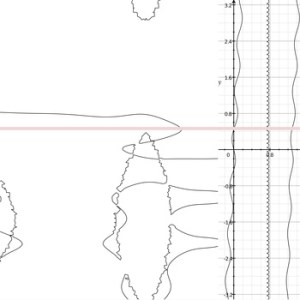
 Zbeen‘s music has always been about pattern, whether created or perceived: the mapping of vectors, linear and algebraic. Although the output of Gianluca Favaron and Ennio Mazzon may be based on mathematics, it sounds more like science, a theme explored in last year’s review of K-frame. Specifically, the duo’s work brings to mind the popping and beeping of miniature circuits and the gurgling of test tubes. A more nature-minded listener might envision expanding ice or the germination of seeds. Each of these impressions, none entirely accurate on their own, shares one common denominator: the impression of movement. Zbeen’s music seems self-generative, the product of a petri dish experiment gone awry or an artificial consciousness. It’s hard to imagine the duo as responsible for every last note; one pictures instead an interplay of instinct.
Consider for example the flutter at the end of “Soundness.” This sound, like that of a small sparrow bathing, may have been generated by a random sequence of algorithms, or it may have been planned. Either way, its repetition is intentional, the evidence of a hand behind the controls. A louder flutter in the following track (more like that of an unspooling film reel or a Large and Frightening Mutant Bird) demonstrates the duo’s propensity for volume control. Some aspects are purposely soft, but the loud aspects are the ones that draw the attention. It’s no surprise that “(ε, δ)” is the most effective piece, by title dealing with error and distance and the definition of limit; the piece pushes against multiple boundaries at once, including that of rhythm (in the playful opening segment) as well as the expected pattern and flow. At what point does one stop perceiving melodic intent? How much can abrasion be used until it no longer sounds abrasive? Is the sudden structure of the fifth minute really structure, or the mind’s projection of structure in proximity to seeming randomness? Is that a bass?
Eigen becomes quieter as it proceeds, but retains its level of activity. “[1k; 0 1] yields a series of carbonate grinds in its opening minutes, but eventually topples into a dark drone with a pulse like that of an amplified clock – one that occasionally adds a tick. “U+222B” is percussive, but not beat-oriented; in fact, it seems to be built upon a template of beats that have been erased and replaced by a more interesting variety of noises. A faint musical loop sputters in at 2:12 and out at 2:42, as if visiting from a neighboring satellite. One begins to wonder, “why do drummers always hit the same variety of drums?” But then one remembers the cold, hard truth: for some, the definition of limit is closer to earth than it is for others. (Richard Allen)
 a closer listen