
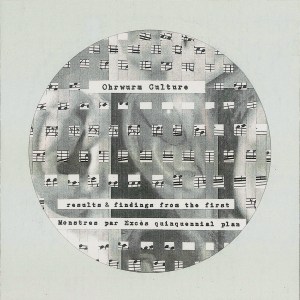
 Rhythm and noise are not natural enemies, but they battle throughout the Monstres par Excès labels’ 5th anniversary compilation. The conflict makes for some uneasy listening. One sinks into a groove and is then catapulted from the reverie by a speaker-shredding screech. But this is also the appeal of such music: to produce sounds for not having the neighbors over.
余益裔‘s opener “Wake Up from a Daydream” is a prime example, as it integrates factory noises, human squawks and a tentative rhythm. It’s clearly music, but of an unusual shade. This being said, it doesn’t “cross the boundaries of bad taste”, as the label warns. That sort of thing is usually left to vocal music, since one’s appreciation of sounds – even feedback, jackhammers and chainsaws – is a matter of taste. I happen to like the loud stuff, as it’s an antidote to blandness, but the general public does not. Noise pollution is a public concern, and the more anything sounds like construction and vagrant children, the more the public wishes to avoid it.
It’s difficult to explain to resistant ears the potential appeal of noise, until one remembers the old experiments in which subjects were subjected to sounds beyond and within their control. In these experiments, subjects were better equipped to handle noise when a volume switch was accessible. When one noise is louder than another, but it’s our noise, we’re simply not as bothered by it: for example, the cranking of a stereo or iPod in order to drown out competing sounds. The sustained tones of FTRG and LxVxTx & ソルマリオ might even be considered comforting given the proper circumstances.
But it’s in contrast that the appeal – or lack of it – becomes most evident. METEK‘s piece contains loudness and sudden silence, and incorporates a classical section. This sort of song that makes one question one’s assumptions and preferences. Is classical music aided by proximity to noise, or the other way around? The same question holds true for many of the beat-driven pieces, such as Pasto Cranico‘s “Decomposizione”, a track whose very title indicates a desire to work against traditional composition techniques while decomposing sound. One wonders how much of what one hears is intentional, and how much may be the product of algorithm.
After a comparatively soft middle section, heavy on drone and discernible guitar, the album wanders off the rails again. One wonders if a different sequencing, from the familiar to the phantasmagoric, might have been more effective. In other words, if one buys a ticket to the circus, one wants lions, not household cats. Thursday Club offers a fine imitation of a power plant meltdown, replete with warning buzzers and leaking radioactive isotopes. Venta Protesix‘s “Sakura Akira” is the album’s loudest and most discordant piece, a test of sensitive sound systems that is abusive enough to drive rats from the walls. Ronez does its best Tonesucker imitation on “Juice and Oil”. After the dust settles, one feels shellshocked; Ohrwurm Culture has burrowed into the brain. (Richard Allen)
 a closer listen