
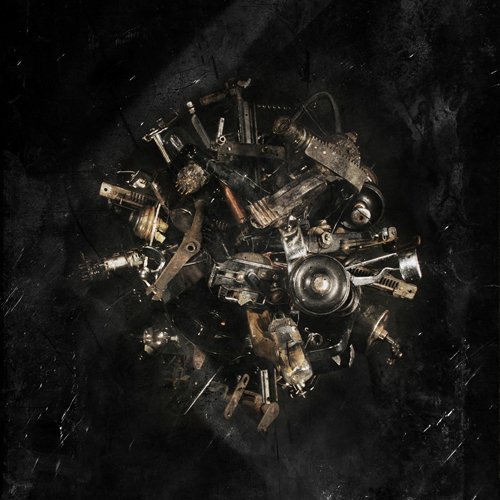
 Digital music production owes its greatness to a kind of thought that places the terms of its progress within the ever-expanding boundaries of fidelity, a sharp cleanliness that denotes the achievements of rationality and its very distinct calls for order. The current throwback to a time of vinyl crackling and tape hiss might constitute, under this light, a sort of romantic turn, a newfound and yet retrospective view of the aesthetic qualities born from the noise of imperfect low-fi machines as a whole, which is to say not as nostalgia but as a way to define the future of music as something entirely else than the flawless manipulation of sound. Where We Were was produced with the analog (all that crackling and all those hisses) in mind, and the sphere of nuts and bolts that makes up the album cover may be an indication of it – all those things that modernity throws away in its passionate quest for the pleasing remain everywhere, an industrial rawness that will never disappear within a screen, and which is actually enhanced by it when no longer under the grasp of use value. Like everything imperfect, they are a challenge for our understanding, shattering the constraints of what we think they must be, perhaps turning the question around towards ourselves.
Where We Were is, in this context, a phrase that emerges from a sense of exploration, an adventurous interpretation of missed opportunities, leaving all longing behind. It is only fitting that it starts with “The Intruder”, a piece that all Greg Haines fans will immediately recognize as familiar, as the steady connection of his past work with the flawed greatness of the present; it is the platform from which the appropriation of the raw, uneven qualities of decades-old production methods launches, an intrusion that cannot obviate its deep connections to rhythm (as work, as biology, as time) and which results in the surprising shift in style on the part of the artist. This enterprise of self-questioning might disturb many a lover of Until the Point of Hushed Support and even Digressions, but Haines has always been honest with the utterly personal nature of his music, and it is in this particular way that this album will definitely not disappoint. “Something Happened” indeed, and in this second track the familiar is turned on its head; the electronics are a logical development from the first track (itself an evolutionary representation of what might have been the next piece after Digressions ended), but they join together in a different direction, one that was possible from the beginning, although not clearly suggested as such. Electronic beats create a compulsive dynamic that emphasizes the rhythm and the way sounds coalesce around it, its gravity pulling all the nuts and bolts into a heartfelt experience that no longer relies, like past works, on the inner movement of dramatic arrangements but on the force of noisy harmonies that seem to stem from the recording as much as from the music itself.
Under these circumstances it’s easy to see how “So It Goes” and “Trasiemo”, in which beats are much less prominent, are still an exercise of rhythm and production, the sort of composition that continually flirts with improv within the subtle distortions of analog processes and those created by the interaction of rhythms: whether the beat repeats every second or every century matters inasmuch a new path in the adventure is opened. In “The Whole” and the second half of the album, we find perhaps the path of the bodily, the most straightforwardly techno and dance side of the spectrum covered by the first half, turning all that inner energy of long rhythms and emotional force into sheer expenditure, into the wasteful energy of movement and stillness with no purpose at all but self-expression. We are guided every step of the way through this, the evolution of Haines’ sound from a dialogue with the heart to a dialogue with the skin, where the bluntness of past machines makes most sense – electricity melds with a mechanism to yield a step, a nod, a jump, whereas newer, better machines yield electronic pulses that translate code into life and life into code in a neatly compelling, ordered cosmology. The one is potentially unpredictable (in the danger of encountering, touching another), while the other just is (the encounter is not spontaneous… it is cybernetic).
The great thing about Where We Were is that it’s fundamentally exploratory, and like all expeditions, it contains a good deal of little problems along the way. The more dance-like parts, although connected not so much to contemporary electronic music but to African rhythms and therefore composers like Steve Reich in passing, are still pretty close to the kinds of things that DJs around the world do. Understood as part of what goes on in the album as a whole, they are fine, but in comparison with the music of other artists of diverse backgrounds (I think here of the African stylings of DJ Zhao, but your own examples will vary) they are not particularly special. Nevertheless the potential to be even better, as well as the skill, is there, and maybe all the nuts and bolts will come together in different shapes in the future, shapes we can barely glimpse at now. Like with all expeditions, part of its greatness comes from the promise of the new, the crossing of old frontiers with the intent to discover something life-changing, the vanguardistic realization of the future in the dullness of the present. Haines opened his way in the world of modern composition with amazing works, and while I wouldn’t say he has left it, he’s carving out a path yet to be trodden upon, but which can certainly draw comparisons and inspiration from elsewhere. This is a great step forward into a place difficult to pin down, and while it might not be perfect, it’s an adventure worth every second. In the end, there seems to be nothing but exciting music ahead of Greg Haines, and that is a great thing for all of us. (David Murrieta)
 a closer listen
Great review – my copy arrived today, I just need everyone to go to bed so i can listen to it properly …