
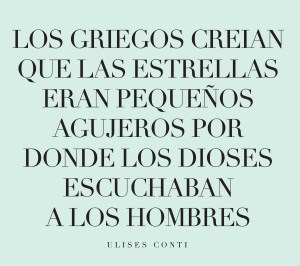
 After publishing the name of the album (whose rough translation is The Greeks believed that the stars were small holes where the gods listened to men), will there be any room left for the review? There’s hardly enough room for the artist’s name on the cover! Thankfully the track titles offset the length of the album title. Each is a single letter, A through Z, with a guest appearance by the letter Ñ. Sesame Street would be proud.
The album has made me think of my own favorite letters. I like more things that begin with the letter C than any other, followed by S and W ~ and of course I already have a song for C (“C Is for Cookie”). But I like the look of O and Q, and on my bookshelf I have a novel titled H. One need not be a synesthete in order to make associations. Pianist Ulises Conti has created a “sound alphabet” by enhancing his ivories with field recordings and occasional choirs. One of these pops up at the very beginning on “A” (A is for A Cappella), but its appearance is brief, as is the running time of every other track, the shortest being 33 seconds and the longest 4:09.
When one listens to Conti’s piano, one relaxes. He’s a calm composer, content to paint with a soft brush. But the augmentations are endearing. These range from electronic squelch on “D” (D is for Detritus) to birdsong and church bells on “N”, “Ñ” and “O” (N is for Nightingale, O is for Osprey) then back to the choir on “Y”. (I’ve made up those subtitles, don’t blame Conti!) The contrast between pure and adorned is exquisite. When all is said and done, we’re left thinking not only about alphabets, but about associations, and this means the composer has done his job. A playful concept has led to an inspired performance, and the pianist deserves a pat on the back.* (Richard Allen)
* This last sentence was brought to you by the letter P.
 a closer listen