
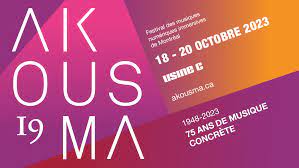
 Joseph Sannicandro reviews the 19th edition of AKOUSMA in Montreal, including an interview with Aho Ssan, who closed out the festival.
Shortly after the release of his stunning new collaborative album, Rhizomes, Aho Ssan presented a live diffusion of The Falling Man at Montreal’s Akousma immersive digital music festival. He had previously presented the Rhizomes A/V show at Berlin Atonal, but Akousma emphasizes multichannel diffusions, encouraging experimentation with different modes of presenting live music. The Falling Man was produced at Paris’s GRM studios, and while elements of that track appear on the album, it is a distinct work from Rhizomes, exploring the sensation of falling as a means of processing grief. Akousma affords artists the rare opportunity of presenting immersive works such as this which simply don’t translate to stereo listening.
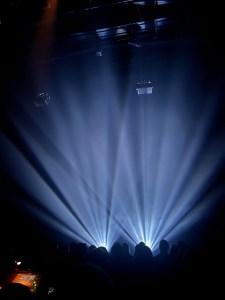 Afterall, what is the point of going to concerts anymore, when so many of us have hi-fi setups or good headphones waiting for us at home? I find myself asking this question more frequently since the pandemic, and in this I suspect I’m far from alone. Many records simply sound better than the artist can hope to sound live. What is great about recorded music is the ability to make a work reproducible, able to be relistened to in great detail and with our utmost attention under conditions we control. Live performance makes a very different kind of experience possible. There’s something to be said for listening together. We just don’t hear things the same way when we’re listening with others. But for many, live concerts are an opportunity to witness musical virtuosity on display in person, to enjoy the pure spectacle of stagecraft and performance. As I’ve often said, however, these are outdated values, and while they have their place in the broader musical ecology, they were never a natural fit for electronic music. And no matter how great your home stereo, it’s not 48.8 channels.
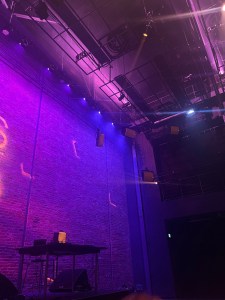
 Montreal’s AKOUSMA festival pursues a different ideal experience, one of dedicated listening in high-fidelity multichannel concerts mostly focused on diffusion rather than “performance” as such. Organized by Réseaux des arts médiatiques, whose mission since 1991 has been to publicly present a variety of “electroacoustic works using an array of loudspeakers,” Akousma has presented a range of works, including acousmatic diffusions, tape music with live instrumental accompaniment, live electronic or electroacoustic performances, as well as other art forms, including dance, video, and installations. And while some concerts have been presented venues including a renovated church and a modern performance hall, the heart of Akousma is Usine-C, a former marmalade factory converted in the late 1970s in a multi-million dollar renovation, resulting in one of Montreal’s finest multimedia venues.
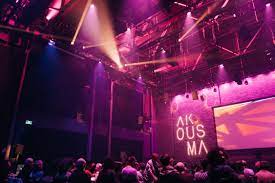 The 48.8 sound system is tailor made for GMR-style acousmatic diffusions, and connections with Paris continue to play an outsized role in the festivals programming (see my 2019 interview with Ina-GRM director Francois J. Bonnet aka Kassel Jaeger). As the second largest city of native French speakers, a strong connection with Paris is perhaps inevitable, yet Quebec has its own history of early electronic music. But is there a Quebec sound? With the Akousma festival and their off-season Électrochoc series, often highlighting artists and composers based here in Quebec, Réseaux has done more than any other organization to answer in the affirmative.
 Beyond showcasing local talent and making available opportunities for young and emerging composers to work with multichannel diffusion, Réseaux has also played a central role in presenting international artists to audiences in North America. The 19th edition of Akousma ran 18-20 October at Usine-C, featuring performances including Marja Ahti, Nicola Ratti, Olivia Block, and Tomoko Sauvage.
I missed the first evening’s programming as I’d just returned from Europe (see my review of Unsound). I was especially sad to miss Rocío Cano Valiño of Argentina, and Sarah Belle Reid, whose electroacoustic trumpet practice draws influence from Wadada Leo Smith and Charlie Haden, whom she worked with while at CalArts. Many of the works came from Canadian composers, like Reid, in keeping with the festival’s history of supporting local talent, especially young composers, something we should support and celebrate. That said, I often find many of the compositions coming from conservatory students to utilize techniques that make their work sound quite similar. For instance, a reliance on low-frequency filter sweeps that some have termed “the booj,” a sound most commonly heard in film trailers.
Happily the diversity of Akousma’s curation extends beyond national origin, also showcasing a range of production techniques and styles. Pierre-Luc Senécal’s Broken Voices did feature some of those familiar low-frequencies filter sweeps, but I found the humorous use of distortion and the sound of laughing to be a welcome element that distinguished his work from some of the others. Marja Ahti’s Still Lives, a 21-minute composition in four movements, fused new material with existing works, reimagined to exploit the capabilities of Usine-C’s multichannel system, making for one of the more dynamic works presented on the second evening.
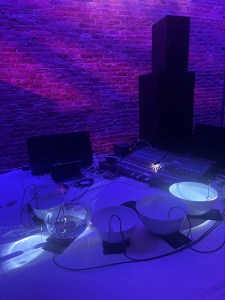 Somewhat unusually, of the second night’s six artists, half featured live performance elements. Devon Hansen, who some listeners might know as part of the improvising trio with Karl Fousek and Roger Tellier-Craig, closed the evening with a live improvisation for modular synth. In a very different register, Tomoko Sauvage channeled pure magic from her bowls of water, subtly playing with resonant frequencies and drops of water whose sonic manifestations transcend their mundane origins. Also choosing to perform live rather than diffuse a fixed work, Nicola Ratti performed a live interpretation of k1/k2, a work for modular synthesizer and tape loops originally released by Longform Editions. Ratti’s work has a level of groove that is often missing from electroacoustic music, grounding the exploration of timbre and tone. As the composition was winding down, Ratti slowly walked around the audience, most of whom couldn’t see him, slowly playing a simple rhythm on a wood block. Bellows, the duo of Ratti and Giuseppe Ielasi, ends their performances with the sound of the unamplified tape loops from the show playing back on portable cassette players. The effect is similar, but Ratti’s use of unamplified percussive gestures allowed him to sound out the space in quite a different way than, but in dialogue with, the multichannel system diffusing his modular loops. After nearly 20 minutes of tuning our ears to the spatialized sound of this multi-million dollar system, there was something refreshing about a simple woodblock moving through physical space.
The third and final evening of programming presented even more variety. The first composition of the night came from Nicola Giannini, a Montreal-based Italian composer of electroacoustic music. Rebonds was produced in 2021 during a residency at the Sporobole art center in Sherbrooke, Quebec, the first time Giannini was able to leave the island of Montreal during the pandemic. The result is a playful piece exploring rhythmic figures of progressively increasing speeds. Think of the sound of dropping a ping pong ball, or Aphex Twin’s “Bucephalus Bouncing Ball.” We might call this phenomenon logarithmic ratcheting; it’s not a simple increase in tempo, but one in which the gap between hits grows progressively smaller, that is, logarithmically rather than exponentially. This breaks from the faux universalism of grid-based time, and while software can model this experience, again it can be produced by something as simple as dropping a ping pong ball. Designed to be played on loop outside the art center where it was created, Rebonds was a welcome injection of humour and play into music that too often tends to be staid and academic.
 Maxime Gordon aka Bénédicte premiered a new work, Halves, Shoals, which also departed from the orthodoxy somewhat in exploring drone and choir in a way that wouldn’t be out of sorts among New Age tape music, of course here distinguished by the clarity of the low end and the immersive potential of multichannel audio. Breach, a 24’ composition by Chicago’s Olivia Block, was one of the more ambitious works presented during the festival. Field recordings of the San Ignacio lagoon set the scene, the gentle lull of water and the cry of seagulls above, a tension between water and air that seemed to animate all the movements of the piece. High frequency sounds disrupt the peace, almost painful at times, later balanced out by rumbling low frequencies. I was not surprised to learn afterwards that the composition was partly inspired by imagining the subjective experience of whales in the lagoon listening to the incursions of man-made sound into UNESCO protected waters.
 Aho Ssan closed out the festival with The Falling Man, a 24’ minute composition recorded at Paris’s GRM studio. Some elements from Rhizomes, released by Nico Jaar’s Other People label, appear in The Falling Man, but the works are otherwise completely distinct. Like his 2020 debut Simulacrum, Rhizomes is full of dynamic bass and abrasive textures. Both records are similarly grounded in philosophical concepts; while the former captured his experiences growing up Black in the Parisian banlieue and connecting with the music of the Ghanaian grandfather he’d never met, Rhizomes explores non-hierarchical means of collaboration, and features a number of high profile guests including Jaar, Clipping., and Moor Mother.
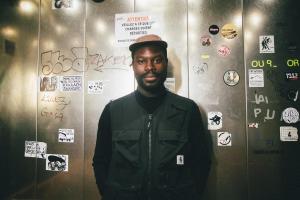 The opportunity to record at GRM did afford some new opportunities, including working with synthesizers for the first time, but simply being at the epicenter of French electroacoustic music was a dream come true. He tells me, “I’m really related to [that] music, I’m a huge fan of electroacoustic music, it’s one of the I think music I’m listening the most in general in my life.” He mentions the work of Bernard Parmegiani and especially Iannis Xenakis, as they share a background in science, as particularly influential. Working in the GRM studios presented an invaluable window into their working methods, allowing him to better understand how such music was made. “You know, when you listen to some pieces from Xenakis you understand more what they were using at this time and it’s yeah it’s so inspiring, the freedom of it.”
The Aho Ssan project began with the debut of Simulacrum at Atonal in 2019, a performance which was very well-received and added to the buzz for that record’s impending release. He had previously worked on soundtracks for films, as early as a 2015 score for a film by Ingha Mago. Film scoring is a kind of collaboration, of course, but the success of Simulacrum created more opportunities to collaborate with other musicians, and even with the artist Kim Grano, who produced the art / lyric book edition of Rhizomes. Working with Exald S on “Wondertomb” and then with KMRU on 2022’s Limen opened up possibilities for further collaborations, particularly with vocalists. Aho Ssan explains, “I grew up with music with vocals, I’m a huge fan of rap music, of pop and R&B.” Exposed to rap music through his older brother, he was drawn to beat makers such as Black Milk and J Dilla, but he recognized the importance of the interplay between the rapper and the producer. With Rhizomes he pushes these experiments between vocals and music in entirely new directions, with means as varied as his collaborators.
 The Falling Man was inspired in part by the famous photograph of a man falling from the World Trade Center during the 9/11 attacks, but the tragic fate of that unknown victim is used as a means to explore a more personal loss. “One of my best friends… died a few years ago, so I was trying to talk about grief, to experiment [with] this kind of falling sentiment in the music.” Elements of “Rhizome I,” both of Josefa Ntjam’s vocals and parts of the track, as well as of Lafawndah’s vocals from “Rhizome II,” are used in The Falling Man, but the result is wholly independent from Rhizomes. The Falling Man was produced as a multichannel composition, and putting the listeners in the center of the work in this way allowed Aho Ssan to push his work in new directions. “My music is kind of maximalist in different ways, with sound design and also harmony, so it’s really cool to have the possibility to stack some different textures in different spaces and give them their own spaces, and their own life, and it’s really different than when you do it with stereo,” which he compares to the difference between admiring a flat picture and three dimensional object.
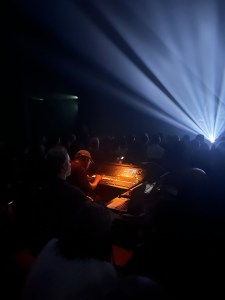 Working with immersive sound made it possible to explore the sensation of falling in a way that isn’t quite as impactful in stereo, while the spatialization tempered somewhat those maximalist tendencies. Even so, The Falling Man was the most dynamic composition I heard at Akousma this year, a welcome exploration not only of bass frequencies but also driving rhythmic beats rarely encountered on multichannel systems. It was an intense experience as one would expect from a work exploring grief and mourning, but with clear narrative cohesion and a proper denouement.
The titles of Simulacrum and Rhizomes make explicit reference to concepts from 20th century French theory, and while he says that Limen is not intended as an explicit philosophical reference, its concept fits this pattern. Simulacrum comes from Jean Baudrillard, while the concept of rhizomes comes from the work of Deleuze and Guattari, having gained additional currency in recent years as so many have become interested in mycology. But there is always a subversive aspect in Aho Ssan’s use of philosophical concepts. Beyond the connection with D&G, he also evokes the French Caribbean poet Édouard Glissant, who theorized hybridity long before white Euro-American thinkers coined the term “postmodern.” Inspired by the creativity of Glissant’s poetry, Aho Ssan explains that, “as I did for Simulacrum, my idea was not just to talk about rhizomes from a direct point of view, but take my experience of it and try to do something new from it.”
 In the same way then, despite the explicit reference to 9/11, the title of The Falling Man also evokes the falling (or floating) man thought experiment of Ibn Sina. An influential philosopher of the Islamic Golden Age known as Avicenna in the Western world, this thought experiment was a precursor to Descartes’ later Meditations, often considered the beginning of modern philosophy. So once again we find Aho Ssan exploring hybridity, evoking deeper roots through an examination of difference. And whether or not this reference was intentional or just myself adding a further mutation of the mix, the concept of “the falling man” comes across in the experience of listening to the piece.
Aho Ssan closed out the festival on a high note, announcing the possibility of many future hybrid musics. And while, sadly, the inclusion of a Black composer in the Akousma festival is itself noteworthy (I’m struggling to find another example, and could probably count the number of non-Asian composers of color on one hand), it also demonstrates the importance of drawing on traditions outside the orthodoxy. Diversity for its own sake isn’t enough if we’re simply selecting those whose idioms most overlap with that of the overwhelmingly white Euro-American tradition. Aho Ssan’s music is very much influenced by the French electroacoustic tradition, but his influences do not stop there, and straddling multiple genres allowed him the opportunity to push multichannel diffusion into exploring new forms. Under the tenure of Francois Bonnet, Ina-GRM has made concerted strides to celebrate lesser known figures from their history while opening up the studios to new artists, such as Aho Ssan, who may not have been given such opportunities in decades past. And for its part, Akousma too has continued to evolve, increasingly showcasing a broader range of techniques and styles in its programming. We look forward to seeing what Akousma will have in store for its twentieth anniversary. Until then, happy listening. (Joseph Sannicandro)

 a closer listen