
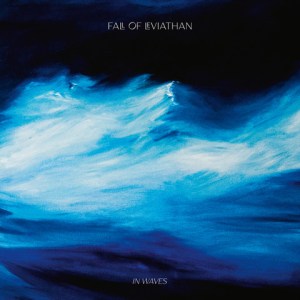
 The experience starts with a beautiful cover, painted by Jéromine Schaller for Swiss post-metal collective Fall of Leviathan. The theme and tone hearken back to Neil on Impression’s classic L’Oceano del onde che restano onde per sempre, with both cinematic and literary styles intact. It will come as no surprise that the album is inspired by Moby Dick, the monologue of opener “Nantucket” leading to closer “Akhab,” which recalls Ahab’s descent to the abyss. Fall of Leviathan has been leading up to this opus all year, first with a single, than a three-track EP, and now finally this six-track double LP in marbled clear and blue.
“Nantucket” alone is worth the price of admission, a patient post-rock build ceding space to the narrative breakdown, followed by an eruption of drums and guitars, while synthesizer mimics a string section. At 7:47, it’s the album’s second shortest track. We’re settled in for the long haul, like a trip across the sea, or the hunt for the great white whale. As the tracks grow in length (peaking with the 13-minute “Pacific”), one starts to ask an unusual question: how can an album with so much power and so many crescendos also be so lulling? The answer is obvious: the band has managed to capture the feeling of the open ocean, the highs and lows, but also the repetition, broken by spurts of wild activity: flying foam and crashing waves. Should the stage set be a hull, all the more fitting.
“Pacific” begins with an attack before calming down. Again the synthesizers provide an elevation of drama. When it grows quiet, it does so quickly, less than two minutes in. The captain is not yet mad; or at least, not as mad as he will be. There are still moments of reverie to be had, of respite, of reflection upon race and class and purpose and revenge. At exactly the halfway mark, the music stops, taking its bearings, establishing its course, and once it plunges forward, it has gone too far to turn back. The piece ends in an extended drone, a harbinger of doom, only to relent with the early placidity of “Spermwhale,” the only track short enough to be a (long) single. As expected, the calm lasts but a minute, although the subsequent surges rise and fall, preserving the harmonic balance, the ship remaining – for now – afloat.
During fleeting moments in “Red Waves,” one can hear the gulls between the guitars, or rather, a repetition of gulls, a memory more than a vision. Soon all this will be left behind. “Ahkab” begins with a squall and a crash. The captain is not himself; he has set events in motion that will destroy all, saving only Ishmael. A second vocal sample, this one a dialogue, brings the album full circle. I shall be waiting for him, intones the captain. And yet fate waits for him. As the captain is dragged down, fathom by fathom, one understands the metaphor. The soundtrack swirls and surfaces and sinks, sympathetic, yet without the power to intervene.
In Waves is ambitious, majestic, all-encompassing. After only an hour, one feels as if one has been out on the wild, wild seas, and returned to tell the story, harrowed yet honed. (Richard Allen)
 a closer listen