

Photograph courtesy of the artist.
Saapato is a project by New York-based musician Brendan Principato, who is deeply interested in the aural connections of the natural world. His new album Decomposition: Fox on a Highway was released last month and includes collaborations with KMRU, Ben Seratan, Laraaji and more. This email interview was edited collaboratively by both the interviewer and the artist. You can find the result below.
David Murrieta Flores (A Closer Listen): Hi Brendan, could you please tell us a bit about Saapato as a project, for readers unfamiliar with your work?
Saapato (S): Hey David, thanks so much for having me—really appreciate it. I’ve been a fan of yours for a while.
Saapato started around 2017, originally as a way to help me deal with insomnia. I’ve always carried a field recorder with me, and back then I’d run those recordings through a pedal-board, layering sound and building textures until I felt calm enough to fall asleep. Those early “sleep sketches” eventually became the first Saapato album. Since then the project has grown into something much more expansive and intentional but that’s where I began.
At its core, Saapato is my way of world-building with sound. Sometimes that means creating imagined environments—places that only exist in my head—and sometimes it means capturing real spaces and complementing them with electronic composition. For example, my album On Fire Island came out of a residency with the National Park Service, where I worked with natural recordings from the island’s environment.
Each record is a little different, but they’re all shaped by the natural world and my deep love of sitting and listening to the forests around my home.
ACL: I’d like to ask you about your interest in ecology. How did it develop, and how do you relate it to music as an art-form?
S: I get asked this a lot, and it’s always a little funny to me—because I have a hard time imagining someone saying, “I have no interest in ecology.” My interest in ecology comes from doing basic, everyday things and simply engaging with what’s around me: breathing, drinking water, watching clouds move, listening to birds, noticing what’s blooming, etc. I wouldn’t call it a separate curiosity—it’s just me being alive and looking around haha.
All organic beings—alive or dead—fascinate me. And my music is, in many ways, a response to this curiosity: toward things I observe, read about, dream about, or fall into deep YouTube rabbit holes over. It’s less about making “art” and more about witnessing the earth’s treasure.
I also don’t really think of music as some lofty art-form. Historically, it was just something people did—a way of being together, of making sense of the world. For me, it’s like making soup: I gather ideas, field recordings, instruments, memories… chop them up, mix them together, and let them simmer. Sometimes for hours, sometimes for years. And over time, something new emerges—still made of the original ingredients, but transformed.
Both my interest in ecology and my way of understanding music as an art form are one extremely interrelated and gentle process. Slow and intuitive. It’s just the way I pass time, reflect, and let off steam. In that sense, making music feels like an extension of the same attention and care I try to give the living world—another way of being in relationship with it.
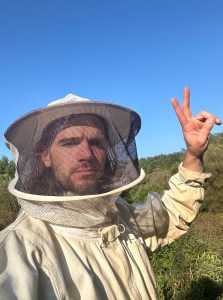
Photo courtesy of the artist.
ACL: Often, field recordings are used under a “realist collage” framework that connects a composition directly with something outside of it by sheer juxtaposition, but from Decomposition’s liner notes and your past albums, I get the sense that the framework here is more systems-driven. What is the role of field recordings in your work?
S: That really depends on the album. For albums like Spring at Home and On Fire Island, the field recordings are left in their natural state. There’s no processing whatsoever. They’re tied directly to place and time. With those records I wanted to let the natural environment speak for itself and shape the emotional tone of the music. The goal there was more about a complimentary atmosphere—connecting the listener to moments I experienced, and then building around that with more traditional compositional tools.
On the other hand, with albums like Decomposition: Fox on a Highway and Somewhere Else, the role of field recordings shifts entirely. There, I treat them more like instruments, bending and layering them into unfamiliar forms. I’m not trying to evoke a specific location—I’m building a world that never existed. That process is much more design-driven: in those cases, the recordings might still begin with real-world sounds, but they’re processed and layered to behave in unexpected ways. I’m more interested in creating systems where sound elements interact dynamically, forming a kind of fictional landscape that suggests its own internal logic. The resulting spaces feel organic, but they aren’t realistic—they’re imagined environments built from familiar sonic material. This obviously ranges from gentle modulation to extreme processing and treatment, based on what I feel the piece calls for.
So I guess the difference is: on some albums, the recordings anchor the music in a real world while on others, they unmoor it. But in both cases, I’m using field recordings to explore how we relate to place—whether fabricated or not.
ACL: Do you consider your soundscapes as an artifice of the natural, or as a naturalized artifice?
S: It’s both—and I think that tension is where my latest album lives. I’m interested in the space where the natural world and human-made tools blur, where a frog call can operate like a piano chord, or where a reverb tail can sound like light rain on a pond. The soundscapes I create are rooted in real, lived environments—specific places and moments in time—but they’re filtered through layers of interpretation, processing, and manipulation. So in that sense, they’re naturalized artifices: artifacts of experience, sculpted with a clear aesthetic point of view.
At the same time, I also see them as artifices of the natural—a kind of homage to the wild through synthetic means. I’m not trying to recreate nature exactly, but rather to express how it feels to be immersed in it, using the tools I have: field recordings, synthesizers, effect pedals, etc. There’s always a push and pull between presence and memory, between documentary and dream. That’s where the emotional core of the music blooms for me.
ACL: Delving into Decompositions, I’d like to ask you about your own understanding of this process in musical terms. Conventionally, decomposition is represented by noise, associated with an objective process of analysis that sort of happens on its own. What is your own perspective?
S: I think decomposition resists a single definition—and that’s part of what draws me to it. It can take a million different forms, and most of them look—or sound—very different from things we typically associate with life. There’s something strangely beautiful about that. Decomposition can be a collapse, a quiet unraveling, a glitch, a moment where structure slips away and something raw or unexpected is revealed. Sometimes it’s deeply unsettling—like a familiar flower rotting into a black sludge—and sometimes it’s incredibly peaceful, like the way silence gradually takes over after a storm.
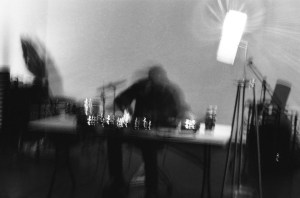
Photo by Ian McPhee. Courtesy the artist.
I don’t see decomposition purely as a process of analysis or entropy. It’s not just something that happens—it can also be something you design. In Decomposition: Fox on a Highway, for example, I was interested in crafting sonic environments that felt like they were mid-transformation—half-eroded, fraying at the edges. But other times, decomposition shows up unintentionally: maybe a field recording gets degraded through too much processing, or layers start clashing in a way that wasn’t planned. I left those moments intact, because they often carry emotional weight that couldn’t have been scripted.
So my understanding of decomposition is more about transformation than destruction. It’s an active, unpredictable process that reveals what’s underneath—or what was never fully formed to begin with. It doesn’t always sound like noise. Sometimes it sounds like memory, or distance, or presence made into something simultaneously serene and frightening.
ACL: Related to the last question: is the album meant to represent decomposition, or is it meant to be a decomposition itself?
S: I think the album is meant to represent decomposition, in the sense that it gestures toward processes of decay, erosion, and transformation—sonically and structurally. There are moments that mimic organic breakdown, where sounds dissolve, textures collapse, or patterns disintegrate but at the same time, I also think of the album as a decomposition itself—not just pointing to the idea, but enacting it. This was why I handed it off to the collaborators, to remove any control I had in the final product.
There are tracks where the structure disintegrates in real time, or where the source material has been processed to the point of becoming unrecognizable. It’s not just about depicting a thing, it’s about embodying it. So the album kind of eats itself as it goes. I liked the idea that decomposition could happen inside the form of the album—that by the end, things have fallen apart in a way that feels inevitable, but also surprising. It’s a process and a metaphor, but also just what the thing is. So I suppose it’s both!
ACL: If we understand decomposition as a systemic, ecological process, the collaborative dimension becomes clear. It’s a play of conditions and natural agents, I guess, which leads me to ask: how did you select your collaborators? What kind of (ecological) system did you construct with the album, in this sense? Was it the one you had in mind since the beginning, or did it surprise you in some way?
S: I selected collaborators in a pretty casual way—I just spent time going through my tape collection and listening for artists whose work felt like it could speak to the album’s intent. Not necessarily in terms of style, but more in terms of atmosphere or emotional resonance. I wasn’t looking for perfect matches—I wanted people who would shift the direction of the material, who could introduce something unexpected. I also never expected so many people to be as excited about the project as there were. It was a really amazing surprise to get so much interest.
The system I built for the album was designed to change as it went. I intentionally left it open-ended, with structures that invited reinterpretation and transformation. That mindset helped me let go of obsessing over small details—I could work more with broad strokes, knowing that the pieces would evolve once someone else touched them. It felt more like planting something than building something.
What surprised me most was the dream-like quality that started to emerge. A lot of the original material felt heavier, darker, more grounded—but once it passed through the hands of these other artists, it came back with this airy, almost surreal tone. That wasn’t what I expected, but it made sense within the system. It’s like the music decomposed and reformed through collaboration—not just breaking down, but transmogrifying into something else entirely.
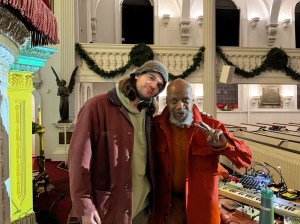
Saapato & Laaraji. Photo by Evan Lindorff-Ellery, courtesy the artist.
ACL: What were the instructions or requirements you proposed to your collaborators?
S: My instructions were basically: it’s open season, go crazy. I made it clear that they could do anything they wanted to the source material—mangle it, stretch it, shred it, rebuild it from the ground up. Nothing was sacred. I really emphasized that they had full control, and that I wasn’t looking for anything to be even faithful to the original. The idea was to create space for genuine transformation, and to let each collaborator bring their own voice into the system without constraints. I wanted the tracks to feel like they’d gone through a process I couldn’t predict—so I had to fully let go. And honestly, hearing the material come back so changed—sometimes pretty far from the original —reshaped my relationship to it in a big way. It stopped feeling like something I made and started feeling like something I had participated in. That shift was really cool and unlike any other album experience I’ve had. I wasn’t attached to preserving any one idea, so I could experience the tracks with fresh ears, almost like they weren’t mine at all. That sense of distance made the album feel more alive, more emergent—like it had its own life force that I was able to discover alongside everyone else.
ACL: Thinking of the album’s system, it seems to me that it grows from a quieter, minimalist state into something much more active, and aurally rich. How did you plan out its structure?
S: The structure actually came together pretty organically. I just listened to all the tracks on shuffle repeatedly and whenever I heard a transition that felt meaningful, I’d mark it down. Over time, I started to notice clusters – collections of tracks that seemed to speak to each other, either sonically or emotionally. Once I had those groupings, I’d listen to them as little suites and see how they flowed together.
Eventually, an arc started to emerge on its own. I didn’t set out to build a narrative or progression, but the sequencing naturally moved from more minimal, spacious textures into something denser and more active. I just followed the feeling. It was less about mapping a structure from the top down and more about noticing what the music was already doing—and sorting it accordingly.
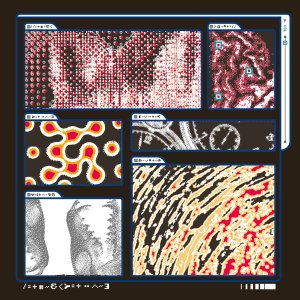 ACL: The album cover is quite interesting, as well. Scientific images are also non-representative devices to an extent, meant to display things as they are. How does it relate to the album concept?
S: Yeah, I had this idea of the cover being like a naturalist field guide but for something dead. A visual artifact that catalogs decay in the same way you would document a living species. I wanted it to feel clinical, but also a little uncanny—like you’re looking at something familiar that’s shifted just enough to feel off.
Taizo Watanabe nailed the design. When I brought the album to Constellation Tatsu, Steven, who runs the label, passed along work from a few artists who had previously worked with them, and Taizo’s style immediately felt like the right direction for the art. He managed to capture that strange in-between space: scientific but dreamlike, objective but deeply suggestive. It felt like the perfect visual parallel to what I was trying to do with the music—treating decomposition not as an absence, but as something observable and intricate. So in that sense, yeah, the cover isn’t purely representational—it’s more like a symbolic diagram of an imagined ecology.
ACL: The language of the track titles is also relatively concrete, it’s got a scientific quality to it. And yet there’s also something evocative about it all – do you think there is something poetic to scientific language? If so, how?
S: Yes, absolutely. I think there’s something really beautiful about a non-hyperbolized observation—about just naming a thing as it is. The matter-of-factness of scientific language can carry a surprising amount of emotional weight, precisely because it doesn’t try to dramatize or embellish.
I’m drawn to that kind of language because it leaves space for interpretation without pushing you toward a specific emotional response. It can be precise and poetic at the same time. There’s something kind of exciting about restraint, especially in an era of overstimulation. So the track titles lean into that—they’re observational, grounded, but I hope still evocative and full of imagery. I wanted them to read like field notes.
ACL: The usual view of the relationship between science and music is that it’s essentially mathematics. Do you think there are other ways to frame this relationship, beyond math?
S: Definitely. As I mentioned earlier, I think music making is such a core part of being human that math often doesn’t even matter. Everyone hums, whistles, taps rhythms without thinking about it—without knowing anything about music theory or counting beats. It’s something we do before we even understand what it is.
Noise is music too, in that sense. Every sound in nature can be heard as an instrument if you’re listening with that kind of attention. That’s part of what drew me to field recording in the first place—it collapses the boundary between organized sound and so-called “chaos.” I recently read Bernie Krause’s book The Great Animal Orchestra which really hammered this idea home for me. He talks about how natural ecosystems have their own musicality, their own rhythms and harmonies, even if no one’s scoring them.
So yes, while there’s definitely a mathematical foundation to the language of music, I think it’s just one way of understanding it. There’s also instinct and other ways of relating to sound that are rooted in experience more than analysis – and thank god, I can’t stand music that’s complicated for the sake of being complicated – unless it sounds good to me, and then I love it, haha!
ACL: Thank you so much for your time, Brendan. Is there anything you’d like to add or tell our readers before we close the interview up?
S: Thank you! And just that I’m incredibly grateful to have worked with so many amazing people on this record. The collaborators really shaped what it became, and it wouldn’t exist without them. It’s been a joy to watch the project evolve beyond what I imagined.
 a closer listen