
Boundaries celebrated its fifth edition last weekend, treating Sunderland to two days of experimental and adventurous music. Using multiple venues around the city centre – in fact, using the city centre as a venue itself – Boundaries is the kind of festival you wish took place in a town near you. It was my second year, so friendships were renewed, new acquaintances were made, and it was a chance to discover a little bit more of Sunderland.
Taking inspiration from the excellent TUSK Festival, which had run in Newcastle (just up the road, for those not familiar with UK geography) but was scuppered by the perfect storm of funding cuts and Covid, Graeme Hopper founded Boundaries with a view to picking up the baton of providing a showcase for similar acts, but once again starting at a smaller level. While Newcastle always had an experimental music undercurrent, Sunderland didn’t really have anything to start from – although, as a great credit to the town, local musicians who have found success have come back to invest in venues.
Frankie & The Heartstrings is a name that may not mean much to you, but they initially created Pop Recs as a pop-up record shop to celebrate the release of their second album in 2013. It immediately found a hunger for such a community hub, and after several moves, a permanent home was found. With a capacity of 250, and an excellent soundsystem, it’s the ideal place to start the weekend.
Friday evening (Pop Recs)
I found out later that Alex Mackay is a touring member of Mogwai, which makes sense when he abandons his improvisatory tones and drones on an analogue box of tricks and picks up a guitar about 15 minutes in. He proceeds to bludgeon the crowd with slow, sludgy goodness. The ground-level speakers at Pop Recs make my trousers vibrate. It’s the first act, and already it sounds like the end of the world.
The Unit Ama look like they could have stepped straight out of the Boundaries crowd, three bearded middle-aged chaps clad in dark grey and black (I speak as one who fits right in with the style). But looks mean nothing. The rhythm section of Christian Alderson and Jason Etherington is the very definition of tight but loose, and Steven Malley on guitar and vocals provides the focus. Sometimes they let rip, other times they seem happy to drop down to almost nothing and see what happens, like a metal trio who always wanted to play jazz. I realise later that the first two acts of the weekend are the only ones with guitars.
The Unit Ama played TUSK back in 2012, as did Rhodri Davies, who makes his Boundaries debut playing the shortest set of the night. But it’s a sublime half hour of harp (I’m not sure which variant he’s playing here), which until the last piece avoids the lure of effects pedals. A smaller and hardier version of the classical harp, this model sounds like a thumb piano and kora at same time while still retaining its own individual sound. It can cascade like the babbling of a brook, or it can escalate like an angry storm. Davies captures both moods perfectly. I’ve seen him in collaboration a couple of times before, but the solo experience is something special.
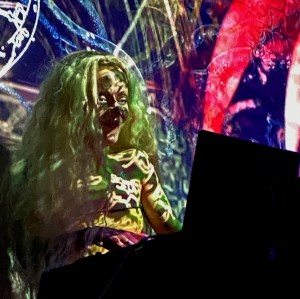 In sharp contrast to the men in dull clothes who have gone on previously, Aja Ireland looks like an alien beamed down to earth in a 70s low-budget sci-fi film. Except instead of a blaster, she has a microphone and a video screen and proceeds to overpower the inhabitants with hyper-pop, all fast beats and multi-pitched vocals. She steps out into the crowd and bravely rolls on the floor. I suspect one side effect of the increase in beer prices is that people are less likely to spill their pints, and the floor thankfully isn’t sticky. After this opening salvo, heralding a 2026 release, Aja steps behind her table of gadgets and promises some improvised techno that is both booming and thudding and gets the crowd cutting a rug. The format means it’s not always easy to dance to. The bassline and kick drum often drift away from each other, but that’s the joy of improv. You never quite know what is happening next. The visuals behind seem mainly focused on teeth, fish, and computer modification of faces. Because Aja is such a presence and the music is irresistible, what’s going on behind is a distant third in terms of elements. The music ends, the lights come on, and everyone has a smile.
Saturday morning (Sunderland city centre)
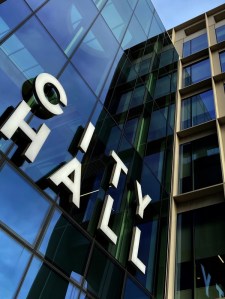 One of the problems with festivals is that it’s difficult to fill in the morning – letting the ears recover is one option; going down to the coast for some of that bracing North Sea air is another. This year, the gap is filled for a select 20 people with Tim Shaw’s Soundwalk. We meet at Sunderland City Hall for introductions and to pick up the receivers and headphones we’ll be using today.
Tim explains that this is a live composition, with his only preparation being that he has planned the walk without technology first. Headphones on and probably looking like members of a very specific cult, we go through one of Sunderland’s main shopping centres, which is attached to a smaller, older market. The sounds come thick and fast, snatches of telephone conversations, people handing out leaflets, Christmas tunes, before we move to a quieter place where the static in the air and on ticket machines and cash points is picked up. Different microphones give different responses – it’s the electromagnetic microphone that picks up static in the air and on the bank and station touch screens.
It’s an intriguing way of experiencing a city centre, particularly as Sunderland has gone early for Christmas with a fun fair in the middle and giant winter figures dotted around the place (in its defence, there had been snow on the ground a couple of days previously). So there’s an extra element to the place that wouldn’t normally be there.
From there, we head down an alley to the Wearmouth bridge, where metal clangs and ambulance sirens blare. Tim attaches a geophone to metalwork, for a sense of the power that goes through a bridge (to give some idea, a geophone is often used for recording tectonic plates – nothing as earth-shattering here, fortunately). Our walk takes us under a metro station, between a building site and a car park, where plenty of audio prompts occur normally, but we just don’t notice them. This walk increases our awareness, and because Tim Shaw is really good at mixing the sound, we can focus on smaller elements without the regular rumble of traffic noise. Across a smaller, pedestrian bridge, and we’re back at City Hall.
Saturday afternoon (City Hall)
… and it’s a good place to end because about 90 minutes later, we’re back there for the afternoon session. The City Hall is a newly built hub for local government, and it doesn’t seem like an obvious choice of venue. My arrival coincides with that of a wedding party, who were there for the registry office. They must have been very confused to see a bunch of experimental music fans milling about on their special day. The chamber we’re in is some distance away, on a lower floor, and is spacious and has pretty good acoustics.
Ailbhe Nic Oireachtaigh plays drones on a viola that tap into a very elemental, earthy vibe. At one point, she puts the instrument away and manipulates the sound of a rainstorm. Then she picks it back up, channelling the spirit of Hendrix by holding the viola up to the amp and letting the vibrations of the resonating body conjure up something altogether different. The set closes with a work that relies on the swoop of the strings with comparatively little manipulation. It’s easy to close the eyes and be carried away.
Looping the sounds of her voice, an accordion and, for the final piece, a floor tom, Dawn Terry brings us a kind of wyrd folk that taps into the murder ballad tradition (where she literally has the blade). It’s at times a drifting drone, but utterly captivating when Dawn starts to sing. I want to make happy music, she says, but while anti-trans and TERFs threaten me, I will fight on. She’s spent by the end, having poured everything into this performance and sits quietly by the stage for a couple of minutes at the end. It’s powerful stuff, and a strong opening to the afternoon – two drone artists who I wasn’t aware of but are captivating presences.
There’s not much to see of Konx-om-Pax, who sits behind his laptop screen, but fortunately, this is an audiovisual set. You may know of Tom Scholefield’s albums on Planet Mu, but there’s a better chance you’ve seen his artwork on albums by Hudson Mohawke, Lone and Oneohtrix Point Never. Here, he uses the screens in the room to convey a fractaled light show, with a skull and some flowers floating across the screens. I’m probably doing him a disservice with that description, but the music triggers the visuals. The music itself is bright and skitterish, often skipping along above solid bass lines. There are a couple of stand-outs, one of which starts as an R&B track before morphing into something else altogether, and then morphing back. It’s a bit of a mood shift mid-afternoon, blowing any potential cobwebs away and is an excellent advert for his forthcoming album.
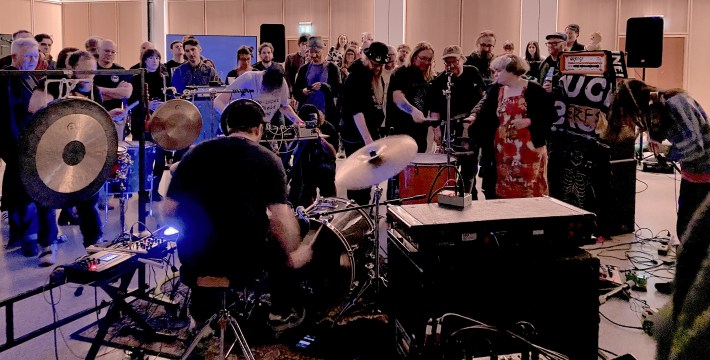 The afternoon closes with Sly And The Family Drone, who set up and get everyone standing in the round with practised efficiency. From seemingly nowhere, drums, amplifiers and a couple of tables of gadgetry are set up as the trio, accompanied throughout by Ailbhe on viola, turn the tuning-up phase directly into the set proper. Is there a structure, or is it completely improvised? It’s hard to tell for sure, but what is certain is that there’s an ebullient lifting of spirits when the drums kick in. It’s easy to imagine the group whipping the crowd into a frenzy more often than not; it’s more of a challenge in the somewhat sterile environs of the City Hall. However, not only do they eventually give us a rhythm to hang on to, but floor toms and cymbals are handed out to those in closest proximity. Most join in with abandon. At some point, we stop being an audience and start being a community. This afternoon we are all the family Drone.
Saturday evening (Sunderland Minster)
The weekend closes in a decidedly older building, the Minster. Ready for the service on Sunday morning (the hymn numbers are up already), this is a lovely place to listen to music. Bathed in chilly blue light, a solo performance by Félicia Atkinson is the best way to ease into the final session. Flitting between piano and laptop, which provides a great deal of colour and texture, she whispers – almost breathes – lyrics over the top in French and English. In person, I am reminded of Laurie Anderson’s spoken word pieces. With the atmosphere shifting through a variety of distinct sounds, often field recordings, sometimes a near orchestral arrangement, this is captivating, a story that we can’t quite follow, leading us along. The final few minutes are just piano and ambience, the crowd suitably reverential as the sound fades away.
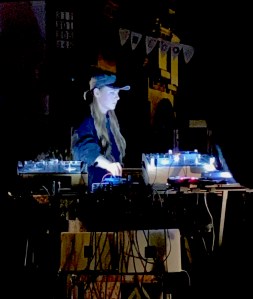 Mixing the analogue approach of tape loops on a pair of reel-to-reel tape recorders with all the modern accoutrements they can muster, such as digital loops and auto-tune, Hyperdawn make woozy R&B-inflected experimental pop. Playing this particular set for the final time, the Manchester-based duo of Vitalija Glovackytė and Michael Cutting are full of wonder and surprise. They use a wine bottle for one of the longer loops and co-opt the minster’s grand piano (left out after the previous set) for a multi-keyboard piece. I didn’t know I was missing this music until I heard it, and I’ve been mentally replaying clips in my head ever since. Fantastic stuff. I’ve been trying not to have favourites from Boundaries, but Hyperdawn are the best thing this weekend.
The evening concludes with Ensemble Nist Nah, a multinational seven-piece hybrid gamelan ensemble (maybe, ’gamelan+’). Playing shorter works than you might expect from a more traditional ensemble, the septet provide plenty of variety with their pieces, swapping instruments multiple times, often during the same composition. Led by Will Guthrie, ENN play their own works and commissions rather than tapping into tradition. It works remarkably well, closing the festival with the largest group with the biggest array of instruments. They admit they are an unwieldy unit, and in their quieter moments, they have to cope with sound leaking in from Sunderland’s various night spots. Crucially, Ensemble Nist Nah end Boundaries on a joyful, uplifting performance.
So, an excellent weekend in which everybody involved – the sound engineers, the musicians, the volunteers – all went above and beyond. It’s clearly an asset to the city, and the ticket price remains insanely affordable for music of this quality. Which makes it all the more frustrating that it was denied funding three times this year and Graeme had to use his savings to keep the event afloat but, apparently, having a special campaign for live music in the shape of Sunderland Music City doesn’t include anything experimental. It’s a frankly baffling state of affairs. Hopefully, Boundaries will return in 2026, and the social media post hinting this, at the end of the weekend, wasn’t just giddy optimism but something a little more definite. In which case, I hope to see you there. (Jeremy Bye)
 a closer listen