
 The Cottingley Fairies were a set of photographs that – for a while at least – proved the existence of fairies. They didn’t persuade everyone, but given this took place in 1917, and that the photographers were two cousins aged nine and 16, and that photography was still a fairly new phenomenon, it’s easy to see why many were convinced. The photos wouldn’t have fooled Sherlock Holmes, for example, but they did find a champion in his creator, Sir Arthur Conan-Doyle. Given that the First World War was costing the lives of many British soldiers daily, it’s understandable that the public needed something to believe in while awaiting news of relatives at the Front.
The need to believe in something magical or otherworldly that bursts into existence seemingly from nowhere persists today, nearly 90 years on. It’s perhaps even more necessary in 2026 than we might have anticipated a few years back. And this need doesn’t just apply to the listener, but also the artist – specifically in this instance, Mary Lattimore and Julianna Barwick, who arrived in Paris shortly after the devastating wildfires that ripped through Los Angeles, including many musicians’ homes. This may go some way to explaining the title – born of tragedy, and needing to reconnect with the magical.
The duo were invited to Paris to take part in a project between the record label Infiné and the Philharmonie de Paris, which offers musicians access to the instrument collection of the Musée de la Musique. A musical instrument is just so much wood, metal and wire if it doesn’t get played and sits in a display or hidden in an archive. So, for nine days, Barwick and Lattimore improvised, experimented and recorded on instruments of varying ages – the harp is a much older instrument, so one of them played here dates back to 1728, while the analogue synthesizers, the Jupiter and Prophet-5, were made in my lifetime, so (obviously) aren’t that old at all.
The results are as lushly beautiful and comforting as you would wish for. Mary Lattimore creates the base that allows Julianna Barwick to ascend, adding texture and colour with synths and voices. The five pieces that stemmed from improvisation retain the sparse freshness that just-created music often has, before the artists begin overthinking or multi-tracking. The other two tracks are a Roger Eno composition, “Temple Of The Winds”, and a cover of “Rachel’s Song” from Vangelis’s Blade Runner soundtrack. The latter will probably be familiar to many listeners of Tragic Magic, but crucially, it doesn’t stand out in this array of gorgeousness.
The album simply flows from start to finish, with the opening “Perpetual Adoration” easing us in with the harp before introducing synth and vocals. It’s bookended by the cosmic brilliance of the closing “Melted Moon”, which lifts us away from earthly bonds into a kind of astral transcendence. It’s as good as any individual work I’ve heard by this pair. They have been friends, collaborating and touring together for a long time, but it feels as if the recording sessions – and the trips around Paris which provided further inspiration – came at just the right moment in their lives.
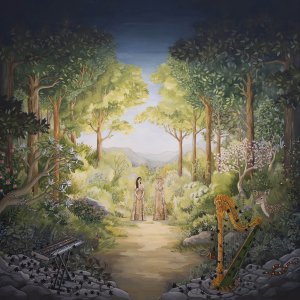
The cover for Tragic Magic sees Barwick and Lattimore in a forest glade, framed by animals and instruments, as if touched by the spirit of faerie. They may be welcoming a weary traveller to rest, reflect and rebuild. Particularly in these challenging times – nothing compared to WWI but not exactly positive – we need something to comfort and restore our faith in the world, and that often comes from music. It already feels like Tragic Magic will be a trusted companion throughout 2026 and beyond. You will believe in magic. (Jeremy Bye)
 a closer listen
Pingback: Big Ears 2026 Preview | a closer listen