
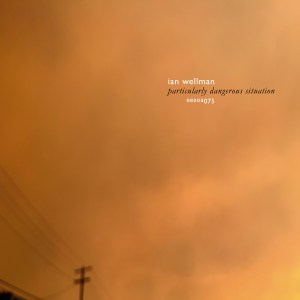
 While many of us are bundling against the elements, cursing an abundance of cold, we pause to remember that a year ago a hotter weather event was unfolding in Southern California. The initial warnings called the combination of accumulated drought and fierce wind “a particularly dangerous situation.” On January 7, the first plumes of smoke appeared. Ian Wellman was there, using his field recording equipment to document the sounds of the Santa Ana winds. As the day went on, he began to smell the smoke; he saw the moon turn crimson as ash accumulated on his clothes. When he returned home, he had begun to realize the extent of what was unfolding. The Palisades and Eaton fires would burn throughout the month, demolishing 180,000 structures, and Wellman was one of the very few to have captured the initial sounds.
A Particularly Dangerous Situation is a document of that day, combining the initial field recordings with drones and tape loops to form a sonic narrative. The album conveys the story without words, its rising tensions mirroring those of the community. To listen is to be immersed and inundated. From the very start, there seems no escape from the Santa Ana winds, which gust up to 100 mph, providing no opportunity to outrun or even battle the conflagration. After the introductory field recordings recede, the first foreboding chords enter; but soon the wind seems even more sinister, taking on a life of its own, seeping through the cracks of buildings considered safe, much in the way the flames would do in the days and weeks to come.
The electronics grow distorted, implying the limited visibility through the smoke, the acrid burn of the unprotected eye. In “Afternoon Report,” the tone of the wind turns piercing, and one begins to hear the crackle of fire. At 3:11, a sudden swirl and near-silence, a bitter augury. By month’s end, 31 people will have died in the catastrophe. The title “Out of Our Hands” says it all; by day’s end, the momentum would already be unstoppable.
The brevity of an album compared to a fire works in the project’s favor, as it emphasizes how quickly a spark can become a wildfire, and how important it is to act quickly in order to survive. Hearing the sound of motors, one thinks of cars idling on the freeway, unable to move. “Nothing Will Be the Same,” writes Wellman, and he is correct; but to extend the idea, the higher frequency of such fires is directly related to climate change and the refusal to heed the warnings of experts. For a visual corollary, see the slightly fictionalized yet extremely effective film The Lost Bus (2025), based on the 2018 Camp Fire in Northern California; for sonic comparison, play Daniel Bachman’s Quaker Run Wildfire (2024), based on events that unfolded in Virginia in the fall of 2023; and for prose, we recommend Jacob Soboroff’s just-released Firestorm: The Great Los Angeles Fires and America’s New Age of Disaster (2026), which not only shares the direct subject of Particularly Dangerous Situation, but a fascination with the phrase.
The major chords of “Nothing Will Be the Same” suggest triumph and recovery, but at a high cost; the minor chords symbolize the friction of knowing such events will likely recur. The album is not merely a reflection of events past, but a prophecy of things to come. (Richard Allen)
 a closer listen