
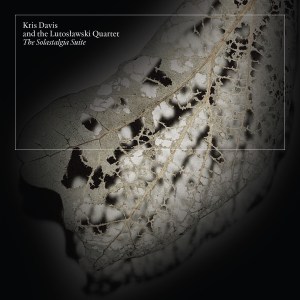
 Dramatic, confrontational and unapologetic,Kris Davis and the Lutosławski Quartet‘s Solastalgia Suite tackles the climate crisis head on, with the intention of shaking listeners from their apathy before it is too late.
The title is a new word coined by philosopher Glenn Albrecht to reflect “a form of homesickness while we are still at home.” Pianist and Pyroclastic Records founder Davis had been feeling this emotion when returning home to Vancouver, noticing how quickly seasons and environments had changed. Teaming with Poland’s Lutosławski Quartet, she composed this suite as a means of processing what she was seeing and what had evolved quickly into a physical and an existential threat. Given the nature of the crisis, it’s no surprise that the composer was partially influenced by Olivier Messiaen’s “Quartet for the End of the World.” The music is both reflection and warning, infused with a sense of immediacy, both vibrant and violent.
While it may seem unusual to begin a suite with an “Interlude,” the title refers to the current time, caught between the threat and the efforts to address it. The tempo is frantic, the strings agitated, as one might become when hearing the voices of climate denial. For now, the composer suggests that there is still a narrow window in which to act. In the middle of the piece, the lower keys suggest a countdown, perhaps the Doomsday Clock. Abuzz with activity, the instruments communicate not only the threat, but the need to spring into action, even to double one’s efforts to make up for time lost. In contrast, “An Invitation to Disappear” is awash in sweetness, a form of mourning akin to that heard on Kyle Preston’s recently reviewed Music for Disappearing Coastlines, an elegy that momentarily darkens late, allowing a bit of anger to seep in before the piano washes it away.
Turning toward the experimental side, “Towards No Earthly Pole” begins with mere whispers of strings, like a cold Antarctic wind over a barren landscape, accompanied by seemingly random notes of prepared piano. Structure appears halfway through the piece, then disappears just as swiftly; the pianist offers her response, then fall quiet; the strings offer theirs, then fall quiet as well; and all the time the cold wind blows. Perhaps the most Messiaen-like piece, “Towards” suggests a post-human existence in which the only music is generated by the elements.
The staccato strings of “The Known End” arrive like an attack, the piano traveling eerily up and down the scales. If the piece is reminiscent of Bernard Herrmann, all the better; the climate crisis is its own brand of horror, not a knife in the shower but a glacier falling into the sea. As if realizing that she may be pushing the listener too far, too soon, the composer relents, shifting to a far gentler tone mid-piece, allowing space for contemplation: was the assault the sound of what has already happened, or what might yet be prevented? In “Ghost Reefs,” there is no such question: the damage has already occurred, and the strings drip with dreadful disappointment.
“Pressure & Yield” treats the Earth as a living being, akin to Gaia, no longer loving but angry. The music reflects its title with chips and fractures, earthquakes and eruptions, skittering and shrieking at the indignities pressed upon it. The agitation of the closer reflects the tone of Greta Thunberg’s inspired 2019 speech: “I want you to panic.” The piece rises to a frenzy, a whirlpool of strings in which piano notes float like debris. Then at the five minute mark, a segment of solastalgia, a brief memory all too quickly carted away by the rising tide. The Solastalgia Suite isn’t meant to comfort, but to disturb; the fact that it does so in such elegant fashion is a sonic miracle. (Richard Allen)
 a closer listen