
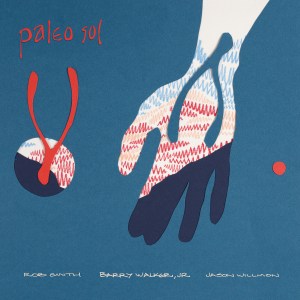
 Seldom has the term “post-rock” seemed as accurate as when applied to the music of Portland WA geologist Barry Walker Jr.. Paleo Sol refers to paleosol, “ancient soils that are variably rusted and leached of their original components.” The incredibly specific liner notes refer to the tracks as “miniature topographical surveys, dioramas for the complex layers of andesite, mudstone, and ash compressed by time into rock formations.” And Walker’s pedal steel, accompanied by the bass guitar of Jason Willmon and the drums of Rob Smith, emphasizes slow, geologic shifts, imitating the behavior of rocks over extended periods of time. While Walker is a member of Rose City Band, the music may remind listeners more of Do Make Say Think; and while Smith calls it “country,” we’re sticking with our original designation.
The album alternates between tones, from intimate to flourishing, based on whether the piece is solo or collaborative. “Quiescence” is as a lovely opener, introducing the instruments one by one; even the percussion begins with but a light shimmer. One thinks of setting off into a vast western prairie, imagining a stagecoach even though a pick-up truck is more likely. Then the album’s most post-rock title: “Son, Don’t Brighten the Bear Creek Rhyolite.” The album was composed after the birth of Walker’s first child, and the piece imagines family connection and a teaching moment. To refresh our memories, rhyolite is an igneous rock many of us first encountered in middle school, sliced like a melon to reveal its intricate design. The same might be said of the track, sparkling in the center like its namesake and bright enough without a tumbler. “Peridot, Call Me” is another (literal) gem of a track, the yellow-green stone also called chrysolite. The ensemble piece is an invitation not only to the stone, but to the listener and prospective geologist.
The passage to intimacy emerges in the closing third of “A Trip to Town” as the density decreases, which allows the piece to shine. In contrast, the 12-minute “Sentient Lithosphere” is the closest the album comes to geological time; each note lands with unhurried grace. By the time the last pedal steel notes fade in “Aether One,” the listener is in no hurry either; instead, one feels a hankering to wander, to explore and to discover. (Richard Allen)
 a closer listen