
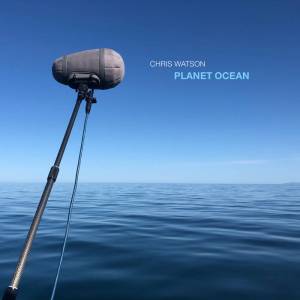
 When writing of the evocative Planet Ocean, Chris Watson references the first color photographs taken of Earth from space. These images revealed a blue planet, whose surface was 70% water. Sixty years later, Watson hopes that sound will accomplish what sight did in the 1960s, raising new awareness of the value of our oceans and seas.
Not all water sounds alike. Sea level, oxygenation, temperature, latitude, aquatic life and pollution each have an effect. In like manner, different beaches possess different qualities, based on the rocks, the sand, and the creatures who live at the wrack line. While it’s easy to tell the difference between the crackling of ice and the crashing of waves, Watson invites listeners to delve deeper, to recognize the subtleties in timbre that distinguish the specific sounds of similar locations. On Bandcamp, the album unfolds as a single piece, with notes identifying the seventeen recording spots; on iTunes, the album is separated into seventeen tracks for immediate identification. Yet the artist is less interested in playing match-up (the accompanying photos are deliberately designed not to be paired with the sources) than in promoting water health as a whole. The variety is meant to dazzle, and it does.
The stereo effects are particularly effective; the opening seconds produce a three-dimensional effect that will continue throughout the album. This is Aldeburg Beach in Suffolk, England, where sea birds chatter above the waves: a combination of sounds familiar to general audiences. When the location changes to Iceland’s Arnastapi boulder beach, one can already hear the differences in the way the waves interact with the land; the foam seems lighter, the withdrawal of waves from boulders heavier. An aha! moment is produced as the focus shifts to a pier, as one can hear the creaking of wood and the retreat of stranded droplets.
The focus widens as the attention shifts to a coral reef in the South China Sea. Many coral reefs have been starved of oxygen, bleached or directly damaged as a result of human interference, from motorboats to climate change. These self-contained ecosystems play a critical role in the health of the sea and its residents; their deterioration has a ripple effect that will eventually include us. The same holds true for the two ice tracks, recorded at Ross Island, Antarctica and below the surface of the Arctic. How long will field recording artists be able to create ice tracks, and how far will they have to travel to do so? Already the ice is receding, subsumed by the sound of melt.
Watson’s recordings are engaging in their own right, but when connected to preservation issues, they speak with a collective, authoritative voice. Water itself is not endangered; but the form of water and the quality of water is determined by human action or inaction. 2026 marks the 30th anniversary of Watson’s first forays into field recordings on the Touch imprint, and his current work is more vital than ever. (Richard Allen)
 a closer listen
Pingback: V33.90 | Chris Watson ‘Planet Ocean’ | Touch
Pingback: Steffen Cordts ~ Blue Element | a closer listen