
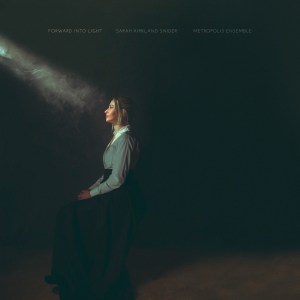
 As indicated by the title, Forward Into Light is a hopeful album, suggesting that history is tilting toward something brighter and more positive. This attitude may be in short supply these days, but its rarity makes it all the more essential. The bookends are carefully chosen, as the album begins with a piece inspired by the women’s suffrage movement in the U.S., which eventually succeeded, and ends with a “meditation on resilience” that might be applied to multiple nations and situations, from Ukraine to Gaza and points afar and in-between. These pieces, titled “Forward Into Light” and “Something for the Dark,” work in tandem to identify the spiritual struggle and speculate on its eventual outcome. The image of Synder like a supplicant bathed in a beam of light suggests revelation, if not divine intervention.
The fifteen-minute title track warms up gently, then springs. The Metropolis Ensemble, conducted by Andrew Cyr, is precise and controlled, unleashing its energy in increments. Each energy blast is followed by a recession, as if reflecting the steps forward and back on the way to women’s suffrage. The message of the movement (pun intended) is to keep pushing forward, as progress is seldom a straight line. The tone is noble, honoring those who persevered. The upper notes of the brass are universally triumphant, while the strings swirl, pounce and eventually soar. Sustaining drama throughout its running time, the piece unfolds like an adventure. Even though one knows the struggle will end in victory, one is interested to hear what lies around every sonic corner.
“Drink the Wild Ayre” features Noël Wan on harp and is freed to be more playful and loose. Originally written as the final commission for the Emerson String Quartet, the piece now finds itself gently transformed. Romance turns to revelry as the piece develops, bounding toward its happy conclusion. The eight-movement “Eye of Mnemosyne” begins with dark, somber chords, a reminder of the album’s overall theme. Originally a multi-media work, the composition reflects on “memory, innovation and culture,” and in this context can be heard as a requiem for histories that have been forgotten, or worse, erased. The second movement, “Wheels of the Muses,” is a pause for reflection – by design, “Mori Memory of the Dead” is even humbler. Severed from its original connection with photography, the piece still manages to convey the power of witnessing; the sixth movement, “Nostos War Story,” contains the album’s starkest moments, borne on the backs on military drums, while the cellos of the epilogue return to the first movement and bear the most emotional weight. Has nothing changed? Has everything changed?
The tension carries over into “Something for the Dark,” which unfolds in two movements, “The Promise” and “Of Rise and Renewal.” The brass timbres of the opener return, suggesting that what happened then – struggle, resistance, resilience, triumph – might happen again. The hefty swirl of strings in the fourth minute of “The Promise” is like an army of angels, war in the skies, darkness and light colliding in a thunderclap of Biblical proportions. The second movement is the subdued aftermath: not the end of the conflict, but the plateau upon which one might rest while preparing to resume the fight. This is what Sarah Kirkland Snider offers: not the assurance that everything will be all right, but that resistance is resilience, no matter what the outcome. (Richard Allen)
 a closer listen