
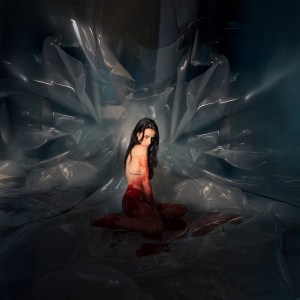
 Noémi Büchi has always been fascinated by the process of transformation. Her videos often feature body morphing, the opposite of body horror in that the fluidity of the flesh is both beautiful and alluring. On Exuvie, she takes the concept further, focusing on “what has been shed” ~ not only skin but memory and self, creating a tension between “matter and memory.” The cover image suggests that such a transformation has taken place, the blood a badge of honor rather than the sign of a wound. The music follows suit; it is often unclear whether these are electronic pieces that have shed their modern composition skin, or the other way around. As a result, the music is caught between resistance and flux, engaged in a cycle of struggle and release.
On the surface, Exuvie is a dark album, but it need not be; the listener is challenged to decide what value they place on the old and new skins. Is transformation something to be avoided or replaced? The skin, replaced every seven years, may bear memory of trauma, making the metamorphosis a relief. “I was almost there” holds a steady beat for most of its span, then splinters in its closing seconds, honoring its title. In related fashion, “beneath form” embraces a slow synthesized form until the finale, when it shifts to a regal brass fanfare. This paves the way for the hyperkinetic “I suppose,” which charges out of the gate at 170 bpm, momentarily relents, then plunges forward again, demonstrating the fact that transformation is not always linear.
The album hits its stride in the two-part “it was” and “a divided surface,” vocal musings giving way to slow beats, orchestral surges and again that valuable brass, lending dignity to the new, even as the old is seemingly put to bed. “dislocated bodies” begins with structured piano before offering the album’s most memorable phrase: “I’ve had quite the day.” The ending of the follow-up phrase, “The main question …” is swallowed in the instrumental ether. What is the main question? Does it address the echoes of memory that seep into the consciousness despite our discarded skin? Or is it whether we can adapt to changing circumstances, becoming something better, more resilient? The chimes of “like they said” seem to suggest positive transformation, while the closing “la mue” (“the molt”) leaves the question open-ended. Should one choose to hear the shift, the album itself has turned from darkness to light. (Richard Allen)
 a closer listen