
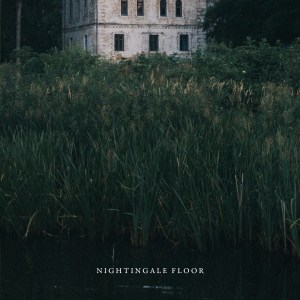
 Nearly two feet of snow fell here last night, and no souls are allowed on the roads, which makes this the perfect time to light a fire and listen to Five Stagings. The album was recorded under similar conditions, “in high summers and brutal winters,” the tableaus reflected in the art. Those ordering vinyl are offered the choice of three double-sided inserts: “Farm Table,” “Frozen Home” and “Winter Pines.” Each underlines the theme of stagings, providing a theatre-like setting in which the scenes will unfold.
The music may remind listeners of FareWell Poetry, although these timbres are more subdued. Like that collective, Nightingale Floor is a gathering of like-minded artists: Lauren McLean (poetry), Josh Horsley (cello), Benjamin D. Duvall (sound collages, strings and trombone) and David McLean (saxophones, keyboards and Bass VI). Together they create a series of moods to match the stagings, each a suspension of time, a space in which to tell a tale.
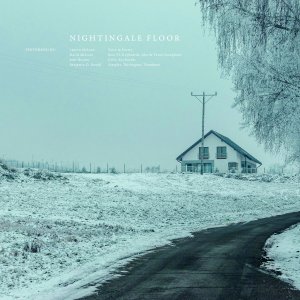 “The Copse and the Hunting Lodge” rises from silence with a crackle, a howl, a rustle, a tweet. “The sound of brave willow trees travels further in cold air,” intones McLean over a smattering of chimes. Shy strings emerge like the blue-eyed cats of the poem. The bird reappears, offering encouragement; if she can make it through the winter, so can we. Human footsteps make their way through the snow. The landscape may be frozen, but the creatures who traverse it are not. A hint of mystery is mingled with the melancholy as McLean proclaims, “the prints in the snow are not yours.” The poet falls silent; the footsteps resume.
Water sounds permeate “Plum Dark” as saxophone takes the lead. “I hold a conch to your ear,” recites McLean, a metaphor for listening, for remembering, for making associations with the sea. The track is about more than the ocean. When the poet admits, “I’ve seen the abyss, and it’s plum dark,” she hints that every relationship – including those between people and between people and environment – are comprised of choices that tilt toward darkness or light. “I make the shape of the cross with my body,” says McLean; “it’s in debt to the earth.” The poem circles back to the start, most intimate in its closing phrase, accompanied by a clap of thunder. “Meudon, 1928,” inspired by a surrealist photograph, contains the closest thing the LP has to a chorus: can I crawl into them? The unsettling mood is a perfect match for the art. The instrumental “Crystal Radio” is similarly compact, populated by bass and the feel of a train passing through the countryside – perhaps the very same train seen in André Kertész’s photo.
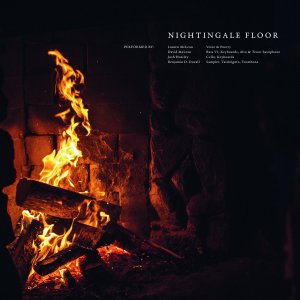 Now only “Lion to Feel” remains, at 13:47 the LP’s centerpiece. The track makes a powerful entrance with confident cello and swirling strings, imitating a whirlpool of snow. There is no need to rush the narrative; the listener is safe at home. The sound design is exquisite, setting the mood through whirl and wind chime. The bass enters gingerly, careful not to disturb the cat. “God is a lion in my love’s heart,” begins McLean, later changing the phrase to “you are a lion.” Passion seeps from these whispery words, along with a sense that the relationship lies beyond definition, the very realm of metaphor. The words “to feel, and to be burned,” set against the crackle of a hearth, invoke both religious and romantic fire.
These stagings contain the same characteristics as theatrical productions; the settings and moods are as important as the poetry. We would love to see stage renditions of these tales, and meet the characters that move within. (Richard Allen)
 a closer listen
Pingback: A Closer Listen Reviews – Avant Music News