
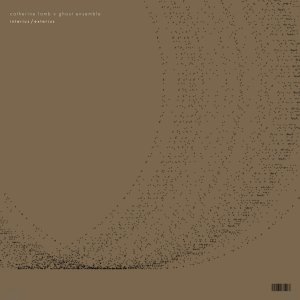
The cover of Catherine Lamb and Ghost Ensemble’s interius/exterius depicts resonance abstractly, but the music itself is a concrete study in sonic architecture. The nonet dismantles traditional notions of ensemble interplay; harmony is not a fixed destination but a relational field, built from an inaudible foundation. Tuning becomes a philosophical act, and the collective performance is a continuous negotiation between expansion and contraction—interiority and exteriority. The result is a work of tectonic movement, a recording that feels less like a document of a performance and more like the audible surface of a deeper truth.
Released via the Greyfade label, interius/exterius is a collaboration between the Berlin-based American composer Catherine Lamb and New York’s Ghost Ensemble. Lamb, a student of James Tenney and Michael Pisaro at CalArts, has built a body of work exploring microtonality and collective resonance. Ghost Ensemble, founded in 2012 by accordionist Ben Richter—himself a student of Pauline Oliveros—has cultivated a practice of deep collaboration with composers. For this project, the ensemble was able to commission Lamb through a grant, embarking on a multi-year process of workshops and refinement. As Richter explains, the working method is central to the group’s identity: “We do these…intensive workshops with composers, not just right before the premiere but like a year before the premiere, so that they can really have a lot of time to build on us knowing one another, knowing one another’s working methods, materials and exchanging back and forth.”
At the core of the piece is a radical tuning system: a harmonic series derived from an inaudible 10Hz frequency. This base-ten just intonation system means every pitch the listener hears is a partial of a fundamental that cannot be perceived. Richter elaborates on its profound implications: “I think it’s beautiful aesthetically that it’s a note that we can’t hear because it makes me think about… the idea that we are realizing and experiencing harmonics of some deeper truth that we can’t quite hear.” He connects this to the work’s philosophical underpinnings, referencing a quote from Poetics of Relation, by Édouard Glissant. The work’s title, interius/exterius, serves as its guiding relational parameter, a binary of intention that dictates the ebb and flow of the sound. “If we’re out, if we’re exterior, that’s generative expanding outwards, like creating substance,” he elaborates. “And inward, interior is sort of balancing within the sound. I think of it as almost as a like extroverted and introverted sound making in a way.”
The instrumentation itself is distinctive, augmented by a hammered dulcimer—a striking addition that emerged from the collection of cellist TJ Borden—and two contrabasses, one with a fifth string, placed antiphonally. The execution of Lamb’s score demanded novel techniques from each player. The oboist physically swaps tuning rings mid-piece; the strings use scordatura (“discord”) and natural harmonics. For Richter’s accordion, Lamb composed in a way that facilitated microtonal precision. “This is all possible because she’s written one or two notes at a time for me,” Richter notes, “very consciously almost treating the accordion as if it were like a mouth-blown wind instrument. So that I can be very precise with the tuning of those notes.”
The work exists within a rich lineage of experimental practice. Richter’s connection to Pauline Oliveros was foundational, with Ghost Ensemble’s earliest events happening in collaboration with her. He also situates Lamb within a broader community, citing James Tenney as a “centrally important figure for both Cat and Ghost,” alongside Larry Polansky, Phill Niblock, and the “Berlin Just Intonation godparents” Wolfgang von Schweinitz and Marc Sabat. This lineage finds a perfect home on Greyfade, a label dedicated to high-fidelity presentation. Ghost Ensemble has a long history with the label’s Joseph Branciforte, who, after the recording sessions with engineer Matt Sargent, came in to mix and master, helping to shape the album’s final sound.
The resulting recording, a relatively concise 33-minute iteration, is the most distilled version of a piece that has existed in performances lasting over an hour. This concentrated form emerged from the intensive process with Lamb leading up to the recording. Divided into six roman-numeraled movements, the opening section dominates at a full third the length of the record, starting with a discordant roar, punctuated by the pointillist stabs of the harp and hammered dulcimer. The disorientation caused by the unique microtonal tuning system slowly subsides, as the listener is suspended in collective movement, culiminating in a beautiful finale. interius/exterius is a culmination and a snapshot—a deeply considered object born from a fluid, living practice, capturing an ensemble and a composer in relational alignment. (Joseph Sannicandro)
To read more about Catherine Lamb and Ghost Ensemble, including an extended interview and a special Just Intonation mix, head over to our newsletter.

 a closer listen
Pingback: A Closer Listen Reviews – Avant Music News