
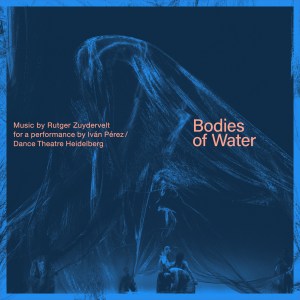
 This has already been a great year for water-based recordings, and now Rutger Zuydervelt extends the theme to theatre with the immersive Bodies of Water (music for a performance by Iván Pérez/Dance Theatre Heidelberg) and its companion piece Fog / Drops. The performance is divided into three sections: liquid, ice and gas; the music begins in ambience and explodes into the electronic. Natural ocean sounds are filtered into the recording as backdrop and instrument. The dancers demonstrate incredible flow while whirling through set designs that imitate the sea. While the performance investigates the relationship between humans and the sea, the music – especially in its most turbulent stages – gets the body moving, a reminder that we are mostly water reacting to water.
The albums are best played back to back. For most of its running time, Bodies of Water remains in the ambient phase, corresponding with the liquid phase of the choreography, shifting only when it arrives at “Gas;” but Fog / Drops balances the occasion with a strong electronic pulse. The organ of opening piece “Dark Waters” sounds like the prelude to a church service and suggests Genesis 1:2: And the earth was without form, and void; and darkness was upon the face of the deep. And the Spirit of God moved upon the face of the waters. “Submerge” contains some of the set’s most hydrophonic sounds, drone swallowing melody, leaving a vast, mysterious void. In “Utopian Seas,” one can hear water flowing and imagine boats rocking, hulls caked with barnacles and salt. Every high-pitched creak sounds like a siren, hand outstretched, beckoning sailors with their song. The track darkens as it progresses, introducing low notes, sub frequencies and percussive taps.
“Crushing Waves” dives even deeper, into the heart of the sea, where sound is muffled and light is muted. The sonics are reminiscent of Machinefabriek’s earlier, more shrouded works, in which danger lurks around every corner, coiled and waiting to strike. One can hear the crashes as they land and the storm as it brews and snaps. Given this introduction, one would expect “Tsunami” to sound even bleaker, but Zuydervelt allows light to penetrate the depths, leading the way for “Gas,” the album’s peak and perhaps the performance’s peak as well. A powerful pulse emerges from a gaseous drone, moving front and center, setting the stage for drums to enter at the three-minute mark. Bass tones and synthesizer raise the water table meter by meter. Now this is a tsunami!
 Two twenty-minute pieces, “Fog” and “Drops,” didn’t make the final cut but appear as a sister album. If this pair were to appear on vinyl, each would fill an entire side. “Fog” begins with the sound of the wind blowing across the sea, matching it with “Dark Waters.” This patient piece creates an atmosphere of expectation, the rhythms not unveiled until 5:23. After a beat-free recalibration in the eighth minute, the piece develops an arhythmic heartbeat, then returns to the original pattern, now surrounded by whirlpools of seething sonics. “Drops” uses piano notes to imitate droplets that accelerate and accumulate, attracting clocklike chimes. A percussive transition begins at 7:52, even stronger drums appearing a minute later, building in intensity until their eventual dissolution.
Must the Bodies of Water experience end here? We’d love to hear a third phase of the project, including 12″ remixes of “Gas,” “Fog,” “Drops” and “Utopian Seas.” One can imagine Iván Pérez’ dancers leaving the stage, changing clothes, heading to the club and dancing again to the same tracks, but in an entirely different way. (Richard Allen)
 a closer listen
Pingback: A Closer Listen Reviews – Avant Music News