
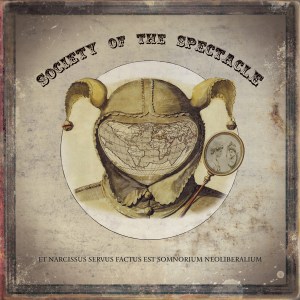
 After playing the LP, I went back to read the book. Guy Debord’s 1967 treatise of the same name is a masterpiece of philosophical prophecy, seeming to predict everything from Facebook to fake news, celebrity culture to A.I., and most importantly, the widespread acceptance of the spectacle as reality. Ancient Methods noted the prescient nature of the prose, and chose to compose his own spectacle, an industrial album built around snippets and quotes from the original work, simultaneously underlining its principles and personifying its warnings. As today is April Fools’ Day, it’s convenient that the cover art depicts a court jester: the only person who could tell the truth without being executed (though some still met that fate, which was often a literal roasting).
“What appears is good; what is good appears.” Debord’s opening words lead to a factory of beats and patterns, imitating the lockstep mentality of society as a whole. “Image Is My Commodity” is reminiscent of early Front 242, the perfect combination of menace and message. The irony is that industrial music is known to reflect depersonalization while inciting resistance. The music brings energy to the listener, perhaps enough energy to escape one’s shackles. At the same time, it tempts the listener to give in and dance. This dichotomy lies at the heart of the album.
Hearing the words, “Human fulfillment was no longer equated with what one was, but what one possessed,” one cannot help but wonder at the fact that they were written nearly sixty years ago. Have we been this blind, this long? The brass backdrop contributes drama, but because it is also entertainment, the album is again at war with itself. “Life in the Spectacle II” may be less than a minute long, but the backdrop shifts so smoothly from circus to apocalypse than one can feel the speed at which society can downturn as well.
Society of the Spectacle‘s final strength is that it refuses to have a happy ending. After quoting Debord’s words on “impoverishment, enslavement and negation of real life,” Ancient Methods offers no hope, no words of encouragement, simply reflecting the truth, like a court jester. “The spectacle is the opposite of dialogue,” intones a female narrator in “Conclusio.” The burgeoning drone in the background seems to scream, this can’t be the end. Then we remember that Debord didn’t intend his words to serve as prophecy; he was simply reflecting what he saw in 1967. The end had already occurred. (Richard Allen)
 a closer listen