
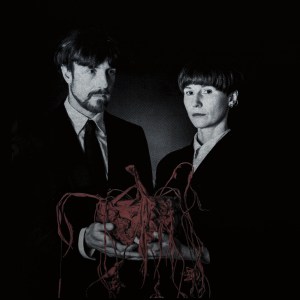
 Recalling the ancient custom of “Liksong” (“corpse song”), Or Gare – funeral procession music from Ryfylke, Norway is reverent, spooky and enthralling, an imagined score to a single, haunted procession. The otherworldly vocals uncouple listeners from the present, immersing them in an imagined past; while the often gossamer-thin music lends the project the feel of an alternate reality, perhaps even a procession on another planet. But of course this isn’t another planet, it’s Norway ~ although it’s a side of Norway that few of us have ever heard.
The funeral procession begins with the gorgeous “Leaving Home – O Verden, Hav da Gode Nat!”, Stine Janvin singing over Morten Joh‘s drone while Lucy Railton wraps the words in a cello shroud. Dead Can Dance is an obvious reference, in name as well as in sound. One recalls the differences between ancient and modern funerals, the ancient soaked in tradition, the modern often shorn of spiritual elements; consider for example the current trend of burying people in flamboyant coffins such as golf carts and cheeseburgers. Janvin and Joh return not only the reverence, but the mystery: the great unknowing that surrounds the afterlife. We hope, we pray, we dream, but we really don’t know. A corpse singer was not only a comforter, but a translator, an intercessor, a questioner.
In “Before the burial site – Jeg Raader Eder Alle,” a cappella words are layered, echoed, distorted and harmonized, imitating the blur of memory and emotion that accompanies a funeral. Here all but words are stripped away, yet no words are adequate; in “By the grave – Akk, Mon Jeg Staar I Naade” they become a wordless moan, a plea, a lament. An electronic pulse rises in the back to replace the pulse of the one who has gone.
Fittingly, by “Lowering the coffin – Vaar Strid Er Endt,” it seems to be raining, albeit an electronic rain: a static mass that befuddles the mind. Janvin’s voice offers clarity in the midst of confusion, as if to say, focus on me. In like manner, the corpse singers provided a framework for mourning, controlling the narrative no matter what the emotion. When a recognizable unison chorus arises in the subsequent piece, accompanied by organ-like keyboards, the listener is initially surprised; but in less than a minute, the timbre and the impression are swallowed by an electronic wall. In this piece and “Acceptance – Kom, Menneske, At Skue Mig!,” Janvin / Joh seem to be honoring the stages of grief as popularized by Elisabeth Kübler-Ross. Doubt is replaced not by belief, but by beauty, conveyed by chime-like vibraphone and hints of brass, as if to say, go now, and rejoin the world. (Richard Allen)
 a closer listen