
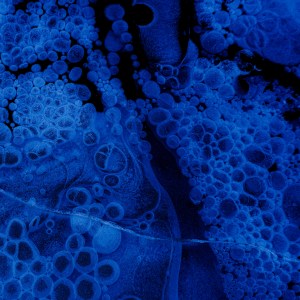
 We last heard from Yoichi Kamimura with ryūhyō, one of our favorite field recording albums of 2025. This year’s Waterforest is closely related; in fact, some of the sounds stem from the same sessions, in which the artist recorded the sounds of Shiretoko’s drift ice. And yet there is much more to be found here, part of a sound and sight installation that incorporates water sounds from around the world, from Swiss springs to the Amazon rainforest and from Icelandic glaciers to Kyoto’s canals. The listening experience is incredibly beautiful, while it also carries a subtle, yet powerful message.
Kamimura was inspired by the “Flying River,” a sea of clouds visible from the Amazon River, demonstrating nature’s cycles of evaporation and return. Extending the phenomenon to the realm of metaphor, Kamimura noted nature’s interconnectedness, its lack of boundaries, its ease of flow: elements present in philosophy yet all-too-often absent in society. One nation’s ice may become another nation’s stream; one nation’s stream may become another nation’s lake. Once upon a time, there was only one ocean.
In the liner notes, Seiha Kurosawa writes of their collaborative exhibition, focusing on the forces of heat and cold as they pertain to human-caused climate change. Shifts in one area often affect another half a world away. The buzzing mosquito in the rain forest is not disconnected from the crackling drift ice; neither is the tree from the glacier. David Toop reminds readers of the “spirit down in the water” from the Nine Songs, and the importance of listening to all creation: not only people of different viewpoints, but entities of different phylums.
There are two distinct ways to listen to the lovely turquoise LP: one may begin with the raw field recordings, or move to the sonic collage. Each holds a different fascination, but the beauty of the extended metaphor is that they lose nothing when combined, not even their distinctive nature. The Lake Biwa canal is still the canal; the Iguaçu waterfall is still the waterfall, whether in monologue or dialogue. In dialogue, new complexities and meanings emerge.
The title track also possesses a spiritual side, conveyed through subtle chimes, flute and chants. One feels as if one is meditating inside a great temple, which is also a description of the outdoors. By making the association overt, Kamimura invites listeners to hear the spiritual side of nature and to breathe it back to the rest of nature, like the ground offering its water back to the clouds.
Waterforest is a reflection, but also a plea to widen one’s horizons. When listening to disparate sounds together, one may intuit the connection between glacier and glade, signifying the unity of all things. Even the notes of the wind chime are part of a harmonious whole. (Richard Allen)
 a closer listen