
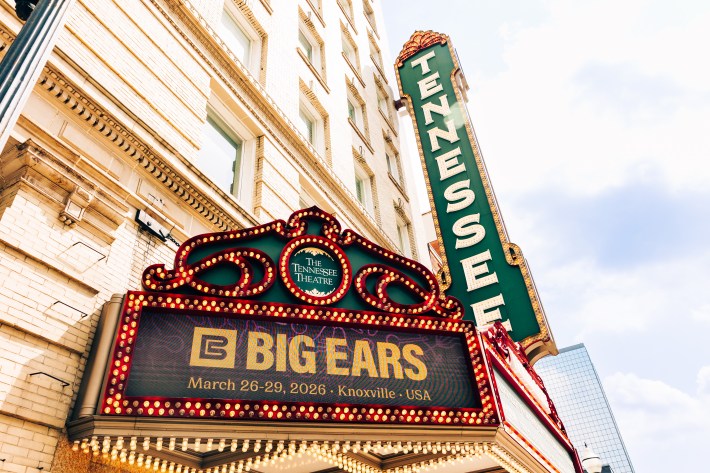
(photo: Ashli Linkous)
A CLOSER LOOK: Big Ears 2026
Four days, forty-two shows, six interviews, and one pilgrimage to Knoxville.
I began my first day at Big Ears with a question that had lingered since the festival first popped on my radar more than a decade ago: Why Knoxville? Driving past strip malls and interstates, longing for the high-speed trains and walkable cities of European festivals like Unsound, I was already nostalgic for a kind of festival infrastructure America simply doesn’t have. By the end of four days, I had something approaching an answer. But that turned out to be less a destination than a condition: a temporary utopia assembled in a tertiary city, held together by little more than good curation and the willingness of hundreds of musicians to play in churches, train depots, and former bus stations.
Big Ears, as its name suggests, is an invitation to listen widely, with openness. Founded in 2009 by Ashley Capps, the festival has grown from a small downtown NYC–inflected affair (those early years owed a lot to The Knitting Factory) into a sprawling, genre-defying beast. This year’s edition—which ran 26–29 March—featured over 250 performances across 24 venues. Perhaps the festival has grown too big? Honestly, it is overwhelming, as it sometimes feels like multiple festivals gathered together. John Zorn alone accounted for twelve shows. While Chicago’s jazz lineage (Roscoe Mitchell, Rob Mazurek), and the downtown New York scene (Zorn, Laurie Anderson) endured, this year may mark the ascendence of Los Angeles (Julianna Barwick, Mary Lattimore, Patrick Shiroishi, SML’s various members and more). But the real star was the festival’s capacity for surprise, placing musicians in unfamiliar combinations and trusting audiences to keep up.
What follows is not a day-by-day recap (see our newsletter for those) but a thematic synthesis: of sacred spaces and secular drones, of the residency as a model for deep listening, of the joy and exhaustion of choosing your way through 250 performances, and of the peculiar alchemy that turns a small city in Appalachia into a gathering place for music that rarely finds a home anywhere else.
The Pilgrimage: Why Knoxville?
 Let me confess my biases. I’m a native New Yorker who has spent the majority of my adult life on the island of Montreal. I’ve covered Unsound in Krakow, Suoni and Mutek in Montreal, Victo in rural Quebec, and various gatherings across Italy. These festivals share with Big Ears a commitment to adventurous music, but they differ in one crucial respect: they are integrated into walkable, transit-friendly cities—or, in Victo’s case, a small town where the festival is the only thing happening (no offense to makers of hockey sticks). Big Ears, by contrast, takes place in Knoxville, a charming city with a walkable core, but one where hotels during festival ran upwards of $500 a night. I ended up in a rundown motel twenty minutes away, renting a car I didn’t want. That’s not a complaint so much as an observation about what it costs to attend an American festival that refuses to be commercial.
Memphis and Nashville are what one thinks of when one thinks of music in Tennessee. But this is Appalachia. Dolly Parton’s Tennessee mountain home is not too far off in nearby Sevierville. There are rich cultural and musical traditions forged in this part of the country. And yet they’re largely not reflected in the programming. There’s some folk, roots, Americana, bluegrass, etc thrown in, but that’s hardly the dominant current, and very few of the musicians seem to come from here.
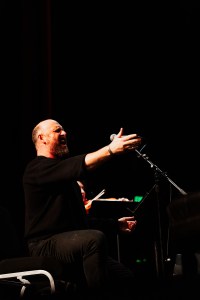
Wild Up performing Julius Eastman (photo: Ashli Linkous)
&yet&yet… By the final day, walking from the Civic Center to the Greyhound, I passed a plaque marking the childhood home of Nikki Giovanni. The poet, who died in 2024, was born in Knoxville. Her words about the city echoed in my head: “be warm / all the time / not only when you go to bed / and sleep.” For four days in March, Knoxville becomes that kind of place: warm, full of music, full of people listening with big ears and open minds.
You can’t build a festival like this in New York or London or Berlin—those cities already have too much else going on, and the rent would be prohibitive. You need a small, walkable city with two dozen venues never more than twenty minutes apart, and a local population that doesn’t mind a man and his teddy bears borrowing their church organ for an evening. That’s Knoxville.
The comparison to Unsound is instructive. Krakow’s medieval center, its synagogue and salt mine and Soviet-era Forum hotel, offer an architectural palimpsest that rewards wandering. Big Ears has something similar, if less ancient: the historic First Presbyterian church, the Bijou’s gilt proscenium, St. John’s Cathedral with its towering nave, the grandeur of the Tennessee Theatre, and the surprisingly good acoustics of a rundown bus station. The difference is that in Krakow, you can take a tram. In Knoxville, you walk—or, if you’re me, you run, scarfing down pizza slices and bean burritos between sets. The logistical friction is real. I ended up at Dirty Three instead of Wild Up’s Arthur Russell set simply because I simply couldn’t manage the walk back to the Greyhound. But this friction also produces a sense of investment, of having earned the music.
Victo‘s full name is the Festival international de musique actuelle de Victoriaville, and that concept of “musique actuelle” covers much of the same curatorial ground as Big Ears: non-commercial contemporary music for adults with deep taste. The diversity of curation also extends to venues.
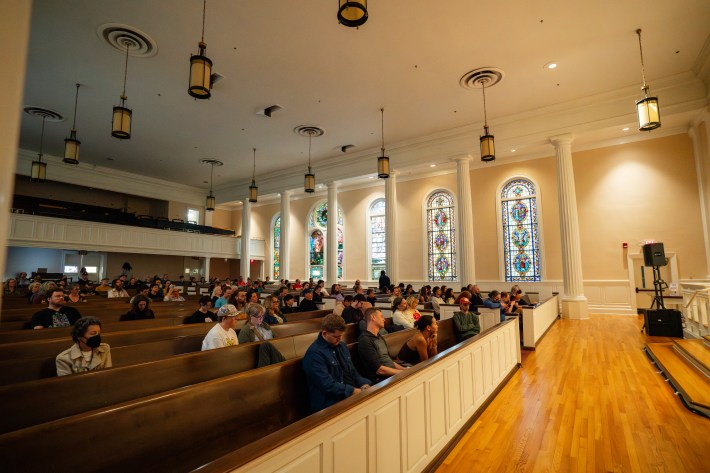
Laraaji & Arji’s Moon Piano at the First Presbyterian Church (photo: Billie Wheeler)
Sacred Spaces and Secular Drones
The churches of Knoxville turned out to be the festival’s secret weapon. There’s something about a nave, a pipe organ, and a wooden pew that concentrates the mind. Julianna Barwick and Mary Lattimore at the Presbyterian Church were predictably beautiful—ethereal voice and harp, the duo’s cover of Vangelis’ “Rachel’s Song” beginning with a field recording of the first rain after the LA fires. As Lattimore later elaborated, “I love playing all kinds of spaces… every kind of spot that allows the harp to be experienced by different kinds of people.” But the setting elevated. Listening to Barwick’s solo set at the Episcopal cathedral the next day, I was struck by the sadness that permeates much of her music, but also a sense of longing that simply resonated more powerfully in church. Reflecting on the themes of Tragic Magic, Lattimore explains “It’s hard to find magic right now. … This record is a combination of that sparkle and of processing all the sadnesses.”
Spring had hit and in the week before Easter, all these sacred spaces did feel magical. Patrick Watson, who played two very different sets at the festival, told me, “When you play music down south… it’s in the air there. It’s quite a magical experience.” Chuck Johnson’s own set at St. John’s took a different tack. Known for his pedal steel, Johnson instead presented a drone set in the vein of his Caoine series, which has documented his live performances in recent years: low-end tectonic rumbles, deep sustained tones, rich harmonics manipulated via LFOs and filters. Not a million miles from early Tim Hecker, but without the distortion and aggression. The setting mattered: the cathedral’s natural reverb gave the drones a gravitas they might have lacked in a club. Johnson later explained his shift to sample‑based performance: “I try to keep it in this same pace or spaciousness music I was doing before with pedal steel… this felt like the next place that made sense for me to go.” Later that weekend, Charlemagne Palestine blessed a full room at St. John’s with his sustained organ tones, pulling stops and slowly morphing, keys held down with wooden dowels, his trademark bears littering the stage, eventually switching to the nearby piano. These were secular prayers, offered not necessarily to any god but the act of listening itself.
The Greyhound station, of all places, turned out to be the most interesting venue. A former bus terminal, as the name suggests, it had surprisingly good acoustics and a 360-degree stage set up in the middle of the floor. Lou Reed Drones—his guitar tech Stewart Hurwood manipulating the Velvet Underground co-founder’s guitars and amplifiers in the style of Metal Machine Music—were a highlight. Running for a full six hours, people came and went, with musicians chosen by Laurie Anderson occasionally popping by to make their own interventions. I myself only stayed for about 15 minutes, squeezed in between interviews and competing performances before being drawn to the next engagement. The rundown terminal, with its scattered audience lying on the floor or walking in circles, created a kind of sonic purgatory. Bus terminals in the States often evoke this feeling, but here it was intentional, and revelatory.
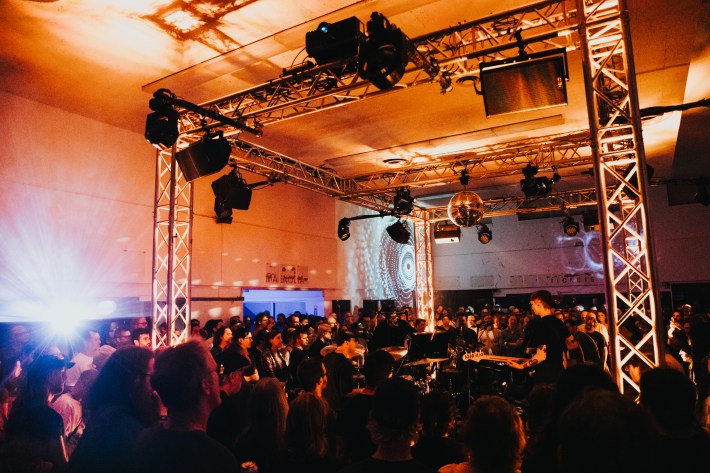
SML XL at the Greyhound (photo: Ashli Linkous)
In-Residence
If Big Ears had an MVP this year, it was the LA quintet SML—and the broader network of musicians of which they are a part, especially the International Anthem label. SML (Anna Butterss, Booker Stardrum, Jeremiah Chu, Josh Johnson, and Gregory Uhlmann) played six sets over four days: three as the core quintet, three as SML XL with special guests. I caught them four times total, including all the XL sets. The first night, they were joined by Rob Mazurek and John Dietrich, Mazurek restless on pocket trumpet and percussion, Dietrich adding a different texture of guitar than Uhlmann. The second night, Marquis Hill and Ben Lumsdaine brought additional percussion and electronics, increasing both the groove and the grit. The third night, Jeff Parker—Butterss and Johnson’s bandmates in Parker’s ETA IVtet—and Mikel Patrick Avery closed out the run on a high note.
What made SML remarkable was their refusal to dominate. Each member is a strong compositional personality—Uhlmann’s tight guitar patterns, Johnson’s saxophone figures, Chu’s remarkable synth manipulations, Butterss’ locked-in bass, Stardrum’s fluid drumming—but together, no one member overshadows the others. Live, the effect was pronounced: a groove-based improvisation ensemble that could pivot from dance party to delicate texture in the space of a fill. They’ve been called trance-jazz and that’s not wrong, but that’s also not the whole picture. During one SML XL set, Butterss’ bass, the dual percussion, the melodic and rhythmic interplay all combined for the rarest of things: an improvised music set that broke into a dance party.
The residency model allowed for opportunities to hear the same musicians in different configurations, and was the festival’s greatest gift. Gregory Uhlmann, in addition to his SML duties, appeared as a trio with Josh Johnson and Sam Wilkes at the Presbyterian Church, and later presented his own solo album Extra Stars at the Jackson Terminal, with Stardrum on drums and wind synth courtesy of Will Miller (Resavoir). Lumsdaine and Chu appeared as Parker’s Expansion Trio. Shahzad Ismaily seemed to be everywhere: backing Sam Amidon, improvising with Maria Chavez and Greg Saunier, joining the Joyful Noise showcase.
There, in the parking lot behind Pretentious Beer, I sat down with Booker Stardrum for an interview, discussing Close-up On the Outside, his deep new solo album for We Jazz in addition to the rise of SML. This is the opposite of the one-off, fly-in, fly-out festival model. It’s a gathering, a summer camp (as Mary Lattimore put it), where musicians listen to each other and adapt, where, as drummer Stardrum noted, “when we lock in, we lock in. It’s an honor to play with musicians of that talent.” Big Ears is a place where that’s not just the experience of the musicians, but where the rest of us run into friends old and new, on paths sometimes intersecting but often running completely parallel.
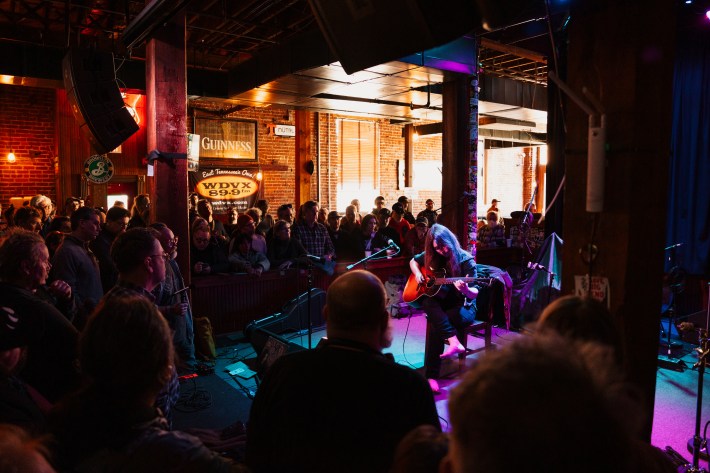
Gwenifer Raymond at Barley’s (photo: Ashli Linkous)
Generations and Geographies
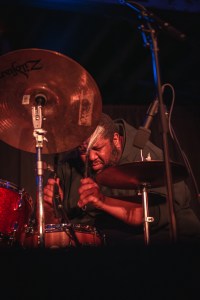
Tyshawn Sorey at the Standard (photo: Taryn Ferro)
Big Ears 2026 felt like a love letter to the rise of Los Angeles as the center of contemporary music in the States. SML, Sam Wilkes, Sam Gendel, Jeff Parker, Mary Lattimore, Julianna Barwick, Patrick Shiroishi—all LA-based. The downtown NYC scene of John Zorn and his cohort was well represented, though I missed most of his twelve performances due to conflicts. Chicago’s cross-pollination—Rob Mazurek, Roscoe Mitchell—was also present. But LA dominated. As SML drummer Booker Stardrum, who lived in LA for several years, told me, “When I lived in LA, I felt like the scenes were kind of fractured…” But in the years since he returned to New York, things seem to have changed, at least evidenced by the cross-pollination on display at Big Ears. The city that gave us the 2010s beat scene and the 2020s “spiritual jazz” boom has become a gravitational center for music that refuses easy categorization.
The intergenerational moments were the most moving. Roscoe Mitchell, 85 years old and looking dapper in a three-piece suit and hat, played very low sustained tones on a bass saxophone while circular breathing. Tyshawn Sorey supported him with attentive percussion, mostly mallets on toms and bass, before switching to sticks and then pulling back again. This wasn’t a duel or a dialogue so much as a passing of a torch that never needed to be passed because the flame was still so bright. Mitchell eventually switched to his elaborate rig of pitched percussion and chimes, then returned to his horn to close the set. The line was long to get in. It was worth the wait.
At the other end of the spectrum, Gwenifer Raymond—a Welsh guitarist now based in Brighton—presented what she calls “Welsh primitive” at a bar called Barley’s: Appalachian fingerpicking filtered through 90s punk energy, thumb and finger picks allowing her to play hard and fast. Barefoot, nursing a PBR, she was already shredding by noon. Her set was a masterclass in reinvention. Folk music, she reminded us, is not about preservation but about what you do with what you’ve got. I sat down with her afterward for an interview in the back of the bar, and as she put it, “I don’t really give a shit about anything – it’s all about creating whatever sound you want. Tradition is good licks. That’s literally how tradition works.” We at ACL were big fans of last year’s Last Night I Heard the Dog Star Bark, and if you haven’t been able to catch her on recent tours, keep an eye out for this upcoming live album recorded at the great WFMU last year. Solo fingerpicker Raymond also embraced the festival’s collaborative spirit, telling me about her duo with Hayden Pedigo: “That was quite unusual for me. It was fun because we’re very different – diametrically opposed in terms of our stuff, but that kind of works.”
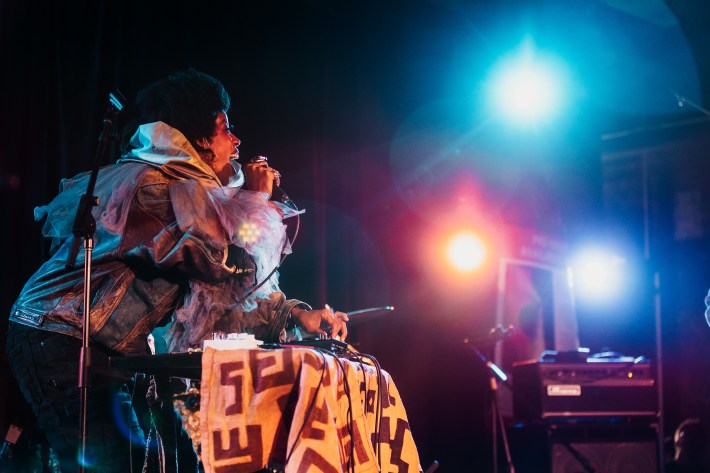
Georgia Anne Muldrow & Harriet Tubman (photo: Ashli Linkous)
Genre as Suggestion, not Convention
Our preview grouped artists by genre—jazz, ambient, modern composition, rock, folk—for practical reasons, but the reality was messier. Wild Up’s performance of Julius Eastman’s Femenine at the Bijou was a case study in what genre labels miss. Sleigh bells rang out around the perimeter, the vibraphone sounded the main motif, members of the ensemble came and went. The inclusion of electric guitar, Rhodes, organ, and drums added heft to the climactic stabs, resulting in a groove-based minimalism that is also a spiritual invocation. The piece lasted over an hour. I could have stayed longer.
Harriet Tubman—guitarist Brandon Ross, bassist Melvin Gibbs, drummer J.T. Lewis—have been a force in psychedelic jazz-rock for decades, but adding Georgia Anne Muldrow’s cosmic soul vocals turned their set into something transcendent. Billed as Electrical Field of Love, their set was call-and-response as deeply spiritual practice. Shabaka, who retired the saxophone after a Pharaoh Sanders tribute in late 2023, recently brought the horn back into rotation; at Big Ears, playing alongside flutes and self-made beats, the British jazz titan reimagined his sound as a grounded exploration of Bajan heritage. His set at the Mill & Mine, backed only by Austin Williamson on drums, shifted between calypso, Bajan folk, and hard-hitting jazz, combining all aspects of his career into something new.
The refusal of genre is not chaos, but disorientation as a a positive value. The festival’s name—Big Ears—implies a kind of listening that doesn’t reach for categories first. You hear something, you don’t know what it is, you don’t judge, but stay with it anyway. Artists, too, benefit from the chance to stretch out. Hania Rani, who performed her solo electronic project Chilling Bambino at the Greyhound station, told me why she created the alter ego: “After Hania Rani’s heavy touring – I did 100 shows a year – this was a chance to play smaller venues, very different festivals. With an alter ego, people who don’t know Hania Rani can just enter with curiosity.” Patrick Watson, whose full-band set at the Mill & Mine showcased his signature falsetto and lush arrangements, took a different kind of risk at the Greyhound with his modular‑synth driven instrumental project, Film Scores for No One. “When I’m singing, I can’t play modular to the full extent,” he told me. “This show I don’t sing, so I can actually perform the crap out of it.” Big Ears presented the band with a chance to stretch out further into unexpected territory. But there was always something unconventional to their music, which often goes unremarked upon, and seeing the two sets was a reminder that a great song can still be a playground for the unexpected.
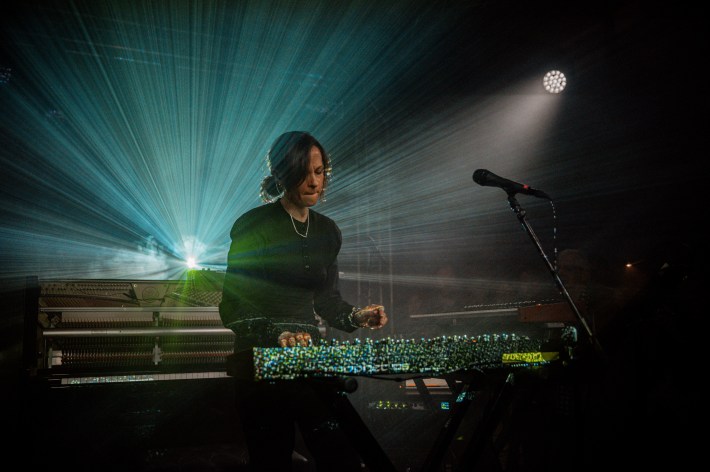
Hania Rani’s Chilling Bambino (photo: Taryn Ferro)
FOMO and Endurance
By the end of the second day—in which I attended a record 13 shows—my body was registering the toll. I had walked miles, subsisted on meals stolen between (and during) sets, and conducted interviews in bars, parking lots, and hotel lobbies. “UNSOUND is eight days!” I kept telling myself, but that was a different kind of marathon—one where I could sleep in and still catch the morning concerts. At Big Ears, the FOMO is real. With 250 events over four days, you’re always missing something.
What did I miss? On Day 1 alone, I missed Marc Ribot, Medeski Martin Metzger & Cline, David Byrne, Pat Metheny, Isaiah Collier (playing Trane), Tunde Adebimpe, William Hooker, Ches Smith, and Dither (playing Laurie Spiegel). Day 2 took away Joe Westerlund, Terry Allen, Eliana Glass, Barbara Hannigan singing Zorn, Lucretia Dalt, John Scofield Trio, and Sullivan Fortner Trio—plus secret shows by Sonic Youth’s Steve Shelley and Thurston Moore, Nils Kline, and Mary Halvorson. Day 3 was brutal: Zorn’s Cobra with a murder’s row of improvisers, Kaoru Watanabe, Chad Taylor Quintet, So Percussion, Hayden Pedigo, Fred Frith, Saul Williams meets Carlos Niño & Friends, Tim Heidecker, Perfume Genius, Mary Lattimore & Walt McClements, and Laurie Anderson & John Zorn! Day 4 took Laraaji (playing Days of Radiance!), DoYeon King, Sam Gendel, Gary Lucas, Qur’an Shaheed, The Westerlies doing Bill Frisell, and Alan Sparhawk with Trampled by Turtles.
That’s multiple festivals’ worth of music right there. But FOMO, I came to realize, is also the engine of the festival. It forces you to make choices, to commit, to be present where you are rather than where you’re not. The alternative would be a festival without stakes, one that has to play it safe, cater to more specific niches and tastes. In short, not Big Ears. The Joyful Noise showcase at Pretentious Beer Company was a two-hour improvisation featuring nine musicians: Greg Saunier, Shahzad Ismaily, Wendy Eisenberg, Patrick Shiroishi, Kishi Bashi, Tall Tall Trees, Booker Stardrum, M.A Tiesenga, and others. It was the kind of thing that could only happen at a festival where musicians are encouraged to simply hang out and make noise together.
The physicality of the festival extended to the music itself. Deantoni Parks’ Technoself was a solo exploration of percussion, electronics, and immersive multimedia—a drummer’s drummer with inhuman precision. Flying Lotus, supporting his new 13-minute EP Big Mama, delivered the most bass-heavy set of the weekend, with the most exciting visuals to boot. The crowd was packed and dancing. At the final SML XL set, with Jeff Parker and Mikel Patrick Avery, I finally saw Anna Butterss put down the bass to play the synth that had been set out in front of them like Chekov’s gun from day 1, and the whole thing wound down with a sense of closure. Six shows, six different experiences. That’s the magic of a residency—and the magic of a festival that trusts its audience to follow a single group across multiple days, in multiple configurations.
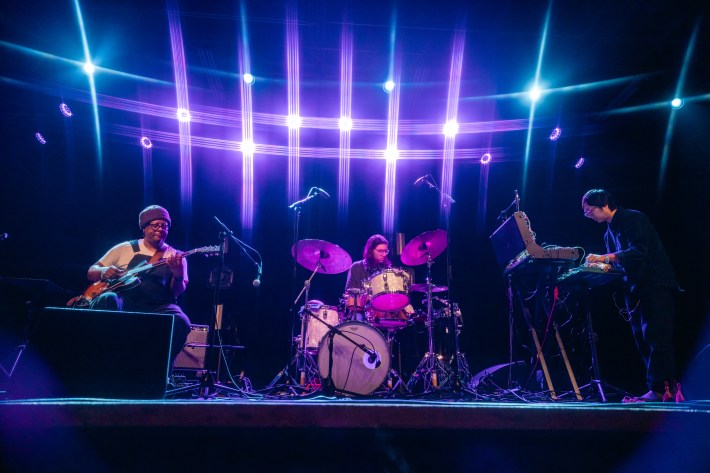
Jeff Parker Expansion Trio (photo: Taryn Ferro)
The Art of Missing Out
FOMO, as I’ve said, is the name of the game rather than something to be avoided. Somewhere around the third day I stopped treating the artists I missed as losses and started treating them as the necessary shadow of a festival worth attending. The list is staggering: Zorn’s Cobra, Mary Halvorson’s secret set, Laurie Anderson’s duo with Zorn, Bill Orcutt’s solo set, So Percussion doing Reich’s Drumming and work by Caroline Shaw, Mary Lattimore’s duo with Walt McClements, Alan Sparhawk with Trampled by Turtles, Wild Up’s Arthur Russell. I didn’t see any of them. And yet I also saw Wild Up’s Femenine, the Chicago Underground Duo, the incredible experience of Maria Chavez with Greg Saunier and the ubiquitous shape-changing Shahzad Ismaily’s masterclass in deep listening, and Laurie Anderson’s retrospective at the Civic Center on the final day.
That last one—Anderson’s set with Sexmob—was a reminder of what makes the festival essential even when you’re exhausted. She told stories about touring with William Burroughs (“he loved guns, and hated women”), about Arthur Russell (“beautiful music with big disco beats”), about performing in Hamburg in October 2001 and being moved by a firefighter’s gala raising money for their brothers in NYC. Her Burroughs-inspired piece “Language is a Virus” felt newly urgent, given the federal government’s recent crackdown on the language that can be used in official documents. Anderson has always operated at the intersection of the personal and the political, and in Knoxville, her voice felt as vital as ever.
I also caught Laurie Anderson because I had missed her duo with Zorn earlier in the festival. And to be honest, as I walked over the bridge, with the Women’s Basketball Hall of Fame visible beyond the Center, I thought it would be inexcusably sexist of me to not catch any of this legendary figure’s performance. That’s the thing about FOMO: it’s not a failure of planning. It’s a structural feature. With 24 venues and 250 concerts, you cannot see everything. Try as I might, I didn’t even catch a fifth of it! (I better bring at least one of my ACL colleagues next time.) The festival’s name is aspirational, an invitation to listen widely, but also a recognition that you will always be missing something. The question is whether you can be present for what you did choose.
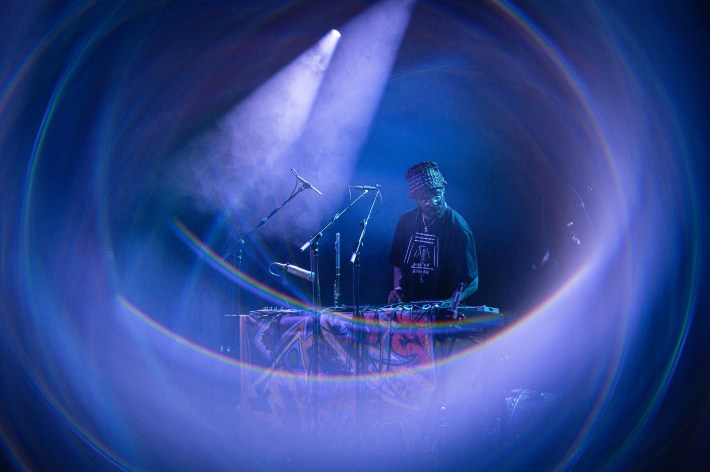
Shabaka (photo: Taryn Ferro)
The Body Remembers
By the final day, I was running on fumes. I had started the festival with Femenine at the Bijou and ended it with Bill Orcutt, Steve Shelley, and Ethan Miller at the Standard. In between, my body had absorbed the low-end tectonic rumble of Chuck Johnson’s drone set, the frenetic harp and percussion of Zeena Parkins and William Winant, the telepathic interplay of Rob Mazurek and Chad Taylor’s Chicago Underground Duo, the surprising groove of Hania Rani’s solo electronic project Chilling Bambino, the joyful noise of the Joyful Noise showcase, the meditative calm of Laraaji & Arji’s Moon Piano at the Presbyterian Church, and so much more.
Not every set can be a revelation. That’s also part of the festival: the permission to be underwhelmed, to leave early, to chase something else. For instance: I left the Jeff Parker Expansion Trio to catch Laraaji; I skipped Zorn playing Harry Smith to see Roscoe Mitchell and Tyshawn Sorey; I passed on Fred Frith’s Fremakajo to see Julianna Barwick; and on and on. And I regret nothing.
The body remembers the fatigue, but it also remembers the moments of transcendence. The Maria Chavez/Greg Saunier/Shahzad Ismaily trio at the end of Day 1 was a masterclass in subtlety and dynamism, Chavez’s increasingly physical turntable playing, Saunier playing with hand and stick, Ismaily cycling through bass, wood flute, Moog synth, and banjo. The Charlemagne Palestine organ set at St. John’s. Hania Rani, after the American premier of her piano concerto Non Fiction, told me that for her, music’s power lies in creating space to think: “Just having a space and time to think feels very precious at the moment. This is the moment when thoughts are flowing through your mind.” The final SML XL set, with Jeff Parker’s ambient guitar slowly building into something fairly straight-ahead, a nice contrast to Uhlmann’s more unconventional patterns.
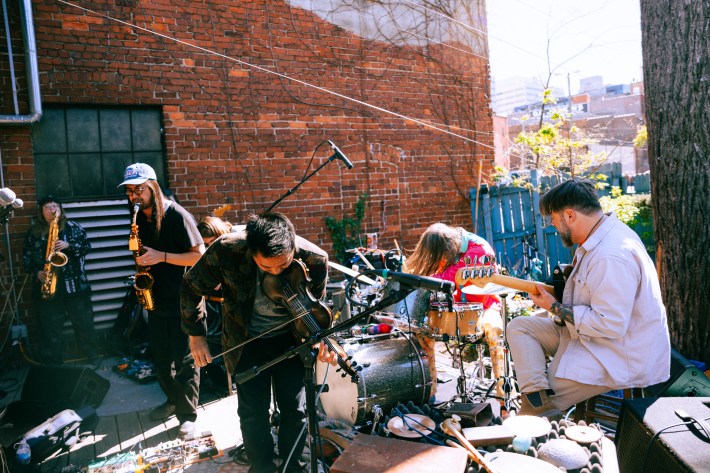
Joyful Noise Players at Pretentious Beer (photo: Ashli Linkous)
Listening as Utopia
On the final night, after ten shows and two interviews, I stumbled out into the Knoxville night, barely coherent, my notes app filled with scrawled impressions. I missed so much I’d told myself I absolutely had to see. And yet, what I did see was extraordinary. And even after 42 concerts, it wasn’t just about the music, but the people. As unpleasant as I may find so much of American infrastructure, as frustrating as it was to drive to the motel late each night, the people are so nice!
I keep returning to Nikki Giovanni’s poem. She wrote about being warm all the time, not only when you go to bed. Big Ears, for four days, makes Knoxville that kind of warm. Not physically—March in Tennessee is certainly warmer than Montreal, though still unpredictable—but socially, sonically. It transforms a tertiary city into a gathering place for music that rarely finds a home anywhere else. The downtown core, with its walkable grid and its surprising pockets of public art, becomes a temporary utopia: a place where genre distinctions dissolve, where musicians who might never share a bill elsewhere find themselves improvising together, where audiences come ready to listen.
This edition featured not nearly enough hip hop for my tastes—a major omission, it seems to me, though, as one commenter confirms, not an aversion, as previous years have included billy woods, ELUCID, Moor Mother, and others—I was pleased to find Black music and poetry so well represented at Big Ears. And hip hop’s spirit of reinvention, recombination, and recontextualization found resonance in many other traditions.
As I drove to my motel outside of town for the final time, lost in thought in the Tennessee night (listening to the new Teller Bank$), I was both exhausted and exhilarated, already thinking about next year. The festival may not book enough rappers, but the spirit of sampling, of recontextualization, of taking old sounds and making them new—that was everywhere, from Chuck Johnson’s sample‑based drones to the joyful noise of the Greyhound station.
The festival’s name is not a boast but a practice. To have big ears is to listen with openness, to tolerate uncertainty, to stay with a drone or a free improv set even when it isn’t giving you easy rewards. It’s also to accept that you will miss things, that the act of choosing is also an act of loss. But that loss is what makes the listening matter.
I’ll be back next year. I’ll bring better shoes. And I’ll try to remember, even while running from the Greyhound to St. John’s, that the point is not to see everything but to hear what’s in front of you. That’s what big ears are for. (Joseph Sannicandro)
Find more media at our Instagram.
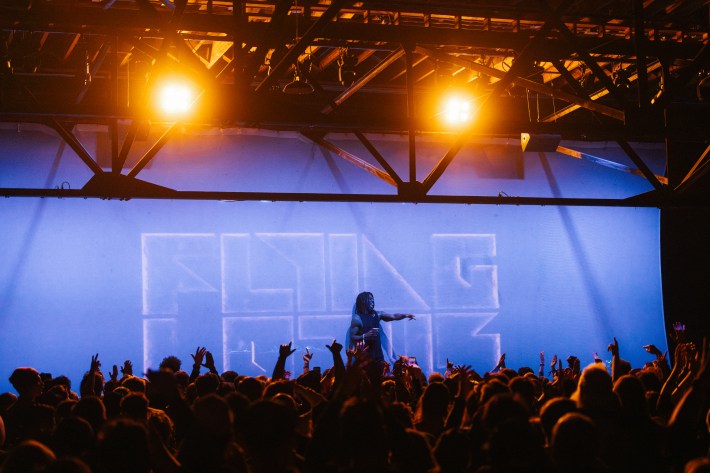
Flying Lotus (photo: Andy Feliu)
Thanks to Big Ears and all the musicians, artists, labels, crew, and volunteers who make it happen. A full podcast episode featuring interviews with Chuck Johnson, Gwenifer Raymond, Booker Stardrum, Mary Lattimore, and Hania Rani will be available in late May.

 a closer listen