
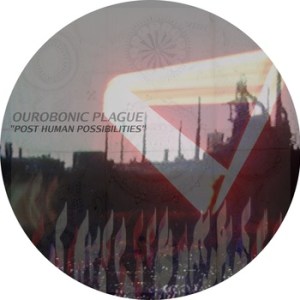
 As short-lived genres go, Witch House is certainly a contender for one that flickered brightest and most briefly, so it is something of a surprise to find Ourobonic Plague still employing it as a genre tag. It was even more surprising because, to these ears at least, OP sounds a lot more witchy (in the occult, spooky sense) than housey. True, he’s contributed to a witch-house.com compilation recently but Post Human Possibilities has more in common with early Cabaret Voltaire than with Salem, as evidenced by a relentless industrial pounding on most of the tracks here.
It’s certainly images of factories and production lines that spring to mind when playing the record (it’s been referred to as an EP but that seems to undersell it). It’s less the clanging of metal on metal that one hears, rather it is the constant, grinding, inhuman rhythm that drives all before it with unceasing power. The humanity seems to be driven out in the opening track “Her Reptile Dysfunction”, with a busy rhythm pattern playing off against what sounds like the screams of the damned. Admittedly this interpretation makes Post Human Possibilities appear an unremittingly bleak work; the title is a bit of a give-away here. Whilst it’s true that there is little let up – even on the beatless “Return to the Lake”, the mood is retained with steely ambience ever present in the background – it isn’t an entirely unpleasant listening experience. The enigmatic Australian throws some fairly ugly noises into the mix but after one has tuned in to the sound of machines dominating the landscape, it all falls into place.
After the heavy first half, the rhythm takes a back seat to atmosphere on the lengthy closing track which neatly caps the whole experience; the drone blasts out like a foghorn, and various noises accumulate, gradually gathering themselves into some kind of recognisable shape. This isn’t a record that one might return to for a casual listen but it does reward being experienced properly with one’s full attention. Ourobonic Plague might be advised to let the witch house go and fully explore his industrial side – this is brutal, bleak and strangely beautiful. (Jeremy Bye)
 a closer listen