
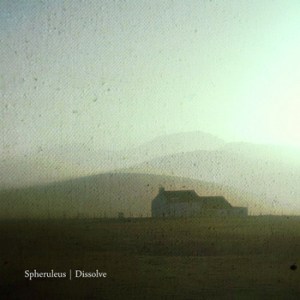
 Many recordings are born of inspiration, but Dissolve was born of a lack of inspiration, which is not to say that it isn’t inspired. This two-track outing from Harry Towell (Spheruleus) was birthed as severe writer’s block led him to imagine a richer physical environment than the one in which he lived. He thought of a favorite photo taken by Richard Outram in Wales: an “ideal home” of which he could only dream. This misted house then became his muse.
In an odd way, Dissolve serves as a companion both to Spheruleus’ last album, Voyage, and to Paper Relics’ Over Exposure, which Towell recorded with his brother Stuart. It’s a sonic sibling of the first and a polar opposite of the second. Over Exposure was an album of memory and warmth, a tribute to a former family home. Sounds from the house permeated the recording; love and nostalgia were obvious threads. Dissolve operates from a reverse frequency: the artificial environment to which one is not connected by any tissue. As such, Dissolve replaces the warmth of Over Exposure with loneliness.
Voyage was a soundtrack to doomed expeditions, and the sound of Dissolve is that of a buckled boat, barely holding on. “Retreat” contains what could be the creaks of a rocking hull, accompanied by a rising drone. It begins with repetition – a vocal loop imitating a stuck mind – then introduces the instruments scratch by scratch, piece by piece, before losing them in the murk. When an acoustic guitar emerges two-thirds in, one thinks of salvation, but then the voice returns as well, still stuck in the Antarctic ice, with no messages on the radio, only static.
This static – which occupies both tracks – is one of the album’s most endearing features. It’s odd to listen to this recording in the digital medium, as it was intended for tape or vinyl; but the crackle is pre-embedded. To listen on an old, sputtering laptop – the modern equivalent of a radio transmitter – might lend the album that air of physical authenticity. As Dissolve progresses, one thinks again of that photo on the cover – the idealized, yearned for destination – and wonders, what is it like to yearn for isolation? Those who have ever felt too crowded, too stressed, or alone in a crowd are likely to understand. As “Retreat” comes before “Dissolve”, it’s easy to think of Towell wishing to retreat from his current situation before dissolving in spirit. Thankfully, a new home and more inspiring environs are on their way. (Richard Allen)

