

artwork by Mariya Primachenko
Ukrainian Field Notes is back after a summer break. This month we discuss toxic behaviour and Ukrainian identity in our Resonance FM podcast with Nastia and Vlad Fisun.
Meanwhile, Divuar, aka Salmiac, decries stolen time, Marina, introduces Vertuha for us, Lectromagnetique gets married in times of war, Olha Balandiukh recounts her TV experience and L’art Noir stop playing the game of life and start really living it.
At the same time, Zolaa. volunteers in the Chernihiv region, bijū sends us a postcard from Warsaw, Lenocza returns to Kryvyi Rih, KiRiK flees Kherson, SAWRAS moves to Canada, and NRTN to Berlin, whereas Flashe stays put in Khmelnytskyi, and Max Andruh remains happily in Dnipro.
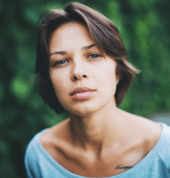
Nastia
New releases include albums by Poly Chain, 58918012, Kadaitcha, Igor Yalivec, Louwave & Splinter (UA), Tetyana Haraschuk, Svitovamora and Svitlana Nianio.
In our viewing room, we watch the latest war crime documentary with a score by Alexander Stratonov, before following Anton Slepakov to Irpin and Vlad and Pavlo to the front.
But without further ado, here’s the UFN podcast followed by our costumory playlist on spotify.
Tracklist:
DZ’OB – “Sometimes Everything Is Wrong (S.Tolkachev re-imagining)”
Louwave and Splinter (UA) – “Baby Let’s Vibe”
Polygrim – “Klang”
Koloah – “Away”
AUGUST 4, 2023 – KYIV
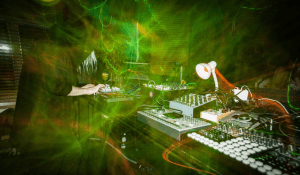 Divuar – Salmiac
My name is Yehor, also known as Divuar in the local music scene. I am a music producer and a songwriter. I participate in few music acts, but also am a solo electronic artist with the monicker Salmiac. In this project I usually make various electronic music, mostly techno, post-industrial and ambient. I also play various instruments and am a vocalist and guitarist in a locally well-known band called Zwyntar (we play a blend of gothic Americana, southern rock and Ukrainian folk ). I also write songs and play guitar for a goth rock/post-punk band Old Cat’s Drama. Despite my participation in live instrumented bands, I see myself primarily as a music producer. I’ve been making music since I was a teenager. I remember my first music production software was a tracker of some kind. I did not know anything about music theory, so I made music intuitively, mostly experimenting with samples. Currently my setup is mostly Ableton Live with Push 2, a now vintage Korg Electric EMX-1 and a Novation Bass Station. I love groove box approach to making electronic music, so earning a Push 2 six years ago was a revelation!
Has the full-scale invasion changed your approach and the way you think about music and sound and has it had an impact on your setup and your playlist?
It absolutely has! I think, as most Ukrainians, I feel like death is much closer than before and it is important to create as much music as possible. I guess I became less of a perfectionist and allowed myself more mistakes and uncertainties. I’d say I value the moment more now, so sometimes these tiny inconsistencies are a sign of liveliness for me. Of course, the music has also become a bit darker, but as a person who works with industrial music I can’t say it was completely “happy” before.

Zwyntar
You took part in the compilation Спадок by Gasoline Radio, what can you tell us about your track “There Is A River No One Can See” and has the full-scale invasion made you rediscover the musical legacy of Ukraine?
Well, yes. I mean, I haven’t been a stranger to Ukrainian cultural legacy before. Ukraine has been going through a process of separation from russian/soviet imperialist legacy since 2014, but of course, the russian full-scale invasion has sped the process up a hundredfold. We rediscover our culture and it turns out there is so much material to work with! Gasoline Radio has made an amazing job by collecting all those sounds, I’m very grateful they did it. I once planned a trip all over Ukraine to collect impulse responses for reverbs in different regions of the country, abandoned churches, castles, caves etc. Unfortunately, it was planned for the summer of 2022, and russia’s invasion cancelled that. Hopefully, I’ll make that IR pack one day and share it with the world.
How would you describe the electronic music scene in Kyiv and how do you see it developing under present circumstances?
It’s a miracle how active it is! I guess most artists felt that we have to fight for our culture, to separate it and so to have our own voice, which will not be considered in the world as a part of the russian one. I’m also pretty happy that not only does the darker music blooms now, it feels like Ukrainian producers of all kinds feel free like never before. For me, these tragic circumstances brought a new breath to the art community in Ukraine.
 How do you feel about the inclusion of “war sounds” in recent releases by Ukrainian artists?
For me personally, the sounds of the air raid sirens are triggering. I mean, I got totally used to them in their real context, but I cringe when they are used in music nowadays. But I’d say not many Ukrainian producers do this, they used to in the first months maybe, but it’s a rare thing now. Other sounds are maybe less triggering because they are less recognisable, but I still think it’s not very good to use the sounds if they are connected to some tragic events. On the other hand, it is a good thing to remind the listeners that the war is not over, especially to those who are not in Ukraine.
Are there any Ukrainian releases from the past year that you feel have helped you to make sense of current events and, conversely, are there any specific tracks or albums that you now find triggering because they might be associated with specific difficult times or events?
I don’t really listen to music which is problematic to me, so I don’t think I can certainly name anything triggering. But I can name some releases which helped me in tough times. “Pulsations of Hope” by Vlad Suppish is an amazing hypnotic work, I remember my first walks in wartime Kyiv listening to it. Heinali’s Kyiv Eternal made me cry at some point, but not in a bad way, it’s a beautiful ode to my home city. Alles Wird Gut by Ship Her Son is a totally different release, a heavy post-industrial anthems collection which helped to seize my aggression towards the aggressor.
Where are you now and have you been displaced by the full-scale invasion at any point?
Currently I’m in Kyiv, which is my home city (well, not really, I come from Brovary, which is a satellite town to Kyiv, but it’s like an hour to Kyiv’s centre). I was in Lviv at the very beginning of the war, because I drove to transport my partner from Kyiv to the western border and Lviv is close to it. I had the luxury to grab my laptop and Push with me so I could make some sketches while I was on the go.
Has the sonic environment in Kyiv changed since the full-scale invasion?
I think so. I’d say music in Kyiv became more mature at once. It became more complicated but more sincere at the same time. Talking about the city’s soundscape, well it was quieter than ever in the first months of the war. The city was deserted and so the soundscape changed too! Now it’s much closer to its original state, but I personally think there is a shadow of uncertainty and dark humour in Ukrainian minds now, of course.
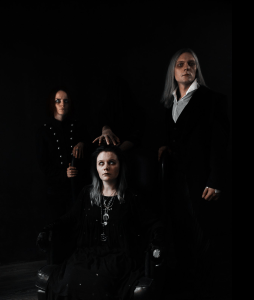 In the introduction to Sky Above Kharkiv, Serhii Zhadan writes, “War sharply changes ways of seeing, changes feelings. Above all it immediately changes the weight of a great many things, things that seemed necessary and obvious just a day ago.” Has the full-scale invasion made you reassess your priorities and are you able to think of the future?
To be honest, it’s hard for me to think about the distant future, but I am doing my best. We have to move forward somehow, as much as we can. But I agree that many things have become unimportant. At some point I also found out that I became a much more sincere person, I tend to speak out what I think much more often. If I like something, I express it and if I hate, I think it’s ok to express hate. Since now we have a serious rival, it’s easier to pick the right side.
How does one get used to the constant separation from close people?
Thanks to the Internet, it is much easier than it was 50 years ago, I guess. Fortunately one can communicate with their relatives and friends, and this is a thing which helps to carry on. Of course, it’s hard, but it is manageable; we have no other choice.
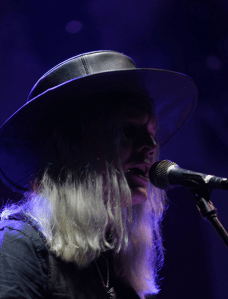 How does one get used to the curfew and other restrictions of military time and how does one save strength for resistance?
I personally hate russians for many things, and one of them is the time they have stolen from us. Instead of enjoying the night summer breeze with friends, people have to stay at home. Not to mention it will take decades to remove the mines from everywhere after the victory.
I guess I just have rescheduled my routine so it became manageable and the most effective as possible. I started to read more, make music more or play instruments as well. I can’t say I’m as effective as I used to be before the full-scale invasion, but I guess I try to fit the restrictions as much as possible. But to be honest, although we got used to the current order of things, we all are deeply traumatised and I’m not sure it will be easier to communicate to people outside of Ukraine in the same manner as we did before. I’m pretty pessimistic about it but many people think otherwise, so let’s hope for the better.
Which book / film / album / song / traditional dish / podcast / blog / artwork / building / meme best captures Ukraine for you?
My favourite Ukrainian book is Shadows of Forgotten Ancestors by Mykhailo Kotsiubynsky, which is a magic voyage to the 19th-century Carpathians, full of mythology, tragedy and a million of amazing little details. It is considered one of the Ukrainian literature masterpieces.
In contrast, I’d like to recommend a modern comedy film called My Thoughts Are Silent which follows a sound engineer guy who has to record rare animal sounds. It’s kinda a road trip movie, with experimental humour, but it shows modern Ukraine in a beautifully accurate way.

Reply of the Zaporozhian Cossacks by Ilya Repin
I’ll describe the others in a listed way:
- Album – ONUKA – KOLIR. The band is one of the most popular acts in Ukraine. They make folktronic music on a stellar level.
- Song – “Очі Відьми” (Ochi Vid’my) by Вій (Viy) – it’s a beautiful sad dark folk song, I think it captures the Ukrainian concept of zhurba in the best way possible. Zhurba is an existential state of a person, something between sadness, melancholy and gloom.
- Traditional Dish – Deruny!! It’s my favourite Ukrainian dish. Reminds me of a hash brown, but is cooked in a slightly different way.
- Podcast – We lack Ukrainian podcasts in English, unfortunately. My favourite Ukrainian one is Minkultpryvit, where the host interviews mid-popular people from the art community.
- Blog – it’s difficult, I almost don’t follow those 😦
- Artwork – “Reply of the Zaporozhian Cossacks” by Ilya Repin (who was a Ukrainian by the way. The russian imperial machine has stolen him from us)
- Building – St. Michael’s Golden-Domed Monastery. It has been reconstructed, but for some reason, I feel like it’s an illustration of Ukraine in the form of a building.
- Meme – This Is Fine doggy.
AUGUST 15, 2023 – KYIV
 Marina – Vertuha
My name is Marina, and I’m 25 years old. I’m the culture and booking manager. I’ve been in the music industry for 3 years now. Before that, I worked for an IT company, and now I have completely moved to the music and cultural spheres. I am engaged in such projects as VERTUHA, BraveFactory Artists, and bookings for Seba Korecky, Alinikuss, Kostya Denys.
Has the full-scale invasion changed your playlist and the way you think about music and sound in general?
There is definitely more Ukrainian music in my playlist, no Russian music at all, and no foreign artists who interact with Russians or support Putin’s policies.
 Could you introduce Vertuha and talk about its mission to revive the Ukrainian cultural heritage?
Who are we and what do we do?
VERTUHA is a musician’s, DJs, and music lovers home.
Our mission is to unite people, build a bright future together, spread love, discover Ukrainian cultural heritage, and contribute to the contemporary music scene. Residents of CLOSER.
There are 8 people in the team: Seba Korecky, HeyKsenia, Maryna, Alinikus, Roma Shum, Nazarii Lisnyi, Kosty Markov, Dima Vilda.
Activities:
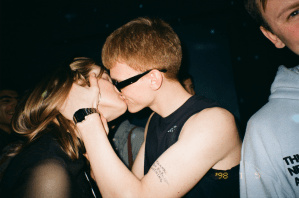 Parties
Since 2019, VERTUHA parties have been held in various popular Kyiv locations, and since 2022, we have been residents of the Closer club. This series of parties embodies a bright dress code, freedom of expression on the dance floor, and a magical combination of musical styles and people.
Since Closer became VERTUHA’s permanent residence in Kyiv, we have held a series of parties in the club, experimenting and playing with formats every time. Dance vogue battles to resident sets, art exhibitions by Ukrainian artists, a sweet pop-up story, and a joint donut from Ponchyk Boy. And all of this in brilliant scenery and under the flashes of a disco ball.
The festival
VERTUHA is expanding, and we have launched a festival format that goes beyond disco and funk parties. This format is planned to be held several times a year. It’s an event with several stages, more guests, we invite Ukrainian bands, artists, and DJs to promote the Ukrainian underground scene. We had Our Atlantic, Lucas Bird, Daniel Okaro, Shanivne CUMSTvo, XXV Kadr, The Curly, Soulike, Figurat, sucilna_nevdacha.exe, Bogdan Cooper, August J, SEMMAR, and others.
 Mission to discover Ukrainian cultural heritage
We are actively working to revive our cultural heritage, which includes researching online archives, providing our own digitized works, and creating music compilations that we share with the widest audience we can reach.
Example: UKRAINIAN Disco & Funk Classics
Since the start of the full-scale invasion, the VERTUHA team has been actively engaged in cultural activities in Ukraine and abroad, enriching the spaces of foreign venues with Ukrainian music. Over the past year of its activity, VERTUHA DJs have visited the European mini-tour, playing the music of contemporary Ukrainian artists whom we invite to perform at our venues.
Example: Contemporary Ukrainian Music @ Rinse FM
Patreon (patreon.com/Vertuha)
In March, we discovered a new way of interacting with our audience: we launched Patreon. This is an important stage for the development of VERTUHA, where true supporters who believe in us, support our activities and development, and together we contribute to the musical development of the Ukrainian scene.
 How would you say the club scene in Kyiv has changed since the full-scale invasion with the introduction of the curfew and the displacement of many?
It has definitely changed. Some of the artists and promotional groups that had firmly established themselves on the local scene have gone abroad, freeing up space for other artists. Most foreign artists are afraid to come to Ukraine. Those who are left have no choice but to start creating and developing the Ukrainian music scene. And it’s great, it’s very noticeable how our scene has grown over the past almost two years. In addition, creativity has been and is an emotional savior for many.
Where are you now and have you been displaced by the war at any point?
On February 25, 2022, I left for Germany, where I lived for 4 months. Then I returned to Kyiv and have no plans to leave. Kyiv is the best place, and I’m weaning myself off the idea that this is where I belong.
 Are there any Ukrainian releases from the past year that you feel have helped you to make sense of current events and are there any tracks that you think should be global hits?
There are many talented musicians and singers among my friends, and I would really like the world to hear their work. We are planning to open our own label, VERTUHA, so I dream that all the performers who will be there will become world stars 🙂
How do you feel about the inclusion of “war sounds”, like air raid sirens, in recent releases by Ukrainian artists and do you find them triggering?
Personally, I don’t like it because it gives me unpleasant feelings. I hear these sounds at night and during the day anyway. I look for peace and security in music, but I don’t find it, because these sounds are there too.
Who should I interview next and what should I ask them?
Seba Korecky, about his work as a music producer (project Lucas Bird, Electromad, Komissia band) and also about his own music, reworks and mission to distribute authentic mixes of tracks by Ukrainian artists, discovers and support new names.
SEPTEMBER 1, 2023 – KHMELNYTSKYI
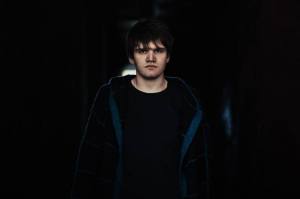
Hello! My name is Eugene Vozbraniuk alias Flashe. I am DJ & producer from Khmelnytskyi. I was interested in music from a very early age, studied drums for few years. In 2012, I started as a DJ in the genre of techno, minimal techno. I played on the same stage with such artists as Ruslan Mays, Enformig, Daria Kolosova, James Bong, Ixi Elo, Komitet, DJ Maxfree & Shimanskyi (ТНМК), Karina Saakayan, Tucha, Vani Vachi, Yana Woodstock.
My music is supported by such artists as: Richie Hawtin, David Reina, Mal Hombre, Justine Perry, Hugo Rolan, HD Substance, Elias Garcia, Translate, Pulso, Ocktawian, Pirick Aydon, Nitromi Galien, Fleep, FGarciolo, Hanton, Be_ca_di, Allpa Puruma, Destination Unknøwn, Humanoizer, M.Philips, Kid Riot and others.
 Has the full-scale invasion changed your setup and the way you think about music and sound in general and has it had an impact on your playlist?
Surprisingly, with the beginning of a full-scale invasion, I immersed myself even more in creativity, so to speak, to move away from reality.
As for the sound. There is one interesting moment when missiles of the russian federation flew over my city, they hit a military facility, and all night and day there was a detonation of ammunition. This influenced the fact that on the same day, my friend CrystaLucifer and I made a track called “Detonation”. Which was released on the Ukrainian label “ОЧІ (OCHI.music.ua)”.
You have a new album coming out in September, what can you tell us about it?
I am so glad! This album, which is called Arrival, is inspired by old science fiction and performed in the style of techno and ambient. It will be released on the Spanish label Legend 1997 Records, run by David Reina. For me this is a new step in development. David Reina has a great release on Jeff Mills’ legendary label Axis Records. And this is feedback for me that I am moving in the right direction.
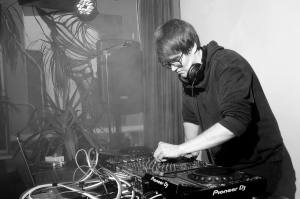 Where are you now and have you been displaced by the war at any point?
I stayed at home in my city. At the beginning of the war, I helped in cyberspace. Also, my music was played in the podcast “UKRAINE LOCALS #11 – BE_CA_DI (KHARKIV / BERLIN)”, with proceeds going to help our army.
What impact has the full-scale invasion had both on your personal and professional life?
It has a big impact, but we all stick together, help each other! As for my work, everything remains as it is.
Are there any Ukrainian releases from the past year that you feel have helped you to make sense of current events?
Of course, I really liked the work by Ryuichi Sakamoto and Illia Bondarenko – Piece for Illia.
 How do you feel about the inclusion of “war sounds” in recent releases by Ukrainian artists and are there any specific sounds you find triggering?
I treat it quite normally, because now it is a reality. But I don’t want to impose or incorporate the sounds of war into my music.
Which book / film / album / song / traditional dish / podcast / blog / artwork / building / meme best captures Ukraine for you?
Traditional dish: Of course, it’s red borscht and varenyky (Ukrainian dumplings).
SEPTEMBER 4, 2023 – KYIV

Greetings to all. My name is Ivan and I’m 36 y.o. My main music project [Lectromagnetique] has existed since 2014. It was winter, the fire of the Revolution of Dignity was burning on the streets of my city, because people were tired of enduring the abuse of the pro-russian authorities who ruled our country at that time. Against the background of these events this project was born, which was originally created purely for electro, but now it covers also ambient and trance, and even sometimes techno (for example Euphoria EP LCTR007 on my bandcamp).
 Has the full-scale invasion changed your setup and the way you think about music and sound in general and has it had an impact on your playlist?
I was born and live in Kyiv. Fortunately, the full-scale invasion of russia did not affect my home and my studio – we have not been physically harmed yet, although over the summer a russian rocket fell 500 mt from my house near a kindergarten and a clinic. The impact was quite loud, and my wife and I woke up a bit scared, but these are small things, compared to the fact that people, including children, died in the epicenter of the explosion. They ran for cover, but this was a ballistic missile, so it took 5-7 minutes from launch to arrival…
My setup has changed a bit, but this is not connected with the war, I just bought a few new devices and did total repairs in my home/studio all by myself.
 You have been quite prolific since the full-scale invasion, has this given you an added push to be more productive and to re-release digitally your vinyl work?
I started writing and releasing more music, because with the onset of the war there was a heightened feeling of the value of every minute of life, which I no longer have the right to live as I want. I now need to work to keep the economy running, to help relatives and the needy, to contribute to the culture of the Ukrainian Underground Resistance and to spread my music vision around the world…
Also, the impetus to increase my productivity was triggered last winter, when russia attacked our power system and the electricity supply in the houses was quite erratic. I once had no electricity in the studio for 3 days, so once we were given more air defense and we fixed the problems with the power supply, I started producing even more music.
I was helped to launch my own label by my friend from Latvia – Igors Vorobjovs, the owner of the BlindAllies label, on which I appeared on 4 vinyl compilations. I am very grateful to him, not only for this, he’s been helping me personally since the beginning of the war (Igors – hey bro!).
 What impact has the full-scale invasion had both on your personal and professional life?
I got married on August 31, 2022, so my personal life changed for the better with the advent of the war. My wife comes from Donetsk, which was occupied by russia back in 2014. She was forced to flee from there without belongings and money, leaving her 3 apartments and grandparents there… Therefore, this war is especially painful for our family.
The impact on my professional life was probably positive, as I feel the energy of the opposition of the whole country, it gives me the strength to create more, and to do it better.
 Where are you now and have you been displaced by the war at any point?
On the morning of February 24, 2022, we decided not to leave our home, because it’s our land, why should we have fled? My wife’s parents said that after being forcibly relocated from Donetsk, they were tired of fleeing and decided to stay in Kyiv, and we fully supported them. There was a feeling that they would not capture the capital. Our gratitude goes to our armed forces, many Ukrainians died, eternal honor to them, but Kyiv remained a fortress that no one will ever capture.
Have you noticed any changes in your acoustic environment since the full-scale invasion?
If you are asking if we are now used to the sounds of explosions, then I am, but my wife is not.
Are there any Ukrainian releases from the past year that you feel have helped you to make sense of current events?
Please check out the label of my local mate Vova – Mystictrax, who releases a lot of Ukrainian electronic music.
 How do you feel about the inclusion of “war sounds” in recent releases by Ukrainian artists and are there any specific sounds you find triggering?
Nothing special, I got used to the sounds of war after the month-long defense of Kyiv, the whole house shook from explosions at the beginning of the war 24/7.
After a year and half since the full-scale invasion, what would you say the West still gets wrong about Ukraine?
I am grateful to all countries and people for their help, I am not a political expert, but perhaps they could help a little more in terms of military supplies for example…
 Which book / film / album / song / traditional dish / podcast / blog / artwork / building / meme best captures Ukraine for you?
My favorite Ukrainian musician is Andriy Kuzmenko. I have been listening to a lot of his old music. Rest in peace Kuzma…
Who should I interview next and what should I ask them?
Volodymyr Baranovsky aka lostlojic [UFN IV]. For me he is a driving force of the Ukrainian electronic music scene, I have made the mastering for some of his releases. I am also looking forward to a future VA release with a track of mine on his Mystictrax label soon… (cheers Vova!).
SEPTEMBER 6, 2023 – UKRAINE

photo by Olesia Dubyk
Hi everyone! My name’s Olha Balandiukh. I’m a Ukrainian singer, violinist, model, and artist. I studied at a music school as a violinist for 7 years. Then I graduated from a professional music college, two faculties: violin and singing. I also studied at the Lviv National Academy of Arts.
You have been on Голос країни (Voice of the Country), what can you tell us about that experience?
It was a great experience! But it was tough: on my performance day, I had to wake up at 5 am. At 7 am, I was on location, spent the entire day shooting some commercials, doing warm-ups, and preparing for my entry. But at around 10 pm, I was told my performance had been rescheduled for the next day. It was quite devastating; I was angry and tired. But finally, my performance took place the next day. It was extremely thrilling because I had taken part in The Voice a year before, and I didn’t make it because I was performing on the last shooting day. So I really wanted to pass this stage. But, yeah, I have such great memories.
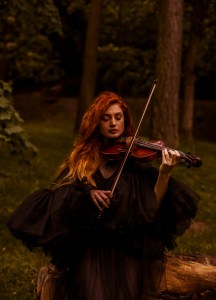
photo by Yana Sverdun
You are a multi-instrumentalist and you write your own lyrics. Which comes first, the music or the words?
Well, it depends. Sometimes the music comes first, sometimes the lyrics. But quite often I write lyrics in English and then translate them into Ukrainian. For example, my mini-album ”The Garden of Cosmic Songs” consists of 4 songs. Lyrics for ”Rainy” and ”Not my home” had been composed before creating the music.
Where are you now and have you been displaced by the war at any point?
I am in Ukraine. And I’ve been in Ukraine since the full-scale invasion.
What impact has the full-scale invasion had both on your personal and professional life?
The war has affected my mental health. I’ve never been a cold-minded person, but now I’m like a dry tree in the heat. Daily news, ongoing war, deaths, casualties, destruction, air-raid alerts, explosions, it seems like there is no end. I just can’t stand this thought. I can’t stand this injustice. I can’t stand that our Ukrainian people are being murdered. It’s hard to cope. To comprehend.
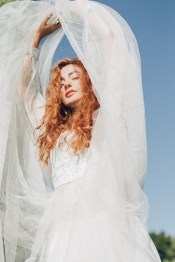
photo by Olesia Dubyk
How do you feel about the inclusion of “war sounds” in recent releases by Ukrainian artists and are there any specific sounds you find triggering?
When I hear some kind of siren sounds, it triggers me so much because I think it’s an air raid alert. When I hear such sounds in songs, I’m like ”Is it an air-raid alert?”. So I can’t listen to songs with these sounds. And I don’t use them for my tracks. Also, when I hear thunder and I know it’s not raining, my first association is ”Oh no, explosions”. Or similar pounding sounds just make me feel nauseous and they scare me for a moment.
After a year and half since the full-scale invasion, what would you say the West still gets wrong about Ukraine?
Numerous people think that citizens of russia are against the war, they don’t support it. But it’s not true. They are cheering for our misfortune, especially when russia shells Ukrainian settlements, kills Ukrainian POWs and civilians, they are happy when there are casualties. They want us dead. russians want to exterminate Ukrainian culture, people, and everything Ukrainian. You need to read the comments russians drop on social media. It’s an atrocity.
Secondly, many people still consider us (Ukraine and russia) related countries, with mutual culture, mentality. But this is wrong. The Soviet Union imposed this deception through years to conquer Ukrainian territory, to destroy Ukraine.

photo by Olesia Dubyk
Which book / film / album / song / traditional dish / podcast / blog / artwork / building / meme best captures Ukraine for you?
- Elderly who harvest crops.
- Grannies wearing head kerchiefs.
- Fields with sunflowers, poppies and wheat.
- Ukrainian Carpathians.
- Prominent poets and writers. Artists and singers. Scientists. Politics.
- Ukrainian Folk Songs.
Who should I interview next and what should I ask them?
You can write to Kristina Fedorniak and to Mariia Yaremak.
SEPTEMBER 2023 – KYIV

Daria: My name is Daria and I’ve been doing music all my life. Since I was 5 and went to the music school, I continued my journey as a piano player and vocalist, graduating from the institute as a pianist. I have the education of a folk singer and an experience in pop music, but currently I teach piano and vocals as well as work on my own band.
Vyacheslav: My name is Vyacheslav and I’ve been doing music since I was 15. For most of my student years I played guitar in different rock bands and around the age of 22 I broke my arm and, since it was a complex fracture, I couldn’t play for some time. That’s how I discovered electronic music.
Has the full-scale invasion changed your setup and the way you think about music and sound in general and has it had an impact on your playlist?
D: Oh, yes. Absolutely. Just like many Ukrainians, I used to listen to russian music since my childhood because that’s what my parents listened to and because I grew up with it. After the war broke out in 2014 I removed more and more Russian artists from my playlist. Since the beginning of the full-scale invasion I try not to listen to any russian artists at all. I try to pay more attention to Western artists and to promote Ukrainian music.
V: The full-scale invasion has generally changed my attitude to music. During the first month I simply couldn’t listen to anything. The first song I consciously turned on in the mid-March was “FN .380 ACP#19074” – a song about the start of the First World War, which has the following lyrics, “One day the empire will fall and Kaiser will die”. Of course, in the current context, these words are perceived differently. I’ve removed from my playlist all russian artists (even the ones I know personally and who are against the war. Some of them gave me the permission to “pirate” their music in order not to pay royalties to the russian labels).

Інсомнія
The lyrics of your songs as L’Art Noir are written in Ukrainian. Was that a conscious choice after the full-scale invasion or something you were already doing?
D: I used to write poems (song lyrics) in both russian and Ukrainian. The band was formed during the full-scale invasion so it was a matter of principle to write song lyrics solely in Ukrainian.
V: When I started this project (the first song was made during the first lockdown of 2020), I was 100% sure that I wanted to hear it in Ukrainian. It was an important part of establishing myself as a self-aware Ukrainian musician.
You contributed to the fundraising compilation Electronic Resistance – Reconstruction. How would you describe the alternative and darkwave music scene in Ukraine and how do you see it developing under present circumstances?
D: These genres are not particularly popular in Ukraine, but 15 years ago they were almost non-existent, now they are gradually picking up pace. As of today many artists get into the limelight via social media, so the previously underground music genres get the chance in becoming popular. And I think that’s beautiful. It’s a chance for the young performers to reach more people with their music.
V: I took part in both editions with different music projects. I think it’s important to show that during the war Ukrainian musicians can create something nice, despite the absence of electricity, connection problems, possibility of missile attacks etc. The electronic scene in Ukraine has always been underground though all these years it had a number of interesting bands.
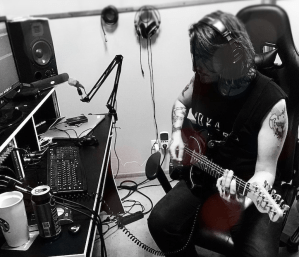 Where are you now and have you been displaced by the war at any point?
D: I’m in Ukraine, in Kyiv. I was born here and have lived here ever since even during the full-scale invasion.
V: I’m in Kyiv now and I’m not planning to go anywhere. Just as I didn’t plan on running anywhere when Kyiv was surrounded last March.
What impact has the full-scale invasion had both on your personal and professional life?
D: It has changed my life in almost every sense: from the loss of job, loved person, some friends to the complete revaluation of personal artistic output, ambitions, goals and wishes.
V: It has made me stop playing the game of life and start really living it.

Ворогу
Are there any Ukrainian releases from the past year that you feel have helped you to make sense of current events?
V: I’d rather mention the release of the year before last – 1914 – “Where Fear and Weapons Meet”.
How do you feel about the inclusion of “war sounds” in recent releases by Ukrainian artists and are there any specific sounds you find triggering?
D: I think it’s alright. My opinion is that it can’t be avoided when it comes to creating modern music in Ukraine. Every musician wants to write a song that will “hook” the public. If one adds the sounds of sirens for instance, the link is inevitable. This is the sound that triggers me most.
V: I find it normal, but I’m sure that it is always possible to replace the sounds of explosions and sirens with something more creative. As a fan of decadence and symbolism I’m trying to avoid it in my own work.
 After a year and half since the full-scale invasion, what would you say the West still gets wrong about Ukraine?
D: The West has always been wrong about Ukraine. My own experience of travelling the world shows that until 2014 in many western countries the difference between Ukraine and russia ultimately wasn’t understood. It’s sad that only during the war did the West (I mean, the masses and the nations) realised that these are two different countries with different culture and even mentality. But personally I see an improvement in this respect with an increased understanding of us as a separate and independent nation… Time will tell.
V: During the full-scale invasion I’ve visited a number of European countries as a sound engineer of modern avant-garde opera and I can say that the attitude and perception of Ukraine in the last 18 months have changed a lot. It’s a shame that all of us have to pay such a price for it.
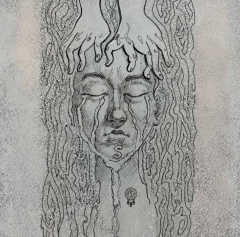
Осінь
Do you suffer from burnout and how do you relax?
V: I try to listen to silence.
Which book / film / album / song / traditional dish / podcast / blog / artwork / building / meme best captures Ukraine for you?
D: It’s hard to tell. Right now it’s all about old folk songs for me. I’ve always loved them, but only just now I’m starting to get goosebumps from them as they are the symbol of Ukraine for me.
V: For me Ukraine is both the cultural heritage of the past and the peak of modern art. If I had to pick only one song, one title, it would of course be “Ukraine” by Taras Petrynenko.
[Interview translated by Anstasia Batyr]
SEPTEMBER 10, 2023 – CANADA
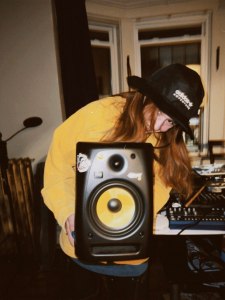
Photo by Roma Verona
Hi, I’m SAWRAS – a DJ, producer, and started to create Live Performances, everything is about electronic music. I also creator & curate the MAS series on “Gasoline” radio. I put my heart and soul into every creative process to cultivate the culture.
My journey began in the city of Sumy. Music has been with me since childhood, when I was involved in pop vocals and piano playing. It all started with folk songs with my grandmother, and it transformed into who I am now.
Once at a gathering with friends, they told me I looked like a girl from a rave. At the time, I didn’t know what that was and started to Google. This moment stuck with me as the beginning of everything. Infected with the idea of rave, I decided to find rave in my city, but there was nothing there. So, I headed to Kharkiv, where I attended a party for the first time. There I met JmDasha, who ignited the DJ in me, explaining what it was and who DJs are (Dasha was performing at the time). It was then that I realized I was interested in electronic music, and I became a DJ.
Has the full-scale invasion changed your setup and the way you think about music and sound in general and has it had an impact on your playlist?
Yes, Just two months after war started, I began learning music production. It was a kind of initial step when I realized I couldn’t contain these emotions, and they started pouring into the music, into everything that was happening around me. This is how I composed my first track “Άξιον Εστίν,” which was featured in our first compilation on OCHI label. It was challenging, yes, just like it was for everyone, but through music, I found solace and kept my faith alive.
 Considering the current situation does being a resident at ОЧІ make you feel part of a community and how do you see the electronic music scene developing in Ukraine?
In light of the current situation, as a resident of OCHI, I feel deeply connected to this community. Serving as the curator for the MAS series on Ukrainian independent Gasoline Radio, I carry a sense of responsibility for the growth of the electronic music scene in Ukraine.
The radio station was launched in May 2022 following the full-scale invasion. Despite a temporary hiatus, my series continues to thrive and evolve. Presently, I’m based with this series on SHUM RAVE, which undoubtedly contributes to further development. Additionally, I have ongoing MAS projects in the expansion phase.
MAS is a concept that unites two distinct realms: music and art. The DJ crafts a unique DJ mix, while the artist creates a painting in tandem. This artwork subsequently became the cover for social media and the radio station’s website, where I’m stationed.
The initial four episodes I created entirely on my own: recording the music mix and crafting the art. However, I later decided to invite guests to my shows, thus becoming the curator of this series. This decision led to its expansion. For me, this series is a means to showcase the incredible talents that exist and demonstrate how two distinct creative spheres can be harmonized within one project. This is particularly vital in these complex times in which we reside.
Regarding the development of the music scene in Ukraine, it has always existed, continues to do so, and undoubtedly will persist. I am committed to being a part of this process. We are a resilient people, determined to forge ahead regardless of circumstances, fuelled by our aspirations. I feel a strong calling to be in Ukraine for this reason, and I eagerly anticipate a swift return
 Where are you now and have you been displaced by the war at any point?
I am currently in Canada, Ontario, in the city of Kitchener / Waterloo. On March 8th, due to the war, I had to leave for Italy. I lived there for exactly a year, and came to the realization that I couldn’t stay there anymore. That’s when I made the decision to move to Canada, just to try, where I’ve been for six months now. Life here has been an immensely significant experience, and everything that’s transpired has only made me stronger.
What impact has the full-scale invasion had both on your personal and professional life?
The full-scale invasion had a profound impact on both my personal and professional life. Navigating through challenging situations and experiencing the weight of adult life at such a young age was eye-opening. This period provided me with the opportunity to grow stronger and more resilient. It was during this time that my process of maturation and self-discovery took on significant meaning… it all converged within me.
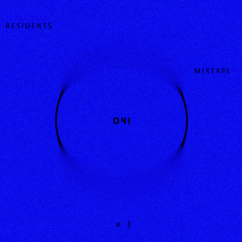 Are there any Ukrainian releases from the past year that you feel have helped you to make sense of current events?
Yes, Ukrainian releases from the previous year, in my opinion, played a significant role in helping me gain a deeper understanding of everything. Our first compilation, ‘Residents Mixtape #1,’ held particular importance for me. This music allowed me to explore an aspect of our culture that is often left unspoken, one that can be felt and heard. The tracks on this compilation were crafted throughout 2022. I believe you may have already heard the story of this compilation from other residents.
It made me realize what resonates within the souls of musicians and how profoundly our culture is shifting and evolving during this time. It highlighted the unwavering spirit that defines us.
How do you feel about the inclusion of “war sounds” in recent releases by Ukrainian artists and are there any specific sounds you find triggering?
To be honest, incorporating ‘sounds of war’ into recent releases by Ukrainian artists may not be the most suitable approach. This theme is profoundly complex and painful. I hold the belief that music can serve as a powerful means of expressing emotions and providing support, but perhaps without incorporating such sounds.
 After a year and half since the full-scale invasion, what would you say the West still gets wrong about Ukraine?
1.5 years after the full-scale invasion, I believe the West still misconceives the situation with our country. While we are undoubtedly grateful for every form of assistance extended to us, there remains a shortfall in the weaponry provided. It’s crucial not to halt or confine our efforts to this, as it comes at the cost of lives.
Which book / film / album / song / traditional dish / podcast / blog / artwork / building / meme best captures Ukraine for you?
At the moment, I can’t say that I feel that one thing can completely describe what represents Ukraine for me. I’m very inspired by this country and would like to make a film specifically on the theme of depicting my own autobiography, or to have such a film made for me. Someday it will definitely happen.
Who should I interview next and what should I ask them?
Jm Dasha, Yevhenii Skrypnyk [Shum.Rave cofounder], Andrew Neretin (NRTN), Pallas Athena, Crematorium Dush, Nadnova. These names represent creative personalities who have experienced significant events in recent years. Each of them has a unique story and a distinctive perspective on how their lives have changed during this time. I think it would be interesting to ask them about it.
SEPTEMBER 11, 2023 – KYIV

My name is Dmytro Zolotoverkhyy and I’ve been doing music since my school years, I’ve been into a few school bands playing guitar and later was involved in something a bit serious – a post-metal band called Rings of Rhea. We had two releases, including one split-ep with the French band Cathedraal, and had a great time touring the country. RoR disbanded in 2013, but I think it had a huge impact on me and my bandmates, who later participated in different projects such as Pree Tone, Kavkazka Sound, Alphabet Cities, Zoanthropy, etc.
Somewhere around 2011 I was infected with electronic music, mostly bass-oriented like juke, breakbeat, UK bass music and so on. Since then I’ve started to twist some knobs in Ableton. The official date of birth of “zolaa.” happened in early 2014 with my debut EP on the London based label Dred Collective.
My production has wandered from here to there since then and I can’t say I like my early works at the moment. I was thinking about changing my alias with every new leap of my music development and hide all the first releases behind, but then decided to stay with the original one, because it’s part of my history, and part of me.
 Has the full-scale invasion changed your setup and the way you think about music and sound in general and has it had an impact on your playlist?
Well, the full-scale invasion had a huge impact on me in general. It split my life to “before” and “after” and it’s so sad to realize it will never revert to what it was. Since the full-scale war happened my passion for music receded to the background for a huge amount of time. I forgot about production, searching for new records and even casually listening to music for a long period of time, I guess something like 6 months. Step by step I returned to work on my music and now I think I have an even bigger passion for it.
The first time I blew the dust off my records was in August 2022 when I was invited to play at Gasoline Radio for the Rejoiced series. I was pretty nervous, because I had barely touched my records for 5 months, but I enjoyed the process, it felt like a proper party for me.
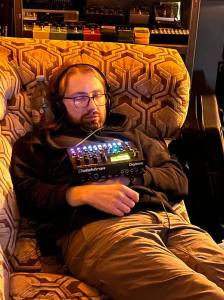
Talking about my setup: I shrinked my live setup to Digitakt, Digitone and a small old tape recorder, which I use to play some found objects, but that’s just a matter of my own choice and is not being dictated by the full-scale invasion. The only big stuff that the war has put in my head is that I want to upload all my unreleased projects (and there are a lot of them) to a cloud storage and send it to someone abroad who will release them in case a missle, or a drone, or anything else russian-related, ends my life. And don’t get me wrong, I’m not pessimistic about it, I’m just very bad about putting my music online and it would be a tragedy for me should all this material end up being buried on my laptop.
Where are you now and have you been displaced by the war at any point?
Now I’m at home, in Kyiv! On February 24 I drove to Chernivtsi with my girlfriend and a friend of hers. I didn’t want to leave and didn’t fully grasp the scale of the invasion, but I had to go because I was the only one who could drive. The first few days were pretty surreal for me as I didn’t quite understand what I was doing, but I think it was a good decision, because things could have turned out very differently, as it happened in the case of cities in the south and east of Ukraine. I went back to Kyiv on April 11, and it was the best decision for me, nothing is better than home.
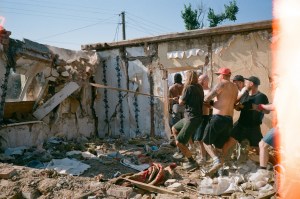
Volunteers of Chernihiv region, August 2022
What impact has the full-scale invasion had both on your personal and professional life?
Huge one. This war is a huge trauma for millions of us and it won’t go away instantly even when we will win. As I said before, life is split in “before” and “after”. Only careless and heartless people can stay aside and silently wait. I started volunteering here and there on the 24th of February, but as soon as I got home volunteering became a huge part of my daily life. First, my friend took me with him to deliver some basic goods to small villages in the Chernihiv region that had just been liberated from the russo occupiers. After that I spent a lot of time with them rebuilding houses from late April to December 2022. The guys did a great job in that timeframe, they rebuilt something like 25 houses and renovated the roof of a school in Kolychivka. Also we constantly fundraised to buy cars, nightvisions, drones, etc for our armed forces.
Many of my friends are doing military training for first aid or basic weapon handling. A lot of friends already joined the Ukrainian Armed Forces or voluntary military groups like Hospitaliers or the Ukrainian Volunteer Army. So, for me and my immediate circle of friends life now is war, tragedy, and hard work, but sometimes intercepted with truly happy moments of love, unity and faith in better days that will come if we work hard enough for them!

Volunteers of Chernihiv region, August 2022
Are there any Ukrainian releases from the past year that you feel have helped you to make sense of current events?
Not much here from the underground scene, but I enjoy a new genre that recently emerged – bayraktar-core (uplifting catchy songs with war-related lyrics, often with a humorous vibe like “Допоможе ЗСУ” by Chico & Qatoshi or “ОП ОП ЗСУ ПОКАЗУЄ ХІП ХОП” by YOXDEN & VovKING). I don’t take it seriously, but sometimes I feel like playing it loud in my car. You probably heard some of it in the background of those drone-bombings videos among tons of phonk 🙂
Also one artist I discovered some time before the full-scale invasion is Jockii Druce. He’s kind of a soundcloud rapper, his lyrics are no “money bitches drugs” but… I can’t describe it very well… it’s fun, ironic, often poorly recorded, connected to a simple lifestyle then and now and just to the point, but even if I translate some of the lyrics, you wouldn’t get all the sharpness without an Ukrainian contex. 3 years ago, I guess, he was unknown, then gained some popularity among young and hip people, and in the beginning of the full-scale invasion he became viral, while still doing proper stuff.
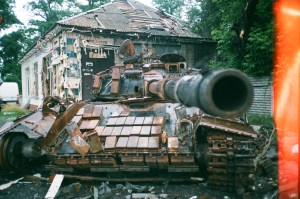
Destroyed tank near the groccery shop in Kolychivka village, August 2022 – photo by zolaa.
How do you feel about the inclusion of “war sounds” in recent releases by Ukrainian artists and are there any specific sounds you find triggering?
It depends on the context that artist uses it for and maybe a technique of usage. I’m sure 100% that air raid sirens or explosions in a track will trigger me and make my gut feel bad, happened once at work while listening to Amazon by El-B. So I guess literal and undisguised usage of war sounds may hurt a lot of people, especially those who survived the occupation or lived in the trenches for months.
After a year and half since the full-scale invasion, what would you say the West still gets wrong about Ukraine?
WE NEED MORE WEAPONS NOW, NOT IN HALF A YEAR, SEND US THAT FAT ROCKETS AND F-16 PLISSS MISTER BIDEN.
To be serious: a lot of people don’t understand the scale of the tragedy, also a lot of people underestimate the cultural value of Ukraine, it can give a lot of beautiful things to the world, because recently we started to be a country that skyrocketed in its development in different ways and we no are longer “some poor corrupt country near russia”. All we need is peace and I believe that with it we can gain so much and show to the world how cool we can be!
 How do you see the Ukrainian electronic music scene develop under present circumstances?
I like a few things war did to our club-scene. I see a lot of new talents emerging and I’m also surprised by the development of some earlier established artists during the full-scale invasion. War forced a lot of artists to leave, but all that crowd that decided to stay – have been marinating in their own juice for more than a year, and the taste is better and better. We do not have many foreign artists in lineups for well known reasons, but I’m grateful to anyone who dared to come in spite of the risk. And I want to encourage artists from all the world to come, it’s a great honour for us and it means a lot and I’m sure you will be suprised by the crowd and the energy they will bring to you in exchange! Also, due to the curfew our parties switched to daytime, and this is so good when you are already in your 30s. Parties end now at 23, you can get home by 00 and your next day will not be ruined 🙂
Here is a good visualisation on the vibe at parties, spontaneous collab with the folk band Shchuka-Ryba at the Masnytsya party at Closer (traditional holiday which have pagan roots, celebration of spring).
 What is the secret of a successful fundraising compilation and are you happy with the ones you have contributed to?
Not sure if I know the secret and can name a successful fundraising compilation, cause I’ve never done one myself, just participated. But every penny earned is a success, because it may save someone’s life.
Talking about methods we use while doing fundraising for the army – there’s no specific rule to make it successful, we constantly try new things, because now social media is oversaturated with this and if you want to catch as much attention, you need to find new ways. We had everything: we were selling items from the battlefield, like artillery shell casings (sometimes painted by some local artists, sometimes reworked for home usage, for example as a vase), keyrings made of destroyed enemy tank, there are those who sell their nudes for donations, and those who offer their professional labor (like “I will do a poster design for you for a certain donation to a specific fundraiser”), we were doing different kinds of charity events, etc.
How do you feel about those Ukrainian artists who have left the country and not returned to Ukraine?
I feel sad, because the more people leave, the weaker we become both economically and morally. But I can’t decide for a person what they should do when something threatens their lives. Also, a lot of artists don’t have a “daytime job” and abroad they have many more possibilities to make a living. I’m pissed and disappointed just at the people that left illegally and those who don’t care about what’s happening here and not helping in any way and living their best lives like nothing happened.
 Which book / film / album / song / traditional dish / podcast / blog / artwork / building / meme best captures Ukraine for you?
It’s too hard to pick one, and if I go for a list – it will be a few pages:)
At first I thought I would go only with the attached meme. But then I remembered a photobook that describes recent days the best way. It’s called We Stay, by my friend Lesha Berezovskiy.
I would also like to include a lot of Ukrainian music from different years, and I can talk about it for hours, but the one track instantly emerged in my mind is the song Велика ріка Хєнь-Юань by Цукор Біла Смерть, an avant-garde Ukrainian band from the 80s, it gives me goosebumps.
Talking about podcasts: I strongly recommend a series of lectures about Ukraine by Timothy Snider, it helps to understand our minds and how we live in a constant fight with moscowian occupiers, who’ve been stealing the heritage of Kyivan Rus since forever.
Who should I interview next and what should I ask them?
Same, it’s hard to pick one, but I guess you should interview Borys – legend, papa, ace in Ukrainian electronic music scene and one of the biggest mentors personally for me.
SEPTEMBER 13, 2023 – DNIPRO
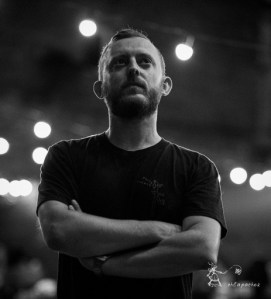
I was born on 29 August 1985 on the outskirts of Dnipro, an area between two plants and two railroad branches. Since my early childhood, there has been a lot of various music at home thanks to my parents. Vinyl records with dixieland, rock’n’roll, tapes with bossanova, synth pop, new wave and other beauties of the 80s.
Dad, even though he wasn’t a professional musician, played the trumpet, the chromatic accordion, the guitar a bit, and sang falsetto a lot. That’s why, our get-togethers were 99% real-life musicians and music teachers. No wonder my brother and I took piano classes in a musical school which I, unlike my brother Taras, quit after two and a half years (he ended up having a great impact on my musical tastes). At that point, my official musical education was over.
The industrial surroundings obviously influenced my outlook, so when I started hanging out in the railroad junk yards as a teenager I was already listening to industrial, grunge, hardcore etc…
I wanted to be a designer or an architect but did nothing for that and entered the faculty of physics and engineering.
Being a self-taught guitarist, I played in a few bands. I took clarinet lessons, but the stars were against it. As a university student, I got interested in electronic music more. In passing, I got to know the modern academic music and the avant-garde rock of the 80s and 90s.
On an average day, I’d listen to Nirvana, Schnittke and Zvuki Mu on my way to school and, back home, a mix of Radiohead and Slipknot. And if I was lucky, at night I, dirty but happy, had a chance to listen to drum’n’bass, noise, or techno at an underground party in an abandoned crematorium or just an incomplete construction site. After university, I understood I wanted to cast my lot with music. I started studying sound engineering while working at a local recording studio.
Now, my love of dixie, bossanova, synth pop, new wave, grunge, hardcore, IDM, drum’n’bass, ambient, industrial, avant-garde rock, modern academic music, my base-level knowledge about tools and NDT, and my childhood habit of breathing creosote (its smell was everywhere) help me in creating my music.
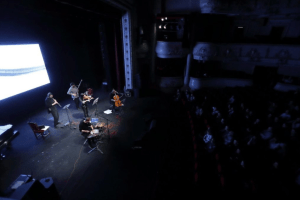
DZ’OB
You recently released Holy Random, which is I believe your first solo album after your experience with DZ’OB. What can you tell us about its genesis and was the decision to go solo prompted in any way by the current situation?
Before February 24, 2022, I was already planning the creation of solo material, as by that time I stopped cooperating with DZ’OB. I accumulated ideas, but did not get around to recording. After the start of the full-scale invasion of russia, like many, I was in a stupor for the first month and could not work. In addition, I temporarily did not have a studio space and all my equipment was at home. But in March I moved the equipment to DCCC (Dnipro Center for Contemporary Culture) and started working on my debut album. All compositions from Holy Random were recorded during the year with several very cool musicians from Dnipro taking part in the recording. The whole album means life during the war. Each track is a personal experience and wishing death to the occupants. There is such a mix.
Do you see the current situation as an “opportunity” for Ukraine to forge its own identity and promote its own culture on an international stage, as the lines “Наша культура розквітне, Забуяє з трупів війни” (Our culture will flourish, Forgets about the corpses of war) from the song “Aeroverve”, seem to suggest?
The war greatly accelerated the process of self-identification of people in the masses. Renunciation of the dominance of Russian culture in Ukraine should have happened earlier, but unfortunately it is happening only now under such conditions. We are paying a heavy price for this, but I hope it is all for nothing. In the track ‘aeroverve’, we hear a poem by the Dnipro poet Oleksandr Shakirov, which resonates with what is happening in our country.
Where are you now and have you been displaced by the war at any point?
I continue living in Dnipro. Although it is close to the front line, it is safe here. We have our community, which is based on people connected with the nightclub Module. Many of our friends are currently fighting and we are organizing a fundraiser to buy everything – from clothes to drones and cars. For this purpose we also organize charity concerts. That’s why I’m here for now, and I don’t know what will happen tomorrow.
What impact has the full-scale invasion had both on your personal and professional life?
It happened that all the changes in personal and working life are not related to the war. But the war greatly affected the general condition. All Ukrainians are psychologically traumatized. And many physically. Unfortunately.
 Are there any Ukrainian releases from the past year that you feel have helped you to make sense of current events?
Now there is a lot of low-quality music in Ukraine, which we call “Bayraktarshchyna” (from Bayraktar – unmanned combat aerial vehicle). These are songs about Patron the dog (a well-known sapper dog), about drones, the Armed Forces, and so on. In these songs, in my opinion, the authors are speculating on people’s feelings. People like it now because it’s all our reality. But for me it’s not all about the music. I think that over time, all this variety of opportunistic “creativity” will become just a single blur, but as a phenomenon it will definitely remain in history.
There is the Ukrainian music and poetry project called WARНЯКАННЯ. This is a very apt combination of Anton Slepakov’s poetry about the present days with very interesting intelligent electronic music by Andrii Sokolov. I heard them live many times.
But in order to express your feelings, it is not necessary to sing or talk about it. You can just google “dnipropop” and find a lot of interesting things there. For example, Monotonne’s album 37. Or there is very emotional electronic music by Symonenko. Andrii Barmalii, a young saxophonist from Kyiv, also released a cool album. And I can’t help but mention Roman Slavka’s yet-to-be-released album. It sounds very powerful live.
How do you feel about the inclusion of “war sounds” in recent releases by Ukrainian artists and are there any specific sounds you find triggering?
It’s like Bayraktarshchyna, but worse. The sound of explosions or sirens immediately summons the feeling of danger and is very traumatizing every time. I don’t think it’s a good idea to use sounds like that in music now.
 After a year and half since the full-scale invasion, what would you say the West still gets wrong about Ukraine?
As far as I can see, many people who have not lived in Ukraine still associate us with russia.
Also, people who have not been under fire, or moreover at the front, can’t understand how much we hate everything russian. Yes, not all of us. But many of us.
Will the world ever sound the same after February 24, 2022?
If Ukraine doesn’t withstand, then perhaps the world won’t sound at all.
Which book / film / album / song / traditional dish / podcast / blog / artwork / building / meme best captures Ukraine for you?
At the moment, I do not have a single work of art that would fully absorb all that Ukraine means to me. I think that right now the process of creating something is taking place, which in the future will embody Ukraine as it will be and should be.
Who should I interview next and what should I ask them?
It seems to me that Monotonne, Symonenko and Roma Slavka have already been interviewed by you. So, let it be Walakos.
[Special thanks to Anastasia Batyr for help with this interview]
SEPTEMBER 14, 2023 – DISPLACED

I started making music in 2000-2001, when I got my first laptop, In short, it was a hobby till 2007-2008 when I had my first release. I have experimented with different genres (Electro, Progressive House, Techno, etc.), and now in 2023, I am back to new experiments with music.
Has the full-scale invasion changed your approach to music and the way you think about sound and has it had an impact on your setup and playlist?
I spent two and a half months in my hometown of Kherson under russian occupation. I was in the basement and made music, which was so deep, strange, and troubled. Those were my feelings at the time.
When the situation around me changed – my music changed and it was already more positive – because only with a positive mood can one move and enjoy life.
As for my setup and playlist, I’m looking for an option to simplify my setup – maybe I’ll go back to the tractor (as an option) I am also preparing a new live. In my playlist, I have introduced a lot of music from Africa (Nigeria mainly). I also love Habibi Funk, etc.
 You run a record number of labels, including @memory-remains-vinyl (sub-label: LODE, BULLION) @crocusvinyl (sub-label: Sweaty Bull) @uzvarrecordings, @razomofficial, @yellowwax and @footballplayervinyl. What aspects of being a label head do you enjoy the most and what would you say are the drawbacks?
I launched my first label in 2014 – After that, the approach to music was constantly changing and I added a new label – Yes, now there are 9, but the constant releases are only on Memory Remains – In the other labels there are 2-3 releases per year, depending on the material – I don’t only let in stars – First of all, I release music that I personally like.
The main disadvantage is time – I don’t always have time for everything – and until recently I did everything myself, both mastering and design – but now I have a designer – so one point is closed))
Back in May 2022 you released a fundraising compilation for your hometown, CHARITY FOR KHERSON. How would you say the international music community has responded to the full-scale invasion and what is the secret of a successful fundraising compilation?
When the war began, everyone helped together (musicians, DJs, labels, etc.) – as best they could – but with each passing month everyone got tired of helping (except us, of course) because this is our land – our people and only we can help ourselves. I still send money to volunteers who remain in my city and help simple people.
 You managed to flee Kherson a few months into the full-scale invasion. What is your understanding of the current situation on the ground?
Yes we succeeded – but the story of how we fled is a long and terrible one, I don’t want to tell you the details.
Regarding the situation, nothing in my city has changed for the better, my parents are still there – the shelling doesn’t stop – people die every day – and this is the worst thing that can happen. But every day we hope for good news.
How did you manage to maintain a steady flow of releases in spite of everything that has been going on and what new collaborations and releases have you got planned for 2023?
Even before the war, many releases were planned and they are coming out gradually until now – Also many collaborations are ready and they are waiting for their time – I’m not saying anything yet – because I sometimes change my approach to music – but you will see in 2023 a lot of releases on strong labels – in short, I returned to digital releases after 10 years)
 Do you suffer from burnout and what do you do to unwind?
Sometimes I do suffer from burnout – but it’s rare – because after new parties – and new travels I get new emotions – I often look forward to the moment to return to the studio and write something new – I can write 3-4 tracks per week) It all depends on how long the pause is without a studio.
What would you say are the biggest misconceptions the West still holds about the full-scale invasion and the worst stereotypes they perpetuate about Ukraine?
Here in Europe people receive information – and believe it, but sometimes it does not correspond to reality – I don’t know at what point it was distorted – but not everyone will check and clarify it – they will simply accept it as it was presented to them (for example, there are a lot of questions about the film Yurik set in Mariupol) everything is twisted, my friends who were there at the time say everything was nothing like what is shown in this movie – but it will go to Europe and they will be watching it and everyone will take it for real – And with this I mean that all information needs to be checked (if one has the time and desire to do so, of course).
Which book / film / album / song / traditional dish / podcast / blog / artwork /building / meme best captures Ukraine for you?
In short:
- Books by Taras Shevchenko.
- Football: Andrey Shevchenko and now Zinchenko-Mudryk.
- Music: For local music DakhaBrakha, for electronic АrtBat.
- The food is borscht and dumplings))
Who should I interview next and what should I be asking them?
You need to talk to producers, for example, iO Mulen, Westboy (IAN), Peshka [UFN XXIII], and Silat Beksi [UFN XXIII]… all Ukrainian DJs who were in Ukraine when the war started have their own stories.
SEPTEMBER 14, 2023 – BERLIN

Photo by Marichka Lukianchuk
I come from a family of musicians, and been playing various music instruments since childhood. I grew up listening to and playing mostly the rock music, while also enjoying pieces classical. These days i feel brave enough working in any genre that i like to explore – ethnic, indie, triphop, hard techno and film scoring.
Has the full-scale invasion changed your setup and the way you think about music and sound in general and has it had an impact on your playlist?
It surely did. The setup I had to rebuild from scratch — I only had my laptop with me, not even the headphones. My guitars, keyboard, and other instruments — they stayed in Ukraine. For the first half of the invasion year, I was not able to write music. It took me almost a year to be able to compose again and also to feel like I had something to say with my music.
And the way I think about music has also changed. I believe that each piece of art produced by Ukrainian artists must be a political statement in these times.
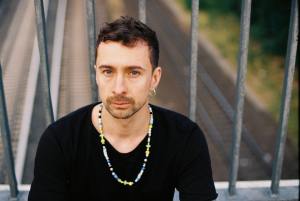
Photo by Lera Berezovska
You recently released the album Volopas on ОЧІ. You seem to have used some traditional instruments that relate to the concept of the album at least in the opening track. Could you tell us about its production process?
It felt very natural to weave ethnic pieces into hard techno tracks, so from the very beginning, it was a concept of the album. “In The Village” has sounds of the Kobza, “Harvesting” uses the aggressive sound of the Drymba, and “Doźynky” revolves around a melody played on the Koza (Ukrainian bagpipe). The album also has a short story attached, basically some of my childhood memories of visiting my grandparents in their villages.
How do you feel about the inclusion of “war sounds” in recent releases by Ukrainian artists and are there any specific sounds you find triggering?
I’m not using these sounds for the same reason I don’t watch some of the war documentaries. But I’m far from criticizing those who do – each one of us is dealing with our war traumas in our own way. Or it could be someone’s political statement – that I value. What impact has the full-scale invasion had both on your personal and professional life I’ve lost a few very close friends; they died on the frontlines. I’ve also lost a few family members, but in another way – they turned out to be pro-russian.
I believe you are currently based in Berlin, are you in touch with the Ukrainian community there and how welcoming would you say the city has been towards Ukrainians?
Sure, I also met some wonderful people here in Berlin. It’s safe to say that in our artsy crowd, we helped each other go through the darkest moments of our lives.

photo by Nadia Bui
After a year and half since the full-scale invasion, what would you say the West still gets wrong about Ukraine?
I would like to rephrase it: Many people fail to realize that russia is attempting to erase Ukraine’s identity, including those of us who share this identity. This is not the first time, and we are not the first victims. Of course, the collective memory of a nation is not something that can be easily shared, but we — both as a nation and as artists — make the effort.
Another thing that really shocks me is the number of western people who still think, ‘The Soviet Union was not that bad.’ I mean, come on, folks. I get it, capitalism is far from ideal, but can we at least refrain from considering communism as a viable alternative?
I would also rephrase the initial question like this: Many folks don’t realize the extent of suffering and grief that russia has caused its neighbors over the decades.

Photo by Andrii Bogun
SEPTEMBER 19, 2023 – KRYVYI RIH
Lenoczka
Hello, I’m Olena Dzhurina, my artist name is Lenoczka.
I am a media performer, and audio is one of the mediums I explore and utilize.
Around 2016, I began creating VJ shows for underground clubs and events in Kharkiv. A couple of years later, I delved into DJing and music production.
My fascination with real-time graphics and electronic music led me to experiment with audiovisual performances and content, which I continue to incorporate into my creative practices.
Additionally, I am part of Kryvyi Rih local community, Poroda. We organize cultural events, support local artists, and contribute to Ukrainian defenders through donations.
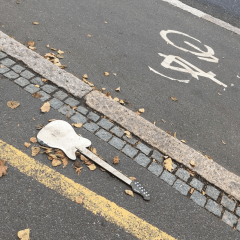 Where are you now and have you been displaced by the war at any point?
I currently reside in my native city, Kryvyi Rih. Prior to this, I had lived in Kharkiv for nine years.
Just a couple of days before the 24th of February, I left Kharkiv to briefly visit my family in Kryvyi Rih before heading to the residency organized by Platforma Tu in Mariupol.
Since then, I haven’t used my ticket to Mariupol. I made the decision to stay in Kryvyi Rih to be closer to my family and to continue working in the cultural field, where I can be of service both to the local scene and to volunteering.
I do not consider myself a displaced person, as I had the great privilege of returning to my hometown, which, thanks to our defense forces, remains neither fully destroyed nor occupied
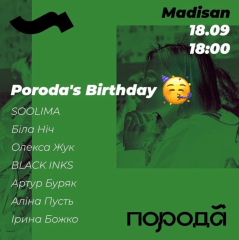 What impact has the full-scale invasion had both on your personal and professional life?
Unexpectedly moving to a different city certainly changed the structure of both my personal and professional life. Many of my closest friends remained in Kharkiv, while numerous friends and colleagues had to evacuate to various cities and countries. The creative teams I used to collaborate with were now separated by distance; some had to transition to online work, while others entirely shifted their focus to volunteering. Many of the working plans were canceled, and some of the opportunities that once seemed promising were permanently closed off.
In the first few weeks following the full-scale invasion, I dedicated most of my time to social media and online chats. There was a significant amount of communicational volunteer work involved, such as assisting people in evacuating or helping them find necessary medicines.
During this period, I was lucky to connect with the local community of Poroda. After the initial shock of the invasion, in April 2022, we organized the first musical charity festival in a bomb shelter in Kryvyi Rih. It was our way of asserting that even in difficult times, modern Ukrainian culture should continue to grow and flourish because it unites and empowers us. Since then, we have arranged several dozen charity events, inviting not only local artists but also artists from Kharkiv, Mariupol, Severodonetsk, and other cities across Ukraine.
I personally had to reevaluate my role within this new cultural ecosystem, and to this day, I continue to engage in activities at the local level and support the underground scene.
 How do you see the electronic and experimental music scene develop under present circumstances?
I’ve noticed an increased number of new releases and new connections between Ukrainian artists and international communities, such as labels, radio shows, and podcasts.
Many artists have taken a pro-Ukrainian stance and have conveyed political messages through their tracks.
Additionally, I’ve observed that daytime events have become more common because of curfew. This has altered the perception of electronic music, which was traditionally associated with nighttime culture, and perhaps made electronic music more inclusive.
From what I can see, there’s greater solidarity and support within the scene now. Numerous beautiful collective fundraising compilations have been released, and many collaborations between artists have been launched. I’m particularly fond of the latest releases on mystictrax label, ОЧІ, Progressive Future, Liky Pid Nohamy and many others.
I’m delighted to see that projects initiated before the full-scale war continue to thrive today, even in adverse circumstances. For example, the Shum.Rave community was established in Sloviansk, Donetsk oblast, and will celebrate its 4th anniversary this September, despite all residents having to relocate from Donetsk and Luhansk regions to safer places, including Kyiv.”
 What can you tell us about the KYUB residency programme you took part in?
The KYUB residency was one of the few opportunities for artists who remained in Ukraine after the full-scale invasion to participate in a multidimensional project and connect with each other online. It was organized by Institute of Sound (UA) in collaboration with IKLECTIK (UK).
The residency took place in December 2022, a time when blackouts occurred daily due to damage to numerous electric stations by the Russians in Ukraine.
During the residency, I, along with fellow residents from different regions of Ukraine, had an interesting experience. As electronic producers highly dependent on electricity, we had to carefully plan our work, combining it with our regular responsibilities and routines while having a limited amount of electricity available each day.
It was inspiring to communicate with both the residents and mentors, understanding each other’s production processes, exchanging insights from lectures and workshops (on AI for music, Max/MSP, Touchdesigner, Tidal Cycles, etc.), discussing activist strategies, and hearing personal stories from fellow residents.
What amazed me the most was that, for the final compilation ‘VA – KYUB: this war,’ each resident chose a specific perspective to express their own experiences from the war. These included audiostories about missing home, drone attacks, blackouts etc. My contribution was about how the curfew in Ukraine changed my perception of time.
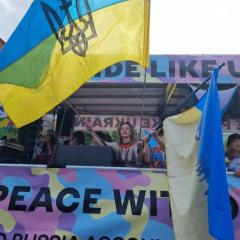 Has the full-scale invasion changed your setup and the way you think about music and sound in general and has it had an impact on your playlist?
I would say that the full-scale invasion and my move to another city changed the way I networked with other enthusiasts of electronic music. In Kharkiv, we mostly knew each other and could exchange experiences, borrow each other’s gear for performances, and were familiar with the places, clubs and studios, where we could listen to our works on a high-quality sound system.
Nevertheless, my setups were always minimalistic and sometimes even sporadic. On some days, it was only the smartphone and a Bluetooth speaker for producing music, while other times there was a chance to work with more advanced synthesizers or controllers. I appreciate that electronic music allows you to be flexible with your setups and to adapt different technologies.
Mostly, my playlists consist of compositions by Ukrainian authors, which I search for and purchase to create conceptual DJ sets of Ukrainian electronic music. I started to closely explore the Ukrainian electronic scene a few years ago, and after the full-scale invasion, I’ve noticed how many new names and works have emerged. There are always archives and fresh releases to explore nowadays. I save some of the tracks in my SoundCloud playlist.
Bombidariy festival in a bomb shelter in Kryvyi Rih, photo by arg4ntum
Have you noticed any changes in your sonic environment since the full-scale invasion?
The main change is the presence of sirens. At home, I hear a chorus of sirens located around the neighborhood every time an air alert is announced, which happens for the few times almost every day. In public places, you can hear not only sirens but also a multitude of notifications coming from people’s phones. Some days and nights, we hear the sounds of explosions in the city, as the russians attempt to constantly terrorize even areas in the rear. The sound of a flying kamikaze drone has turned out to be the most unpleasant and disturbing. In winter, the noise of a working generator became an inevitable companion when walking around the city.
As I had to move to another city, I have certainly noticed a difference, transitioning from the city center of Kharkiv to a quiet neighborhood in Kryvyi Rih. Now, I hear more natural sounds in my garden and the sounds of the nearby train station, familiar to me from my childhood.
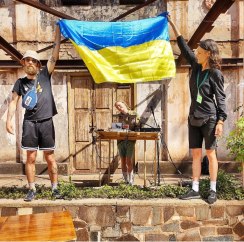
truffikss photo by by Sasha Dolgiy
Are there any Ukrainian releases from the past year that you feel have helped you to make sense of current events?
There is one very special release – the album ‘Zapovit’ by TRUFFIKSS . TRUFFIKSS is a young, talented artist from Mariupol, and he created this album while being deported to russia. TRUFFIKSS draws inspiration from the folklore and poems of the Ukrainian literary classic, Taras Shevchenko, who was also in exile in russia, and incorporates vocal and sound experiments into his work. When I discovered this release and the story behind it, I was truly amazed by the inner strength and unbreakable spirit of the Ukrainian artist.
How do you feel about the inclusion of “war sounds” in recent releases by Ukrainian artists and are there any specific sounds you find triggering?
I see this trend declining. There was a wave of using, for example, sounds of sirens in tracks during the first few months of the full-scale invasion, as those sounds were a new experience for many of us. I believe that it is appropriate to use them if they reflect the idea of the work.
An example of such a conceptual work consists solely of the sounds of sirens from different regions of Ukraine – Silence of Sirens.
 After a year and half since the full-scale invasion, what would you say the West still gets wrong about Ukraine?
I believe it’s the history of Ukraine and Ukraine’s connections with various European countries. This may require a specific focus on fact-checking and source exploration since Russian imperial propaganda has, for centuries, worked to eliminate facts and names, and to appropriate or distort the meaning of historical events.
I think it is important to know history in order to understand the current moment in which Ukraine is fighting not only to preserve its sovereignty and culture, but also to protect other European countries from the horrors of the war with russia.
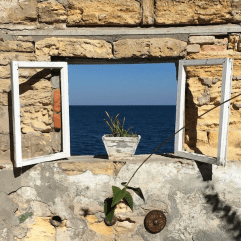 Which book / film / album / song / traditional dish / podcast / blog / artwork / building / meme best captures Ukraine for you?
I’d like to share a song I recently discovered while watching archive videos from the 1989 festival ‘Chervona Ruta,’ a revolutionary event and the first mass festival of Ukrainian song under soviet occupation. Maria Burmaka performed a song based on the poetry of Ukrainian poet Oleksandr Oles, written in 1906. The lyrics struck me with their relevance in 2023, as in both past eras, there was the same struggle of the Ukrainian people for freedom, with the same threat – russian imperialism. I view this as a dialogue between generations, and it seems to me that Ukrainians are currently making significant efforts to ensure that future generations do not encounter such problems or can address them more effectively.
Марічка Бурмака – «Ой не квітни весно» / Червона рута–1989 / #RutaFEST
Who should I interview next and what should I ask them?
NFNR – about volunteering [UFN 21 September 2022]
Lostlojic – about mystictrax label [UFN IV]
Motoblok – about Ternopil music scene and Pincet label [UFN XXIV]
Syncøpe – about next release and other project Diser Tape
BODRO – about how to be an electronic artist in Armed Forces of Ukraine
SEPTEMBER 19, 2023 – POLAND
I was born into a Moldovan family in a small recreational town on the shores of the Black Sea in the Odesa region, where I spent most of my childhood and still the memories take me back to these weedy steppes and endless sandy beaches. In my early teens I started my incessant search for a new sound by listening to independent radio shows, broadcasting on the internet mostly worldwide electronica and post-punk. In Odesa, where I moved to study at the military lyceum, it was really difficult to find some clubs supporting independent culture. Therefore my addiction to musical discoveries became a shelter from the crushing pop culture and I started to share and spread the most interesting ones by making playlists for my friends on social media.
Later, when I moved to Poland, I realized that deejaying might be the most interesting way of sharing, knowing nothing about the rave scene, so after I finished my engineering degree I started to associate myself with the Polish electronic scene by organizing DIY events with likeminded people in various parts of Warsaw.
 Has the full-scale invasion changed the way you think about music and sound in general and has it had an impact on your playlist?
Obviously since the beginning of the war I experienced a lot of trauma even while being abroad when a whole residential building next to my family’s apartment was destroyed by a russian missile or the loss of the loved ones of my close friends.
Even before such events, I guess my music selection was always full of melancholy, anger and sometimes even aggression albeit in a different context. So now I just change the context when I feel the need to express feelings related to war through music selection.

SUMISH event
You recently released the album Land of Abundance on Sons Of Traders Records. The linear notes indicate this is “An attempt to reach the undefined emotions between commotion and anger, sublimity and thrill, which, along with grief and hatred were brought by the war in his homeland in Ukraine.” Could you tell us about the production process for this album and how does one articulate complex emotions relating to current events through sound?
This album turned out to be a surprise for me, because originally it was supposed to be an EP, but when I sent the rest of the tracks to Mike [Mike Tansella Jr., label head at Sons of Traders Records] he proposed to add more tracks, because in his opinion they fit well together. Therefore the tracks “Martial Law” and “Silent Cities”, that I made after the full-scale invasion, were also included in the album, but I won’t say they were inspired by war, because it would be very pathetic, war is not something that can be inspiring. So that’s why I called this an attempt, because we feel all these emotions, like thrill and anger, etc., differently at different times in our lives, so I just tried to reflect my personal state of mind at that particular time. After all this album turned into a compilation of tracks from very different periods of my life but still they had something in common, namely these undefined emotions that I mentioned in the liner notes.
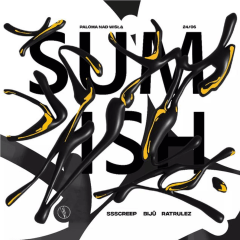 You are part of the Warsaw based Ukrainian collective SUMISH. One of the remits of the collective is to accept diversity and create unity. How diverse and united would you say is the electronic music scene in Ukraine and how does it differ, if at all, to the one in Warsaw in this respect?
To be honest, I don’t feel competent enough to evaluate the Ukrainian electronic scene, since it is very massive and to even understand how it works and develops, you most likely need to be inside it. But from the stories of my friends hailing from the Ukrainian electronic scene, I can conclude that it has already become a big “techno/electro business” there. Perhaps that’s why I don’t notice so many Ukrainian labels releasing experimental music, because it simply cannot be sold to the crushing rave scene. Sadly, because of this, most Ukrainian artists creating non-rave electronica remain niche for a long time. But, yeah, we should admit that finally it slowly started to change but still that’s very different from Warsaw or even the Polish electronic scene. The electronic music community here doesn’t have such a big audience and resources, probably because it is more conservative. But despite this, I’ve noticed in PL many more small labels releasing obscure kinds of electronic or even acoustic music, and even small festivals supporting noise / industrial / experimental / ambient music.
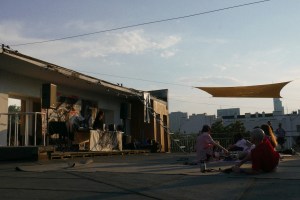
SUMISH event
Are there any Ukrainian releases from the past year and a half that help make sense of current events?
As I mentioned above, war should not be a source of inspiration; conversely, we will see what happens to russian society, whose mentality is built on the glorification of war and the illusion of victory. But art still remains a kind of tool for expressing deep feelings or traumatic experiences. It can also be a tool to immortalize and pay tribute to the people we have lost forever. One example is the track Ivan by a good talented friend of mine who lost a family member in the war. Also, a huge number of charity compilations by Ukrainian and non-Ukrainian labels shows that the war is still not over and our society still needs support.
Though recorded before the russian invasion of Ukraine in February of 2022, Oleksandr Demianenko’s tape 𝐼𝑛 𝑀𝑒𝑚𝑜𝑟𝑦 𝑂𝑓… serves as a meditation on the importance of preserving art, culture and roots at a time when war threatens to erase them.
 You host the Machine Healing series on Mutant Radio. How did this come about and how do you choose your guests?
This wouldn’t have happened without Mike’s help, I am really grateful to him for his trust in me and big support. When he was preparing the next label showcase on Mutant with my contribution, he asked me if I would like to curate a show there and this was a perfect match as my 2,5 year residency on Warsaw’s Radio Kapitał had just come to an end. So I was more than happy to start my own show there, because since I discovered this platform it has become a very valuable and educational radio for me in terms of niche music. As this radio became one of the most important bridges between the rave and experimental music community, I found it a good space to promote my talented friends and artists who inspire me and should be more prominent in my opinion. So I saved the concept of my previous radio show but added the new more flexible context. Namely, the idea behind the Healing Machine is to present the kind of music that a DJ wouldn’t dare to play in the middle of a party in a club, but that could be inspiring in terms of the production process or just formative in shaping them as artists.
 You are based in Warsaw, Poland, a country that is currently home to just under a one million refugees from Ukraine. After one and half years since the full-scale invasion, has public opinion in Poland changed in any noticeable way towards Ukrainian refugees and the war?
Definitely the Polish society realized that the migrant community here has already become a very important part of everyday life and I’m not talking only about Ukrainian migrants here, but also about Belarusian. Of course some of the Polish people can’t come to terms with the fact that migrants are everywhere, usually it concerns the far right supporters, as we can unfortunately observe that growing tendency in the whole EU.
A big impact on the crushing of the migrant stereotype was the influx of more educated and qualified employees who fled from the Lukashenko regime and partly from the war in Ukraine. It also concerns displaced talented artists, who started to create and enrich the art industry here and soon the Polish art community began to support them. But on the other hand, the task of integration with local society lies partly on migrants’ shoulders too. That’s why the main goal of our art collective SUMISH is to integrate the migrant art community and local one, as we feel privileged to have been able to move from our country by choice in the search for a better life and not simply to save our lives. And still we have a lot of work to do towards an adequate level of acceptance here.
Which book / film / album / song / traditional dish / podcast / blog / artwork / building / meme best captures Ukraine for you?
- Movie – one of Parajanov’s masterpieces Shadows of Forgotten Ancestors (1965)
- Album by the Ukrainian Cocteau Twins: Вежа Хмар – Сон (2000)
- Book – a novel, INTERMEZZO by Mykhailo Kotsiubynsky (1908)
Who should I interview next?
The talented Crimean DJ currently living in Warsaw Facheroia.
NEW RELEASES
SMART-155 ~ Poly Chain
“Poly Chain aka. Sasha Zakrevska presents a blistering set of cold, radical and introspective electro tracks on one of her most entrancing records to date.
Weaving influences from a wide palette of styles across electro, IDM, techno, trance, breaks and experimental sounds, the Ukranian composer and DJ builds stories and shapes patterns seemingly from another dimension, yet clearly close to heart.
Undoubtedly a commentary on experienced hardship, strong willed hope, unjust conflict and most importantly the power of expression through music, SMART-155 is a testament to possibilities and a reminder of the importance of unity.”
NECH022 ~ Louwave & Splinter (UA)
“Ukrainian record label NECHTO introduces a new design concept with the upcoming release NECH022 by Louwave & Splinter (UA). Founded by the illustrious DJ NASTIA, NECHTO has been a torchbearer for authentic dance music. This fresh design is a testament to the imprint’s commitment to evolving while staying true to the core values of the dance music community. From its very beginning, Splinter (UA) has played a pivotal role within the label by joining label nights, producing the third EP and making notable appearances on both volumes of the ‘Scary Beautiful’ compilation. Following his relocation from Odessa to Lviv, he embarked on a collaborative studio venture with Louwave, ultimately giving rise to their joint release. Louwave and Splinter (UA) are no strangers to the electronic music realm, each boasting over 15 years of experience in their individual careers. Their live performances stand out with their ability to connect with the audience, turning each live show into an immersive experience. The upcoming EP skillfully blends classic techno elements with tribal groove aesthetics, resulting in a sonic landscape that tugs at emotions and entices dance floors alike.”
Transilvania Smile, 1994 ~ Svitlana Nianio
“Svitlana Okhrimenko (artist name: Svitlana Nianio) is a Ukrainian artist, musician, and signer. She is one of the most prominent representatives of the independent music scene of Kyiv in the late 1980s — early 90s. She has repeatedly recorded and performed in collaboration with other musicians and bands, such as Oleksandr Yurchenko, Sugar White Death (Cukor Bila Smert’), Ivanov Down, GeeNerve & Taran, and Blemish. Svitlana still performs and publishes new recordings today.
Transilvania Smile” is one of the first solo works recorded in 1994.
Distant Frequencies ~ 58918012
“Hello. Finally, Distant Frequencies is here! This release is melodic, light, dark, and deep at the same time. It’s like a mixture of 9 minds, 9 musical points of view, and 9 different worlds and lives in 9 tracks. It’s a huge work and a big period of my life.”
Tramontane ~ Kadaitcha
“time lasts as a fossil beast, as the yells of liars, as the whispers of prophets; hear the master before he leaves, mind solely the victim. a fruit and a claw mark thereon, a dirty seed and a vacuous paradise. when will your beast quench its thirst? what is the ground of your confidence when this crimson mist is growing ever more viscous? black, mortal, unappreciated. white, dreadful, alive. on the slope, in curses, in oneiric masks. the night won’t end, it’s not the night. the bonfires burning down, the last songs rustle. for everyone to leave, for anxiety to recede. are they, the ones who left, the strangers or are you a straggler? and the sun that has no heat henceforth is nothing but an incinerating fire.”
Etudes ~ Igor Yalevic
“Etudes is Yalivec’s sophomore album. His 2021 album Still Life came out on Polar Seas Recordings and has long since been sold out. Yalivec’s more esoteric electroacoustic project with guitarist Sergey Yagoda is called Gamardah Fungus and exorcizes a more cosmic and heavier consciousness. Etudes is remarkable in it’s ability to walk a middle path between the overtly melodic and arpeggiated Still Life and the heavy duty experimentalism of Gamardah Fungus.
An etude, in musical language, is generally a short exercise designed to improve the player’s skill. The skill, it seems, that Yalivec is improving here is his ability to see clearly. Not ahead into some unknown future, but to see clearly into the present – a present, that on good days, is full of the chirping birds and prairies alive in some kind of eternal autumn afternoon that are full of life. And perhaps, no matter what happens, there will be artists like Igor Yalivec – capturing those moments and stretching them into eternity.”
Aneveno ~ SVITOVAMORA
“I’ve long wanted to create music like this. It’s not meant to be listened to with just your ears; it’s meant to be felt with your body, your soul, your mood, and understood on a deep level.”
Someone You’ve Never Been ~ Tetyana Haraschuk
A new EP by the Canadian/Ukrainian composer and drummer Tetyana Haraschuk dissecting societal norms, genre and other existential things through “freaky alien” textures, psychedelic vocals, 80s guitar, synth bass and rule breaking grooves.
VIEWING ROOM
(Gianmarco Del Re)
 a closer listen