

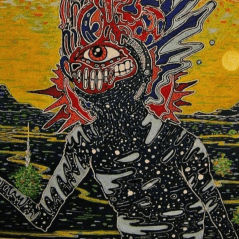
Artwork by Mariia Oksentiyivna Prymachenko
We have now reached the second anniversary of the full-scale invasion. With over 270 interviews to date, a book compiling all interviews from the first year, an 80+ track compilation with proceeds going to Musicians Defend Ukraine, and 16 podcasts for the London based community radio station Resonance FM we have attempted to give a sense of events on the ground throughout Ukraine.
It’s been a privilege and an honor to speak to so many talented artists from a wide range of different genres, from experimental to electronic music and from ambient to techno. Unfortunately, for lack of resources, from next month we will be scaling down the number of interviews we do to concentrate mostly on our podcast.
For the current episode we talk to Wiseword.Nidaros from Mikolaiv about grief and C.S. Lewis, and we hear from a crop of young deejays and electronic artists from Kyiv, including CHWBK and Bakunn. Ochii introduces us to the feminine side of the scene, Volodis reflects on the legacy of Ukrainian music, while Maria Sonevytsky puts the Eurovision Song Contest into context for us, and Ilona Babkina investigates the role of music in shaping national identity.
On a more sombre note, Буду Думати tells us about the mental toll of working for a humanitarian mission and Saturated Color goes through an identity crisis.
As usual, there’s lots to ponder here but, if Blooms Corda muses about the weight of an uncertain future, bOOsh reminds us that, “Life is meant to be danced,” while LIGHT WAY tells us that “To make music? It’s easy!”

Polje
And to begin with, here’s our monthly UFN podcast with Polje.
Tracklist
Wiseword.Nidaros – “Лев”
Polje – “Maliunok”
Polje – “Pa”
Polje – “Yasne Mi”
Polje – “Wall of Sirens”
Arthur Mine – “Helicopter Theme”
Bayraktar – “Ukrainian War Song”
Вічний Ґандж – “Комарик”
Polje – “Janmarko”
JANUARY 28, 2024 – Mikolaiv
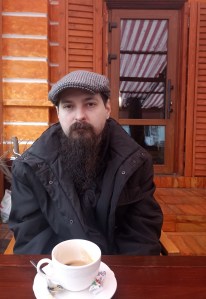
photo by Anna Parkhomenko
My name is Serhii S. Hololobov. I am the founder of the dark folk / neofolk project Wiseword.Nidaros (city of Mykolaiv, Ukraine). The project has been active since 2010. The lineup has changed multiple times over the years, and currently consists of two people. We have released 8 full-length albums, one of them is Забуті клейноди Півдня (“Forgotten Kleynods of the South”) is a collaboration with the Odesa-based duo Casa Ukrania, various song collections from different years, and several singles.
Two years before the establishment of Wiseword.Nidaros, I was the vocalist of the gothic rock / post-punk / folk rock band Wiseword. Actually, half of the songs on the first Wiseword.Nidaros album Сад Гетсиманський (“The Garden of Gethsemane”) released in 2010 are repertoire from that previous band.
In addition to the mentioned genres, my musical tastes include authentic world music, medieval and liturgical music, extreme metal – black metal and funeral doom metal, as well as alternative / rapcore / rap-rock (it’s no secret that I’m a fan of the famous American band P.O.D.).
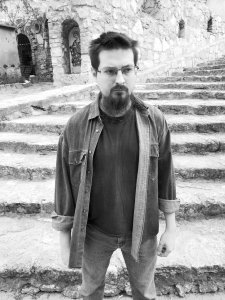
photo Anna Parkhomenko
Your lyrics often draw from the work of poets and religious texts. How do you go about writing your songs?
Typically, I start with the lyrics. I either select excerpts from classical texts or works of ancient poets, or I write the lyrics myself to fit the chosen concept of a particular album. When I’m writing the lyrics myself, it’s usually the case that I map out certain rhythmic nuances in them, which I may later try to play around with while choosing the melody. Once the lyrics and melodies are ready, arrangements are further refined in the recording studio together with the sound engineer.
What can you tell us about the production process for your recent album Хроніки dedicated to the memory of your sister Kateryna and aunt Larisa and did it feel cathartic to write?
The underlying concept of our album Хроніки (Chronicles) is linked to the ideas of the fantasy series “The Chronicles of Narnia” by the English writer, Christian apologist, and medieval literature expert Clive S. Lewis. I wrote the lyrics for this album first, and the process of creating the songs unfolded roughly as I described above. As for catharsis, let’s just say the lyrics of this album are probably the most personal stuff we’ve ever written.
photo by Zoriana Tarasiuta
Have you read A Grief Observed by C S Lewis which he wrote following the death of his wife?
Yes, I read this book, though it was a very, very long time ago. When I saw this question, I tried to refresh the text in my memory. It turned out that I even remembered some quotes (not word for word, of course). By the way, when I was working on the album Хроніки, I deliberately did not re-read the The Chronicles of Narnia series so that I would only use what had stuck in my memory.
My belief is that all the works of Lewis – The Chronicles of Narnia, Surprised by Joy, Reflections on the Psalms, Mere Christianity, A Grief Observed, etc. – are different facets of one large ‘woven’ Text, in a sense. Echoes of the same thoughts and conclusions connect all these works, even though the style in these texts was different.
Has your sonic environment changed since the full-scale invasion?
Indeed, with the onset of the full-scale russian invasion, the echoes of shelling and explosions commenced, along with the wails of air raid sirens. The latter, unfortunately, swiftly became routine, virtually part of daily life.
Where are you now and have you been displaced by war at any point, and how would you say life has changed for you since February 24, 2022?
For almost 2 years now, since February 24, 2022, and up to now, I have been staying in Mykolaiv. It feels like these are two different realities: life before February 24, 2022, and life after.

photo by Anna Parkhomenko
What is the current situation on the ground in Mykolayiv?
For more than a year and a half now, the residents of Mykolaiv have been without drinking water in their taps (only technical water is supplied). Drinking water has to be obtained at special water collection points located throughout the city (or by buying bottled water in stores). This is a consequence of the fact that in April 2022, the russian occupiers destroyed the pipeline that supplied water from the Kherson region to Mykolaiv.
Mykolaiv is still occasionally shelled by russian forces (though not as frequently as, for example, Kharkiv or Odesa). Until the Ukrainian forces liberated the city of Kherson from the russian invaders in the fall of 2022, Mykolaiv was shelled almost daily. When Kherson was liberated, the russians lost the ability to shell Mykolaiv from close range, although they still have the ability to attack with long-distance missiles and UAVs.
Despite all this, shops, medical facilities, post offices, cafes and restaurants operate in Mykolaiv; public transport runs, and cultural events take place (although, of course, not to the extent they were before the full-scale invasion).

photo by Anna Parkhomenko
How do you feel about the inclusion of “war sounds” in recent releases by Ukrainian artists and are there any specific sounds you find triggering? Also, how do you feel about bayraktar-core music?
It’s quite natural for people to try to make sense of their experiences in their creative work. Throughout history, people have always done that. Sometimes, sharp sounds like sirens in movies or music, especially unexpected ones, make me a bit jumpy, but nothing more than that.
Do you experience burnout and what do you do to relax and unwind?
I don’t think I can describe my feelings as burnout. As for relaxation, even routine things like making coffee in a cezve every day and tasting it bring my wife and me a bit of comfort.
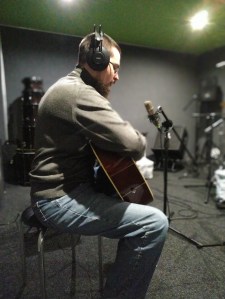
photo by Anna Parkhomenko
Which book / film / album / song / traditional dish / podcast / blog / artwork / building / meme best captures Ukraine for you?
As I see it, three books best represent Ukraine: the first Ukrainian historical novel Чорна рада (The Black Council) by the 19th-century writer Panteleimon Kulish; Vasyl Barka‘s novel Жовтий князь (Yellow Prince), dedicated to Holodomor of 1932-1933; and the popular science book Історія України-Русі (“History of Ukraine-Rus’”) written by the renowned composer and historian, a native of Mykolaiv, Mykola Arkas.
Not everyone is aware that the Ukrainian film director Oles Sanin is rooted in the authentic Ukrainian epic performing tradition known as kobzarstvo, playing traditional ancient musical instruments. As a result, ancient epic tradition songs, known as dumas, and ancient spiritual songs, or folk psalms, are featured in Oles Sanin’s historical films Мамай (Mamay) and Поводир (The Guide), with some of these songs being performed by Sanin himself. Also, you can hear the reconstructed ancient Crimean Tatar music in the film Mamay.
For me, the most interesting thing in Ukrainian architecture are the fortified churches. They were built in the late Middle Ages and early modern periods of our history. This style is mostly called “defensive Gothic”, but besides Gothic, it contains elements of Romanesque and Renaissance architecture. A vivid example of such a church, for instance, is the Pokrovska church (the church of the Intercession of the Theotokos) in the village of Sutkivtsi, Khmelnytskyi Oblast.
Who should I interview next and what should I ask them?
It would be nice to interview Volodymyr Kuchynskyi, the founder of the band Ворождень (Vorozhden’). He has several musical projects, all of which are quite prolific, so it would be beneficial to ask about his creative work, which he has been engaged in for over 30 years within three different projects – “Vorozhden’”, “Dead Faith”, and “Totem”.
JANUARY 28, 2024 – KYIV
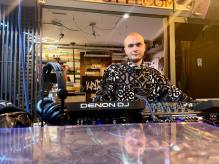
photo by Nelson Vasetska
Yo, my name is Volodymyr Iliukhin, and everybody calls me CHWBK (ex-Chewbaka Underground).
I am a drum and bass/breakcore/crossbreed DJ with about 2 years of experience and a starting music producer. I started deejaying in late 2021, and then got into music production a year later.
You will be able to hear my first big self-release on Feb 24, 2024.
Has the full-scale invasion changed the way you think about music, and sound in general, and has it had an impact on your playlist?
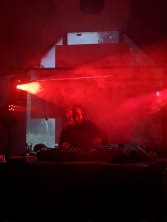
photo by Alexander Markov
The full-scale invasion gave me more focus on my dreams and what I really want to do. About half a year after the full-scale invasion I started learning Live by Ableton.
My sound also changed through that time, but it followed my plan. When I started deejaying I chose to play DNB ’cause I didn’t have enough experience to play Breakcore and Jungle well.
My playlist has remained mostly the same in terms of genres and styles.
Are there any Ukrainian releases from the past couple of years that you feel can help make sense of current events?
Well my opinion is that there are only 2 bands that did it well and stylish: Surface Tension and Прозак.
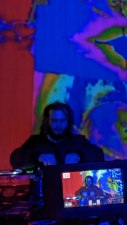
photo by Alexander Markov
Where are you now and have you been displaced by war at any point, and how would you say life has changed for you since February 24, 2022?
I was in Kyiv, am here, and went through the first months of full-scale invasion in it. Life has changed but it didn’t have much impact on my plans, ambitions, and path. Since the full-scale invasion, I’ve started earning more and changed from renting a room + learning deejaying on Bluetooth speakers to renting a flat and learning music production on KRK Rokit7 g4.
How do you feel about the inclusion of “war sounds” in recent releases by Ukrainian artists and are there any specific sounds you find triggering? Also, how do you feel about bayraktar-core music?
Well, the dub sirens were pretty triggering but I’ve got used to it cause I love jungle. Bayraktar-core is pretty nice actually, this is better for society than that wanking on russian school of Pop and rap music which was playing 24/7 on the radio before. And it’s not about russian artists.
My opinion is that Bayraktar-core is the first shine of creativity from our pop musicians.
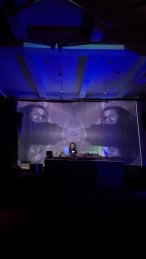
photo by Alexander Markov
How would you say the Ukrainian electronic music scene has developed over the years and what direction do you see it taking under present circumstances?
Medium names became big ones and small became medium.
There is much development in terms of quality and meaningfulness in the scene and music itself. The main game-changer in the direction that musicians are moving on is their awareness.
What would you say the West still gets wrong about Ukraine, if anything?
Well, sometimes there is a feeling that Western countries still don’t get that we don’t want to die.
Do you experience burnout and what do you do to relax and unwind?
I sleep.
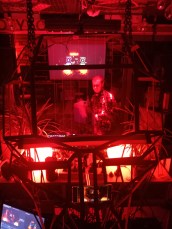 Who should represent Ukraine in the next Eurovision Song Contest?
Who should I interview next and what should I ask them?
- UBRZ, an experienced music producer from Kherson and a friend who taught me a lot about music.
- Tagaddam, a great DJ and selector, one of the creators of the BRUKXT project.
- Strictly old school roots Jungle DJ and Producer who has been in business for more than 10 years.
- JM Dasha Future Rave DJ and Producer from Mariupol.
- EIGHTEEN a hardcore DJ and producer from Odesa City.
- Ceezbo Tekno DJ and producer from Odesa City.
- Nelson and Vitaly, two skilful djs and selectors, creators of project Krytotyt.
JANUARY 29, 2024 – KYIV
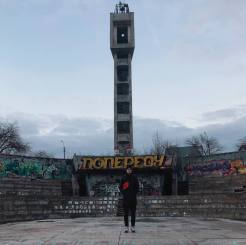
In short, it all started with the fact that I graduated from the closer connection school, thanks to my mentor Vera Logdanidi, who opened me up. Then а residency on Gasoline radio with a series of HUM/ГУЛ ethers, where we recorded 36 slots, 13 guests, 14 series. These series grew into a series of parties at HVLV, where we held 4 events. Then I did a mix for NTS, I released an album on mystictrax label and got a track in the shshchs compilation.
Has the full-scale invasion changed the way you think about music, and sound in general, and has it had an impact on your playlist?
No, it didn’t change. I felt that I, as a composer, must record the atmosphere and mood of this period. I will send compositions, my first works that I wrote at the beginning of the full-scale invasion.
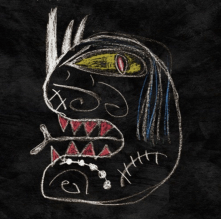
artwork by Bakunn
Your album Trip to Rivne looks back at a secret gig you did there 4 days before the russian full-scale invasion. What can you tell us about the production process and how it felt like to revisit that time when life was so different from what it is now?
There was a feeling of war even then, but few people believed, I personally felt it. Almost all the tracks were written when there was no light, I specifically charged the computer to spend time usefully. Returning there, you understand the value and uniqueness of the moment, as if fate itself is leading you, telling you your direction and path, who you are.
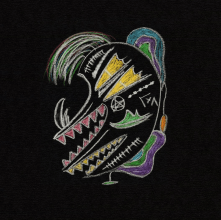
artwork by Bakunn
Where are you now and how would you say life has changed for you over the course of the past couple of years?
Life has changed radically over the last year, finally I am engaged in music professionally, radio, performances, releases. What I dreamed about, studied and prepared for this moment all my life.
Are there any Ukrainian releases from the past couple of years that you feel can help make sense of current events?
Heinali – Kyiv Eternal.
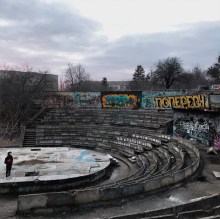 How do you feel about the inclusion of war sounds in recent releases by Ukrainian artists and how do you feel about bayraktar-core?
I also had a mush—up with industrial techno and screams from Mortal Kombat, like I wanted to show the audio scene of the battle for Gostomel. Yes, you can use anything in music if it reveals the artistic content. Bairaikar core, maybe this kind of music raises the morale and mood of someone. It is difficult to comment.
What would you say the West still gets wrong about Ukraine, if anything?
The West primarily thinks only about its own security and interests. We see the paradox that a nuclear country gets away with everything, it can do whatever it wants. We are going through a transformation of the global world order, war and cataclysms are waiting for us.
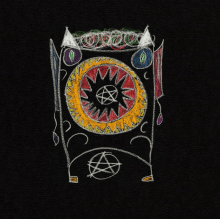
artwork by Bakunn
Do you experience burnout and what do you do to relax and unwind?
Up to now I haven’t faced burnout, on the contrary, I want to work and write, record, perform, learn music even more. But the main work takes a lot of time and effort.
Which book / film / album / song / traditional dish / podcast / blog / artwork / building / meme best captures Ukraine for you?
Borsch .
Who should I interview next and what should I ask them?
Sommer. Ask the same questions.
JANUARY 30, 2024 – CHERKASY
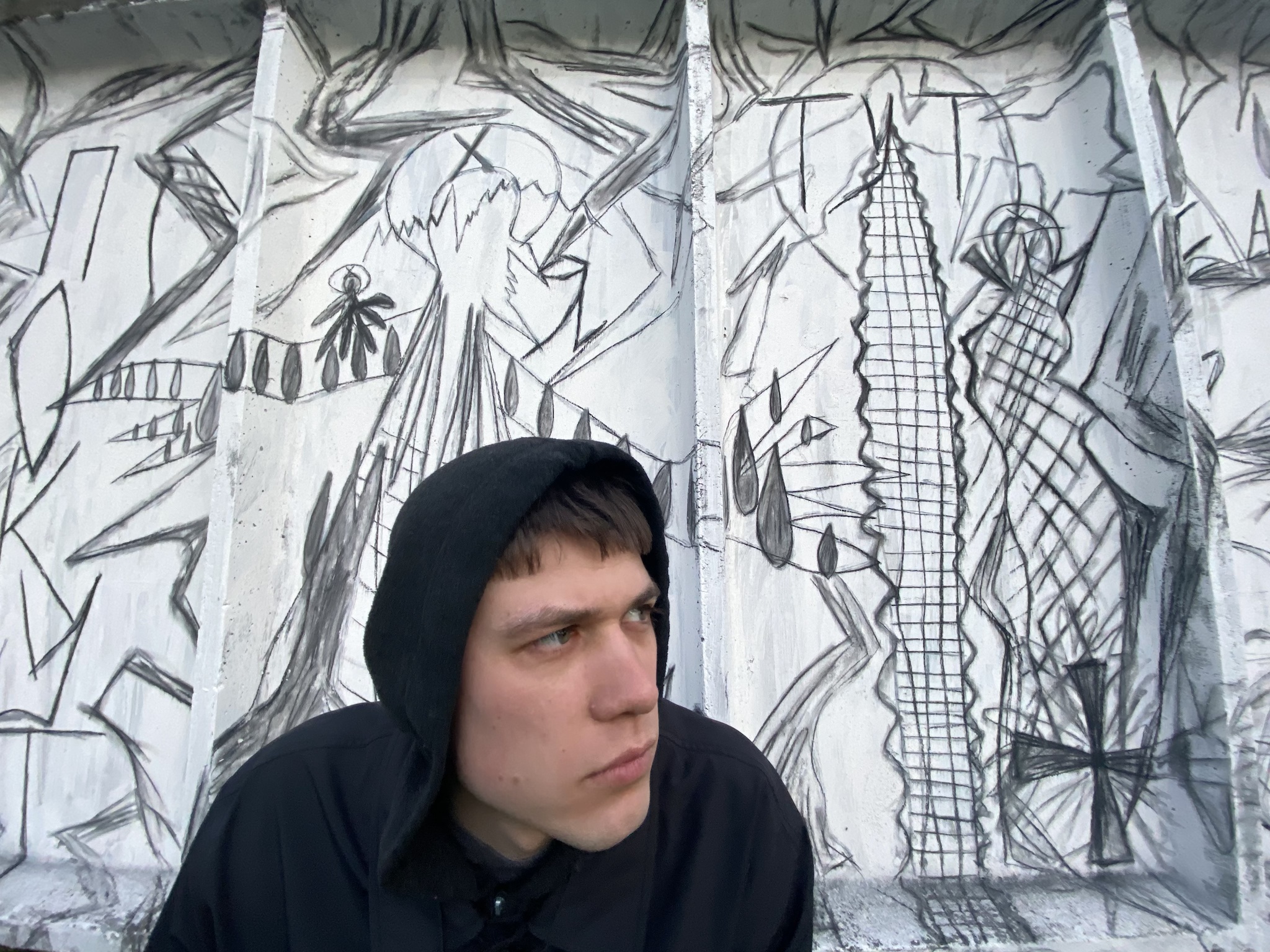
photo by Hanna Hak
My name is Volodymyr Milchenko, I make sounds in the Буду Думати (Budu Dumaty) project, research urban vices at Urban Downgrade, and I am a co-founder of the artistic association Proniknennya. My hometown is Cherkasy.
I became interested in music in 2016 when I was studying in Chernivtsi. One day I heard the Ukrainian band Kollezhskiy Asessor by accident and realized that there was a lot of Ukrainian music around that I hadn’t known anything about before, and it was very interesting. Then I started working as a content maker for the Amnesia.in.ua art research project. Because I had to work a lot with archival data, I significantly expanded my knowledge of Ukrainian music in completely different genres, and not only music. In 2018, I learned about the Hamselyt Festival of Experimental Music in Ternopil. I went there for two years in a row. It is the largest festival of experimental music in Ukraine. Unfortunately, it is not held now, as I understand it, because they could not withstand the stress of the Covid. There I discovered many contemporary artists who made a huge impression on me.
In July 2019, I returned to live in Cherkasy and from that moment on, I stopped being just an outside observer of artists. The community that existed in Cherkasy at that time encouraged me to interact with sound in every possible way. We would get together with friends and play a lot in Аbleton and Korg Volca FM. It was a wonderful period. I miss it very much. Then in 2020, I was invited by my friend Oleksandr K to the Forest Song festival in Manevychi, Volyn, which reminds me of Twin Peaks.
Oleksandr asked: “What name should I use for you on the poster?”
I replied: “I’ll have a think”
And he said: “Fuck, it’s a cool name”.
That’s how I became “Буду Думати” [literallay: I will think].
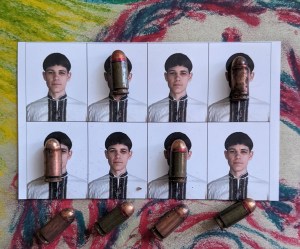
Photo by Volodymyr Milchenko
Has the full-scale invasion changed the way you think about music, and sound in general, and has it impacted your playlist?
Now I have complicated relationships with light and cheerful music. Sometimes I have to force myself to do it to get into the world of good thoughts. It is also very painful that many talented musicians have died during the two years of full-scale war. In particular, Vlad Onishchenko, the lead singer of the !alarm band. I love their music and I liked Vlad a lot for his energy and character.
Has the sound of your album Пусті Думки been influenced by current events and what can you tell us about its production process?
The full-scale war had a big impact. My sounds were not cheerful before, but the increase in the number of deaths, constant anxiety, stress, and uncertainty has layered it even more. For example, the first track Звуки думок (Sounds of thoughts) is a track I made in March 2022. I needed to somehow release my anxiety, and it’s about that. The whole album, although not directly, describes my feelings and thoughts during the war. The last track is Моя капека (My Kapeca) with the word Kapeca coming from a central Ukrainian dialect that describes something very bad happening. It is the longest track and describes my state most fully. It is the last one because this is not the end of this terrible story, it will only get worse and you need to keep this in mind all the time.
 Has your sonic environment changed since the full-scale invasion?
At first, no. Subsequently, the friends with whom I played a lot left Cherkasy before the full-scale invasion. And a year and a half later, yes, because I moved from Cherkasy to Lviv myself. Lviv is now home to a lot of artists with whom you can do collaborations, jams, and joint events. For example: in the six months I’ve been living in Lviv, I’ve received more offers for concerts or collaborations than in the four years in Cherkasy.
Where are you now and have you been displaced by war at any point?
Now I live in Lviv. I work in the humanitarian field for a large international humanitarian organization. At the beginning of the full-scale invasion, I lived in a village near Cherkasy for a while, my relatives said it was safer. At that time, it was not clear where our military would stop the russian invasion.
 Are there any Ukrainian releases from the past couple of years that you feel can help make sense of current events?
1. I will not be modest and will be the first to call my release Хроніки Болю (Chronicles of Pain)
It is about the confrontation between russia and Ukraine in a broad historical context. After all, this is not a war of two years, or even 10 years, if we count 2014 when the pseudo-“anti-terrorist operation” began.
2. Вічний Ґандж – мобілізований гоп
It is an ironic composition about the beginning of a full-scale invasion.
How do you feel about the inclusion of “war sounds” in recent releases by Ukrainian artists and are there any specific sounds you find triggering? Also, how do you feel about bayraktar-core music?
Very negative, because such sounds are very irritating. Especially the air raid sounds. By the way, I noticed that there are a huge number of tones and tempos of this sound. Each city has its sound/s. I can say that by the end of this war, I will become an expert on alarm sounds, just like the rest of the Ukrainians.
Bayraktar-сore is also a kind of reflection, just simplified. I don’t want Ukraine to be associated with this kind of music and I don’t want Ukrainians to listen to it. I hope this will change someday.
How do you see the noise and experimental music scene develop under present circumstances?
I think this is a golden time for such music. We’re tired of harmonious melodies, techno culture is gone. The sounds of grinding, screaming and noise are what modern people need.
What would you say the West still gets wrong about Ukraine, if anything?
I think the mistake is that the context of the consequences of russification is not taken into account. People do not delve deeply into history. And it’s also annoying that people who don’t live in Ukraine are trying to reconcile us with the “good russians”.
photo by Hanna Hak
Do you experience burnout and what do you do to relax and unwind?
As I not only live during the war in Ukraine but also work with its consequences as part of a humanitarian mission, I help people affected by the war every working day. I listen to their stories about the occupation, about being forced to move to russia, about the shooting of civilians. Recently, one woman showed me a video from Mariupol where a russian tank was shooting at a residential building. She said that at that moment she and her husband were in the basement of this house. It has a poor impact on my health. I try to relax with the help of cannabis, walks, music, and drawing, sometimes I write lyrics. For some time I visited a psychotherapist, but stopped because that specialist was not very effective. Now I want to start therapy again with another one.
Which book / film / album / song / traditional dish / podcast / blog / artwork / building / meme best captures Ukraine for you?
Video meme “Petro Shchur Mama’s room”
Who should I interview next and what should I ask them?
Новий Твій, band Чортополох, Arthur from the band !alarm and by the artist Роман Сірий. Ask them what they think about when they listen to the sounds of Буду Думати).
JANUARY 31, 2024 – LVIV
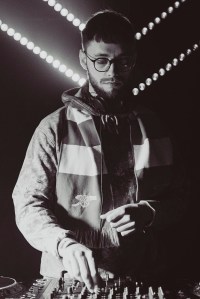
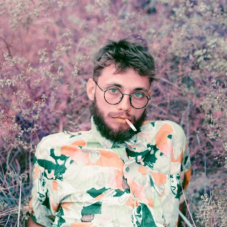
My name is Volodymyr aka volodis. I am a Ukrainian artist, DJ and recently sound producer, film photographer. Originali i’m from Rivne, now based in Lviv mostly. I have been playing music since childhood. Performed as a DJ in various cities of Ukraine, organized parties, cultural events, participated in the organization of festivals, etc.
Has the full-scale invasion changed the way you think about music, and sound in general, and has it had an impact on your playlist?
Ohhh yes, after the start of the full-scale invasion, I started to study and dive deeper into music, especially I started listening to old Ukrainian music, mainly from the 90s, and found some musical treasures that I did not know about. Also, I greatly expanded the boundaries of my music perception, and began to listen to a lot of non-dance and sometimes experimental music. Well, of course, I canceled all russian, although I didn’t have much of it.
photo by volodis
How aware would you say younger generations are of the Ukrainian music heritage and what are your favourite artists and albums?
I think that the younger generation is not very familiar with the Ukrainian musical heritage, I was not very familiar with it before too. The younger generation is now growing up on *tik-tok music* and this is cultural death for me. There is a lot of Ukrainian music and I would like young people to pay more attention to it than to trends from social networks.
For some time now, I’ve been listening to the band The Hostilnia the most, their sound and lyrics really resonate with my condition. Ihor Cymbrovskyi, whose concert I recently went to for the first time, is also very impressive. Новий світ is also one of my favorites. In general, this list is very long!
Regarding recent albums, Ukrainian Field Notes VA from the Odesa label – система, if we are talking about modern Ukrainian experimental music. From the old albums, I would single out The Hostilnia – Непри100совані.

photo by volodis
Has your sonic environment changed since the full-scale invasion?
I think so. My views on music and sound have changed, and with them, the environment. I will not say that these are radical changes, but they are there.
I began to cooperate more and communicate with people who move Ukrainian music and the scene in general forward, so yes.
Where are you now and have you been displaced by war at any point?
Before war started, I lived in Kyiv, but on February 24 I was forced to leave the capital, which, of course, had an impact on me. Now I live mainly in Lviv, but it is always nice to return to Kyiv from time to time.
 Are there any Ukrainian releases from the past couple of years that you feel can help make sense of current events?
During this time, we as a society experienced many different states.
From fear at first, a collective trip of unity, insomnia, aggression and the desire for the death of the enemy to temporary happiness from good news from the front or important political decisions from the world.
There is a lot of music that describes these states, but from the individual perspective of the musician.
Here are some that I would highlight:
- Cosmic Inflation by mystictrax;
- Military Kyiv by PAAT & RUSIIICK;
- Bezsonia by Sominaryst;
- Kyiv Eternal by Heinali;
- REACTOR by Polygon Records;
- Автопортрек by Andrii Barmalii
 How do you feel about the inclusion of “war sounds” in recent releases by Ukrainian artists and are there any specific sounds you find triggering? Also, how do you feel about bayraktar-core music?
Personally, I am not triggered by the sounds of war in music, but I think that during a war, they should not be used, there are so many reminders about war everywhere we go.
I honestly feel sick about bayraktar-core music, and trying not to let it into mine sonic bubble. Airpods helped me a lot with this)
How do you see the development of the electronic music scene in the current circumstances?
I am very proud of Ukrainians and our scene because it did not stop development and I personally discovered a lot of super talented musicians during this time. Also, the scene has shifted to charity events instead of commercial ones, we all try to support the army and each other. New associations such as Unight are being created, which consolidate promoters and the scene around them.
*Great heroes, poets and musicians are created by the people in moments of the highest tension in the life of the nation – in moments when people need them like air, like food.*
 What would you say the West still gets wrong about Ukraine, if anything?
I am grateful for everything they do for us, of course everything can’t be perfect and there will always be disagreements. Many still do not understand the threat that russia poses not only to Ukraine, but to the entire civilized world and the world order. We are teetering on the brink of World War III…
Do you feel burnt out and what do you do to relax and unwind?
Of course, there are difficult days, weeks, months. It is hard to live in constant uncertainty, but in difficult moments you can always think about our soldiers who stand to death between us and the russian world.
Creativity and music, social interactions or simple walking are what help me feel better and relaxed.
Which book / film / album / song / traditional dish / podcast / blog / artwork / building / meme best captures Ukraine for you?
- Book – Кобзар by Тарас Шевченко
- Film – Rhino
- Album – Русалки in da house by Katya Chilli
- Song – “Україна” by Тарас Петриненко
- traditional dish – Borshch
FEBRUARY 1, 2024 – KYIV
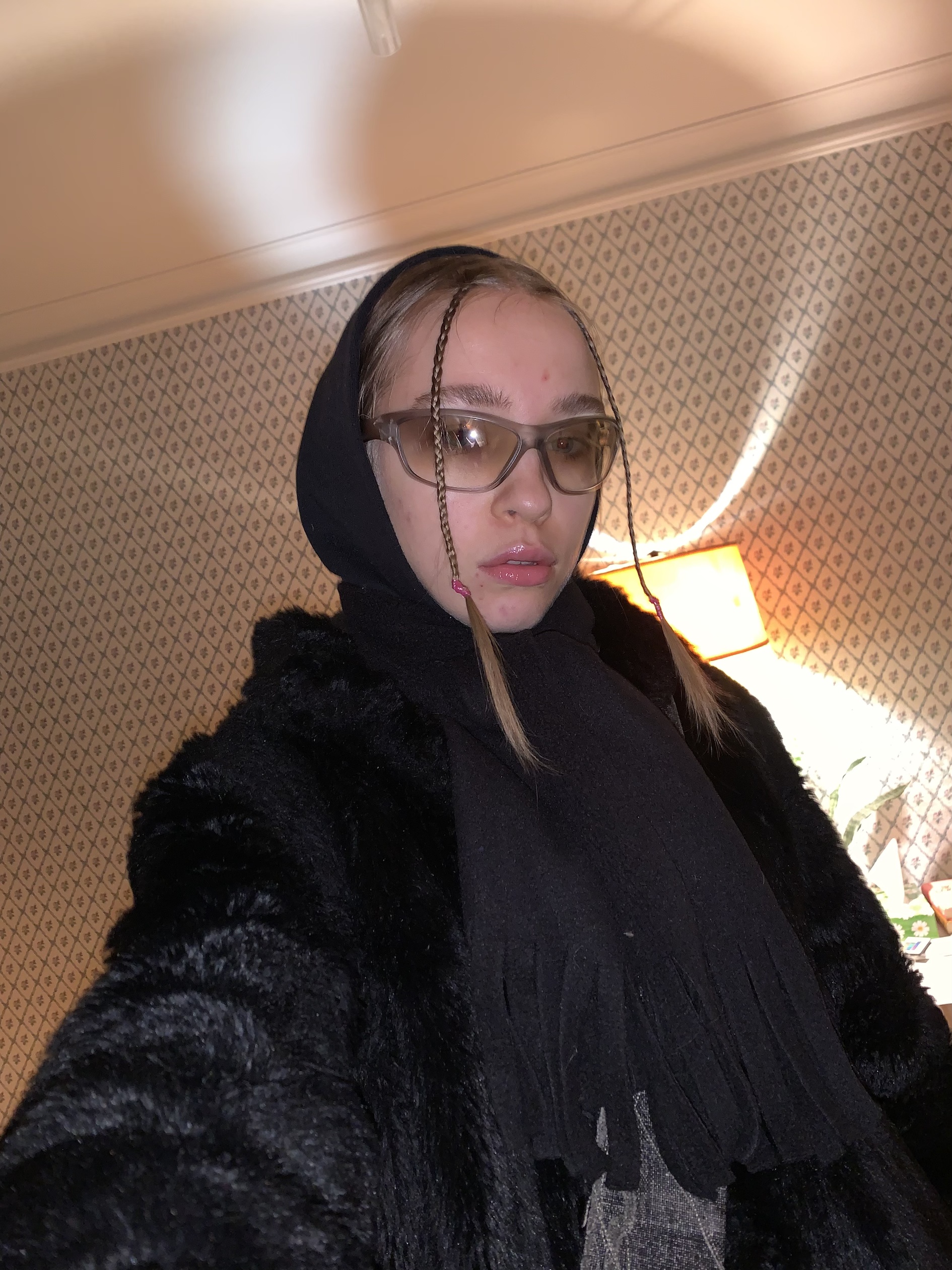
Hi, my name is Olena Pobochii, I am a DJ and creator of the music series Fèminine from the Ukrainian town Kremenchuk. Currently living in Kyiv where I actually developed as a music selector and digger. In the electronic music scene I have been evolving for the last four years and during this time I discovered a lot of emotional connections with this type of music and with the community which is united by it. All my love for this sound and what it represents started very commonly — by an accidental visit to one of the big raves in Dnipro city where I was studying.
Now I feel like a real part of the Kyiv local scene with constantly improving skills and a big passion to create and embody something important.
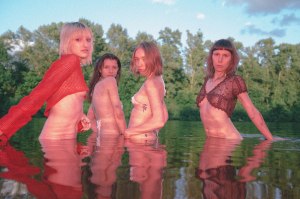
photo by Yaroslav Kozlitin
Has the full-scale invasion changed the way you think about music, and sound in general, and has it had an impact on your playlist?
Actually I started to really see myself as a DJ after the full-scale invasion. Before that electronic music was just a hobby to me without any thoughts about turning it into something bigger. So all these tragic events in my country did stimulate me to turn to music for some emotional relief. That’s where I discovered a lot of new genres and started to imagine my music personification as something confident, dreamy, sexy and full of love. Just like my favorite side of myself.
That’s how I created my own musical series Feminine, in which I organize events with special musical content and a feminine vibe, both with female artists and with boys.
How “feminine” do you consider the electronic music scene to be in Kyiv and Ukraine and do clubs provide enough of a safe space in terms of gender, and sexual orientation?
Regarding the femininity of the electronic scene in Ukraine: women definitely do not predominate among artists and producers at the moment, but the male side of the community supports us a lot. Unfortunately, it has historically been the case that the electronic scene is often associated with men, but this is changing now. I feel quite free to promote my sound and musical concept, but of course there are not many women in the line-ups of events so far. I am glad that the main operating venues and promotional groups of Kyiv emphasize the value of non-binary and any sexual orientation in every possible way. In general, I have the impression that our community is very open to mutual respect between people, regardless of their manifestation.
 Where are you now and have you been displaced by war at any point, and how would you say life has changed for you since February 24, 2022?
When the full-scale invasion started I had just moved to Kyiv two months ago and was assimilating to its rhythm, people and the whole environment. But after February 24 I spent two days in an apartment with my friends scared as hell and we decided to leave. Next two months I lived in Lviv in the West of Ukraine until I decided to come back to the capital and see how the city was reborn. That was a really good decision. I met a lot of great people in 2022 which changed my vision of music, action, culture and responsibility.
I can definitely say that my personal life and consciousness has become absolutely different and better in the last two years. When you live in constant chaos and danger around, you move faster. And you have a chance to choose the most important things in your life and live for them. To do everything you can for the sake of your goals and your vision of a better world.
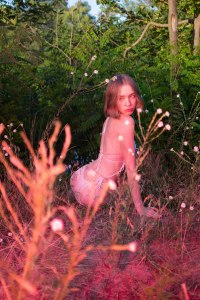
photo by Yaroslav Kozlitin
Are there any Ukrainian releases from the past couple of years that you feel can help make sense of current events?
In fact, I cannot name individual releases that embody modern events for me. All artists living in Ukraine and creating music reflect completely different feelings and impressions, and they are all true. I just admire the fact that so many people find inspiration in themselves to create and push our culture further, may it continue.
How do you feel about the inclusion of “war sounds” in recent releases by Ukrainian artists and are there any specific sounds you find triggering? Also, how do you feel about bayraktar-core music?
Now most DJs in my community have rules not to play music with sirens, explosions and other sounds that cause associations with scary events. I can say for myself that when I hear sirens in the track, I look out the window or check my phone for an air raid alert. I think that’s common to a lot of people, so it makes sense not to make listeners feel anxious.On the other hand, if these are releases aimed at an audience abroad and which aim to reproduce the modern sound background of Ukrainians, it may make sense.
About bayraktar-core — I personally can’t stand any music in this genre. But I consider this a common phenomenon for the culture of the country, which is going through difficult times and chooses popular associative images for creating music, movies, clips, etc. I really want to emphasize that this is not the main thing that reflects us as a nation and this is a relief 🙂
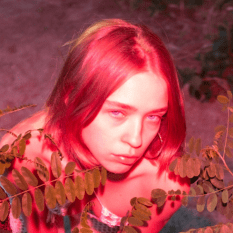 You are a resident of Hvlv, how would you say the Ukrainian electronic music scene has developed over the years and what direction do you see it taking under present circumstances?
I see now in the Ukrainian scene unique phenomena, when young artists can advance at an incredibly fast pace, and the public is open to new names, visions and experiments. Unfortunately, this is not the field where you can earn and build a career, because we send all profits from events to help the armed forces (and it’s great that we have this opportunity to help). On the other hand, the electronic scene is a community of incredibly talented, socially active and responsible people who create the future for the entire country with their actions. Developing side by side with such personalities is a really great opportunity to feel yourself and show your strengths.
Unfortunately, the war changed the scene in cities other than Kyiv, in some places it completely destroyed it, and this is painful to understand. I really hope for the revival of local opportunities and interest throughout Ukraine in the development of the culture of electronic events. It is a really important part of culture that should live and represent our national talents. In a couple of years, I see only the strengthening of our musical product and its rise to a new level, and I also long for the perception of this scene as a full-fledged art and a culturally significant phenomenon. Now is the time to create new awareness and destroy myths about electronic music.
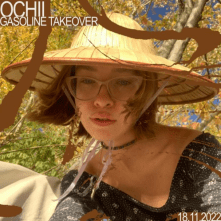 What would you say the West still gets wrong about Ukraine, if anything?
I don’t communicate very much with those who live abroad, but I observe in social networks sometimes a great aversion to news about Ukraine, about the financing of our troops and terrible events. We are still in constant tension. We still don’t have enough money for weapons and equipment, local activists really give everything they can to buy the most necessary ammunition. We really need support from abroad and awareness that russia is a terrorist country that threatens not only us, but is also an enemy of the whole world that needs to be eradicated. We want to get rid of russia’s many years of oppression and we need your help.
Do you experience burnout and what do you do to relax and unwind?
I am constantly filled with anxious thoughts about how life will be and whether it will be at all. To keep me moving, I’ve found a few things that save me and fill me with peace: yoga, meditation, and music. And also conversations with people who live the same experience nearby and can understand and support.

photo by Yaroslav Kozlitin
Who should represent Ukraine in the next Eurovision Song Contest?
Absolutely not interested in this. This musical niche seems to be passing by in my life, and I’m actually glad about it.
Which book / film / album / song / traditional dish / podcast / blog / artwork / building / meme best captures Ukraine for you?
I simply adore Ukrainian culture, mentality and sense of humor and am simply proud to be Ukrainian. So this is a super minimalist list of my associations.
Book — The Enchanted Desna by Oleksandr Dovzhenko.
Film — Shadows of Forgotten Ancestors by Serhii Paradzhanov.
Album — Rusalky In Da House by Katya Chilly.
Traditional dish — borsch with smoked plum.
Building — St. Sophia Cathedral.
Meme — https://ua.reactor.cc/post/5522954#comment27616727
FEBRUARY 1, 2024 – KYIV
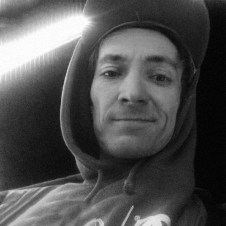
Hello, I am a guy born in the early 80s, and as most young people from old military towns I began my musical education thanks to American disco tapes and bands like Prodigy. Also, discofunky house, break beat, and electronic music that started with the Chemical Brothers.
All my life, I’ve always walked with music on, headphones on and off. Later, I heard a phrase with which I agree wholeheartedly, “Life is meant to be danced.” And together with my friends I started to make music events and to play music. It was the mid 00s. And I am still trying to keep my hand on the pulse… and yes. I like to dance)
Has the full-scale invasion changed the way you think about music, and sound in general, and has it had an impact on your playlist?
Sure, it changed. At least I had much less time and mood to dive into music. Style of music still belongs to genres with a deep and dark sound, that has grey color… halfstep and 170 techno still my favs. More positive, intelligent drum and bass also appeared on my playlist. Also, it’s important to remain in a positive state, switching between news, war and normal life.
Has your sonic environment changed since the full-scale invasion?
The sounds of the street are now permeated by the wailing of sirens with occasional explosions. At night, we learned to identify the sounds of drones.
Where are you now and have you been displaced by war at any point, and how would you say life has changed for you since February 24, 2022?
From the beginning I have been and remain in Kyiv. Fortunately, the war did not displace me. Generally speaking, the perception of reality has changed.
Are there any Ukrainian releases from the past couple of years that you feel can help make sense of current events?
To be honest, I haven’t followed the events on the music scene for a long time.
How do you feel about the inclusion of “war sounds” in recent releases by Ukrainian artists and are there any specific sounds you find triggering? Also, how do you feel about bayraktar-core music?
I am lucky not to have been sent to the front line yet. But I understand that the sounds of war can be disturbing to others who have experienced it directly. I have never heard of the style of “bayraktar-core music”.
 How would you say the Ukrainian electronic music scene has developed over the years and what direction do you see it taking under present circumstances?
I believe that in order for music to develop, we need conditions that we unfortunately do not have. As pessimistic as it may sound.
What would you say the West still gets wrong about Ukraine, if anything?
I am not the most knowledgeable person in geopolitics, but I know for sure that we will win with or without the help of the West. With help, we will do it faster.
Do you experience burnout and what do you do to relax and unwind?
Fortunately, burnout has not yet occurred. But the range of leisure activities has narrowed along with desires. Meeting up with friends helps a lot to dispel the sadness, sometimes I attend parties when my friends play. At times like these, one appreciates basic needs more.
Who should represent Ukraine in the next Eurovision Song Contest?
This is not a question for me.)) I hope it will be someone worthy.

Вхід У Змінному Взутті
Which book / film / album / song / traditional dish / podcast / blog / artwork / building / meme best captures Ukraine for you?
- I can’t suggest a book.
- I think Netflix made a good documentary about the Maidan. I also want to watch Moustache Funk – many friends recommended it.
- The radio airwaves are very cluttered and it’s hard to wait for something nice))
- I remember bands from the 00s. One of them is Вхід у Змінному взутті, a hip hop band from past. I listen to music more often from soundcloud.
- Traditional dish, for sure, borsch and deruny (potato pancakes).
FEBRUARY 1, 2024 – ODESA
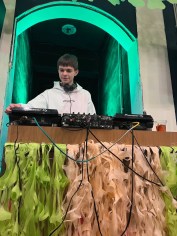
Greetings! My name is Yevhen Pecherskyi. I am 19 years old.
I was born in Teplodar and lived there for half of my life! In 2017, I moved to Odesa, and that’s when I got acquainted with rave culture and the electronic scene in general. Parties like PORT and AGHARTI have become my favorite places near the sea.
Exchanging experiences and getting to know new people inspired me to love dancing and music. One fine day I heard the following phrase, “To make music? It’s easy.” From that moment on, the search for the promised one began. (29.12.2019)
I studied, studied and studied again – through the Internet. At first I used Fl Studio, but then I realized that I was missing something and started learning Ableton, it is more intuitive.
But in March 2020, I already wrote my first track, and everything started moving. So far, I have released 6 singles, 5 albums, and 7 live recordings. I am currently working on two projects (DARK WAY) to show what evil can be through music, because if you don’t know what evil is, how can you understand what good is? (LIGHT WAY)
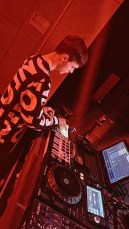 In the liner notes to your latest album, Falling Sky, you say that with this album you achieved inner freedom. Could you expand on this topic and tell us how you managed to achieve this?
I had a relationship, which lasted 3 years, and contributed to the beginning of my creativity completely in terms of support, inspiration and in the sense of developing without knowing the limits. It was love – a whole life and dreams that ended and collapsed, and with it, my inner world.
As soon as it was over, I was lost and couldn’t understand what was wrong with me – but it was an emotional bomb that had to be endured. For this, music helped me to tell about the sequence of my inner experiences. As soon as I finished the album, I was free and the love for myself came back.
 Where are you now, have you been displaced by the war, and how do you think your life will have changed after February 24, 2022?
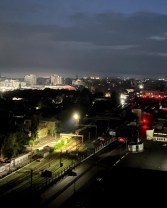
As I live in Odesa, I will stay here. Life has changed to shades of white and black, the military needs help every day. Donate and repost! This is important for victory.
Are there any Ukrainian releases from the last few years that you think can help to understand current events?
Many new things have appeared – both new artists and musicians, and artists and new labels. I cannot give an exact answer. Every city and every community has something unique, valuable and special for everyone.
 What do you think the West still gets wrong about Ukraine, if at all?
As for corruption, there is a lot.
Who should I interview next and what should I ask him about?
Sekta.Music – culture. war politics
BE_CA_DI – music scene. artists label
FERBUARY 14, 2024 – HUDSON VALLEY
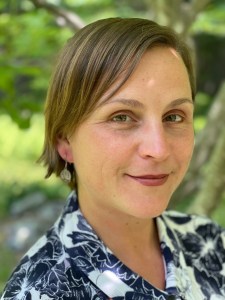
Thanks for inviting me. I’m currently a professor of Anthropology and Music at Bard College in the Hudson Valley of New York. I’ve written two books about Ukrainian music, a bunch of articles, made some musical recordings and a museum exhibition as well. I’m also a person of Ukrainian heritage: both of my parents arrived in North America as children from Displaced Persons camps in Europe after WWII. So my upbringing in the post-war Ukrainian diaspora meant that I learned to speak Ukrainian before English, learned Ukrainian history as distinct from but entangled with Russian history, read Shevchenko before Pushkin, etc. Once we reconnected with our family in Ukraine, and I started traveling to Ukraine in the 1990s (first as a child, and then independently as a teenager and adult), I grew fascinated in the overlaps and contrasts between my diaspora upbringing and the lived realities of people in Ukraine. Eventually that led me to study Ukrainian culture during my doctoral studies, and steered me towards topics that were not directly related to my family’s story.
My father was an amateur but quite accomplished classical musician, and so I grew up immersed in classical music culture. I finished a degree at the Manhattan School of Music in piano performance and then played a lot of experimental chamber music in addition to more standard classical repertoire. But after college I also picked up the accordion, and it really—without exaggeration–changed my life. The accordion exposed me to all kinds of folk musics that I’d never really played before, and allowed me to play music that aligned more closely with the music I listened and partied to as a 20-year old in NYC. So that also fed into my scholarly research, which has usually hovered in the blur between folk and popular music, though recently I’ve been reading and writing a little more about classical music again.
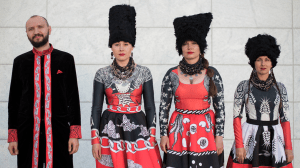
DhakaBrakha
Has the Russian invasion of Ukraine and the annexation of Crimea changed the way you think about music and sound in general?
Not in a profound way, but it has affirmed my belief that music is not merely decoration for life, not just indulgence; it can be central to the substance of life, of how we connect and affiliate, of how we relax and express our rage, of how and when we spend our money, of how we think about our histories as individuals and communities, of how we shore up morale and build solidarity, and of how we understand the world. If we think back to the viral moments that defined the first weeks after the Russian full-scale invasion, we might remember how many of those were musical moments – from the “Oi u luzi” gestures of international solidarity, to the videos of musicians playing in bomb shelters, to the concerts that raised money for Ukrainian efforts. I don’t want to overstate the role of music in a time of emergency, of course, but the notion that musical culture is just fluff that distracts us from the real matter of life is plainly wrong. It’s deeply bound up with the quote-unquote real stuff of life.
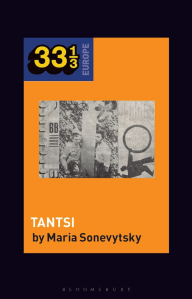 You have written a book on the Ukrainian punk band Vopli Vidopliassova. Their work was only mentioned a few times over the course of the 270+ interviews I did with Ukrainian artists. Do you think younger generations are aware of their musical legacy?
First of all, thank you for doing so many fantastic interviews. Second, no I don’t think many younger Ukrainians know of VV’s musical legacy in the late Soviet period. I think it’s likely that younger generations of Ukrainians only encountered them in their post-Soviet manifestations (there have been many), and—reserving aesthetic judgement—the Vopli Vidopliassova of the “wild capitalism” era was not the same as the VV of the late Soviet period, as most of the original band members would agree. VV of the late 1980s was hemmed in by the constraints of Soviet life, to be sure, but they were also speaking to the specific absurdities of the Soviet 1980s, which was part of what made those songs / lyrics / videos so damn appealing. I found that their punk affect, just irreverence to everything, and the subversive sarcasm and humor that’s integral to their earliest recordings, plus the Ukrainian twist they added through lyrics and gestures, to be truly original. My hope in writing that book was to shine a light on this fascinating moment when the so-called “Kyiv Underground” was in full swing. And I really hope that it fills in one of the many little-known chapters in Ukrainian musical history, at least for people who are younger, and who can read in English.
When asked by Natalia Korniienko in Chytomo, “How long will it take the world to stop seeing Ukraine – historically, politically, culturally and mentally – through the lens of russia?”, the Ukrainian writer and artist Anatoly Dnistrovy answered that, “The problem here is that Ukraine has never presented itself on foreign markets. And russia, on the other hand, put great efforts into it: they’ve been tirelessly retailing their messages all over the world and feeding their narratives to the European [sic] society for centuries.”
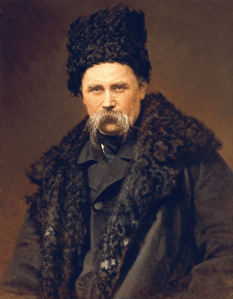
Taras Shevchenko
Did you see a shift in the international public’s perception and understating of Ukraine over the course of the past two years?
I think Dnistrovy has a valid point. There’s a book that just came out in January 2024 titled How Russian Literature Became Great. And the author’s thesis is not that Russian literature is or isn’t objectively “great,” but rather that the Russian “classical tradition” became formed as a canon explicitly to contribute to Russian nation-building, and then that project became exported throughout the world, contributing to the entrenched ideas we have about the “mysterious Russian soul” and so on. While the author isn’t making the case that Russian literary “greatness” is exceptional compared to other nation-building projects that tried to market their culture as a coherent and exceptional tradition, the fact of Russia as an empire, the sheer scale of the PR machine behind it, has obviously overshadowed places like Ukraine, where the greatest hero of modern literature — Shevchenko — was not the owner of serfs, but was himself born into serfdom and had to have his freedom bought for him.
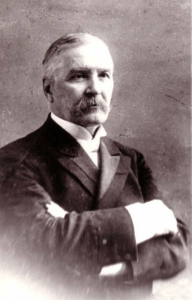
Mykola Lysenko
This has clear applications to music too, and I’ve written about it a bit. Why does the whole world sing about the singular
greatness of Tchaikovsky, but not one outside of Ukraine seems to have heard about his contemporary, Mykola Lysenko?(In their lifetimes, the two admired each other as composers.) So basically, yes, Russia has been proactively marketing itself, competing for inclusion on the terms of “greatness” set by colonial Western European powers, for centuries. This was happening while Ukraine was divided between empires and subject to waves of cultural (linguistic, musical, theatrical, filmic) repression at the hands of Kremlin powers. The terrain was never equal, and it’s disheartening when Ukrainian artworks that managed to break out still get categorized only as “Russian.”
All that said, popular music has been an important arena in the post-Soviet decades for Ukraine to present itself on the
international stage. Right now, we’re also finally seeing some recognition of Ukrainian composers, both living and dead, just as people around the world are finally getting acquainted with Ukrainian literature. But this is happening for the worst reason, which is the existential threat that Ukrainians face today due to Russian aggression.
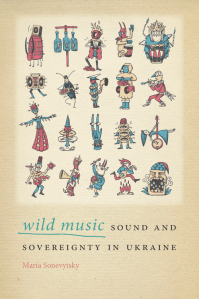 In Wild Music you write that “The Wildness of DakhaBrakha’s ethno-chaos also attempts to rehabilitate the fractured past of Ukrainian history as a way to move beyond its post-Soviet ‘memory wars.’” Could elaborate on this?
Sure! In that chapter of the book, I’m writing about how DakhaBrakha use various “soundmarks” – musical or sonic gestures that are associated with a specific place, or history, or tradition – the way that landmarks designate specific territories. I make the rather simple point that they often stitch together diverse soundmarks in their compositions. So you might have a soundmark from the west of Ukraine arranged in next to a soundmark from a central, southern, or eastern region. It’s a compositional method to establish a whole out of parts, which is what every project of collective identity is.
Given how contested the history of Ukraine is, I think this is a powerful method of showing how the fractures of the past can be incorporated and even overcome. Every modern nation-state is an invention, but we invest meaning in nation-states, enough that people are sometimes willing to put their lives on the line for them. Part of the project of national survival is to allow diverse populations coexist harmoniously, and I hear them doing that through their music in explicit and more subtle ways.
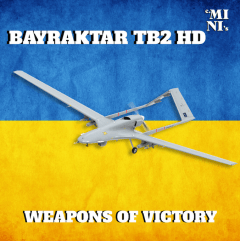 Many of the Ukrainian artists I have spoken to are critical of sharovarshchyna and bayraktar-core. What is your feeling of its actual impact within Ukraine society?
Sharovarshchyna — like kitsch of any kind—is in the eye, or ear, of the beholder. People sometime use it just to name music they don’t like aesthetically, which is a normal feature of any lively cultural sphere. We always mark distinctions in taste. When I was doing the interviews for the VV book, I was delighted to hear original band members describe how they would take inspiration from what they considered to be the worst Soviet state-sanctioned pop music, estrada, and use it as inspiration for their songs.
Kitsch can work in mysterious ways, and I have my own relationship to it, but in general, I think it’s always interesting when generations go back and re-evaluate the music that was denigrated as kitsch in its own time. I wonder if that will happen, or is already happening again, in the Ukrainian case.
Bayraktar-core, as you call it, is perhaps an expected response to the Russian full-scale invasion. It’s not music that I seek out, but I understand its purpose to boost morale during very difficult times, and I believe it’s probably serving some group of people who want or need this particular kind of morale boost. Who am I to judge?
It also needs to be said that the majority of Ukrainian artists I interviewed are young electronic artists. Few of them, for instance, showed any interest in the Eurovision Song Contest, which you have analysed in particular in relation to Ruslana’s win. After Kalush Orchestra’s “Stefania”, how does one negotiate between drawing attention to Ukraine while avoiding repeating damaging stereotypes of exoticism?
This is really the main subject of my first book, Wild Music. I was really fascinated how, in 2004, Ruslana repackaged Hutsul culture—Carpathian Mountain highlander culture—in pop form by doubling down on the most common stereotypes of Hutsul exoticism. That this was done under the guise of presenting Ukraine as “European” was a contradiction that I wanted to explore. And of course, such self-exoticizing representational strategies continue at Eurovision, not only by Ukrainian artists, but by many participants in the Eurovision Song Contest. “Stefania” by Kalush Orchestra was also drawing upon Hutsul sounds and images to some degree, though the display and conception is quite different from Ruslana’s “Wild Dances.” In other years, we’ve seen Ukrainian Eurovision participants draw on many regional folk traditions—from the Chornobyl Zone to Crimea—and these artists have often ranked higher than those who offer a more generic straight-up pop song, so I think it’s safe to conclude that Eurovision audiences are often appealed to by the incorporation of folk gestures in the music. Is it possible to incorporate these without slipping into damaging stereotypes? I think it is, but that line is blurry, and changing, and 100% subject to interpretation.
I wouldn’t really expect Ukrainian electronic artists to pay a lot of attention to the massive pop-kitsch spectacle that is the
Eurovision Song Contest because it’s a world away from the kinds of scenes that electronic musicians typically inhabit, and both worlds are valid and rich and diverse and politically engaged in different ways. As a researcher, I find the Eurovision Song Contest to be a fascinating site where geopolitics meets pop, and so therefore worthy of study. Even the recent history of Russian and Ukrainian conflicts at Eurovision is fascinating – like the controversy over Jamala’s “1944” song, which the Russian delegation tried to disqualify in 2016, alleging that it was “political” and therefore in violation of Eurovision Song Contest rules.
Eurovision artists win access to platforms and support that have historically been difficult for Ukrainian pop musicians to access otherwise, so it’s also a vital launching pad for musicians who then become prominent advocates or representatives for the image of Ukraine to a certain segment of an international public. Again, I want to be careful not to overstate the impact of Eurovision!
But I also think we should not ignore it. Whether we like it or not, a lot of people learned about Ukrainian pop music for the first time through Ruslana’s “Wild Dances.” I’m following the contest this year again, and eager to see how Alyona Alyona and Jerry Heil perform with their song “Teresa & Maria.”
Has the role of music in Ukraine shifted from one of entertainment to encompass the expression of identity, communication, and emotional and physical survival?
I think it’s always been capable of both – going back to pre-Soviet history.
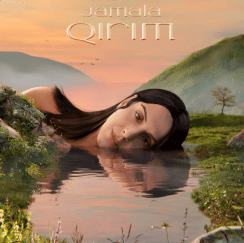 Are there any Ukrainian releases from the past year and a half that you feel can help make sense of current events?
Probably too many to list. Since I tend to gravitate towards things I study in folk and popular genres, I’ll list a few in that space.
Jamala’s QIRIM, is a really fascinating musical intervention on behalf of Crimean Tatar people and their claims to the territory of Crimea. That album is currently in the running for the Shevchenko National Prize in Ukraine, which suggests something about its wide circulation and its political interpretation. Jerry Heil and Alyona Alyona’s EP “Dai Boh” featured guests from various countries in Eastern Europe and reimagines various folk materials. (They just won the Eurovision nominating context for this year.)
I find Onuka’s music and the recent song “Peremoha” to be very in line with these conversations about making music to boost morale. Her husband, Eugene Filatov, has been doing an interesting project on various Ukrainian cities, combining field recordings with studio techniques titled “How Chernihiv Sounds,” or “How Odesa Sounds,” etc. As someone who is an ethnographer, I suppose this field recording approach is close to my heart. And I’ve enjoyed learning about Gasoline Radio and some of the music featured there, including some of the people you’ve featured on here before, like Heinali.
What would you say the West still gets wrong about Ukraine?
A lot. I think there’s a persistent habit of thinking of Ukrainians in very binary ways, like either 1) not “real”/non-existent (this is very prominent in Putin’s rhetoric, of course, but it also has found audiences in the West and in the Global South), 2) or nationalistic/fascistic and threating. Or 1) as superhuman fighters for the values we in the West supposedly so cherish (but consistently fail to live up to!) or 2) alienated and ready to surrender to Russian domination. And so on. Such simplistic categories basically don’t apply to most of the Ukrainians I know and have known in many different regions of the country, and I do worry about the ways in which the West doesn’t allow Ukrainians full and complex humanity.
And finally, a provocative question, has Ukraine overcome its inferiority complex?
I don’t really know how to answer this one! The condition of postcolonial inferiority complex is something that people like Frantz Fanon and Albert Memmi wrote about extensively, but we see in many post-war decolonizing societies that these inferiority complexes can end up overcompensating, tipping into extreme forms: of ethnonationalism, xenophobia, or primordial nationalism. I just hope that the brutal effects of this Russian war don’t breed these extremes in the Ukrainian public. When I was working on the VV book, it was fascinating to hear some people from the Kyiv Underground scene reflecting on their attitudes in the 1980s as those of colonized subjects, people who believed that to speak Ukrainian, for example, was embarrassing. So I wrote about it there as a process of confronting a kind of postcolonial inferiority complex. And notably, those interviews were done before the full-scale invasion in 2022.
I do see a reappraisal of the legacy of Russian imperialism, Russocentric cultural policies, and anti-Ukrainian repressions
happening today, and that has had far-reaching effects in Ukrainian music culture. More pride in local musics, more investment in learning the history of diverse regional traditions, more musicians choosing to sing in Ukrainian or to speak to Ukrainian audiences. That’s all to the good, in my opinion, and I hope it flourishes.
FEBRUARY 14, 2024 – VINNYTSIA
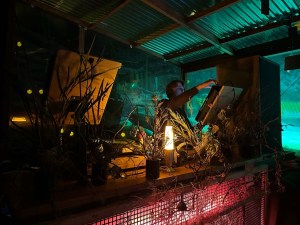
My name is Volodymyr, my moniker is Saturated Color. I live in Vinnytsia, Ukraine.
I have been playing music since I was 15 years old. The journey started from my school days. I became good friends with two boys I was in the same class with who listened to electronic music. One of them made a simple beat, I was surprised and interested. Also, I wanted to be as “cool” as them, as they made it seem so effortless and playful to make music. As a consequence, I began to dive into the world of creating electronic music myself. It’s been an amazing path to follow. I started to discover releases on bitport, to analyze them, and to study and understand styles, genres, discussing them together with friends, every Monday, systematically. After that, we began to review the results.
I released my first track in 2014 and began to delve further into the world of music. I started with an EDM music festival. Later, my tastes and needs began to transform. I was introduced to records by Rick Wade, Delano Smith, etc. After that, I gradually began to discover the underground scene. From house to ambient, breakbeat and absorbed everything I saw and heard.
That’s how I got to where I am now.
How did you become a DJ?
My career as a DJ began thanks to an acquaintance who suggested that I play in a bar in my hometown. We had just met and became friends later. It’s an amazing story.
It was back in 2017. I arrived by train from another city, and thought, “Wow, underground is playing here.” I also managed to meet the established, resident DJs who played there.
That’s how, slowly, I started to play more often, to create more dance tracks, and I saw the meaning in this business.
Has the full-scale invasion changed the way you think about music, and sound in general, and has it had an impact on your playlist?
Yes, it was very difficult for me to make music in the early days of the full-scale invasion. I was knocked out of music life for almost a year. I fell into a deep depression. I listened to more atmospheric music, reflected a lot, went through a personal crisis, and sometimes managed to process my experiences creatively.
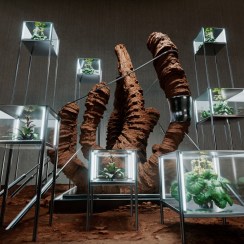 Your album Phenomena came out in September 2022 on mystictrax. How much of it was written before the full-scale invasion and what can you tell us about its production process?
The entire album was created before the full-scale invasion. The tracks were made in different periods of time and under the influence of different styles of electro. One can hear the influence of Detroit, namely Aux 88, E.R.P., Plant43, the peculiarities of interpretation, the influence of the Kyiv scene and different air temperature and rainfall.
I formed the concept under the influence of inspiration from undergoing personal psychotherapy, as I was going through a difficult and deep identity crisis. Acquaintance with phenomena of various kinds, and how after the album I now accept myself as different.
The creation process was spontaneous and easy, it was 2018-2019, full of inspiration and productivity. The album cover is really about something metaphysical and modern.
 What can you tell us about Hey You! Recordings and about the lighthearted and positive sound of your EP Complete Nonsense?
Hey, you! is about creativity of various kinds and categories. It is difficult to give a short answer but, basically, the project was formed by two of my friends, Cornrows and Karpman Huger. Initially, the guys wanted to shed a spotlight on the Vinnytsia scene, but later, their ambitions grew, and we abandoned the idea of producing only Vinnytsia musicians.
After the release of my album, they invited me to work with them on the project and label. I agreed and invited another friend to join the team, Fin Force.
Complete Nonsense is an album about easy future days, in a native place, about streets, about coffee, about friends. This is exactly about life.
 Do you experience burnout and what do you do to relax and unwind?
Yes, I am still dealing with depression. And besides me, it’s music, reflection and just silence.
Which book / film / album / song / traditional dish / podcast / blog / artwork / building / meme best captures Ukraine for you?
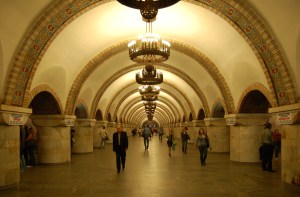
The city of Kyiv, it is very modern, alive, full of heritage that inspires, that conveys the mood of culture. For me, this is a city that speaks of freedom, will, and respect. I especially adore the “Golden Gate” metro station in Kyiv. It is amazingly beautiful there, and fascinating. A feature of culture that inspires authenticity.
FEBRUARY 16, 2024 – KYIV
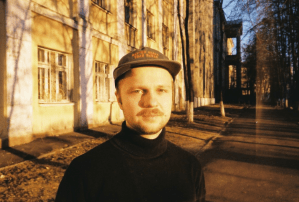 Danylo Galyko – Blooms Corda
Hi there! I am Danylo, a poet, musician, artist, and frontman of the indie musical group Blooms Corda. Listening to music was my main pastime as a child. There weren’t many toys, the Internet hadn’t been invented then, and my parents were often gone at work, but I knew what to do because I was taught how to use a vinyl player and play records.
Since my dad had great taste in music, and I had nothing left but to sit in a chair and listen to music for hours, I believe this became the first spark for further creativity in this area.
Has the full-scale invasion changed the way you think about music, and sound in general, and has it had an impact on your playlist?
For the first three months after the start of the full-scale war, I could not listen to any music at all, although before that I listened to a lot of different things every day. I was in a stupor. Then gradually I began to listen to classical music, and then to all other music, the last in this chain was jazz. Although before that I liked it, the complexity and chaotic nature of this genre probably scared me off.
I’ve also noticed that sometimes while listening to music now I can hear the air alarm siren wailing, even though it’s not going off at the time. I think this is a very unpleasant feeling that will be with us for a long time.
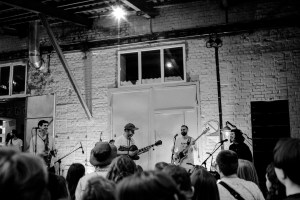
photo by Tania Horbatiuk
What can you tell us about one of your most recent songs, “Пісня про війну” [Pisnya pro viynu – A song about war] and its lyrics?
This song depicts the permanent states in which we (Ukrainians) are now. The lyrics play a big role in this song. It contains several meanings (basic and hidden). One of them is that even if sometimes you manage to feel the small joys of life for a moment, the realization that there is a war now, people are dying, sleeping cities are being shelled and it is not clear what will happen to you tomorrow weighs on you. Let me try to make a quick literal translation for you:
Sing-sing, my little bird
Let your song echo
Blooming summer mornings
But don’t forget that it’s a war
Rejoice, my heart
Every day, as you wake up
There is still so much beauty around
But don’t forget about the war
Travel, travel, my little one
On the train from Kyiv to Chelm
Discover places and new people
But translate them that there is hell here
Give, give your smile
It is so radiant
Forget everything that once was
But don’t forget that it’s a war
remember
remember
remember that it’s a wa (r)…
remember
remember
remember that you are ali (ve)…
Where are you now and have you been displaced by war at any point?
I am in Kyiv now. In the first weeks of the full-scale invasion, my beloved and I went to relative’s house 200 km from the city, but after a month we decided to return.
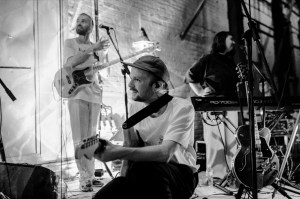
photo by Tania Horbatiuk
How do you feel about the inclusion of “war sounds” in recent releases by Ukrainian artists and are there any specific sounds you find triggering? Also, how do you feel about bayraktar-core music?
Once I was riding in a taxi, and the driver was listening to the radio, which was playing some modern Ukrainian music. And suddenly I heard the sound of an air raid siren. Even though I’ve been living in this for the second year, you never get used to this sound and it triggers you every time because you understand that now there could be another rocket attack, and you’re just going in a taxi. In a moment, I realized that this sound was in the song itself. As for music in the bayraktar-core genre… Well, it is mostly something done purposefully, without a soul and real emotions.
How do you see the indie folk music scene develop in Ukraine under present circumstances?
Currently, there is a surge of new artists and new music within the country and also the attention of listeners to local performers increased. It’s really amazing cause now is not the best time to be a musician in Ukraine and most artists, if they are not fighting yet, are at least working at other jobs to make ends meet. It seems to me that when Ukraine wins,
then there will be an incredible rise in music and not only in music.
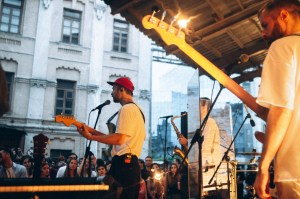
photo by Tania Horbatiuk
What would you say the West still gets wrong about Ukraine, if anything?
I hope I’m stating the obvious thing, but I’ll repeat that Ukraine is not something new that emerged after the collapse of the USSR. Ukraine has a long thousand-year history. The officially accepted date of the foundation of Kyiv (the capital of Ukraine) is 482 AD. This is hundreds and hundreds of years before the existence of Russia.
I also have a fear (and I am not alone in this) that the world is beginning to forget about us. I understand that people are living their peaceful lives, and the media are beginning to get “tired” of the war, putting news from Ukraine not in the foreground. But the war is still going on, Russia is still actively trying to invade and seize our territories, people die and tragedies happen absolutely every day, this is what we wake up to and live with every day. And we would really like to be remembered and supported. If you delve deeply into this topic, it becomes obvious that now there is a struggle between good and evil, even if it does sound pathetic and metaphysical. And anyone can add at least a drop of their help and
participation in this struggle, at least in terms of information.

photo by Tania Horbatiuk
Do you experience burnout and what do you do to relax and unwind?
In my current conditions, I cannot burn out from my favorite business, because now we rarely go to concerts due to a dangerous situation, and creating and recording music in my free time from work, on the contrary, saves and helps mentally. Making music now makes me feel as alive as ever before. In addition, to somehow maintain my mental state, I try to meditate every day, sometimes I take a cold shower, I do sports, and sometimes I use less constructive ways, such as drinking with friends, but this socialization is also important now.
Who should I interview next and what should I ask them?
You can take a closer look to project Blue Lizard who films lives of Ukrainian indie scene.
Here’s their channel: https://www.youtube.com/@BlueLizard
Here’s the email: love.bluelizard@gmail.com
FEBRUARY 24, 2024 – BOLOGNA, ITALY
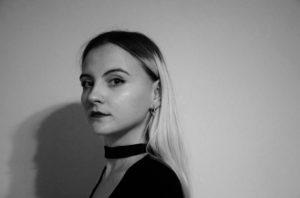
I am a Ukrainian with a multicultural background, having spent a significant part of my life in Italy. My journey into the realm of cultural studies and music has been shaped by a deep-rooted passion for self-expression and a love for the arts.
From a young age, I immersed myself in the world of music, exploring contemporary dance as a means to articulate my identity through movement and sound. This early connection between my body and the language of music fueled my curiosity and led me to intertwine my academic pursuits with my cultural interests.
During my university years in Bologna, Italy, I delved into courses on social movements, popular culture, and nation-building in Eastern Europe. The university experience was punctuated by my involvement in techno raves and electronic music events, which became integral to my journey of self-discovery. The pulsating beats and immersive atmosphere of these gatherings provided a unique space for me to connect with my roots, explore diverse cultural expressions, and foster a sense of community.
Has the Russian invasion of Ukraine and the annexation of Crimea changed the way you think about music and sound in general?
Yes, the russian invasion of Ukraine and the annexation of Crimea have indeed shifted my perspective on music and sound. In times of societal upheaval, music emerges as a powerful tool for communities and nations to articulate their experiences and voice their ideas. It becomes a means to create a new language that transcends space and time, encompassing the collective memory, traditions, traumatic experiences, as well as new dreams and hopes.
Music, in this context, takes on a political and revolutionary role, serving as a medium for social commentary and resistance. It becomes a channel through which a people can speak up and give voice to their sentiments, contributing to the broader discourse surrounding identity, resilience, and the pursuit of a better future.
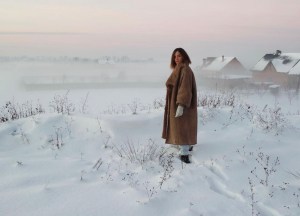
Chernivtsi Oblast
You have written your masters degree on “Post-Soviet Ukrainian Identity: The Impact of Music on the Shaping of the National Identity.” What made you look at the role of music within Ukrainian identity in the first place?
The choice to investigate the role of music within Ukrainian identity for my master’s thesis on ‘Post-Soviet Ukrainian Identity: The Impact of Music on the Shaping of the National Identity’ was inspired by the significant historical event of Euromaidan. This pivotal moment prompted a critical examination of the injustices Ukrainian people have endured throughout history.
Through this exploration, a consistent theme emerged—the integral role of music as a tool for preserving Ukrainian identity through pivotal historical junctures encompassing the Soviet era, the period of independence, and beyond. Music served as an anthem during the Orange Revolution, actively involving numerous artists in the national discourse. Notably, during Euromaidan, there was a visible cultural shift—a collective pursuit of an avant-garde renaissance of the Ukrainian spirit, reflecting a forward-looking movement seeking to shape the nation’s future. This study aims to delve into the profound impact of music on the shaping of post-Soviet Ukrainian identity within this broader historical and cultural context.
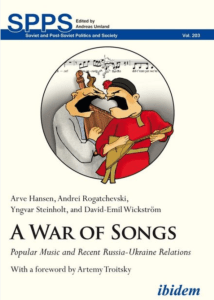 In your thesis you draw on Andreas Umland’s “A War of Songs: Popular Music and Recent Russia-Ukraine Relations”, among others, a book that discusses “how political turmoil, particularly war, can create new conditions for creative cultural production.” How would you say culture and specifically music reacted to the full-scale invasion?
Reflecting on the full-scale invasion, music emerged as a potent tool for the defense of self-determination—not merely confined to physical borders but extending to the broader Ukrainian cultural identity. Music took on a heightened political role, actively engaging in the discourse and creating spaces for fundraising. It became a generational manifesto, reaching an international audience to communicate the significance of Ukraine, fostering a deeper understanding of its cultural identity and the ongoing struggle for survival. Despite the horrors of the aggression, this challenging period also catalyzed the development of creative tanks, generating ideas and artistic productions that emerge as a testament to resilience in the face of adversity.
When asked by Natalia Korniienko in Chytomo, “How long will it take the world to stop seeing Ukraine – historically, politically, culturally and mentally – through the lens of russia?”, the Ukrainian writer and artist Anatoly Dnistrovy answered that, “The problem here is that Ukraine has never presented itself on foreign markets. And russia, on the other hand, put great efforts into it: they’ve been tirelessly retailing their messages all over the world and feeding their narratives to the European society for centuries.” Did you see a shift in the international public’s perception and understating of Ukraine over the course of the past two years?
Yes, there has been a noticeable shift in the international public’s perception and understanding of Ukraine over the past two years. However, the historical and cultural ties with russia remain strong according western perception, posing a continued challenge. For an extended period, Ukraine existed in the shadow of Western narratives, often perceived as a mere extension of russia, a narrative perpetuated by russia’s dedicated efforts in global messaging over centuries. In recent times, there has been a positive development with the emergence of volumes in the literary market that delve into Ukrainian history, aiming to elucidate its cultural heritage and historical trajectory. These works contribute to emancipating Ukraine’s history from the imperialistic russian narrative, offering a version of the story that has been omitted for a long time. They narrate the intertwined experiences of the people in the post-Soviet space, detailing their endurance through the Soviet dictatorship and their efforts to preserve their roots, integrity, and culture. This is offering to the international audiences a nuanced understanding of the country’s unique cultural identity
The Russian full-scale invasion sparked an unprecedented flurry of fundraising releases both on a national and international stage. How do you explain this and why would you say have we not seen the same proliferation repeated in the case of Tigray or Palestine, for instance?
The surge in fundraising releases following the russian invasion in Ukraine can be attributed to the physical and collective capacity in Ukraine to organize and maintain spaces for such efforts. In contrast, the devastation in Palestine has obliterated infrastructure and hindered evacuation possibilities, limiting the potential for similar initiatives. Additionally, the political positions of the EU, coupled with international double standards and Western world hypocrisy, contribute to the disparity in attention and support. Notably, a recent statement from DJS AGAINST APARTHEID underscores a growing movement of DJs standing in solidarity with Palestine, emphasizing the dance music scene’s historical roots in love, liberation, and resistance, calling for a safer, fairer, and freer world for all.
Has the role of music in Ukraine shifted from one of entertainment to encompass the expression of identity, communication, and emotional and physical survival?
Yes, the role of music in Ukraine has evolved beyond mere entertainment to serve as a profound means of expressing identity, facilitating communication, and contributing to both emotional and physical survival. It has become a vital tool for navigating the complexities of societal challenges and resilience.
 Are there any Ukrainian releases from the past year and a half that you feel can help make sense of current events?
Yes, the release I chose is Jerry Heil’s “кохайтеся чорнобриві.” While her music generally falls outside my usual genre preferences, this track and its accompanying video are exceptionally impactful. The fusion of folk sounds, drum and bass elements, and pop vibes, along with Zelensky’s speeches advocating for Ukrainian victory, creates a unique auditory and visual experience. The video, showcasing vast Ukrainian landscapes and vintage films, adds depth to the themes of victory, identity, and tradition, all interwoven with experimental sounds.
How do you feel about the inclusion of “war sounds” in recent releases by Ukrainian artists and how do you feel about bayraktar-core?
I find the inclusion of “war sounds” in recent releases by Ukrainian artists to be intriguing. It serves as a unique way to create an audio archive that captures the historical experience and emotional struggle for survival, offering a visceral and evocative connection to the realities of the time. As for “bayraktar-core,” the fusion of music with the symbolic and political connotations of the Bayraktar drone adds an additional layer of complexity to the artistic expression, reflecting the intersection of art, technology, and contemporary geopolitical narratives.
What would you say the West still gets wrong about Ukraine?
The West often misconstrues the cultural ties between Ukraine and russia, overlooking the nuanced historical relations. Ukrainian nationalism is frequently misunderstood and misinterpreted through Eurocentric perspectives. Additionally, there is a tendency to oversimplify the relationship between Ukrainians and russians as mere fraternal ties, whereas the distinctiveness of Ukrainian history and its unique characteristics may not always be fully acknowledged. There is a need for a more open-minded approach in the West to delve into Ukrainian history and appreciate its complexities.
Screenshot
Which book / film / album / song / traditional dish / podcast / blog / artwork / building / meme best captures Ukraine for you?
The movie that best captures Ukraine for me is Shadows of Forgotten Ancestors by Parajanov. This cinematic masterpiece vividly presents the essence of Ukraine through its portrayal of folk music, landscapes, colors, pain, melancholy, and suffering. Similarly, the song “Vesna” by DakhaBrakha holds a magical power for me. It has the ability to transport a person to a primordial time, connecting them with the foundational essence of the Ukrainian spirit, even in eras we haven’t personally experienced. Both the movie and the song serve as profound representations of Ukraine’s cultural depth and timeless spirit.
Finally a provocative question, has Ukraine overcome its inferiority complex?
The notion of Ukraine overcoming an inferiority complex is subjective and dependent on the perspective of comparison. In the face of challenges, Ukraine has demonstrated the strength and courage of its people. Whether Ukraine harbors an inferiority complex could be influenced by external perceptions and treatment. If Ukraine is treated with respect, free from infantilization and marginalization, it is less likely to internalize feelings of inferiority. The narrative surrounding Ukraine’s perceived standing in relation to other nations plays a crucial role in shaping any potential complex.
Is there a particular track you’d like us to embed with your interview?
The track I chose from BandCamp for you to embed is “Moment of Beauty amidst Destruction” by Symonenko. All that I have mentioned until now is encapsulated in this mesmerizing composition.
VIEWING ROOM
(Gianmarco Del Re)
 a closer listen