
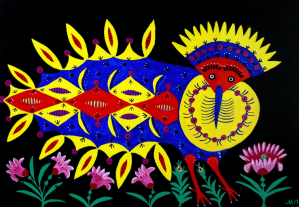
artwork by Mariya Primachenko
For episode XXXV of UFN we chat to Ihor Zavhorodnii about cultural survival, we discuss hybrid moments with Béllis, reflect on being stuck between two worlds with La_Fanette and delve into noise with Christ Vs Diablo.
New releases include albums by Koloah, Difference Machine, Andrii Kunin, NFNR, 18uah, Alexander Stratonov, Bogdan Zaiets, Yevhenii Loi, панич and XTCLVR.
In our Viewing Room, we have a discussion on drones, videos by Ship Her Son and Andrii Kunin and the Kamikaze Drones Original Documentary Series (with English subtitles).
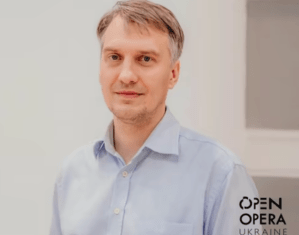
Ihor Voronka, principal singer with Ukraine’s Dumka Capella, killed in action
But before we begin, we would like to pay tribute to Ihor Voronka, another casualty of the full-scale invasion.
And now for our monthly podcast for Resonance FM we talk to composer, performer and co-founder of Art Association NURT, director of the Festival of electroacoustic music VOX ELECTRONICA and Experimental Educational Studio of Electroacoustic Music (EESEM) of Lviv Music Academy Ostap Manulyak about musicians composing on the warfront and the multicultural music heritage of Ukraine.
Tracklist:
* Ostap Manulyak – “Aeolian processes” [Fragment]
* Myroslav Trofymuk – “Місто” [The City] [excerpt]
* Dallek – “Arpeggio Disorder”
* “Unspeakable Weight” – A multichannel audiovisual installation by Andriy Linik, Ostap Manuliak, Yurii Vovkohon, Yevhenia Nesterovych, based on the Yevhen Hulevych’s recordings
* Edgard Varese – “Ionisation” [excerpt]
* Ostap Manulyak – “Reprogression” (Fragment 2)
* Alla Zagaykevych – “Mithe IV: K.S.” [excerpt]
* Valentin Silvestrov – Maidan Requiem – Cycle IV – “Prayer For Ukraine”
* Revshark – “Ukrofuturism” [background]
* Kimiko Ishizaka – Bach- Well-Tempered Clavier, Book 1 – Prelude No. 1 in C major [background]
* Kalush Orchestra – Stefania ( Gjaka K. Reinterpretation ) [background]
JULY 12, 2024 – KYIV
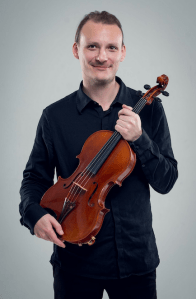
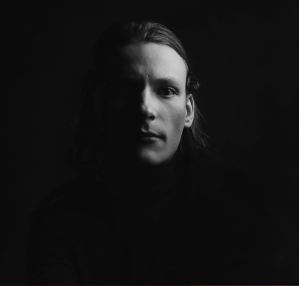
I am a violinist, violist and composer.
In recent years, I have been mostly working as a composer and playing chamber music on the viola. Before, everything was much broader – mostly violin and also a dozen different instruments, performative creativity, teaching. Now I’m finally trying to keep my activity more focused.
Has the full-scale invasion changed the way you think about music and sound in general, and has it had an impact on your playlist?
Yes, it has changed. Oh, I’d say I can recognise a few different “waves” of this “change”. The first reaction was like “simplification”: The body rejects all complex thoughts and feelings. And on the first days of full-scale war I noticed that I couldn’t hear the music in my head, for what seemed like the first time in my life. And also I couldn’t orient myself even in tonality and scales, I lost the ability to distinguish notes, intervals, chords, so music had simply left me. So it turned out that music was first on the list under “simplification”, as music, even the simplest, is very complex, and it is a luxury of civilization. This was a very strange discovery, because before that music was always with me, as something very familiar and simply inseparable.
After about a month of “deafness” and unsuccessful attempts to write something (I worked hard because I still believed in the power of art at the time, it’s very cute) some abilities began to gradually return and I could compose a few pieces. But no art impressed me, none. The movies where they shoot blanks from the 8th take, seriously? or doing some silly stuff… music where the composer decided to whine and got a 60-people orchestra to realise that… it all seemed kind of silly at that existential time. That summer (2022) I decided to write the Trio “Music of The Dead” – just “a musical testimony” about what I saw and felt in Bucha, Borodyanka and at home (there are no recordings of this piece available, but the musical score was published by Donemus). I faced the fact that I worked “blindly”, because no art could impress me, so the main criterion for selecting and evaluating musical material did not work.
The next phase, which continues to this day: my work is now only for the audience. I remember myself as an artist before: I was just a punk with a musical education, absurdity was the main material and way of my thinking in art. Now it makes no sense: absurdity, experiments for the sake of experiments. My art is now social and objective.
And the last one: the understanding that I have no future as an artist. I obviously will, but I can’t control it (because this war is existential, we do not know how long we will last as beings, as artists, as a country, as a culture), so I can’t start writing large-scale works, I can’t plan concerts for next year. But I have my TODAY. This all affects my music as well but not necessarily in a negative way.
About the playlist. Of course, it has changed. Much more very heavy rock, Bach and Beethoven, Messiaen, Lyatoshinsky. I still can’t go back to music that’s uncertain, blurry, overloaded with tons of inaccurate notes and thematics. So much contemporary classical music I just can’t listen to the end now. What is not and will not be on my playlist is russian music. Not only because of a physical reaction to it of as a matter of principle, but because russian music is the best weapon of the russians, far more perfect than their rockets and their thugs. I am very sorry that the world has no idea about this.
russia is investing all its efforts in one thing: to convince the world that the “real” face of russia is Tchaikovsky’s musical genius, not the rapists from Bucha, not the face of the brutal medieval aggressor. And it works – the world believes in that mask. We shouted in 2014, but the world did not believe us, because the world believed Tchaikovsky. The world believed Tchaikovsky in 2008, it did not believe the Georgians, let alone the Chechens, and so on.
The world naively thinks that this is JUST cool art which is so far from politics. The world does not understand that this art is a weapon in a war, a war on their territory.
In addition to a pile of iron and soldiers, they have two really super-powerful weapons: nuclear and cultural. The world fears nuclear war and loves Tchaikovsky. And this is exactly what russia needs – so the world exists and behaves according to russia’s plan. That’s why I have no russian music on my playlist.
Has the role of music in Ukraine shifted from one of entertainment to encompass the expression of identity, communication, and emotional and physical survival?
It has encompassed the expression of all these things during our history, especially the surviving: we wouldn’t survive as a nation if we lost our folk songs for instance. But for now let’s say: Yes. Even for VERY average citizens.
When speaking recently to Alla Zagaykevych, she singled out your piece “Lacrimosa” as one of the more effective reflections on war to have come out since the full-scale Russian invasion. How did you go about constructing this piece for violin solo and has it been cathartic for you?
No, it hasn’t been cathartic. Firstly, it is a small form, the Etude in fact. So it barely has time to reveal itself, to show itself to us. Secondly, I call this work “Lacrimosa without tears”. So you certainly know you’re crying and the tears aren’t flowing the same as your endless pain doesn’t hurt you as pain usually hurts, because it’s endless and your body pretends that it’s getting used to it.
About the way I constructed it: there are two things that lie in the basis: the idea of sound is based on white noise and the musical structure based on quasi-baroque Passus. So my idea was to achieve the effect that a giant orchestra and choir playing Passus are closed, compressed, cramped into the softest microscopic line of white noise.
Do you find war sounds and air raid sirens in recent pieces by Ukrainian artists to be triggering and how would you say can one best describe the war experience to a foreign audience?
 Yes it triggers, any sound like a siren, plane or explosion will trigger.
I still don’t know how to describe the war experience to a foreign audience, I’ve thought about it a lot and will continue to do so, I have to. Art aestheticises, even if you try and avoid that. And there are some things you’d better never aestheticise. And if you manage not to aestheticise, it will be called “sensitive content” and it will be banned. But it’s just your everyday life… your routine is banned, your reality becomes the sensitive content for FaceBook or YouTube. It’s such a stupid situation. If society is afraid of just an image on the screen (just a lighted piece of glass), and is ready to blur, to avoid and avoid and avoid the truth which is happening several hundred kilometres to the east because for some reason (why?) the truth becomes more and more unpleasant, then if such a society ready for a real struggle or just for living in the real world? Because we can blur sounds or words in audio recordings and images on the screen, but we can not blur real blood or the sound of missiles above your roof.
I don’t know how to tell a foreign audience in the language of art “friends, it’s happening, let’s be ready to physically defend our values. Not only Ukraine, we all found ourselves in a very serious situation”. So, we are working on it, we have to say that somehow)
Your piece “Music That Leaves Itself” for string quartet (2021), seems to capture current events perfectly. Could you describe your compositional process and would you say it could be seen as a modern take on Hadyn’s Farewell Symphony or were you inspired more by Ovid’s Metamorphosis, for instance?
Oh thank you for such beautiful parallels. Yes, this piece has become somewhat prophetic. But I wrote it for myself. You know, I’m one of those people who will never cook fancy meals just for myself. But here I decided to create a “fancy” medicine for myself. Not like common painkillers or vitamins, but rather for resuscitation, so to speak. This work helped me a lot and it remained very intimate for me. The idea is that music should get rid of itself, give itself to Silence, so that a new Silence appears – from it – a new view of music. I would say that this is a quintet for a quartet and silence, and silence is the main mystic character here.
What other compositions / tracks / albums from the past two years and a half have captured current events for you?
It is difficult to answer this question. A lot of good music has been made, and there is also music that was written much earlier but somehow reflects or rhymes with our present.
We have a very cool thing going on with our literature. Ukrainians discovered their own modern and contemporary literature and this became a mass phenomenon. I would like for the same to happen with music. So that’s why we are currently recording all of Lyatoshinsky‘s chamber works. Also, recently we performed the quartets of other Ukrainian modernists – Yanovsky and Senytsa, which had not been performed for many decades. It’s really important here and now. Good pop artists also appear. But in general, it is a myth that wars strengthen or contribute to the development of culture. Artists die all the time, today a colleague, a beautiful singer, died on the front line.
Our enemy is insidious, so the war will be long. Therefore, it does not matter whether you are an artist or an accountant or an athlete – you either already serve in the army, or you prepare for it in every way and help the army as much as possible or even more than possible. And then art after that.
Art is extremely, fundamentally important in the long run, but it’s not important at all in an “urgent run”: when the occupier is 20 km from your house (and I remember this state), your art will not help in any way. So we always have both of these things at the same time and we have to balance between just making the right decisions.
Has Ukrainian music finally moved away from the periphery to occupy a more central stage?
I don’t know. Also I have no idea where the “centre” is.
 Having recently visited Ukraine I was really impressed by how vibrant the experimental and electronic music scene is with so many festivals and parties going on in spite of the blackouts and curfew. Due to the current mobilisation law, how do you see the experimental music scene developing in future?
We have to win the war. If we are defeated, the russians will exterminate the entire cultural community, as it has already happened many times in these lands. We know well how they always did that with us and how they do it now (it’s been the same over the centuries) – erase, destroy generations with the roots. And it looks so beautiful on the façade: genocide on the inside, and “The Nutcracker” and “Swan Lake” on the outside. It is a very beautiful picture – thousands of Ukrainian, Crimean-Tatar, Belarusian, Georgian artists were cynically and brutally killed under the “swan lake” facade. Therefore, if we endure and win, even with great losses, we will definitely be reborn in time, like the Phoenix. If not, Ukrainian culture will cease to exist.
Where are you now and have you been displaced by war at any point?
Now I am at home in a suburb of Kyiv. In March 2022 we moved to the centre of the city for a few weeks, it was safer there.
Which book / film / album / song / traditional dish / podcast / blog / artwork / building / meme best captures Ukraine for you?
- The building is Saint Sophia Cathedral in Kyiv.
- The historic book is: Serhii Plokhy’s The Gates of Europe.
- The Fiction book is Lesia Ukrainka’s The Forest Song.
- In music I’d say all the huge number of folk songs.
- from contemporary music – maybe “Tutti” by Svyatoslav Lunyov.
- In visual art it’s “Triptych” by Fedir Krychevsky, also all the Arkhip Kuindzhi’s works.
JULY 16, 2024 – KYIV

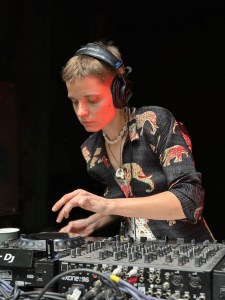
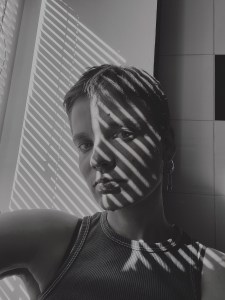
Hey, I’m Margo Kryhliak aka Béllis. I’m a DJ and promoter from Zaporizhzhia, currently based in Kyiv. Co-organizer of the Hybrid Moment party series, curator of the Inner Voyage show at 20ft.
My musical journey began early on without any formal education. Starting from a childhood choir to solo performances and eventually joining a synthpop and nu-disco group called M.I.F. as a backing vocalist when I moved to Kyiv.
Following the disbandment of the group, I had a hiatus, which I unknowingly filled by attending parties and raves, this period coincided with the formation of club culture in Ukraine. I consumed a lot of music, and I needed this time to realize what I like the most, what genres I would like to play and in what direction to develop.
Deejaying started for me after the start of a full-scale invasion, in 2023, with the realization that it was impossible to postpone, the planning horizon had became too small. And here I am)
Has the full-scale invasion changed the way you think about music and sound in general, and has it had an impact on your playlist?
I definitely determined that music is my pillar on which I can always lean, under any circumstances. Music is with me if I’m sad and if I’m happy.
But with the onset of the full-scale invasion and the trauma it caused me, I stropped listening to music. This is one of the long list of consequences of the psyche’s reaction to stress. I think that many people in Ukraine have gone through this.
And I definitely remember the day when I wanted to listen to something again. It was an organ music concert in Lviv sometime in June 2022. I had the feeling that I was discovering it for myself anew.
Now my playlist has become more aggressive and darker than before February 24, 2022. It is a way to get relief by releasing emotions while listening, dancing or deejaying.
 Could you introduce Hybrid Moment for us?
Yes, I will gladly tell you!
Hybrid Moment is the brainchild of my partner in crime Katia Stieber and I, a series of parties and community in Kyiv inspired by dark shades of music, slow and heavy beats. The main genres we promote are dark disco, ebm, the dark side of indie dance and italo, new beat.
Almost a year ago, we just decided that we wanted to bring this part of the electronic scene together and make it more visible to the audience, give a platform to artists and introduce them to the public.
So far, we have already held several independent parties and collaborations, and released a series of mixes. We are currently in the process of preparing for the release of the compilation for our first anniversary.
What is the secret of successful live set and on average how many track by Ukrainian producers do you play in your sets?
I think success is a balance between what you have planned and what people want on the dance floor. That is, on the one hand, you must not lose yourself on the way, on the other hand, be flexible. I don’t play the most popular genres, it’s very niche music, but I always try to find out what kind of mood people have, and what will suit them the most from my selection.
I’m trying to find Ukrainian producers, but dark disco and new beat are not developed genres in Ukraine. However, I always try to include Ukrainians in the selection when I have some important gig, this was the case in Berlin with the track “Unstoppable Beat” by Vladyslav Putistin & Lvcerate, and with “Not Ok” by The Against at Strichka.
 Having recently visited Ukraine, I was really impressed by how vibrant the experimental and electronic music scene is with so many festivals and parties going on in spite of the blackouts and curfew. Due to the current mobilisation law, how do you see the electronic music scene developing in future?
This is very difficult, our nation is actually choosing its future at the moment and everything that is happening has a bad effect on all spheres of life. Many left the country, many joined the army, some became volunteers, many people died and are under occupation. The mobilization law has its very tangible disadvantages, but it’s also a consequence of the fact that russia is trying to destroy us, and we have been resisting it for many years.
June was Pride month, how would you say the clubbing scene in Kyiv embrace its LGBTQIA+ community?
Ukraine is still on the way to forming a tolerant attitude towards all people except russians). Clubs currently remain a safe place for the community, where everyone can be who they want to be, behave as they feel comfortable, of course, taking into account the comfort of others.
Such parties as Veselka, for example, and later the club on Kyrylivska showed that in our country you can feel safe being among a large number of people who are on the same page as you.
 Has the role of music in Ukraine shifted from one of entertainment to encompass the expression of identity, communication, and emotional and physical survival?
I think that in a broad sense there have been changes, but they are small. For many people, music is still entertainment, a background for their life affairs and recreation. This is neither bad nor good, it’s just that ordinary Ukrainians currently have few opportunities to entertain themselves, to escape the reality that does not bring joy. But in a more underground environment, I think the picture is a little different, with a greater focus on expressing one’s onw identity, searching for meaning and preserving the cultural fund of our country. Like Gasoline Radio’s project “Cpadok: Hutsulshchyna“, where the radio team explored the local musical flavor.
After two and and a half years since the full-scale invasion, how can one keep“all eyes on Ukraine” at a time when the international attention is diverted to Gaza and Israel?
We just need to keep talking about the need for support, about the people who are in russian captivity, about the fact that the war is not over and it is taking place in the center of Europe. In my opinion, this applies especially to those Ukrainians who live abroad and have already been able to assimilate there. They do not need to wait for another tragedy to gather for a rally, this should become a permanent, methodical way of their personal struggle.
Are there any Ukrainian releases that have captured for you the current situation and have helped you process the events from the past couple of years?
Yes, for me these are two Ukrainian releases. First is Oleksii Podat – “the language of tears, i speak to tragedy in it“, which maximally twists your emotions of the inevitable, loss, tragedy. Second is Heinali – Kyiv Eternal, in which there is so much love for peaceful Kyiv.
 Where are you now and have you been displaced by war at any point?
When the full-scale invasion began, about a week later, when I managed to get out, I went to Lviv. I stayed there for several months, trying to recover from the experience and figure out what to do next. After some time, I made the only right decision for myself, I returned.
Now I’m at home, I’m in Kyiv. I feel more than ever that this is the place where I like to live, despite the fact that we have a constant threat of massive shelling, a new offensive and problems with blackouts.
Which book / film / album / song / traditional dish / podcast / blog / artwork / building / meme best captures Ukraine for you?
Ukraine is so big, different, diverse, I don’t know how it can be described by just one thing. There are the poems of Shevchenko, Stus and Symonenko, the films of Parajanov, the early songs of the band Scriabin. One could also write a book about our memes, because our sense of humor is what keeps us in an adequate state, when you actually understand the words of Lesya Ukrainka, “щоб не плакать я сміялась” (in order not to cry, I laughed).
JULY 17, 2024 – BARCELONA, SPAIN

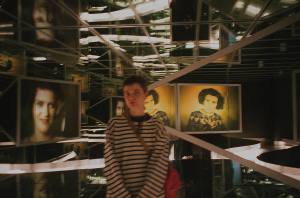
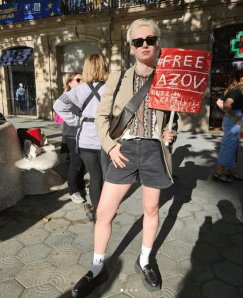
Born and raised in Donetsk. In 2014 I was forced to leave my native city due to occupation and the start of russian aggression in the Donbass region of Ukraine. From 2014 I lived in Kyiv, which I now consider my hometown in Ukraine. In 2019 I moved to Spain with my husband who is from Barcelona.
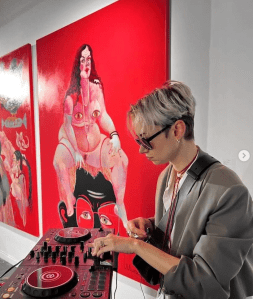
This is where I started my career as a DJ and producer. Although music has always been an important part of my life, Barcelona gave me the push to start expressing myself through music.
I completed several deejaying and electronic music production courses in Barcelona, which gave me a basis to promote Ukrainian music abroad.
Has the full-scale invasion changed the way you think about music and sound in general, and has it had an impact on your playlist and your setup?
I remember that for the first month of the full-scale invasion I was not able to listen to any music, let alone to deejay.
As time passed, things started to make sense again thanks to the new Ukrainian music which was being released as a reaction to the war. This was music that expressed my emotional state back then and that helped me to cope with the despair, depression and fears arising from this stage of the war.
My playlist, which already had a lot of Ukrainian music, now switched to 100% Ukrainian music, with 70% of it occupied by new releases and the rest 30%, by old Ukrainian music which I started to discover and delved deeply into.
Now I am more open to foreign music (not russian or similar of course), but Ukrainian music still has the priority.
 Has the role of music in Ukraine shifted from one of entertainment to encompass the expression of identity, communication, and emotional and physical survival?
I would say so. And especially in the beginning of the full-scale invasion. We’ve been hearing songs with motivational lyrics, songs and music expressing our emotional state. If I could name one, I would pick “шо ви браття” by jockii druce, which went viral and helped many to cope with the state of panic, despair and fear that many of us experienced back then. Furthermore, we’ve got many new bands and artists who expressed the emotional state of Ukrainians. You can see that even from their stage names: хейтспіч (hate speech) or Sensitive Content. When Ukrainians wanted to show the world the truth of what was happening in Ukraine and who was to blame, social media started to put labels on us. And even these facts had an effect on our music, our artists, our lives.
We have seen now more and more songs, tracks about russia being a terrorist state (see ТУЧА – russia Is A Terrorist State), about our language and its importance (see Rusiiick – Моя мова), about the lack of electricity and blackouts as russians continue destroying our power stations, songs about the enormous price we pay for our freedom (see Стасік – Герої вмирають (Heroes die), music about how Ukrainians feels inside every day (Andrii Barmalii – Я нормально), etc. On top of that we’ve a new wave of ‘come back to your roots’ music, where we rediscover forgotten or less known music: folk and pop which underlines our unique identity.
Do you find war sounds and air raid sirens in recent pieces by Ukrainian artists to be triggering and how can one best describe the war experience to a foreign audience?
War sounds and air raids were used in the music especially in the beginning of the full scale invasion. It was new and scary and we wanted to scream about this to the whole world.
I think foreigners were quite understanding of such “sound effects” back then as russian-Ukrainian war was in all papers back then. People abroad were more involved. Now, Ukrainians, I think, have gotten kind of used to it (if you ever can get used to such reality), and don’t use air raid or war sounds much. And most of the foreigners got tired of our reality and our struggle.
Are there any specific tracks or albums from the past two years and half that have captured current events for you?
Be_ca_di’s mix has a special place in my heart. And I think this set helped me a lot to process all the chaos I was living through in the beginning of the full scale invasion by russians. This piece has a strong narrative expressed through the spoken word, quotes and music. It reminds me about the piece by Bernd Alois Zimmermann – Requiem für einen jungen Dichter which expressed the times of WWII.
It also inspired me to create my own set of four parts “Requiem Contra Bellum in Ucraina”.
 How aware would you say Ukrainians are of their musical heritage and did the full-scale invasion made you personally rediscover any unsung composers or works?
I would say we are now more aware of our musical and cultural heritage than we were before the full-scale invasion. It is extremely sad that we had to pay such a tragic price for it and still it is not enough. I believe there must be a government program for this to spread awareness of our cultural heritage, both in Ukraine and outside.
Of course, I rediscovered some artists and works, as like for many Ukrainians, this war made me want to know my heritage deeply. Volodymyr Ivasyuk is just one of the examples. We all knew his songs from our childhood, from TV programs and our radio. But not so many knew about his less known works, about his struggle with Soviet government and KGB and suspicious circumstances of his death.
Ihor Tsymbrovsky is another great example of unsung talented musicians. Such a great talent, musician with unique voice, poet and architect from Lviv was known to very few and still known by not many people, although he was active as a musician from the early 90s. I am very proud of having his vinyl.
Has Ukrainian music finally moved away from the periphery to occupy a more central place on the world stage?
I believe this process has started back in 2014, after the Revolution of Dignity, the occupation of Crimea and the war in the Eastern part of Ukraine. There was a huge wave of patriotism back then, when people realised that russia and russians are not our friends or brothers. When russian artists were banned from Ukraine, their concerts were cancelled and the government finally applied quotes for Ukrainian music on the radio. It was the time when great artists like Dakha Brakha came out of the shadows and became very popular in Ukraine (although they were already famous abroad), when we got Onuka, Dakh Daughters and other Ukrainian artists. This was not enough though.
This process continued up until 2022 although not as strong as it used to be in 2014 and we’ve seen some artists switching back to russian language, russians musicians coming to Ukraine with concerts, etc.
I want to believe that 2022 was a point of no return to how it was before, that we learned our lessons and from now on we won’t tolerate anything brought to us by the invaders. That we will cherish our culture and our language and promote them worldwide.
 How does it feel to be “stuck between two worlds”?
I tried to express it in my DJ set “Lost in BCN” where I was reminiscing about my past life in Kyiv and my current life in Barcelona, also trying to catch the current music mood in Ukraine and in Spain
For me “stuck between two worlds” is to see the ‘normal life’ in the EU and try not going mad about the fact that my country suffers every single day. It is trying to be understandable as much as humanly possible when you are trying to explain the russian aggression against Ukraine to foreigners and hearing the stupidest russian propaganda in return. Sometimes it feels like being an adult talking to an innocent child.
This all usually results in having depression, anxiety or other disorders.
How do you feel about the cancelling of male Ukrainian artists who left the country?
It depends. It depends when this guy left the country. Maybe this was before the full scale invasion, and this was a legal border crossing. Also it depends on what this male Ukrainian artist does abroad. If they donate, if they help raise funds for Ukrainian people and especially the army, if they promote Ukrainian culture on “every corner”, speak about russian aggression from the scene and they go or organise manifestations for Ukrainian support, I am ok with that overall. This means that this person, or artist does care about his country and finds alternative methods to help from abroad.
If they just escaped Ukraine to forget their country and “live their best lives” abroad, for me these people are not really Ukrainians anymore. They are just holders of a Ukrainian passport. Same goes for women actually.
 Many Ukrainian artists have told me that in the first few months of the full-scale invasion they were unable to play music, let alone compose or perform new music. Do you share this experience and if so, what were you listening to, once you went back to music?
Totally. In the first months of full-scale invasion music did lose all meaning for me. It was a great loss since music surrounds me all the time and always has been a part of me although I am not a professional musician.
With the time and new Ukrainian music born with this stage of the war it started to make sense again. And then a huge desire to make music came along.
Where are you now and have you been displaced by war at any point?
Being from Donetsk (Donbass region) the war started for me in 2014. It is also when I was forced to move from occupied Donetsk to Kyiv. In 2019 I moved from Kyiv to Barcelona and got married to a Catalan guy. Barcelona is where I still live and where the full invasion caught me.
JULY 18, 2024 – KYIV
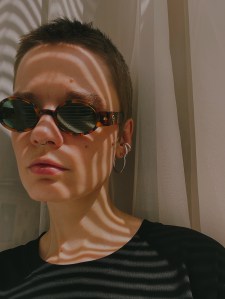
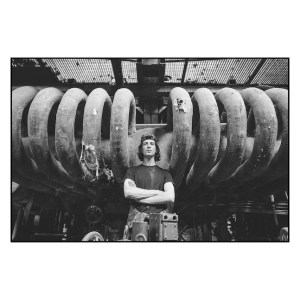 My name is Igor, I was born in Kyiv in 1987, since childhood I liked to take apart different objects and collect them in some fantastic sequence. I also liked to create different sounds: knocking on boxes, glasses, bottles, metal.
At the age of 17, I got an electric guitar, and I made my first one-man band eternal forest, followed by a second one Сancer, it was depressive black metal. During 3 years, I recorded only a few demos and splits.
In 2012, I had already been engaged in urban exploration, train hopping and squatting for 4 years, but I also did not leave music, so my colleagues and I decided to create a raw black metal project Dog, which was later renamed to Staryi Kyiv. The band was known in narrow underground circles. After releasing a number of demos and albums, the group disbanded.
In 2014, I got into the circles of experimental electronics, and went to noise concerts and festivals. I was very impressed by the expression and the incredible variety of ways to work with sound, so I decided to try it myself in this.
I started making my own synths because I just didn’t have the money to buy expensive gear at the time. So, by 2018, I made several analog synthesizers and went with them to the Coschey bar, where I gave my first noise concerts and formed as an artist of the experimental electronic scene.
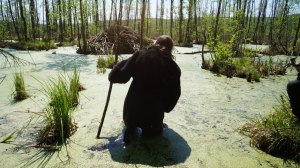 Has the full-scale invasion changed the way you think about music and sound in general, and has it had an impact on your playlist and your setup?
I think to answer this question, I will start with memories of my first performance since the beginning of the full-scale invasion, it was a performance in the early spring of 2023, at the Shumoizolatsia festival, which took place in Lviv at нульовий поверх (nulʹovyy poverkh).
I consider this to be my best performance ever. There was a lot to say through music. In general, I consider music, like any other art, a way of sublimating the inner state of the artist, so of course the state of war greatly influenced what I wanted to express. I had a lot of aggression, I wanted to blow everything up, break synthesizers, break walls, just destroy everything. Of course, I played aggressive music before that, but this was the peak of my passions.
But time has passed, and today I no longer have that aggression. On the contrary, for example, I took up field recordings, I recorded nature, the surrounding environment as a whole. I want to capture the moment, capture reality, find a point of mental balance in the surrounding noise. Folk music, traditional medieval music is also a certain anti-stress therapy for me.
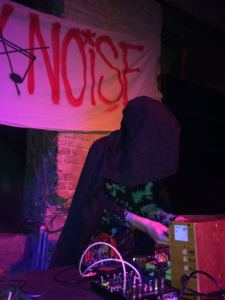 Do you consider yourself a “noise artist” and why would you say there is currently such an interest in noise music in Ukraine and in Kyiv specifically with initiatives like “Noise Every Wednesday“?
Yes, I believe that I play noise, maybe a little industrial, in my project I chose a fairly characteristic sound and it can change within certain limits, but within rather narrow ones.
I know that there were many experimental artists in Ukraine even before the war, now everyone is just more active in this field. I want to say right away that I don’t think that the noise scene in particular has become bigger, because most of those who perform at Noise Every Wednesday don’t play pure noise, it’s still, generally speaking, experimental music, because noise is quite a specific genre.
Regarding Noise Every Wednesday, I think that this is a successful case in supporting the underground, the existence of this case is largely due to the fact that there was nothing particularly happening at the Otel club on Wednesdays, and it was a good idea to create something with the prefix “noise” to gather people for strange music, it’s cool.
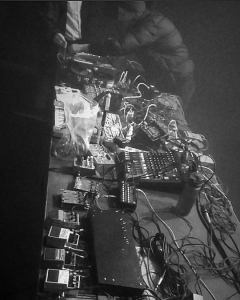 Has the role of music in Ukraine shifted from one of entertainment to encompass the expression of identity, communication, and emotional and physical survival?
I don’t think that it has changed, but it is obvious to me that the more stimuli in the environment, the more pronounced the reaction to them will be.
You have recently started doing field recordings. What has prompted such a move, what are the sounds that interest you the most and generally speaking have you become more sensitive to your sonic environment as a result?
Yes, definitely field recordings, as I said before, for me it’s like anti-stress therapy, I relax by recording sounds. I have lived near railways, tramlines and highways since childhood, so on the one hand I am adapted to this noise and it distracts me from tinnitus, on the other hand these sounds are so dense that they create a complete noise field through which it is difficult to hear anything else.
My initial inner intention was to shift my focus to natural landscapes and register the sound field of these landscapes, I will of course return to the city, but for now I am interested in wildlife. I started in the vicinity of the Moschun River, which is not far from the village of Moschun, which suffered greatly during the full-scale invasion. I got the feeling that nature adapts or recovers quickly enough. Having said that, the hostilities there started more than two years ago and did not last long.
I noticed that I started to hear more of everything. I think that concentrating on natural sounds has a therapeutic effect on the psyche. I want to learn to identify birdsong and learn not to scare wildlife with my presence. I understand that for field recordings I need to allocate more attention to the environment and the way it gets used to human presence.
 Do you find war sounds and air raid sirens in recent pieces by Ukrainian artists to be triggering and how can one best describe the war experience to a foreign audience?
I think that if your music sounds like explosions or sirens, it’s ok, because there is a field for interpretation for that. For example, I know soldiers who told me that they want to hear something like that again. For me it’s like a sublimation of aggression.
But if you use specifically, literally, the sounds of explosions or sirens, it can be a trigger for a person who was directly affected by them, or someone close to them, because here the field for interpretation narrows, these are quite concrete things.
Moreover, I think that such sounds do not affect the consciousness of people in the West, they only have an association, with no real sense of what lies behind the sounds of sirens or explosions, which is fear and hatred. Inevitably, there is a wall between the Western perception and the realities of Ukrainians, I wouldn’t expect anything else, it’s in the order of the universe. It does not mean that we should suffer, but also, not everyone is going to feel this.
Are there any specific tracks or albums from the past two years and half that have captured current events for you?
No
 How aware would you say Ukrainians are of their musical heritage and did the full-scale invasion made you personally rediscover any unsung composers or works?
I think that since the beginning of the war, the desire of people to understand what Ukraine is, to re-understand historical and cultural narratives has increased, and music is no exception to this, I see more and more genre selections of Ukrainian artists appearing.
Recently, I have been listening to VIA “Orbita” – they were a revelation for me. Of course, Стрілецькі пісні [Streltsy songs], that’s good.
Has Ukrainian music finally moved away from the periphery to occupy a more central place on the world stage?
Was Ukrainian music on the periphery? Never heard of it
Having recently visited Ukraine I was really impressed by how vibrant the experimental and electronic music scene is with so many festivals and parties going on in spite of the blackouts and curfew. Due to the current mobilization law, how do you see the experimental music scene developing in future?
I think that those who work in the cultural field should stick to their jobs. Unfortunately, this does not often apply to experimental performers, so I don’t know what will happen to those who don’t want to go to war but want to continue being creative, that’s a big question.
 Many Ukrainian artists have told me that in the first few months of the full-scale invasion they were unable to play music, let alone compose or perform new music. Do you share this experience and if so, what were you listening to, once you went back to music?
Since the beginning of the war, I did not play music for almost a year, I had the illusion that the war was a reason for me to start a new life, and I was full of these thoughts. The first thing I listened to, and still do today, was a selection of new age artists on NTS radio, I really love this genre, as well as progressive electronics.
Where are you now and have you been displaced by war at any point?
I lived the first year of the war in the Carpathians, I went to the mountains before the start of the full-scale invasion and did not plan to stay there, but it turned out that I stayed. Then I went to Lviv, there were my friends who were also engaged in various creative works. I wanted to stay there, but I returned to Kyiv, this is my home.
Which book / film / album / song / traditional dish / podcast / blog / artwork / building / meme best captures Ukraine for you?
Kobzar.
NEW RELEASES
18uah ~ Long Time Ago
«I started making this album at the beginning of a full-scale rissian war, and it was kind of spot-on – because all the tracks on this release were written by one take and I came back to them only when I started mixing. Because of that trax are my emotions and experiences of that moments and period of my life. This is my first release, although I’ve been writing music for a long time, but I’m glad that it will be my debut in it everything that I love in music from groove to noise, from breaks to ambient. For me, this release is something enigmatic and maybe for some it will seem depressing, but it is not, it inspires me to create and return to music again and again. Why exactly the name of the tracks? – the process of creating this release took me one and a half years, I very rarely returned to music during that period, but as you can see, it’s good )))»
Bogdan Zaiets ~ B!F23
Bogdan Zaiets, a Ukrainian sound producer and DJ, created a live program for the performance at Brave! Factory Festival 2023, which has now become the album BF!23.
This music is about drive, daring, sexuality, as well as the atmosphere of carefree and festive spirit that one wanted to experience at the festival.
панич ~ елегійні студії
[mainly] jazz-related improvised & academic-like composed music for piano or organ emerging rather from particular transitory scene/state imageries than consciously operated intellectual frameworks
Alexander Stratonov ~ “Kamikaze Drones” Original Documentary Series Soundtrack
“I went through high school in the early 2000s to the sound of drums. Drum’n’bass, breakbeat, trip-hop. I was fascinated by the rhythms of artists like High Contrast, Goldie, The Prodigy, Fatboy Slim, The Chemical Brothers, Portishead, Massive Attack, Tricky, Morcheeba, Sneaker Pimps, UNKLE, Akira Yamaoka, you name it. The only reason I didn’t pick up the drumsticks when I started playing in rock bands was the complete lack of coordination between my upper and lower limbs 🙂 And also the fact that for most of my “rock career” I had the talented Serhii Myronchuk next to me at the drums, and I could not have reached his level of skill even in 100 years. However, I remained in the rhythm section, playing bass and rhythm guitar.
At the same time, at the turn of the millennium, I began my first attempts at creating electronic music with a PC. The first “pen tests” I found on old hard drives date back to 2001. Most of it is viscous atmospheric trip-hop in a low tempo, written in the spirit of the soundtracks of the first Silent Hill games by Akira Yamaoka. Although I’ve dabbled in other genres, I even released a drum’n’bass EP in 2007 with my dear brother Dmytro Khytryi, the Distorted Twins project (I’ll have to dig it out and upload it to BandCamp sometime).
So my new soundtrack for the documentary miniseries Kamikaze Drones by our investigative team at Suspilne is kind of a “return to roots” after more than 20 years. There are a lot of trip-hop beats, framed by the sounds of vintage synthesizers and sequencers, mixed with organic traditional Japanese percussion (it would be a sin not to use it in a Kamikaze theme) – taiko drums, chappa hand cymbals, hyoshigi bamboo sticks. I had an incredible nostalgic pleasure working on this soundtrack. I hope some of you will enjoy it as well.
The titles of the first three tracks form a haiku. I’m not an expert, so it’s amateurish, but at least I tried to follow the 5-7-5 structure 🙂
Wind Whispers Goodbye
Soaring Into Twilight Sky
Honor Meets Its End”
Koloah ~ Mind Control
Salon Imaginalis opens up a new chapter, launching a sub-label. Tanz Salon is the imprint’s new venture dedicated to dance music and club-oriented output.
The first release on the sub-label is by no other than the Salon Imaginalis boss, Koloah. The Berlin-based Ukrainian producer continues his broken beat explorations with a 5-track EP titled ‘Mind Control’. With recent works touching upon breakbeat, bass, and dubstep, this time around Koloah is putting his twist on classic electro. Staying true to the acid genre tropes, ‘Mind Control’ is cold, sharp, and futuristic, yet it is not deprived of the cinematic quality that is by now a signature to Koloah’s sound.
The record is enchanting, with the tracks laced with mystical motives and bewildering rhythms. It’s meant for an adventurous club experience where glitchy, out-of-context vocals lend themselves into the most mischievous dancefloor moments.
NFNR ~ Fragility
NFNR – Ukrainian, Kyiv based, electronic musician Olesia Onykiienko creates emotional dreamy electronica with a strong core, balancing sound between fragility and finding inner strength via rich saturated textures.
NFNR was searching for themes that can go deeper than personal anger, hatred and despair caused by the russian invasion into Ukraine where she continues living, and found a solution in talking about fragility, vulnerability, tenderness and her feelings to the dear ones – the most precious thing in life. Writing these compositions became for the author a psychological treatment and a way out of a state of frustration and the inability to write music after the beginning of a full-scale invasion.
EP combines reflections on the fragility of human life and finding inner strength to stand, but also ardor of taking the enjoyment of life even in such tragic severe circumstances as the war is. The sophisticated sound of the compositions depict most delicate tenderness which the author addresses to the most valuable things in her life.
100% of donations to UA defenders
XTCLVR ~ INVERSE
‘INVERSE’ unveils a different facet of XTCLVR’s sound, with heavier and more aggressive tones. The traditional genres dissolve, and a grotesque tone draws the listener into a surreal, chimeric journeyThe album blends rich synthesizers and post-club polyrhythms with euphoric, upbeat elements, maintaining his distinctive style. Written throughout 2022-2023, the tracks on ‘INVERSE’ reflect a time of emotional instability and a dream-like state: is this all for real? The music features liquid sonic textures that escalate into distorted synths, fractured noisescapes, and eerie melodies. A standout track, ‘FEEL ME’, poses a bold inner dialogue, questioning reality itself.
Difference Machine ~ небесні тіла можуть зазнати руйнації
“heavenly bodies can undergo destruction (reversal)” recorded at Otel’ for every Wednesday, Kyiv, 2024.05.01
“the echo of your mind left a gap in the sky” recorded as part of the International Drone Day 47-Hour Drone Marathon organized by Ceramic Beats, Pererva Studio and KYIVPASTRANS Records Kyiv, 2024.05.25
Andrii Kunin ~ Strongly Downward
4-track experimental EP created with a 19th-century concert zither using a bow, prepared techniques and spectral effects.
The artwork uses an article by F. Berwein about zither’s acoustics.
Yevhenii Loi ~ Flux ⇶
Yevhenii Loi returns with nextgen intimate lyrics, expressed through trance synths and energetic house rhythms, united in the four-track “FLUX” EP. Mini album will be released on July,19 on Kyiv-based label Noneside.
After the last EP «I’m here. I am alive. I love.» and «Nothing will stop an idea» compilation («Elastic Bounce» tune) noticeable progress of atrist in the direction of maintaining tension and sharpening his style. The track «Flux Emanation» is a continuous multi-layered wave of bass and synthesizers that make the mind riot. «Fly My Darling» – is about the same one who “never knew how to be like everyone else». «Sonic Tide» drags the mind and body into an eternal dance, and “Beyond The Unknown» is an epic about human intransigence and the thirst for victory. We wish Yevhenii a Cossack success in performing combat tasks in the ranks of the Armed Forces of Ukraine, and inspiration for new music ❤
VIEWING ROOM
(Gianmarco Del Re)
 a closer listen