
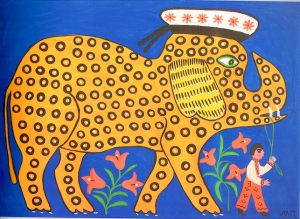
The Little Elephant Who Wanted to Be a Sailor by Mariia Prymachenko
This month, we get an a 360 degree look at music in wartime Ukraine thanks to an in-depth interview with Vlad Yaremchuk, director of the Atlas festival. We also get to hear from Mertvi Dereva about addressing the war head on in his latest release , while Bohdan Stupak looks at war datapoints and to round things off we take a look at sound through the prism of the artworld with Kateryna Semenyuk.
Also, new releases aplenty by the likes of Heinali, Hidden Element, Heskbo, Radiant Futur, Bayun the Cat, Silat Beksi, Smezkh, Ujif_notfound, Vlad Suppish, ОЧІ, Kindracoma, Midnight Revenant, Aircraft, Nina Eba, and 58918012.
In our viewing room we catch new videos from Blooms Corda and Latexfauna, plus Vlad Fisun spins Ukrainian vinyl.
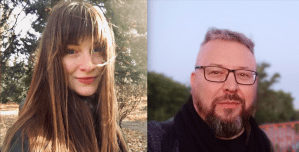
Olga Tsuprykova and Oleksandr Rybalko
But to begin, for our monthly podcast we picked up from the conversation we had last month with Oleksandr Rybalko about the North Azovian Greek community and developed many of the same themes in the company of Olga Tsuprykova from the North Azovian Greek NGO. This is followed by our monthly playlist.
Tracklist
Folk Group Fos – “Bugdanku”
Sartanskie Samotsvety ensemble – “Of, mana, vay!”
Nadiia Kalus – Ditty (udrama) “Ela miia kamiia”
Suren Voskanian, Yaryna Dron, Andrii Levchenko – “Bohdan-ava”
Bir Taifa group – “Dushenkalar”
Bir Taifa group – “Chikhmakh Khirimda”
Vasyl Tanacha – “track 9 (button accordion)”
Suren Voskanian, Yaryna Dron, Andrii Levchenko – “Vari-ava”
OCTOBER 3, 2024 – KYIV
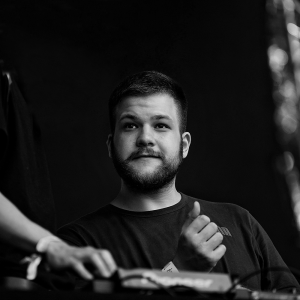
My name is Vlad Yaremchuk. I am based in Kyiv, Ukraine. I am the programming director of Atlas Festival – Ukraine’s biggest music festival and partnership manager of Music Saves Ukraine – a humanitarian fundraising initiative created by the Ukrainian Association of Music Events. My primary background in music is Drum & Bass and other genres of UK electronic music. I discovered Drum & Bass in 2009 when I was 12, and it changed the course of my entire life from that point. I never pursued a career in music. I just spent all my free time interacting with it – listening, discovering, hunting down mixcuts and previews of upcoming releases before anyone else, and running a blog with my friends which was called Displace Audio. I always thought it would be my expensive hobby and passion, but when you surround yourself with what you love and people who share your passion, you get opportunities you never expected. One such opportunity led me to join the Atlas team.
 Has the full-scale invasion changed the way you think about sound and music? Also, in what way would you say your acoustic environment and your awareness and appreciation of it changed, if at all?
I appreciate and cherish music more than I ever did. I also saw just how much the music community is capable of when it really is needed. At the beginning of the full-scale invasion, I put together a massive Drum & Bass / Bass charity compilation called Together With Ukraine with my friends. It ended up being a 136-track compilation featuring a lot of my all-time favourite producers, which raised more than 150,000 EUR. We put it together in just 6 days amidst chaos. It was and remains one of the most defining moments of my life, seeing how the community that I love and gave so much of myself to, never expecting anything in return, came together in the most critical moment to help in a truly meaningful way. Much of the same continued on a different scale with Music Saves Ukraine – the team has worked with dozens of music festivals and conferences and raised more than 630,000 EUR.
Also, this summer, Atlas Festival returned and raised 100 million UAH (2.3mln EUR) for the military. All these things just reinforce my belief in the power of music and inspire me to keep going.
The unifying and healing power of music is also something I feel on an entirely different level now. The events and concerts I have attended in Ukraine since 2022 have been unlike any others I have ever experienced. Music brings you all together, touching your very core and it reassures you that as long as we are united, we are more than the terror Russia is bringing down upon us. You get to process all these different suffocating emotions that sometimes you cannot process in any other way. Music can express things in such a profound, precise way. It lifts a heavy burden from your chest. It gives you strength to go on when you think you’ve got none left. It reminds you of what is important.
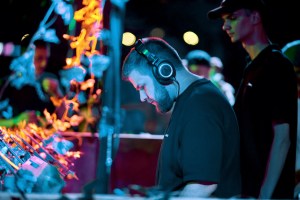
Photo by D.Golovchenko
Most of those I have interviewed so far, were unable to listen to music in the immediate aftermath of the full-scale invasion. Is this something that happened to you as well and what were the genres, albums and artists that helped you come back to music?
I found myself unable to listen to music when the full-scale invasion started, just like many others. Even when we were working on Together With Ukraine – I could not really listen to what we were being sent, partly due to abysmal internet connection at the time, but also because I just could not bring myself to it. That really scared me, it felt like the very essence of me was pulled from my chest, as listening to music was always as natural to me as breathing and there I was, unable to enjoy it.
Russians took away so much from us and kept doing so every day, not being able to listen to music seems like such a nuisance compared to all the suffering, but for me, it was a very personal kind of terror, I never thought that could happen to me. I eventually came back to music in about two months and started to catch up with everything that I missed. It felt so liberating. I connect a lot of pictures, moments and memories with music I listened to at the time. It helps me perceive the world around me and having that again brought back some kind of order and continuity to my life. Just spending a lot of time with music, listening to my favourite things or constantly discovering new stuff is a constant in my life that helps me stay sane in the midst of the war. I don’t think I would manage without that.
 You started off as a booking agent for the Atlas Weekend festival and have now become its artistic director. You recently discussed the challenges of putting on a festival in wartime with Luzia Tschirky on her podcast Yak Ty? These included security issues, logistical issues with having to move the festival by a week in light of the bombing of the children’s hospital in Kyiv, and the difficulty of booking international artists. And yet despite it all you managed to pull it off and fundraise 100 million hryvnias for the army. Did you expect it to be the success that it has been and how confident were you that you would manage to hit your target, and what is the process to book artists currently serving in the military like Serhiy Zhadan?
I am yet to fully comprehend what we managed to achieve this year, I could not be happier with the result. We are not strangers to challenges, every single Atlas was full of them, often seeming like everything might just collapse and yet the passion that everyone involved puts into it always ensured things turned out great. I mean, before this year, we had 2021, when we had to completely restart the festival 3 months before it took place in the middle of COVID. But this year was a challenge on an entirely new level.
Back in 2021 we thought we were ready for everything after doing it during the pandemic, but oh boy, does that seem like a child’s play compared to what followed. We never take our success for granted and we never get complacent, which was critical this year. It was a difficult call to make, and we wanted to make sure we get it right. Considering how unpredictable the environment was, we could not be sure that the festival would happen, that everything would be okay and that we would hit our fundraising goal; none of these were a given. The only thing each of us could do was to contribute our 200% and know that others would do the same, hoping it would be enough. Finishing the festival this year was an incredible feeling – it happened despite everything, we brought it back, it was safe, there were no air raid alarms during soundchecks or festival open hours. 2 days afterwards, we hit our target of 100 million UAH which was an even more rewarding feeling – we managed to contribute in a meaningful way while doing what we love.
Booking artists who are currently part of the military is not easy. Sometimes, it is also simply impossible. These people get few days off, if any and they don’t always get to choose when they can get them. You are also asking them to spend this precious time playing your festival instead of getting rest or being with their family and loved ones, which is also not easy. But many of them are happy to make it happen, especially since it will translate into meaningful aid for their unit and would make a lot of people happy. Many artists announced from our stages that this will be their last performance for a while as they will be joining the ranks after the festival. More and more are joining these days.
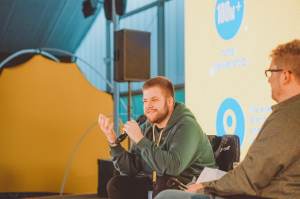 What would you say have been the pros and cons of not being able to get international artists (or very few of them) to play in Ukraine in recent years? I am thinking, maybe, of the Ukrainian scene becoming more insular but at the same time allowing for new names to hone their skills and come to fore?
The full-scale invasion resulted in a cultural reawakening of sorts, just like the revolution of dignity did back in 2014, but on an even bigger scale. So many new artists emerged, understanding that there might be no tomorrow and the time is now, many existing ones switched to Ukrainian and started reconnecting with their roots and Ukrainian culture, digging deeper into it, reinterpreting and reflecting on it through their art. Ukrainian music has never been more vibrant and diverse. The absence of international artists created a lot of gaps which started to be filled and gave time and space to all these artists to get a chance at recognition and to hone their skills. At the same time, the absence of russian music and concerts was also a significant factor. The invasion made most people completely disillusioned with russian culture and music and it could finally be seen just how much of a parasite it was in Ukraine, always stifling the development of local artists and music.
Things are changing, though. The initial tidal wave is over – it is not easy to build a sustainable career amidst the war. There is not much money to be found in music as most concerts are charity-driven, so artists don’t get much out of them. There is no proper infrastructure as well – a direct result of the ongoing war, you just don’t have the same tools and opportunities that you would have in other places and it starts to show. Many artists cannot travel outside of the country to perform for international audiences and get experience with international touring, which does not help. We could all benefit from having more cultural exchanges with international artists and seeing more of them coming here. Russian music was not just stifling the development of the Ukrainian scene, but was also in the way of building stronger ties with the rest of the international music community.
I cannot wait for the day Ukraine will be victorious and these challenges will be gone. It would be incredibly exciting to see how the Ukrainian scene will develop when the cultural exchange is renewed, Ukrainian acts will travel more abroad and international acts will flood to play in Ukraine, when the infrastructure will be there to support this scene and let it unleash its full potential.
Music Saves Ukraine brought to the country the most influential representatives of the international music industry to show the current situation and attract future support. We know festivals have not always been considerate when expecting Ukrainian artists to play on same line up with Russian artists, and while there have been international artists stating that music is apolitical, it seems to me that are now more names who are willing to play in Russia (I am thinking of people like AtomTM for instance). How aware and supportive would you say has the international music community been towards Ukraine and has this support changed over time?
 The international music community has been incredibly supportive of Ukraine since the full-scale invasion started and it remains so now I’d say, despite the fatigue. Music Saves Ukraine is living proof of that – our fantastic team recently finished another summer tour through European festivals where they were welcomed with open hands, had a special zone where they told people about what’s happening in Ukraine, sold Ukrainian charity merch and raised funds together with the festivals in other ways, totaling at more than 78000 EUR.
We did another Music Ambassadors Tour this year, as you mentioned and it also shows that there are people within the industry who are not scared to come and take a closer look at themselves and become ambassadors of Ukraine within their own countries. Everyone who came to visit us started helping with renewed vigour using their platforms and together with them we managed to raise significant funds to provide humanitarian aid.
I think at this point you can see who really cares and who does not. Ukraine is not a topic most people actively follow, the initial shock is far gone, so at this point, a few camps formed and they are becoming rather static. Some people within the community did something when the invasion started and after a few months never mentioned Ukraine again and moved on. Among them are people whose music I genuinely love, who now end up using Ukraine as some sort of punching bag in their support of Gaza, which has been very painful to watch. Others have actively supported us from the start and continue to do so to this day, sometimes even to their detriment, as their fans and audiences grow weary of the topic.
And then there are those who could not care less or have a totally distorted moral compass – those who are now playing in russia, post or say heinous things about Ukraine, hide behind ignorance and, frankly, laughable excuses. I’ve been so disappointed to see some well-known Drum & Bass artists playing russia, for example. The likes of DJ SS (who actively brings in all the others), Grooverider, Roni Size, Ragga Twins, Aphrodite, The Prototypes, Sub Zero and others. The same is happening in other electronic genres, as well as in hip-hop and jazz. I find it revolting and I also did not expect to see such shallow discourse around it, with arguments like “music is apolitical”, “people in russia have nothing to do with putin and the government” and “these acts are not so popular at home and money is scarce, so I can’t judge them”. So it really is a mixed bag, as always.
But what matters is that we have made many very dear friends in Ukraine who support us no matter what. I am grateful for that, and it is one of the reasons I love this community so much. In the end, this matters way more.
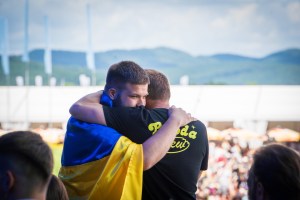
Pohoda Festival Mainstage
What do you think are the ethics of playing music in wartime (you yourself have moved the Atlas festival by a week in the aftermath of the children’s hospital in Kyiv being hit), and how do you feel about the inclusion of war sounds that many could find triggering in tracks by electronic artists?
Music during wartime is essential, and it also plays a different role. It’s not about entertainment. It’s about raising morale and funds. It’s about hope and unity. Events happen in Ukraine wherever and whenever possible because they are needed. You will find music events in Kyiv and Lviv, which are relatively safer. You will find it in the trenches, when artists come to support our defenders. It is also important to bring music and culture to cities relentlessly attacked by russia, like Kharkiv and Zaporizhzhia, where events are really scarce due to lack of safety.
Music Saves Ukraine co-organized a free festival in Zaporizhzhia this year called “To Be In Ukraine”. It took place in a shelter venue and it has brought so much joy to people who live there under constant bombardment with no regular access to culture. It was a much-needed breath of fresh air for them amidst such difficult times. It reminded them of how things used to be and should be.
At the same time, it is essential not to be tone-deaf. The events and concerts now should not be about total escapism and pretend the war is not there. Each event should contribute somehow, be it helping the military or civilians. People should never forget that they are a privilege enabled by those who protect us at the cost of their lives. And safety needs to be accounted for as much as possible. You cannot be entirely safe in Ukraine, but you can also do your best to ensure you do not put people at unnecessary risk. If your event checks these boxes, then it should happen, in my opinion, and it will contribute to the cultural process, which should not stop, as this is also what we fight for – our music, culture and identity.
When it comes to using war-related sounds in music, it depends. For example, I still cannot believe how much the air-raid siren sound is used in music. It is ubiquitous. And I barely noticed it before as that sound became so detached from its initial meaning. But then the invasion came and I started hearing it multiple times, signifying a genuine threat. I started noticing it everywhere and it was hard to believe I did not notice it before most of the time. It triggers me a lot. My brain thinks for a second that it’s the real thing and it is not a good feeling. So I discard a track immediately as soon as I hear so much as a hint of it. I’d be happier if musicians stopped using the siren randomly everywhere. I don’t think I’m the only one. Of course, if it’s something more conceptual and you warn people about it, then it is fine, but it has no business being used as any other sample when it’s a real sound heard by real people for whom it means they might get killed by a missile heading their way.
In general, though, using war-related samples can be fine if you do it tastefully, with real purpose and treat these things with due respect and responsibility. If you have nothing to say and nothing to reflect on – in my opinion, you better not touch it.
How can one sonically convey the war experience to an international audience that has not experienced it first hand and is it ever possible, or even auspicable, to do so?
I don’t think there is a universal answer to that. Music exists in a context, not in a vacuum, and relies on the perception and awareness of the person listening. You can experience the same music in an entirely different way when you learn about the context in which it was created. A very light, hopeful sound can hit you very differently when you know what the person who wrote it was thinking about or who it is dedicated to. Music can speak for itself, but not in the same way and not to everyone, as it is a subjective experience. The music itself should not sound like war or as if it came from a war zone to carry the meaning and the message. I also do not find it heavy-handed to provide that context, especially now. If the author wants to convey that they wrote this music in a war zone while grieving, being scared for their life, cursing the enemy or dreaming about a better future, then they should do so and it does not matter what the music itself is like.
Photo by Tasha Dudka
If music helps process emotions, what tracks or albums by Ukrainian artists have been successful in capturing and articulating the war experience for you?
Everything warнякання did is probably at the pinnacle of documenting and articulating the feeling that the invasion brought. I barely listen to it, but I am so happy that it exists and that I have it on record. It is like having a historical archive and a personal diary that belongs to every single one of us simultaneously.
I started appreciating jazz more, especially the amazing new wave of jazz here in Ukraine with the FUSION community at its helm and acts like Hyphen Dash, Yevhen Puhachov, Yevhenii Dubovyk, Andrii Barmalii, and others. Their live performances are incredible conductors of what all of us are going through, and I’ve been captivated by that.
There are acts recovering and reimagining older Ukrainian music and folk. DakhaBrakha and Dakh Daughters are in their best shape despite years and decades of excellence, but now they are joined by new names on the block like Pyrig i Batig, SchukaRyba, GANNA, and Krutb are doing incredible things.
Some tracks by Stas Koroliov, dity inzheneriv, OTOY, The Unsleeping, Tonka, STASIK, Blooms Corda and acts mentioned above helped me reflect on a lot of deeply-vented emotions that I have due to the war.
And then, in no particular order, are acts whose music I’m excited about and listen to: YARIMA, Figurat, Blooms Corda, Sophistication., Tonka, vladislava melis, Heinali, Hidden Element, Lugovskiy, Sensitive Content, SI Process. There are a lot more I can mention, more than ever before and that makes me happy.
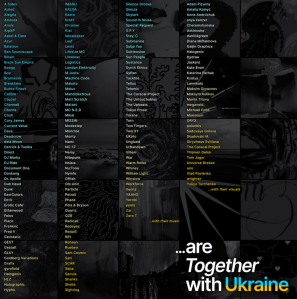
Together with Ukraine
You worked on one of the very first fundraising compilations Together With Ukraine to come out after the full-scale invasion. It seems to me that there’s been an unprecedented number of compilations for Ukraine, why do you think that is the case and what would you say is the secret of a successful compilation? And is there still a point to these compilations?
In the case of Together With Ukraine, there are a few factors that made it as successful as it is. The idea of creating it did not come out of nowhere. I thought about other similar charity compilations that I had noticed before: Music For Aleppo by Foreign Concept, Bou’s DNB 4 Peace, #savefabric and others. These laid the foundation for such a concept, meaning artists are more eager to contribute. I was confident in my network and the network of my close friends who I got on board, and I knew we would reach enough producers to get something decent going, given we all dedicated years to the community.
Timing was also a significant factor. It was really important for us to release it as soon as we could when all eyes were on Ukraine and people were ready to act. We picked the upcoming Bandcamp Friday and chose it as the deadline, meaning we had 6 days to do everything. I am under no illusion that if we were to do this compilation now, it would not be as successl as it has been.
We thought a lot of things through. The affordable price made it such an excellent deal that even if you don’t care about Ukraine or hate it – you can’t pass on the release, just because it was such great value. We set up dozens of premieres with all kinds of promo pages and channels, had an incredible PR person helping us get the compilation featured in all the media, we all were reaching out to everyone we knew to ask and spread it. As a result, we raised way more than we could have ever imagined and it was the best-selling Bandcamp release for a couple of weeks. You just could not avoid the release if you listened to Drum & Bass or Bass music. It was everywhere for a few months. I’ve been happy to share the lessons we’ve learnt with other people who made their own compilation for a variety of causes since.
All these charity releases are great as they raise both awareness and money. Artists often have great music laying around that they struggle to release for various reasons and these compilations help these tracks make their way to the artist’s audience. Music has the power to transmit good values. Yes, there are a lot of ungrateful, entitled people who immediately start screeching that music is apolitical and that it is all virtue signalling whenever an artist or a label supports something that they don’t. But at the same time, there are a lot of people who love and trust artists whose music they enjoy and are willing to listen when the artist has something to say and asks to support something.
 How do you feel about the divide between those who left Ukraine and those who stayed behind? And have you ever been tempted to leave yourself?
This is a complicated one. There is a divide and it is growing, especially among those who stay in Ukraine the whole time and cannot leave and those who left at the beginning of the full-scale invasion. A similar one exists between those who have been fighting and those who are still civilians. The reality here is very extreme, fast-paced and full of daily tragedies. A lot has changed and keeps changing. No matter how hard you try, you cannot keep up with it remotely. It’s been almost 3 years. In that time, some people who left are living very different lives now, full of new people and challenges, so they are getting more disconnected from what is happening in Ukraine and put down roots where they are, it’s only natural. There are exceptions, of course, but this is a general trend.
I am worried that a lot of these people might not return, which is really bad for our country, as we need those people. When some do return after Ukraine’s victory, it will also be a big challenge on its own – you have people who have fought in the war and struggle to integrate into civilian life, you have people who are traumatised and transformed by living through the war and you will have those who skipped a lot of it and cannot fully understand or relate. There will be tensions that won’t be easy to smooth out.
When it comes to artists – it’s difficult as well. Those who stay get fewer and fewer opportunities to travel outside, if they have such opportunities to begin with. Many joined or are joining the military, a significant number have died defending the country. At the same time you have those artists who left and they are the ones that are cheaper and easier to book if you want to get a Ukrainian act. They are more and more often the ones to represent Ukraine, yet they don’t live in Ukraine, many have not been in Ukraine since 2022 and it is unclear if they will ever return. Hardly fair, but so is this war. So it begs the question whether they are the ones to represent the Ukrainian struggle. But it’s better to have someone then no one at all. You see what I mean? There are so many nuances and arguments, it’s a vast and complicated conversation with no clear-cut answers and easy solutions. It is also always a struggle between the greater good of the country and Ukrainians and personal safety, well-being and prospects of individual people.
 I don’t want to leave Ukraine. I am luckier than most – I get opportunities to travel occasionally to represent Ukraine at conferences and establish collaborations with festivals, artists and organisations on behalf of Music Saves Ukraine. It has been a privilege and it helps to get a fresh perspective by talking to people outside of Ukraine and to shed light on what is happening here. But I would not want to stay outside of Ukraine for long – I am actually more anxious that way. It can be scary and difficult here at home, but I want to bear witness to what is happening and do my part. I enjoy travelling, but I don’t believe I can feel at home anywhere else as I do here with the most incredible, brave and caring people.
One thing is certain for me, though – the international community must invite Ukrainian artists to perform and speak as much as possible. It should also strive to invite as many Ukrainians living in Ukraine right now as possible, as these are the most important voices, yet they get the fewest opportunities. We need attention, donations, platforms, opportunities, investment, support and we deserve it.
OCTOBER 10, 2024 – ODESA
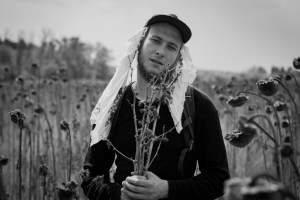
Hi! I’m Andrii, the person behind Mertvi Dereva, my solo project. Alongside this, I’m involved in several metal projects, including Waidelotte and Floscule — both of which released albums this year — and a post-punk duo called Signals Feed The Void. My musical journey started when I was 14, making it nearly two decades in the making.
Has the full-scale invasion changed the way you think about music and sound in general and have changed your setup as a result?
Russia’s full-scale invasion of Ukraine completely changed my relationship with music. The tragic events of the past three years have deeply affected how I experience it — I no longer listen to music the way I used to. It’s more of a background noise now, rather than an emotional outlet. However, creating music still brings out emotions and serves as a way to escape reality, even if just for a while.
As for my sound and setup, they evolve periodically. The only significant change was having to switch several bases. We organized a few fundraisers for the armed forces, where my instruments were the main prizes in the lottery.
 You just released the album Непереможне Сонце (Sol Invictus). It addresses the war directly, not just in the lyrics, but also in the music. Indeed the percussive sounds in tracks like “Toxic Fangs” are reminiscent of battle shots, to give just one example. What can you tell us about the production process and how does one convey the experience of war to an international audience who’s never been directly exposed to it?
Music, in terms of the ideas it represents, is very abstract. Some people might clearly hear gunshots and explosions in my album, while others interpret it as a mix of random industrial sounds. However, one thing that stands out beyond abstraction is the level of tension. The production process is quite straightforward: I feel the tension caused by the war, and I channel that into my music.
For example, when I come up with a bassline or a beat, I loop it and then experiment with chords and melodies that build on that tension. When it’s time, I fine-tune specific sounds, as they add significant depth to what I’m aiming for. But I’ve never intentionally tried to mimic battle sounds — it all came about organically, flowing naturally during each production session.
Are there any sounds you find triggering in music?
I can’t pinpoint anything specific — it could be anything, really. But how it’s perceived is entirely up to the listener’s own experience. Everyone brings their own perspective, and that shapes how they interpret the sounds.
 Has the role of music in Ukraine shifted from one of entertainment to encompass the expression of identity, communication, and emotional and physical survival?
I don’t think the musical landscape has shifted much. There are still plenty of artists focused purely on entertainment. However, in underground music, the expression of identity, communication, and emotional or physical survival has always played a significant role. What has changed is how we view identity, especially as we’ve begun to rediscover and reconnect with our Ukrainian heritage. So, the overall landscape has shifted a lot. The search for self-identity and the need to communicate certain ideas or find emotional refuge have always been present in underground music. What’s different now is how people perceive these themes and, of course, themselves in the new reality.
Most artists were unable to listen to music during the first few months of the full-scale invasion. Was it your case as well and if so, what were the tracks of artists that you listened to when you went back to music?
I’m still not able to connect with music the way I did before the war. However, Вежа Хмар truly stirs something within me. There’s something uniquely mystical about their music, something deeply tied to the core of the emotional landscape. The recent track by Kojoohar had a similar effect—it really moved me in a way that few things do these days.
What are the albums / artists that have helped you make sense of current events and helped you process your feelings?
Just these two examples, unfortunately. Perhaps, early works of Kadaitcha.
 Where are you now and have you been displaced by war at any point?
I live in Odesa now, having moved here just a few months before the invasion began. My hometown, Kherson, was occupied, and my mother and friends were trapped there. The city faces daily attacks from the Russians — shells, mines, drones, bombs, you name it. Almost every day, someone dies. Many of my sacred places across the region have been either destroyed, occupied, or contaminated by mines. It’s heartbreaking.
Do you suffer from burnout and how do you relax?
It feels like either I’ve grown accustomed to a never-ending burnout, or I’ve been lucky enough to avoid it. My girlfriend is a huge help, just by being herself. Climbing also plays a big role — it keeps both my body and mind in shape. And since July, we adopted a dog, who has quickly become a beloved family member and provides immeasurable emotional support.
As the line from one of your tracks says, “Will it get better? Or maybe it will be the other way round? (Чи стане краще? А може буде навпаки?)”
I don’t have a clear answer. All I know is that you have to keep learning how to live in new conditions and stay flexible, no matter what.
Which book / film / album / song / traditional dish / podcast / blog / artwork / building / meme best captures Ukraine for you?
- Book – Shadows of Forgotten Ancestors;
- Film – The Living Fire;
- Album – Полин Квітне;
- Song – Велика ріка Хєнь-Юань by Цукор Біла Смерть;
- Traditional Dish – Buckwheat;
- Podcast – never checked any;
- Blog – Neformat;
- Artwork – anything by Mariia Prymachenko;
- Building – Kyiv Crematorium;
- Meme – Веселий палій.
OCTOBER 11, 2024
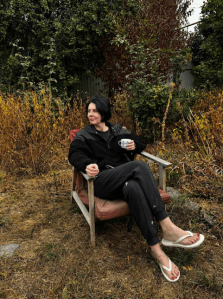
photo by Alla Bovt
I am Kateryna Semenyuk, curator and culture manager from Dnipro, now based in Kyiv. I have worked with Ukrainian contemporary art for around 15 years already. I started as culture manager and curator of the institution, it was Ya Gallery art center in Dnipro, then in 2017 I narrowed down from visual culture as it is to art which precisely works with traumatic past.
In 2019 together with Oksana Dovgopolova we founded Past / Future / Art, a memory culture platform that carries out commemorative, research, and art projects to engage broader audiences to work through the past. Co-curating the platform’s program remains the main focus for me for 5 years already, it includes exhibitions in Ukraine and abroad, laboratories, research programs etc.
You co-curated the project “Land to Return, Land to Care” a laboratory for artistic research on war experiences. Live streams were part of the project together with 5 sound-artists who simultaneously shared sounds that marked their personal wartime experiences in five different cities: Dnipro, Kyiv, Odesa, Lviv and Uzhhorod. How would you say the changed soundscape has informed the artistic practice of artists in Ukraine?
I would start by saying that the change in the soundscape has affected all the Ukrainians. The role of sounds in life changed radically during the war. If normally we focused more on visuals, during the war the audio experience takes on special importance. The sounds signal both danger and, conversely, that everything is relatively calm at the moment. This experience in one way or another becomes part of the practice of artists – for example, musicians integrate war sounds into their tracks, or artists work through the traumatic experience we have from the sounds of weapons (the project by the Open Group), or as it was in the project “Land to Return , Land to Care”, laboratory participants recorded changes in the soundscape of the cities and broadcasted the soundless Odessa of 2022, which was always loud before the large-scale war.
Most recently you also curated the National pavilion at the Malta Biennale showing the work of Alevtina Kakhidze in a project focused on working through the imperial past. Decolonisation has entered the art world but how receptive would you say is the international audience to seeing Ukrainian artists operating within this framework?
It seems to me that the language of art remains the most comprehensible to a Western audience. Not documentaries, not the images of horrors of war, from which some people want just to close themselves, but for others it turned into a background. Another thing is that not everyone understands Russian-Ukrainian relations as colonial. Western experience of the colonial past is quite different compared to us –– we are not across the sea, we are all white and even neighbors.
One of the topics of the @maltabiennale.art 2024 was decolonization, so we responded on request to work with this issue. Malta had a different empire, in some ways we have similar problems, in some they are various. We could joke about who was luckier with the empire, but only those who had a common experience can laugh at such jokes.
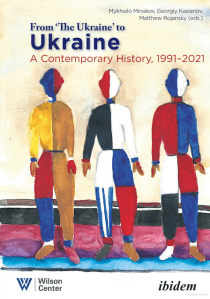 In their chapter “Ukrainian Art of the Independence Era: Transitions and Aspirations” in From The Ukraine to Ukraine, Oksana Barshynova and Olena Martynyuk identified two different periods for Ukrainian art.
The first period 1987–2004 supported mostly by foreign donors is marked by the creation of contemporary art institutions and by the complicated existence of contemporary art outside the state’s attention during a time of economic distress with the artists actively catching up in the new and contemporary media sectors, as well as in the field of contemporary critical and curatorial practices.
The second period was ushered in by the Orange Revolution and is marked by the emergence of artists who developed a line of critical art and is focused on performance art and public space activities. This period is also characterized by a high degree of artists’ self-organization and an aspiration to engage the widest audience possible as well as a closer engagement with social and political activism.
Do you agree with this and would you say the full-scale invasion has now ushered in a new period with contemporary art in Ukraine now mostly addressing survival and issues of national identity?
I am not sure in this conclusion but it’s too complicated to answer short )
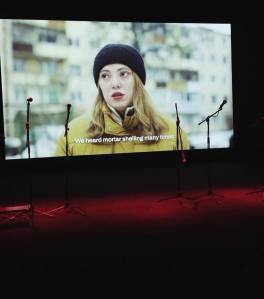
Repeat After Me by Open Group
Sound can often carry trauma. There are indeed a few Ukrainian artists who have been working with sound in their work, I am thinking of Open Group, for instance, who presented Repeat After Me at the Venice Biennale where IDP gave voice to the sounds of weapons. How would you say sound compares to the visual arts in conveying the experience of war?
This is an extremely important project by the Open Group. It seems that the sound here is not about retraumatization, instead it is about working through traumas, about sharing experience with others, it calls for participation and joint action. Separately, I will add not about the project itself, but about the fact that the Polish Pavilion presents a project about Ukraine. If it is possible to use this platform to call on international artists and institutions to talk more about Ukraine, then I will use it. It will give benefits not less than what we speak by ourselves.
 In Regarding the Pain of Others Susan Sontag writes, “We can’t imagine how dreadful, how terrifying war is; and how normal it becomes. Can’t understand, can’t imagine.” How can the visual arts engage with an international audience that might be desensitised by the “customary” images of war shown by the media?
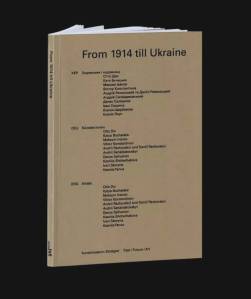
I already mentioned it just above. I suppose that one of the ways to be heard by a random audience is using an instrument of art. Through art exhibitions, books, theater performances, music. A year after the large-scale invasion, we presented an exhibition “From 1914 till Ukraine” at the Kunstmuseum Stuttgart, we didn’t use war documentation, horrific footage in the exhibition, we didn’t talk about the war literally. Visitors told us that in this way they understand us better, our losses, feelings, they understand what we are dying for. Documentation is important for international courts and politicians who make decisions on supplying weapons to Ukraine. If we want to be heard by a wider foreign audience, we have to do it through culture.
 Many experimental musicians have told me that they’ve been rediscovering their musical heritage after the full-scale invasion incorporating folk sounds in their work. Has something similar happened in the visual arts with traditional images and motifs?
I would say that the Ukrainians in general have become more interested in their history, especially in the rediscovery of those layers that were prohibited during the Soviet regime. I cannot say that the artists tend to use traditional motifs, but they definitely appeal to history. I also observe the use of motifs in modern design. I can mention a wonderful brand @gunia.
Are there any specific works by Ukrainian artists that are particularly poignant on a personal level for you in the way they managed to capture current events or address feelings closely related to them?
There are too many artworks to list them here. To mention at least one, I would mind the video “Write at Least Once a Day” by Yuriy Biley. Many hours in a row the artist reads aloud a long correspondence with his brother, who is in the army.
Do you listen to Ukrainian artists and if so what track and albums are currently on your playlist?
There are many of them 🙂 I would mention Курган & Agregat, except for being great performers, they make great contributions to the support of the Armed Forces of Ukraine –– they collect millions of hryvnia to the needs of militaries during their concerts.
OCTOBER 19, 2024
I am a creative coder who applies interest mainly in the field of music, but not limited to it: I create textual and visual works as well.
Creating music is some sort of personal journey to understand the hidden mechanics behind the things I enjoy. My latest big project dedicated to that matter called “grammars” is a set of rules that allows computer programs to create some sonically pleasing compositions. I plan to use this grammar-based musical language for a little bit longer, creating more complex rules and more elaborate sound design to give listeners something that not only will challenge their perception of music but also something they can enjoy
Has the full-scale invasion changed the way you think about music and sound in general and have you changed your setup as a result?
Not much has changed in my perception of music apart from the fact that I find some sounds a little bit triggering nowadays. However, what has changed is my understanding that I need a stronger voice for my story to be heard. Turns out my life as well as the lives of my close ones might depend on this. For that reason, recently I focused a bit more on making my music recognizable.
Regarding the setup, me and my family decided to move from Kyiv to Lviv so my son could live somewhere where there are fewer explosions. As I’m pretty anxious about transporting my guitar to long distances, I left it in Kyiv. For that reason I don’t incorporate organic sounds in my Supercollider textures as much as I’d want to. However, as recently I’ve moved back to Kyiv I hope we’ll hear some guitar in my tracks soon as well.
You just released the track “air raid siren is over”, a composition created for the Stop All Wars compilation. As you describe in the liner notes, the track uses “multiple field recordings such as me and my colleagues ignoring occasional air raid alert or me and my son discussing that air raids and explosions are over.” Air raid sirens have been extensively used in tracks by electronic music producers especially at the beginning of the full-scale invasion. Your take is more in line with musique concrete rather than bayraktar-core. What are the ethics of introducing war sounds in tracks?
This is an interesting question since before I experienced war myself I could never imagine how many sounds can be triggering. For instance, the whale song may resemble the sound of an air raid siren going off or some SFX in a computer game can remind you about the explosions near your house. Still, while the answer may sound a bit harsh, I think that including war sounds in music is an interesting challenge for both those who experienced war and those who didn’t. The former have to learn to heal their trauma eventually, while the latter have to understand that the war is about the people involved, not just about some numbers or news headlines
In your work you frequently analyse what Martin J Daughtry calls the belliphonic ie “the imagined total of sounds that would not have occurred had the conflict not taken place.” Most are used to seeing images of war on the news and on social media but sound is seldom represented. How does one best convey sonically the war experience to an international audience with no first hand experience of it?
To be honest, I don’t know the answer since every project on this matter tackles the issue from a different perspective. “voices of war” tells the story of higher-level concepts, narratives. “war.datapoints”, on the surface, may seem as a simple data sonification project, but its main purpose was to tell the personal story of the dreadful sonic atmosphere of early days of russian full-scale invasion. “air raid siren is over” while even more intimate tells the story of the aftermath, of how children who will shape our future see this war. While the conflict is far from over, after almost 3 years we can definitely see the first consequences of this brutal war.

war.datapoints
In the liner notes to war.datapoints you write, “When observing war long enough, people’s lives, hopes, dreams turn into plain numbers, statistics, datapoints.” After almost three years since the full-scale invasion, numbers have increased exponentially becoming almost abstract. As Susan Sontag writes in Regarding the Pain of Others, “We can’t imagine how dreadful, how terrifying war is; and how normal it becomes. Can’t understand, can’t imagine.” Has war become “normal” to you and what coping mechanisms have you put in place to preserve your mental health?
Over these years I am constantly amazed how the human mind can adapt to literally everything. Regarding coping mechanisms I can’t tell that I was a believer before the full-scale invasion or that I’m fully converted now, but I try to adhere to what I imagine Christian mentality is: at any point do what is right for you, for your family, for your community and let God figure out what’s best for you in these circumstances.
Some of your soundscapes like “Voices of the war” incorporate, among other field recordings, sources of tactical information and triggering sounds from the battlefields but rather than narrative your approach seems more geared towards textures. Is your aim to induce a physical response rather than an emotional one?
First of all, I have to correct you. I didn’t disclose any tactical information since otherwise I would end up in jail. All recordings of russian servicemen I used were in open access. As per my aims, I never intended to make my listeners suffer. Still, the early months of full-scale war were a pretty intense experience and documenting them led to harsh power-electronics type of sound. As you might have guessed, power-electronics is not something that you listen to among your family in a relaxed atmosphere with a cup of tea.
Your work “Is the war over?” is a text piece addressing many of the same issues you have tackled in your sound pieces. You labeled it poésie concrète drawing an analogy to musique concrète where music is composed of non-musical pieces. As you explain, your poem is similarly composed of search engine results for “russian war crimes” which are then processed by a sentiment analysis model to extract sentences that highlight russian atrocities most properly. After ML-processing sentences assembled in the poem. Every Sunday the poem is regenerated with new war crimes. The work is pretty graphic because, as you also state, “war is a graphic thing.” At a time when “war fatigue” has set in, how effective do you judge the graphic approach to be?
It is hard to answer precisely since to measure effectiveness you have to operate with numbers. Still, I can definitely say such a project is necessary. Up to this time I encountered a lot of false narratives trying to explain russian aggression. The most prominent one of course is that NATO expansion somehow justifies ruining the lives of millions of Ukrainians. However, there are more exotic ones. For instance, my wife’s friend who lived in Bucha and now moved to Germany with her son, upon telling stories from the early days of the full-scale war was met with a surprise “I couldn’t imagine people really killing each other there!”. So both the graphic nature and the project’s continuity are an attempt to show that the war russians waging on us is the barbaric attempt to genocide as many Ukrainians as possible and to force the rest into submission. Just as Holodomor (soviet engineered famine that took the lives of nearly 6 million Ukrainians) almost 100 years ago.
Would you agree that the role of music in Ukraine has shifted from one of entertainment to encompass the expression of identity, communication, and emotional and physical survival?
I think that it’s not something that happened 3 years ago. Euromaidan revolution followed by russia illegally seizing Crimea and parts of Donetsk and Luhansk oblast helped Ukrainians shed their postcolonial trauma and reignite interest in their own identity. Music just like every other aspect of human life followed this process.
 Most artists were unable to listen to music during the first few months of the full-scale invasion. Was it your case as well and if so, what were the tracks of artists that you listened to when you went back to music?
For the first month the only thing that bothered me was keeping my son far enough from windows so in case of artillery shelling or air raid he wouldn’t be hurt by glass shards. Once we were relatively safe the main aim for me was to start living as usual, so I listened to almost the same things as before the full-scale war. The only thing that changed was that for the first half of the year, I was becoming very anxious when listening to martial industrial. Now I’m not anymore, but nevertheless, I don’t enjoy it anymore as much as I used to.
What are the albums / artists that have helped you make sense of current events and helped you process your feelings?
I’d single out not a musical work but “La Peste” by Albert Camus.
Where are you now and have you been displaced by war at any point?
Now I’m torn apart between my native Kyiv and Lviv where my family stays. However, Lviv is a pleasant cozy town and I’ve met many nice people there. My wife dreamed about living there as well. So I rather think of myself as being presented with a fine opportunity than as a displaced person.
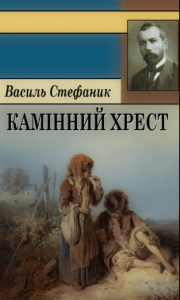
Vasyl Stefanyk – The Stone Cross
Which book / film / album / song / traditional dish / podcast / blog / artwork / building / meme best captures Ukraine for you?
Let me start from afar. My theory is that world literature consists of 3 main clusters. The first one is people trying to contemplate life, the second one is people actively trying to change it and the third one is magical realism. Ukrainian literature has brilliant examples of all these clusters. Mykola Gogol was creating beautiful magical realism almost 100 years before the term was coined. Sofiya Andruhovych’s “Amadoka” is a great example of intellectual fiction depicting the problem of memory on individual levels as well as on the level of the family and the entire country. However, most Ukrainian literature is about a person fighting a pretty rough world.
Russian literature lies on the other side of the spectrum with few chosen ones (overly)intellectualizing while the masses are reduced to slave status. As Svetlana Alexievich puts it “Russian life should be evil, worthless. Then the soul rises, it realizes that it does not belong to this world. The dirtier and bloodier, the more space for her.”.
With that said, my choice is “Stone Cross” by Vasyl Stefanyk. It is a succinct story that due to Srefsnyk’s landmark style uses just enough words to tell the stunning story of a man’s hard work to make the best of his living and his connection to the land where he spilled his sweat. Put into perspective, it explains one of the main reasons why russia so desperately clings to Ukraine. With people who only contemplate life and no people willing to work hard to change it, russia faces the imminent danger of collapse. So Ukraine is the most proximate source of vitally important human capital which russia craves that much. For that reason, until russia exists Ukrainians will always face unrest.
NEW RELEASES
Smezkh ~ Joyful And A Little Sad EP
Artist’s note:
‘The tracks have eloquent titles for a reason, like the names of paintings or Ukrainian poems. These are memories, strong memories of childhood, summer holidays in the village, my great-grandmother, grandmother, cherry blossoms, a mud hut, and a big willow tree in front of the yard. But memories pass quickly, just like childhood. That’s why it’s important to preserve this treasure, it helps us to live on.’
Hidden Element ~ Unity
“Hello, friends! Greetings from Kyiv, Ukraine. These 3 tracks were written in Ukraine during full-scale invasion between 2022 and 2023. They represent different vibe and tempo (as well as my other releases on YUKU) but they show my understanding of electronic music. I was inspired by my favorite artists and labels such as Astrophonica, Metalheads and YUKU for sure.
Ulterior Tune – is the backlash to the track of Ulterior Motive’s “Elephant Tune”. I hope you can guess what element from their track I hide. “Unity” is my reinterpretation of DnB tracks from my childhood. “Ash” – the track was inspired by Ténèbre’s album “Terraform” released on YUKU but it has radically different atmosphere. It’s funny that at the time of writing it seemed to me that the sound was copied. “Ash” is my personal favorite for this release: as you may know I’m obsessed with old sci-fi movies, so I hope you’ll understand the origin of the main sample here.
It was so important for me to involve a Kyiv-based artist Slava Kryzhanovski for the artwork. Slava has his own visual style that I like & it’s perfectly matching the sound of whole release – rude, uncouth, but beautiful.
Many thanks to Jef & Ilda. Enjoy”
—Hidden Element
Radiant Futur ~ Circuit Complexity (VORTX009)
Acidic futurism awaits you on October 11. Сircuit Сomplexity EP from recognizable Ukrainian artist Radiant Futur will not leave you aside
Silat Beksi ~ Flips
«FLIPS» is a collection of six remixes I created between 2014 and 2023 for artists like Fedo, Wyro, Luminer, Csurt, Ali Demir, and Counrad. Some tracks were released on vinyl, while others came out in digital format. I’ve now gathered them in one place to share with those who might have missed the chance to listen or download them before.
hjumən, Unknownfunction ~ Assault EP
Hey there! Such a productive time 🙂 Here is my collab work with Unknownfunction. It’s called “Assault EP”. It’s a solid dark / hypnotic techno stuff. Check it out! Peace ❤️
Heskbo ~ Textures
Fourth album in a year, Textures weaves complex rhtymic patterns delivering a carefully balanced interplay of light and shadows with echoes of gritty, industrial soundscapes.
User Kyx ~ Cold
Back with his trademark off kilter style and provocative cover art, User Kyx delivers another intriguing slice of experimental electronica.
Midnight Revenant ~ Woodoo Heaven
Hello everyone! This is my first album!
The protagonist returns to his hometown and learns of an abandoned mansion that once belonged to a powerful corporation that conducted illegal experiments with neural networks and human consciousness. Getting inside, he finds old technology that has begun to destroy reality, and finds himself drawn into a game of manipulation and mind control. The hero tries to restore the truth, but gradually realizes that part of his memories have been erased or changed. Now he is forced to fight not only the corporation, but also the shadows of his own personality to regain control of his life.
Kindracoma ~ Skiftjan
Skiftjan is an old German word and has the roots of “change, transition, layering” in modern Norwegian, German, and English languages. It is about changes, both in the author’s personality specifically and humans in general throughout life and different circumstances, about being brave enough to accept reality as it is, regardless of the dramatic episodes that appear. This type of music has never been felt by author before, war changed everything.
It is how it is.
Bayun the Cat / louri Grankin ~ Appearance of Dionysus in a Bomb Shelter
A collaboration between Kyiv-based ambient and experimental music producer Dmytro Postovalov aka Bayun the Cat and Dusseldorf-based Ukrainian improvising vocalist Iouri Grankin.
“Appearance of Dionysus in the Bomb Shelter”, as you can guess, is inspired by Nietzsche’s famous work and severe realities of Russian invasion of Ukraine. It is an attempt to find some supreme joy in conditions when there seems to be nothing to be happy about. Dionysus brings into the context of tragedy his distinctive spontaneity, lively response to what is happening, emotional fullness and a sense of triumph of life. Surely, in this case joy is understood by Nietzsche not as ordinary gaiety, but as a deep, ecstatic influx of mental forces caused by the awareness of the greatness and invincibility of the human spirit, which often manifests itself in the most terrible conditions. This music is an experience of conscious idealization, dictated by the need to survive and not lose faith in humanity.
BtC: ‘I asked Iouri to record something that could become a starting point for an interesting experiment, and he recorded several minutes of pure noise, using extended vocal techniques, in which he is an absolute master. I multiplied, transformed and amplified this noise, trying to deal with this as with musical instrument.’
Heinali ~ Aves Rubrae
Aves Rubrae (‘red birds’ in Latin) was initially commissioned by the Museum of Modern Art in New York for MoMa magazine in 2023. It was recorded in one take on Heinali’s modular synthesiser—an instrument that Oleh set up informed by artistic research of the past five years, enabling him to improvise polyphony and monophony, borrowing techniques and ideas from medieval composers & theorists and contemporary fields of analogue synthesis & generative music—exploring intersections of the Providence and Contingency, the past and the present, technology and the sacred.
Similar to the organa of XII-XIII century Notre Dame polyphony, Aves Rubrae is an organum that features fast-moving upper voices with intricate melodies created by the machine overlaid on the slow-moving drones of the lower voice. However, unlike the Notre Dame polyphony, composed for grand church celebrations, ‘Aves Rubrae’ has an eschatological tone that is perhaps more fitting for the world at hand. The piece references ‘Red Birds Will Fly Out Of The East And Destroy Paris In A Night’ (allegedly referencing one of the apocalyptic prophecies of Nostradamus) by Coil, paying homage to one of the most influential artists whose music shaped Oleh during his teenage years.
011010 ~ 12 Years After [ОЧІ 043]
Even the cold wind over the dance floors we’ve been bathing in for the last decade has these warm patterns that the skin needs blood to fill in.
Words are therefore replaced with bleeps, and the drum section feels closer to the foil-wrapped roof than to the concrete of the warehouse we’re all trying to get into. Our breath is shared in and out, with a tempo likely set by our hearts and guided by the bassline we’re doomed to follow. A decade in, decade out. [Vlad Fisun]
Vlad Suppish ~ Slow Yet Steady
Vlad Suppish is a Ukrainian musician in the ambient and drone genres, known for creating intricate soundscapes using modular synthesizers. His music explores themes of resilience, contemplation, and self-reflection.
About the album Slow yet Steady: “From my own experience, I can assert that the best things happen slowly. What becomes a habit defines our essence. Resilience slowly shapes a unique character. And steadfastness allows us to endure even the toughest times.
Four compositions, four slow but steady meditations. From simplicity and naivety to hypnotic complexity. And back again—to conscious simplicity.
The inner child that has understood itself. This is music of experience, habit, resilience, and steadfastness.”
VA ~ Even the Forest Hums: Ukrainian Sonic Archives 1971-1996
Light in the Attic Records proudly presents Even the Forest Hums: Ukrainian Sonic Archives 1971-1996—the first comprehensive collection of Ukrainian music recorded prior to, and immediately following, the USSR’s collapse. From subtly dissenting Soviet-era singles to DIY recordings from Kyiv’s vibrant underground scene, the compilation chronicles the development of Ukraine’s rich musical landscape through rare folk, rock, jazz, and electronic recordings.
Ujif_notfound ~ Metanoia
The one who didn’t do enough to stop this.
The one who is no longer in charge of himself.
The one who silently agrees.
The one who is ready for the sake of profit.
The one who never thought.
The one who lies.
The one who wants to kill.
The one who is too small.
The one who will be forgotten by everyone.
The one who is decomposing.
The one who is not guilty.
The one who was forced.
The one who needs money.
The one who lies dead.
The one who regretted at the last moment, but it’s too late.
The one who pressed himself to the ground.
The one who is rotting.
Suffer the one who is rotting.
58918012 ~ the music for non-existent movies
Hello, friends. I always wanted to write music for some movie… But this wanting is still only my dream. On the other hand, who can forbid me from writing music for movies that don’t exist? You’re goddamn right — nobody! Actually, these movies exist but only in my imagination. I think you can draw your own story for each track in this album 🙂
In this release, I used a lot of piano and orchestral instruments, which makes it incredibly soft, melodic, and atmospheric at the same time. The main idea here is to create an imaginary movie out of nowhere. So, free your brain and you’ll see what story you will finish with. Btw, I didn’t give names for tracks on purpose…to let your imagination do it. Enjoy your experience! Thanks for listening and support ❤
Aircraft ~ Evidence
This is the seventh long-play album by Ukrainian electronic artist – Aircraft. It consists of 9 tracks connected by one idea and composition. The album starts with the celebration song “Leftover” which reminds past days of carefreeness and love. The title track – “Evidence” reveals the whole essence of the album. Searching for evidence of oneself existence in the rapidity of life that sometimes emerge from nowhere, each time accepting himself in current reality. The mood is traced already in the first songs, but the real journey awaits the listener in the middle of the album, where the artist immerses you in a mysterious world. Pop songs like “Leftover” and “Tonight” flow into ambient fragments of memories and nostalgia, ending the album with a melancholic but rather bright song – “Lighter”.
Work on this album was started 5 years ago in Kyiv, but was completed in Berlin. This long and difficult path the album underwent at the same time as the difficulties of the artist himself. But no matter what, the desire for art and music always overcomes the darkness of history, leaving a bright beacon for future generations. The album was mixed and mastered by talented Ukrainian sound-engineer Sergii Pynchuk.
Nina Eba ~ RE:MORPHIX
Following the release of her critically acclaimed album MORPHO this summer, Ukrainian artist and DJ/producer NINA EBA returns with RE:MORPHIX — a remix compilation that reimagines her original work through the lens of a diverse lineup of electronic music producers from around the world. The compilation features multi-genre edits from Nina’s close friends and favorite sound producers, each having played a vital role in her DJ sets. This special drop is aimed at electronic music lovers who enjoy exploring a fusion of styles ranging from future garage to breakbeat, IDM, and more.
Vestibular Glow ~ I Don’t Give A Fuck
Vestibular Glow is the alias chosen by Sviatoslav Nemchenko in 2021 to start his journey as a musician, debuting in his hometown of Dnipro. He learned to play the piano as a child, so when he later discovered electronic music, it was no surprise that he felt drawn to explore it. Sviatoslav believes that combining both dark and light elements in music deeply enhances the expression of any genre.
The music Sviatoslav creates spans a wide range of genres, yet maintains a distinct, recognizable sound. His influences include EBM, New Beat, Post-Punk, Gothic Rock, Dark Disco, Acid, Synthwave, Minimal Synth, Darkwave, Coldwave, Indie Dance, New Wave, Electro, Industrial, and Italo. Over the years, he has built up a significant body of work through continuous production.
His debut EP, I Don’t Give A Fuck, released on Regulardisco, is a collection of personal tracks written during emotionally challenging times. After channelling this energy into his music, Sviatoslav made the decision to move to Kyiv and start fresh. The EP is somewhat of a split release, with the first half featuring playful, melodic tracks, while the second half adopts a tighter, harder sound, walking a fine line between dark and light tones.
VIEWING ROOM
(Gianmarco Del Re)
 a closer listen