

artwork by Mariia Prymachenko
This month we have a predominantly female lineup starting with Iryna Lazer from Mavka talking about art as beauty and war as absolute blackness. Meanwhile Anna Aloka delves into Ukrainian traditional music and Advikainsane dispels some of the misconceptions about Donbas.
Furthermore, Rita Kulyk holds listening parties in Vienna, and Stipa reflects on fading connections and respect in differences. To round things up Denys Chornomorets expresses his love for Italo Disco and talks about the importance of music for military personnel.
New Releases include nes albums and EPs by Selective Softener, Revshark, Lu Joyce, Stipa, Trinidad Shevron, RinniR, Pymin, NRNT, Andrii Kunin, Kotra, Khrystyna Kirik, Danilenko, an honest fox, essentialmiks, walakos, ummsbiaus, ЛІЗА ПАДЛІЗА, and v4w.enko.
But to begin with, for our monthly podcast on Resonance FM, we celebrate the release of the second volume of UFN with the collected interviews from the second year of the Russian full-scale invasion. The ebook is available both in PDF and ePub formats and comes with a 35 track fundraiser with proceeds going once again to Musicians Defend Ukraine.

photo by Ellis
Special thanks are due to Ivan Samokrutkin for releasing the album on the bandcamp page of система system, Clasps for doing an excellent job mastering such a diverse album into an organic whole, Massimiliano Masa for the ebook layout, Ellis for the artwork and Anastasia Batyr for help with the translations.
Tracklist:
Alexander Stratonov – Traces of Ember
Hockins – Arzamas On Fire
Juli Riot – Bozhevillia
Zahvat – Bouquet for Olha
Septim – Cyber Thoughts
Phite Noise – Hydrogen
Myroslav Trofymuk aka. AЙKTRONER – 31.03.24
Kirik & Sidletskyi – area of passive recreation
This is followed by our Spotify playlist featuring our interviewees and new releases from November 2024. To round things up we have new videos by Human Margareeta, TANKATAKA, The Unsleeping and Alina Pash.
OCTOBER 29, 2024 – HOSTOMEL
 Iryna Lazer – Mavka
I am Iryna Lazer, the leader of the Mavka band. Conductor-choirmaster, artist-vocalist (academic singing) and theater and film actress by education. Ever since I was a teenager, the parallel musical worlds of Bjork and Bach existed for me, which were closely intertwined in my head, inviting Leontovych, the genius of Ukrainian folk song, to join. It was my point of reference, a sense of a kind of musical reality in which I am still growing.
Has the full-scale invasion changed the way you think about music and sound in general, and has it had an impact on your playlist and setup or had that already changed back in 2014?
I deleted modern russian music from my life back in 2014. In 2022, it became painful to hear even classical composers of the aggressor country. The playlist became tougher, I was looking for the strength to live on… However, in 2022, I couldn’t listen to music at all.
Has the role of music for Ukrainian artists shifted from one of entertainment to encompass the expression of identity, communication, and emotional and physical survival?
Indeed, the changes are striking. On the one hand, you don’t need to look for inspiration, you know very well what exactly you want to say (shout) with your creativity. The form of expression already depends on the level of qualification, taste and sincerity. Music has become something more than sound and emotion and is certainly a powerful expression of identity. For me, creativity is a constant struggle and an opportunity not to lose my mind.
Mavka have been deconstructing and reinterpreting traditional Ukrainian songs in albums like Gagilka. Die Verwandlung and Spy for a number of years now. Ever since the full-scale invasion, Ukrainian artists have been rediscovering their musical heritage and using folk elements in their electronic works. How does one ensure to uphold traditions without reinforcing damaging stereotypes of exoticism?
These two albums were a certain experiment and strengthened my connection with the Motherland. The texts of our songs, so incomprehensible to me as a child, opened up for me in the historical context, and the melody mesmerized with its diversity and beauty. ⁃ At the end of 2023, my mini-album Rusalii was released, which is the result of three years of work on the unfinished opera of Mykola Leontovich. There are bold musical solutions, but, in my opinion, a rather organic combination of electronics and classical constructions.
Now I see a lot of manipulations with the use of folk motifs, it is very unfortunate, the line is too fine. In order not to harm, there should be a thorough approach to work with heritage and it should be as sincere as possible.
Following from the previous question, how do you feel about Ukrainian winning entries for Eurovision from Ruslana (2004) to Klaush Orchestra (2022) via Jamala (2016) in the way they portrayed different Ukrainian identities and values?
This competition is foreign to me. It’s hard for me to rate music that I don’t listen to. But thanks to participation in Eurovision, the winners have done a lot for the country in the informative space, and also collected a lot of funds to support Ukraine. This is very important for us, my support and respect to all winners.
Do you find war sounds and air raid sirens used in electronic music tracks to be triggering and how can one best describe the war experience sonically to a foreign audience?
Yes, I consider it a trigger and an unacceptable way of expression. Metaphor has always been a powerful tool for artists, it is necessary to act through artistic reinterpretation, and real sounds should be left to documentary forms. Therefore, the theme of my residency at the TD Theater in Berlin was exactly “Sounds of War in Music and Theater”. I worked through associations and emotions, taking into account the space in which the sound waves would have a certain effect and the sounds formed into a kind of noise construction. The performance Ver-Rückt was the result of this research, there are whole compositions of the sounds of war, only they are performed with musical instruments in a reconstructed form.
Are there any specific tracks or albums from the past two and a half years that have captured current events for you?
Only documentary forms are capable of such reflection. For me, these are “tracks” of intercepted conversations of Russian soldiers with their relatives. “Tracks and albums” of the voice messages of my neighbors who could not evacuate and sent to our shared house chat, what happened while there was a connection. A “track” of explosions that I now hear almost every night. Through art we can convey our own experience of trauma, but not current events.
You have taken part in a number of fundraising compilations. After almost three years since the full-scale invasion, how does one manage to keep focus on Ukraine as international attention is diverted to other causes?
I created the performance Ver-Rückt, which premiered at TD Berlin in 2023. Based on documentary interviews from the occupation of the Kyiv region, as well as using real instructions on how to act in critical situations during the war, I combined theatrical conventions, humor, music and animated visualization with the horror of real events. And, it seems to me, this performance helps Europeans to be closer and feel the Ukrainian reality almost to the touch. Performances of the play continue until now, but it has really become difficult, because there is really less attention paid to Ukraine now. And this is natural and normal, the misery and suffering of others become tiresome and boring, especially when russian propaganda contributes to this process.
Having recently visited Ukraine I was struck by how vibrant the electronic and experimental music scene is. How do you see the scene developing under present circumstances after many have now left and with more and more musicians being mobilized?
Currently, we have reached the peak of Ukrainian experimental music, it is developing rapidly. There is pain, powerful senses, concentration in the moment. Each track can be the last one or it might never be released.
As for mobilization, it is a natural process and in fact, many musicians go to defend the country voluntarily. With more support and technical assistance, fewer Ukrainian poets and musicians would die.
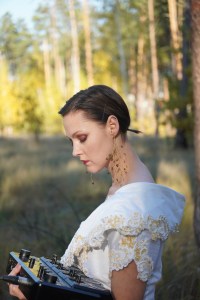 Many Ukrainian artists have told me that in the first few months of the full-scale invasion they were unable to play music, let alone compose or perform new music. Do you share this experience and if so, what made it possible for you to reconnect with music and what were you listening to, once you went back to music?
Yes, this experience is familiar to me. I couldn’t create anything and I didn’t understand why. What I saw and felt is impossible to convey through art. In 2022, there was an attempt to share one’s own experience of fleeing the war from the stage of the theater – “Mavka Remixed Brecht” at the Berliner Ensemble. But it was too difficult for me emotionally and I was looking for a new creative form that was less traumatic. The residency on researching the sounds of war helped me then, in a certain way, to accept reality and feel how I should survive, transform my experience into creativity and be useful.
I feel something similar right now. The decision to return home to Hostomel has meant both great happiness to be together as a family but also many fears for our child, for the future, for life. What I feel and how I could sound now is too painful and, I’m afraid, no one needs it. Art is beauty, even if it evokes different polar emotions. War is absolute blackness, there is no and cannot be beauty, there cannot be art. Since I came back, I haven’t been able to create anything yet… All my new recordings were made in Berlin during short concert tours.
Which book / film / album / song / traditional dish / podcast / blog / artwork / building / meme best captures Ukraine for you?
I have my own image that reflects Ukraine for me. This is a cuckoo with butterfly wings – beautiful, fragile and sad, I will definitely visualize it in my work someday. This image came to me with the song “Cuckoo”, which is dedicated to the memory of the victims of the famine.
NOVEMBER 5, 2024 – KYIV
 I’m Anna Aloka, a DJ and beginner electronic music producer and singer / songwriter. I’ve been in the music industry for 14 years and worked as a music journalist, photographer, PR, and social media manager. I used to be a festival organizer and art director for such big projects as the Vedalife Yoga Festival, and the Samskara Exhibition. I still organize parties from time to time and I’m a co-creator of the Mix by Mix project, where I mix music and my partner mixes cocktails. It all blends together into a united experience.
Has the full-scale invasion changed the way you think about music and sound in general, and has it had an impact on your playlist?
I would not say it changed my way of thinking about music. But it definitely affected how I listened to music. I mean I could not listen to it for the first three months at all. But thankfully step by step I’ve got back to listening and mixing. Even before I always aimed to showcase music by Ukrainian artists and producers. And I think this desire has only increased.
Also, I’ve become interested in Ukrainian traditional music. I am learning and singing traditional Ukrainian songs now. And this journey is very inspiring. My idea behind this is this: if I learn a song I will remember it for my whole life and I’ll be able to transfer it to other people, the next generations, and in this way I can save the tradition. Because russians are hell bent on destroying our culture.

photo by Misha Kot
Has the role of music in Ukraine shifted from one of entertainment to encompass the expression of identity, communication, and emotional and physical survival?
I think music always has the power to express our feelings. Every producer and songwriter will tell you this. But because the level of emotional intensity we live with now has drastically increased, all the “metaphysical” power music has also strengthened. Music helps us to live through our pains whether we’re civilians or in the military.
Do you find war sounds and air raid sirens used in electronic music tracks to be triggering and how can one best describe the war experience sonically to a foreign audience?
I had an idea in my head to use air raid sirens in my performances abroad to trigger foreigners to think about what we live through. But then someone pointed out to me that there could be Ukrainians in the audience and also people from other countries who lived through war in their lives and it could be very traumatic for them to hear this sound during a festival in the place where they came to find peace.
I think talking sonically to a foreign audience about war is not as simple as it is. Yes, we can use air siren sounds in music production, we can put our emotions into music. But as we’re human beings and we experience art through each of our psychological perspectives I think it’s important to use words in our communication. I don’t mean everyone needs to start writing songs instead of instrumental music. But with our releases online and during our performances we can talk about our experience.

photo by Matthias Marke
Are there any specific tracks or albums from the past two years and a half that have captured current events for you?
The most painful and yet the most beautiful and honest project about current events is WARНЯКАННЯ by my colleagues Anton Slepakov and Andriy Sokolov. I wish foreign audiences could experience it as we Ukrainians do. It’s electronic music with incredibly smart, true, and painful lyrics about our lives. Even translated to other languages it would be hard to understand it to the fullest if you hadn’t lived through war experience. But I still encourage everyone to listen to it.
How aware would you say Ukrainians are of their musical heritage and did the full-scale invasion make you personally rediscover any unsung composers or works?
There’s a new wave of Ukrainians discovering their cultural heritage from young to old people. My personal interest is traditional Ukrainian music — folklore. It is definitely the war that made me rediscover what we had for centuries. With the risk of our culture being destroyed again and again we realized we need to treasure and study it. But we need to keep working hard in order for the whole nation to value it.
Has Ukrainian music finally moved away from the periphery to occupy a more central place on the world stage?
No. And if we’re honest we will see there are not so many “periphery” cultures from other countries on the “main stage” as well. You can easily see that on streaming charts. But what I’m happy about is that there are a bunch of strong big electronic artists who evolved drastically during the past 5 years on the big stage: Woo York, 8keys, Artbat, Miss Monique, and many more. This makes me happy because they’re Ukrainians and people want to listen to them and see them at the festivals.
Having recently visited Ukraine I was struck by how vibrant its electronic and experimental music scene is. How do you see the scene developing under present circumstances considering that more and more musicians are being mobilised?
There’s a lot to be sad about in the music industry in general and the electronic scene in particular. Because it’s war. And war is never good. But the appearance of new names, constant big and small parties, and even festivals just show us how important music is for our survival. If you can imagine feeling pain, happiness, despair, and life loss and life being born at once you can understand how Ukrainians or any other nation being killed feels.

photo by by Maria Markevych
Many Ukrainian artists have told me that in the first few months of the full-scale invasion, they were unable to play music, let alone compose or perform new music. Do you share this experience and if so, what were you listening to, once you went back to music?
After 3 months of not listening to music, I’ve come back with listening to DakhaBrakha band and also my favorite downtempo. It was how I’ve recorded my first mix since February 2022. I’ve released it on the American-Georgian label Downtempo Rituals. It’s also my most played mix.
You recently had a residency in the South of Italy. What can you tell us about this experience and how many opportunities are there for Ukrainians in terms of grants and residencies?
First of all, I want to thank Giulio Vita and the team at LaGuarimba who created that amazing opportunity for 5 Ukrainian musicians and 10 Ukrainian filmmakers to just come, rest, and create freely in the peaceful seaside in Italy. A month in a peaceful country with dedicated studio time and like-minded people creates magic. It was the place where I produced and performed my very first track.
And yes, there are a lot of opportunities for Ukrainians out there provided by projects like Creative Europe, Culture Moves Europe, organizations like Goethe Institute, and many many more. Ukrainian Cultural Fund, Ukrainian Institute, and Music Export Ukraine are those Ukrainian organizations that constantly work on creating more opportunities for Ukrainian culture.
 Which book / film / album / song / traditional dish / podcast / blog / artwork / building / meme best captures Ukraine for you?
- The meme but also the very real photo is that kitchen cabinet and an old ceramic rooster on the wall of the half-destroyed multi-story house in Borodyanka. Destroyed but not broken.
- The dish is definitely Borscht to me.
- For the art thing, I would name Telegraph design magazine. It’s a wonderful editorial with a selection of the best Ukrainian designs and artworks.
- Music? I don’t know when this interview is going to come out but I would recommend listening to the new album by Valya Levchenko — Vidgomony Stepu.
NOVEMBER 7, 2024 – KYIV
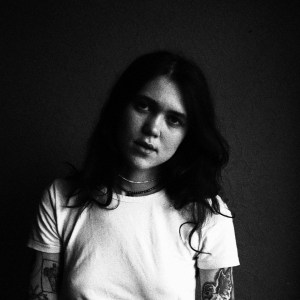
photo by Oleksandr Maksymenko
My name is Advika, and I’m from Sloviansk in the Donetsk region. I consider the beginning of 2023 as the true start of my musical journey—that’s when I began working on my first EP. Before that, I was only a devoted listener. In 2019, I met some musicians and was drawn deeper into the world of music. I studied music history, explored my favorite artists, and listened closely to their concepts and musical experiments. I tried creating my own melodies, learned how to play DJ sets, and even recorded my first one, which is still on SoundCloud. But I see the start of my first EP as the real beginning of my conscious musical path.
Has the full-scale invasion changed the way you think about music and sound in general, and has it had an impact on your playlist or did that already happen in 2014?
My perception and relationship with music really shifted after the full-scale invasion. Back in 2014, I was just a child—I was 13 and couldn’t fully grasp what was happening around me.
photo by Kyrylo Diskoteka
Has the role of music in Ukraine shifted from one of entertainment to encompass the expression of identity, communication, and emotional and physical survival?
From my own experience, the role of music in Ukraine has definitely changed. Music has become a powerful voice for our identity—a tool without borders. At the start of the full-scale invasion, it was one of the instruments of unity. Singing and music in the shelters brought back a sense of life, offering refuge from the fear and horror of war. Music helped us endure things that our minds couldn’t process. Even now, on the front lines, music is one of the key sources of motivation for soldiers and plays an incredibly important role there. Artists who perform for the troops all say the same thing: it helps them keep going, mentally and emotionally.
What can you tell us about the production process for your EP внутрішньо переміщена особистість (An internally displaced personality) released on Ochii and specifically about its title?
When I started writing this EP, I was a complete beginner in music. I reached out to a musician friend for guidance, as I knew exactly what I wanted to convey and how it should feel and sound, but I had no idea how to achieve it technically. The process felt like an explorer’s journey — I searched for different sounds, used voice recorder samples, and relived my experiences from 2014 to express them musically. I wanted to release the pain I’d been holding onto. My home was destroyed back in 2014, and I had no place to return to after Sloviansk was liberated. Irpin and Bucha took my family in, and I lived and studied there for four years.
I was in Kyiv when the full-scale invasion began. My heart shattered when I learned what had happened to Irpin and Bucha, while my family was still in Donetsk. The pain was unbearable, and I found release through music. I wanted to tell the story of a displaced person and the feeling of losing one’s home. Each track represents an emotion or state, expressed in its title. For the album cover, I created a collection of portraits of people from the Donetsk and Luhansk regions, to show that displaced individuals are diverse, often right next to us, living through this unique and painful experience of forced loss. The title was inspired by the term “internally displaced person.” I reshaped it into An Internally Displaced Personality to show how this experience transforms who you are.
photo by Kyrylo Diskoteka
The first track on your EP begins with field recordings. One of the things I have noticed is that, to my knowledge, there are not that many field recordings based works by Ukrainian artists to have come out since the full-scale invasion with a few exceptions, such as Difference Machine, ummsbiaus and Adaa Zagorodnya, for instance. Is that a correct assessment and why do you think that is the case and can you tell us about your inclusion of field recordings?
My first track does indeed start with some unconventional recordings of war. You can hear birds singing, sounds from a school and children, as well as the noise of a train and news reports. These elements symbolize how, like so many, I first encountered the war as a child in the spring of 2014. We were just regular school kids, greeting spring without the faintest idea we’d soon be facing war. The sound of the train represents our forced relocation to safer places, and the atmosphere is broken by urgent news of occupation, shelling, and battles in our hometowns. The contrast aims to capture the unease and fear of the unknown that war brings.
I think one reason many artists may not use field recordings like these is, firstly, because they might not have access to them. Secondly, it’s a complex way to convey mood—it’s challenging to work with these sounds subtly rather than directly. There’s a need to carefully consider how such recordings will enhance a track rather than overshadow it. And these recordings can be triggering, both for the artists who create the music and for listeners who experience it.
You are from the Donetsk oblast if I am not mistaken. Could you dispel some of the most persistent misconceptions about Southeast Ukraine?
Yes, I’m from the Donetsk region, specifically from the city of Sloviansk. It’s located in the resort area of Donetsk Oblast.
One of my other projects is a lecture series about Donbas, and its purpose is to dispel these myths, to offer a different perspective on the region. Most people imagine Donbas as an industrial area, filled with panel buildings, coal mines, slag heaps, the grayness and smoke of factories. That’s true to some extent, but it doesn’t show the full picture. Very few know that there is actually a resort region in Donbas. There’s incredible nature, lakes, landscapes, the most beautiful sunsets, forests, and picturesque views. This is one of the myths.
Another misconception is that the region has always been pro-russian and that the Soviet government created it the way it is. This is simply not true. Donbas has European roots, with a European history of development. The Soviet authorities took this history and erased much of what existed here before their arrival. If you dig deeper, you’ll learn about Greek villages, Jewish settlements, and the fact that the region was traditionally Ukrainian-speaking. It was only later that there was an attempt to settle it with Russian-speaking people, to shape it in a particular way. There are a lot of myths like this, in fact, and I’d recommend watching the film EuroDonbas if you want to learn more about the history of the region.

photo by Oleksandr Maksymenko
Do you find war sounds and air raid sirens used in electronic music tracks to be triggering and how can one best describe the war experience sonically to a foreign audience?
I think war sounds and air raid sirens can definitely be triggering for those who have experienced them firsthand. For those who’ve been through it, those sounds carry a weight that can’t be ignored. However, for foreign audiences, these sounds might be uncomfortable or unsettling, but they might not have the same immediate emotional impact.
Describing the experience of war to someone who hasn’t lived through it—that’s a challenge. It’s an unpleasant, difficult subject, and exploring it is complex and painful. But it’s necessary, because war is happening so close to us. If it’s not stopped in Ukraine, it could become your reality as well.
I believe it’s easier to convey the contrast of life during wartime to foreign audiences. The contrast of what Ukrainians live through. Where daily life exists side-by-side with air raid sirens, drone attacks, and the front lines. Life continues, but it’s not normal. Not in the way we usually think of normal life. So, that contrast needs to be shown, and it can be expressed sonically.
Even as I’m writing this now, there’s an air raid alarm going off in Kyiv. You can feel it, in the background, always present. A good example of capturing that atmosphere is Pavlo Treva’s UkrJazz. Listening to that can help you understand the mood in which Ukrainians live today.
Are there any specific tracks or albums from the past two years and half that have captured current events for you?
advika insane – Характер
туча, RUSIIICKI, BADWOR7H – russia is a terrorist state
Andrii Barmalii – я нормально
Nadnova – людина
asc3ea – anxiety diaries
HAVRYLO – Naturhumain
Maxym Liutcode – Де мої сни
YUVI – Градом
3sds – 3 days at frontline

photo by Oleksandr Maksymenko
How aware would you say Ukrainians are of their musical heritage and did the full-scale invasion made you personally rediscover any unsung composers or works?
It’s hard for me to judge, because I live and work in a creative bubble (або artistic community, як тобі більше подобається) where music heritage is studied and appreciated. But what I can say is that Ukrainians are definitely starting to learn more about their own heritage and becoming more interested in Ukrainian culture. Documentaries about our musicians and poets are being released, and people are watching them. So, the musical consciousness of Ukrainians is definitely growing.
However, on a broader scale, there’s still a lot of ignorance and a reluctance to seek out and listen to Ukrainian music, unfortunately. Why is this? That’s a complicated question.
The full-scale invasion has really affected my personal relationship with our heritage. There is now more material available, and it’s easier to access. I was already interested in the Ukrainian scene and the history of Ukrainian music before the full-scale invasion, but it’s this war that has turned our gaze inward, much like it did after 2014. Now, our musical heritage is slowly taking its rightful place, where it belongs.
But personally, I wish there were even more focus on it, more attention given to this rich history. It’s something we need to cherish and share.
Having recently visited Ukraine I was struck by how vibrant its electronic and experimental music scene is. How do you see the scene developing under present circumstances considering that more and more musicians are being mobilised?
Right now, I’d say our scene is developing despite everything, not thanks to it. It’s all because of the people within this industry who do what they do because they can’t live any other way.
The hardest part right now is the concert industry. I see events being canceled due to low ticket sales or air raid alarms going off. It creates huge challenges, but it also demands a new level of creativity. Musicians and bands are often changing their line-ups due to mobilization. But I believe that it’s our artists who are and will continue to find ways to create and promote their work, no matter the circumstances.
This is something that forges resilience. Also, I feel an incredible sense of mutual support within the music community, no matter what level you’re at as an artist. Right now, it’s more about the meaning, the idea, and the concept you’re carrying forward, rather than the number of streams or followers you have. And this creates a truly unique atmosphere of solidarity and unity, where we all know we’re in this together.
I believe that this experience is something we’ll later share with other countries. It’s something universal, and we are learning to carry it through our music.

photo by Kyrylo Diskoteka
Many Ukrainian artists have told me that in the first few months of the full-scale invasion they were unable to play music, let alone compose or perform new music. Do you share this experience and if so, what were you listening to once you went back to music?
I can say that for me, nothing changed in terms of performing because I actually began my music journey after the full-scale invasion. But at the beginning of the war, when I had to leave Kyiv for a month, I tried to channel my thoughts into music. However, they were so chaotic, and my inner state was so shattered, that those melodies never really materialized into anything. Still, it helped me keep my sanity.
I did continue listening to music, but I can say that during the first few weeks, I didn’t listen with headphones because I was afraid of missing air raid sirens or not hearing explosions. It felt terrifying to miss something. I immediately deleted all Russian music from my playlist (there wasn’t much, but it was there), and I mainly listened to Ukrainian music. Almost everything foreign started to annoy me with its carefree vibe. I needed music that could help me cope with anxiety and fear, something that would pull those emotions out of me, not numb them.
It was important for me to surround myself with sounds that felt connected to what I was living through—something real and grounded in our reality.
Which book / film / album / song / traditional dish / podcast / blog / artwork / building / meme best captures Ukraine for you?
That’s an interesting question!
Book – I Will Mix Your Blood with Coal by Oleksandr Mykhed
Film – My Thoughts Are Silent by Antonio Lukich
Album – I’ll cheat a bit here because it’s a compilation, not an album: Volunteers, Vol.1 – Blackout. Or Rusiiick and Misha Substance – Reactor (both from Polygon, yes. I really love what they do).
Song – Pavlo Treva – UkrJazz
Dish – Bograch or varenyky with cherries. Simple, but it is what it is.
Podcast – Mincultpryvit by Nariman Aliyev
Blog – What Dmitro Kuleba is writing right now
Artwork – Anything by Gareleya Neotodryosh
Building – Flowers of Ukraine
Meme – This is a tough one, but just go to Instagram and check out skvot.io for their memes. Ukrainians always joke, always, even about the most terrifying things.
Each of these things holds a piece of Ukraine for me—its complexity, its resilience, its creativity, and its unbreakable spirit.
NOVEMBER 8, 2024 – VIENNA

during the shooting of La Palisiada, 2021, photo by Valeria Sochyvets
Hi, I’m Rita Kulyk, artist and production designer. I studied production design in the Art Academy in Kyiv and worked on short and feature films. Currently I study digital art in Die Angewandte in Vienna and focus more on my own artistic practice which is usually based on combination analog and digital techniques.
I am also co-founder and co-curator of cultural initiative Kriegsbilder here, in Vienna. We organize screenings of Ukrainian contemporary and classic films, listening sessions of Ukrainian artists and musicians and do hybrid events. So as you can see my background is not really related to music, but it has always been an important and influential part of my life.
One of your most recent art series is called Souvenirs and consists in a series of miniature destroyed Russian armoured vehicles made of porcelain. What was the inspiration behind this work and would you see this as an art equivalent to “bayraktarcore” music?

destroyed russian Kamaz Typhoon from the Souvenirs series, 2024, photo by Yulia Sudarchykova
This project appeared rather accidentally. I was playing around with a Polycam App on my phone and was trying to scan objects of different sizes. Once I tried to scan a destroyed russian tank that was exhibited at Maidan Nezalezhnosti during independence day and a few weeks later the idea to recreate it in porcelain appeared. I did some research and found out that there is a significant production of military-themed objects made from porcelain in russia, ranging from tank-shaped teapots to decorative military vehicles for household adornment. It shows how the cult of war is deeply rooted in their society.
I have never thought about this parallel with “bayraktarcore” music, but now when you asked I would rather say no then yes. I think that music has much more emotional impact on the audience and is very different in the narration approach.
You are also a production designer and have worked on the films Honeymoon and La Palisiada. While documentaries are still being made the film industry has practically ground to a halt. What can you tell us about your experience? Also, Honeymoon was shown at the Venice film festival, where Russians at War was also showing. At best this was a misguided decision on the part of the artistic director of the festival. What are your own feelings about this?
Any film industry depends on fundings. Dealing with full-scale war, the current government focuses on producing mass video content rather than on festivals and experimental films which of course influences development of the Ukrainian film industry. That is why some Ukrainian cinematographers have to search for additional financial support abroad. For instance, “Honeymoon”, the last film I worked on, was firstly financially supported by the Ukrainian Cultural Foundation, but the production of the film was fully financed by Biennale College Cinema.
Russians At War was shown two days after Honeymoon and immediately after another Ukrainian film by Olha Zhurba, Songs Of Slow Burning Earth (they were in the same competition programme). By that time I had already left Venice, but heard that unfortunately the public perceived the russian film with long ovations afterwards. Also in one of her interviews Olha Zhurba emphasized that the order these films were shown is also very important and plays a crucial role, because being shown after two Ukrainian films looks like justification of all the terror russians brought and is continuing bringing towards Ukrainian people. While if it would have been shown the other way around it would’ve had another impression. It is still an enigma to me why Europeans want to justify russia so much, why they want to clean russian hands so hard or believe in russians humanity afterall.

Listening session Drones for Drones with Kyiv PasTrans records and Clemens Poole, 2024, photos by Mark Chehodaiev
You also work as a VJ. Many Ukrainian artists have told me that in the first few months of the full-scale invasion they were unable to play music. Do you share this experience and if so, what were you listening to, once you went back to music?
I remember that for the first few months me and my friend were so busy volunteering and creating Kriegsbilder that there was no time to listen to music, read or watch movies. There was no time to be by yourself. Although I remember that music was always as a background on protests or gatherings. I didn’t listen to it for some time intentionally because I didn’t want to provoke hard emotions that could stop me from being productive and focused.
The Cossack Сhorea and joskii druce were probably one of the first I started to listen to consciously again.
You are the curator and founder of Kriegsbilder an event series introducing Ukrainian cultural and political context, based in Vienna. What are the most common and persistent misconceptions about Ukraine you had to counter since the full-scale invasion and how aware and supportive would you say is the Austrian audience?
The Austrian audience can be very diverse in its understanding of this war, but what really is common for lots of people I met (also from Germany) is that they don’t understand why we separate russian culture from our context, why we don’t want to be on the same platforms with them, why we think there should be no platform for russian culture till the very end of this war. Some of them really believe that people in Ukraine burn books of russian authors whereas it’s russian rockets that destroy book publishing houses in Ukraine.

Listening session with Panghoud – photo by Mark Chehodaiev
You have done events in support of queer artists serving in the military. Has there been a shift in Ukrainian society towards the LGBTQIA+ community in recent years or is there still a lot of work to do?
The fact that many LGBTQIA+ people are defending Ukraine at the front and risking their lives provokes discussions, especially in the legal field.
It is difficult for me to assess how significant the shift in support of the queer community is, but the issue of legalizing civil partnerships, which determine the legal status of partners and are provided for both different-sex and same-sex partners, has been actively discussed, which was almost unimaginable before.
Has the role of music and the arts in Ukraine shifted from one of entertainment to encompass the expression of identity, communication, and emotional and physical survival?
Of course. First of all, art became an instrument of diplomacy. It acquired a more utilitarian function and became simpler in form, but not in meaning. Lots of artists and musicians turn to documentary practices whereas it’s moving image or sound.
Are there any specific tracks or albums since the full-scale invasion that have captured current events for you?
There is an album by my friend and musician Max Serzhenko – Drafts Of War which is a reflection on a new reality of full-scale war and his approach to cope with it. Also a track by Ivan Skoryna “russia delenda est” is a very powerful boost of anger.
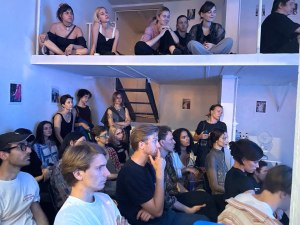
screening of Landslide by Oleksiy Radynski and photo exhibition by Alina Panasenko, 2024, photos by Danylo Kovach
Which book / film / album / song / traditional dish / podcast / blog / artwork / building / meme best captures Ukraine for you?
Books: The Gates of Europe by Serhii Plokhy and Kassandra by Lesia Ukrainka
Films: Infinity: According to Florian by Oleksiy Radynski and Heat Singers by Nadia Parfan
Album: Океан Ельзи – Модель
Song: Курган: “Крик Душі”
Traditional dish: borsch and dumplings with cherries
Artwork: “Fountain of Exhaustion” by Pavlo Makov
Building: Квіти України [Flowers of Ukraine] and Будинок: Літаюча тарілка
Meme: Chest breaker cat
NOVEMBER 15, 2024 – PORTUGAL

photo by Darianna Oleinikova
Hi there, my name is Stipa, born & raised in the Luhansk region, now based in Portugal. I make, play, and sing music – I pretty much live for it.
Without access to formal musical education, I moved to Kyiv at 19 and bought my first bass guitar on credit. Since then, I’ve played bass, synths & vocals in the noise-rock band On The Wane, produced techno as 6th Crowd and evolved into the funky version of myself that you know. As Stipa, I create both vocal and dance floor oriented instrumental music.
Has the full-scale invasion changed the way you think about music and sound in general and has it had an impact on your playlist and setup?
The full-scale invasion has forced rapid maturity on all of us. Every decision now carries real weight and responsibility – including in music creation. Each release is a message, a thread in our cultural fabric. I’m learning to be mindful of my impact on listeners, though I still start from what I personally need to express. Then my inner editor checks if the timing is right.
As a DJ, I now check if artists perform in russia before adding them to my collection. Russian music is completely gone from both my work and personal playlists. Even old Ukrainian recordings in russian language don’t feel right anymore – I just can’t listen to them.

Darianna Oleinikova
You have recently released the EP Unconditional Love on Regular Disco. In the liner notes you write that its upbeat mood was a conscious reaction to the war. What can you tell us about its production process and how popular would you say disco is in Ukraine?
In the first year of the invasion, I hit a wall with my usual dark, introspective music. To try and balance it out, I put on some disco while working out. It sparked my curiosity in the genre, and I discovered disco’s role in the American civil rights movement. This showed me something simple – you don’t have to feel happy to write cheerful music. You can create the future you want to hear.
I started with samples to understand the genre. As I got more comfortable, I began replacing commercial samples with my own recordings. When Serhii from Regular Disco reached out about releasing an EP, I already had a folder full of decent sketches I’d been working on. I selected the strongest ones and finished them.
One track, “Mantra,” features rural samples from Gasoline Radio’s expedition to the Carpathians, where an old gentleman (дід Іван) mimics a bird’s song and calls it a mantra. I found that comparison genuinely simple and true, so I built a song around it. Another track, “Train,” mixes real Kyiv Metro announcements with AI-generated ones that I trained to say “Dear passengers, be nice to each other and support the Armed Forces of Ukraine.”
The title composition is the hardest. As I was finishing it, I learned that a very dear person to me was killed in the war. In a desperate attempt to keep their essence in this world, I named the song and the EP after the main thing they taught me. I thought that everyone could use a bit of Unconditional Love these days.
Disco has real potential in Ukraine: we’ve got our funk music heritage from the 70s (documented in Вусатий Фанк [Moustache Funk]), plus sometimes we need that sparkly escape from daily life. There’s already a small but passionate scene with Regular Disco, Vertuha events, and bands like Ziferblat & Our Atlantic.

photo by Darianna Oleinikova
When I visited Kyiv last May I was struck by how vibrant the electronic music scene is. How do you see it developing with so many artists now being mobilised?
There’s not much to sugarcoat here. Best people get pulled out of all the fields, and the electronic scene is no exception. Some of my music friends put down their headphones and went to war. But at the same time, I see new names popping up in the scene, so I am not hopeless here. Music is a powerful art therapy and people need it both from the perspective of a listener and a creator. Exhibit A: one of the centers for veterans’ rehabilitation now has classes on DJing. Therefore, the electronic music scene will continue to exist, no matter how severely damaged and thrown back by this hell of a war.
You have since relocated to Portugal. How does one bridge the widening divide between those who left Ukraine and those who stayed?
That’s an excellent question I’m still trying to answer for myself. In my experience, some connections fade, while others flourish and even grow despite the distance. Those who left need extra awareness since people who stayed face daily survival pressure, making them more fragile and short-tempered. As long as we all can be gentle, respect differences in our experiences, and remember why we value each other… I think it can work? I hope so.
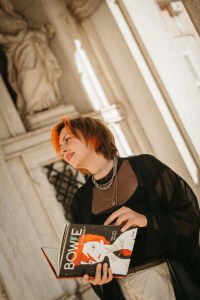
photo by Darianna Oleinikova
Do you find the use of air raid sirens and other war sounds in tracks by electronic artists to be triggering and can they ever be used in an ethical way?
It’s a grey area, where an artistic expression needs to be weighed against the risk of unintentionally triggering trauma. There are creative ways to reference without using sound directly. Take rapper Palindrom, who sampled the “all clear” notification from an air raid app. No actual siren sounds, but for anyone in Ukraine over these past 1,000 days, the meaning is crystal clear.
Many Ukrainian artists have told me that in the first few months of the full-scale invasion, they were unable to play music. Do you share this experience, and if so, what were you listening to once you went back to music?
I couldn’t enjoy music or listen to it for entertainment, no. But I had two songs that I used as a cry starter. When the full-scale invasion happened, I was in Ireland. There was a high hill behind our house, covered in sharp bushes with little to no paths, and absolutely no people. Sometimes I would climb there with “У мене немає дому” by Один в Каноє on repeat and cry as ugly as a wolf until exhausted. Another one – “Saudade, Saudade” by Portuguese artist Maro. It got me crying too, but in a lighter way.
When I finally went back to actual listening, it was through a mixtape of old Ukrainian funk on Vertuha’s YouTube channel. I even made some sketches with samples from that mixtape. That might’ve been the first micro seed of future Stipa.
Has the role of music in Ukraine shifted from one of entertainment to encompass the expression of identity, communication, and emotional and physical survival?
Music as an art form has always been an expression of identity and communication. We just didn’t necessarily realize it, but our enemy did – russia has been stealing and suppressing our culture for centuries. The threat to our existence just made this clear. As I mentioned, we had to mature rapidly, and now more artists and music lovers take their practices more seriously.
Are there any specific tracks or albums since the full-scale invasion that have captured current events for you?
The album Мегалюбов [Megalove] by the band Крихітка Цахес [Krykhitka Tsakhes] managed to organically combine the raw feeling of despair (in the track “Під весняним дощем” [Under the Spring Rain] featuring Хейтспіч [Hatespeech]) with the uplifting anthem of resilience “Падай і Вставай,” [Fall and Rise], adding lyrical pieces like the title song and “Сонячні дні” [Sunny Days].

photo by Darianna Oleinikova
What are the most persistent misconceptions about Ukraine?
Many believe Ukrainian and russian languages are almost identical. In reality, russian ranks only 5th in vocabulary overlap with Ukrainian (62%), after Belarusian (84%), Polish, Slovak, and Church Slavonic. This limited similarity exists mainly due to centuries of forced russification and imposed changes to Ukrainian language. The relationship between Ukrainian and russian is comparable to that of Swedish and Norwegian, or Spanish and Portuguese – related but distinct languages.
Which book / film / album / song / traditional dish / podcast / blog / artwork / building / meme best captures Ukraine for you?
Parajanov’s Shadows of Forgotten Ancestors from 1964. Survived censorship, blends folklore with avant-garde, and celebrates life despite hardship. Pretty much Ukraine in a nutshell, really.
NOVEMBER 17, 2024 – UKRAINE
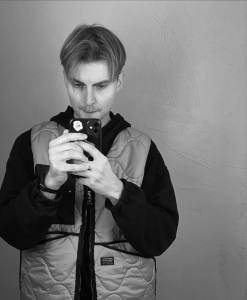
My name is Denys Chornomorets and I compose electronic music primarily in the genres of Italo Disco, Dark Disco, and Indie Dance. Currently, I am a serviceman in the Armed Forces of Ukraine.
Slavik Dzyga is the alias I picked to reflect and emphasize my authenticity and here’s why: “Slavik” is a derivation of the word “Slavic.” I changed the last letter of the word to “K” because that’s how my father’s name is spelled, but still sorta have a reference to the geographical area. “Dzyga” (Дзиґа) is the Ukrainian word for a “whirligig” (the spinning toy), but in Ukrainian, the word Dzyga has a much deeper and broader meaning. So, I decided to combine these two words. Funny – for a Ukrainian audience, my pseudonym looks like a first and last name, but for listeners from other countries, it carries a completely different meaning.
I’ve been into music since I was child. When I was 16, I got a classical guitar as a gift from my mother, and perhaps that’s where my musical journey began. Back then, I felt that I appreciated melody in songs the most, as melodies are there to evoke emotions and tell a full story. I was fortunate to have close friends who were also passionate about music. One of them is Alex Ashtaui, who now lives in Berlin and is known for his music project called “Morwan.” We spent a long time trying to create our own music project together, spending many hours in studios where we constantly jammed. During our rehearsals, I realized that playing only the guitar is limiting me greatly, so I started my journey into learning the Ableton software.
 Has the full-scale invasion changed the way you think about music and sound in general and has it had an impact on your playlist and setup?
As strange as it may sound, the full-scale invasion actually gave me an additional push to start writing music. Two months before the invasion, I began to study at the Module Exchange electronic music school, and the invasion started right in the middle of our course. Obviously, I couldn’t focus on music at that time. After returning to Kyiv in the summer of 2022, I discovered the French label Ritmo Fatale. At that time, an album by the artist Luca dell’Orso had just been released on the label – I was thrilled by what I heard and kept listening to the label’s catalogue on repeat. I discovered artists like Kendal, Pablo Bozzi, Chinaski, and many other incredible musicians… And that’s when I realized the direction I wanted to develop in and focus on.
In the realities of war, you begin to appreciate more what you have and value the people around. Because everything can be lost any moment — yourself included. It felt that the best time for new beginnings was now. At that time, I was just starting to make music, and all I had in terms of equipment was a laptop, an audio interface, and headphones. However, a friend of mine asked me to check the condition of his apartment in Irpin (as his building had been under occupation). Luckily, the apartment was intact, and his music equipment was still there. With his permission, I moved it to my place, and that’s how I got studio monitors and a MIDI keyboard (which was partially dysfunctioning because of spilled beer). So, to sum up — yes, during the invasion, I began to make progress and gained more opportunities. Throughout the summer of 2022, I hardly left my apartment, constantly working on my skills and knowledge of Ableton.
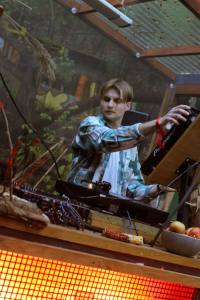 You have recently released Noir on Regular Disco. How popular would you say Italo and dark disco are in Ukraine and what can you tell us about the making of this album?
The appreciation of Ukrainians for dark disco has been noticeable for quite some time, especially during parties organized by Worn Pop, where you could listen to melodic synth pop, post-punk, as well as the darker side of disco. These parties always had a very human-like atmosphere, and I can also highlight the East Kulture party series. I even noticed that dark disco is really popular among the military people; they often listen to bands like Ultra Sunn and Boy Harsher. It seems to me that some of them are craving moments with this music as a soundtrack – via Instagram, for instance. As for Italo Disco, I had the feeling that I was the only one showing a strong love for this genre, because the only place I encountered Italo was in my headphones while cycling around the city.
The turning point was when I attended a party organized by Regulardisco. It’s hard to precisely describe the feelings I experienced there, but I knew for sure that I had found what I had been searching for all that time. That’s when I started to notice that the love for Italo among Ukrainians was much greater than I thought. As an example, there’s always a huge excitement around the visits to Kyiv of artists like Pablo Bozzi and Phase Fatale. Despite high ambitions, I feel like the Ukrainian Italo and dark disco scene is just emerging and scaling up.
The EP NOIR is a special story for me; in every track, I’ve poured separate emotions from specific life events I’ve experienced. My biggest desire was to bring to life a synergy of my vision of noir, the rhythmic energy of Italo Disco, and the restrained romantic style of Bryan Ferry and The Blue Nile. This is also the result of titanic efforts and the realization of a dream. What’s particularly special for me is that my debut album features remixes by Luca dell’Orso and Ubre Blanca. Discovering the work of Luca dell’Orso became a key point of reference in my music, and when it came to choosing the first artist to reach out to for a remix, without any hesitation, it was Luca dell’Orso. Ubre Blanca is a powerful music project from the UK, which also set creative benchmarks for me. So, I was incredibly happy when all the artists immediately agreed to remix my tracks.
 When I visited Kyiv last May I was struck by how vibrant the electronic music scene is. How do you see it developing with so many artists now been mobilised, including yourself?
You’re absolutely right; yes, we are currently witnessing the blossoming of the Ukrainian music scene, and this applies not only to the electronic scene but also to new names in pop music and the underground scene. I can compare this to the blossoming of Ukrainian culture in the 1990s, when, after a long period of imposed Russian culture, our people got a breath of fresh air and wanted to hear and see their own culture, both historical and contemporary, keeping pace with the present. I am constantly amazed when I discover a new artist with a beautiful and high-quality sound. This genuinely makes me happy and gives me hope that we will be able to reach a much higher level together.
As for the mobilization of artists, we have many who voluntarily took up arms and have been fighting against the occupying forces since the very beginning of the invasion. People with a creative mindset are highly valued in the military for their ability to make unconventional decisions and work with advanced, complex systems. We are up against a very powerful enemy who has an advantage in both human resources and weaponry, so we are forced to employ creative methods of warfare. After all, if we fall, the entire blossoming of our culture is at risk of being buried again under bans and the imposition of foreign culture.
 Has your perception of sound changed since you were mobilised and do you find the use of air raid sirens and other war sounds in electronic tracks to be triggering and are they ever justifiable?
In my opinion, one must know the limits when using sounds of war, because these are not sounds of celebration; they are the sounds of sorrow, pain, suffering, and death. Of course, foreign artists use these sounds in their works, but they do so without fully realizing the weight that these sounds carry. I’m not opposed to using siren sounds, explosions, or gunshots in songs that directly focus on tragic events or honor the fallen soldiers and civilians in this cursed war. But I believe in dance tracks it’s mostly not appropriate.
Many Ukrainian artists have told me that in the first few months of the full-scale invasion they were unable to play music. Do you share this experience, and if so, what were you listening to once you went back to music?
At first, I simply didn’t listen to music; I had no desire at all. I just kept following the course of events. When I finally started listening to music again, in addition to the usual playlists and artists, I added songs by Ukrainian artists from the ’90s and 2000s to my daily routine.
Has the role of music in Ukraine shifted from one of entertainment to encompass the expression of identity, communication, and emotional and physical survival?
Of course, we were taught to preserve our own history and rediscover almost lost fragments of our cultural heritage. Today, we have many songs that in one way or another highlight military actions, everyday problems, psychology, and comedic takes on today’s issues. Many marketing companies are creating content with good and high-quality music that is relevant to our present reality. The same applies to the film and theater industries.
 Does music play a role in the military, for instance for boosting morale, to keep the connection to civilian life back home alive, to memorialise the deaths of fallen comrades, or simply as a release valve?
Personally, the music is an integral part of life. I recently suffered a minor injury, which resulted some problems with my hearing, and my first thought was, “How will I continue with music if I lose my hearing?”. Fortunately, I managed to avoid serious issues. For many soldiers, music helps to boost motivation, get focused for work, and also to relax. I often listen to certain songs that I played during specific periods of my life to support my mental state or to nostalgically remember the good times spent with friends and family. This helps me to keep myself relatively stable during emotionally difficult times. Certain songs have the ability to be associated with specific events and people, and sadly, this already includes fallen soldiers. Therefore it is connected with my own state of mind – sometimes, on the contrary I avoid listening to certain songs for the same reason: they are associated with friends who have passed away.
Are there any specific tracks or albums since the full-scale invasion that have captured current events for you?
I’ll be honest, in my opinion, there is no song that can fully capture everything what is happening with us.
Are you currently able to work on new material?
Currently, I took a forced break from creating music, as physically there’s no opportinity for this. However, as soon as I have one, I will definitely return to songwriting, as I feel that I miss the process of creating songs so much. Plus, I have a bunch of interesting projects to finish.
NEW RELEASES
Selective Softener ~ seismic data Kyiv, Ukraine February 24, 2022
All sounds on tracks 1–3 on this release are derived exclusively from sampling and manipulating audible seismic data from February 24, 2022 at a seismic monitoring station outside Kyiv operated by the Institute of Geophysics at the National Academy of Sciences of Ukraine. This audio file has been made available under a Creative Commons BY-NC license by the Earthsound Project (www.earthsound.earth).
[The original audio file has been included in full as Track 4.]
The seismic recording for February 24th, 2022 is notable for the abrupt silence that begins one minute and fifty-six seconds into the recording. This interruption is the basis for rhythmic manipulations used throughout the performance. Fragments were edited and repitched in real time. Melodic elements are created by reducing the parts of the sampled audio to looping single cycle waveforms. Basic audio effects such as delay and reverb have also been applied.
This album was recorded live on October 30th, 2024 at Kunstmuseum Bochum in Bochum, DE. The performance was part of the program Let’s Talk About Something Else, curated by Natalia Matsenko and Yuri Yefanov.
This piece was previously performed live on August 10th, 2024 at MuseumsQuartier Wien in the framework of the program SEE:UA — connecting landscapes.
Revshark ~ Marathon
Revshark presents Marathon EP. 4 tracks created entirely on Elektron music machines specially for ОЧІ label.
bedez ~ Solitude
“Solitude” EP by a talented producer bedez introduced is an immersive experience of depth and containment. Compositions based on modular synthesizers form an atmosphere that conveys isolation and inner dialog
This EP creates a space for reflection, revealing unique shades of sonic textures
v4w.enko ~ Terracotta Pixel Path Mix
Reprocessed sound in the “Terracotta Pixel Path Mix” continues journey of V4w.enko into the scape of old and new periods in time of released/ unreleased and remastered/ regenerated materials. The mix was once played on Radio Campus France in 2017. Both studio and live sounds are mixed in one story that is rediscovering various moments of sound of different time spaces. Carefully transferred from many HDDs and saved again, the sound is now released at the V4w.enko`s sublabel FF`Space to get distributed for the ears over the Earth.
Pymin ~ Amulet
“Amulet” is my musical embodiment of the source of inner strength and love in these challenging times.
Perhaps music and art aren’t just an embellishment to our lives, but the very foundation of them. I believe that an open heart gives us strength, igniting our inner fire that can light even the darkest times. These qualities are our amulet.
We are all united by the timeless, undeniable need to create. It’s an act that helps us release the last drops of sorrow, allowing us to breathe, heal, and move forward once again.
NRTN ~ NOIR
An ancient, magical city frozen between past and future. Here, the rain never stops, almost like a noir detective. Only, this murder has no mysteries to solve, just revenge.
With a jolt, you catch yourself staring into the eyes of a street witch. Her gaze is dark, intimidating, consuming. She does not move or speak, just silently hisses without breaking eye contact.
“Nonsense”, you mutter as you step on the gas to continue your long drive through the night, the wipers barely containing Noah’s flood on the windshield. As you stare ahead in a trance, your mouth moves of its own accord, repeating the same words under your breath in a neverending loop, over and over, again and again:
“In the furnace, fire burns, Timber smolders, embers dance
May my foe’s heart turn to ash
Wasted in a scalding blaze
Wasted in a scalding blaze”
Trinidad Shevron ~ Ignorance
Trinidad Shevron returns to Eclectic with five techno tracks that delve into the depths of human nature’s Faustian aspects. Each track, though abstract, explores a different facet of virtues and vices, offering a rich, thought-provoking journey. To complete this powerful EP, Esilum has crafted a remarkable counterpart, perfectly embodying the distinctive style of this duo.
Danilenko ~ Nightingale Language
Nightingale Language is a fresh EP from Ukrainian artist Danilenko, impressing with its depth and conceptual approach. Four tracks unite into a single story, creating a holistic sound
This is music that doesn’t just sound, but leaves a strong emotional experience
Lu Joyce ~ Shift
shifted space, rhythm, cigarette ash.
Andrii Kunin ~ Friendly Scanner Mixtape
This album was created using concatenative synthesis, pitch-shifting cassette dictaphone, some keyboards, zither and “accidentally discovered tape recordings of a Japanese choir class”.
RinniR ~ Messy Silence
Recorded on July 8 and August 12, 2024.
Composed by Fuad Buaita.
Equipment used: 4-track Tascam with tape-loops, glitch synth, drone generator, guitar and effect pedals.
Cover photography by Sandro Nicolussi a.k.a. BYDL.
Released by Epileptic Media in 2024.
Thanks to Sandro and Andy for help in releasing this album!
Support the label and check out their other releases: epilepticmedia.bandcamp.com
Distortion (UA) ~ Full-Auto Friday
Oleg Distortion (UA), a musician you may know from releases on Bass Water Freak Out, Your Character, Polygon and Mystictrax labels (with the “Bullet Seeds” “I grow ammo, you bastard!”), as a writer – who recently presented to the world his memoir about the defense of Kyiv region in February 2022 in the book “Survive at Villa San Marino” as part of a volunteer battalion, a soldier who now continues to protect Ukrainian lands from russian invaders. His easy and relaxed creative style, almost reflexive, hits listeners and readers as clearly as possible, evoking violent emotions. Known for his uncompromising electro style, this time, on Full-Auto Friday EP, we hear notes of old-school breakbeat of the early 2000s – something from childhood, full of music from The Prodigy, The Chemical Brothers, soundtracks from games like Need For Speed. Expected in late November – early December 2024. The names of the tracks encode the military black humor, inherent to author. Artwork “Music as the weapon” by Lostlojic.
Kotra ~ Grit Light
The choice seems impossible and obviously clear.
Burn into dust or transform.
There is no escape to rest or recharge.
Total presence is not optional.
There is no gradient anymore.
Everything and everyone is black or white.
And there are many who are true, those who care.
Those who conduct light.
Darkness shapes the light, the light restrains darkness.
And the light must be bright and strong.
It torches, cuts through, and slays the old.
Makes the impossible ways.
Igniting the leap of faith.
The truest of grit gives credence to win.
Khrystyna Kirik ~ Sub-sur-face
The album “Sub-sur-face” is the music for a performance exploring the spectrum of human existence. It’s a sonic meditation that tunes one into openness, a connection with being, and emotions. It is a journey inward, evoking deep memory. It attempts to dive into a time when we were neither body nor consciousness. It is an invitation to meet at the intersection of the external and the internal in pursuit of the longed-for balance and essential serenity. The project was created by Khrystyna Kirik during mentorship sessions with Julia Santoli under the Time Based platform.
Sub – represents the mystical dimension of the sub-surface world, reminiscent of the womb. It is something undisclosed, yet connected to the fundamental rhythm of life. Sur – unfolds as a dimension, emerging like a surreal world. It evokes a sense of intimate touch and nostalgia, linking individual consciousness with collective empathy. In this state, the unconscious mind finds expression, often resulting in dreamlike, illogical ideas and scenes. Contradictions between dreams and reality merge into absolute reality, or surreality. Face – is a dimension we encounter beyond physical space, an expanded imaginary world. It marks another threshold, moving from the inner to the outer, from the undisclosed to the disclosed. It embodies a level of extra-sensory perception.
The sound blends cinematic, naturalistic, glitch, and ambient elements, evoking intimacy through delicate vocal tones, whispers, and the earthy resonance of the double bass. The piano brings warmth, like memories of childhood. Field recordings capture the sounds of nature, street life, conversations, and interactions with everyday objects, aiming to define the external world and convey its essence. Bells made from shell casings remind us of the importance of presence in this reality, in the here and now. This creates an imaginary space to focus on how we listen, what we hear, and how we feel it.
Lyudska Podoba ~ Petite Mort
Lyudska Podoba will release a track with our favorite Artur Snitkus, a Ukrainian queer artist who died in battle with the russian invaders. The first 1000 euros earned from this release will go to Artur’s mother. The next 300 euros will go to Taras aka Clasps, a super musician who mixed and mastered the track, who also from Arthur’s hometown Ternopil and is currently in the Ukrainian army. After crossing 1300 euros (if it happens), the profit from the track will be reconsidered.
an honest fox ~ looped dungeon
some stuff from 2022 (splitted here in two parts, because of limitations).
VA ~ Justification of Major
Curated by our friend Dmytro Postovalov (aka Bayun the Cat) this is “a relaxing and hopeful album for those who hate everything relaxing and hopeful”.
essentialmiks ~ Pryvydy
essentialmiks is an alias of Odesa-based artist and musician Maksym Ponomarenko. His sound is deep and light, whimsical and graceful, thoughtful and weathered; it is a clouded space filled with ghosts and spooks, where every phenomenon lasts as long as it wants. Before that, Maksym’s tracks could be heard in the charity collections: “VA. NOTATOK 1”, “Operation Perevtilennya”, and “Ukrainian Field Notes VA”.
“The album “Pryvydy” was created over the past two years and absorbed the controversial moods that I had to deal with during this time. The vibe of the album was most influenced by the blackouts*, which plunged the city into a mysterious, post-apocalyptic atmosphere and for a while turned apartments into caves of sorts.”
* The blackouts were caused by russia’s bombing of Ukraine’s energy infrastructure, which is still ongoing, – Liky Pid Nohamy.
Walakos ~ interrupted
After having delivedered one of the defining albums from the full-scale invasion (warнякання) together with Anton Slepakov, Andrii Sokolov is back with a new solo album that feels fractured and urgent.
ummsbiaus ~ FAVNA
FAVNA is a polyphonous electronic hymn of female power, embodied in water, flame, earth and air. It celebrates femininity through legends of Old Slavic goddesses and mythological creatures, singing of their strength and vulnerability. The album as a whole delves into the fauna of a female artist, incarnated in the figure of Syryna the Firebird, exploring the haunting echoes of her pains and struggles.
We all are different in our nature and form, yet we exist within the same fauna.
ЛІЗА ПАДЛІЗА ~ Тут немає місця для тебе
There is no place for you here
addressing my *weak personality* as a projection of fear that sinks into the body, makes movements lame, tries to flood the brain with bad thoughts, and the only thing left is to fall down to escape all this madness
Anklav ~ Bass Resistance
We’re super excited to drop ‘Bass Resistance’, our latest V/A compilation
This 12-track compilation is a true bass lover’s dream – 6 tracks from talented Ukrainian artists and 6 more from incredible global creators. It’s a journey through bass music that stays true to what we’re all about: pure passion for the sound. ❤️🔥🔊
But this release is more than just music. All proceeds will go directly to Vitsche campaign to help build a bomb-shelter school in the Kharkiv region. Together, we can make a real difference.
Let’s end the year on a high note – with music, community, and impact! 🦾💋
Native Outsider ~ Kōhai
On the new album ‘Kōhai’ by Arkady Lenov under the pseudonym Native Outsider, the raging bass and elements of the inherent techno sound are organically intertwined with advanced sound design, creating a multi-layered and fascinating soundscape. Continuing to explore the ideas behind his previous album Modern, released on Progressive Future, the artist delves deeper into the low-frequency spectrum, placing distorted drumming against a backdrop of thick and mysterious textures.
Created in Kyiv in 2023-2024, the release carries the symbolism of renewal, both external and internal. The cover artwork with the texture of the artist’s severed hair emphasises the idea of shedding spiritual burdens, complete emptying and the beginning of a new life cycle. Deep reflections on one’s own place in the world and the present formed the leitmotif of this release. The main source of inspiration was reflections on the struggle against the pervasive feeling of lost opportunities and restrictions that limit freedom of action. It came through all the stages of realising the inevitability of global processes and their unstoppable inertia, which changes everyone’s life.
The album was also influenced by the spirit of the current Ukrainian electronic music and club scene, which is developing rapidly despite all the circumstances. Instead of succumbing to fear or trying to avoid reality, the author chose to immerse himself in exaltation. Music and movement have become a way for him to live his emotions – sincerely and openly, even in the face of an existential abyss and an unknown future.
VIEWING ROOM
(Gianmarco Del Re)
 a closer listen