
Ukrainian Bull by Mariia Prymachenko
Lots of in depth interviews this month mostly recorded back in May in Ukraine which you can both listen to and read. In Dnipro, I reconnect with old friends Roman Slavka, Eugene Gordeev and Igor Yalivec to talk about Module and the local scene.
In Kyiv, I discuss the whole notion of the “good Russian” with Giorgiy Potopalskiy, one of the very first artists to feature in Ukrainian Field Notes back in March 2022.
Furthermore, Oleksii Podat shows us photos from relatively safe spaces and puts things into perspective through his experience with war in Sloviansk back in 2014.
A welcome tea break came courtesy of Oleksandr Ostrovskyi and Tetiana Novytska from the classical music website The Claquers (which has just published and in-depth interview with ACL favourite Katarina Gryvul) while Gordiy Starukh plays the hurdy-gurdy in Krakow.
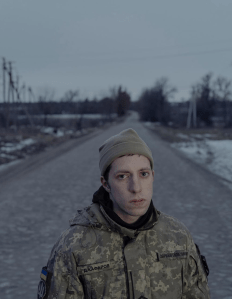
John Object photo by Sasha Maslov
But to begin with here is the monthly UFN Resonance FM podcast with John Object one of the most outspoken and interviewed electronic artist in Ukraine.
Tracklist
John Object – 500mg [VA – Intermission]
John Object – Demo New Life Immediately (2015) [Life]
John Object – Famous Eyes (live 2021)
Група Б – Нічні кімнати [Drones for Drones, Volume 3]
John Object – East Piano [Piano]
birdsandpeople – Bakhmut Song [Syndrome]
John Object – Kiss (Live 2020) [Sweat]
The full trascript of the interview is at the end to respect the chronological order the interviews were taken. Ad yes, it is our longest interview to date.
This month we also have three more podcasts which are to be found below before their respective interviews. But before we do get stuck in with the interviews, here’s the usual Spotify playlist featuring our interviewees and recent releases.

@jonas.gruska
On the subject of Spotify, a few international artists recently pulled their material from the streaming site in protest to David Ek’s investment of more than €600 million (around $640 million) in Helsing — a German defence technology company that produces and supplies AI-powered drones, including thousands already delivered to Ukraine.
Criticism of Spotify has long been rife in the blogosphere. “Being on a streaming platform that pays musicians so unfairly has always been annoying, but somehow I could live with it,” is a typical example (@thebluesagainstyouth) generally followed by a variation on the following, “Daniel Ek’s investments in AI weapons cross a line for me” (@sleeppartypeople).
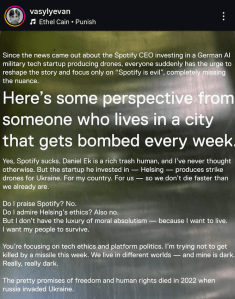 The tipping point for many has indeed been the headline news that Prima Materia, the investment company founded by Ek and early Spotify investor Shakil Khan in 2020, has doubled down on its original investment in Helsing with Ek becoming chairman of the company. This was enough to unleash a frenzy of outrage from “leftsplaning” bands raging against the war machine. Not everyone was impressed. And not just in Ukraine.
We have never been great fans of Spotify here at ACL either, but for Ukrainians who are trying to survive and have seen the delivery of Patriot Systems being halted, only to be resumed a few days later in the now customary Trump’s decision making roller coaster, this moral outrage is possibly misplaced.
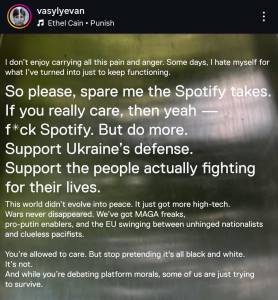
Tellingly, the debate revolves mostly on what the best streaming services might be, rather than engaging on the actual topic of drones. Instead of scrutiny into Helsing’s ethical claims, calibrated on the Economist’s democracy index, critics prefer to conflate Ek with AI warfare, facial recognition, ICE and the Trump administration, turning this into a US centric argument. The fact that the Spotify crusade is led by bands that seem to justify, or at least explain, Russia’s invasion of Ukraine as a response to Nato expansionism highlights how ideological the issue has become.
Yes, Ek and Prima Materia have made an investment and are looking to make a profit, that’s what investors do. Helsing have always sought to attract a broad range of investors, while committing to remain independent with plans to take the company public in the future rather than sell.
 And no, this is not an ad for Helsing, who have made a long-term commitment to Ukraine, but whose own track record is seemigly contested. But their AI sofware is currently saving lives in Ukraine. And yes, there are other similar European startups such as Tekever and Quantum Systems also doing very well. At the same time, there are also Russian made drones, the MS001 for instance, that use Nvidia tech from the US. To focus on Ek is a distraction. Whether one likes it or not there is a war in Europe, one that the EU has been unable to respond to effectively.
ACL might not be the right forum to discuss such issues in depth, but this is also the reason I started this series in the first place, as the voice of Ukrainians on the receiving end of unrelenting shelling is all too often missing from the discourse. A number of the artists I have interviewed over the course of three and half years have had to learn to make and operate real drones, as this 30 minute documentary on Arte featuring Ice and Petstep, both from Dnipro’s electronic scene, testifies.
So, to better understand the reality of the battlefield in Ukraine, let’s hear it from Nataliya Gumenyuk, a Ukrainian journalist embedded on the frontline. But before that, a quick disclaimer, all of the above does not reflect ACL’s editorial stance, it is my own personal position.
To close proceedings we have a great batch of new releases courtesy of Igor Yakimenko, LUCIVORA, SHKLV, djsnork, ROSS KHMIL, xtclvr, Natalia Tsupryk, Rudni, invisible noise monasticism/нойз галичина, Manoua, and two VA compilations from Telesma and Shum Rave, the latter one made from their recent sample pack from Crimean Tatar musicians.
In the viewing room we feature Katarina Gryvul, Cepasa, Tucha and Sawras.
As a closing remark, it is sad to note that the Russian cultural offensive is back in full swing with Anna Netrebko and Valery Gergiev set to appear on the international stage in a busy summer schedule. Both Netrebko and Gergiev are supporters of Putin. Gergiev, in particular, will be conducting Tchaikovsky’s 5th Symphony at the Reggia di Caserta in Italy under the usual (naive or complicit) pretence that art should be divorced from politics, blindley ignoring how Russian music has been weaponised.
I hope you’ll find something of interest in these pages. UFN will be back in September.
MAY 22, 2025 – DNIPRO
Roman Slavka – Egene Gordeev – Igor Yalivec
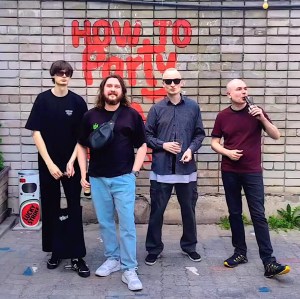
From L to R, Parking Spot, Roman Slavka, Eugene Gordeev and Igor Yalivec
Roman Slavka: I am a musician from Dnipro and now with my friends Eugen and Igor we are in Spalah a place where we can do a lot of different events especially for experimental music, dance music. The majority of events are deejaying with drum and bass, and electro. However, this is also a place where we can raise funds for our friends in the army.
The biggest change since the full-scale invasion is that more and more people from the music community in Dnipro have been joining the army and we are doing our best to collect donations for them because they really need our help to purchase cars, drones and medical equipment. The main goal of this place is to raise funds. For instance, we have a free donation option for those attending parties, like 100 or 200 hryvnas [2-4 Euros] to help our friends on the frontline.
In terms of the music scene, as I mentioned already, since a lot of guys are on the frontline and not many can do music right now it has become more complicated to present Dnipropop as a label compared to 2022.
In terms of music, we do mostly experimental stuff or ambient. Personally, I am switching from ambient to more dance-oriented music, I don’t know why, it can be just something simple like a kick, or snare.
Dnipro has not been occupied as yet, but we have issues with air raids, with some explosions around, etc and dancing can be a way to deal with our stress. Sometimes you just need to produce some techno music!
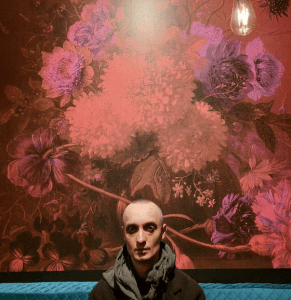
Eugene Gordeev
Eugene Gordev: I am the composer, lyricist and vocalist from Kurs Valüt. Roman Slavka has already said everything that there was to say.
I met your other half in terms of Kurs Valüt, Eugene Kasian, last year in Kyiv, is he still based there?
EG: One man is based in Dnipro and the other in Kyiv.
So, how do you work together?
EG: Through audio messages.
RS: It’s a process, not only for Kurs Valüt. Other bands are also split in different locations and communicate by sending audio files. Then Eugene goes to Kyiv to work in the studio. With other bands, the bassist might be in Lviv, and another band member might be in Dnipro, so they exchange audio files and record separately, but it can still work.
EG: Next question please?
Didn’t you sign to a German label?
EG: Now we are in the process of transferring all rights that were held by the label back to Kurs Valüt as our contract is expiring soon. But I am very grateful to the label for all they have done, it’s been a very good collaboration.
So when is the new material coming out?
[General laughter]
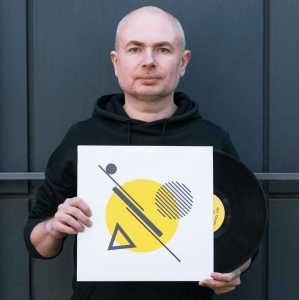
Igor Yalivec
Igor Yalivec: We ask this question every time we see Eugene!
EG: Soon. In Summer.
IY: Ok, my name is Igor Yalivec. I am a composer and sound designer from Dnipro. Also, I have a band called Gamardah Fungus, we make ambient music, experimental, electroacoustic, with a bit of doom, metal, even. However, we are now taking a pause because Serhii, the second half of the band, says it is too hard for him to play and compose and make live shows. Still, even if we are taking a pause, during the past three years we recorded an album that we hope to release in Autumn. It has been longer and harder to make than any of the previous albums and it will be very different. We won’t play live until the end of the war, so for the time being, Gamardah Fungus will remain a studio project, I think.
Personally, I also have a solo project under my own name. I released two albums before the war and one that came out after the full-scale invasion in 2023. But now I also don’t compose anything new. It is interesting because while Gamardah Fungus has taken a pause in terms of live show, as a solo project I keep performing even if I am not producing anything new, whereas with Serhii we are still composing. So, it’s the opposite.
The war changed our production process but, as Roman said, we try to do our best and collect donations for the army. Dnipro is very near to the front.
Would you say there is a specific Dnipro sound?
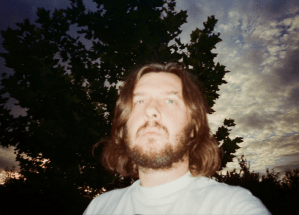
Roman Slavka
RS: We have a label called Dnipropop, so it should represent the Dnipro sound.
EG: No one else represents the Dnipro sound. We are the Dnipro sound!
RS: But in terms of music, if you go to Dnipropop label and listen to our releases, it’s very different music in different genres, it might be ambient, IDM, or Kurs Valüt.
EG: There is a little bit of experimental music, and a little bit of crazy stuff, but not a lot. All this is mixed into one sound.
IY: Before I forget, the Dnipropop label is very interesting right now because it is like a mixture of many genres but if you look at the history of music in Dnipro, – we lived here all our lives, Roman and I are from Dnipro, Eugene is from another city but now lives here, – and there were a lot of genres that were representative of our city in different years. Dnipro was the capital of Drum and Bass maybe 20 years ago; then there were a lot of experimental small bands and groups, rap and hip hop bands. And there were many deejays in Dnipro that were representative of house in Ukraine. And now it is very interesting that during all this time our sound is a mixture of all these genres.
RS: Something between Drum and Bass and house music with some rap.
IY: I think it is because we all tried many different genres. We experimented a lot and now we found something very authentic for Dnipro and we are very proud of this.
I want to get a sense of how big the community is, how many of you are there and is this one big happy family or is it a dysfunctional family like most families are?
RS: I think this is a huge family… hmm, not huge but yeah, our relationship is great. We are friends and we can help each other, not just in music, we do not compete with each other, we prefer to do things together at events We understand that we can help each other, not only musically. If our friends on the frontline need something we usually do this. We never compete with each other, we prefer to do everything together, like events. Also, a lot of musicians from Dnipro went to the Module Club and did like a live electronic jam, like jazz but with electronics, and the goal was to listen to each other, not to compete. Sometimes it was a hard task but usually it was a great type of communication.
And the second thing that is really important right now, is that fortunately we have this new blood because for ten years we had this gap where almost no one joined the electronic music scene here in Dnipro. It was a strange case because we did a lot in our 20s, then we took a break to build our careers and when Module opened, we could play again like we did in our 20s but the majority of people from that community was 35-40 years old. Fortunately, now we have new names, and we try to help, like Eugene and Yura [Yuriy Bulichev aka Monotonne] help them in their production process and I already see the results in the work of Parking Spot or Toucan Pelican, who released an album on Dnipropop a few months ago. It’s really great and interesting stuff; it’s really professional stuff thanks also to Eugene and Yura.
Can we actually talk about Module now?
IY: Eugene can talk about Module, because he was there from the beginning.
RS: Eugene wrote an essay for the second issue of POMIZH magazine, an art magazine created by DCCC [Dnipro Center for Contemporary Culture], about the history of Module because it is a very complicated history and it will be published both in Ukrainian and English. You will be able to read it there, but Eugene can tell you something about it now. He arrived at Module like a man from the street with a proposal for the owners to make minimal wave parties. So Kurs Valüt was created to popularise this style and invite other groups. It was some sort of bluff, as Eugene didn’t have anything. He created this whole new project in eight days because he had like this free time slot between different techno parties. And this is how it started.
So the club itself already existed?
Yes, but those were the first weeks of its opening.
And what kind of club was it going to be?
IY: Just to clarify, there were two men behind Module, Mykyta [Kozachynskyi] and Eugene, another Eugene, [Honcharov]. They are now in the army. They founded this club, it was like an art club, it was meant to be a club for music and art for the community. At the same time, Eugene [Gordeev] also came to the club, and we all got to know each other. It was never meant to be a club for just one genre, techno or house or even just music. Also, there were some exhibitions with artists from Dnipro and various performances, not just music but also theatre. But, yes, most of the events were musical even though that wasn’t the original aim, maybe it was because we were mostly into music. And when DCCC started, the community expanded with artists and musicians. Since Module closed down [before the full-scale invasion] our community now holds events here [at Spalah] and DCCC.
Sorry, what year was it that Module opened?
RS: It’s a good question.
EG: 2016.
RS: Yeah, a third Eugene [Kasian], the second Eugene from Kurs Valüt, he was the art director of the Module Club before stopping to concentrate on his work with Kurs Valüt, but all these guys were involved in the club for its first years of existence, and contributed to its development and to its culture.
EG: It was the best club in the centre of Ukraine in my opinion.
RS: It is not a joke; it was the biggest and best club in terms of music in Central Ukraine, because usually all clubs with techno and experimental music are based in Kyiv and Module was the place were we could invite artists from Kyiv and make events.
What was its capacity?
EG: Four hundred people.
IY: But it had a yard, the club was located in a private yard and there were held in the yard itself, so 400, plus another 400. For the most popular events we had 800 people, something like this.
And did it have a regular programme?
RS: Yeah. Every weekend they had parties. In terms of spaces, there was a main stage, the yard and the Module Lab — a chill-out area and a venue for lectures. We also used this space to play experimental music during techno events on the main stage. Additionally, we recorded videos of our lives during the COVID-19 period in this location.
EG: Two studios.
RS: Yeah, two studios where Yura [Yuriy Bulychev] and Maxandruh worked. Also, this lab was a space made especially for experiments.
EG: Vegan.
RS: Yes, that’s where the kitchen was.
IY: It was a really great place for the community with any taste of music, art… I think Module is the place that really connected people at the time.
EG: A people’s blender.
So, in terms of the music…
RS: Eugene says it was more about the sound, rather than the style. The sound was supposed to be raw, and yeah, the majority of parties were techno, but sometimes it was house techno, etc, but this was the main idea of the place…
EG: Andrii Deme made techno.
RS: Yeah… and maybe the main idea of the place and maybe the Dnipro sound in general.
So, when the full-scale invasion happened, at what point did Kozachynskyi and Honcharov enlist and closed the club?
RS: The club had already closed before the war, because the owners…
EG: It was Covid.
RS: The club worked during Covid the way clubs did then, but the final stages of the club were a few months before the full-scale invasion, as far as I remember, and the reason was not because Mykyta joined the armed forces, there was an issue with the owner of the place who also owned a huge building by the club and he didn’t want young strange people near his expensive flat and that’s why he did a lot to close the space. As far as I remember, local government and the mayor tried to find another space, but everything they suggested was really awful, somewhere not in the centre or derelict. Before the war, Eugene Honcharov found a place and started thinking to reopen Module but unfortunately the full-scale invasion happened so Spalah and DCCC will need to function as some sort of new Module for the time being because here we have almost the same people with the same ideas of how sound and art should look like.
Ok, can we talk a little bit about Spalah, when did it open and how does it work?
RS: Yeah, this is the second Spalah. The first one was a really interesting place, but was half the size of this place. I found it on Instagram because I saw a place where a lot of people were drinking and dancing but when you got there it was a shock because it was a really small space, the kind of place that looks crowded even with 10 people. But then Mykyta decided to rent this space and here we have more space allowing them to make far more activities, not only techno, and drum and bass events but some sort of art lectures and so on.
EG: Spalah is the next people’s blender.
Sorry, I am a bit confused. You were talking about Mykyta but is it the same Mykyta as in the Module club?
RS: You know, in Ukraine we have a lot of Eugenes and a lot of Mykytas… but we have only one Igor and only one Roman!
Yes, it’s different people. Mykyta Kozachynskyi is the co-founder of Module and he joined the army at the beginning of 2022. Mykyta Shpak, is the owner of Spalah and he joined the army about four months ago.
Are there any other venues aside from Spalah and DCCC?
RS: In terms of the music we make it’s just Spalah and DCCC. There are probably other venues for popular dance music, but it’s not about electronic sound how it should be.
Do you have connections with other venues or cities like Kyiv, Odesa or Lviv?
RS (translating for EG): Yeah, these connections exist and started during Covid. Eugene and other guys from Dnipropop created an online event called Intercity. The idea was to link ten different communities and venues to represent the electronic music in different places. These communities still exist like Shum Rave from Sloviansk. They used to take part in events at DCCC. For example, now they are going to release an album inspired by Crimean Tatar music based on a sample pack with sounds from Tatar instruments. This is a way for us to collaborate not only in terms of support and communication, but also by doing music together with artists from different regions.
Also, artists from Odesa, Kyiv, Kharkiv usually play here. It is a typical Ukrainian thing that we collaborate when something goes wrong. Like when Covid started we rallied around the club industry, same with the full-scale invasion, we work together with a common goal.
For example, the club Abo in Kyiv is very similar to Module, even Mykyta, the founder of Spalah has said so.
You mean the record shop Abo?
RS: Yeah. They are from Kyiv, but they do a lot for the Dnipro community and the Module squad who are now in the army, and this is an example of how different communities from different cities can help each other.
Can we talk about new blood? You were mentioning Parking Spot and Toucan Pelican earlier. How do you connect with younger artists?
RS: That’s a question for Eugene because Parking Spot released on Dnipropop. Parking Spot performed at DCCC, which is the kind of place you can go and say, “Hey, guys I am doing this stuff, and I want to perform here,” and Yuri Bulichev and Eugene saw him and asked him to join the Dnipropop label and released his album. He also took part in VA albums.
I think that with Toucan Pelican it was a similar story. Eugene talked to him and really motivated him to finish his album.
IY: I think in Dnipro there is the most powerful artistic community now in Ukraine. Only Kyiv can challenge us, but Dnipro is the first one. I think it is not just my opinion; it is really so. The most interesting events, musicians and art projects are from Dnipro and Kyiv. And a little bit in Lviv.
RS: Because Ship Her Son has moved to Lviv. He was born in Dnipro but now lives in Lviv.
EG: Also, the owner of Closer, the best-known techno club from Kyiv is from Dnipro.
IY: So, Dnipro is the capital…
RS: Of everything!
EG: Stanislav Tolkachev is also from Dnipro.
IY: Ah, there is also a famous techno producer, Stanislav Tolkachev who is also from Dnipro. And there is another very famous deejay, Topolski, who is from Dnipro. He was in the armed forces and is now in Kyiv. They make shows to support the army. So, every nice producer needs to be from Dnipro or to live here for some time. It’s a joke but…
RS: But no!
How do you see the future?
RS: We are waiting for it to be over, but once it will be over we expect it to be really interesting because the guys from the army they will see things in a different way and I hope, and expect, that the majority of them will try to find new ways of working with that experience in different artistic practices, in music, in sound design in photography. I hope this is how things will turn out to be, but again no one knows when the war will end. This is the biggest issue in Ukraine right now because it doesn’t look like it is going to be easy nor in the nearest future, and as I mentioned before, more and more guys from our community are joining the military. There was a first big wave, then a second one and probably some of us will be in the third one because we still need to protect our country.
[The interview was edited for length and clarity]
MAY 28, 2025 – KYIV
Georgiy Potopalskiy
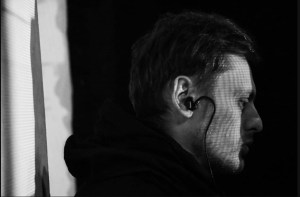 I don’t know if it’s a good way to start this, but I am from russia, I am from Moscow, but I have been here in Ukraine for more than 15 years now and I consider myself to be Ukrainian. I don’t have any contacts with russia anymore and I don’t want to have contacts. So, it’s like I turned the page.
As a musician I started my project in some bands in Moscow. As it is common when you are young, I had a band with my friends from school, and we played some experimental punk-core music. However, when I came to Ukraine, I found myself on my own and I decided to go deep into electronic music. So, in 2007-2008 I started my project Ujif_notfound. I called it this way because after I escaped from russia, nobody knew where I was, hence “notfound.” Now you know.
The chief idea was for me to learn some program where I could do some media art. Back in the 00s this stuff was very popular with people like Ryoji Ikeda and Alva Noto and many more. That was like the chief thing I wanted to do, code, minimalistic audiovisual stuff with sound and vision. That’s how I found the program Max MSP, which was really interesting to me. At the time there were no manuals, so it was very hard for me to learn this program. It was like an empty window. I didn’t understand anything, and it was a big challenge for me. Here in Ukraine, I was one of the first to use it. I had only one friend who is also an audiovisual musician, but I only found him three years after I moved here, so I spent like one or two years at home making my patches on my own.
My first albums were really minimalistic, and my first shows were with Dmytro Kotra, Katya Zavoloka and Andriy Kiritchenko at Detali Zvuku and later the Kvintu Festival. These were the first festivals, and my first albums were also released on Dyma’s label Kvintu. And I still work with Dyma to this day.
At the Detali festival I also saw an artist who was very strange for me because she played experimental music. The festival had young people making noise, but this woman played the most impossible music I ever heard. That was Alla Zahaikevych, a teacher from the conservatory. For me it was incomprehensible how this woman could be at this festival. I decided to speak to her, and I told her, “It’s amazing music, I would like to know how you made this.” She told me she was a teacher and had made this music in Super Collider, a very difficult program with scoring and so on. I asked her if she could show me how to make music with this program, and she said, “Ok, come to the conservatory and we will see.” I went to see her, and she asked what I was doing. I showed her my patches on Max MSP, and she said, “Wow, this is very interesting. Max MSP is used in all music academies, so it would be nice if you could teach this in our conservatory.”
I started facultative classes for students and for two years I run the Max MSP class in the conservatory. That was strange because at the time, the students didn’t have computers, they were classical musicians with violins and stuff, and they came with pencil and paper and drew my patches from Max MSP but never tried them in practice as they didn’t have the opportunity to do so.
Sorry, remind me what year was this?
2008-2009 maybe. But then the following year, the students already had laptops, and it was really cool and I was surprised because in the space of a few months some of the students became really professional with Max MSP and they started being cool electronic musicians.
Then I went through a long period of doing gigs, and played at Kontrapunkt and Plivka, so I was playing in clubs with many guests from all over the world with experimental music and DIY indie, something like this.
In parallel I had my own projects with media art and exhibitions in museums.
So, is there always a visual element in your work?
Sometimes they’re installations, and it’s not always visuals but interactive. You can see on my website. It’s probably 50% maybe. And also, you know, my work with Alla is something different, it is electroacoustic music. And my work with the label Kvitnu, and now I Shall Sing Until My Land Is Free, is more about experimental electronic music, not media art.
Ok, can you tell me how your music has changed since the full-scale invasion?
For me it’s a really difficult question because when the full-scale invasion started, I decided that music was like a closed chapter until my land was free! I decided that what I wanted to do was to help the army. I started working with my friends, we have a company, and we make FPV [Firs Person View] drones. Now we are already a big company with many products that works on the frontline, and we have a production line and so on. This is my main job at present, but I understood that after working five days a week, and even seven days a week before then, I now feel like an engineer in an office, and this is really hard for a musician or any artistic person…
 Sorry, this company… is it like an independent company or is it associated with the military and how is it founded?
It is hard to say because you know how it works in Ukraine, we have our war, it is DIY war and it’s half from the government and half absolutely pirate. So we have like a NATO certificate for of our products, but on the other hand we can go to the frontline without any documents, and we can test the new stuff that we make by ourselves without any permission so it’s like pirate. But we also have Prytula, I don’t know if you know this guy, this crowdfunding company, it is the biggest one in Ukraine and this guy helps us so it’s now under the government like this.
How did you learn to make drones?
When there is a war in your country, you can make amazing things you didn’t even believe you could make. It is not so difficult. We knew one guy, a friend of ours, who is a really cool engineer. He never worked with drones, but he’s like a genius programmer. He has his own company, some project with google, something like this, and he’s from Kharkiv and when the war started, he closed his company and invested all his money in developing drones. He is a really genius guy and he made amazing things that are still the best in Ukraine at present. Once he came to me and asked me if I wanted to make a plane and I said, ok. So he just told me, “You need to take this and this and now it’s your turn to develop it and think how this can fly.” So I did it and it works very well actually. This little plane works like a… I forgot the English word, like a predator. So this plane is preying on other little aircraft from russia.
Tell us about the music and the album Hypogonadism which is the first one you made after the full-scale invasion.
After I decided to be an engineer in an office, I felt like I lost the chief thing in my life, and felt like I couldn’t live without art and this was really interesting for me because I thought I was only making music because I knew how to, but when I stopped making music, I thought, “Wow, that’s it, I cannot live anymore, because I don’t know who I am.” I needed to do something, but in this situation, when you hear missile attacks every night, it is very hard. In my case, I also know what is happening on the frontline because of my job with the military, and this, of course, is depressing.
That is why I decided to make very simple music that anyone could understand, and I wanted it to be about our pain and about what is going on and the reality of life. So I took my guitar, and all my gear from the institute, my synthesizer, and consoles and took everything home. I had all my stuff on the floor, an electric guitar, an acoustic guitar and the bayan, and the accordion. The album Hypogonadism was made only with guitar, bayan and some synthesizers, but mostly guitar and bayan.
Wow, ok. There are also a couple of samples from Shadows of Forgotten Ancestors.
Yes, Parajanov. I don’t know why. Just because it is a really amazing movie. His life and destiny was really hard because he was imprisoned by the Soviet Union. He made the film in the Ukrainian language which was forbidden. The authorities did everything in their power to make you believe that it didn’t exist anymore or that it was just the language of villagers, but everybody knows the truth now.
You know, one of my recurrent questions for UFN is what book, film, album etc. best represents Ukraine for my interviewees and I’d say that maybe 80% pick that film.
Interesting.
To me, that’s a good film, and I love Parajanov, but there are more recent Ukrainian films I also find outstanding, like last night I was watching Atlantis.
Amazing film.
But most people pick Shadows of Forgotten Ancestors as the one classic that they can turn to.
Yes, because it’s the most Ukrainian film, because it is authentic with its madness and it’s hard, and musically poetic and that represents Ukraine for me.
What are the samples you used from the film?
Some sounds of trembeat, because I like that instrument, and also some snippets of conversation about the molfar [A molfar (Ukrainian: мольфа́р) is a person with purported magical abilities in Hutsul culture. Their abilities focus on herbalism and other folk magic].
Ok, and why the title, Hypogonadism?
It’s an homage from the Second World War when there was a song about Hitler who had only one testicle [hums the tune]. And, I don’t know, it was just funny to imagine that Putin has only one testicle. Hypogonadism is not actually that funny because it is an illness where someone doesn’t have testicles. The cover art was made by Liosha Say, I like it, it’s a very nice project.
Ok, can we talk about Metanoia now?
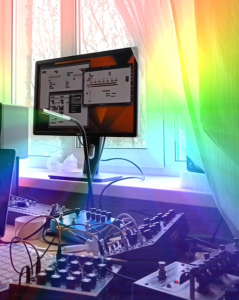
That was just the music that came to me. Once again, after Hypogonadism, I had some time when I didn’t make any music, but I always have to do something with Max MSP. When I have 50 minutes or one hour, I just open my laptop and make a new patch and of course every new patch gives you a new sound. That is why I like Max MPS, because you have an idea and then you develop a patch and during this development you have a lot of sounds, and you record everything that is going on. So, after the development of a patch I have a lot of samples, some strange material that I put inside some DAW program and sculpt this sound. This is how I made Metanoia, but I made a lot of music and this is only the first part of it. I have the second part of Metanoia already completed with even one track with Parajanov once again. It goes from Hypogonadism to Metanoia. So, I think the next album will be Metanoia 2 because it has already been one year since I released the first one. I just sent it to Dyma Kotra and he said, “Nice, let’s do this album.”
Actually, now I also prepared another album, it will be a full LP which is now in production [Postulate]. I have already been waiting for half a year for it come out on vinyl and I decided to connect different styles like IDM breakbeat and hardcore, so it’s like Squarepusher meets Korn because hardcore music is the first music I played when I was in my 20s. Squarepusher was amazing for me, this strange album, I will play it in June. It is much more understandable, because all the Max MSP or the electroacoustic music I make is not for everyone, but this is like 50% pop music, of course it’s not pop music, but IDM and it is not hard to listen.
 Was there a specific concept that you wanted to develop with Metanoia?
It’s not about a concept, it is much more about technical… You know, Kotra said about my work that I try to take a cold program like Max MSP, which is just code, and I try to install life. That is why it sounds really strange even for me, it’s like dead code but with emotion and that is what I like about it. 32
For me it was always the question of why Aphex Twin was so popular because I know a lot of musicians, especially now, who make music, which is almost the same, but they are not famous and so on. I know it’s because it is much more simple now to make music than it was in the 90s when Aphex Twin started. But the true thing is about the spirit, about the soul of the musician that goes into the music. And Authecre is another example of guys who work with dead code, but each track, when you listen to it, you understand that is has soul. And that’s the case with Metanoia, I think. You can feel the emotion and that it is about pain. Metanoia is about asking for forgiveness and getting this feeling that you are forgiven. During all this time I thought a lot about my friends from russia, about my best friends from school, my mother, my sister, they are all there and I don’t speak to them, and it was interesting to me to imagine what they think now about the whole situation and about this feeling of forgiveness. Maybe they understand that nobody will forgive them. It is impossible.
You know, when I was in Moscow, it was the time of Chechnya, and I was so stupid really, I thought, war is bad, but I did nothing. I was 16-17 so I did nothing, I didn’t say anything. I only started to demonstrate against the government of russia when I was 21-22 and then I left the country.
Sorry, if I may ask, how do you feel about the idea of the so-called “good Russian”?
Of course it is bullshit, absolute bullshit, because you know, when you are a soldier, or you work with soldiers like we do in our office, we have this kind of black humour, and we just say, a good russian is a dead russian. And when we see the dead body of a russian we say, “Oh, a good russian,” something like this.
It all depends on what this good russian did to be a good russian. If you just escaped the country and you live in Europe and say, “I am against the war, Putin is bad, etc.” That’s not being a good russian. You are just thinking of your own comfort if you live in Europe.
You know, I had the opportunity of leaving the country and going to Europe, because I don’t have a Ukrainian passport, but I decided to stay here because my friends are here, and we want to fight against this invasion. I think maybe I am a good russian in this case, because I am here and I am doing my best. I thought maybe I should go to the frontline but after speaking to my friends we decided that since se have such a good company, it is more useful to be a good engineer here than just a good soldier on the frontline. But we still go to the frontline, we speak to soldiers and try out what we have been developing. So, to answer your question, it depends on who you call a good russian.
Can I ask you about the track “The Population of Bakhumt”? Since the full-scale invasion there have been a number of tracks and compositions within contemporary music about cities like Mariupol and Bucha, such as “Bucha Lacrimosa,” etc. How do you feel about this and about tackling such subjects and what was your own approach?
You know, I try to avoid simplistic ideas, like “this is good,” or “this is bad.” That is why I try to make some code starting with the title of the album and tracks and so on. As the war goes on one would assume that people would understand what is going on, but then they don’t and you keep having to repeat, “this is bad,” “look at this.” Unfortunately, it becomes a necessity. I would like the information to be more shaded and for people to work out the meaning. I have a lot of issues with music that uses triggers like sirens for instance. At the beginning everyone was doing this. It is naïve, and I don’t like it.
You know, I don’t even remember the titles of the tracks from Metanoia, but they are not that direct, sometimes they do point to something specific but not always. “The Population of Bakhmut” was meant to be tragically ironic, because the population of Bakhmut is zero. I thought it would be interesting if someone from another country would google “what is the population of Bakhmut?” and would find out that this city no longer exists.
Ok, so I was just looking at the other titles of the tracks.
“Lost in Transition” is the name of this snowboard movie because in another part of my life I am a snowboarder, and I remember it was an amazing film.
“A Whole Revolution”, “Digital Battlefields”, “Lament of the Peacemaker”, “Budding Dub”, “The Population of Bakhmut”… And of course, “I am not interested in politics” is ironic about russians.
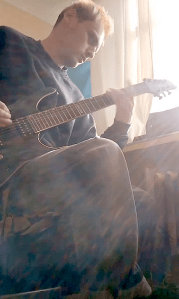 Ok, could you talk a bit more about the music itself. You seem to give great importance to space in your work, and I am thinking as well as the album you released at the time of the full-scale invasion, Ter.rain which was centred on urban landscapes. How important would you say is space within your acoustic world?
Yes, it is important, but actually I cannot analyse what I am doing because it is just a feeling, it is more intuitive for me. But you should understand that when I work with Alla Zahaikevych, I use ambisonic systems, multichannel systems and so on. I have many works with 8 or 12 channels. For instance, I made work for 12 accordions. The idea was to put all the musicians in a circle around the audience, so it is like ambisonics but analogue, without electronics. They had scores and they played. It means that I work with space every time and how I work depends on the material. I can work with classic musicians, or electronic music or generative music like Max MSP or even just synthesizers, like when I go for simple powerful noise IDM music, but I still use some kind of knowledge of space. And when I perform my setup, I build it so that I can switch to four or even eight channels.
If this is what you mean by space, then this is my answer, but there is another idea of space and that is emotional space and that is a completely different thing. Sometimes when you listen to music you listen to the person who made the music, and sometime you listen to yourself in music. I like it when it is not so important who made the music because you find yourself inside the sound. This person has given you space for yourself. This is the case, for example, in some piano pieces by John Cage, it’s simple, minimalistic music with a lot of space in-between. It’s very interesting. Or Brian Eno with Music for Airports.
Ok, let’s talk about Silvestrov now and the album Landscapes of Silvestrov.
Ah, yes. Ok, it was very simple. I have worked with Alla for a long time, but I never made music with her. She has her own way, I have mine, and we never thought we could connect our ways and meet somewhere. I used to make Max MSP patches for her and her opera Vyshyvanyi. King of Ukraine which was performed in Kharkiv in 2021, for example. I made complex patches for real time generative process for musicians to make these sound effects in real time we used multichannel.
Then she asked me if I wanted to create some music together for the Bouquet Festival in summer 2022. We got our friend Lisa on Bandura and we took Silvestrov and thought what is special about his music is that it is music about emotions and about the landscape. Alla can speak better about this as she is a classical musician, but she said this music is about art, wind, sea, water and she said, “Ok let’s make this a 40 minute piece that would be like a journey through the earth in the vision of Silvestrov.” So I made some Max MSP patches, she gave me some scores from Silvestrov, and I used them to generate some soundscape and music. I then made another patch to make these real time effects for Lisa on bandura, I cut what she was playing into little pieces, like granules and I started working with sand or wind, and so on and we played it live. When we listened back to the music we thought, “This is interesting, maybe we should make an album.” We gave it it to another friend of ours who is an engineer and he put it inside an ambisonic system and you can now listen to it on apple music.
I actually talked to Alla last year, and she was critical of Silvestrov, she likes very much early Silvestrov, but is more critical or his more recent stuff.
It’s pop music!
So, I was surprised when I saw the album. Did you actually take the scores from Silvestrov then, and which ones did you work on?
Yes, Alla gave them to me, but I used the atonal music, not the harmonic stuff. And I understand why Alla says this, because she is an avant-garde musician and she loves this period of music and she feels like it is “зрада”… how to translate in English… like a betrayal for musicians such as Silvestrov who made really cool avant-garde music in the 60s and who then moved to simpler and more understandable music. Alla still goes her own way, the way of French spectral music, but sometimes she still makes music for movies, which is more classical.
 Are there any works from the past three and half years that you feel have captured this situation and give a sense of current events?
It’s a difficult question because I don’t listen to music. I can listen to very simple music from the 00s, or music from my youth like Korn.
Recently, I was listening to all this “no name” music on Spotify, people with like 20 listeners and I thought wow, it’s really cool. Amazing music, professional and nicely made, but when I try to find something Ukrainian, I haven’t heard anything that catches me on an emotional level as yet, but maybe I need to listen to more Ukrainian music. I am very critical and I am very critical of my own music as well.
Have you performed at нойз щосереди [Noise Every Wednesday]?
No, it’s funny because I thought it was just noise. They asked me to play and I said, “Sorry, I don’t play noise,” and they said, “But it is not just about noise.” I don’t understand, why is it called Noise Every Wednesday then? So, we had a little misunderstanding. For me, noise music is Merzbow or something like this. But when you say everything is noise then it’s funny.
I think it is more about giving people a platform to experiment.
Yes, but it is not about noise music. With Kotra we were joking that one day someone will start a course of noise music, “We will teach you how to take a microphone and smash it on a snare with blood!”
Is there anything else you want to add?
No, I think I already said too much. I hope the war will end. And fuck Putin. That’s all.
Are you optimistic, pessimistic or realistic?
I am bipolar, optimistic-pessimistic, but you know we are tired and if you live here you will understand.
[The interview was edited for length and clarity]
MAY 29, 2025 – KYIV
Oleksandr Ostrovskyi and Tetiana Novytska – The Claquers
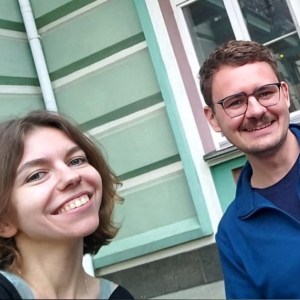
Oleksandr Ostrovskiy: We are Oleksandr and Tetiana and both of us are part of The Claquers, media about classical music in Ukraine and Ukrainian music abroad. I am a co-founder of this media from 2020 and Tatiana is editor in chief from March 2024.
So, is she your boss?
OO: No, it’s more horizontal.
Is it a democratic structure?
Tetiana Novytska: It’s a very friendly and democratic team.
OO: We try to manage things together but of course many of the tasks are on the shoulder of Tanya but we try to help when we cantogether with colleagues like Liza Sirenko and Dzvenyslava Safian. But since our founder Stas Nevmerzhytskyi mobilised in March of last year, Tetiana took on the role of editor in chief.
When you say Stas mobilised and joined the army, if this is not too personal a question, but has he joined cultural forces?
OO: It would be better to ask Stas, but no, he joined the fighting forces.
Before we get into the specifics of the Claquers, can you describe where we are?
OO: We are in Podil in the newest area called Vozdvizhenka with big ugly buildings in a mock baroque style that were built in the late 2000s. There are a lot of flats for the rich.
So, is this a posh part of Podil?
OO: Yes, but many of these flats are still empty, so it was like a ghost district for a long time. Now we have some offices on the ground floors, and some coffee shops.
Describe this coffee shop where we are sitting right now.
OO: Tea G Spot is not a coffee shop, it only serves tea from different parts of the world, but they also serve them in the style of coffee drinks, like espresso, latte…
So an espresso is made with an espresso machine but it is actually a shot of tea?
OO: Yes. But they use a special machine for making this espresso tea. I like this place because it is quiet. This is not a very popular district but you can find cosy places and one can work here and drink tea.
Ok, back to the Claquers, how long has it been in existence?
TN: We will celebrate five years on June 11.
OO: The site was founded in 2020, but our team formed in Autumn of 2019. It started off with the communication team of Kyiv music fest. Stas was the head of the communication team and he offered to write different articles, critical reviews and previews of the concerts at the Kyiv Music Fest. We decided then that we should be a team as we realised that we didn’t have great coverage of such concerts and different events in Kyiv, so this work was useful to us first of all. In Lviv they already had such media, the website Moderato, but there was nothing of the kind in Kyiv. Of course there were critics from Kyiv writing for Moderato, but we wanted to expand such coverage.
Ok, for those who don’t know, could you explain what Moderato is?
OO: Moderato was a critical media about different classical music events founded in Lviv by…
TN: The musicologist Stefaniia Oliynyk as a personal endeavour.
OO: She ran it on her own, which can be a problem because one doesn’t have a team to rely on and there are not enough resources. So, unfortunately, Moderato closed and now one cannot even find it on the Internet as the domain was lost after Stefaniia became the communications manager first at Lviv Opera, then at the Krushelnytska Museum, and after that at the Zankovetskaya Museum. She just didn’t have the necessary resources to manage the site. It was a very good project though and our first texts were published there.
Let’s talk figures, how is The Claquers structures in terms of editorial content, how many articles do you publish?
TN: Now our work has changed because we can no longer publish as many texts as we used to at the beginning of The Claquers. We currently publish I think two-three texts per week. They now tend to be more analytical articles, and more explainers about a composer or about some particular work or project in Ukraine. We don’t publish as many news items, and not as many critical reviews but we have a lot of analytical texts and interviews. We still do have reviews but we don’t have the resources…
OO: I think it’s no longer the main aim now because if you write reviews of events made under bombs in shelters and you know how people made them, this is great and you should explain why it is great, but it is not really about how well a piece was played. The reviews would be about making a good project under the circumstances. “Of course, it couldn’t be so good but…” So, I think analytical reviews that take into account the context of present times are more important than just a description of news and facts.
TN: And now we have more and more articles about different social topics. Last month we published a text about Ukrainian musicians in captivity, the second large article on the subject. We wrote about members of Ukrainian orchestras who have been in captivity for over three years now.
Also, there are many articles about musicians who joined the army, about the fallen ones and those on the frontlines. Next week we should have an article on Olena Kohut, the Ukrainian organist killed by russians in Sumy back in April. It is important to talk about this. And we also translate these articles into English. That might even be the most important thing we do, to communicate with the world at present times and give the Ukrainian context.
So, The Claquers is not just about promoting Ukrainian culture but also about giving the full picture and providing the context into which works are produced and performed?
OO: At least we are trying.
I believe it is fair to say that you have a lot of catching up to do, as Russia has been very good at promoting their own culture for centuries, how do you even begin to educate the general public and introduce Ukrainian composers the them?
OO: We are not an educational media, I prefer to say that we try to explain things. We aim to produce texts that are readable but not simplistic. There are many articles in different scientific journals about Ukrainian music and musicologists write texts, but it could be hard to read with scientific jargon, but I think…
TN: We are “popular scientific.”
OO: Yeah. Popular science, we try to explain better. Of course we cannot rely on the same funding that russian outlets benefit from, and we cannot compete with the promotion of russian culture in the world. Still, we don’t have a choice but to speak, even for ourselves because many of us have lived within this russian context for a very long time. We read these books, we listened to that music, back at a time when it was ok to have russian text books in our conservatory with no Ukrainian translations.
TN: There were special courses on russian music in music academies and colleges.
OO: We should explain for ourselves first and foremost that Ukrainian culture is not second rate and is not outdated. It’s not the case that russian culture is big and Ukrainian is small. Even for myself, I have discovered new names and works thanks to articles to The Claquers.
Ok, on the topic of education, so you had music classes in school and studied mostly Russian composers? And how aware were you of your Ukrainian musical heritage?
TN: The music education system before the full-scale invasion, required us to study European classical music, a separate course in russian music, and a separate course in Ukrainian music. At the same time, contemporary music was not actually taught in music schools and colleges…
OO: You know, when I was studying in music college, I thought that the year Shostakovich died, 1975, was the end of classical music. I remember thinking what a pity it was that Shostakovich had died!
We studied on Soviet books from the 80s, and the 70s were the last chapter.

The Nota Bene chamber ensamble of Kyiv
TN: In the last year of the music college, we studied Soviet music (according to the quota of foreign music, obviously). The manual I studied on (also Soviet, as you might guess) ended with the death of Khachaturian [1978], so that for me was the end of classical music. But anyway, in the music academy we had no choice but to study russian music, from the Middle Ages to modern times. But now, the education system is transforming. Also, it needs to be said, that while we did cover classical music from Ukraine, russian music always commandeered a place or prominence even in independent Ukraine.
OO: That was in your department in the conservatory. I was studying at the culturology department, and we didn’t have a specific course on russian music even in 2015. We had a course on Eastern European music, and of course the biggest part of it was dedicated to russian composers, but we also covered Polish music and… that’s it! (laughs). Maybe even Czech music.
Also, we had two special courses on Ukrainian music. I had good courses from Vitaly Vyshinsky, a Ukrainian composer and musicologist, about Ukrainian music. It was really useful. I can say I had a more balanced musical education.
TN: Yes, we also had this course, but we still had this special course on russian music in 2022, but after the beginning of the full-scale invasion we decided no longer to study russian music.
OO: It needs also to be said that the greatest number of books are on russian music. We only have one textbook about Ukrainian music by Lidiia Korniy and Bohdan Siuta published in 2014. That is a problem because one can find a lot of information about russian music, whereas there is only one textbook for Ukrainian music other than articles in scientific journals. This means that The Claquers is also used as a valuable source of information on Ukrainian music.
TN: And that is why it is important to write more analytical texts.
OO: Yeah, it’s also about the ecosystem. We didn’t have one, and we should be a part of it, and build it from the beginning. I am not saying we are like messiahs, but we should be a part of this. It is also very cool that two weeks after coming back from Paris [Ostrovskyi and Novytska took part in the international conference Ukrainian Music Beyond Borders at the Sorbonne University in Paris on 24-25 April 2025], a new media was launched. They already promised to write more about Ukrainian music. The more the better.
What is this new media?
OO: Huck.
Ok, back to the Claquers. What can you tell us about the makeup of your team?
TN: We invite young musicologists who study at music academies from Kyiv, Lviv, Kharkiv… to contribute. The biggest part of our authors are young musicology students and our teachers.
OO: Colleagues! You have already graduated.
TN: We have maybe 15-20 authors, but we are all freelancers, us included. We all have different day jobs. So, authors might write an article every three or four months, but they are all highly motivated. They studied as musicologists and normally write scientific articles, but it is cool when they can write accessible articles on their specialised subjects.
Maybe two weeks ago we published a text about Crimean Tatar music written by a specialist on the subject. So, our collaboration is maybe sporadic with some authors…
OO: But they know their topics and they can write about them. It is difficult to find people to write about Crimean Tatar music, for instance, but Anton [surname and link to his article?] did all this research and knows where to find the necessary information, so that one cand find everything in one article.
TN: And these articles can be of really high quality because our contributors are experts on such topics.
And who is reading The Claquers?
TN: The largest part of our audience is in Ukraine, but we also have readers in other European countries, the US and Japan. So, who is our reader? I believe young people interested in classical music with music education who want to learn more about Ukrainian culture. We have different articles that can be interesting for a different target audience. They can be useful for students, for teachers. We try to write the articles in a simpler way for a large audience.
OO: The audience can be different, and our analytical articles can be interesting for students and teachers alike, but social pieces about Ukrainian musicians in captivity, or about banning russian music…
Sorry to interrupt but on the subject of cancelling Russian culture, has your position changed over time? I am asking because at the Lviv media forum some were saying that since calls to cancel Russian culture seem to be increasingly falling on deaf ears, new strategies should be put in place.
OO: That was being said about cancelling russian culture abroad. In Ukraine, russian culture is cancelled without questions, because our own identity is at stake…
TN: And our very existence.
OO: Yes. We cannot promote russian culture in Ukraine. Of course we cannot fight against the windmills in Europe like Don Quixote, but we should concentrate on our own culture which is a matter of survival for us.
Absolutely, but on the international stage, is the message really getting through or shouldn’t you be rethinking your strategy?
OO: You know, at the beginning of the full-scale invasion we banned all the musicians who performed russian music and who played concerts with Russian musicians. We decided we shouldn’t write about them.
The Claquers is a space for Ukrainian music and Ukrainian musicians. We want to shine the spotlight on Ukrainian music. And if you are a Ukrainian artist playing russian music abroad, we don’t want to know, that’s your choice. No one can prevent you from doing that, but it’s an ethical choice at the end of the day.
We stated our position right at the end of February 2022 at the beginning of the full-scale invasion that we wouldn’t cover such musicians, and we even took down some articles about musicians who later performed Russian music or performed with Russian musicians. We cannot promote them.
TN: Also, after the russian full-scale invasion we had some articles about russian music through the lens of postcolonial discourse. We wrote about Pyotr Ilyich Tchaikovsky, and about Glinka. We wrote about Tchaikovsky because the music academy in Kyiv is still named after Tchaikovsky which is a problem.
OO: That article was very at the end of 2022 because of very public discussion on whether one should consider Tchaikovsky a russian or a Ukrainian composer and there were many manipulative discussion about his Ukrainian roots and the Ukrainian themes in his work and so on and so forth, so we decided to write this long read that was published only in Ukrainian because it was an internal discussion we were having. I went to the archives and registry offices to find the birth certificates. Back in 1940, on the centenary of Tchaikovsky, they published books about the unity of Ukraine and russian and their cultural tradition at a time when the Soviet Union was already involved in WWII. The article I wrote was designed to dispel this myth. And now, many publications and people refer to this text. Is this still relevant? Yes.
Let us talk about works composed after the full-scale invasion, have many composers been addressing current events?
TN: Talking about concrete works, we had Yevhen Stankovych’s “Psalms of War”; Victoria Poleva with “Bucha Lacrimosa”; Svyatoslav Lunyov with “Post”; Zoltan Almashi’s “Maria’s City”…
OO: I’m traying to remember if some of them chose escapism in music as well. Because I think that escapism in art could also be a valid choice to distract us from the anxiety and the troubles.
We don’t have to put all of our experiences in art. The bigger problem is to avoid putting what is not your direct experience in art. I think it is strange if you speak about someone else in your own words, It is ok if you are reflecting on what you might have seen on the news as a therapy for yourself, but if you try to speak as a defender or soldier in culture without having been on the frontline or even heard explosions, that is not your own experience. One could claim they are giving voice to those who no longer have a voice, like dead soldiers, and their stories should be heard, but it is not ok if you speak for them and put yourself in their shoes because it is not your experience, you cannot understand them even if you try.
TN: There are cases when you can explain the situation to a European audience and this can work, but in Ukraine, approaching certain topics can be retraumatising.
OO: From the very beginning of the full-scale war many composers tried to use air raid sirens played on violin or electroacoustic instruments and such pieces were intended to make foreign audiences hear the sounds that we hear every day. But when you perform these pieces in Ukraine if people hear a siren they might wonder whether this is part of the piece or a real siren. This is not ok because it is our everyday experience, we shouldn’t have to listen to this in music.
TN: And let us not forget we were all scared by the loud thunder today so…
Are you also saying that Ukrainian composers who live abroad and have no direct experience of the invasion maybe should not be writing music about the war, because they have not experienced it first hand?
OO: It depends. It is also about timing. In 2022 many composers who went abroad already had this experience and they used it in their work. But when you have been abroad for three and a half years without visiting Ukraine, you have more in common with foreign people than Ukrainians. That said, even within Ukrainepeople have different experiences.
We have regions that are more sheltered. They can also be dangerous because in Lviv for example there was a family killed and one cannot be safe even there, but when you hear drones on a daily basis that is another experience; when you live on the frontline, that is also another experience; when you are in the army, that is a further experience. There are a lot of different experiences, and, unfortunately, it is hard to understand each other. But we should speak to each other and find some common ground and be helpful to one another.
TN: Also, I want to mention Roman Grygoriv who released the album Irrenaissance last year, with music played using the shell of an Uragan MLRS cluster munition missile. It’s electroacoustic music and he presented this work at the EU parliament as a political statement addressed to European society and I believe it works.
OO: Yes, but the missile was launched on Kyiv and he lives in Kyiv so he is talking about his own experience.
I am also interested in the idea of the landscape and how contaminated this has become in Ukraine because of the war. This is a favoured topic in the visual arts as well and I wanted to have an idea if this translates into classical music. Also, has there been an increase in works that reference particular regional music? I was also thinking of Landscapes of Silvestrov for instance.
OO: We can talk about Gaia 24 and Opera del mondo by Roman Grygoriv and Illia Razumeiko which is about the Khakovka damn catastrophe. Razumeiko is from Nikopol, so this is personal for him.
TN: They also made CHORNOBYLDORF about the fallout from the Chornobyl nuclear power.
OO: Yes, but that was before the full-scale invasion.
I also wanted to get an idea if there is an increase in the use of traditional themes from specific regions, like for instance Tchaikovsky used traditional tunes from Ukraine…
OO: You know, this has always been common in Ukraine from the times of Lysenko, he used these specific themes and made works like folk and it was very common.
Is it common now?
OO: It is hard to say. Also, if you want to use a folk song and use it as sharovarshchyna [a culturological and journalistic term, usually negative, for the ethnic stereotype of Ukrainian culture through pseudo-folk] this is not ok …
TN: Oleksandr Nestorov wrote a piece at the end of the 90s called Irradiated Sounds, an electro acoustic album where he used folk songs from Chornobyl performed by the folk group Drevo, a folk group specialising in folk singing from different regions because Polyssia and Slobozhanshchyna for instance have different traditions of singing, and these are mixed with electroacoustic.
Ok, anything else we should mention?
OO: We should mention the Shevchenko Scientific Society. It is thanks to their grant that we can keep the site alive. We also have a team of patrons who make donations and are a big part of the equation.
[The interview was edited for length and clarity]
MAY 30, 2025 – KYIV
Oleksii Podat
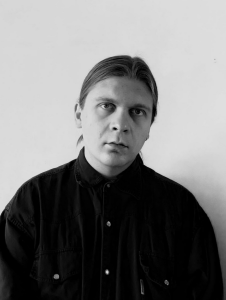 My name is Oleksiy Podat. I live in Kyiv. I was born in the Donetsk region in Sloviansk, which is now on the frontline.
Did you have a musical education?
Kind of. You know, it was really weird. I did not go to musical school or anything like that, but in my regular school there was a class with in-depth musical education. We had like four lessons of music a week instead of one. So yeah, we learned how to play sopilka, learned some drumming, and arpeggio, and stuff like that.
So you can read music?
I kind of can, but it’s all very… it was very basic.
Most of the time we listened to classical stuff. Like we sat and listened. Or there were lessons where we could bring our… not the music that we produced, but the music we liked to the class, and everyone shared what they listened to. And it was age of, uh, CDs, CD discs, CD players. So, everyone brought their CDs from home and took it to the lesson.
What kind of music are we talking about?
I brought the album Crazy Frog’s Best Hits. I played the intro because it’s really great melodic-wise. I think it’s still super for me. Other people brought some rap music, some, rock stuff, and Soviet stuff. You know, that was back in 2002.
Okay. The first thing is, how come you don’t have a moniker?
Like why I didn’t choose some project name?
Yeah.
Okay, basically when I started making electronic music, I was like 14, 15 years old. And since then, I’ve changed like, three or four (laughs) different monikers. And basically, like in 2019, I guess, I thought that the best way to name my project was just my name as I don’t want to stick to the idea that if my taste in genre changes, then I have to do another project and name it another way.
I’m just a person who lives his own life, and life is changing, and tastes are changing. It’s all right to release and to perform under my real name because it’s more convenient and I already have a name, so yeah, I am going to use it, and I like my name. Before that I had different monikers which translated into English would be something like World Championship of Meditation and different other ones. This was kind of a joke because it’s kind of absurd. But I have been Oleksii Podat for six years now, I guess. And for 28 years of my life also.
I was talking to Zhenia [Skripnik] yesterday and we were talking about Sloviansk. Could you just give me your own view of Sloviansk and what life was like for you back then?
Usually when I talk about Sloviansk to foreigners, I say that it’s a wonderful city. But it’s kind of difficult to tell my story from this perspective so I will be honest. At the time when I grew up the city was kind of all right, but there were no or little activities for the youth. So it was kind of dull. You had choice to fuck around like go and drink in the city and so on, or to be like addicted to some computer stuff and social media. Or you found yourself some interest in, I don’t know, FL [Fruity Loops], Ableton, and so on, because there was not much to do in the city.
 Were there any music venues?
Uh, of course, yeah, there were, but, um… but, but, but, but… there were kind of like some venues in bars, restaurants, you know, something like that.
The biggest one was in the main square of the city. The biggest celebrations were on the anniversay of the liberation of the city from the Nazis which in Sloviansk is in September when Ukrainian stars would perform in the main square in front of a many people. But there was no such thing as a scene before Zhenia started Shum Rave. I didn’t hear of any activities regarding electronic music or instrumental music which could be regular and interesting at the time before Shum Rave.
I liked being raised in small town because it motivated me to leave very fast and not to remain stuck in one city with my parents, which is very important. And yeah, there were not a lot of activities for students, and I just wanted to go away and travel throughout Ukraine. So in August of 2014 I moved to Kharkiv and lived there for 8 years.
Sorry if I ask this, but did you move to Kharkiv because of the situation?
No. Okay, the invasion of Sloviansk by russian troops happened on the 12th of April 2014. At the time I was graduating from school, and I lived under occupation for two, three months before we left for Kyiv, so I could pass my finals and apply to university. But while I was in Kyiv on maybe the 5th of July or the 5th of August, I don’t remember, the city was liberated. Ukraine forces retook the town and liberated Kramatorsk, Sloviansk and other cities.
I moved to Kharkiv when I started collage just to live in another city and not be with my parents. I mean, they are good people, but I like to be less controlled in my life.
What did you study?
I have a master’s degree in political science from Kharkiv University. I studied political sciene because when I was thinking about what I wanted to do, I looked at all the options, like any profession I could be interested in and the only one was political science.
I watched a lot of movies, films, TV shows about politics, Ukrainian and worldwide, and I liked the news as a kid. So, I don’t know, it was like a no-brainer for me.
What about music?
Music is, I suppose… a medium through which I can understand myself more. I just use it to process some emotions or some thoughts that I have been experiencing for some time and when I do it through music, I can understand myself more, not on a verbal level but more in some emotional space or something like that.
And have you always been interested in electronic music or were you like a punk kid playing in bands or…
I went through different phases in my life, but I was a punk kid playing in one band like for two months. It didn’t go well. When I was 13, I was kind of a DJ. I made mixtapes and sent them to independent radio stations and the mixes consisted of trance music and after that I got into Thom Yorke, Radiohead and some electronic stuff like Q Day. At 14-15 Radiohead just turned my vision of how music can be made and after that there was Modeselektor, Aphex Twin, James Holden and some other stuff. So, basically, yes, I was always interested in electronic music for as long as I can remember, but that was not common in my city. The majority listened to rap, maybe some house like David Guetta or something like that, but it was not common in my area. The Internet helped a lot at the time.
we’ll just do it again
So are you self-taught in electronic music?
Yeah.
What kind of programs did you use?
Uh, when I was 13, I was deejaying and I thought it would be great to create something myself, so I downloaded FL Studio. I didn’t understand shit like at all, so I thought music production is not for me, but one year later I randomly downloaded Ableton, and it was much easier for me and…
Really?
Yeah, because there were different modes where you could see the real structure of a track and the arrangement mode in Ableton really helped me to understand how everything assembles into a composition. So, yeah, it was much easier for me, and yeah, it was Ableton when I was 14-15. I started my vaporwave project at the time, but it basically helped me to understand how to play with structure. I didn’t have a powerful computer, so I wasn’t using some of the plugins and instead of that I recorded the sounds of the city and of people talking on an audio recorder, or on the phone, and I imported those sounds and used tiny fragments to create drums, bass, other instruments synth, just from the recordings and it helped me a lot because my computer couldn’t handle plugins so yeah, I found my own way of doing music within certain limitations.
Has the full-scale invasion changed your production process?
If we talk about process in terms of emotional space and readiness to do something, yes, it affected me. But technically not a lot of has changed. Things changed in terms of the time I can spend making music because I am involved in some war related activities. Also, I would say that all external events affect my music on an emotional level, but in terms of the technique it hasn’t changed.
But now you work with plugins or are you still taking field recordings?
I would say 50-50. For plugins I use effects like reverb, delay and so on but most of the time I use Ableton’s built in plugins or synthesizers and the other 50% are my field recordings which I transform into instruments. I like to keep the balance. It’s more interesting for me, rather than stick to one method. Now my computer is fine, it can handle synths like Serum or Omnisphere but I am more comfortable with simple things that are limited because I often find inspiration with limited possibilities.
Many musicians have told me that they in the immediate aftermath of the full-scale invasion they couldn’t even listen to music let alone produce anything new. Is your experience similar?
My experience with the war started in 2014. So, I think that this allowed me to start my creative process straight away after the invasion. The first track I created was in the end of March 2022, which is pretty quick.

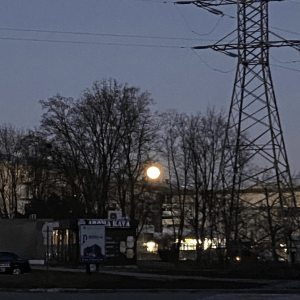
my mom sends me photos from relatively safe places
Sorry, was that “my mom sends me photos from relatively safe places”?
Yeah, yeah, yeah. That is an EP with two different versions of the track.
That was included in the DTF magazine list of the best tracks and albums that make sense of the war experience.
Yes, I have seen that.
How do you feel about that?
I think of that more like a business event, I say about publications and stuff. The moment my name is in some media, it is easier for people to google me. It is not about music but about finding new listeners that might come to a live show.
Did you have the feeling you were capturing events?
For myself. The feeling of capturing stuff regards only myself. I can say, yeah, it captures a moment in my life. Of course we have a common experience in Ukraine, which is the war, but there are so many different perspectives, different traumas… I am glad if music resonates with someone and they feel seen and heard, and they see their reflection in my music, but in the first place I am being egoistic. I am not doing work to reflect someone else’s feelings because I cannot understand them on the same level I understand myself right now.
So, what would you say you have understood about yourself in the first few months of full-scale invasion?
That’s the point, I can understand stuff about myself, because it is not language medium. I can feel my emotional level at present, I can see how I deal with reality through melodies and structures because often I think of myself as if I were living in automatic mode, which can also be a response to stress but when I do music, I can feel what state I am in right now. It is more beyond the language; it is kind of difficult to understand.
At the same time, is there work from other Ukrainian musicians that resonates with you?
This stuff has not been released yet, I hope it will be, but the latest performance by Anna Dhovan in Kyrylivska which was two weeks ago, I guess, at Miasma of the Real. It was amazing.
She also made the cover of your album…
Not because of that. I like that she used the recordings of air raid sirens, but she made them barely recognisable and she turned it into a great melodic palette. And the structure of the live performance is great, it’s not separated into track one, track two, track three… it all has a common space and is perceived as a common work of art.
The other stuff I like very much is Katarina Gryvul’s last album [Spomyn] which was out last month. I was amazed by how it is produced and made, it is not very commonly made, it’s not very obviously made, regarding also for example the bass, it is not very bass-y, there is not a lot of bass where it would logically be and because of that lack of bass I perceive it as more interesting. it is very curious and the vocals are great, I like this album very much.
And I don’t know… every last three or four releases of Adaa Zagorodnya. Like the last two or three albums, I like her art very much, it’s “ambienty-noisy” stuff, leftfield. I like it, it’s connected to me on an emotional level.
I cannot explain how I perceive this music regarding the full-scale invasion, but I feel that these works I described are right on time. They resonate with me a lot.

The Migraine Association of Ireland
I don’t know, there has been an increase in interest in both ambient and noise music, how do you explain for instance the success of нойз щосереди [Noise Every Wednesday]?
I don’t know I dreamt of this situation in the scene since 2015. I dreamt that some leftfield stuff would be at the forefront of the scene and now it is here and I like it very much. I will play at major festivals in Kyiv very soon, the Vegan Weekend, Brudny Pes, and there will be a lot of noise musicians also… How can I explain it? I don’t.
When I was a teen, I was very “maximalistic” in my hate of techno music, like it’s so dull, too much functional music, it’s soulless, but now I am older and I like some techno projects a lot. Back then I would have explained it like people are tired of techno and some predictable beats and so on, but now I can say that the emotional state of Ukrainians is kind of hard to explain through traditional electronic music and I feel that people try to find new ways of explaining their emotional state to themselves and to experience new stuff musically. The main thing, though, is that Noise Every Wednesday is very important in its structure because Vadim and Ksenia have been running this event every Wednesday since October 2023, I suppose. There is no such event with this regularity in Ukraine and when you run an event like this eventually you will gather publicity and more and more people, and it will become a scene, not only of musicians but also of listeners.
So, is it about a sense of community?
Yeah, Noise Every Wednesday built a community basically around the genre, not only limited to noise but leftfield overall, ambient, even screamo at some point. At present you get 150 people, 200 people and that’s a lot for this genre in Kyiv. Promoters from other formations and other festivals see that it is popular and they invite musicians to their gigs maybe to challenge their listeners with this, even if I don’t see it as a challenge, but some people do.
There’s also Miasma of the Real…
That also helped a lot because Kyrylivska is a big institution with a lot of capital money and influence on the scene, so it is very important that Tofu DJ created this party and for an influential institution to provide support for this genre and to show everyone on the scene that this is legit, it’s real and it’s worthy of your attention right now. I kind of feel some connection between war related stuff and interest in this music, I cannot explain it in words, but I feel this connection and I feel that the popularity of noise and abstract electronic music will not be at this peak forever, but it will definitely gain some listeners that have been sticking with it for a while.
How many times have you performed there?
I guess four times. There are a number of people who have outperformed me in the number of performances, like Konstantin Poveda who performed there like six or seven times, but I like being welcomed to this party very much. It is a great place to understand how spontaneous you can be with sound and how you can make on the post decisions that you would not allow for yourself normally and it’s a great space and I like the audience very much.
So how do you prepare a set for Noise Every Wednesday vs a set for a festival?
Basically when I prepare a set for Noise Every Wednesday I also prepare a set for events for the next two months. The important thing is that for the last year I built my live performances on a lot of improvisation stuff. It is not improvised from 0 to 100%. I basically play something at home, I remember it, not record it, and then perform it, but there are a lot of on-the-spot decisions.
When I prepare for Noise Every Wednesday I play some stuff at home, “Ok, that might work,” I play it, it works, I remember it, and I try to repeat it. I repeat it, I repeat it, I repeat it, and if it is still good for me, I produce a track over that and I put it away.
My music now is more improvisational than pre-produced, and I find more joy in this way of doing stuff.
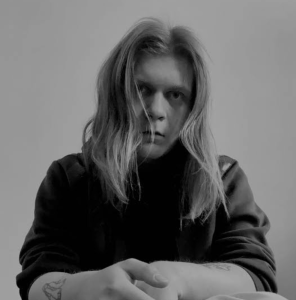 How do you avoid the risk of overexposure? I mean there so many festivals but because of the situation you might get the same names performing in all festivals. So, how do avoid the risk of repeating yourself and always keeping it fresh?
Basically when I open Ableton for a live performance what I have are only like bones without meat and muscles and stuff, and I can change the structure just by moving my mouse 10 cm away from the starting point and, I don’t know, at some point I can go to my chat and ask people to send me their recordings from their phones. I transform them into WAV, I open it into Ableton during my live and I make an instrument out of them.
I try very much to keep myself interested in the performance and I feel very bad when I am bored, when I am not interested. I keep it fresh through improvisation and through the ideas that come to me on-the-spot, and I use stuff that I can get when I am playing. For instance, at some point when I was playing recently, I had an idea of using some water sounds and I remembered that a friend had been to a waterfall and had recorded some sounds, and during the live performance I asked her to send them to me which she did on Telegram and I imported them into Ableton…
What, during the live performance?
Yeah. I like to keep myself busy during a performance. That is one of the examples.
Let’s talk about the titles of your albums and tracks. They are very narrative, they don’t consist of just one word, but they contain a whole story. How do you go about it?
Actually, I find album names or track names that consist of one word more pretentious than album names that are oversharing a lot of stuff. I guess it is more human for me to name something not in a single word rather than a sentence because it is too hard to feel that one word can contain a lot of stuff. Also, I like the tradition of emo screamo music where artists name albums like poems. At some point in my life, in my teens, I was writing poetry, and it stuck with me. I like words very much and I like when there a lot of them and they create a feeling. It is hard for one word to create similar feelings.
I have an experience, I have an album called Love because I thought that would be a bold statement and that it would be maximalistic, but now I feel comfortable speaking through my album names not just claiming something.
You mentioned poetry, many musicians have been using poems from the Executed Renaissance as a way of reclaiming their cultural heritage. Is that something that you find interesting and the have you also been rediscovering your cultural heritage?
I think that there are people who can do this well. On a personal level, I am not interested in, I don’t know, in using some cultural heritage or discovering some cultural stuff from the past. But on the same album Love, for the track titles I used words from the paly by the British playwright Sarah Kane and, if I remember correctly, it was the play Crave. So, I went through the play and picked some stuff. That was in 2018 and after that some publication asked me why I called those tracks the way I did and I once I answered something like, “Music speaks for itself.” Basically at one point I liked to see titles being functional, bringing some emotion, and affecting people, but now I just name tracks the way they affected me and I am comfortable with this right now.
Sorry, I am curious, how did you discover Sarah Kane and her work, was she performed here in Ukraine?
No. I suppose Sarah Kane died a long time ago [1999], I was probably 5 at the time, and she died in a psychiatrically hospital, she took her own life. The Internet is great that way. I cannot recall how I got there, maybe, I was interested at some point in my teens in some American post modernist big novels like Infinite Jest or Pynchon. And some roads brought me to Sarah Kane. Her plays ache and bleed. Unfortunately, I didn’t see them performed. At some point they were staged in Kharkiv, but I didn’t know her back then.
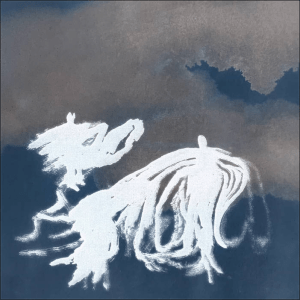
лагідні стосунки зі світом на дні землі
Let’s talk a little more about your latest album. Is it about unconditional love?
At some point. It is about the fact that during hard times you want unconditional love more. You want to be safe, you want some space where you are perceived as a loved one no matter what because in this situation people have become more fragile and their need for closeness is bigger.
What are you working on at the moment?
I am working right now in the way I described before, I play live I remember something is cool and I save it for later. Once I have a lot of material I think of the time I created it and the emotional state I was in, and will come up with some concept. I rarely sit at my computer and think, “Ah, I want to produce a track about some topic,” you know? I create a track and then reflect on what it could be about, the state I was in at the time…
Now I am working on material that I hope will be ready by the beginning of next year. I want to get some people to help with vocals, and instruments. For now I can see it being more “ambienty” but we’ll see.
When I started the last album I thought it was going to be a screamo rock album because I dreamt so much about this, but unfortunately, I do not have skills for screamo and playing guitar well. I can just play guitar somehow, but not structurally correct, so yeah, let’s see what it is gonna be. I think it’s 70% ready.
You mentioned that you use a lot of field recordings. Are there any particular sounds that you have discovered, or sounds that have disappeared from your sonic landscape?
The most obvious is power generators when there is no electricity, and shops and places use them and it gets very droney, noisy. This is a very common sound at times here in Kyiv.
But have you used it in your work?
I am not sure, I used it in my live performance in Dnipro in November at DCCC when Clemens Poole created a residency, but in my tracks I don’t think so. Ok, the war sounds, or recordings the sounds of war, I am not very comfortable to use these in my music. Conceptually, ok, it may be a great idea to someone or something like that, but it’s not very comfortable for me because air raid sirens got overused at some point by everyone. In terms of explosions, I can create a better sound by kicking a ball.
I suppose I contain the war sounds in my head while creating something, just like I contain any experience I am living through but I am not using them directly. But let’s see, it might change. Maybe I will record an air raid siren the way it will fascinate me and use it as a synth and I will deconstruct and put some effects, and it will be supergreat, but for now, not really.
I use the emotional state of war, not the audio. Usually, I record stuff when I go for a walk, or I am with friends, and they talk about something. For example, a conversation is a good source for a track because there are a lot of sounds that become the kick, the drums, the bass and so on. And it sounds very personal because you were there and they are your friends.

I as a slash symbol
Ok, last question, you have done political science as well, so, one-million-dollar question, how do you see the current situation evolving?
It will get much worse. It doesn’t look very good. I don’t believe that history is spiral or cyclic. I don’t believe that history repeats itself, but the trends I see right now lead me to believe that no one wants us to win, nobody one wants russia to win either, except for russia, North Korea and Iran. Everyone hopes to save this status quo we are in right now, so yeah, it will be like this for a long, long time, until it will escalate to something bigger, but I am not using my political science instruments, analytical stuff, to say this, I graduated five, six years ago, it’s jut my feeling and most of my friends in the military share my feelings. It will just be worse.
Do you think you feel like this because you have been living through it since 2014?
Yeah, it’s kind of connected. And it’s gotten worse since then. I cannot see an end to it. If there is an end, a lot of people will not feel it in a good way, I suppose. Everyone is so devastated right now, also in the military. I think it might be some coping mechanism not to expect too much from the future. The maximum I can hope for is that my loved ones will be alive.
Any last words, anything you’d like to add?
I suppose I want to say that I am overwhelmed by events that are happening in Ukraine right now and I hope we can overcome these Orwellian moments to help ourselves out of this shit at some point.
What do you do to relax?
I go to Lviv, I have a girlfriend there. She lives there, she has a job there. I go there for a week or two to live a slow partyless life, just making food and walking in the street.
[The interview was edited for length and clarity]
JUNE 2, 2025 – KRAKOW
Gordiy Starukh
 Hello, I am a musician and a luthier. My passion for making instruments is focused on the hurdy-gurdy. In Ukrainian it is called Kolisna Lira which translates as “wheel lira.” It came from Western Europe around the XVII Century, but in our culture it is connected to the Kobzary traveling musicians who performed epic songs.
This culture was almost – I want to say deleted or erased by communists. For us is like our national memory which we held onto for 300 years when Ukraine didn’t have a state, so it’s like our DNA that music.
I started making hudy-gurdys just for fun, for me. I have a little collection of folk instruments and the hurdy-gurdy is too expensive for a student, so I started making one for myself, then I had three children, the war happened, and I needed money, so I sold it, made a new one, sold it, etc. After a while it became a real profession and at present, we have 250 instruments the world over. Except for russia. Most of my clients are not from Ukraine. In Ukraine, I probably sold 15. It became very popular in the world.
When did you actually started making the first instrument?
In 2009. I finished it in 2011. But as a profession it started in 2014, and it became bigger and bigger. So, yeah, 10 years ago.
How many people do you work with?
At he beginning it was just me, then my brother joined. At present, there are three full-time people, and I have an engineer who helps and that I work with when I need some pre-amps or pickups and electronics. And I have one person making fabrics, the cases, and other stuff.
And you said your clients are from the world over.
The furthest away I sold a hurdy-gurdy to was in New Zealand, Tasmania, Australia, South Korea, Malesia. Regularly it’s been Canada, the US, the UK, Europe, Poland, mostly every country in Europe.
Can you talk about the way you use tradition instruments in your own work?
In my music the idea is to connect old folk songs with modern styles of music. My biggest hit has 10 M streams, it’s called “Дубе” [Dube]. It’s like a remake of an old song and I use a hurdy-gurdy a Moog Synthesizer and electronics. It’s very simple. All my music revolves around this concept. It’s like trying to give a new life to old songs. Ukraine has a lot of music connected with folk songs.
It is probably fair to say that since the full-scale invasion there has been a rediscovery of the Ukrainian musical heritage, especially from a new generation of electronic musicians using sample from folk songs and traditional instruments. How do you feel about that?
Since the independence in 1991, we had waves of using this heritage. Before that, in the 70s, we had a wave called…
Moustache Funk.
Yes. So, it’s also based on folk songs. Then, after independence, we had Katya Chilly and before her it was Автентичне життя [Authentic Life], if you know the band Dakh Daughters, one of them was in that and they played what could be called Eurodance with folk vocals. With Katya Chilly, at the end of the 90s we started more sampled based music. In the beginning of the 00s there was a popular series of CDs from expeditions with recording from grandma’s songs, but authentic. And a lot of music producers started using these sample in their music which started a trend of grandmas singing backing vocals for pop artists. In 2014 Onuka was making waves thanks to very high production values and all the producers started using sopilka in their tracks. After that, using sopilka started being scoffed at, “Ugh, too much sopilka!”
Now in 2022 we have another big wave because in moments of danger, folk is something that one can rely on. There are differences in the way samples are used. Sometimes it’s for corporate music, only for money, it’s on trend and they are using it, even if they may happen to be funeral song…
In most cases, I think it’s very good because when you get the quantity sometimes you get the quality.
Do you know Gasoline Radio? They released a sample pack of Hutsul music after going on an expedition to the Carpathians. Now Shum Rave are making a sample pack for Crimean Tatar music. In both cases they made VA albums looking at different musical traditions within Ukraine with artists using those samples.
I also made a sample pack last year. Hutsul music is very popular, a lot of culture from monutain areas has been preserved, so it’s very unique.
You are from Lviv, do you have a background as a musicologist?
No, for that you need to read notes, sheet music, I am sculpture.
One of the other trends is from musicians to use texts from the Exectued Renaissance as an affirmation of identity.
You mean Пиріг і Батіг [Pryg i Batig]?
As well, yes.
We grew up together. It started in Dzyga, if you were in Lviv, you know about Dzyga.
Yes.
It’s like a cultural centre, and in 2009 they started the project Етноклуб [Ethnoclub] with bands like Fidel Trio Quartet or Pryig i Batig in their previous incarnation as the Hych Orchestra, etc. There were a lot of musicians who played there with ethno folk musicians from the entire Ukraine and many musicians that played in different bands. I have three bands in Ukraine, and I have four members of Hych Orchestra in my band, so it was like a big smashing band club, and that is why I know Marjan Pyrig Pyrozhok.
Ok, so was it one big happy family or one big dysfunctional family as most families are?
All sorts of that in a very different combination. There was one rehearsal space, so it was like one big family.
How do you see that community holding on since the full-scale invasion?
It depends. When I am in Lviv I feel part of community and everyone knows everyone. But as I now live here [in Krakow], I have fewer connections. I know some musicians who left Ukraine and went to the US and different countries and cannot return or visit Ukraine. So, it is more complicated for them, but I have a different situation because I have three children, and I can travel to Lviv.
To be honest, I wasn’t aware that those with children abroad could come and go to Ukraine.
Yes.
So have you been playing in Ukraine a lot?
Last year, I didn’t do many concerts, but from 2022 to the end of 2023 I played a lot in Ukraine. However, since many artists are unable to perform abroad, I am now more focused on playing outside of Ukraine to raise awareness.
What kind of feedback did you get from different countries in Europe and how aware would you say audiences are about Ukraine?
All reactions are always good. I don’t remember bad reactions because most concerts are organised by Ukrainians and if you go to that gig, you already know about the situation. Mostly I played at pro-Ukrainian events, so it’s been a good experience.
I have been told that the further away one is from Ukraine the less people know.
I think this is normal. But as Ukrainians it is our job to talk about the situation.
In terms of lyrics, what can you tell me about your own material?
I only use folk lyrics. I try to pick songs that resonate with current times. Folk songs are some sort of therapy. We have a song about everything, – ok, maybe not about HDAD, although, maybe, if I do have a good look, I might find something about that as well. In terms of war, we have a lot of songs. When you lose someone, we have a lot of good songs. For funerals, we have a lot of folk songs that are good therapy when you cannot put into words your feelings.
My father is a musicologist. We have 17 books, like an encyclopaedia of folk song with 60,000 songs in there that were created by the diaspora. In Ukraine we a much bigger archive of songs.
What are the themes that you concentre mostly on?
Different one, because if I stayed only on one theme it would be boring. At present I am working on a Kupala song which is an old pagan festivity coinciding with the Summer Solstice. It is a love song about a girl preparing a magic tea who is waiting for her Cossack to return from war. It is very romantic and related to the calendar because when I am performing all my program of songs is related to the calendar, so I go from Winter to Spring, Summer, and Autumn and back to Winter.
Have you always been doing this, following the calendar?
Yeah. I think it is ok. There are songs that might not fit into the calendar, but I try to make a story that is related to that.
In terms of electronics, could you talk about your setup?
My love is analogue synthesizers. I don’t like VSTs when you have a MIDI keyboard and stuff in a computer. When I decided to make electronic music, my idea was to buy a good analogue synthesizer. At the beginning I was trying with Korg, but my savings went into a Moog sub 37, which is my go-to machine. It is very heavy and a disaster to travel with, but it sounds amazing. Also, my second synthesizer is sequential, but a budget one, Take 5. The idea was to have a mono synth from the guy who invented the mono synth for musicians and poly synth from the guy who invented the poly synth, so I have instruments by real guys!
Now, my production process consists of searching for a song, trying to sing it with a guitar or the hurdy-gurdy, write it in the computer, then I look for arrangements with synths, drum machines and make all the record. Then I make like a live version. I have a Roland SPD-SX for playbacks, and I cut out some drum parts, some bass parts in the playback.
Do you play solo?
Yeah, I am a one-man orchestra. Some tracks are based on live looping. I have only a loop of hurdy gurdy and all the rest I play myself but for other tracks there is a lot of playbacks and I use bass, bass drum and sing. It’s different kind of live performance.
Do you mind if we talk a little bit about Eurovision now?
Oh, interesting!
Sometimes one gets cheesy songs that use folk instruments like the sopilka…
It’s like a secret one trick-pony, if you have a bad song you can use folk instruments and have naked girls or guys.
How does one make sure they don’t fall into the trap of exoticisation and play into stereotypes?
It is a hard question because, for Ukrainians, Eurovision is not a music contest, it’s like a geopolitical strategic game, so if we win, it’s like, “Now Europe is hearing us!” Within this framework, if something works, then it works. Like Ruslana who won Eurovision in 2004.
Did you like the song?
I liked the moment she won, but she has a lot of better music than “Wild Dances”, more related to folk but without this “exotic” thing.
And then Jamala won, and then Kalush Orchestra.
And now we have Ziferblat, who have also a few folk notes in their song.
Do you watch Eurovision?
Yes. Not all of it, only specific moments.
You also took part in the Ukrainian version of The Voice.
Yes, in the beginning it was not my decision. I generally stay away from these kind of shows. But I have to say that it was a good experience because in that particular moment they decided to move away from this shitty scenario whereby you have some drama in your life, like your mother is dying and you take part in the show to raise money to save your mother. They have a lot of these shitty scenarios, but then, they decided to only go for real stories and they needed like a special story and I represented a special story as I live in Poland, I make instruments, I have many kids, which all makes for good TV, I am a self-made man with a big family, and I am not divorced which is good for the 45+ yo audience. For me it was fantastic because for my performances, I played my own music without any…
No external input?
Yeah, I played all my own music. It was like a shock for me when I first played live in front of them all, all the sound producers etc. They all just said, “You don’t need us, you can just play your own stuff!” For me it was a very good experience.
Going back to your instruments, when you sell them to electronic musicians abroad, do you get special requests?
As I am a musician myself, playing my own instruments with electronics, this is the best advertisement for other musicians. They can see they work fine with guitar effects, with modular synths or something, but honestly, I only tried to connect it through an external input into the Moog, and you have a signal from the hurdy-gurdy going to the Moog… Special orders are mostly related to colours because my hurdy-gurdys are famous for their colours. I have the most wild colours in the entire universe of the hurdy-gurdys! At present I don’t have any special orders. The last one was, “I need two outputs one for the melody string and one for drones and trumpet strings, so drones go in one bunch of effects and melody strings in another. So that’s all the special orders.
So, you make them custom made.
In the beginning I was making all the hurdy-gurdys custom made. They looked fantastic, but were horrifying in terms of sound.
Really?
Yes, the very first hurdy-gurdy I made, I tried to play it and then I tried to sell it and one customer came to Lviv from Kyiv to try it and said this is shit and didn’t buy it. But since then, I gained a lot of experience. The first 15 instruments were custom made, like a solid body hurdy -gurdy, etc, but then I decided to make them like Fender guitars, so that if you buy one, you know how it is going to sound. It is a more predictable strategy, but works well for the customer, because most of my clients are from the internet, they might have seen one of my instruments on Facebook, or reddit, and decide to buy one. For me it is also better because I can plan.
Orders from Luthiers normally take one year to be fulfilled. Before the war I had a waiting list of 18 months, now I have six months of waiting list, because many are scared to leave a deposit when the workshop is in Ukraine. But from the beginning of this year, business has started growing again.
So, the workshop is in Lviv?
Yeah, before I was making instruments all the time, but now, I have a bigger company and more time to make my own music.
Ok, so, when is the new album coming out?
Every time I say a new album is coming out it doesn’t. In Winter I dropped an album about Christmas songs, but they are more pagan songs. It was like a conceptual work, I worked on it since the Autumn and when I finished it, I was exhausted.
My last release was a few weeks ago. I also made a YouTube show to demonstrate how to play folk instruments. I started with the hurdy-gurdy, talking about its history etc, then I played it with guitar effects, like delays, etc. They were 20-minute videos. The first one was with the hurdy-gurdy then the buben, which is like a tambourine. It is very interesting when you hear distortion and delay on percussion, because you have this skin and when you make this noise with your fingers with a long delay and reverb it is mind blowing. And the last one I tried with the Jew Harp. We have a lot of these instruments in Western Ukraine, in the Hutsul region and the Boiko region. I am a Boiko from my grandfather’s side.
And today, I received my Duda, a bagpipe from the Hutsul region, which was restored, so I am very excited and happy because I have a friend, the former drummer from Pryig i Batig, and he invented a style of drumming on the buhalo, which is also a Hutsul instrument. My friend worked as a fixer and a volunteer, and after some time he moved to Ireland and there he started making Hutsul dudas and he also works as a musicologist specializing in Renaissance music. I had this bagpipe from 2008, and he restored it for me and made some upgrades because it is a very diatonic instrument.
Are there any Ukrainian albums from the past three and half years you think are especially good?
I need to try and remember. A lot of good music has been produced, but certainly Pryig i Batig.
[This interview was edited for length and clarity]
JUNE 6, 2025 – KYIV
John Object
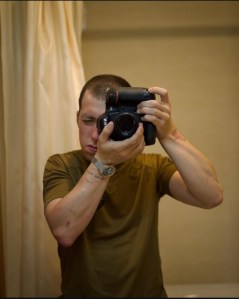
photo by Timur Dzhafarov
Timur Dzhafarov, aka John Object, was the very first Ukrainian artist to get back to me when I started the Ukrainian Field Notes series in the immediate aftermath of the Russian full-scale invasion. My initial approach was misguided. As a peace-loving leftie, I was hoping there could be dialogue between Ukrainian and Russian artists. His reply made me reevaluate my perspective, and I am grateful to him for that. He volunteered for the armed forces back in February 2022 and it is only now that we have had a chance to speak directly.
Thanks for making, I hope you are not too sleep deprived?
I think it is more usual that we have attacks at night than the opposite. There were a couple of days in a row when there were no attacks during the night. I was like, “Oh, my God, I just got seven hours sleep.” That was unusual, so this is fine. It’s ok. I do feel my brain is functioning at 70% power when I don’t get enough sleep. I feel dumber, just stupider but that’s just how it has to be.
And, yeah, the matter of dialogue is kind of… I think foreigners, especially, and even people who have been here a few times, and even people who spent a couple of years here they often… what doesn’t happen is that russians don’t kill their child, they don’t have a personal tragedy attached to this, nothing happens to them that is so dramatic and so horrifying that your life changes forever and there is no way to ever go back. There is no way to apologise for that, there is no way a dialogue could change that, you know?
And so many Ukrainians have gone through that. I mean I have; my partner has. We have all lost people we loved, and I think the people who suggest a dialogue don’t have the understanding of how huge this war is, how many people get killed every day. It is way worse that anyone can think. That’s my impression. Because I speak to a lot of foreigners, of course, and they all have this idea that it is much less violent than it i. No, it’s fucking insane. It’s unbelievable.
 Ok, you recently took part in a BBC audio documentary “East Piano” still available on BBC Sounds. If we could start by one of the quotes from that documentary, “One of the things I wasn’t prepared for when enlisting is that I would lose control of my acoustic environment.” If you could elaborate on that and tell us if the full-scale invasion made you rethink your approach both sound and music from a different perspective.
You know, a lot of people ask me that question or similar, but I always have a slightly different answer because it changes with time. I think when I said that I was not prepared when I enlisted, that is not strictly true. Of course, I was not prepared, but the thing is, even if I had not enlisted, just regular life in Kyiv sonically has changed so much because of the war, and because of the russians specifically, that it is almost impossible to compare it to how it was before.
So, of course in the military you just… as a soldier, as I was, well, I still am but… I have been promoted, of course, a couple of times (laughs)… Having no previous experience you enlist and you are just some guy, you are given orders, you have to fulfil them, you have to go and do this, go and do that, whatever it may be, and of course you have to be always listening for an order because whoever your commander is, they are not going to want to repeat themselves, that’s not… It’s the army way, you have to be constantly attentive, and that’s just how it is. It makes sense to me. Of course it was kind of shocking, and it was a bit upsetting that I couldn’t listen to music, because like, what’s the big deal? No one is talking to me right now, I am not expecting any orders, I am allowed to hang out here for half an hour and I can’t put on my headphones or something, but of course, it’s not how you do in the army so…
That was difficult to get used to, but in all honesty I think it may have been beneficial because… in a way I am kid of glad that I dropped out of the constant news cycle of modern music, like whenever a new album comes out I used to… from a bunch of different artists, I would use to feel the pressure to listen to it and form and opinion, be able to discuss it with my friends or with strangers on the internet. Sure, I may have discovered a bunch of great music that way, but I feel like it’s been somewhat beneficial to me to not to listen to new music, and not to listen to music a lot, generally, which is interesting.
Also, of course, the biggest component here is the russians, because what you really have to listen out for is the russians, not your commander, because your commander, yeah, that is important, but hearing a russian drone, or a rocket, or a shell, or a missile, or whatever it may be, can be life saving and hearing literally the soldiers creeping up to you in the trench, of course, that as well, or a tank, or a car, anything approaching, plane, helicopter, whatever it may be, and hearing the air raids of course that is important.
The russians really took away a lot of things from Ukrainians and control over the sonic environment is one of those things. It just happens that to me it is one of the more important ones, but then of course I have never been taken prisoner, or I have never been denied the fundamental freedoms. So, if that is my biggest complaint, then I am fine. Relatively. Yeah, sorry, I hope there is an answer in there somewhere.
Absolutely. You also talk about… and you mentioned this already, but you also say in the documentary that it is impossible to justify listening to music and that is because, as you said, you have to listen to the Russians and what is happening.
One of the most common experiences that Ukrainian artists have been telling me about, is that in the immediate aftermath of the russian full-scale invasion they found it not only difficult to compose music, but also to listen to music as well because everyone is in a state of hypervigilance listening out for sounds of danger. It is probably very different for you because you were serving in the army, but I want to get a sense of when, or how, you went back to music…
Well, my friends pulled their money together and got me a new phone for my birthday, it was a used iPhone, but still, it was much better than the one I had. And I realised that is had GarageBand, which is like this app that you can write music. It is pretty simple, but it is actually quite capable, there are a lot of fun things that you can try.
I realised that, at night, when I was legally allowed to go to sleep or if I wanted to, or do whatever it is in my sleeping bag, than when a lot of other soldiers would call their families, – of course I would call too, – but they would then watch a movie or something, and I would open GarageBand and try to write something.
It took me a long time to start because it was unfamiliar software and I didn’t understand how it worked, but also because I didn’t really have… I didn’t know what kind of music I wanted to write. I just felt that the old music that I used to make as John Object was pretty far away from me at that point. It didn’t feel right or interesting to make that music, because if you listen to my old stuff, the pre-invasion stuff, I think it is very clearly music made by someone with a lot of idle time, you know? A lot of this kind of opportunity to fine tune it until it is just right, and looking back it feels a luxury to be able to write in that manner, produce in that manner. Of course, on a phone, you can’t really do that even if you wanted to, but also, I didn’t even want to anymore.
I just slowly found my new voice, however corny that sounds, but I realised that there is a lot of music from my teenage years, from my high school years, that I loved and that I never… the influence of that music never appeared in my own stuff. So, I realised, what if I just start a new project? What if I do something else? What if I start from scratch, and just remember what it was like to be 16 or 17 in high school and listen to EBM, Electronic Body Music, you know, industrial goth and all that stuff from the 80s, minimal wave and all that stuff? I realised that I know that music and that there is something I could say in that language, at this point, for some reason.
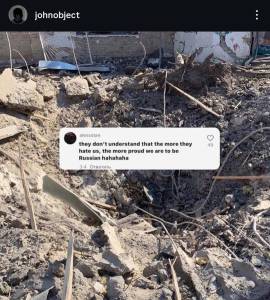 Let me focus and get back to the question. I think yeah, the only thing that let me slowly get back to music was night hours. I would sacrifice two or three hours of sleep for some music writing. Of course that was kind of terrible because we didn’t get much sleep in the army, maybe six hours or something, even less, and I would cut it down to four hours which is bad. I shouldn’t have done it, I kind of regret it because it manifested itself in some health issues. My stress levels were through the roof in the military. But yeah, at night, at least… the russians are still bombing us, they are still attacking us, but there are soldiers and commanders whose duty is to protect us at night, who are on night duty, so I am pretty much free, and I can do whatever I want.
Of course, then it would my turn to be on night duty listening, or reading something on the computer, data… Well, I multitude of different jobs that I had to do, but some days it would be my turn, so that system when you have a night shift of people who are protecting the camp and then there are soldiers who are allowed to sleep, that was really the reason that I was able to write some music.
Then, occasionally, when I was proficient in GarageBand on my phone, and I could do something quickly, I could open it for 5-10 minutes and sketch something really quickly during the day, if I had the opportunity, for example when we would be allowed to take a smoke break, instead of doing that I could write a music sketch if I had an idea.
Now, of course, I am still in the military, but I have transferred to Kyiv, which is probably one of the best protected cities in Europe right now. I mean we have amazing air defence, and we have the smartest and most professional people serving in the air defence, so it feels relatively safe. Of course, it is much more dangerous than any other city that is not being bombed by a fucking nuclear superpower, but it still probably is the best place to be in Ukraine. I think. Probably. That means I can just pretend that, in the evening when I get to go home from the military office, I can play my synthesizers and do whatever, you know.
In fact, before the call I was working on a track that I am trying to finish. It is very slow; it goes very slowly because often I come home very tired and my brain just doesn’t work, especially if I didn’t get enough sleep. I can listen to the sketch, but I have no capacity to add to it at all. I can listen to it and it’s just, “Yeah, it’s nice, it needs something, and I don’t know what it is.” And then the evening goes by, and I go to sleep disappointed and then the next day it happens and it’s the same. It can go weeks without writing anything, just listening to a sketch and thinking, yeah, I got to finish this, I don’t know how, but I have to. Yesterday I did have a bit of a breakthrough, I wrote a melody for the chorus, which is kind of cool, but that took several weeks. I was trying every night, and it really never come to me, I was just exhausted. Yeah, I think that is it.
Also, the change in my music process during the war has been that in the military of course the pay is quite good, especially if you are close to somewhere near the frontline. That is, compared to the average Ukrainian salary, of course, because if you just change it to Euros, it would be not much to you, I think, but in Ukraine the prices are lower, you know. If you look up the numbers, it is a relatively ok salary, the biggest one I ever had. I have never been paid this much by anyonem and I was able to buy a lot of equipment and instruments that I loved and that I wanted.
It’s been kind of life changing to be able to play music on professional equipment. It’s beautiful. It’s very rewarding in the most basic sense. It feels like something I was rewarded with by my government, or my country, or my people for protecting them. That’s why I have a cool guitar, or that’s why I have synthesizer. It’s amazing. That feeling is very heart warming because there are a lot of ways to make a lot of money doing whatever it is you can do, cryptocurrency, a startup, scamming people, I don’t know, whatever.
Capitalism allows you to do anything you want, but I think that what happened to me is one of the most ethical ways of doing it. That, to me, feels good because I have done work that I wasn’t really proud of, I have done commercial music work that I was like, well, I don’t know, that sucks. Having instruments and feeling that they truly belong to me it’s been important.
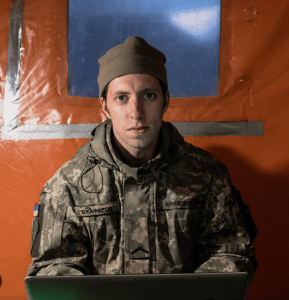 Ok, one of the things that people have been telling me is that they were forced to downsize because they had to make sure all their gear could fit in a backpack in case they needed to relocate because of the war, and some of them have kept that same setup.
Also, and this is something different, but when I talked to Sasha Boole, who was also on the frontline, he was telling me that one of things he learned was to try and be simple in his music in the most clear and direct way, and not having production values that are too complicated, but just go for a cleaner and more simple production process.
You mentioned instead acquiring new gear, so I wanted to get an idea of how you developed your setup.
Well, as you know, the music that I make is electronic music so it’s primarily with synthesizers and keyboards and since I was in high school there were certain… there were particular models of synthesizers that I wanted to have because they were the classics, it was the equipment used by ma favourite bands and it sounded beautiful, it looked beautiful and it was iconic, and I could recognise it from any picture.
After I got my first couple of pay checks form the military, I was like “Wow this is actually a lot of money.” I was still hoping that russia would be collectively defeated with help from allies or something, so I was kind of expecting the war wouldn’t last you know a year, or two years, or three years, or ten years, as it probably will. So, I was thinking I am just going to get a few pay checks, maybe six months, maybe more, so if I want to buy a synthesizer, it is going to be this one, so I would buy a Korg MS20, which was the first one that I bought during the service. It’s a classic synthesizer from the late 70s and it is beautiful, it’s black, and it looks like goth and industrial, it’s beautiful. So, I found one on eBay and I asked friends in Berlin to pick it up and they kept it in Berlin, and then someone brought it Kyiv on a bus.
I had a list of gear that I always wanted. I had that list forever, it’s been in my head for many years. And so, what I started to do, is just slowly build the stuff that I always wanted to have. Like, for example I can even show you, because it’s right here, I have a modular synthesizer system which is something that I always wanted to have since I was maybe 15 or something. Of course, you have to buy each module separately, you have to buy the case separately. It’s relatively cheap, I think the price is affordable, but to me it was still a lot of money, and the case is very high quality, durable. You could buy a cheaper case, but I wanted to get the good one.
And so, that was when I was building this system. Every month I would buy one or two modules. Next month I am buying these… Of course, I had to import them from Europe through shipping companies, and I had to manage it on my phone and call my Mum, “Can you pick up this, and open the package and send me a picture if it broken or something?” And she’d be like, “I think it is broken because you can see the circuit boards on the back,” and I’d be, “No, it’s fine, it’s supposed to be like that.”
I knew what to buy, it was something I had wanted half of my life, you know, so that’s immediately what I went for. And also there is a lot of stuff that’s like among electronic producers, it’s the classic affordable microphone Shure SM58, for example, it doesn’t matter, but of course I bought that microphone. I bought one of the classic headphones. I bought different little classic equipment, small stuff, but if you want to build a studio, you should probably have it. Some guitar pedals, that everyone is using.
So, yeah, I kind of knew what I had to buy. And especially after I started making music on my phone, I realised that if I am making 70s-80s-90s inspired music, I am probably going to need this and that. I even bought a guitar amplifier which was similar to the one John Lennon used, of all people, can you imagine? But the thing is, it’s very loud. I can’t put in my apartment. It’s in my friend’s studio, and I haven’t played in a year or something, should probably sell it. Yeah, I don’t know, I hope… does this answer your question?
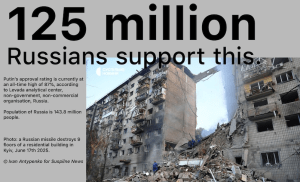 A couple of things. You have also become a noise artist in the meantime. You have been performing at нойз щосереди [Noise Every Wednesday] and you released tracks on Clemens Poole’s Drone for Drones fundraisers. How did that come about, and how do you explain the success of Noise Every Wednesday?
Hmm… I think those are two great questions, but they are also two very different questions, so I am going to take them one at a time, and if you don’t mind, I will start with the event question.
The events are wonderful, and I am actually playing there later this month. I am excited. I love those events, I think they are very good but, that being said, respectfully, not all the music that plays there is noise, not even when I try. I will play a 30-minute set, and I would play maybe 10 minutes of noise and then I would be, ok, I am going to add some rhythm, add some melody or something because I feel I am scaring people. The thing is that the promoters, the founders of the events…
Kseniia and Vadim.
Yeah, exactly. They don’t have the pretentiousness, or they don’t feel the need for exclusivity, they don’t really exclude people. When you apply, – because you can just apply, no matter if you have a career, if you have followers, if you are going to bring 50 of your fans, it doesn’t matter, you can just apply, – they will check out your music and, as long as you are not absolutely terrible, or a troll, or maybe completely so far away from noise, like drum and bass… – no, I think they had drum and bass… I guess folk rock would be the furthest thing from noise or opera! And also, as long as you are not political radical, far right or whatever, some asshole, they are probably going to invite you to play at some point, and I think that is beautiful.
I think this acceptance, and this desire to give a platform and a stage to everyone, or to a lot of people, is admirable and I think that is why the events have blossomed. It’s because they never have a shortage of artists, as the artists supply themselves, they do not expect to be paid a lot, or something. I don’t know, they sent me a little bit of money after the show. I never asked, and then they are like, “We had a bit more money today, so if you want, give us your card details and I will send you something,” which is very nice. I don’t know if people expect to be paid. I never do. And I never did when I first came there. So, that creates a totally different relationship where the artist is not incentivised to have any demands. I think that can be good, not always, but I think that is interesting to be in this situation where the promoters and the artists are both just random people off the street, they are the same, they are working class people who are trying to make this thing happen and come together. And maybe to try and make a bigger thing happen together and build something for one evening. That is beautiful. It’s nice.
The absence of judgement, and of this kind of, “Oh, this is not real noise, it is not made on analog equipment, it is made on a computer, Jesus, we can’t have that, dude, you gotta play somewhere else.” They don’t have that, and a lot of scenes in Kyiv they have that, they have a certain bias of how things are done in a certain genre.
If you are deejaying techno, you have to bring vinyl or something, or in a different scene if you are deejaying a slightly different kind of techno you have to have a flesh drive because if you bring vinyl, they are going to look at you, “What are you 50 years old? Grampa, go home.” It is going to be embarrassing if you do this here or if you do that there, you know. You have to really fit in, and it’s been my experience that I don’t really fit in a lot of scenes. People did look at me funny when I was playing with a laptop in a club, or I have this synthesizer here, or I have this groove box here, or I have this expensive FX pedal and this setup is crazy and I am just going to play techno all night on it, it’s old school true techno. When I showed up with a shitty old Del laptop they would say, “What are you doing, dude?” But then they would listen to the music, “Ok, it’s kind of cool, but still…”
I never was part of any particular scene, so that is why Noise Evey Wednesday is so good, because it is made for everyone. It is democratic. It is made for the outcast, for those who are not outcast but are trying to make something else, because you can play there without any pressure. There is no expectation that you will play this genre, and I will be able to do this dance, and I will be able to buy this beer, and I will be able to meet these seven friends of mine. You just come and you don’t know what is going to happen. You don’t know who is going to play what. No one promised me that it will be the greatest show in the world. If you don’t like it, you won’t be disappointed. Oh, I guess this guy is not for me, maybe the next one is going to be awesome. There is not really a feeling of high stakes, as there is with expensive club events and venues where there is a dress code. When you pay a lot of money for a ticket, you expect to be rewarded with a particular kind of product, and that is just not the case here.
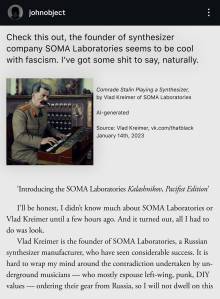 So, the other question was how did I get into noise? I mean, I think I have been kind of a bystander fan of noise music for years. Since I was teenager, I was well aware that it existed, and that avant-garde music existed, and avant-garde composers, Stockhausen. I remember looking it up on the Internet and being intrigued and listening to it. So, I always felt that noise music was something I was comfortable with, I know what that is, I know noise music that I like, I know noise music that I don’t like. Again, just like with the synth pop and the 80s stuff that I started making know, in the military I realised that, damn, I could be killed tomorrow, I could be dead, my life is not going to go the way I wanted it to go, it’s going to be a short and a painful life. I was always intrigued by noise music, and I think some of it, not all of it, but it can be easy to make and why did I never even try. What was stopping me?
My first attempt at noise music… I did once record a noise track that was very harsh, but that was just a literal reaction to something very bad that happened in my life and, as a means of reacting to it, I recorded a piece of noise music. I did put it out briefly, but then no one liked it, and I was like, yeah. As I started processing what had happened, I didn’t want it to be there on the Internet because it felt too private or something. Now that I am able to treat noise music not as a trauma response, but more as a conscious pursuit, something that you actually sometimes just want to do, or listen to, or experience, it’s quite interesting.
I do think that there is a certain sound in my head that I am always trying to get at when I am making noise music. There is this certain sound, I can’t even describe it, but I do have an idea of what noise music could be, and I do sometimes want to try it. And it’s really simply because the war has been so horrible that it’s like, “I am going to die tomorrow, and I never even tried these things that I always wanted to try.” I guess that must be it. But also, I should say that, of course, if it wasn’t for the war, there is also a bunch of other music that I love and that I never tried recording, folk music, or beautiful ambient, or something that is the opposite of noise music, classical music. I always wanted to write a piece for piano write and really write something that could stand on its own and have a structure and a beauty and a message to it.
There are a lot of things that I could have chosen to do if the only fact that I was facing was my mortality, but since the mortality is violent and so intentional, I guess noise is the choice because it does still reflect on the violence a little bit. Yeah. I think. Because if I was ill and got cancer and knew I was going to die, I would probably make some gentle music because there is no aggression to that, there is no violence to that. It is a sad and horrible thing, of course, but it is still something that is not done to you, you are still you, you still have your agency. In the war it is way different, and I think noise can be a reaction to that. And maybe there are other artists at Noise Every Wednesday that have come to make noise music for similar or completely different reasons. I don’t know.
You just mentioned the piano and you released an album called Piano, could you talk about that?
I wouldn’t call it an album, it’s a compilation, but it doesn’t matter, it’s not very important, but it really only existed because it is meant to be a companion to a compilation called Life which is like a collection with the majority of my stuff that I finished and that wasn’t published anywhere else. And I realised that I kept all of those piano pieces off Life because I never considered them to be proper tracks. They were quick sketches. A lot of the piano sketches are made on different pianos because I would visit a friend and I would see a piano and I would be like, “Can you give me five minutes? I will write something and recorded on my phone, if you want to go and have a cigarette or something.” And not everyone would allow this, but most people would and when they would, I would just sit down and quickly compose something without having any preconceived idea and that is why I don’t treat them as significant works. Also, I am a terrible piano player. They are not serious; they are not very good. Anyone that is familiar with quality and professional piano music, serious passionate artist stuff, they would listen to this and be, “Wow, you got to work on your technique for another 10 years,” or something, which is true, it would be a completely fair criticism.
I have no expectation to be taken seriously as a composer, because I am really self-taught, I can’t even read sheet music, I barely know what a chord is. All I know is just from the process of playing keys for many years and be like, oh this and this one sound good together, and then this would sound good. I would have this invisible network in my head. I cannot even draw it or describe it, but I have this subconscious feeling, which is what happens I guess when you are self-taught on an instrument.
So, those piano pieces are recorded on my phone. The majority of them have major issues with sound quality also, but I am still proud of them because I think that being able to deliver an idea when all you have is a piano is interesting. I feel like that is an achievement, a small one, but still. It is important to me to be able to squeeze an idea out of a piano that doesn’t have any settings, that doesn’t allow you to change the sound in any way, and there is not much you can do with it. And if you have something to say on a piano, that’s cool. I always wanted to be one of those people.
In my electronic stuff I always tried to make sure that… I have like this test in my head. If I am working on a track, I would ask myself, if someone listens to this track and I then played this track, or try to play it on a piano, would they be able to tell, “Oh yeah, that’s the one, that melody, or that track”? If an electronic track that I am making doesn’t have anything notable, or catchy, or memorable enough that it can relate to a piano that, to me, feels kind of like a failure. I feel unsatisfied when I realise that I have created a piece that doesn’t something that is just pure melody. That’s why I always had this weird relationship with the piano. I love it, I admire it, I want one, but I’m not going to learn how to play, I am just going to keep plinking my fingers…
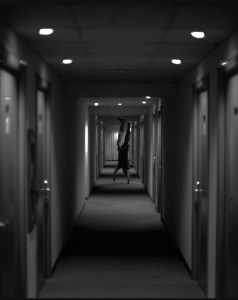
photo by Timur Dzhafarov
You also played a destroyed piano you found on the frontline. Could you talk about that. Also, I believe the piano might have a special significance if we think of Maidan and the pianos that were being played on the barricades. Was that ever on your mind when you approached the piano on the frontline?
I understand why you are asking that, but no, I would have to say no. I don’t know if it is different in other countries, but in Ukraine at least, and in a lot of post-Soviet countries, there is a very common tradition of having a piano in school. Every school would have… what’s the word… an assembly hall and would have a piano for concerts and the teacher would play and the students would sing. There were a lot of cheaply made pianos manufactured in the Soviet Union. They were all named after cities. One of the better models is called “Ukraine,” Ukraina, which is fairly common, my grandma had one in her apartment. A lot of the shittier ones are called like “Chernihiv,” or the smaller towns. The smaller the town, the worse the piano. They were all pretty bad. The really good ones were brought in from Germany, I think.
I have not researched this, but I would imagine the process of bringing in a German piano from the early XX century, like 1910, would have happened after WWII, maybe because there are a lot of German pianos made up until the 1930s in Ukraine. And of course, because there was also the Soviet occupied part of Germany after the victory, there was a lot of trade between that part of Germany and the Soviet Union.
Basically, what I am trying to say is that pianos are a very common site in Ukraine, especially those old Soviet pianos they are like everywhere. You can walk down the street and see one. I have seen one today in a park, it was just standing there. I think I have seen two today. I have seen another one in a… Jesus where would that be? I just remember walking by and thinking, maybe I could play it, but no, it’s probably locked, and it would probably annoy people, I remember thinking. There were a lot of people nearby. Must have been somewhere outside as well. Yeah, pianos are just common. It’s not an instrument that people choose to involve in historic events in Ukraine, it’s just something that happens.
Of course, the guitars are even more ubiquitous, because they are light weight. You can bring one. We had a guitar in our unit, in fact next to the piano that I found on the frontline near Bakhmut, one of the soldiers, one of my comrades in arms he had a guitar on him. I tried to downplay my skills because I didn’t want him to… “Oh, let’s play a song!” I’m like, “Ehm, I can’t play.” I am really horrible at… I can improvise, I can play some of my own stuff, but I can never look up chords on the Internet and then play a song immediately. It’s going to take me half an hour to figure it out.
So, yeah, the piano, I didn’t think about it as symbolism, because, to me, Maidan and the presence of a piano there was just such a minor blip, despite the fact that I was at Maidan, and I have seen that piano, and some other stuff that has happened with pianos in Kyiv. It was still such a small thing because primarily for me that piano reminded me of my high school of my middle school, of my grandmother’s apartment, of just a lot of stuff from my childhood because there were pianos just like that one everywhere. And that one it was just horribly broken. I am not sure what happened to it, I think… I don’t remember whether the house was bombed or not. I think we chose that house in the village because it was still relatively intact, because it was the place where we slept and left our gear. And so, it’s not that the piano was destroyed by a shell or something. I think it had fallen into disrepair by neglect. It had one of the… I don’t even know what to call it, one of the wooden panels on the face of it was missing, for example, so that you could kind of still see the hammers and the strings inside. The top panel was still there, you could put stuff on top of it, but it was generally a piano that had been beaten up and disassembled partly for God knows how long.
Oh, I just realised, the house was not abandoned, it had 20 or 30 cats living in the house. When we moved in, we had to chase away a gang of cats, we let live in the shed nearby, but still, they lived in the house, it smelt horrible. It was awful. We had to clean out the house for two days or something. So, yeah, maybe the cats did something to the piano, who knows?
Essentially, I guess the assumption would be that many strings had broken, or popped, or something, torn, and so most of the keys would not make any sound at all. I could press on the keys really hard, and they would kind of respond and I could hear something, like the hammer punching inside and be like… thump… thump… but they would never really make a sound… a note. So, I found a few notes that were still intact. There were maybe clusters of notes still working, still making sounds. Some of them would have something stuck inside, so if I pressed really hard, they would play, but unless I hammered on them, they would not make a sound. And the thing is that those clusters didn’t even go harmonically together at all. They were like disparate chords, or not even chords.
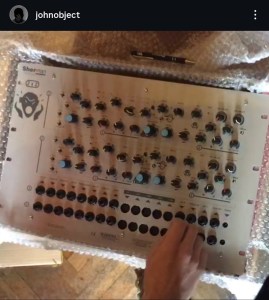 I didn’t want to play anything avant-garde or weird because my friends and comrades were listening, and I thought I need to play something primitive and beautiful that kind of speaks the common language of radio pop music. If that’s all you know, I want to play something that exists in the same world of radio pop. Because, of course, most of the people I served with were not specific about what kind of music they liked. They had other interests in life. That’s totally valid and fine. I never look down on someone because they don’t listen to music. It doesn’t matter. But the thing is, yeah, you have to play something that is familiar to them, if you don’t want to be asked something like, “You can’t play?” Or “Are you playing that intentionally?” Or “Why are you doing something weird?” There is no point in that conversation ever. So, I think the best I could find were three chords that were beautiful. I think there were two minor chords and one major chord, I forget, but they went together beautifully, it was fine. So, if I really hammered them hard, you could get some kind of rambling harmonic drone going, which was kind of cool.
I do miss a little bit that piano because it was broken in such an interesting way that to have more time with it and to be able to play it again would be interesting. But of course, it’s probably destroyed now. Or it’s occupied by russians who probably took a shit on the piano or something.
This is an aside, but one of the artists I have interviewed is a musician, and he goes under the name Хвоя будить сов…
Yeah, I know him. Actually, we were in the same brigade.
He did mention that he met you and he said you were very nice, but I think he first came across you from an article in Neformat?
It could be. I remember him, and I remember talking to him and he was likewise very nice and very… he was really very sweet to me, he said a lot of nice things. But the article is not something I would remember.
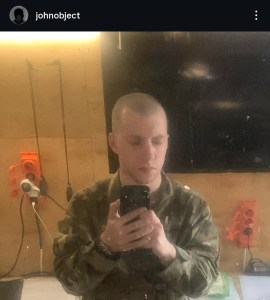 Yeah, I know, but what I wanted to get at is that you mentioned there was a guitar, and I wanted to have an idea of what role did music have in the military, or in your specific unit?
I mean, non-existent, really. Unless you count TikTok. I think in a way I was kind of relieved. The one thing I didn’t want to happen was that the unit would, or not the unit, but a group of people would reach a consensus on what kind of music they love and they would play it out loud in the company of our unit, and odds are that would not be the kind of music that I like, right? I don’t know, that’s just an assumption, maybe not a very fair one, but still. That was something I was afraid of because I really treasure the ability to not listen to music chosen by other people. I am not a person who listen to radio. I like the choice, I like the freedom, and I like having my own playlist and finding music that fits my mood, so whenever I am in a taxi or on the bus and someone is playing music, it’s like torture to me, I cannot stand it, honestly. So, I was glad that people who are not really passionate about music would not start something like that.
A lot of people were on TikTok all the time and they would usually not wear headphones, so you could hear the same maybe 15 pieces of music kind of bursting out every couple of seconds and it would be… Over time they would change, as pop music probably changes, you know. Something comes into fashion, something fades away, something replaces it maybe a couple of weeks or months later. So, I have a vague memory of a bunch of different tracks that I never even found out who the artist is, just TikTok hits, Ukrainian stuff. And that’s about it. Music is not…
I think listening to music actively, putting on a song and bobbing your head to it or singing along or maybe you know showing it to a friend, “Check out this song, this part is awesome,” it requires a certain freedom and a certain… It requires you not to be busy with anything. You have to be completely free to do whatever you want, and you have to also, maybe have most of your desires and needs satisfied, perhaps. Because I think people were on TikTok a lot when they could potentially listen to a song, and enjoy it, because TikTok would give you dopamine, would give you pleasure in such a concentrated form that we were all probably lacking, that was something that people were requiring and that’s why they turned to TikTok and sweet and really trashy foods for example. Coffee, and trashy movies. I heard people watching blockbusters with explosions and cursing.
I think music was not really an efficient system of dopamine delivery in that particular context and I think it can be a super-efficient system of dopamine delivery because if I went to see Fiona Apple and she sang Cosmonauts, which is my favourite song, I would probably cry, it would be the most beautiful moment in my life but there have to be specific conditions, I have to be free to go there, we all have to be safe so that a show can happen, and I have to able to afford the ticket. There are so many different conditions that have to be met in order to enjoy it to the best of our abilities, I think.
In the military you have to be pretty crude in your pleasure. Just give me something on TikTok – compilations of people falling down or something, or women with shapely bodies. People just tend to gravitate towards very simple pleasures because you cannot afford nuance, I think. You cannot afford it in terms of time and effort. As a soldier, a huge amount of your brain power is always allocated towards your service even if you are not doing anything right at that moment. You constantly have to be aware of where your weapon is, what condition is it in, is it loaded, is it not loaded, where you armour is, where your helmet is. You have to know what you are supposed to do in half an hour, all this stuff. You can never truly relax and I think music can suffer great from the listener being stressed.
Ok, can we talk about the kind of sounds… in the BBC documentary you talk about your time in hospital and listening to the sound of rain and that being the first time you could record something not related to war. I heard other people talking about finding it difficult to listen to sound in a purely aesthetic way, which is disconnected from the reality you are going through. Is that something that you are actively pursuing now in the music that you are making, sounds that are divorced from the reality of war?
I think so. It’s a good question, but I don’t know if I have a good answer. Lately I have been feeling the… give me a moment… I think the russians have been pursuing a much more aggressive tactic of attacking civilian infrastructure in the past several months. Maybe I am wrong but to me it feels there is more shelling, more bombings, more drones every day and that has really affected me mentally very much, especially… It’s not even the explosions; it’s the absence of reaction of everyone else in the world.
The war has got considerably worse, I think. I have been to a lot more funerals in the past few months, and I have seen a lot more pictures of people being killed in my feed on Instagram than before. That has been really a constant sensation in the back of my mind, and I feel that the absence of reaction from the rest of the world has been demoralizing.
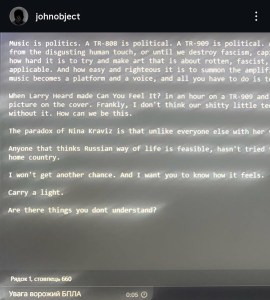 Even if I can process this war into something beautiful and I can make a piece of art that speaks of the horror of being ripped apart by an explosive drone, or something less gruesome, even if I could make a piece that would speaks to that, what’s the fucking point? Who is going to listen? Who cares? No one cares. The russians will kill us anyway. I feel pretty… to be honest, kind of hopeless. I mean I am going to keep fighting, it is not going to stop me, I am not demotivated, I am just upset and… because of that I have been kind of thinking I have done my fair share of artistic statements that are poetic and tragically beautiful, romanticising the war maybe a little bit or something, and they have had a certain kind of response but I don’t feel they have changed anything on the battlefield, it didn’t really help us get the F-16. By the way, those are really old planes. People always talk about the F-16s but if russia attacked any other country, would they be flying F-16s or something better? “They’re Ukrainians…” We are not really important. We don’t deserve the modern equipment. It’s ok, I understand. We are very much a second-class people in terms of the world.
A lot of these ideas have given me the understanding that making something that is connected to the war in any way would be embarrassing because on the most important front they would be a failure. However beautiful something I could create would be, however realistic and kind of true to life and important it could be, nothing is going to change. They are still going to kill us; they are still going to send 400 explosive drones tonight in two hours. What is the fucking point? I might as well make some music for Ukrainians. Of course, Ukrainians don’t want to hear about the shaheeds, or the explosive, no, we just want to party, we want to have one last good night of dancing of playing music, singing, whatever it may be.
So, the music I am making now is not connected specifically to the war, because I want to… because of defiance and because of this idea that to be this person who is still making art about the war thinking that someone is listening, no one is listening. It’s fine, it’s not… no one cares. There is no point to it especially when you realise that no one cares when you have already created something, and you see that it didn’t really go anywhere. That is so heart breaking, you have no idea. It is horrible.
I don’t want to be this person who is trying, expecting Europe or the US to suddenly develop empathy for Ukrainians, it’s not going to happen, I know that now, because it has been three and a half years and people are like… Well, Ukrainians are just going to be killed, that is fine, it’s just what happens when you live in Ukraine, you get killed.
I think a lot of people in the rest of the world knew russia as a natural phenomenon, it’s like the weather, it falls out the sky, what are you going to do? And so, I don’t really care about making art that will say anything to the world. If anything, I would like to tell the world to go fuck itself, something really aggressive but also still, I don’t devote any of my time to that. I have very limited time, obviously, and all of my listeners have limited time. The longer the war goes on, the less people are going to come to my shows, because they are just going to get killed one by one, so I might as well be making the kind of music that I would’ve have been making if there wasn’t a war, pretend we are still living some kind of life. I guess that’s it.
In terms of sound, again, I was talking to the guys from Victory Beats who do music therapy for veterans in Lviv and they have a chapter in Kyiv called EnterDJ teaching deejaying skill, and they were telling me about one session of music therapy they did with women who were held captive and out of ten women, two of them found the sounds of birds triggering.
Birds?
Heat artwork by Timur Dzhafarov
Yes. They didn’t go into detail about it, but in terms of sounds, many people have different triggers, so I wanted to hear what your own triggering sounds might be and if it is ever ethical in your opinion to use of war sounds in music.
Hmm, the birds, you know. I have been thinking about the birds. There was a period in my life before the full-scale invasion when I had a horrible sleeping schedule. For some reason I had it messed up and I would go to sleep at 1 pm and wake up at 9 pm and then stay up all night and so the sound of birds was be very depressing to me because it would often indicate that I was up all night and now the birds are waking up and I could hear it outside, and I would be, “Fuck, it’s 5 am now,” but I don’t know if it could be connected because a lot of Ukrainian have to stay up all night because of the explosions and the constant attack. Yesterday I was up at 4 am, and I did hear the birds chirping and that was pretty depressing. I don’t know if it could be connected. But triggering sounds? No, I mean, you can’t use them in electronic music, no, never. The peace of mind of any single one Ukrainian to me, is more important than anything else in the world, than any artistic statement I could make. All that can go to hell. If it upsets even one Ukrainian, then it is not ok to me.
You know, in the first year of the war, I have been thinking… the first two years, I think, because I still imagined that I would get to travel to Europe some day and make a couple of shows there, – not Europe, maybe somewhere else, – but specifically what I wanted to do was write a track for the German audience and make a track out of explosions and sirens and all that stuff and play with visuals, and put like statistics about German promises and the aid that was actually delivered to Ukraine and the terms, and how long it took, how we got, you know, ten Leopard 1 tanks, I think, that were so broken that we couldn’t even fix them, they were not even usable at all, and we didn’t even have the ability to fix them. Basically, Germany is throwing us their trash. So, yeah, I wanted to do that just to upset the German audiences and punish them in some way. I still think that it would be a great thing to do, but I don’t really see myself playing in Germany, to be honest, at this point. It is so like far from my priorities and my desires. I think I would rather not play in Germany… there are a lot of russians in Germany by the way as well. I could only imagine using those sounds for something in Germany if I was relatively sure that there were no Ukrainians in the venue and maybe if there were Ukrainians I would make sure they were people who spent the war in Germany and not in Ukraine, but otherwise no.
Of course, the air raid siren is the universal trigger sound for everyone. My and my partner, we were watching some show on the Internet a few days ago and there was a sound that was similar to the siren, but it wasn’t, and we both looked at each other… it’s miserable, a bit funny, but really it is not funny, if you think about it. And there is also this one show that we were watching on YouTube that has the sound of an actual air raid siren in the intro, because it is… I am not really sure why. The show was about competitions, and it uses the air raid siren as a metaphor for war, for fighting between some characters. And it uses the siren in the intro, and I have to skip the intro every time because it is going to give me a rush of anxiety, almost like a panic attack. Of course, the show is like an old show, they don’t make it anymore, and I was thinking, maybe I should write that in the comments, but who is even going to sympathise with me? It’s a stupid thing to complain about. They’re not guilty of using that sound. You are not going to assume there is going to be a war in the world somewhere and people are actually going to hear those sounds.
Those sirens seem like a reference to WWII, old times. I was surprised they were still operational in the first day of the war when they started going off. “Oh, my God, that’s like in the movies, the stuff that I heard!” So, I understand that sound to most people in the world is a funny sound from the old movies, I get it. But I would die a happy man if I didn’t have to hear that sound again. And I don’t mean die tonight. Like when I am old, or something. I’d happy not to have to hear it ever again. But of course, you know…
Pre-Heat artwork by Timur Dzhafarov
Is snoring a triggering sound to you? I just mention this, because in the BBC documentary you talk about snoring being something you had not anticipated…
had no idea of the way my body sleeps. I have always slept at home and usually in a context where it is fairly quiet. In the apartments where I lived it is usually quiet outside. I don’t live on a busy street and never had to face the necessity of having to sleep with loud noises. Also, I thought that anyway, I’d probably be so tired that I would fall asleep anyway. And I was very tired; that’s the worst thing. You are fucking tired as hell, and you just can get to sleep because of the snoring. I don’t know what it is about my body, but it just can’t do it. And I have been suffering, it was horrible. I tried talking about it to my comrades, not in the sense, “Can you stop snoring?” but in the sense of sharing.
I couldn’t fall asleep, it took me two hours, I don’t know why it is hard for me. And it is funny because people don’t usually empathise with that. What I would hear is, “Oh, maybe you weren’t that tired.” “No, dude, I was tired, you saw me working, I was digging the fucking thing the whole evening.” Or people would say something like, “Well, you shouldn’t have drunk so much coffee in the morning.” “No, dude, it’s not the coffee.” “Oh, of course, you lived in Kyiv, and you are privileged,” you know?
People don’t take that seriously and it is hard to have this relatively progressive view of human health, and biology and psychology and to explain to people, no, it’s a real problem, it’s not made up… to penetrate that shield of toxic masculinity where you are supposed to be a tough guy, and you are supposed to do anything anywhere. And I mean, yeah, you are supposed to, and I strived, and still strive, to be that universal soldier that can do anything, be resourceful, and be capable, and be, you know… what’s the word? Be basically, un… Jesus, what’s the word? Not be needy I guess, I forget, there is a word, and I am spacing out. But still, it was a real problem, and I never really found a solution to it. It was haunting me every night.
On the plus side, when you are somewhere around the frontline, when you are somewhere in some God forsaken village, there is no siren, you don’t hear an air raid. You can hear explosions, of course, but they are kind of constant. But there are no sires. You got an application on your phone, because in the area there is an air raid, but if you silence your phone, you don’t get a siren, which is cool.
So, I think in the military it would take me a long time to get to sleep, but once I was sleeping, I could be like six hours maybe in a row and it’s fine. In Kyiv it’s different, because the sirens are right outside my building. It wakes me up every time, of course. And the explosions are horrible here because they are targeting… compared to small village somewhere in the east, the area that they are likely to bomb is so huge that the nearest rocket or UAVs would probably fall tens of kilometres away from you unless they are targeting you specifically. And in Kyiv it’s like everything is pretty close together, so whenever they are targeting a completely different building or whatever it is that they are targeting, I don’t even know, it will still be pretty fucking close to your building, you will still hear it real loud. Yesterday, my whole building was shaking, it felt like an earthquake.
Sweat artwork by Timur Dzhafarov and Julia Davlatyorova
Ok, is there anything that you think is important to highlight or anything you’d to talk about?
Oh, this is the worst part, when someone asks me that, I’m just like… No, but thank you of course, it’s… there’s so much I want to say and a lot of it is very aggressive. And a lot of it is very accusatory, because I can’t believe a literal fascist, nuclear superpower is murdering us for three and half years. Of course, they invaded Ukraine before, right? So, it’s not three and a half years, it’s over ten years, actually. But still, the sheer amount of murder that has happened in the past three and half years is unbelievable. And the fact that people in Europe and in the US, – well, anywhere, in Asia, in Africa, South America, it doesn’t matter, – feel used to it, feel comfortable with what is happening, is to me insane.
Whenever I raise this point with any foreigner, they say, “No, but we support Ukraine, I do want you guys to win and I try this, and I donate here, and I do this, and I do that.” Yeah, it’s very nice, but the thing is, if people did enough, we wouldn’t be here right now, we wouldn’t be in this situation. If people did what I think it would be right to do, we wouldn’t… This war wouldn’t last this long, we wouldn’t have so many people killed, and russia wouldn’t feel so comfortable and confident.
russia is probably going to win, they are probably going to annex a huge chunk of my country with people still there and they are going to torture and kill those people. And the world is going to force us to sign a paper that says, this is ok, most likely. russia has a plan, their actual plan is to annex the entirety… the left bank of Ukraine, so the entirety of Ukraine by the Dnipro River in 2026. That is their plan. And you know, to have literal fascists admit to this, “Yeah, this is what we want to do,” and to have them say so much of what they have said and admit it publicly, is to me so crazy that it I don’t even have the words anymore.
What is there to say? I get it, people are fine with it, people don’t care, that is why I also don’t want to make music that is dramatic or that is about the war anymore, because I feel like… I feel humiliated and I feel like a loser for trying, because I have been trying and people are like, “Yeah, dude, ok. Keep it up, dude. Good job.” A lot of people text me, “Stay safe.” I am trying, but what do you mean stay safe? It is not up to me, you can text a russian and tell them, stop bombing Ukraine or something. I understand, it is just a phrase. I understand, but it always makes me think about this like… Grammatically that phrase implies that I should do something. That I should stay safe, this is a request to me. It’s a good sign of the situation that I think we are in.
And, yeah, I guess that I am pretty sure that someone will listen to this, or read this, somewhere in the future when russians have already killed me and if there is anything I could say, is that I didn’t want to die, I did not want to be killed and I don’t think I deserve it, I think I was just a regular guy, as is every other Ukrainian who has been killed, of course. So, yeah, what else is there to say? If people are fine with this, then I guess it’s fuck me. Sorry, I don’t mean to be glib.
Sorry, I feel like I have done a lot of interviews, and I feel like I tried every approach. I feel like I tried to say this and this, and I have been fine tuning my messaging, and I am trying to be descriptive and to appeal to empathy and to humanity and none of it worked. It’s all bullshit. Here we are. They are still going to bomb Kyiv tonight in an hour and half or something. They are going to kill someone. Someone who is alive now in this town will be dead tonight. It’s crazy. Dead not because they had a stroke, but because russians voluntarily decided they want to kill him intentionally, of her, or them. Not only that, but that russian will not be punished ever. They will be rewarded and be protected by the government. They will be old someday, they will be 70 years old and be tellingly their grandchildren, “Oh, we kicked those Ukrainian arses so hard, it’s awesome. I remember being young and strong and fighting them.” Dude sitting in Moscow, entering the coordinates. Fucking pisses me off, you know. Because that is what is going to happen. Literally, someone is going to be killed tonight, and no one is going to do anything. We are going to try and do something.
Yeah, sorry, I struggle with interviews now because it always feels like, if I could only find the right words, if I could only say the right thing, I could change something, I could help, I could save someone’s life, maybe, who knows, I could cause someone to finally shed a tear and send us 500 tanks or something. I don’t know. To have this opportunity and know that I am fucking it up every time, I have never said the right thing, I have always been trying and never get it right. Whenever the interview ends and it comes out and nothing happens, I feel like I fucked it up, you know? I should have said something else. Sorry, I think I am done with that.
photo by Timur Dzhafarov
If I may, it’s something that I forget to ask, do you actually go to live music events and how do you feel about it? For instance, I was talking Nastya and Mariana from K41 [Kyrylivska] and they were saying they have been speaking to veterans to make events more comfortable for them, so I wanted to get an idea if you feel comfortable going to big parties and does it feel weird, in a way?
I go much less now, because I can’t… Tomorrow I have to be… Tomorrow is Saturday, right? I asked for a day off, but usually, I have to go into service on Saturdays. So, there is very little time to go and do a proper club night, because I have to be fresh and sober and not hangover tomorrow, because they can still call me even if I have a day off, “Come in you have to do this and that.” So, I simply don’t have the time, and also, when I felt I briefly had the time, I did a couple of times, and it just wasn’t interesting because Ukrainian society has been really fractured by the war.
We all have extremely different experience of what daily life is like and when you encounter a huge assortment of young people in a club who have come here from completely different situations in their lives, it can be disorienting because I feel like, unlike a peace time country and a peaceful life, right now, there are things that are kind of like the wrong way to live, a little bit. What I am hinting at is people who speak russian. It upsets me, I don’t feel comfortable with it. Especially when I hear someone speaking russian and describing something that is about taking drugs or having fun or fucking someone, just something that is so surface level and so vapid, and to hear that in a joyful russian speaker’s voice, that can be quite upsetting to me, because I think, what the fuck are we even fighting for? Are we going to be ok or not? And that person is probably not my enemy, they are not evil or something, and probably not a russian supporter, they are just different in their processing of the war, but it still upsets me and there is not really anything to be done about it.
I have gone to clubs, and I have had people ask me for a cigarette in russian. I mean, if you are asking me for something, if you want something out of me, just do me the courtesy of you know… It’s a small thing, but it adds up, because when it happens five or ten times in a row, it just kind drills into your head this point that you are not really made for this, that this is not maybe the place for you.
Also, I don’t think I want to be cuddled, I don’t want the environment to change to accommodate me. If we are talking about russian speakers, for example, if I want that to change, it is not because I don’t want to be upset by their voices, it’s because I want them to change for themselves, and for Ukraine, and for us, not for me. So, the idea of rebuilding or reconstructing spaces in a social context for veterans to me feels a little shallow because we are still just people, we are the same, it’s fine.
What Ukraine has to change about itself and what society has to change about itself is for its own sake, not for us. What I value a bit more are tangible, simple things. A discount, or something. Or someone just thanking you. It’s simple, it’s small. I don’t like being treated as if I am fragile, because I am really not. I am fine, I can process my own difficulties. The changes that can or should be made are not for me or for the veterans that I know. I don’t think they would disagree with me here. Somebody probably would, but that is just one point of view and that happens to be mine.
Ok, I will let you go now, thank you so much.
Thank you as well, of course, I really appreciate anyone just dedicating their time to Ukraine when they don’t really have to. I am grateful to you for that, and I am sure everyone else is, so thank you for that.
[The interview has been edited for lenght and clarity.]
NEW RELEASES
VA ~ Shum:Qirim
This album was created as part of the Shum:Qirim project using a sample pack of traditional Crimean Tatar music which you can also find on our bandcamp.
Igor Yakimenko ~ Son of the Universe
A cinematic journey beyond genre and era.
Textures, breaks, and silence come together in an ambient DnB narrative that explores illusions, silence, cleansing, and cosmic depth.
This is not music for charts — it’s music for listeners.
LUCIVORA ~ Last Person on Earth
A slow descent into solitude.
SHKLV ~ Warped Garden
SHKLV is an electronic musician from Kremenchuk, Ukraine. He combines elements of techno, jungle and breakbeat in his music, creating unique sound worlds that surprise and captivate listeners. Inspired by the deep traditions of electronica, he constantly developed his own style and experimented with new sounds. His album Warped Garden forthcoming on Mystictrax in June, 11 with remix from OPR8 – DJ/Producer based in Bristol / Gloucestershire. He runs Radio show on SWU FM, Veteran of 1020 <> 5127 Thekla Night Club Bristol, released on Phuture Shock Musik.
djsnork ~ backchasing
Written during curfews and under shelling in 2024/25, Backchasing is a sonic response to emotional delay, interrupted time, and the disorientation of living in a wartime.
This is not nostalgia — it’s longing for a version of the present that never fully formed.
djsnork shifts from reflecting on surroundings to exploring the intangible: matter, memory, inner thresholds.
The album moves through loops of synthetic stillness and dissociative atmosphere — a document of living forward while feeling behind.
Backchasing is not a return, but a study in deferral. A soft collapse rendered in sound.
⚠️ Content note: this release contains loud dynamics, sharp transitions and emotionally intense textures that may be triggering or discomforting for sensitive listeners.
ROSS KHMIL ~ EVERYONE HERE IS BETTER THEN ME 1
SERIES: “EVERYONE HERE IS BETTER THEN ME”
INCLUDES 6 ALBUMS.
ITS LOFI OUTSIDER TRANCE TALES
MADE COMPLETELY WITH AI.
i write all of it like sound diary,
capturing particular feeelings, pain, mistakes and inspiration ive experienced.
hope you enjoy, maybe something would resonate with you!
by the way
best wishes to all listeners!
VA ~ Landscapes
We invite you on a captivating journey through sonic landscapes, where each track is an imprint of a personal story transformed into music.
Touch the sounds that guide you through memories, cities, and places – crafting a unique map of melodies.
Let the journey begin!
xtclvr ~ Blessed Loops
Thizzing and blown-out ambient trap x dub techno vapours from Ukranian artist xtclvr…
Produced under trying circumstances, Ukraine’s xtclvr wrests an escapist sense of hazed beauty on a compelling maiden voyage for bleary-eyed specialists Sferic, written and recorded during long nights under curfew and occasional shelling. Vocals are there, but mostly unintelligible, disrupted by a persistent offbeat churn and fragmentary instability, a paradoxically lush but anxious sound that reflects broader butterfly effects of war and its ripples of socio-economic fuckery on one level, and simply a trippy soundtrack to the afters on another.
Ten smudged shots unfurl across a 3D stereo space in gyring and shearing motion, cryptically shielding and scrambling a message meant to be deciphered by your sixth senses. A vocoder is diffused in aerosolised designs on the rugged lean of ‘Perspective’, setting up a chain reaction that buckles to more fraught feels on ‘Allgreen’ and the ruptured raptures of a ‘Storm Shadow’ recalling Nazar’s recent sound design spheres for Hyperdub.
BSW948 lends nervous bars laced into the warped matrix of ’Night Shift Cut’, and OB3TH perfuses the iridescent dub techno of ‘The Wise Mystical Tree’, whilst Indy lends to the ambient drill of ‘Acid Flavour’, and closer ‘Dead Smoke’ perhaps best betrays, even if metaphorically, a feeling of psychic distress in its dank, submerged mire. (Boomkat)
Natalia Tsupryk ~ Чорнобривці
Recorded at Funkhaus Berlin in 2022 together with ‘When We Return to the Sun’ EP (released by LEITER in December 2022).
Rudni ~ Veil of Sorrow
Veil Of Sorrow marks Rudni’s return to VORTEX with a four-track EP that delves into hypnotic rhythms, shadowy atmospheres, and restrained intensity. A focused and introspective journey built for both inward exploration and late-night dancefloor momentum.
invisible noise monasticism/нойз галичина ~ Concrete Revelations
Stone-like wall of solid sounds full of inner energy. It meet you with its expressive call, and then, as you are immersed in it, it will show you the depths of visions. Here you will find a huge picture of internal expression in its pure progression.
Here is a worthy work by two veterans of noise from Ukraine
MANOUA ~ STRICHKA “Odyssey” Live 2025
Live recordings from Manoua capturing the perfect summer vibe balanced somewhere between electro, downtempo and acid.
DEDDOM & НОЙЗ ГАЛИЧИНА ~ Гуцульський мольфар отримує свою першу пенсію
Have you ever imagined that you have magical superpowers? Close your eyes, turn on the music and imagine that you are a magical grandfather who was unexpectedly awarded a too low pension. A complete rethinking of the events that have already happened this winter with the alcoholic grandfather. This time magic, noise, expression, drums and saxophone.
VIEWING ROOM
(Gianmarco Del Re)
 a closer listen
Pingback: ACL 2025 ~ Top Ten Rock, Post-Rock, Folk & Jazz | a closer listen