

artwork by Mariia Prymachenko
And we’re back after the Summer break with another packed episode from the four corners of Ukraine. We start off in Kyiv (via Baku) addressing anxiety with äsc3ea a common feeling for many Ukrainians; in Kryvy Rih, we meet ДЖАП who mourns the demise of the only rock club in the city hit by a rocket; in Dnipro, Andrew Deme thanks AI for voicing the fake hope of a moth; in Cherkasy we engage in Low Communication with Bohdan Linchevskyi; in Slovyansk we discuss Nostalgia with Brief für frau Fisher; eventually we backtrack all the way to Dnipro to explore Hybrid Trap & Twerk with Sharky before returning to Kyiv to discuss scoring documentaries with Didi Armor.
Taking a quick detour to Canada we speak to Nalobi Zrobe about Odesa Melancholia before heading back to Kyiv to hear the Fallout Shelter Advertisement Theme from Oleksandr Karško; in Lviv Darko Lisen agrees that “It ain’t much but it’s honest work”; back in Kyiv Slava Lepsheiev recalls the early days of Cxema; from Pavlo Poputalo we then learn that Okhtyrka is the new Bristol; in Kremenchuk, Mechika looks at nature; in Kherson we visit the shipyards with ILYICH, and finally, we end up full circle in Kyiv with Gapon who invites us to count elephants with Petryk Pyatochkin.
In the New Releases section we listen to the latest masterful VA charity compilation from KLIKERKLUB with proceeds going to Superhumans, as well as new albums from 1914, Daniil Tkachenko & Andriy Lukashev / Tangara, Difference Machine, Tongi Joi, СМИК, Parking Spot, Bohdan, Vera Logdanidi, Na Nich, ЛІЗА ПАДЛІЗА / LIZA PADLIZA, Pøgulyay, Антон Слєпаков / Андрій Соколов, Lu Joyce, Yevgen Chebotarenko, гриби мого дідахарабора, Hanna Svirska, Morwan, Merzotna Potvora / Обрій, Vortex, ARSNQA, Gamardah Fungus, Dirtbag Loris, Son of Oleh, KBT, SI Process, Театр Абсурда, Fedir Tkachov, Alexander Stratonov, and Tolmuepa.
In the Viewing Room we are treated to Alla Zahaikevych, Hidden Element and Міша Правильний; DhakaBrakha, a new investigative documentary by Suspilne (Ukrainian state TV) with a score by Alexander Stratonov, and finally a short film by Ilya Dutsyk & HOLYWATER.

Anna Kravets (left) and Anna Khyvl (right)
But first, here is our monthly podcast for Resonance FM with Anna Kravets and Anna Khvyl discussing everyday life in Ukraine, collaborations with international artists and creating an emotional and psychological space where the war experience could be shared even with those who have never experienced it firsthand.
Tracklist
* ЩукаРиба & Bunht ft. Yevhen Puhachov – Що й святоє… – То не ластовка (acapella)
* Anna Kravets – Mariupol – March 2022 – SIRENA Podcast (excerpt)
* Anna Kravets – Maria from Chernihiv – 2022 – SIRENA Podcast (excerpt)
* Mokri Dereva – Abo Live (excerpt)
* Anna Kravets – An Emotional Encyclopedia of War (excerpt)
* Anna Khvyl – Still Present as you notice its absence (excerpt)
* Anna Kravets – Closer – Mai Aproape – Poetry by Valentina Chirita
* Anna Kravets – ZAHISNYTSIA Podcast (excerpt)
* Anna Kravets – Prut
AUGUST 5, 2025 – KYIV

My name is Emma Hamza Grünwald. I’m based in Kyiv, but originally from Baku, Azerbaijan, and come from a mixed multicultural family. I’m a multidisciplinary artist working with audiovisual media. I started out in visual art back in 2008, working with photography, design, video, and text. But at some point, I realized I wanted to create my own music for visuals—and in 2019, while living in Kyiv, I began composing.
Since then, I’ve joined artist collectives like Photinus Studio, which focus on new media, as well as Module Exchange in Kyiv. I started participating in jam sessions and exhibitions. In 2023, I launched my own project called Die Aufgabe, which brings together musicians and visual artists to process emotions through audiovisual performances. We’re currently preparing a new noise compilation.
I also began mentoring emerging artists—especially those just starting to write music and afraid to perform. Next month, I plan to launch a platform called Spielraum to continue that work, where we support people in building confidence through sound, because I know firsthand how hard that early stage can be. I’ve also joined the Noise Obsessions project as a mentor this year. In 2024, I joined a collective of queer artists from the South Caucasus working on themes related to identity and queerness in the region.
Has the full-scale invasion changed the way you think about music and sound in general and has it changed your setup?
Honestly, I’ve always been drawn to darker moods—sarcastic, anxious, sometimes even funereal. When I was studying, most people in my course were trying to make dance music, and I used to joke back in 2019 that my first performance would sound like a funeral march. So in a way, my emotional tone didn’t shift much after 2022—I was already anxious before the invasion.
But what did change was my sense of urgency. The invasion made me realize that if I die tomorrow, I want to know I did everything I could without regret. I have nothing to lose and nothing to be afraid of anymore. So I just make music—because if not now, then when?
 Most artists I interviewed have told me that in the first weeks and months of the full-scale invasion they were unable not just to play music but also to listen to music.
Has this happened to you as well and if so, when and how did you come back to producing new material and listening to music again?
Yes, absolutely. During the first month, I couldn’t listen to anything. I remember seeing a new release from a foreign musician I followed, and I felt this deep jealousy—because it seemed like I’d never be able to make music again. It felt unreal. Everything had shifted so dramatically, and it felt like nothing would ever be the same. It seemed pointless to create anything joyful.
Even wearing headphones felt dangerous—you could miss the siren or the sound of incoming missiles. (Though, to be honest, you don’t really hear missiles until it’s too late.) So both mentally and practically, it was hard. Most of the time, we were listening to the news, not music.
Eventually, I noticed that some of my friends were starting to create audiovisual works to raise awareness. That made sense to me. I joined my colleague Daria and composed music for one of her visual pieces. We showed the work as part of Carbon events in Europe and took part in online artist talks to share our experience: The Snow Will Melt.
Later, when some friends organized a festival to raise money for the army, I wrote a set that eventually became the album Broadcast of Daytime Nightmares. I did the same with Melting Distorted Remembrance.
I kept participating in similar fundraising and awareness projects. Since then, I’ve approached sound like I used to approach photography—trying to capture a specific emotional state, like a frame in time. Something I can return to later, like a sonic diary.
What can you tell us about the production process for your latest album Acute: Anxiety Diaries and was this born out of a form of PTSD, something that most Ukrainians suffer from, after three and a half years of full-scale invasion?
Definitely. But it’s also important to say that I’ve struggled with severe anxiety my whole life—since childhood. I just didn’t know the name for it back then. For years, I thought something was wrong with me. Now, I’ve learned to accept that part of myself.
I’ve always had intense nightmares, and I still do. On top of that, my situation is complicated—I’m still legally a foreigner, even though I’ve lived in Ukraine for the past seven years. I’ve built my identity here, stayed after the full-scale invasion started, learned the language, and call it home. But bureaucratically, I’m in a constant state of uncertainty, which adds another layer of anxiety. My migration experience has been harsh, especially during COVID and the war. As a foreigner, you never know if you’ll be allowed to return, or if you’ll ever see your friends again.
And when it feels like the whole world is burning, sometimes it’s hard to find meaning in making music at all. But this album became my excuse—it was my way of holding on, of documenting the inner chaos, and of trying to make sense of what I was feeling. I treated it like a diary, something private but also something I wanted to share, in case it resonates with others going through similar emotional states.
Has your use of analog sounds and field recordings changed since the full-scale invasion as your aural landscape changed?
Definitely—but not in the way I expected. I thought I would end up using more sounds of war, but instead, I found myself drawn to silence, nature, the everyday sounds of people talking, and the rhythms of city life. I started recording mundane things—as if I wanted to capture the air, the smell, the feeling of a moment.
It became a way to preserve the mood of peaceful times. When I feel lost or anxious, I can return to those recordings and remember how I felt. They help me tune back into myself.
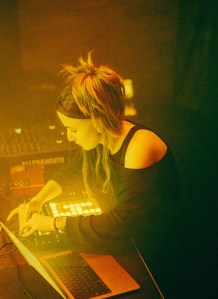 The visual arts also play an important role in your artistic practice. How do you see the interplay of art and music in your work and how does this translate in a live setting?
Oh, I love working with color. With a background in photography and design, I often use my own photos, typography, or abstract, glitched, grainy textures. My love for textures and colors stays consistent across all the media I work with.
Right now, I use TouchDesigner to create audio-reactive visuals that respond to sound in real time. I see it as a kind of dialogue—what you hear influences what you see, and I want the audience to feel like they’re inside the work, not just observing it. Like they’re stepping into a shared space where sound and image interact.
I’m currently working on expanding my setup to make it more immersive and scalable. But I’m still figuring out how to fully merge my visual and sound ideas. Sometimes they naturally align; other times it takes more time to find the point where everything clicks. It’s a process—and I love that part too.
At the beginning of the full-scale invasion, many were inscribing current events into their music through the use of air raid sirens, and slogans and speeches from a variety of sources included official statements from Zelenskyy. Your approach seems to have always been more oblique, for lack of a better word.
Your album Melting Distorted Remembrance from 2023, for instance, describes the process in which memories lose their original clarity and accuracy over time. Tracks like “This Too Will Pass” and “Un-condition Yourself” look at the way our thought processes are conditioned to respond to external events which we perceive to have no control over. Do extraordinary times and events call for new approaches in culture?
I think by the time I started creating again in 2022, many people were already a bit tired of the more straightforward approach—like using air raid sirens directly in tracks. I was searching for something else, something from the “before times” that could calm me down. Maybe even something naive or childlike. I needed tools to survive emotionally through the most difficult moments—like the phrase “This Too Will Pass,” which became a sort of mantra for me.
Because when something awful happens, my brain tends to panic and convince me that it will stay this way forever. So I try to remind myself that everything changes, nothing is permanent. That idea really helped me get through everything.
You know how people either fight, flee, or freeze in response to trauma? My response was freezing—getting stuck. Writing music became my way of unwinding, of finding motion again. It gave me focus and a sense of meaning in a situation where nothing made sense.
With “Un-condition Yourself,” I was reflecting on something unexpected—that despite the horror of war, I still had moments of real joy. I found myself appreciating the smallest things. And that was a conscious choice: to interpret reality in a way that allowed me to survive and stay human. I felt grateful for the chance to stay in Ukraine with my friends, to keep doing the work that feels important to me. At the start, that felt impossible. But thanks to the Ukrainian army, we had space to continue living.
 One of the themes you seem to be addressing in your work is sleeping disorders, I am thinking for instance at the track “Synthetic Insomnia.” With the recent increase in night time shelling of Ukraine, sleep deprivation has become an increasingly common experience for Ukrainians. Some have even come to approach evenings with a sense of dread.
Also, after three and half years of martial law, the whole experience of night life has radically changed signalling the end of night clubbing. What has your personal experience been and how can one even begin to understand the psychological effects of the full-scale invasion with no first hand experience?
That has affected me deeply. I’ve been a night owl since childhood, but since 2022, I’m usually home by midnight at the latest—even if I’m in Baku. I don’t feel comfortable being outside for long anymore. My anxiety was already present before, but now it’s much stronger, and I’ve learned to accept it and do my best to manage it.
Whenever I’m outside, I’m always searching for the nearest metro station as a safe place—since we often hide there during air raids. I avoid going far from home for extended periods. I don’t go to clubs unless I’m performing—I hope that will change someday—but generally, I can’t stay and relax in very loud, crowded places for more than about ten minutes. However, if I’m playing music or working, it’s different—then I can handle it.
Are you still currently based in Kyiv and have you been displaced at any point?
I had to take care of some documents and visit my family in Baku, but I bought a ticket to return to Kyiv in September since my whole life is here. It mostly depends on bureaucratic matters and finances.
 You were born in Baku. Does this give you a different, or wider perspective on the decolonisation discourse and the “east vs west” debate?
I’ve only recently started to put the whole picture together. I see many similarities in our experiences with russia, but also some differences. For example, in Azerbaijan, russians enforced changes like modifying everyone’s surnames by adding suffixes that didn’t exist in our language. They also forced us to switch from the Latin alphabet to Cyrillic, which caused a lot of difficulties.
For instance, my mother learned Cyrillic, but I was learning Latin, so I can’t read many works written in Cyrillic. This created a cultural gap and caused a lot of information to be lost for our generation.
At the same time, the russians used similar tactics here to instill feelings of inferiority. So while the contexts differ, the patterns of control and cultural pressure feel connected.
I’m not even referring to the centuries of russian occupation—during which cultural memories were erased, poets and intellectuals were executed, places were renamed, people were relocated, and our country was divided and lost territories.
And still, they have never acknowledged that they colonized us. Instead, they claim that we share many things in common. But Azeri culture has never had anything in common with russia—they colonized us for centuries and framed it as “bringing us civilization.”
Are there any Ukrainian albums from the past three and a half years that you feel have captured current events in a meaningful way?
There are quite a few, actually, and they come from very different genres. For me, it’s about whether it clicks or not. Recently, I’ve been listening a lot to the work of my friend OKRIP—I absolutely adore everything he does and have lost count of how many times I’ve replayed his music. I also really like Unsleeping and Хейтспіч. More recently, I discovered Пиріг та Батіг, which I find very compelling.
A lot of them. Genres are totally different by the way. But it either clicks or not.
Which book / film / album / song / traditional dish / podcast / blog / artwork / building / meme best captures Ukraine for you?
 If we’re talking about memes—I’d say “This is fine.” That was already my favorite meme before coming to Ukraine, but by 2025 it feels even more relatable to a lot more people.
As for visual art, I’d mention Maria Prymachenko’s paintings—wild, defiant, naive, visionary, and rooted in something much older than colonization. I’d also highlight the work of Alla Horska. And when it comes to modern murals, I really recommend checking out Interesni Kazki—I love the colors and the surreal worlds he creates.
When it comes to art and music, it’s hard to name just one thing. There’s so much, and it’s all so contrasting—but that’s what I love. These contrasts coexist, and that coexistence feels very Ukrainian to me.
For a podcast, I’d recommend Вродила—it’s a great way to explore multiculturalism within Ukraine. And if you want to understand the broader Ukrainian context in a way that’s not dry or boring, I’d suggest watching Телебачення Торонто. They cover a lot of educational content with sharp humor and critical thinking—it really helps to grasp the bigger picture.
AUGUST 27, 2025 – KRYVYI RIH

Hello, my mother is a piano teacher from Sri Lanka, so music was there from childhood. I started playing the guitar at the age of 10, after school I graduated from a music college and a pedagogical institute. I worked as a guitar teacher at a music school.
Also, since childhood I was fond of rock and always played in local bands, so I combined two personalities in myself, one studied classical music and the other gravitated towards rock.
Has the full-scale invasion changed the way you think about music and sound in general and has it changed your setup and your playlist?
The war changed a lot. Life changed. The only rock club in our city was hit by a russian missile, so now the youth have no place to hold non-mainstream concerts. The band I played in also stopped its activities because some members of the band went to serve in the armed forces.
Ukraine is rich in culture and music. In my city there are wonderful performers who are professionals in their field, but promoting music is extremely difficult.
 What can you tell us about the production process for your latest album Мантри (Mantras) and how would you say it differs from last year’s Музична скринька (Music Box)? Also, how important would you say is humour in your work?
Before the war, I wrote my music in russian and our band did too. But since the full-scale invasion the song of the beginning of the war I recorded the last song in russian called “Occupant” and since then I have been writing songs in Ukrainian. Each of my albums has a certain content, mood, and plot. Comedy also has its place in my work.
What can you tell us about the track Це моя земля (“This is my Land”) and is your Ukrainian identity a big part of your work?
About the song “This is my land”, I believe that national identity is very important, and you need to remember your roots.
 Like your previous album Музична скринька (Music Box), Мантри is released by the Odesa based label Khatakomb, how did this collaboration come about and did you know Nata and Leonid, who run the label, beforehand?
I didn’t know Leonid and Nata personally; I was looking for a label that could promote my songs. Since my music is non-mainstream, there were fewer labels to choose from, of all the non-mainstream labels, I liked their name. Later, I contacted them and talked to them, I really liked them. Very sincere and open people. That’s why I decided to collaborate with them.
How would you describe the hip-hop scene in Ukraine and are there any recent trends you might consider particular interesting? Also, how would you position your own brand of hip-hop/horrorcore within the Ukrainian scene?
I do not follow the hip-hop trends of Ukraine, and I do not really like music charts. I like old Ukrainian heavy metal acts like ТОЛ (TOL), ЗЛАМ (ZLAM) Скінхейт (Skinheit) and others.
 Most artists I interviewed have told me that in the first weeks and months of the full-scale invasion they were unable not just to play music but also to listen to music. Has this happened to you as well and if so, when and how did you come back to music?
Probably many people during the beginning of the war were completely apathetic, burnt out and unclear about what to do next with music and in general.
Are there any Ukrainian albums or artists that have been able to capture current events and convey the war experience in a meaningful way for you?
I don’t like the popularization of war in songs, especially in mass form. In my songs, every album has a song about the war, but it’s more of a cry of the soul than a desire to get into the charts.
AUGUST 30, 2025 – DNIPRO
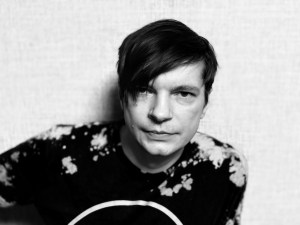
My name is Andrii Kovtoniuk, I’m from Dnipro, Ukraine. I’ve been creating electronic music — mainly Brighton and bleep techno — using modular and analog synthesizers for more than ten years.
Before that, I was a DJ starting in the early 2000s. I collected vinyl records and, at some point, shaped my own musical taste and began experimenting with making the kind of music I enjoyed, but in my own way.
I perform and release music under the name Andrew Deme.
Has the full-scale invasion changed the way you think about music and sound in general and has it changed your setup and your playlist?
The full-scale invasion has changed all of us. For me, it has transformed my attitude toward what I do. When you realize that tomorrow may never come, you want to do things properly, to bring your efforts to a tangible result.
As for my setup — I hold on to the thought that one day the war will end and big raves with powerful sound systems will return to us. It feels good to imagine that, and the thought itself inspires action. That’s why I’ve been gradually transforming my setup towards live performances.
My playlist has also become more energetic and uplifting — a kind of counterbalance to what’s happening around me.
How important is it for you to use analog gear?
I like workflow – and i create music based on improvisations. So it’s the only working way for me. Computers/software and sounddesign it’s boring for me.
What can you tell us about the production process for your album Fake Hope of a Moth and the way you experimented with AI?
All of the tracks were recorded during 2024. This time, I wanted to put more meaning into my work, so I used texts that I had written 20 years ago. Since I don’t really like how my own voice sounds on recordings, I turned to AI voice generators. AI translated and voiced my texts — I thanked him, and that’s how it happened.
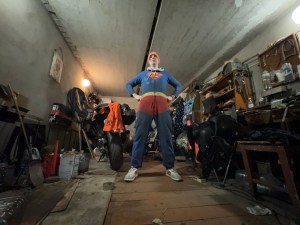 Can you talk about the track “I am the landscape” and has your relationship to the landscape and your sonic environment changed since the full-scale invasion?
As for the track “I am the landscape” — it’s a story about the reckless behavior of the lyrical character, who took on too much and believed in himself so much that he ended up failing. So, the “landscape” in the title is more metaphorical than a direct reference.
I also ride enduro a lot, so I know very well how diverse the landscapes of our country are — and they’re worth experiencing and observing, rather than just talking about.
The music scene in Dnipro has been heavily affected by the full-scale invasion with many of its active players volunteering in the armed forces. How would you say the Dnipropop community has withstood such challenging times?
A significant number of musicians are now defending our peace — deep respect to each and every one of them. Sadly, some artists have given the most precious thing of all — their lives — and that brings great sorrow.
Our community has always been close-knit, but since the beginning of the full-scale invasion our connection and collaboration have grown much stronger. To me, it’s like a non-Newtonian fluid — the greater the external pressure, the stronger the structure becomes.
Would you there a specific Dnipro sound and, if so, what would you say makes it unique?
Of course it exists — and its main characteristic is authenticity and rawness. This is due to the extremely limited number of cultural events, venues, and spaces where an artist could receive recognition or feedback from an audience — because there isn’t much of an audience either. It’s like a closed kettle boiling over a flame, with no escape for the steam inside. That pressure is what shapes the authenticity; a musician simply has no other option than endless maturation.
What can you tell us about the Construction festival and how would you say it compares with similar festivals in Kyiv, for instance?
I witnessed the emergence and development of Construction, but I don’t think it would be fair to compare it with other festivals, since I’ve hardly attended any myself. Still, I see Construction as a very timely, personal, and multilayered experience — one that I believe is worth having for everyone.
The first Construction festival was held in 2014 as a reaction to the events of the Revolution of Dignity. As the liner notes to the VA album Construction volume 2 state, “The first Construction’s program was vibrant: audiovisual performances in the planetarium and aquarium, a rave party in an abandoned factory, educational, urbanistic, and art events.” How would you say the 2025 edition of the festival compares?
The Construction 2025 festival has become more culturally and professionally oriented, and less abstract-emotional. I understand that the war imposes many limitations on the festival’s program, and much is simply waiting for better times. The very fact that Construction is happening this year is already a huge achievement for the entire festival team, and for that — many thanks.
So, I wouldn’t compare 2014 and 2025, but it’s certainly possible to feel nostalgic.
The first Construction interacted with a variety of spaces, complementing them and filling them with new meaning. This combination created genuine emotions, especially for the audience from Dnipro — familiar locations seen from unexpected angles and combinations allowed people to look at the city differently, to rediscover it.
But the best is still ahead, so there’s plenty more good times to come!
Under present circumstances and after almost four years since the full-scale invasion is it inevitable for musicians and artists to reference the war in their artistic practice?
In my view, the theme of war in art was very relevant for many artists during the first year of the full-scale invasion — almost like an aftershock. But by the fourth year, there is simply too much pain, too many deeply personal and sensitive moments to bring out into the public space and to creatively reinterpret. Still, everyone is free to do what they wish… As for me, I don’t plan to.
Are there any works by Ukrainian artists that you feel have captured and conveyed the war experience in a meaningful way for you?
For me, the best project in this direction is Warнякання by Anton Slepakov and Andrii Sokolov — true chroniclers of our region, our community, and of each individual story.
Many have told me they had difficulty listening to music in the immediate aftermath of the full-scale invasion, let alone producing new material. Has this been your experience as well and, if so, when and how did you go back to music?
I also experienced complete paralysis for about three months — it was impossible to listen to music, let alone think about creating anything. I only began to gradually return to creativity when my wife and child came back from evacuation in mid-May. The way that return sounded can be heard in my album “Idyll Delirium”, which was entirely recorded during 2022. It’s restless, heavy, and slowed down — that’s exactly how the first year of the full-scale invasion sounded to me.
Aside from martial law making all live music events daytime events, how would you say going to a concert or a party has changed for you since the full-scale invasion?
Since I make techno, nightclubs with powerful sound systems are very important to me. That’s why I converted the basement of my garage into a mini club for one person — just to satisfy, in some way, my craving for powerful sound and underground music.
As for parties and concerts, now when I get to go somewhere, I try to take in as much as possible from each outing — like a wild animal released into its natural environment. But with the curfew in place, everything ends very quickly, and it often feels more like a walk inside a prison.
 What does being Ukrainian mean for you?
For me, being Ukrainian means having the inner freedom to make your own choices every day, regardless of circumstances — and in some moments, even in defiance of them.
Which book / film / album / song / traditional dish / podcast / blog / artwork / building / meme best captures Ukraine for you?
Lately, I’ve been paying a lot of attention to the history of Ukraine and reflecting on its past and future. For me, the book The Gates of Europe: A History of Ukraine from the Scythian Wars to Independence by Serhii Plokhy captures and embodies Ukraine beautifully.
SEPTEMBER 5, 2025 – CHERKASY

photo by Daryna
I think that since I was 10-11 and got my first phone with headphones and the ability to listen to music on it, that’s when I became addicted to it. Five years later, I installed DJ software and started mixing tracks that I liked, and then at 17, I downloaded my first DAW to see what would come of it. Now I’m 24, and to this day it has become an important part of my life, I think it’s more than just a hobby. I even have a degree in sound engineering and two jobs that are related to music in one way or another.
I currently release music under the pseudonym Low Communication (my first release was in March 2024, Mabui Music). I had a different pseudonym before, but I’m not very proud of my old project, even though it gave me a lot. So far, everything is going very well with the new project.
At the moment, I have released five albums, some larger, some smaller. I have four releases planned for the future and have already signed with various labels. They are all very different, but I like that.
Low Communciation is not focused on one style of music. I see it more as a leftfield project. It could be ambient or breakbeat, soon there will be Detroit techno and quite dark drum’n’bass. Right now, I’m working on a new album in the 2step/garage style with quite dark melodies.
Has the full-scale invasion changed the way you think about music and sound in general and did it change your setup and playlist in any way?
I remember that at the beginning of the full-scale war, it was quite difficult to listen to music. Perhaps I didn’t listen to anything at all for a couple of months. Then I gradually started to return to it. I had to unfollow all russian artists on social media and remove likes from tracks by russian artists on SoundCloud. Fortunately, there weren’t that many. To this day, I strictly adhere to this. I don’t think my playlist has changed in any way. I listen to music mainly on Bandcamp, quite a variety. On SoundCloud, I like to listen to DJ sets by artists who interest me and whose music resonates with my mood. For example, I recently really liked a set by Andrew Weatherall, which unfortunately was one of his last.
As for how I feel about the sound itself and how the war has affected it, I can say that some of my tracks have become quite dark and gloomy, and it seems that I am drawn to that more and more. My album, released on “Byrd Out”, is probably a vivid example of this, and I think there will be more of the same in the future. However, I never know for sure how it will turn out, because I also have quite a positive and light album, such as “We Should Leave the Earth,” released on “EC Underground”. At that time, I really needed to write that kind of music. Those weren’t the best of times. I think I’m drawn to the dark side because I’m becoming more and more disappointed with the world we live in.
When I was creating “Memories for Quiet Days,” I had to look for certain sounds that would resemble an explosion. For certain tracks, that was the main task.

photo by Bohdan Linchevskyi (memories for quiet days)
What can you tell us about the making of your latest album “memories for quiet days” and how important (or inevitable) was it for you to reference the full-scale invasion?
I had the idea to create an album about the war since the beginning of the full-scale conflict. I kept putting it off, but after two and a half years, I decided it was time. Why is this important? I think it’s normal that if something hurts you, you can express it in some way. Since I create music, my way is a music album. I didn’t want to create this album for Ukrainian listeners. We are already overwhelmed with that. I think I wanted to immerse listeners who don’t know what war is in a certain soundtrack that we are currently experiencing in Ukraine.
Actually, I want to clarify that this album was not released this year(2025). This album was released in September 2024 by the “Neotantra” label (you can find it on the label’s Discogs page), which operates on Bandcamp. I was pleasantly surprised when its owner, Lee Norken, accepted the demo. But a month passed and this release disappeared from the label’s page. After that, I tried to figure out what happened, but neither Norken or Bandcamp support gave me any answers. I think the owner just deleted it. The disappearance of the album was quite an unpleasant experience. Later, several labels wanted to release this album, but things didn’t work out there either. So I decided to post it on my Bandcamp page, which is now linked to the “EC Underground” label.
What can you tell us about the music scene in Cherkasy and can we talk about an actual music community? Also, are there music venues that cater to different musical genres?
I moved to Cherkasy in the summer of 2023. Before that, I lived in Kyiv for five years. Cherkasy is my hometown. The difference between these cities is quite significant.
Since both of my jobs are related to music, I do know a thing or two about the music scene. I would describe it this way: there are many talented creative people here, including musicians and sound engineers, but perhaps no one is able to realize their full potential due to certain external factors that influence them. In cultural venues that belong to the state, everything is quite bad because there is no funding, no decent technology, no equipment. There is only human desire, but no opportunities. There is no specific audience either. Sorry, I see this quite realistically and, unfortunately, the community I would like to have does not exist. There are people to talk to, people to play my new track to, but for me, this is limited to three people.
There is a culture of street musicians, guys who play the guitar, girls who sing, and so on, but even there, the situation could be better. As for my music, I don’t see a place where I could fit in. We have some raves from time to time, someone organizes them, but for some reason, I don’t go there. This culture is not yet properly developed here. And hookah clubs with silly pop music don’t interest me. The situation is much better in Kyiv.
Still, as I mentioned, there are plenty of creative people here, and they all express themselves in their own way, either individually or in small groups.

photo by Daryna
A friend who is from Cherkasy has told me that in spite of the full-scale and the air raid sirens the city is currently thriving and feels rather dynamic. Is this your experience as well?
Yes, that’s right. I agree with him. Despite what I described in the previous question, Cherkasy is a very comfortable city to live in. It’s quite easygoing, stress-free, and cozy. It has everything you need, distances are short, and prices are reasonable. There’s a river and a park. Perhaps for me, there are not enough bars, but that can be dealt with.
I think we are lucky that we are in the center and quite far from the fighting. There are sirens, but compared to Kyiv, the consequences are not so significant. And you don’t pay much attention to the sirens anymore.
Now the children have gone to school. The city is really very dynamic.
One of the tracks on your album is titled “anxiety is getting worse”. Most Ukrainians suffer from PTSD to varying degrees. What are your coping mechanisms and what do you do to unwind?
Music, creativity, spiritual development, positive thoughts before bedtime — these are probably my mechanisms for overcoming anxiety. Things are going pretty smoothly right now. I have creative jobs, I have a creative music project, and I think all of this has a positive effect.
By the way, after I wrote “memories for quiet days,” in a sense, my perception of the war and the horrors it brought became somewhat easier.
How would you say the loss of nightlife due to curfew hours has affected you if at all?
I had a certain nightlife in Kyiv before the war. I went to certain raves and clubs. I don’t think I did it very often, and I can’t call myself a clubber. I really liked СХЕМА, some of my best memories are connected with it, if we’re talking about raves. After I turned 21, I went to Closer a few times. I was lucky to be there for New Year’s Eve 2022. Lucky because I really had a good time there, because then the full-scale war started and it no longer exists in that form.
From time to time, I want to hang out somewhere. After the war, I didn’t go anywhere until August this year (2025). Most of all, I want to listen to music with good sound, in a crowd of people with gin in my hands, so this year I attended a small event at Closer on Lisnyi Prychal. Of course, it’s unusual for a party to end at 10 p.m., but I still had a great time.

photo by Liza
Have you used processed “war sounds” in your album and, on a general level, is the inclusion of air raid sirens and similar sounds in electronic and experimental music triggering, or can it be successful in raising awareness about the war experience?
In my album “memories for quiet days,” there are real sounds of war in two tracks. These are the tracks “We Need To Save The Children” and “Evil.” All other tracks contain certain sounds that imitate some element of war, which can be a sample or a synthesized sound.
Once I was in Kyiv at an exhibition dedicated to the russo-Ukrainian war. This exhibition was held at Ukrainskyi Dim. There were many good works at this exhibition, many mediocre ones, but one surprised me. Some artist, unfortunately, I don’t remember his name, although I searched for a long time, made an installation about russian military radio called UVB-76. It seems to me that this is one of the most powerful installations I have ever seen. It was quite creepy, but it fully conveyed the fear of russia. That is why my track “Evil” is one of the most radical tracks. It contains the same radio sounds. The track is also filled with real sounds of missiles flying and alarm sounds. Working on it was difficult both technically and morally. This track really exhausted me.
“We Need To Save The Children” is a rather dark and gloomy track, perhaps a little sad. I managed to find samples of a children’s choir, so I was able to build the main melody on that. This track also features the sound of a rocket and real explosion sounds.
In fact, I had to think about how to convey war if, for example, a person listens to the track with their eyes closed, knowing absolutely nothing about it, not knowing its name or what the album is about. How would they know that they are listening to a track about war? Since I don’t have any lyrical vocals, I decided that real sounds of war were the best option. So, in order to convey the military experience, in my opinion, why not use such sounds. I think such sounds are both provocative and make it clear like in your face what the experience of war is like. Everyone will perceive it in their own way.
Are there any works by Ukrainian artists that have managed to capture the war experience for you?
I like the videos on musician Eugene Filatov’s YouTube channel about how each city in Ukraine sounds today. Unfortunately, all of these videos from his channel have disappeared somewhere today. He visited different cities in Ukraine, recorded sounds in different locations and with different people, and then used all this material to create a finished track.
When I got in touch, you said you were aware of Ukrainian Field Notes. Is there a particular question I still haven’t asked Ukrainian artists and that I should be asking?
I would ask the question: what are you willing to sacrifice in your life in order to spend more time making music?
Or: what is preventing you from making music more than you currently do?
 Which book / film / album / song / traditional dish / podcast / blog / artwork / building / meme best captures Ukraine for you?
The first release by Ukrainian label “Progressive Future” – VA #001
Cxemcast on SoundCloud by CXEMA.
“Zhovten” cinema in Kyiv.
Closer.
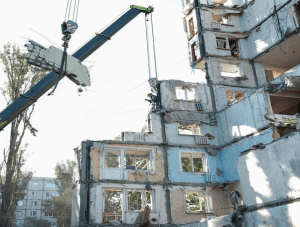
My last apartment where I live in Kyiv now looks like this. unfortunately reflects Ukraine. It was one of the last attacks in July 2025
SEPTEMBER 6, 2025 – SLOVYANSK

My name is Egor, I represent the group Brief für frau Fisher from Donbass, the city of Slovyansk. At different times we started as a duet, then became a trio, now I am working on a new experimental album, which is almost ready, it will be something completely new!
Our musical influences, as time has shown, are a mixture of post-punk, new wave, avant-garde, low-fi and other styles… We promote freedom and experimentalism in creativity, that is, there are no guarantees that we will not be carried away in different musical directions.
What can you tell us about the making of your latest album Час відпочинку з суботи до понеділка (Chas vidpochynku z suboty do ponedilka – Rest time between Saturday to Monday) which was recorded in three days as part of a challenge?
We planned to make a minimalist album back in 2021, and then the idea of using lyrics in Ukrainian came up. And now, after some time has passed since the previous album Воля и такт (Will and Tact) ,we decided to return to this idea. I suggested to a friend to set a time frame – let’s record it in 3 days, 2 of which we filmed on video, they are available on our YouTube. In short, we rented a modest house where we set up the equipment and recorded everything in 2-3 takes.
 Your debut album from 2019 is called Nostalgia and was recorded at home as a trial demo and turned into an experiment accompanied by psychedelic influence. Could you elaborate on its production process and tell us what “Nostalgia” means for you, especially at present?
The album Nostalgia is the very case when you have a mad desire to record something, but you don’t know yet how to do it technically.
It was 2019 before the creation of the group, the songs appeared instantly, something was recorded every day, it was immediately clear that they formed a single concept.
A borrowed Soviet flanger, guitar and effects processor helped, and instead of a sound card, all the guitar parts, bass, vocals were recorded on a phone recorder from regular speakers, pure DIY.
As for psychedelicity, it is definitely there, there are recordings of telephone conversations, my childhood recordings when I recorded myself on a cassette through a tape recorder, the sounds of trains, the sea, various noises.
A narrow circle of my acquaintances liked it; this also gave some of the impetus to create a group.
And nostalgia for me is the same as for everyone, a feeling of longing for good times, even if the “triggers” for the time machine in everyone’s mind are different.
 Egor you also play in Delirium. Both Brief für frau Fisher and Delirium share a similar sound, but as you stated when we did the Delirium interview for UFN back in January, there seems to be a decline in interest in post-punk and darkwave compared to the end of the 2010s. Why do you think that might be the case?
Delirium, yes of course, we continue to work together and prepare a new album. Of course, there is a similarity in sound because I write songs for both projects, that’s why the style is similar, but not only that. We started in parallel, together from the same city, rehearsed at the same rehearsal space, and met the members of Delirium in absentia at a concert of the Ploho group from Novosibirsk, which played in Kharkiv as part of a tour [Ploho relocated to Serbia after the full-scale invasion]. It turned out that many in the audience were from Slovyansk. Later, in the process of communication, we realized that we grew up on the same music and we have a lot in common, from love for the same bands and general immersion in the business, to a passion for football and similar views on life.
The post-punk genre has now outlived itself, it’s closed in on itself. To be honest, I’m not a big fan of the post-punk that is about panel grey houses with a cigarette in their teeth and a template sound, but yes, it was popular in the mid-2010s to the early 2020s, and this is already a lot, especially for the modern pace of life. To maintain interest in such music, you need to expand the palette of sounds, as it was in the late 70s and early 80s with the bands that replaced punk, they did what they wanted, and today all that remains of this are beautiful melodies, but rock has disappeared, it has become too bland.
You are from Slovyansk which has been on the frontline of the war since 2014. Are you all still based there and what can you tell us about the current situation on the ground?
In the city, when you are distracted, it is as if there is no war, people are going about their daily lives, but the sounds of explosions bring you back to reality.
Is it fair to say that Shum Rave put Slovyansk on the map? And is its legacy still felt or has the full-scale invasion compromised any possibility to develop the music scene?
Shum Rave really became a real event, but unfortunately, I never got there for various reasons. Although I am a big fan of electronic music.
In Slovyansk there was always some kind of musical life. In a city of 100 thousand residents there were festivals and regular concerts, but all this ended for obvious reasons. I will not say that there were any prospects here, the main success here was to perform on the main stage located on the central square of the city.
Unfortunately, there was weak support, and the regularity of these concerts was weak, but there were interesting bands in various genres, especially in the 90s and early 2000s, I can highlight Рокові яйця (The Fatal Eggs) the band played a wild mix of avant-garde free music with some kind of hardcore, post-punk and God knows what else.
 You have lived with war since 2014, which is probably almost half your life. One learns to adapt, but what are the things one never gets used to?
I know that man is an adaptable person to any circumstances, even the most extreme ones. The circumstances of war have strengthened our willpower and the value of every moment, and power outages and other problems are a trifle.
What does being from the Donetsk oblast mean to you?
I love the Donetsk region from the Holy Mountains to the Sea of Azov, I love the cities of Donetsk and Mariupol, Kramatorsk and Bakhmut. There are many beautiful landscapes here, this is what inspired me in childhood. I remember trips to the sea, to amusement parks or to the Donbass Arena stadium to watch Shakhtar football, this is what causes strong nostalgia for peaceful and fun times.
Because of the border zone with another country, there are many contrasts here.
I can say that we had the most powerful industry in the country and many enterprises where millions of people worked. Every 5th relative is a miner, steelmaker, etc. Wonderful people live here and hardly anyone cares what language anyone speaks.
 After over 10 years of war, are there any Ukrainian albums or artists that have been able to capture the war experience in a meaningful way for you?
Well, first of all, I want to highlight our album with Delirium Схід [East] about which we gave the last interview [UFN XL]. We will also continue this topic in the next new album which will be released soon enough. There are indie bands that successfully express this topic, but basically at the top of the hype are ridiculous pop songs that simply parasitize the war and are engaged in dehumanization.
Which book / film / album / song / traditional dish / podcast / blog / artwork / building / meme best captures Ukraine for you?
– Books: Oles Buzina – Revolution in the Swamp and Union of the Plow and the Trident.
– Film: A Strict Young Man filmed at the Kyiv Film Studio in 1935.
– Dish: Okroshka.
– Artwork: “Black Square” by Malevich
– Building: For me, it is the Derzhprom, which is located in Kharkiv.
AUGUST 9, 2025 – DNIPRO

Hello! My name is Anton Sharky and I’m from the city of Dnipro. I started making music as a teenager – first as a listener, then I became interested in production. I studied on my own, first writing hip-hop beats, then switched to dub step, trap, midtempo.
Has the full-scale invasion changed the way you think about music and sound in general and did it change your setup and playlist in any way?
First of all, my attitude towards music hasn’t changed at all, but I’ve removed all russian artists, producers, and DJs from my playlist.
If I am not mistaken, you started off with Hybrid Trap & Twerk. How popular were they in Ukraine and where did you use to play?
These styles had their audience, especially among young people. I played in clubs and at local events in Dnipro, Kyiv, Kharkiv, Simferopol, Sevastopol, Odesa and other cities. It was an interesting period, because the audience was always waiting for something new and energetic. I especially remember the audience in Sevastopol, very energetic, at that time it was 2013.
What can you tell us about the making of your latest EP The Maker which signals your shift to Drum and Bass and is out on Alexander Pavlenkos’s label 22:22?
The Maker is my first dnb release, and my start in the dnb scene. I have long felt a pull towards Drum & Bass, and this release was a logical step. Alexander and I went through my demo tracks and selected the best of them for the EP, which will work more on the dance role.
Have you noticed the rise of any specific music genres in Ukraine since the full-scale invasion?
To be honest, I don’t follow all the genres, but I can tell you for sure that drum & bass is gradually developing in the country. There are new parties, new podcasts and a bunch of new talented artists.
You are from Dnipro and have recently played at Spalah Rooftop. How would you describe the electronic music scene in your hometown, what would you say are the most popular genres and do you feel part of its community?
Dnipro has a strong local scene, although not as big as in Kyiv. Techno, house and, of course, drum & bass are popular. I feel like I am part of this crowd, because we all support each other and try to develop the culture despite the circumstances.
How would you say the loss of nightlife due to curfew hours has affected you if at all?
This restriction has changed the rhythm of life. Instead of night sets, daytime parties and new formats have appeared. In my opinion, people have become more appreciative of meetings and music here and now.
Many musicians and producers have told me that in the immediate aftermath of the full-scale invasion they were unable to listen to music, let alone produce new music. Has this happened to you and, if so, what made you return to music and what did you start listening to when you went back to music?
On the contrary, music helps me get through difficult moments. Music helps me get away from the present and forget about all the problems for a while. I don’t know how it works for others, but it works for me.
The full-scale invasion has enabled many young DJs and producers to come to the fore, after many of the more established names left and since international acts have not been traveling to Ukraine. And yet, in spite of many festivals like Construction in Dnipro and Brave! Factory in Kyiv to name just two, the situation after almost four years has become untenable. How do you see the electronic music scene developing under present circumstances?
Now is a very important time for young artists — they have had the opportunity to prove themselves. The scene has become more local, but also more sincere. I believe that even in difficult conditions it will develop, because there is demand and there are talented people.
 Are there any albums or tracks by Ukrainian artists that you feel have managed to capture the war experience in any meaningful way for you?
Yes, there are a few works that really stick. For example, the releases of Hidden Element or the hip-hop artist Ropan – they were able to convey this atmosphere of the time.
Which book / film / album / song / traditional dish / podcast / blog / artwork / building / meme best captures Ukraine for you?
It’s hard to choose one thing.
- From the podcast – “Komma podcast”.
- From music – all Ukrainian artists who integrate folklore.
- From books – “Zakhar Berkut” by Franko.
- And from traditional things – borscht, because it is always a symbol of unity and home.
SEPTEMBER 10, 2025 – KYIV

photo Anastasiia Kozina | Kyiv 2025
Well, let’s start from the beginning. My name is Olha Havrilenko and I have been living with this name since birth and working in the field of cinema, performance and theatre. Didi Armor is a name that was born along with my ‘first track’ in Cubase 5 with an analogue synth emulator. It was something completely different from the experience I had gained during my years of study. A kick and an acid bass line at 130 BPM. It was 2017, and there was a big wave of dance electronic music in Kyiv, which also swept me for a while.
My music background was built on formal music education: music school, music college, also formally studying music continued at the university where I studied to be a sound engineer. But it turned out that specialised music education completely covers the entire music course for sound engineers.
The music I listened to in my childhood or as a teenager did not impress me. For a long time, playing and reading, analysing and studying music was much more important to me. It became especially interesting for me when I was given sheet music by composers from the mid-20th century at least. But academic music education in Ukraine, based on my empirical experience in two cities, Zhytomyr and Kyiv, is heavily based on Soviet party materials with a very strong bias towards russian musical culture. In my final years of college I did manage to get a more modern Ukrainian programme, but it was rather a movement against the system.
With thoughts about the need to expand my sound work tools, I enrolled in sound engineering at our idolised Karpenko-Karyi University of Theatre, Film and Television. And somewhere around 2018, I began an active period of work as a production sound mixer on documentary films. I think this experience left a strong impact on me as an artist. After all, in documentary filmmaking, there are no retakes, and no script. I mean, of course, you can fantasise about a story from beginning to the end, but no director has the power to force the world to embody their fantasies. You can’t fool reality. That’s why documentary film crews are usually very small teams of a director, a cameraman, and a sound mixer who immerse themselves in other people’s lives and closely monitor the balance between artistic tasks, real physical and technical capabilities, and what is actually happening around them.
If you are observant enough, even as a newcomer to a particular context, you begin to see that nothing comes out of nowhere. Every action and event are preceded by something. It is very similar to musical improvisation, just as life is felt in front of a camera that can only capture it, so does life happen when music is played. That is, you can perform a piece, or you can perform music. Just as it is here and now.
Has the full-scale invasion changed the way you think about music and sound in general and has it changed your setup and your playlist?
What disappeared completely from my playlist are russian composers and performers. Overall, I don’t feel that my opinion of music has changed, but it has become much more difficult to enjoy listening to music. In principle, there is less joy, so I am now looking for specific criteria in music that will appeal to me.
photo Anna Teplykh | Kyiv 2019
You have been playing the violin for 20 years and combine this instrument with electronics. Could you elaborate on your production process and the way you are able to apply this into a live context?
Yes, the violin is my main instrument in live performances and improvisations. I can’t perform all the music I write in the studio live by myself. Also, not all compositions created in the studio feature the violin at all. The process will often differ from composition to composition. This could be due to external circumstances as well. For example, I remember how during the blackouts in the winter of 2022-2023, in my ‘studio’ conditions, I only had a laptop with some battery power left, a USB audio card, an acoustic violin with a condenser microphone, and headphones. So, I recorded several minimalist improvisational compositions where everything depended on the violin playing the main part; the most I could do was create a two-part harmony.
For some time, I also felt an interest in compositions with guitar and cello. We recorded the parts in the studio, but I cannot perform them live without having musicians. Therefore, some of the music can only be listened to as recorded material.
Now, in live performances, I use an acoustic violin, an electric viola, and a laptop with Ableton. Usually, in the parts I play violin, I also have pre-recorded material in the project that sounds like an accompaniment to my improvisation. The electric viola in live performances gives me more opportunities for live composition, I have the opportunity to create a musical landscape from the silence. I enjoy this process a lot. But even those pre-recorded parts which I play from Ableton are the processed sounds of violin or viola. I really like playing music on those instruments. I feel emotional freedom in improvisation; I let go of things through playing. Several times after a concert, people came up to me and say that some listeners were crying, but I’m not surprised, what can I say, even I couldn’t hold back my tears at times. I think these were moments of catharsis.
In the studio, I enjoy experimenting with different instruments to create music. With harmonies. Working with form and rhythm. Arrangements. Searching for new timbral options. After moving to Berlin in the autumn of 2023, I also started writing soundtracks. I created the music for the documentary Pictures from War about the photos of war correspondents who filmed the first wave of the full-scale invasion, as well as the authors of other iconic photo in the history of the russo-Ukrainian war. It was my first experience working with a full-length film and a director. Sounding war footage with music is a huge responsibility, an internal censor regarding the documentary characters and the work of arranging their harsh experiences.
Together with the director and cinematographer Sofia Gera we presented documentary material on blackouts in Ukraine at an art gallery in Berlin through an exhibition and a live scoring performance – an improvised audio-visual interpretation of the material – under the title “Light in Darkness.”
The next project “Zatmara” was a continuation of the development with materials related to blackouts. “Zatmara” is an immersive documentary shadow theater performance where I wrote the music and was head of the sound department. The music was entirely done in the studio. A lot of work with text. With a script. I rewrote it on sticky notes, and drew maps, diagrams, and transformations. I left a lot of reflections in my notebook, to all these states and connections from the metaphysical-spatial field could also be embodied in sound. In music. Because with theatre everything was way more interesting for sure. There were no fixed images, no editing, no frame size and no restrictions about physical points of view. The viewer could be anywhere in relation to the stage, and it felt like everything happened everywhere and at the same time. The actresses and the director worked on the production not like athletes honing mechanical movements so that everything would be automatic. Therefore, the music did not accompany anything specific that we see in front of us. It was an intellectual work with the very idea of the performance.
Until now, the theatrical form has been the most serious challenge for me.

photo by Kateryna Kushnir / at Klikerclub live session v.2 Berlin 2024
In your track “Dreamer” from the VA KYUB, you include field recordings of Kyiv during blackouts. How would you say your sonic landscape has changed since the full-scale invasion?
That’s a good question. I’ve been recording ambient sound since 2018 as a sound engineer on documentary film sets. At that time, I was really excited about the idea of using field recordings in my music. After recording “Dreamer,” I started working on a documentary film that sought to capture as much of the war as possible, both at the front and in the rear. We also travelled to the front line and were present during evacuations in the combat zone. To be honest, the need to record explosions, frightened voices, and evacuation driver commands affected me so much that I no longer do field recordings. I don’t use documentary material in my music. The exception was “Zatmara,” for which I wrote music. Since it was documentary theatre, the audio part includes integrated evidence interviewed documentary characters.
This August, for the first time in two years, I recorded war sounds in Ukraine. Against strong internal resistance. But when writing the atmosphere of a city for a film, you can’t completely ignore sirens or drones.
But in music, I got on a different path and found myself in noisy sound. It lets you drown out other channels. It’s like resetting in a way. You don’t need melodies or even poetry anymore. You just need to clear your head. Switch off the future and the past for a second. And noise music can give you that.

photo by Sofia Gera | on filmset Ivano-Frankivsk 2018
What can you tell us about your track “Efir 2023” from the VA album ДІМ / HOME and how would you say the inclusion of snippets from a conversation on the topic of “the future of the Moscow Patriarchate in Ukraine” relates to the overall concept of the album?
I wrote this composition in November 2022. At that moment I’ve already get this strong feeling that my home is Ukrainian State. It’s not just about territory. It’s about dynamic processes. If you ask me how things are at home? I will answer, “There is war there, serious decolonial processes. Processes of separation, of establishing ourselves as a Ukrainian political and cultural entity. There is struggle there.”
It’s been a long time since “home” meant only a safe place. For me, home is about action — about thinking deeply, reflecting, and fighting. At home, our defenders never sleep. And while they are winning for us, in the rare moments of peace we must also shift our mindset: stop believing in illusions, take off the rose-colored glasses, and act with clarity.
Since the beginning of the full-scale invasion, countless people who had once remained passive became engaged in political and civic life — because these choices shape not only our daily reality but also the future of our country.
The recording of “Efir” took place in Kyiv in the winter of 2022–2023, at the height of massive strikes on Ukraine’s energy infrastructure, when even the capital had electricity for only a few hours a day. One evening, when the power briefly returned, the guitar pickup accidentally caught an FM radio signal — a live conversation about the future of the Moscow Patriarchate in Ukraine. I immediately pressed “record.” This fragment became part of the guitar track itself, so the Ukrainian context literally entered the music on its own, imprinting the moment of our shared reality into sound.

photo Mykhailo Lubarsyi | on filmset, Donetsk region 2020
You have played in different cities within Ukraine. Would you say that each city has its own specific experimental music scene and how do you see experimental music developing in Ukraine under present circumstances?
This was my first Ukrainian concerts outside Kyiv in two years. And even then, in 2023, among Ukraine I only visited Lviv and Ivano-Frankivsk. So, I can’t say that I was able to fully discover the potential of each local scene during these short stays. But there were some pleasant discoveries. For example, in Ivano-Frankivsk, I met artists from the Garden Hub community. If you follow their activities on Instagram, you can see that they break stereotypes and focus on the uniqueness of the sound and methods of local artists. I think that if I were to return to this city with a new programme, it would be cool to collaborate with them.
In Kyiv, I also discovered a new location this time, the Miskyi Theatre. It’s a truly unique initiative. The venue is literally a kiosk in the middle of the street, owned by a public organisation headed by theatre director Dmytro Levytskyi. They hold noise concerts every Saturday, where the artist plays in this small kiosk and people wear headphones. This is a format of quiet concerts.
Odesa also pleasantly surprised with its lineup. Dj Tsymbal is an Odesa musician who is not easy to find on the internet, as he does not use social networks to promote himself, but at the same time, his performance was at a level that you don’t often encounter. The dramaturgy, music, and performance were 10/10. In Lviv, there was a pleasant collaboration with the noise musicians CHOMU? who is from Kharkiv, and the true local underground experimenter and enthusiast – 08:30, and everyone who came to the concert was not a random guest there. This was essentially my first performance in Lviv as Didi Armor.
Vinnytsia was also a new discovery for me, since I had never been to this city before. I performed at a place called Bar 0432, located in the oldest district of the city, Yerusalimka. They have a cosy hall for performances and a dance floor, as well as an inner courtyard where events are held in the summer. It’s a really cool place, it opened two years ago and, as far as I understand, it’s currently the only local initiative focused on independent electronic dance music. And I was also a discovery for them, because it was the first electroacoustic performance on this stage. I think it was a great experience for both of us.

photo Mykhailo Lubarsyi | on filmset, Toretsk Donetsk region 2020
Most artists I interviewed have told me that in the first weeks and months of the full-scale invasion they were unable not just to play music but also to listen to music. Has this happened to you as well and if so, when and how did you come back to music?
Yes, it happened to me too, and I can say that I am still on this path. On 24 February, I was in India. It was a trip that began in November 2021, and from the beginning of February that year, I was in Goa working in a casino. My job was to play some nice music on violin in the evenings. In general, the casino has a carnival atmosphere and feels like a holiday every day. Life turned into pain at once. The first few days I hardly left the room, then I tried to go back to work and for the first time in my life I felt what it was like when your hands literally drop. I couldn’t play, even though I tried to put the violin on my shoulder and the bow on the strings, but my hands refused to obey.
After a while, I managed to force myself to play, but the process was quite mechanical. It was difficult to cross the barrier from silence to playing. Overall, it was a strange experience, and I don’t remember March at all. Some memories and connected thinking appeared at the end of April.
It was impossible to listen to music; it caused physical pain. I often imagined how smashing my violin to pieces and screaming.

photo Olha Lutsenko | Odesa 2025
Are there any Ukrainian albums or artists that have been able to capture current events and convey the war experience in a meaningful way for you?
Current events can be summarised as ‘war’? I was personally very impressed by Tomasz Gajlinski’s work (the tomi – “Victory Parade for the dead“) on the album by KYUB: This war. It is a 20-minute drone composition, where for the first 5 minutes you only hear the sound of a flag fluttering in the wind. Then an electronic instrument comes in… In addition to the description given by the author himself:
“The sounds of flags, a city with no lighting and humming generators. Sometimes I imagine Khreschatyk, many different Khreshchatyks and a parade, not a victory parade but a memorial parade? Parade of solidarity or mourning? I don’t know what it will be like…
I wonder what kind of music will be there? What sounds will there be? What faces?
Will we be there?”
I remember the rows of flags in the cemetery. A flag is placed on the grave of every Ukrainian defender. It is quiet in the cemetery. Only the flags can be heard. This is someone’s lost life. War is death. I think the Ukrainian nation will mourn the lost lives for a long time to come.
War has many forms. It coexists with every Ukrainian and affects everyone differently. Therefore, there are many experiences, they are different, but behind each one is the experience of current events. This includes Roman Hryhoriv with a concert for rocket and chamber orchestra, Hypen Dush with the album Basement 626 recorded in Kramatorsk, the poetry of Kateryna Kalytko, filmmakers and the work of the Babylon 13 organisation, Oksana Karpovich‘s film Intercepted, Mstyslav Chernov‘s films, and the film Real by director and active military serviceman Oleg Sentsov. I am impressed by the work of correspondents who go to the front lines and military positions with their cameras and microphones. In particular, the work of correspondents from Hromadske TV
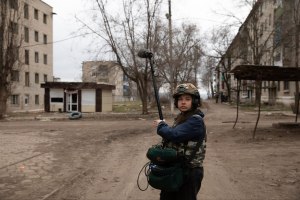
Pierre Depont | on filmset, Siversk, Donets region 2023
The war also enters gallery halls, spilling out in exhibits, staring at you from images on the walls, as, for example, in the Mala Gallery of Mystetsyi Arsenal in Kyiv at an exhibition by artist and soldier Andriy Len. What we see, here is a stone from the first year of his soldiering, here is a photo of a city where there was fighting a year ago, here is a photo of a painting on the wall of a random house that has not existed anymore, because it was destroyed and burnt to the ground, and in the corner of the gallery there is actually a pile of soil. In case questions about what exactly we need to defend. Of course, we have differences in values with the russians. But they are not trying to change our minds. They are trying to destroy us. They are occupying our land. I keep thinking about that land in Donetsk Oblast as an exhibit. I think about the wide steppe and black soil where people fight, die, and dig shelters.
I don’t know how to make the war experience meaningful. War is violence, blood and suffering. The russians spare no one and nothing in their path. This is all being captured by artists, reporters, governments and alliances. I think the most significant and meaningful thing was a decision of millions of Ukrainians not to convey the experience of war, not to let it spread, but to go and stop the army of russians, who, for 2,000 euros per month, are ready to take up arms and destroy another country. For every advanced kilometre, they are paid an additional 500 euros. If some of them reaches Przemysl (a town in Poland on the border with Ukraine), he will earn €600,000 and will be able to buy property, say, a two-room flat in Berlin. By the way, I got this information from the Kremlin’s official website Gosuslugi.ru by simply typing “контракт армия рф” which means “contract of the armed forces of the russian federation” into Google. Probably no one has yet been able to explain in any meaningful way what kind of war the russians are waging, since in Germany you can easily sign up online for their occupation army.

photo Sofia Gera | on filmset, Rome
Do you find the inclusion of “war sounds” like air raid sirens in tracks of electronic music producers triggering?
Yes, of course. But some types of transportation that sound like Shaheeds are also triggers. Sometimes closing doors or when something falls scares me. I still don’t understand what it is, but in Berlin there are sounds similar to gunshots or even explosions. Once while sitting at home I even checked the local news because I was sure that it was the sound of weapons.
I think everyone understands that air raid sirens are a trigger. The question may be what exactly the author is trying to achieve by using them.
You performed 1097 minutes of silence together with Dmytro Goncharenko at the Serpen Gallery to mark the anniversary of the full-scale invasion. Could you describe that experience and what role would you say silence has now acquired for you?
Thoughts about the need for ritualised mourning and quick work arose in me long before this action, or performance, took place in Serpen Gallery. Moving from Kyiv to Berlin, like any other refugee or migrant, you face an ocean of tasks and challenges, even at the most basic level.
Life there and here is very different, and I found it difficult to cope with these changes. I missed Ukraine and immersed myself in the news, gathering information from the front line and the rear.
Hundreds of people die every day. Every day, hundreds of tragedies occur that would not have happened if the russians had not started this war, if they had just stayed at home.
I wanted to mourn every such tragedy, every violent death. But there is so much to report that it seems that if you start, there will be no end to it. So, you hold on and don’t give in. But this is also against human nature. We are capable of compassion and empathy.
I thought about the Ukrainian national minute of silence since the start of the full-scale invasion and came to the conclusion that this collective ritualisation of grief provides psychological relief. It is impossible to deny reality, but there is something that helps to cope with it.
I am very grateful to the Serpen Gallery and Natalka Yakymovych for their support.

photo Zoriana Yevych | Berlin 2024
Which book / film / album / song / traditional dish / podcast / blog / artwork / building / meme best captures Ukraine for you?
Ukraine is large and diverse. It seems to me that art is also different everywhere. Therefore, I suggest approaching the question fundamentally 😊
If there is an option for a podcast and blog that should cover Ukraine, then I can name a really interesting course from the History Department at Yale University: Making Modern Ukraine by Timothy Snyder. They are available on the YaleCourses channel.
SEPTEMBER 10, 2025 – CANADA
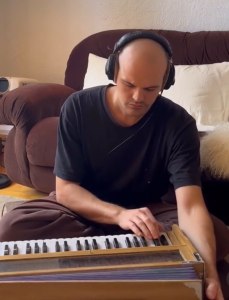
Playing Harmonium
My name is Kostia I am a Ukrainian artist and a parent. I am from Odesa, Ukraine and for the past 11 years, I have been living in Canada. My music revolves around field recordings, improvised and experimental sound. Nature, dreams and memories inspire me the most.
Among my latest works – cold wave album Odesa Melancholia, VR collaboration with Alfred Muszynski “Planet of Sorrow” and binaural field recording that I made for a virtual residency at the University of Music and Performing Arts in Graz. I also create soundtracks for short films and exhibitions.
I briefly attended piano and saxophone classes as a kid, but I wasn’t passionate about music until I turned 16 and heard Stan Getz on the Getz/Gilberto record. Since then, I have been obsessed with different instruments; I have quite a big collection of them now. My favourite one is the saxophone and that’s what I mainly use along with synthesizers. Lately, I find myself drawn towards playing harmonium, piano and accordion. It’s so easy to create beautiful harmonics with these instruments.
You moved to Montreal 11 years ago. What was your experience of the full-scale invasion and has it had an impact on the way you think about sound and music and has it changed your playlist in any way?
My Canadian journey started 11 years ago when I moved to Toronto for school and for the last three years I’ve been living in Montreal. My wife and I moved to Montreal just before the full-scale invasion. In November 2021, I went to Ukraine to visit family and to stay in Kyiv for a couple of weeks. I came back to Canada, and we decided to try living 50/50 in Montreal and in Kyiv.
I remember very well that I was sitting in the kitchen of our Airbnb in Montreal, scrolling through the news at the moment when Putin declared full-scale war. I immediately called my mom in Odesa and she told me she heard missile explosions. The next day we joined others for a protest in front of the russian embassy. We felt like the world was collapsing. The Catholic church Paroisse Catholique Ukrainienne St. Michel in Montreal was gathering humanitarian aid for Ukraine. That’s where we spent most of the time during the first weeks of the war. People were bringing all kinds of food, medical supplies, diapers, flashlights, etc There was a lot of stuff to sort and to pack, all of these things were then shipped to Ukraine. We met a lot of amazing people there from different backgrounds. We’re friends with some of them to this day.
I think volunteering during the first months of the invasion helped me to cope with the situation, and not only me – it was very therapeutic for other volunteers. The first months of full-scale war brought people together; it was very powerful. We were going to the protests every day, volunteering, communicating online, to let the world know what was happening. It felt like during the first months of war people were united like never before.
From the VA compilation ДІМ / HOME
You took part in the VA compilation ДІМ / HOME for Klikerklub with the track “Stara Istoriya.” How did you approach the concept and has the full-scale invasion influenced the way you think about home?
I am happy to be a part of this compilation among so many talented Ukrainian artists. All the proceeds will go to Superhumans Center in Lviv/ UA, an All-Ukrainian center of war trauma. A few months ago, Heiko approached me asking if I had a track I would like to contribute to this compilation. I’ve been working on a track at that time, which was almost finished, Stara Istoriya, which means “Old Story”.
The initial track I made 11 years ago in Cubase, I was just learning the ropes in the world of digital workstations such as Cubase and Ableton and music production in general. Before that, I’ve never tried to record music and make it into a track. It was pure improvisation and living in the moment before:) The sound quality of this track was poor and the lyrics were in russian, I used only a midi keyboard and a cheap mic. It was lost forever with my old laptop breaking down. It would be interesting to come back and listen to it now, to listen to songs that I made at that time. I think it would be funny.
A few years ago, I created a bass line in Ableton and thought to myself, “It would be interesting to use those song lyrics from many years ago”, so I did. However, this time the lyrics were in Ukrainian. Lately, I’ve been experimenting with drums a lot so I decided to make the track “Stara istoriya” sound as minimal as I could with additional samples from the Adriatic sea that I recorded in Italy in 2018 and a sinister synth line.

Odesa Melancholia tape
What can you tell us about the production process for Odesa Melancholia and in particular about the lyrics and the instrumentation with the saxophone playing a large role?
I produced Odesa Melancholia in Montreal in 2022 in World Creation Studio. It is a non-profit organization that aims to strengthen creative communities in Montreal.
It took me a year to make all the sounds for that album and tweak them until I liked them.
Saxophone has always been my main instrument. This is the instrument I play first whenever I come back from a long trip. I’ve always had trouble incorporating saxophone into electronic music. So for Odesa Melancholia I wanted to overcome this challenge. I am very much inspired by the music of New German Wave (Neue Deutsche Welle), such as Grauzone and Joachim Witt. I think it has an interesting DIY vibe to it when the sound, rhythm or vocals are not perfect but that’s the beauty of it. The energy is there thanks to these imperfections. This was the strategy that I applied when I was working on Odesa Melancholia, and I think it worked. Basically, I tried not to care, not to worry about how imperfect everything sounded. The saxophone blends into electronic sounds naturally this way. This album is also my debut as a singer.
It was really easy to come up with lyrics – very often I would just describe a dream I had or think of some nostalgic memory I had about home, the Black Sea, Odesa, people who live there. The album is dedicated to all the wonderful artists that I met there and places that hold a special place in my memory of this city.
Like I said, it took me one year to create an album, one year to polish it and get it properly mixed and mastered. For the cover, I chose a photo of my room in Odesa in 2007, back when I was living with my parents. When I took that photo, I was trying to capture the beautiful sunset but accidentally captured the interior of my room.
Three years from the initial idea until the release of Odesa Melancholia! It was my first experience of a physical self-release. It turned out to be more work than I expected.

Performing on stage in Odesa
What is your memory of the Odesa underground scene in the early 00s, was it a tight-knit community and what were the most popular music genres?
It was literally underground! Most of the clubs where you could hear good music were some kind of basements. Shkaf, Exit, Iskra – these are some of the good spots where you could hear good experimental sound and meet all kinds of creative people. These were good places to do networking, drink beer, smoke cigarettes (there was so much smoke that it hurt your eyes). Many cool musicians moved from Odesa to Kyiv, some people never left.
Music projects were very DIY, there was no budget or a very small budget. The biggest pay I got for my music was probably 200 hryvna (around 40 dollars at that time) in 2008 for playing a percussive instrument while DJ was playing minimal techno.
One of my buddies rented a two-story garage that used to be a photo studio not far from the railroad station. It was really old and there were rats in the washroom the size of a kitten, but it was a spot for random jam sessions that attracted musicians of all levels and also a crowd of listeners. At that time, I was around 16-17 and heard that CD with Stan Getz and started playing saxophone myself. I wasn’t any good but I would still go to a jam session at this garage and make random noise, trying to play along with more experienced musicians. The concert was like a conversation where we gave each other space to play solos or play together. If you couldn’t keep up with the others or were making a mess of your solo, other musician would pick up and cover up your fuck ups with their own music. It was a lot of fun. I cherish memories from that time.

Humanitarian packages ready to be shipped to Ukraine
Are there any works by Ukrainian artists that you feel have captured and conveyed the full-scale invasion and the war experience in a meaningful way for you?
Of course! So many, I will name just a few.
Works by David Chichkan, an artist and anarchist who was killed in action in August this year. Projects by Zhanna Kadyrova “Palianytsia” about internally displaced people and “Russian Rocket“; paintings by Katerina Lysovenko and Sana Shahmuradova-Tanska.
In documentary – Babylon 13
In music – I recommend reading Blackout Tape: Documenting Post-2022 Ukrainian Scenes by Olena Pohonchenkova. Olena writes a lot about new releases in Ukrainian music scene, I like her compilations a lot and really recommend her blog.
What does being Ukrainian mean for you?
That’s where I was born, that’s who I am. I carry Ukraine with me wherever I go. I think that the strength that everyone of us possesses is in the people who surround us, our friends and family.
Are you in touch with the Ukrainian diaspora in Canada and what are the most common misconceptions about Ukraine you have been faced with?
Yes, I am in touch with many Ukrainians here. The diaspora is amazing. When russia invaded Ukraine, we had to learn how to organize events and how to stand by each other’s side in the most difficult times. I consider many of my friends from diaspora and other Canadian communities my family because they truly are. I would like to mention 2 cool projects organized by diaspora members: Fundraising exhibition Moya Ridna and artist collective Cv1tlo.
The most common misconception about Ukraine is that the russo-Ukrainian war is a proxy war between the US and russia or that russia didn’t have a choice but to start this war because the West was tightening the ring around it. These talks very often also come from people whom I respected and considered to be reasonable, such as Brian Eno and Noam Chomsky. What they ask for is to disarm the victim and come to terms with an oppressor who is still committing genocide. They themselves, in my opinion, are looking at the world through a lens of Western imperialists, denying Ukrainians agency in the russo-Ukrainian war and whitewashing Putin’s goals, saying that we should “hear both sides”.
I suggest listening to Ukrainian voices on the russo-Ukrainian war.
Solidarity Collective, Hanna Perekhoda, Svitlana Matviyenko and, of course, a long-time ally who is aware of the Ukrainian context Slavoj Zhizhek are the ones I like to read.
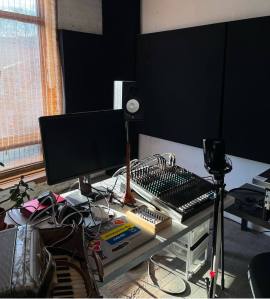
This is where I recorded Odesa Melancholia
Which book / film / album / song / traditional dish / podcast / blog / artwork / building / meme best captures Ukraine for you?
It’s impossible to answer this question because there are so many! I will mention a few of my favourite all-timers and some of the most recent artworks.
- Movie: Tragicomedy Second Class Citizens by Kira Muratova. It reminds me of Odesa like all movies by Kira Muratova.
- Book: Grey Bees by Andrey Kurkov and Драбина (Ladder) by Yevhenia Kuznetsova. Some of the most recent books by Ukrainian authors that I’ve read.
- Song: Twiggy Pop – “Painkiller“. It’s a song by Masha Navrotskaya, a vocalist of this underground dream-pop band from Odesa Twiggy Pop. She was a very talented and charismatic person and had a big future ahead of her but tragically Masha died very young. I went to couple of her concerts and hearing this song always carries me to those times, bitter-sweet feeling.
- Dish: Plachinda (the way it’s cooked in Odesa region, in Petrivka village where I was born)
- Album: Kuzma Skryabin – Mova Ryb. Just a cool cold-wave album from the 90s.
SEPTEMBER 10, 2025 – KYIV
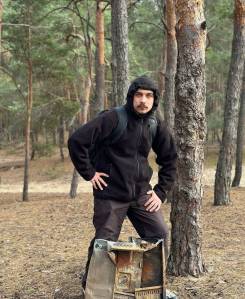 Oleksandr Karško – Sasha Very
Hi. I was born in Luhansk in the 90s. My dad was a civil servant with a background in education, and my mom was a teacher.
I grew up on rock from my dad, new age and pop from my mom, and rap from the older kids next door. For a while, I felt like I experienced music more deeply than everyone else, but as I got older and my surroundings changed, that feeling faded.
In my adolescence, I was heavily influenced by the Luhansk fusion crowd at a rehearsal base called “Downed Helicopter,” set up in a garage complex on the outskirts of town. That place brought together people playing punk, post-rock, trip-hop, shoegaze, and all kinds of stuff. It was there that I really evolved, both on the guitar and in my approach to music. I still feel that influence today. A milestone for me was the release of the fusion project Snayhatt Trio, where I played guitar, produced, and also sang.
At the same time, I was getting into electronic music in a broad sense. I’ve always been drawn to the unknown side of music, and through the people around me, different kinds of music just kept finding me — and I was fascinated by all of it.
I also have a long-running side project with my close friend Andrii — apipad.live, a website where you can mash up content from different services. Back in 2017, it felt like creating content itself wasn’t that exciting anymore because there was already too much of it — more interesting was building tools to work with it (so you could make new content, haha). It’s our little pet project, and I still hope to come back to it.
Did you leave Luhansk because of the war?
Yeah, I left Luhanks in 2014 summer due to occupation.
Has the full-scale invasion changed the way you think about music and sound in general and has it changed your setup and your playlist?
During the first weeks of the invasion, I couldn’t listen to music at all — it made me feel repulsed for some reason. Those were tough times, when everything became sharper, including my perception of electronic and club music — it felt too entertaining, too light, while I was dealing with grief and pain.
Slowly, that began to shift. The first thing I started listening to again was guitar music, because it felt alive — like a triumph of life against the backdrop of death. So my playlist became more guitarish.
Later, in the winter of 2022, during the blackouts, I felt the urge to play again.

by @hntkv Yuliia Hnatkova
What can you tell us about the production process for your album Recents and what can you tell us about the track titles that directly reference the war like “Fallout Shelter Advertisement Theme” and “After the battle for the terrikons theme”?
I played in every free moment and recorded everything I played. I had some older compositions that I finally finished (the first parts of “Im Rocker” and “Easteppe” I actually wrote back in 2013). The track titles came to me through associations and imagination. For “After the battle for the terrikons theme” I instantly pictured a battle scene, but in a kind of multiverse — where knights in armor, drones, spears, and terrikons all exist at the same time. The terrikons were massive, as if left behind after mining something rare and precious long ago, so they looked like mountains — toxic mountains.
How did Recents, an album of acoustic guitar, end up on Pep Gaffe a label specialised in electronic and experimental music?
That’s very simple — we’re friends. They were the ones who suggested recording and releasing it. I’m really grateful to them for that. We had talked about how Pep is basically about urban music, it just happened to be electronic before.
 Also, what can you tell us about the production process for the ep .als in terms of setup and constraints you were work with and how did John Object end up doing the artwork for it?
It was a very open and experimental process — I was trying things for the first time and recording with whatever I had at hand, mostly a sampler and an Alesis Micron synth.
The cover has a really sweet backstory: Tymur [aka John Object] and I were coming back from a volunteer cleanup in Holosiiv park (we were collecting recyclables), and I wanted to show him something for the cover art. We went into the elevator of a nearby building and I showed him how the panel under the light was cracking in this pattern — the same one you see on the cover. Tymur photographed it, wove in the “.als,” and that became the artwork.
Moreover, without Tymur, this release wouldn’t have happened as it is — he was the one who introduced me to the label runner.
When aswering the question “what is the sound of Kyiv #rightnow?” for cxemcast back in 2018, you stated, “#rightnow we mostly have imitation, I guess. I can’t see any Bristol or Chicago here, neither right now nor in the near future (partly joking). But that doesn’t mean that we don’t have sincere musicians here.” What would your answer be today?
I’ve thought about that word “imitation” (nothing’s really original, blah blah). Personally, the sound of Kyiv has become more concert-like, more intimate, and less dance-oriented for me. I like the formats of Miasma of the Real, Noiz Shchoseredy, 20ft Radio, Seredmistia (RIP Yana, we miss you). I basically listed almost everything that’s around, but I still like it, haha. There have been some exciting performances.
 How instrumental would you say Cxema has been in developing the post-Euromaidan electronic music ecosystem in Kyiv and Ukraine?
I’d say successful and notably instrumental.
Under present circumstances and after almost four years since the full-scale invasion is it inevitable for musicians and artists to reference the war in their artistic practice?
I don’t know, but it feels like yes, one way or another — either by processing /interpreting war or as a way to keep some distance from it. I think everyone who deals with the war artistically does it in their own way: some use field recordings of explosions, street sounds, imitations of soundscapes to capture the atmosphere of wartime; others, like me, make music into a safe space, opening up something triggered by the war but not symbolically referenced to it.
For me, it was about relief. Music became a way to distance myself to a safe place — my own little island where the war isn’t present in the feelings, but I still am, living in Ukraine.

Are there any works by Ukrainian artists that you feel have captured and conveyed the war experience in a meaningful way for you?
I like some of John Object’s obscure tracks that he recorded with a piano — and the backstory is that it was a broken piano somewhere in a house near the frontline. It felt almost visceral. I also remembered another release with a “lazy piano”: Son of Oleh – Elegia in Two, but that one is more about the collective experience of the rear, I think.
I also like a live performance by Mokri Dereva. Rumor has it that Yurii creates his music while actually being on the frontline. I don’t know if that’s more about “processing” or about “distancing,” but it’s just life-affirming.
Aside from martial law making all live music events daytime events, how would you say going to a concert or a dj set changed for you since the full-scale invasion?
Honestly, not much. I mainly go to see my friends play or when they organize something. It’s a bit of a conservative approach, but I’m not really interested otherwise — I prefer enjoying interesting local music while being around my people.
 What does being Ukrainian mean for you?
That’s a tricky question, even if we narrow it down to “for me.” It’s both childishness and heroism, devotion and foolishness, love and hate. Maybe being Ukrainian means being and acting in a state of constant turbulence, a local uncertainty multiplied by global uncertainty.
I don’t want to describe some “ideal Ukrainian,” because that probably overlaps with what I think of as an “ideal human,” but I do wish we valued our own more. Being Ukrainian now means learning — or re-learning — to appreciate and support what’s ours. I think we’ve all felt what it’s like when that gets taken away.
Which book / film / album / song / traditional dish / podcast / blog / artwork / building / meme best captures Ukraine for you?
Probably a video I shot of a TV channel called “Ukraine in HD quality” — except instead of an image, it was just the color test bars. We all have to make an effort to see the image finally.
SEPTEMBER 11, 2025 – LVIV
photo by Yana Byk
Hello, my name is Darko Lisen, or Lstn, if you need a DJ nickname. I’ve been a bedroom DJ since 2010, a DJ/promoter since 2012, and a music journalist (now part of mighty Trommel) since 2011.
Has the full-scale invasion changed the way you think about music and sound in general and did it change your playlist in any way?
Not much. Just all ruzzians and their supporters were cut (not that there were a lot of them, but still, it’s impossible to listen to them now). Ah, stop. the sirens, hehe. Almost all tracks with the sirens were cut. It’s very triggering, so screw them. And something like 2 Bad Mice – “Bomb Scare” (literally jumped up after hearing it for the first time in 2022, while searching for the origin of that rave sample inside).
If you don’t mind, I would like to start by taking a bit of a “historical look” at the Ukrainian electronic music scene. You are from Lviv. How active was the nightlife in your hometown before Euromaidan? What parties or bands would you single out and what played at those events? And did the Revolution of Dignity bring about a significant change in the music scene in Lviv and Ukraine?
We had a lot of history, actually. The first parties were in the 90s, and there were “the proper ones” (as close as you could be close to “proper” then), with DJs playing some fresh stuff and even using cassettes to DJ (sic!). Then we had the era of the 00s, which, as the 00s themselves, ended in 2009, I think, with the economic crisis and the ban on cigarette commercials. And then we came in 2012, hehe. The music was different, there was “rave” in the beginning, then techno, house, electro-house, minimal in the late 00s, breaks… The DNB scene was (and still is) HUGE. I can’t say that the revolution brought something to the scene; the development was a natural process altogether – the Revolution and all other cultural processes went hand in hand.
First there was Cxema and then came Closer. Would you say these were the game changers for the Ukrainian electronic music scene post-2014 and how would you describe their winning formula?
Defo! Closer as a club, and Cxema as a series of events. It was even game-changing for Lviv, as it was the first city to host the Cxema Backstage sub-series (which we organized), where in the crowd we met the future Hypnohouse crew for the first time. The winning formula is to believe in what you’re doing and have a good team by your side. And a taste. I think.
Was the cliché of Kyiv as the new Berlin just annoying or did it have some marketing value?
It was funny. Especially when foreign journalists started to come and write about the dancing in the middle of the war in 2016. Damn, if that was dancing in the middle of the war, what do we have since 2022? It was clear that most of them didn’t understand anything here, but that gave the scene a huge exposure, which started to work a bit later.
Let’s talk about Zavtra now, the party you co-funded. As I understand there was some dubstep but not a lot of electro at the time. If Zavtra played the “music you will want to listen to,” what genres or artists did it introduce to the audience in Lviv?
Nono, defo not dubstep. Our first parties were, let’s say, bass-oriented. There were 2012, the last days of decent bass music, before trap came and ruined it. So we moved into another side we loved – house/techno and became a bit more vinyl-oriented. Grew up. What we introduced – almost any genre of bass (you name it, and, probably, you won’t miss). And if you look at our parties, 90% of the people we brought were in Lviv for the first time (and they were booked again by others later). Later, when we started to book international names, it changed to “in Ukraine for the first time”. This still stands in 2025; we are still trying to lead and push. I’m not considering the year “good” if I didn’t bring anyone new to my city.
The pandemic and then the full-scale invasion brought about the demise of clubs like Port in Odesa. With the full-scale invasion, many festivals were initially cancelled only to be resumed in 2023 or 2024. How do you see the clubbing scene developing under present circumstances and what are the biggest obstacles it faces (like insurance costs, lack of international names, a certain insularity maybe?)
It’s not developing, it’s surviving. So far, successfully, but who knows what will be next. Electronic music is not important at all when your country is on the edge of existence, and all the best people are either in the army or on the edge of joining those first.
Has holding a party or even attending a party or a festival acquired a new significance for you since the full-scale invasion and have you noticed a different kind of energy or maybe even different demographics within the audience?
At the beginning, in 2022, when the first parties held and you could see the people you hadn’t seen in months – that was powerful. The energy, since the parties are daytime-only, is far from usual; it’s obvious. No matter how nice the picture is, it’s a million light-years far from 2021 (and we thought that 2021 was a hard year).
How would you say martial law with its curfew has affected the electronic music scene in Ukraine and has playing at daytime events changed significantly the vibe and the way deejays approach their sets?
Let’s take the timings. You could stretch the line-up for the whole night (or even more), and it was almost equally interesting. Now everybody understands that the final evening hours are the best, and you can’t do anything with that.
Due to the full-scale invasion and the difficulty in getting international acts to play in Ukraine, many local new names have been able to play at festivals like Brave! Factory Fest. What would you say are the pros and cons of this situation?
Me, at least, ahahahah. Joking (partly), but obviously, when a huge part of the scene flew to Europe (or didn’t come back from Europe), or went to the war, there was a lot of space that should be filled with other people. The scene changed. I don’t know if it’s better now, but it’s definitely different.

photo by Pavlo Fedoriv
What can you tell us about your new ventures Dzvin and Zorepad?
Dzvin is a moderately new party series, founded with my friend Nani in 2017, when we talked with her in her kitchen at some pre-party, saying that we still can’t hear all the names we want in the city. So we need to bring them by ourselves (as always). Since 2017, we have had Noizar, Borys, Anna Haleta, Timur Basha, iO (Mulen), Robert Drewek, Francesco del Garda, Nemo Vachez, Antoine Sy, and Alexander Skancke as our lovely guests. The biggest names in the city, and I don’t think that anybody will overcome those in the near future.
Zorepad is not “mine”, it was organized by Night Ambassadors. I was the resident in that organization and was responsible for the first two line-ups and timings (huge, yes, but just that). Since it was organized in a hurry and at the last moment twice, I guess, I can organize anything after that (call me if you need, hehe). At the third edition, we did just a usual b2b with Ocean T (that was met with some crazy warmth from the people, must say, I didn’t have THAT many people coming to say “thank you” since the gigs at Closer). Since there are usually a lot of organizational problems with the event, I can’t tell you if it will be held next year and if we’ll be a part of it.
The success of a party series like Noize Every Wednesday indicates an appetite for more adventurous styles of music. Is this something you share and, if so, what would you say have been the most surprising developments within the electronic and experimental music scene in Ukraine?
Not my type of music, but I think it always was something near. I can remember all that noise/experimental stuff available since I was a kid. Obviously, it’s not in the spotlight, but it stands still. Can’t say that I’m surprised, but THAT existence of the DNB scene in Lviv is something you need to pay attention to.
Which book / film / album / song / traditional dish / podcast / blog / artwork / building / meme best captures Ukraine for you?
Damn, can’t say “captures” for all those answers, but if we need
- Book – Amadoka (Sofia Andrukhovych).
- Film – Earth (Dovzhenko).
- Album – Ptahy (Skryabin).
- Song – “Kokhanyy” (Lina Prokhorova).
- Dish – obviously, borscht with all its variations.
- Podcast, let’s say “Dovha Viyna” by Grunt Media.
- Blog – We had a nice Amnesia project, but it’s now closed.
- Artwork – anything from “Silence” series by Anatoly Kryvolap.
- Building – could be the Motherland Monument in Kyiv or any modernist building in the loveliest areas of Lviv.
- Meme – definitely a translation of “It ain’t much but it’s honest work”.
SEPTEMBER 11, 2025 – KYIV

photo by @sashakurmaz
I started music at a music school at the age of seven, learning violin and piano, but lost interest sometime in my teenage years when I first heard The Chemical Brothers’ debut album, which sparked my passion for electronic music.
You started Cxema as a response to the dearth of nightlife following the Revolution of Dignity back in 2014. Could you describe the electronic and experimental music scene at the time in terms of music and venues and what kind of reach would you say it had on the international stage?
Ukraine or Kyiv were rarely mentioned in the global context of the electronic scene. Some artists like Stanislav Tolkachev, Kotra, Zavoloka, Andriy Kiritchenko, and the Muscut label were known. However, the festivals and venues of that time were not recognized internationally.
Is it fair to say that you pioneered the use of abandoned spaces in Ukraine for your party series and what were the main challenges you faced in setting up those early events?
Before Cxema, I had experience organizing small parties in abandoned and unconventional locations, thanks to my collaboration with DJ Borys and our friend Vladislav Sharapa. We’ve been doing this since 2009, and I could say we were the first to do so.
 I’d now like to ask you a couple of questions you have asked others for the Cxemcasts series, if I may. Could it happen that you would be tired of all of this? There is a lot of people who are breaking up and starting to do ordinary commerce; how long will you last?
That’s a very good question, especially in the context of the difficult conditions of war. I was never concerned about becoming commercial. Personally, the hype we managed to create around Cxema was enough for me. But now, under the current circumstances, only very mainstream events are successful, and moving in that direction is impossible for me. Already now, it can be said that our activity is almost suspended compared to the years before the pandemic. And it may stop completely, with me focusing on another project instead.
Don’t you think that the era of music as art has ended a long time ago? Everything has been already studied and used and there are no options to experiment. What’s next?
I don’t think the era of music as an art form is over. We will all need music in the future, and we will continue to discover new and interesting things. But there are serious concerns about DJ culture and club culture as a whole. Unfortunately, there are fewer cultural values in it, and more pure entertainment.
Consumer habits of the new generation are also changing, and they are not really compatible with this culture. So perhaps this field needs to go through a certain crisis — which has already been ongoing since the pandemic — in order to regain its value in the future.
How do you see the clubbing scene in Ukraine developing under present circumstances with many deejays and producers moving abroad?
Yes, many artists have left, and many of the male artists who remain have been drafted or may be drafted into military service. There is also a deep exhaustion in society overall, which affects motivation, inspiration, and the ability to create. But the scene continues to develop despite the circumstances, and many events are still happening in Kyiv. One of the most interesting things over the past year is the series of events Нойз Щосереди (@noizshchoseredy), where noise and experimental artists perform every Wednesday at the club Otel’.
What can you say about Ukraine’s place on the global scene since the full-scale invasion?
It’s hard to say what it will look like after the war ends. Of course, there will be a period of euphoria, with people returning from abroad and a large number of foreigners coming. But surveys show that a significant part of the youth will leave the country once borders open after the war. And our society will need some time to recover from this tragedy in order to be able to present itself to the world not just as victims of this war.

photo by @demi.cadre
Back in 2015 you also asked Bodya Konakov during his interview for Cxemcasts if there was a need for a local media to which he replied, “Of course (…) we have nothing.” How would you say the media landscape has developed since, and has it developed enough to adequately inform the international press, counter Russian misinformation and sustain interest in the cultural scene in Ukraine?
If I’m not forgetting anything, only one independent media outlet appeared that specialized in the electronic scene — Tight Magazine, which existed from 2018 to 2021. Creating such media in Ukraine is a very altruistic initiative that cannot last long. Overall, the media landscape is underdeveloped, but in recent years we can note the growth of media covering culture in a broader sense.
You have been instrumental in setting in motion the careers of a number of DJs and producers, with many like Voin Oruwu, John Object, Nastya Muravyova and Bodya Konakov describing their first sets at Cxema as their launching pad. Whose career have you found the most rewarding and surprising to watch develop?
I consider John Object my favorite Ukrainian artist, so I’ve followed him more closely. From the perspective of growth and career, the example of Nastya Muravyova is impressive — she used to come to the first Cxema events. She later decided to take up DJing, started playing at our parties in Kyiv, and went on to perform abroad. Now she lives and works in Europe.
Are there any tracks that became “clubbing anthems” after being played at Cxema or are there any specific tracks that people have come to associate with Cxema over the years?
I think Cxema can be associated with the music of Stanislav Tolkachev, whose track appears in the film Dedicated to the Youth of the World II, directed by Roman Khimei and Yarema Malashchuk. This film was shot in 2018 at a party we organized at the Dovzhenko Film Studios — one of our best events.
Finally, you were born and bred in Kyiv, is the city still able to surprise you? And is the “Kyiv as the new Berlin” cliché just annoying or has it been useful in any way to promote the city’s musical scene?
I love this city not for the comfort of living here or for any aesthetic appeal, but because of the people who live here. It’s the people and their initiatives that continue to surprise and inspire me. There was a time when Kyiv started being compared to Berlin because of the development of nightlife culture, and I see nothing wrong with that — if it meant more foreigners came here and discovered the unique identity of this city.
SEPTEMBER 11, 2025 – OKHTYRKA

Photo by: George Ivanchenko
Hi! My name is Pavlo Ihnatchenko, stage name – Pavlo Poputalo (I try to keep my music and public activities connected, so that one doesn’t interfere with the other).
I was born and still live in Okhtyrka, a small town in the Sumy region of northeastern Ukraine, about 50 km from the russian border. It’s a small, rather quiet place with beautiful nature.
I’ve been into music since childhood. I’m not an academic musician, more of a musical adventurer. My first experience of making music was on a PlayStation 1 program back in 2000. Now I’m 32, and I’ve gone a long way: from Fruity Loops, where I first realized you could play a keyboard like a synthesizer, to building my own studio in my hometown — something I’ve been working on for over 10 years.
I don’t aim to write a “super hit” — I enjoy the process, the way music resonates with my community and with people close in spirit. Just like a samurai has no goal but has the path, for me art is about the process itself. A good result is just a nice bonus.
 Has the full-scale invasion changed the way you think about sound and music, and has it changed your playlist?
Yes, absolutely. The full-scale invasion has changed me: my attitude towards myself, life, and of course towards sound. Maybe I became more aggressive and “raw.” I pay less attention to post-production — it’s more important for me that people hear the energy I put into a track.
But the war also showed me something else: thanks to music, we managed to build a community. People who once came to parties just to hear tracks came together around shared values and needs. Music became the glue.
Many of my friends are now in the Armed Forces of Ukraine. Sadly, some are no longer with us. This is a great loss for us and for my hometown’s local scene. So yes, my relationship to music has changed radically — in a good way. Here’s an example: my interview from 2022 for RA, where they captured that emotional state well.
Looking back, has the experience of Euromaidan served as a blueprint for how to mobilize civil society?
For a small town like mine, Euromaidan itself wasn’t a direct “blueprint.” But the changes that came after it became a direction and a vector of movement. We were able to understand our values and potential more deeply, to hear more local artists, and to build an independent scene without russian influence. That is truly valuable.
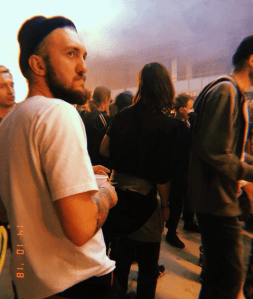 If Cxema and the Construction festival in Dnipro acted as drivers of change after the Revolution of Dignity, what were the main lessons learned from those experiences?
For me, Cxema was a strong motivator and a moment of realization. I saw the video they made with VICE and thought: “Wow, we can do this too. Why not us?”
At that time, Boiler Room was a huge inspiration — there weren’t many alternatives of that format. We watched them and dreamed of creating something similar. When Cxema held an event with Boiler Room in Kyiv, it was the first time we went as a big group to a rave. It was incredible. From then on, we clearly knew what we wanted to do.
Is Ukraine’s media ecosystem sufficient to promote and support Ukrainian talent both at home and abroad?
In my opinion, only since 2022 has the ecosystem begun to recover and be reborn. Before that, we were all under russian influence, and their propaganda and cultural expansion had enormous resources.
Now we can see progress, which inspires. But it’s not enough: financial and material resources are needed, as they give real strength for development. So at the moment, the ecosystem is still weak, but its potential is huge.

Photo by: George Ivanchenko
Gasoline Radio had to shut down due to financial difficulties. How can cultural projects ensure sustainability in such conditions?
This is a very difficult problem. We also suffer from a severe lack of resources. There were many projects like Gasoline Radio, and some of them had to close. But it’s also a kind of “natural selection” under tough conditions: someone disappears, but new ones appear.
Right now, we are step by step launching a similar project — Vibe Radio, which highlights the local scene. We had long dreamed of a platform that would support the independent local culture, and now we have a good start.
In the first days of the full-scale invasion, Okhtyrka was heavily shelled. Did many people leave for good, or did some return?
Yes, many people left, but some came back. Even before the war, small towns had this problem: people leaving because they couldn’t realize themselves, especially in creative professions. We always suffered from this.
The war put everything in its place. I don’t judge — everyone has their own choice. But I really miss those people, their inspiration and motivation.
When friends return from the frontline, we gather in the studio, write new tracks, try to organize small events — just to feel a taste of the old times again.
 You once said: “Communities are created not around music, but around a common idea.” Could you elaborate, using Okhtyrka as an example?
Sure. We were united by a common problem and the idea of creating an alternative space. We had no underground place where we could listen to the music we loved instead of pop, and gather without judgment or aggression.
So we created VibeRoom — a small space on the grounds of a former factory. The idea became the backbone: it united people, values, goals, the community itself. Thanks to this, we are still together, developing culture in Okhtyrka, not looking for the easy path. We want to make the city a place of modern independent culture.

Photo by: George Ivanchenko
Is Okhtyrka the new Bristol?
Yes, this idea appeared even before the full-scale invasion. Our friend Ihor Zadorozhniy, a DJ and former serviceman, once said at a party: “Okhtyrka is the new Bristol.”
I researched it and realized it made sense: the town has a lot of graffiti and murals for its size. And people at parties go crazy for broken British sounds: jungle, drum’n’bass, grime, breakbeat. This comes from the local disco in the 90s, where they played music brought on tapes from Europe.
As a kid, I once saw a VHS recording from that disco with The Prodigy – No Good. It left a huge impression on me and stayed with me for life. Okhtyrka is now creating a new wave of peripheral avant-garde.
There’s also a story about a youth center in Bristol where Banksy as a phenomenon was born, working with young people through graffiti.
I’m proud that over nearly 10 years, we managed to create our own space where kids practice graffiti, skateboarding, DJing — a place where a new generation grows.
How did the recent collaboration with Wellboy on “Міняй УЄ” come about?
Anton and I have known each other for a long time. At the very beginning of his career, he recorded “Husi” in our studio. “Міняй УЄ” was born spontaneously: we were supposed to record a different track, but during a break he heard one of my demos with a deep bass and started humming. I immediately turned on the mic, and we captured the emotion right there in the moment.
It became another confirmation of the power of local culture: we’re from Okhtyrka, yet we create music that resonates with the UK sound. The track came out emotional and self-ironic — a true manifesto of Ukraine’s “Bristol.”

Photo by: George Ivanchenko
Which music genres resonate with you most right now?
I’m very much into the British sound of the 90s — you can hear it in my music. But I’ve also discovered Ukrainian funk from the 70s, which fascinates me.
Recently I’ve been listening to a mix of jazz soundtracks from the cartoon “Hey, Arnold!”, songs by Ukrainian composer Volodymyr Ivasiuk and funk of that era, plus UK acid house and breakbeat from the 90s — Baby D, SL2, 808 State.
What does being Ukrainian mean to you?
For me, it means loving the land where you live. Loving it sincerely, knowing both its strengths and flaws. And despite everything — pursuing your dream.
Which book / film / album / song / traditional dish / podcast / blog / artwork / building / meme best captures Ukraine for you?
- Film — these days it’s hard for me to watch films, I struggle to focus.
- Book — The Garden of Gethsemane by Ivan Bahrianyi. A difficult, tragic story about repression, which hits even harder when you recognize the places described.
- Dish — borscht cooked by my wife. With salo and black bread — absolutely delicious.
- Podcast — Komik + Istorik. Two guys from Sumy — one comedian, one historian — telling history with humor and in simple words. I love listening to them on the road.
- Building — the historic 1896 steam mill building where we set up the Krytka skatepark. It survived three wars, and now kids skateboard inside.
- Meme — former president Kuchma saying: “This has already happened.”
SEPTEMBER 12, 2025 – KREMENCHUK

photo by Mariia Kukyk
My name is Maria, I grew up in Kremenchuk, an industrial city in central Ukraine. I studied russian and World literature in Kyiv for a few years, but dropped out of uni when the war started in 2014. I dropped out mostly for personal reasons but the war did influence my decision. I could already see the possible future, or rather “no future” (at least for myself in the russian studies). I returned back to Kremenchuk and I live there currently.
My first interaction with music began with my mother’s lullabies and brief music lessons in the kindergarten. In Ukraine, all state kindergartens have a piano or an accordion and a music teacher who hosts seasonal celebrations and teaches kids to sing and dance at those. I don’t know how old I was, maybe three or four, but I remember the music teacher slowly pressing the low-pitched keys on the piano saying that it was a bear walking in the forest and then pressing the high-pitched keys fast — that was a hare hopping, possibly running away from the bear.
My family also had a piano (they got it in the neighbourhood by exchanging their old tv for the piano!) and I would do the same at home. I’d imagine a forest and all the different animals making different sounds. I especially loved causing havoc in the forest by pressing all the keys at once with my both arms while and holding the pedal with my foot at the same time. My older sibling went to the children’s music school to learning piano and violin, so when I turned five years old, I begged my parents to let me play the violin. Five-year-olds were too young for the school, but the violin teacher tested my ear and agreed to enrol me at the school. I’d only just learnt to read at five but still couldn’t write cursive so for the solfeggio lessons my mom would copy my older classmates’ notes, writing them with print letters so I could read. I finished the children’s music school at 13 years old. I didn’t pursue music, instead I studied literature, languages and pedagogy.
Later on, as a working adult I had an unfulfilled dream to learn cello, and I tried my luck applying once again at a children’s music school. A cello teacher there helped me enrol despite me being “too old” this time, since she also tested my ear and was pleased to work with me just for the sake of teaching music to someone who’s actually musical, since children’s music schools are in decline nowadays. I’d like to mention her name — Liubov Vasenina, she’s an amazing human being. Besides basic cello skills she also taught me humanity, patience and her positive outlook on the world and people remain a great inspiration. I studied cello there for three or four years, enough to learn the basics. And that concludes my background in music.
 Has the full-scale invasion changed the way you think about music and sound in general and has it changed your setup and your playlist?
After learning cello I’ve only just started exploring creating my own music, I didn’t have any equipment besides my violin, cello, laptop and a usb microphone, my laptop was also too old for any major DAW, all it could handle was Audacity. With time I started accumulating different broken instruments and recording all that and voice with minimum editing. You may hear some of those early raw tracks (along with some of the early raw war tracks of mine) in a mixtape compiled by Revshark for the SONIC TRAVELS series on Gasoline radio.
Even though I originally had a limited setup, the full-scale invasion robbed me of even that. In the first weeks of the full-scale invasion, I took my younger sister and fled the country, the two of us sought temporary protection in Denmark. We escaped those nightmarish first weeks with just our backpacks. I have friends in Denmark, and they helped us with housing for the first few months and gave both me and my sister used laptops, which we only used for job searching and filing documentation to enter the Danish system. Those months were a nightmare, my body was far away but my mind was in Ukraine, every waking moment was filled with fear and anxiety for my loved ones and all Ukrainians who remained in Ukraine, I felt it my responsibility to help my younger sister settle in a safe environment, but at the same time I despised myself for leaving Ukraine. I couldn’t enjoy any entertainment or culture, I couldn’t read, watch films or listen to music. And of course, being a refugee in a different country is not a great experience either, it’s not “immigration”, and I wouldn’t call it much of a “choice”.

Oak tree next to my country house, a screenshot from a lost video archive, Kremenchuk, 2019
After the first month of mental horror I finally found something that pretty much saved me — an initiative called “Ukraines Venner” (eng: Friends of Ukraine) (shoutout to Alex and Ira, the founders of the initiative, who are still doing amazing work to support Ukraine!), which organized dinners for Ukrainian refugees, and later opened a cafe for refugees (Ukrainian refugees primarily but all refugees were welcome), where all drinks and snacks were free. The initiative also helped Ukrainians with documentation, and translation and created a safe space for interaction, adapting to the new reality and culture. I volunteered to help manage the cafe, helped with translating and also taught English to some of the regulars who could only speak Ukrainian, occasionally I’d also bake an apple pie for the visitors (the one I used to bake at home frequently).
I must say grassroot initiatives like that play such an important role in establishing real human connection and acceptance. That experience helped me get out of the constant horror, anxiety, fear, helplessness and I could finally do something “useful” for my people. And thanks to that eventually I started letting music into my heart again. Although I’d only listen to Ukrainian artists, read Ukrainian books, and watch Ukrainian movies. After almost half a year of silence I started singing again, voice was the only instrument I had on me. I downloaded Audacity again and with a cheap usb microphone I started recording choral pieces with just my voice. All the music I made was dissonant, fragmented, sad, slow, the lyrics would all be full of anxiety, war, losing myself, my homeland, but also hope for the “spring” to come to my land. I’d also borrow some small instruments like a harmonica, and would record just that and voice, or any instrument I came across in Denmark (a grand piano at a church for example, you may hear it in the SONIC TRAVELS series), I’d improvise and record with my phone.
I didn’t consider myself to be a musician, I was ashamed of all my attempts and wouldn’t show it to anyone, but I couldn’t restrain myself from creating, although I really did try to do that, I’d delete my SoundCloud a few times and some tracks are lost forever. Everything changed as soon as I returned to Ukraine two years ago.
I feel extremely lucky and grateful that Kremenchuk is still standing and that I still have my home, despite the russian drones flying above my roof ever so often (I set up a sleeping spot in the corridor of my apartment, the safest spot in the house away from windows).
 What can you tell us about your track “Swallow” which is included in the VA compilation ДІМ / HOME and how did the concept of home resonate with you under present circumstances?
In the VA compilation ДІМ / HOME, in the description to my song “Swallow,” I focused on the experience of war in my homeland, but the song originated from my very personal feelings — the letter that the swallow carries in the song is a letter to my loved one:
“The little swallow carries my letter
Across your sky it flies.
The field is covered with a white crumb
Carried from your skies”
That first verse introduces the listener to the longing of a loved one to be heard by their sweetheart, but the turmoil of our current reality (the war) makes everything way harder, the future is more than “uncertain”, and the way each of us deals with this tragedy may also result in coldness towards the people close to us.
“Grey haired snow will cover the distant sea with ash
No end of skyline can be seen”
However abstract these words may sound, for me personally they clearly express the anxiety and melancholy, the distance, the uncertainty. The grey snow also references the images of fallen soldiers in the trenches that I’ve seen a few times online and that haunt me in my dreams.
“The little swallow left my letter
In that field.
The white crumb covered it—
Upon your greyish field
The little swallow…”
Despite the cold, the distance and turmoil, the swallow does carry the letter, and does reach the destined field in hopes of it to be found by the loved one (the choice to pick the letter up is on them). That hopefulness is expressed by the cheerful melody, playful folky singing and the repetitiveness of the verse and the main actor being a “swallow”.
The Swallow is a migratory bird that travels large distances in order to survive, and in Ukraine swallows always return in spring, which is a hopeful sign of new beginnings and the life cycle going on. So, as I often mention in my lyrics, the “spring” will once again come to my land. That is how this song is connected to the idea of home.

Cornflower, Kremenchuk 2024
With the war, the concept of home has become very pronounced in my life, because regardless of how mobile the modern world is, how much of our lives is spent online, creating some sort of virtual “safe space”, which is, turns out, not safe at all — those early childhood experiences in a familiar physical environment, familiar smells, landscapes, rivers, lakes, forests, familiar taste of fruits and vegetables often homegrown, familiar songs, people, mentality — are irreplaceable, it is something you always return to and long for regardless of your travels and grand ambitions, financial stability in a faraway land, or whatever drives you to leave home — when there is a tragic possibility that you might lose those very deeply ingrained things forever, that is when you really start to appreciate it and long for it, and choose it (home) over safety and comfort.
And somehow oftentimes you feel safer at home in a warzone than somewhere far away, somewhere alien, somewhere where you’re “unwanted”(the feeling most immigrants have to struggle with, regardless of how well adapted they may be). Not like Ukrainians feel all that “wanted” in their own country to be very honest, given all the corruption and other struggles, but it is the land that birthed you, the soil that fed you, the people that nurtured you and it is the land where you are entitled to have a voice by law, as a citizen you have the power and responsibility to bring change, to advocate for your rights, for the protection of your native nature, which you are a part of, for preservation and blossoming of your land’s culture, for the flowing of its songs and melodies for the sharing of its stories. For me all of that constitutes Home, under present circumstances especially.

A dry flower from the Carpathian mountains that I received in the letter during my stay in Denmark, Copenhagen, 2022
Can you tell us about your work as a visual artist which seems to be deeply inspired by nature and has your sonic landscape changed in any way since the full-scale invasion?
I find peace and solace in capturing the beauty of nature both through music and visual art. I mostly draw flower sketches and watercolours of native landscapes. Since the full-scale invasion drawing was the first creative outlet, I allowed myself. I drew sunflowers as a token of gratitude to all the kindness I received from different Danish people while trying to navigate the Danish system. Drawing flowers also helped me explore Danish flora, bond with people and make accidental acquaintances with the curious passersby. I appreciate all kinds of flowers, but I find wildflowers and weeds especially beautiful for their seeming simplicity and their medicinal qualities.
The sonic landscape difference is only noticeable during the air raid sirens, drones and rockets flying, gunfire, and explosion sounds of interceptions or explosion sounds of rockets and drones hitting the targets. Other than that, it’s the same! Of course I’m partly being ironic, but at the same time in a city like Kremenchuk, far from the frontline, there’s a clear division between the “normal” time, and war time. It’s as if the mind tries to block the omnipresence of danger (as it felt acutely in the beginning of the full-scale war) and only reacts during the time of clear danger — when you can actually hear the “war sounds”, your entire being is reduced to something very fragile and small, something easily crashed. Sometimes you might briefly experience those feelings even during a simple air raid siren, that you hear multiple times a day here. That is the sonic landscape in the city.
Out in nature, in the countryside things feel far more peaceful, you might not even notice the sirens, it often merges with the sound of the wind in the trees, the birds chirping, the goats grazing, the cheerful banter of the neighbours. Everything around you is blooming with life, it embraces you and cuddles you, and you can truly relax, which really differs from your mind simply “blocking” it in the city. After horrible nights in the city filled with russian attacks, I often go to nature to recharge and it always works. The trees, the river, the wildflowers, the countryside folk, all of it is so dear to me, it gives me immense inspiration and love for the world. At the same time though sometimes, I imagine the experience our soldiers have in nature on the frontline… I can’t ever entirely distract myself from this reality, but I wouldn’t want to either way, I firmly believe it’s important to stay aware.

Sanya, Maria, Danya, after playing live at 20ft Radio for Liky Pid Nohamy label showcase in Kyiv, 2025 – (photo by Polje)
How would you describe the music scene in Kremenchuk in terms of its venues and community? Also, how did you get involved with Tongi Joi?
Well, the venues are non-existent if I have to be honest, except for maybe the palaces of culture (cultural centres founded by the Soviets), where they still host big concerts of pop artists and classical performances every once in a while, but besides that there’s no stable venues for youth and older folk to experiment and share their music. Such venues pop out during the waves of local cultural activist movements, but since there is little to no support by the community and the local government such venues have a short lifespan. Examples of good cultural spaces that allowed musicians to play something different than pop or classical music in Kremenchuk would be #Adapter (2015-2018) and Erzgamma studio (2023-2025), there were and there are other non-profits that organized cultural spaces and do important cultural work, but I mention these two because they really made a difference specifically in the local music scene’s development. Some of the co-founders of Erzgamma studio are the same people that started the O’Komova community which became active during the full-scale invasion and still hosts quality gigs inviting very diverse artists from Ukraine and abroad. The venues they manage to utilize these days vary greatly, from an open air location in the local park, to a pretty small space of a photo studio, and this summer they even managed to host a festival at a very large building — Kremenchuk City Palace of Culture (cultural centre). I say “they”, but this year I also became a part of the community and participated in organizing the festival’s exhibition of local artists and foreign artists whose art is connected to their Kremenchuk experiences. This same community is the reason I got involved with Tongi Joi.

Danya, Sanya, Maria – Tongi Joi performing live at 20ft Radio for Liky Pid Nohamy label showcase in Kyiv, 2025 – (photo by Polje)
When I returned to Kremenchuk at the end of 2023, I frequented events at Erzgamma studio, that’s also where I did my first solo performance with singer songwriter kinda stuff and an experimental improvisational set with a looper, bits of which Daniil Tkachenko (orfin), an active member at O’Komova community and a great artist himself, also used in some of his tracks in his ambient album “Uvi Sni”. Danya (as friends call him) has become a good friend of mine ever since, his personal project has influenced my creative process, both musical and visual, and likewise you may hear my influence in his music, sometimes even by simply doing the dishes in the background, which you might hear slightly in one of his improvised tracks, perhaps unreleased yet. Since I had a similar relationship to music as Danya and his friend Sanya Lyashenko, the boys invited me to join their band Tongi Joi. So far together (with my active participation specifically) we released a double sided single Hmara and a single Знову хочу бути that we did for the VA compilation Home/Дім. Currently the three of us are finishing a new album, so stay tuned, the release date will be announced very soon.
Besides Tongi Joi, orfin and myself, there are electronic music artists (Revshark, Smezkh, shklv) a garage rock band відень спить, and a young indie band Mova Tila. There are also musicians from Kremenchuk that have since moved including Stoned Jesus, Love’n’Joy, and Komisia.
I mentioned only the artists I know personally, but there might be more I’m not aware of, since Kremenchuk is a place full of hidden gems, which sometimes hide deliberately (like myself until only very recently).

Tongi Joi’s photoshoot for the album Chimera, Nyzhnia Manuiliivka, 2025 – (photo by Nazarii Lisnyi)
Are there any Ukrainian albums or artists that have been able to capture current events and convey the war experience in a meaningful way for you?
I think most of the music that comes out influenced by the war is meaningful, but it’s hard for me to tell whether it is possible to convey the war experience to anyone who doesn’t have that experience. It seems to me that for most people removed from this horrid experience such music can sound simply “heavy”, maybe uncomfortable, maybe strange, and hard to listen to.
That being said, there is an album that comes to mind that I really appreciated when I heard it first, контакт by Difference Machine, an electronic musician based in Kyiv. This album is really chilling, it is very uncomfortable to listen to, as it should be. But it is very masterfully made, and it visualizes the coldness and harshness of the war reality, whilst the folk instruments add this cultural element that isn’t easily erased even in the midst of a brutal genocide. I don’t know if I could call it music, but it’s a powerful sonic experience which I find very meaningful.

Evening primrose, Kremenchuk 2025
Do you find the inclusion of “war sounds” like air raid sirens in tracks of electronic music producers triggering?
Oh yes, very much so. There’s no helping it for anyone who experienced those sounds in wartime. To be honest, I’m not sure if I can appreciate it in music as part of musical pieces, but I do find it important as a kind of archive and for therapeutic purposes of creators reflecting on war. I personally wish to create a piece using string instruments mimicking the sound of air raid sirens, but these thoughts often stop me. I’m sick and tired of this cursed sound and the destruction that follows. For me those “war sounds” cause a range of feelings between anxiety, fear, frustration to irritation and anger.
I must admit though there are spots in the city where the sirens’ soundwaves from different sources in the city intertwine and create pretty cool sounding harmonies, like an orchestra tuning beautifully, and it comes in waves. I’m sure other musicians you talked to have mentioned it before, it’s truly a tasteful sound art if you get to experience it at a perfect spot at a perfect moment.
What does being Ukrainian mean to you?
That’s a very difficult question, the answer to which I’m still trying to figure out, and versions of which are constantly changing for me. But I’ll share some words that come to mind when I think of it — struggle, hope, soil, community, home, resilience, doubt, existential threat, fear, hope, beauty, wildflowers, dacha, fresh vegetables and fruits, love, friendship, family, humanity, struggle, sorrow, folk song, craft, winter, spring, summer and autumn, the swallows return, the sun, fields, rivers, lakes, the sea, snow, snow angel, ice over a lake, a swim in the river early in the morning, the moon shining above the Dnipro river… and I could probably go on and naming all these images and feelings that come to mind. I hope that gives you an idea of what being Ukrainian means to me.

Danya, Maria and baba Halia sharing a watermelon, Staryi Mokhnach, 2024
Which book / film / album / song / traditional dish / podcast / blog / artwork / building / meme best captures Ukraine for you?
I will start with a film — the first title that came to mind is The White Bird Marked with Black (ukr: Білий птах з чорною ознакою) directed by Yuri Ilyenko, in 1971. It’s a period drama film about a Ukrainian family of musicians in a small village torn by the neighbouring countries’ claim of the territories and the conflict of ideologies within the family. There is probably a degree of Soviet censorship influencing the film’s narrative and ideology commentary, but I think you’d get the gist of the Ukrainian struggle throughout its history. Besides that, the film is absolutely beautiful, the nature, the music, the frames, the costumes and acting are superb. I really recommend this film to anyone interested in Ukrainian culture, history and mentality.
As for Ukrainian music, it’s really hard to pick since the variety is just so large. But I will go with traditional Ukrainian folk music because it represents the Ukrainian livelihood, the struggles, the dreams, the family relationship and pretty much all spheres of life through centuries. Given all that the Ukrainian folk song tradition is also very diverse and the amount of songs, melodies and polyphonies are also large, so I’ll go with a folk song I heard last year while traveling through the villages along the Dnipro River with Daniil Tkachenko (orfin) and Ryland Bouchard filming the nature and the people. At Staryi Mokhnach village in Cherkassy oblast, our kind host and guide Victor introduced us to baba Halia, an older lady living in the village for many years. She sang a song called “Посіяла огірочки близько над водою” (eng: Sowed cucumbers close to the water Sowed cucumbers close to the water – Personal and Family Life – Text, audio ), I hummed along, and for me that interaction with the lady is what really captures Ukraine.
As for the artwork, the one that speaks to me quite a bit is the Red Sunset by Arkhyp Kuindzhi. That might be a questionable choice, since despite being born Ukrainian and spending his formative years on our land, painting Ukrainian landscape, Kuindzhi found recognition after moving to St. Petersburg and of course Ukraine being part of the russian empire at that time, russia considers him a russian painter, whilst here he’s considered Ukrainian. Given all that, when I see his paintings of the Dnipro River and the poplar trees, the moon shining over the river and the sunsets — all of those are images I grew up with here in Kremenchuk, I see this same river, this same sunset, this same moon path on the river’s surface. So, for me personally these images invoke something I only ever experienced at home. I dream of the day I could express this beauty through my art.
I’ll end this already extremely long response with the best traditional dish ever existed — borsch! I love it so much I could eat it every day in all its variety.
SEPTEMBER 12, 2025 – KYIV

My name is Oleksandr Kudryavtsev, my stage/street name is Gapon, I was born and raised in Kharkiv and spent most of my life there, but in 2018 I moved to Kyiv for romantic reasons. I don’t really consider myself an artist, since I don’t produce any art, I participate in the local scene as a DJ and as the owner of a record store (Octan).
Has the full-scale invasion changed the way you think about music and sound in general and did it change your playlist in any way?
In 2021, I went through a kind of “breakup” with music. Searching for something new became difficult, and I even stopped enjoying my favorite records. So I stopped digging and stopped buying anything. When the full-scale war began, this feeling reached its lowest point. Like many others, I felt uncomfortable with anything that could bring joy. A few months later, I slowly began returning to music. At first, I mostly listened to Pulse Demon by Merzbow, a great album for completely stopping the flow of thoughts. Later, I started adding some favorite ambient and downtempo mixes and albums back into rotation (mas amable by dj python and Stoned…Chilled…Groove by Coldcut & Strictly Kev, fav picks at that time).
I honestly don’t remember the exact moment I started DJing again, but even now I feel very mixed emotions about playing at parties.
As for my playlists, for obvious reasons, I completely removed russian music or anything with russian vocals. I wasn’t a big listener before, but I did have a few artists I loved — especially Dina Verni and Oleksandr Vertinsky. The only song with russian lyrics I still occasionally listen to is Украина, спасибо тебе! [Ukraine, thank you!] by Imam Alimsultanov.
 You have been performing both at Strichka and Brave! Factory Festival before and after the full-scale invasion. What can you tell us about the development of both festivals over the years and how has the difficulty in getting international acts to perform in Ukraine affected the development of the local electronic music scene?
When it comes to DJs, many pre-war festivalgoers (myself included) agreed that local DJs usually played more interesting sets and took their preparation more seriously. For them, these festivals are one of the main events of the year and an opportunity to play to much bigger dancefloors than usual. For international star DJs, it can sometimes just feel like another gig in their tour schedule. Of course, that’s a generalization — there have been incredible sets from international artists (Sotofett’s set at Brave! 2023 is the first that comes to mind).
What we miss most now are live performances, especially those with full live bands. It’s much harder to convince a whole group of people to come to a country at war and spend two days on a train.
 How would you say the loss of nightlife has affected the clubbing scene in Ukraine and what are the practical implications for a deejay in terms of building their sets?
It’s important to remember that right before the war, we had two years of COVID lockdowns with varying levels of restrictions, which had a huge impact on nightlife and venues. Right after that came several months of complete shock when partying was the last thing on anyone’s mind.
Since then, parties have been allowed only until 10 p.m., usually starting around 5 p.m. This means venues have much less time to sell drinks, which significantly affects their income. The number of partygoers has also dropped since many women and some men left the country. I don’t have full data, but from what I hear, many venues are just barely staying afloat, without money for serious upgrades to their sound systems or any significant renovation, etc. And that’s the situation in Kyiv — in the regions it’s likely even more difficult.
On the positive side, these circumstances have changed people’s listening habits. Working at the record store, I noticed when many DJs switched to downtempo and ambient after the first lockdowns were lifted. For a while, it was allowed to play music in venues but forbidden to dance — which encouraged this “non-dance” scene. Probably it existed before, but from my point of view, both COVID and the full-scale invasion helped it grow. Now it’s much more present and developed, with more chillout events like Денний Сон (Day Sleep), PUP, Ambience, and more experimental events like Noise Every Wednesday, and Miasma of the Real.
 Have you noticed a different vibe within the audience over the course of the four years since the full-scale invasion?
People are getting more used to the fact that parties must end at 10:30 p.m. In the very early months, everyone felt extremely awkward, there was a huge sense of guilt and confusion about whether it was even okay to feel joy and party in such circumstances.
With many deejays and producers having left or serving in the military, how do you see the electronic music scene developing under present circumstances?
There used to be many great DJs but not enough spots in lineups. Since a significant number of well-known DJs and musicians have left the country, new opportunities have opened up for “bedroom” DJs and producers to step into the spotlight.
Has the full-scale invasion made local artists more “adventurous” in their musical tastes and open to experiment (I am thinking for instance at the success of Noise Every Wednesday)?
I don’t think the artists who play at Noise Every Wednesday would be playing some cheesy house music even if the big war hadn’t started. Still, I think this particular scene serves a different purpose than the dance-oriented one. Not that the latter is shallow, I rather mean that house or techno events are conventionally seen as a form of escapism, but the experimental scene feels more conceptual and reflective, with a stronger and more vivid response to external events. Or maybe that’s just how I personally perceive it.
Do you feel there is a growing divide between those who have left and those who stayed behind and how does one maintain connections?
The divide is real and significant — and I honestly don’t know if it can or even should be “fixed.”
 You are also a record store owner. What are the main logistical issues you have to contend with (I am thinking possibly of importing stock from distributors that might be reluctant to ship to Ukraine, for instance) and how has the vinyl market been developing (I am thinking as well of Abo records opening after the full-scale invasion) in Kyiv?
We mostly sell secondhand records, and a large portion of our stock comes from local DJs’ collections. Selling brand-new distribution stock is challenging right now for many reasons, i.e. logistics, low profit margins, etc.
You are also the co-founder of Enger Tech providing FPV drones for the military. There is an increasing number of musicians working in this sector. How do you feel about the recent controversy about Ek, Spotify’s founder, investing in Helsing? Also, do you believe other European countries are up to date in terms of readiness for present day warfare?
Our FPV drone project started more as a hobby (a very common one for Ukrainians these days). We later tried to scale it into a production stream, but we were a bit late and quite low on money, so we didn’t move forward significantly. We still have ideas and maybe some of them will hit the bull’s-eye, but right now I’m a bit pessimistic about it. What I’ve been more successful with is organizing crowdfunding campaigns for the needs of our defenders.
As for Ek’s investments — ironically, back in 2021 I read that he was planning to invest in weapon production, and that actually stopped me from creating a Spotify account. At this point, I share the opinion that pacifism is a privilege, but I also understand artists who don’t want to indirectly fund military technology, especially considering all the other controversies with Spotify (like AI-generated artists, low revenue for small artists, etc).
As for Europe’s readiness: who am I to judge? From the news and official EU statements, it sometimes seems like they’re not ready at all. But I doubt that all of their defense capabilities are public knowledge. And while it’s tempting to think of them as weaker or less prepared than us, I think we should avoid that mindset.
 What are your pets called and how do they respond to air raid sirens and the constant shelling?
Yoshi (the dog), and two cats: Maslina and Hector. Yoshi is completely fine with explosions and other noises, he just looks at us to see how we react, and since we stay calm, he stays calm too. The cats are more sensitive to loud sounds, but they’re slowly getting used to them as well.
Which book / film / album / song / traditional dish / podcast / blog / artwork / building / meme best captures Ukraine for you?
For me, probably the most “Ukrainian” melody is the Radio Ukraine jingle from the early ’90s. I have a core memory of standing in a room in the village when I was about six or seven, hearing that melody, and realizing for the first time that I was Ukrainian (link).
Albums that come to mind are Планове Засідання [Planove zasidannya – Scheduled Meeting] by ВУЗВ and Село [Selo – Village] by Цукор біла смерть [Cukor Bila Smert’ – Sugar White Death]. The first was my second cassette ever (my dad bought it at my request). ВУЗВ was probably the most famous Ukrainian hip-hop act of the ’90s. Most tracks were sample-based (using instrumentals from well-known American groups like Fugees or Naughty by Nature), but they were very transparent about it — the inlay listed which song was sampled for each track. The lyrics were catchy and patriotic, and my classmates and I used to sing them during school breaks.
Second one [Цукор біла смерть] — for some time forgotten act but later (probably in 2014-2015) rediscovered and became a very big and important thing. I even tried to arrange a vinyl pressing, I found all the group members and got their permission but I ran into too many problems finding the original master tapes and eventually gave up. Luckily, the Shukai label accomplished it not long ago. Truly a unique band!
I also recommend listening to this musical report from Maidan, recorded in 2013 before the first deaths when there was still a glimpse of hope that the government might respond to peaceful protest.
For film, I’d choose Як Петрик П’яточкин слоників рахував [How Petryk Pyatochkin Counted Elephants] — just a cheerful childhood memory that almost everyone here can quote at least a line from.
For architecture, I’d pick Saint Panteleymon Church in Khmelnytskyi — when I first saw it, I was amazed: it starts as a fully traditional Orthodox church, then transitions into a regular residential building with laundry hanging from the balconies.
Minding that meme is not obligatory something funny and there are some semantic criterions of this term I’d pick the image of Cossack Mamay, painted in hundreds of variations from the 18th century to today — it is said that it symbolizes freedom, joy, and individualism.
Favourite traditional dish that I like to talk about — sweat soup with poppy seeds, honey and bread that my grandma used to make on Honey Feast of the Saviour (Маковій)
SEPTEMBER 14, 2025 – GERMANY
 ILYICH
My name is ILYICH. I begin in the middle. ILYICH is my middle name that disappeared from my papers after leaving Ukraine and claiming asylum in Dessau, Germany, at the end of 2000.
My background in music is eclectic, shaped by my father’s piano training and interest in jazz, which I resisted, and by the musical life of my district in Kherson with its mix of funk, pop, punk, hardcore, and metal. Ostriv, or Shipbuilders Island, was built around what was once the largest shipyard in the Soviet Union. It was home to bands and musicians whose rehearsals led me to self-organised concerts or busking from my early teenage years. Bands like Brilliance and at some point nationally popular Sbei Pepels (Knock Off the Ashes) were central to my upbringing, offering informal lessons on guitar, bass, and drums, as well as jam sessions and hangouts. At the same time, I was constantly surrounded by the sounds of 70s and 80s jazz.
Later, as I gradually legalised my status in Europe, I discovered “creative new music” while living near Café Oto in Dalston, London. That scene challenged my listening and opened me to radical sound experimentation, leading to conceiving of collective improvisation formats like Sound Stories Silent Site and the residency band Grounded Outer Space People. These projects centred on listening and collaboration, shaping how I approach both as a shared practice. After embracing experimental music and sound, I no longer prioritised one sonic register over another, looking instead for sonic potentials in any direction, however strange or conventional the music might appear.
In 2016 I was invited to take part in an art exhibition documenta14 under my artist name Anton Kats, where I initiated Narrowcast House, an open radio studio and site for workshops and events. Around that time, while performing more in public spaces in Kassel, Germany and Athens, Greece I realised again that I had lost my middle name in the migration process. I reclaimed it in all caps for everything related to music, sound, and storytelling in my practice, as if the name reappeared again from between Anton and Kats, pushing them aside to make room for a different space.
From the abyss where the name had disappeared, ILYICH emerged as a fluid semi-fictional identity. Through it I have travelled and performed in unexpected ways, no longer tied to fixed expectations of how music should sound but more attuned to how it can. Since then, I have been making music collectively and solo under this name across cultural spaces such as museums, galleries, clubs, festivals, theatres, and concert venues with a very open sound.
On 31 October I am releasing Sudnozavod (Ukr. Shipyard), an album available on vinyl and digital formats that grows out of my latest stage work, After Hope. Almost to my own surprise, it echoes much of the music that was close to me throughout the 1990s and 2000s, alongside the sound that keeps me afloat today.
 You left Ukraine back in 2014. What was your experience of the full-scale invasion as seen from a distance?
Actually, it was earlier. In 2000 I faced being drafted into the army and could not find a way to avoid enlistment. One of my first performances was to pretend I was unfit to serve during the medical examination, and I failed miserably. That was when part of my family and I decided to leave Kherson at the peak of the 90s. We were still living in the echoes of early post-independence dreams but also their nightmarish episodes, shaped by the collapse of the communist project and the abrupt arrival of the free market, through the so-called “wild nineties.”
Once my legal status stabilised, I returned often to Kherson, particularly to my home district Ostriv. There I began projects that deepened my understanding of the site’s specificity while also opening outward to broader political contexts. In 2009 I made a film with my grandfather, a former anti-fascist Red Army radio operator, asking why he rarely spoke about the war. In 2018 I initiated After Joy, linking Kherson’s shipyard history with the Cochin shipyards in India, tracing the vanished ships of the Indo-Soviet partnership and discussing self-organisation with workers’ unions. In 2020, at the start of the pandemic, I began Vostok 7, a radio play and video. It explored connections between the early Soviet Space Program, the original name of Ostriv, listed in the Shipyard archives as Satellite Island, and the radical nationalisation of post-Soviet space, in collaboration with the Kyiv collective Sosenko 33, filmmaker Yarema Malashchuk, and choreographer Viktor Ruban. The album Sudnozavod continues from these projects and was developed in parallel with the theatre performance After Hope, which it accompanies with a soundtrack of both performed and unperformed tracks.
When the full-scale invasion began in 2022, it felt unfathomable and beyond words. It still does. My first instinct was to return to Ukraine and be useful on the ground, if not through the military then through volunteer support. After much consideration, I realised I could be more effective from afar. I redirected my projects to channel support, funds, and resources to artists on the ground, and to focus more closely on the situation at stake: what can be learned from it, and how art can respond to such a tragedy.
In this sense, perhaps like the district I am from, distance reaffirmed my position as a satellite, far enough from the frontline, privileged to continue my work, yet still formed by and connected to Kherson in finding ways to speak through the site. Disconnected and tied to it at the same time. The tension of this liminal space is still something I am figuring out in my practice.
Sudnozavod (“Shipyard”) your forthcoming album, video, and solo exhibition is inspired by your hometown of Kherson which was invaded by Russian forces at the beginning of the full-scale invasion and subsequently liberated. One of the first things that Russia did was to loot the museums of Kherson, which is part of their systematic attempt to erase Ukrainian history and culture. How did you approach your project taking into account Kherson’s specific place within Ukraine’s cultural landscape?
Indeed. Thank you for bringing attention to this. There is a remarkable work, Explosions Near the Museum, by Roman Khimei and Yarema Malashchuk, who is also a close collaborator and cinematographer on my project Vostok 7. Their work shows that while this act aims to erase history and culture, the surgical, professional removal of museum artefacts also perversely suggests a valuing of this history and culture by a calculated and profit-oriented empire. From how I understand it, they do not erase it because it is worthless, they take it away because it is priceless.
The theatre performance After Hope, through which the album Sudnozavod emerged, is rooted in archival research I conducted in the shipyard museum of Ostriv before the full-scale invasion. From what I know, this specific museum was of no special interest to the looters, yet it is exactly what interests me most. With most of my family and friends working in the shipyard, embracing blue-collar labour alongside an appreciation for jazz, I see this as one of the places where culture resides before it is formally recognised by state museums, galleries, and exhibitions outside the sites of everyday labour.
The shipyard was large enough to run its own radio station, furniture factory, choir, music ensemble, and museum. It also operated on such a scale that the entire district of Ostriv had to be built at the demand of its workers for housing. Conceived as a Satellite Island to the city of Kherson and artificially built from the sand of the Koshova River, Ostriv grew alongside the ships produced there. Built largely by Soviet prisoners in 1951, the shipyard employed up to sixty thousand workers and at its peak produced twelve cargo ships a year. Since then, ships such as Freedom, Paris Commune, Yuri Gagarin, and Leninskii Komsomol, which transported a Soviet rocket division to Cuba in 1962, circulated internationally and remain embedded in the socio-economic and political making of the world.
Since Ukraine’s independence in 1991, the shipyard has been repeatedly shaken by corruption scandals, privatisation, and restructuring attempts, as well as economic collapse following the annexation of Crimea in 2014. In the 1970s, as part of the Indo-Soviet collaboration, the shipyard produced ships for India: Universal Joy, Universal Grace, Universal Wave, and Universal Hope, a cargo ship built in 1974. Decades later, Universal Hope is decommissioned or lost, a ghost ship drifting through fractured narratives of war.
It is precisely from this place, where the ships of Kherson once shaped not only Ukraine but much of the world, that my three grains of hope emerge. They form the core elements of the performance After Hope, and three excerpts made it into the album through the voice of Susanne Sachsse.
First Grain: If Life Has an End, Why Wouldn’t Death?
Second Grain: An Actual Choice Is Never Binary
Third Grain: For Those Who Are Born, Death Is Certain. For Those Who Die, Birth Is Certain.
To an extent, each grain wrestles with the correlation of politics, culture and war. And to answer your question: this expanded understanding of a museum in the context of blue-collar labour, together with personal experience, the histories of friends and family, and years of research into the specificity of this place and its past, shapes the project as it unfolds as a stage work, an album, and an exhibition.
What is Sudnozavod‘s debt to Ukraine’s Moustache Funk and how did you go about acknowledging Ukraine’s resistance culture of the ’70s and ’90s?
Although it echoes the structural context through which Moustache Funk emerged, Sudnozavod does not directly reference this phenomenon.
For me, it connects more to subtle forms of resistance I learned through my father Ilya and musicians like Valery Volkov. When my father was at music school, he was exploring jazz such as Bill Evans, Weather Report, and Mahavishnu Orchestra, when a teacher walked in and warned him: “Ilya, be careful, you’re playing forbidden chords.” That story always stayed with me because it showed how something as seemingly smooth as Bill Evans could be an act of defiance.
Resistance is not only structural, it is also intimate, embodied, and sometimes smuggled. Musicians like Volkov, a legendary Ukrainian drummer and family friend who recorded with the Brecker Brothers in the early 1990s, were smuggling records back from cruise ships. Those records were sometimes copied onto X-ray images, bootlegs printed on pictures of cancer or broken bones. Like this, you might have been listening to Weather Report on an image of what could happen to your bones if you were caught listening.
Including Volkov’s story, as he is the drummer on the track Plavni, is important because it still echoes that sound of smuggling and soft resistance, where intention shapes a listening that goes beyond genre. I feel it is in listening that intention, political agency, and urgency reside, shaping the world as we know it and what it can become. Listening is concrete.
With Sudnozavod I am embracing sometimes seemingly banal, soft, and genre-fluid forms of music and listening with a subversive echo on my radar. Here I am also influenced by what Polish feminist anti-fascist Ewa Majewska calls “weak resistance,” small, persistent everyday gestures that may feel meaningless but mean a lot.
My focus keeps returning to subtle acts of listening and to embracing music as it comes, whether noise, avant garde, creative new music, pop, electronic, classical, or anything else. After all, what is not music? It might sound cliché, but while music is always more than the sum of its parts, it makes sense to listen and to find it everywhere, whether it takes the most expected or unexpected forms.
At the same time, the track that comes closest to Moustache Funk is Sudnozavod, which became a funky six-string bass track with clear drum machine patterns and fast bassline chords and riffs on the one. And while funk emerged in the context of the civil rights movement in the US, a different history than Ukraine, I feel the echo of funk here is the simultaneity of the seemingly driving and upbeat moment within a catastrophic present.
The concepts of care, listening, and renewal are central to your artistic practice. How would you like the audience to engage with Sudnozavod?

After Hope – Performance : Concert : Exhibition
I am interested in working with sound, music, and sonicity as a site-specific practice, and with this I invite the audience to enter a specific site, a sonic territory.
Each composition on Sudnozavod unfolds like stepping into a place. Stapel is a common site on Satellite Island where ships are constructed, repaired, and launched. It is a launching pad full of potential for what awaits. Plavni are the marshlands surrounding the island. Don’t Be Afraid is a geography of emotion, invoking calm and grief through the intensity of the present. Kyiv 324 is a sound piece I recorded in Kyiv in March 2024 that breaks with linear time by switching radio channels and walking the city during air raids. The three grains of hope are like islands of thought, pirate radio transmissions from ships in motion.
Once you start listening, you realise the album is eclectic. There are field recordings, electronic pieces, fusion jazz elements, poetry, and text-heavy radio-like tracks that address ideas of suchness, musical harmony, sisterhood, and the tension between fascist politics and fascist regime. In a way, the whole album is a map of different sonic and musical sites. However clear a territory might seem, every map is ambiguous, leaving space for the audience to use their own compass and listening.
For me, listening is indeed very concrete and haptic. It carries the intention of the listener and manifests over time in events, situations, processes, and their outcomes. This is also the place where the potential for care and renewal resides. It was with this kind of listening in mind that I composed, played, and chose the tracks for the album. And just like any place, I am interested in these terrains as forms of experience, not to remain stuck in one place, but to travel through and move elsewhere.
Right now, it can feel hard to imagine other ways of living, working, or listening together. But I hope the audience can use the album as a site to go elsewhere, to imagine alternatives, and to find new paths of care and connection without losing touch with the challenges of the present.
My invitation is for audiences to travel through this ambiguity, and to share listening as something haptic and intentional, a way to care, to grieve, and to imagine otherwise.
 Kherson has also become a frontline city where civilians are targeted by drones in what are effectively sniper attacks. Was that ever at the back of your mind during the production process of your project?
Thank you for this question, because it brings attention to one of the many war crimes russia is committing in Ukraine. Even though I am at a safe distance, these events are not at the back of my mind, they are way more upfront, for me and for my friends and family.
That awareness shaped how I approached the work, though not in the most conventional way. I think there is a twofold path I have been navigating, especially since After Joy in 2018 and Vostok 7 in 2020, and even more so after the full-scale invasion in 2022 and the theatre performance After Hope. On one hand, the war in Ukraine is one of the most documented conflicts ever. With so much footage online you can witness almost every death from multiple angles if you choose to, and the production of this footage is itself part of the war. For that reason, I realised I did not want to work directly with the raw imagery or sound of war, except in Kyiv 324, where the air raid sirens are interwoven with everyday life that simply carries on.
The reason to move away from documentary or overly literal work is mainly that these images, sounds, and war crimes are already so present, so clear, and overwhelming. And while I recognise that witness testimonies, accounts, and documentation of war crimes, among many other forms of evidence production, are profoundly important, I personally no longer have much hope in the power of documents alone to provide sustainable solutions.
As an artist, I turn instead toward an imaginative world through the semi-fictional identity of ILYICH. I do not approach it with ethical certainty, but with imagination and artistic process, knowing the situation remains utterly complex. Amid destruction and anger, there is also a need for music and sound that create spaces to process grief, to sit with frustration and fear. And I trust that this music can take any form, whether almost too recognisable or entirely otherworldly.
In Sudnozavod, there are compositions that hold space for grieving, like the bass poem Barkaya, honoring a classmate who fell victim to what was arguably a racist crime in the mid-nineties, or the percussive poem Click Click, whispered with two clicking shakers. There are also tracks like Don’t Be Afraid with George Lewis Jr. aka Twin Shadow, which spirals into something mantra-like, offering sonic space to find fearlessness or hope. The album also holds space for joy, perhaps most present in Plavni and the track Sudnozavod, not ignoring what is happening, but providing counterbalance, a place where people can stay with the music and navigate their own emotions. There is also the deep house-like track Koshova River, named after the river that is now the frontline of Kherson, with Satellite Island almost fully evacuated after the destruction of the bridge. Or Rule of Two Walls, a reference to the rule of moving into a space that separates you from a missile’s impact by two walls. These pieces I composed in Kyiv during an air raid, not to amplify the sound of the siren or the drones, but to imagine a steady sonic pocket of calm and rhythm, a hum on the opposite side of the equation.
Endless People (After Hope), featuring Olivia Lucy Phillip, is the leading single of the album. It is a poem carried by a haunting blend of voice and electronics, unfolding almost like a ballad: somewhat heavy, meditative, cinematic, and ethereal. A gesture of remembrance for how hope is built amid war and displacement.

Kherson
You collaborated with a number of different artists on Sudnozavod, among them Andrii Barmalii who has since joined the military. How important is it for you to initiate a dialogue with other artists in your artistic practice?
The composition Stapel, featuring Andrii Barmalii, was recorded in 2024 with Andrii’s part blown out of his saxophone in one spontaneous take and later layered in my studio in Berlin. At that time Andrii was 24, and the age to be drafted in Ukraine is 25. He is a very talented, high-energy artist, always on the go, and we often spoke about whether he would return to Ukraine and face being drafted once he turned 25, or whether he might try to stay abroad. In the end he chose to return, and he is drafted now, something difficult to accept but also something I see with deep respect. Recently Andrii wrote: “I have the opportunity to communicate with real warriors, to absorb their experience as much as possible, to understand life better. These people give their time, health, life for us. What I want to do is give them the opportunity to sound. For now, my contribution is this. And it is not so big. But it is not small either.” That is the reality of war, and I honour this moment for Andrii while hoping for a safe journey and his return.
Collaborating with different artists inside and outside Ukraine while working on Sudnozavod was also about creating a space where these connections can happen. Not only with artists who stayed in Ukraine like Andrii, Valery Volkov, or Yuri Shepeta, or Don who mastered the album, but also with those who left in the early days, like Viktor Kurando who mixed the record. And it is not only Ukrainian artists. An album is always a possibility to create a new space, a cross-temporal network, and a relationality that goes beyond borders. I am very interested in this.
Like sound itself, which never exists in isolation, this album brings together Susanne Sachsse, co-founder of the artist collective Cheap; the renowned LA artist Twin Shadow, whose voice on Don’t Be Afraid opens portals to another world; the flutist Fanni Zahár, moving brightly through the European jazz scene and curating her own events; Valery Volkov and Yuri Shepeta, a virtuoso jazz pianist and composer based in Kyiv; and Olivia Lucy Phillip, musician and actress, who has joined me multiple times and as part of my band Grounded Outer Space People. In one way or another, the record is also a way of sailing together, even with people who might never meet in person.
 What is the responsibility of the artist in times of fascism and war?
Thank you for this question, it is central to my practice.
For me, the responsibility of an artist in times of fascism and war lies in being specific and intentional. It is not a one-size-fits-all moral principle, but something concrete and action-based: the ability to respond, literally response ability, through one’s work and by committing to the process of figuring these moments through “artistic practice.”
I recently looked into the etymology of the word “apocalypse” and realised it actually means revelation. In other words, doomsday and crisis are about clarity: things become starkly visible. In that clarity it is crucial to take a position, however dynamic and changing it might be. There is no way around choosing a battle in one form or another and seeing this battle as part of a broader ecosystem of struggle.
At the same time, I am committed to learning and education as practice, especially after realising how much the strategic and consistent production of ignorance is at the core of fascism, racism, nationalism, sexism, and other forms of violence and discrimination. With this, for me the responsibility of the artist is also shared with that of an educator: to grow through one’s own learning and critical self-reflection, while also focusing on dispelling ignorance and contributing to collaborative ways of learning and unlearning. In this way, I trust that artists can offer counter-narratives to violence and oppressive structures. Every artist can do this in infinite ways, which is also the strength and beauty of practice.
It is no surprise that critical artistic practice and education are among the first to be dismantled or corrupted by regimes tending toward totalitarianism. By critical, I mean practices that challenge dominant narratives, cultivate listening, and insist on antifascist and emancipatory approaches. Sonic Antifascism as a field of practice is something I am beginning to articulate in this context.
Finally, I would add that all of this is a process of figuring things out in real time. Given the complexity of what is happening, it is about continuously navigating, adjusting, and applying oneself with as much apocalyptic clarity as possible. It is a constant process of responding, refining, and resounding to imagine the world after hope as a world after war.
How can Ukraine free herself from whiteness, straightness, or heroism and still affirm her identity?
Thank you for echoing the narrative excerpts from the track Third Grain. I wish I had a clear recipe or a magic spell for this.
I would not limit it to Ukraine or speak on its behalf. While certainly not universal, this is a profound problem affecting the planet. I see Whiteness, Straightness, and Heroism as capital-letter concepts, political positions, or manufactured identities that become violent when they are fixed and unquestioned. They are built on exclusion, othering, and extraction. To move forward in a meaningful and sustainable way, these concepts and their application need to be located and dismantled to allow other ways of being to emerge.
A critical practice of sisterhood is something I am very interested in exploring as a way of creating counter-narratives to these dominant practices. I am deeply inspired by the voices and practices of Yevgenia Belorusets, Octavia Butler, Vaginal Davis, Silvia Federici, Ruth Wilson Gilmore, bell hooks, Candice Hopkins, Ligia Lewis, Ursula K. Le Guin, Ewa Majewska, Susanne Sachsse, Adania Shibli to name just a few.
There is a situatedness and positionality to everything. I speak as someone from Kherson, but also as someone who made and, in a way, had the choice to leave the country twenty-five years ago. Returning regularly yet remaining at a satellite distance from the war, this in-between position inevitably shapes how I approach these questions and my practice, connecting the present back to the moment I left to avoid conscription.
With this in mind, and close to my heart, artistic and musical practice can help destabilise those fixed ideas and propose different worlds in practical ways, where rigid categories can be perceived, questioned, and reimagined. It is about finding fluidity and plurality, and listening to the quietest and most marginalised voices, which is life-long learning trajectory.
Ukrainian artist Frypulia once said, “my body is endless.” For me, this does not mean escaping or spiritually bypassing what is happening, but sitting with the darkness of it, inside and out, as a way of being implicated, whether from close or from afar.
 Are there any albums or tracks by Ukrainian artists that you feel have managed to capture the war experience in any meaningful way for you?
Yes. Andrii Barmalii’s track “Ya Normalno” (Ukr. I am fine) is deeply meaningful to me. It takes a recognisable drum-and-bass rhythm and synth line and adds his artistic signature, in this case an otherworldly moaning saxophone responding to it. The track is raw and echoes the constant check-ins with friends, the messages that sometimes do not get delivered, the hope of hearing “I am fine,” but also the constant pressure to reply that everything is okay when it is not. That simple phrase becomes profoundly significant in the uncertainty of war, and this track resonates deeply with that feeling for me.
Which book / film / album / song / traditional dish / podcast / blog / artwork / building / meme best captures Ukraine for you?
There are too many. I love the film Infinity According to Florian by Oleksey Radynskii, intertwining avant garde approaches to sound, light and architecture with the new business racketeering, corruption and redevelopment of Kyiv just before the full scale invasion. The works of Yarema Himney and Roman Malschyuk are very close to me as well, whether addressing the looting of Kherson’s museum or the legendary raves Cxema. I love the work of Dana Kavelina, especially the Lemberg Machine, which is very powerful. I also value the texts, deep analysis, and events curated by Vasyl Cherepanyn, such as the Kyiv Biennial that now unfolds on a displaced trajectory, and the artists and musicians featured within this framework. Last but not least, I turn to the works of the artists featured on the album.
Overall, once one starts digging, it becomes clear that it is perhaps impossible to capture the richness of artistic expression coming out of Ukraine, just as it is, hopefully, impossible to capture Ukraine as land in any other way.
It is very powerful. I also love texts, deep analysis and the events curated by Vasyl Cherepynin, like the Kyiv Biennial that now unfolds on a displaced trajectory and the artists and musicians featured in this framework. Last but not least I also turn to the works of the artists featured on the album. Once one starts digging it becomes clear that it is perhaps impossible to capture the richness of artistic expressions coming out of Ukraine as it is hopefully impossible to capture Ukraine in any other way.
NEW RELEASES
 V/A Charity Compilation ~ HOME/ ДІМ
KLIKERKLUB is happy to release its new V/A Charity Compilation called “HOME/ ДІМ” today – on the 24th of August – The Day of Independence of Ukraine!!!
The album is a wild, genre-spanning collection of 45 unreleased tracks by exclusively Ukrainian artists. It aims to reflect the colourfulness and diversity of Ukrainian independent music in times of Russia’s ongoing war against Ukraine.
Many of the songs on the album reflect on the theme of “HOME/ДІМ” on various emotional levels. They deal with feelings of loss, longing, grief, memory, hope or rediscovery.
KLIKERKLUB would be happy if the album radiates something reminiscent of a warm late summer evening spent with loved ones at the edge of a forest, in the carpathianbs, a wheat field, a swimming lake,or by the sea. Where you lie next to each other, hold each other tight, talk about the past and the future, laugh liberatingly, cry,and dance.
Even if only in your thoughts. Because these thoughts are free. No matter where they are thought or under what circumstances.
The album is dedicated to all those who suffer under Russian occupation or captivity and to whom these thoughts give support, strength and courage to resist!
Hanna Svirska ~ Trees | Сни Дерев
Ukrainian electronic artist Hanna Svirska releases her second release on Standard Deviation—Dreams of Trees | Сни Дерев, a ten-track Ukrainian-language album composed between 2022 and 2024. Built on a foundation of ambient textures, choral layers, and carefully chosen field recordings, the album reflects on a life interrupted by war—hovering between memory, suspended time, and the imagination of what lies ahead.
“This album is my transformation between 2022 and 2024,” says Svirska. “A journey where the silence whispers of ancient fears and unknown secrets, revealed only to those willing to feel them.”
Divided into three parts—nostalgia for pre-war times, the realities of today, and a fragile belief in the future—Dreams of Trees | Сни Дерев unfolds more as a sequence of dreams than a traditional album narrative. Svirska uses field recordings made during 2023–2024: the wind in the Carpathians, children in a Lviv fountain, Kyiv’s street noise, and a children’s choir. These are not background effects but emotional anchors that deepen the texture of each track.
“Each track represents a separate dream with blurred lines between surrealism and reality, where one does not want to wake up,” she explains.
On the standout piece “Svitanets,” five women—aged 10 to 45—form a small choir. Their voices embody different stages of life, narrating a transformation of a human into a willow, as told by a river. The moment of rebirth is marked by a recording of a neighbor’s child crying. Ukrainian musician Revshark joins on guitar, weaving in spontaneous, atmospheric lines.
“I wanted each voice to reflect different stages of human life, various perceptions of death, and the infinity of existence.”
Other tracks work with symbolic tension: “Rodysiia” reimagines an old harvest charm to protect against a pest that stands in for Russian aggression; “Kazka” speaks to the emotional toll of nightly air raids and the loss of comfort. “Are there fairy tales from pain?” the song asks.
1914 ~ Viribus Unitis
Ukrainian blackened death/doom metal formation 1914 return with unrelenting force on their fourth studio album, Viribus Unitis, Latin for “With United Forces.” Far more than a historical reference to the personal motto of Franz Joseph I of the Austro-Hungarian Empire, the title reflects the band’s resilience through war, loss, and upheaval – a powerful symbol of survival and solidarity.
Continuing their chronicle of World War I, 1914 shift their focus slightly, from the raw portrayal of death and destruction to themes of camaraderie, endurance, and the emotional landscapes of those who endured the horrors. While previous releases like The Blind Leading the Blind (2018) and Where Fear and Weapons Meet (2021) centered on the futility and finality of war, Viribus Unitis explores the human bonds forged under fire and the strength of those who returned: broken, changed, yet still alive.
Daniil Tkachenko & Andriy Lukashev / Tangara ~ Sonic dialogue 6 – Svitlo
As the war in Ukraine erupted, Andriy, one half of Tangara, sought refuge abroad, adapting to new environments and working on music remotely. Meanwhile, Danya retreated to a countryside house, immersing himself in musical exploration after leaving his job. This period of isolation and transformation became the crucible for the album.
SVITLO serves as a testament to Tangara’s resilience and creativity, bridging their individual experiences of upheaval while maintaining their collaborative spirit. The album invites listeners to traverse the emotional landscapes shaped by displacement, introspection, and the enduring power of artistic connection.
Difference Machine ~ Transmission from Station H4778-37-IR
Three 10-minute segments of an eternal transmission from a secluded place and time.
Tongi Joi ~ Chimera
For us, Chimera is a kind of bizarre creature that does not shy away from absurdity and unobvious combinations.
Recorded between January and March 2025 in a home studio, this LP blends childlike wonder and existential chaos. Each track unfolds like a distinct part of Chimera.
When downloaded on Bandcamp, the album includes a zine-style PDF booklet with our notes about the recording process and photos.
струнно-смичковий рейв СМИК ~ СМИК.Весна
SMIK.Vesna is an immersion in the Ukrainian vocal tradition. Spring ritual singing, slow electronics and lyrical songs intertwine here, resonating and creating a gentle musical landscape.
The tracks were first performed at the SMIK.Vesna concert on 04/27/25 in Kyiv.
Bohdan ~ Originem
“Originem” is about returning to yourself and holding on to who you are in the midst of an intense crisis – when the world you once knew is falling apart before your eyes. It’s about the things that help us get through tough times and stay true to ourselves. Four original cuts of hypnotic techno and lush ambient, “Originem” is intent to bring the listener to another world of fresh air, clean seas, and verdant expanses.
Featuring spellbindingly intricate artwork from Portuguese artist Algaesum, as well as remixes from hypnotic techno maestro Vague Imaginaires and ‘Leftie – a talented Ukrainian producer and Bohdan’s longtime collaborator on the Asyncronous project.
Vera Logdanidi ~ To All That We Lose And All We Fight For
To All That We Lose And All We Fight For is the debut album by Vera Logdanidi — the culmination of nearly two decades of musical evolution. Her journey began in the world of drum & bass and jungle, gradually expanding into deep explorations of house, dub techno, and techno. Over the years, Vera has performed on leading stages across Ukraine and internationally, while also mentoring a new generation of DJs and producers, hosting radio shows, and supporting the scene through her label and community work.
This album was written during a time of deep upheaval. The outbreak of full-scale war forced Vera to leave behind a well-established life and begin again on the international stage. While the music often feels dreamy and introspective, To All That We Lose And All We Fight For is a profoundly personal record — a sonic refuge shaped by grief, uncertainty, and resilience.
The album doesn’t follow formulas; it’s driven by intuition, texture, and a genuine connection to sound. It’s rich, emotional, and occasionally unexpected. The tracks form the core of Vera’s current live set, which has resonated at major festivals such as Draaimolen or Strichka — captivating audiences with its depth and subtle, immersive energy.
Na Nich~ Your Curves
Na Nich returns to his roots after a series of successful releases on respected labels such as Delsin, Semantica, On Board, and Fur:ther Sessions. The Ukrainian producer’s latest EP pays tribute to his foundation in broken beats and bass music — the core of his craft before adopting the Na Nich moniker.
Co-founder of Rhythm Büro and formerly known as Sunchase, Oleksandr Pavlenko shifted from his decades-long bass music career towards house and techno about ten years ago. Yet those early influences never truly disappeared. On Your Curves, Oleksandr skillfully blends his bass-heavy legacy with the sonic palettes characteristic of his later work, merging two worlds into a cohesive sound.
The A-side opens with ‘Unfulfilled Expectations’, a deep roller rich with bass textures and mellow synths. It’s followed by ‘Everything’, a slow burner infused with ’90s vibes, featuring old-school vocal samples and a drum pattern reminiscent of UK garage. On the flip side, ‘Rain Inside’ delivers the EP’s grooviest moment, with broken beats crafted for the dancefloor and an intimate, close-your-eyes 4 a.m. mood. The title track, ‘Your Curves’, closes the EP with a deep and melancholic atmosphere.
This release stands out amid contemporary offerings, reminding listeners that essence always triumphs over form.
Lu Joyce ~ Symbols of Escapism
Hypnotic ambient electronica from Lu Joyce. Precision pieces looped to perfection.
ЛІЗА ПАДЛІЗА / LIZA PADLIZA ~ Entry into Consciousness
The mini-album “Entry into Consciousness” is a deep dive into the labyrinths of the human soul, where each song becomes a kind of reflection of inner experiences and the eternal search for meaning. This work is a frank dialogue with oneself, where through the prism of sadness, disappointments and wanderings an indomitable will to fly, to the light, to true life breaks through.
This is a journey through loneliness and despair to the realization of one’s own strength. This album is for those who are not afraid to look into the most secret corners of their soul and find answers to questions there.
Tolmupea ~ Lõuna Flegma
I brought you this little album – four short pieces, pieces from my current world, stupid stories from my stupid life. What the hell is going on in this life? I don’t understand at all. Something is happening, nothing is happening, but it seems like I’m wrong every time, like in a fraudulent lottery. Just when I think something is finally starting to become understandable, everything immediately turns upside down. This time, however, I decided to capture this nonsense, through the dusty prism of my phlegmatic perception. What can I say here, changes are troublesome, language is tricky, singing is laborious. But all of this becomes fun if you don’t forget that life is a joke and nothing really makes sense. I dedicate this album to the third anniversary of my arrival in Estonia. I never thought that it would ever come true.
Parking Spot ~ Moai!
The album title Moail refers to the stone statues on Easter Island which mysteriously moved from one place to another. The traces left on the ground and stone surfaces reveal the complexity and duration of this process.
Similar to the relocation of these statues, every movement in a person’s life leaves a certain impact. It is about irreversible losses and changes, which at the same time are a source of strength.
Marko Medvediev is a musician and sound artist from the Horlivka, Donetsk region, currently based in Dnipro. He leads the music project Parking Spot, which began with techno releases in 2020 but is now focused on the intersection of ambient and experimental music. In his practice, Parking Spot combines a generative approach, the use of field recordings, and the layering of complex rhythms and textures.
Yevgen Chebotarenko ~ Birth of a song
Through experimentation and exploration, noise and fragments evolve into something more. In one pivotal session, the album comes to life, shaping itself from chaos into structure.
What started as random moments of sound gradually leads to a cohesive, finished piece, where every layer finds its place, culminating in a voice that speaks to the listener.
Recorded in my home studio, the process was intimate and organic, allowing the music to develop naturally within a familiar space.
VA ~ Tributum Invictum
From hypnotic to modular via raw techno, another choice compilation with some of the best names from the Ukrainian electronic scene.
Антон Слєпаков / Андрій Соколов ~ warнякання, частина друга – позивний публіцист
Two new tracks from Anton Slepakov and Andrii Solokov, always a cause for celebration. Cutting lyrics over minimal electronics.
Bayun the Cat ~ Communal Music
The music was written for Communal Music project run by AEMC, where all the participants collected a joint set of samples for each musician to create their own track based solely on these samples.
Idea by Abe Vink.
See detailed information in the track description.
The album is updated as new tracks are released.
Pøgulyay ~ Reflection on the Future
This collection brings together raw, minimalist, and industrial tracks I created in my early years. Back then, I wasn’t searching for inspiration — I was simply making music all the time, learning through the process itself.
Today, my sound has become deeper, more complex, more mature. Still, these tracks remain an important part of my journey. One of them, 2008, unexpectedly found popularity on Instagram when photographer Fedir Monastyrienko chose it as the soundtrack for his video, even though I had long forgotten about it.
This release is my way of sharing a part of my story, revealing the context from which my current music has grown.
гриби мого дідахарабора ~ гриби мого діда
Psychedelic journey between stars and roots. Through youthful memories and newfound vision. A sealed case from the fly agaric era, like a musical ritual of transformation and passage, where sounds become symbols of the inner path.
Transportna ~ Чорна Зоря
Transportna is a post-punk act from Ukraine: cold drive, hypnotic bass, and honest lyrics about city silence and memory.
Neformat Family ~ Merzotna Potvora / Обрій split
On this split, Kyiv-based Merzotna Potvora return to black thrash in the spirit of their earlier work, something between their first album “Halas z pekla” and their debut EP “Suča maty”. Meanwhile, Uzhhorod-based band Obriy finally presents a studio recording with the participation of Seira (ex-Puška), where the listener will be treated to solid all-metal punk rock.
Morwan ~ Vse po kolu, Znovu
“Vse po kolu, Znovu” (All in a circle, again) is the fourth studio album by Morwan, marking the culmination of years of creative exploration. The collection features eight tracks recorded between 2023 and 2024, except for the title track, “Vse po Kolu, Znovu”, which was written back in 2020.
The new album delivers a heavier, more aggressive sound, representing a noticeable departure from the band’s earlier works. Genre-wise, it drifts from post-punk to avantgarde rock and even shoegaze. Combined with deeper and more personal lyrics, this makes it Alex Ashtaui’s most emotional and honest work to date.
“Vse po Kolu, Znovu” is a story about fears tearing you apart from within and conflicts that give you no peace. It’s about the endless cycle of existence, pulling you into the vortex of inevitable dread. It tells of the moment when control over yourself slips away, and you become a helpless observer, forced to watch your life crumble before your very eyes. It’s about the rejection of oneself, about the desperate desire to escape your own essence and return to the beginning, just to feel something real once again.
ARSNQA ~ FIREFLY
Music I recorded in Odesa between 2014 and 2022.
We are the modern day kobzars and bards, using laptops in our bedroom to create imprints of assemblage points and moments in time. This is one such imprint, created before the new era, while longing for the lost home and at the same time feeling the warmth and friendship of a sea-side kurort town.
Once, walking by the sea at night, I saw a firefly.
Dirtbag Loris ~ Я більше не мрію про втечу (Демки)
Lo-fi slowcore from Kharkiv by Dirtbag Loris. Gentle and languid sountrack for the end of Summer.
Gamardah Fungus ~ Trees and Roots
Trees and Roots marks a significant shift in the duo’s creative process. For the first time, they abandoned the guitar that had been central to their previous work and here they embraced a more tactile, exploratory approach. Sergio used a series of custom electroacoustic instruments using unconventional materials: wooden and plastic boxes, strings, stones and even paper envelopes fitted with piezoelectric sensors. These objects were manipulated, processed through pedals, and layered into intricate textures. Alongside these are Igor’s immersive Ambient drones created by using Eurorack modular synthesizers. Field recordings gathered across Ukraine from over the years add another dimension of intimacy, anchoring the album in the natural and cultural environments that inspired it. No virtual instruments were used; the entire project was captured, mixed and mastered in the analog domain.
Written during an ongoing time of conflict in Ukraine, this album carries with it a deep emotional and cultural resonance. Rather than respond to these challenges directly, Igor and Sergio chose to look inward toward the enduring symbols of their heritage. Trees and Roots is dedicated to the mythology, folklore and natural beliefs of their ancestors. Trees have long been sacred in Ukrainian culture, representing strength, wisdom and spiritual continuity. Each track bears the Latin name of a tree revered in these traditions, reflecting both its physical roots and the metaphorical roots of identity and belonging. In this sense, the album is both a personal and cultural statement: a meditation on resilience, memory and the quiet power of nature to heal and sustain.
The sound of Trees and Roots is meditative yet charged with a fragile tension, balancing organic resonance and abstract tones. Drones swell like distant winds through the forest while percussive textures suggest movement beneath the surface. It is an album of layers and spaces, inviting deep listening and reflection. At its heart lies a quiet determination: to preserve the stories and symbols that shape a people, even in times of uncertainty and upheaval.
Alexander Stratonov ~ Spider and Other Unpunished
The documentary film “Spider and Other Unpunished” is an in-depth journalistic investigation into a war crime in the village of Yahidne in the Chernihiv region. In March 2022, Russian occupiers held 369 civilians, including children and elderly people, in the basement of a local school, using them as a “human shield” for their headquarters.
Journalist Alla Sadovnyk and her team reveal the identities of two Russian officers responsible for this crime: Semyon Solovov (call sign “Maple”), who has already been convicted in absentia in Ukraine, and the main suspect, Alexei Zhukov (call sign “Spider”), commander of the 228th regiment. The film traces how the team of investigators identified the perpetrators using eyewitness accounts, data from Russian propaganda channels, and open sources.
The investigation raises questions about accountability for war crimes and the limitations of international law. The film features interviews with international experts: former prosecutor Reed Brody, former commander of the US Army in Europe Ben Hodges, Canadian analyst Michael MacKay, and executive director of the Balkan Investigative Reporting Network Denis Džidić. They discuss the prospects for punishing war criminals, in particular the creation of a Special Tribunal, and whether trials in absentia can be effective for victims.
This film is an attempt to find answers to painful questions: Will the guilty be punished? Does international law work in the context of modern warfare? And what should be done when international institutions prove powerless?
Son of Oleh ~ Elegia in Two
Late night tale from the summer before last
Recorded raw at the deep of the night,
Playing live as light to passed,
Sharing shades of spell forecast
Feeling mazed, but brave & fast
Showing love & faith broadcast
Created by Son of Oleh in the summer of 2024
Release crew: Ross Khmil, Anthony Junkoid, Daria Ovchinnikova & Sasha Sakara
Dedicated to the first day of autumn
SI Process ~ For Me EP
These are the sound accompaniments of my states. The sounds of a person in the modern world, balancing between its turmoil and his own reflections. I allowed myself to be distracted from stylistic boundaries and simply recorded them. I wanted to hear air and peace, noticing over the years that such moods are becoming more and more inherent in me. I want to hear myself more and more. I hope your moods will also be found in these sounds. Enjoy your immersion.
KBT ~ It’s Possible
KBT is a Kyiv-based producer and multi-instrumentalist exploring the intersection of neo-soul, trip-hop, electro house, and disco. Known for immersive live sets and genre-defying compositions, his music blends grooves with subtle emotion and sonic storytelling.
“It’s Possible” marks his debut EP on Regulardisco — a deep yet dancefloor-ready journey through groove-based arrangements, lush basslines, and dreamy melodies. The tracks seamlessly transition from house to disco, slowly building an emotional arc shaped by change and introspection.
The release features original tracks alongside remixes from Thongvor, and Kadiristy, offering new perspectives on the EP’s themes. A body of work equally suited for movement and reflection.
Театр Абсурда [Theater of the Absurd ] ~ Тінь минулих днів [Shadow of Bygone Days ]
The album “The Shadow of Past Days” is an atmospheric and deeply emotional work in the dark folk genre, released on May 25, 2025.This release combines dark folk motifs with elements of post-punk and gothic in its music, creating a melancholic and emotionally rich sound palette.
Fedir Tkachov ~ No Overthinking
The goal and the idea of this album was to come back to the joy of creating and completing music after a brutal and existentially dangerous period in my personal life. To reset and get back on track. To remove excuses and impossible, inhumane standards, to put my perfectionism to the side, and to get out of my way as much as possible – to simply complete and present the musical ideas as they come. To not overthink and just do things.
The music presented here is fairly simple, but it’s honest and dare I say pure. All of the tracks were born out of experimentation and exploration of different instruments and techniques, later emerging with bigger meanings and stories.
This release is before you now, which probably means that I was mostly successful in achieving my goal. I only started overthinking during mixing and mastering stages of the project, which in turn allowed for some level of sonic excellence.
I’ve heard these compositions more times than I could count, but I can’t wait to hear them through your ears and hearts.
NEW SETS AND COLLABORATIONS
VIEWING ROOM
(Gianmarco Del Re)
 a closer listen