

artwork by Mariia Prymachenko
With attacks on Ukraine intensifying, we travel to the frontline with Мс Мягкий Металл (Mc Soft Metal) and Raavel. For much needed relief, we turn our attention to Kim Kardashien to indulge in some doggy style music in the midst of Kyiv and we get dark with Hungry Boys.
Meanwhile Cre helps us to find a pulse within the chaos, we enjoy daytime clubbing with Ksena, go on traditional dance parties with CMYK and remember air raid sirens from 2014 in Kramatorsk with Mykyta Herasymov.
In Iza we decompress as we indulge in a spot of Theatre of the Absurd; to find out about celtic mythology we transfer to Kharkiv with Díréadú; and, while there, we get down to some serious dungeon rap courtesy of its inventor, DJ Sacred. In Kherson we go dystopian with Гусениця Хтону and finally in Dnipro, we await the grand opening of a new club courtesy of DJ Vanya.
For New Release we reveal new titles by Native Outsider, Lostlojic, Demian Feriy, 58918012, lebben, PURE TOOL, Ship Her Son, Low Communication, Disk_D, v4w.enko, and Юрій Йосифович.
In our Viewing Room we indulge in many new clips, from the poppier side to the darker shade of post punk with a touch of jazz. After welcoming the return of Gravitsapa, we take a look at the latest offerings from Morwan, OTOY, Latexfauna, David Glads, Boombox, Andrii Pokaz, ДК Енергетик, Boombox, and Святослав Вакарчук, Lady Aphina, Гурт Дно.
Before we get to it, it is with a heavy heart that I report the end of нойз щосереди (Noize Every Wednesday). Big thanks to Kseniia Yanus, Vadym Oliinykov, Misha and Pavlo. At least I can say I got the t-shirt.

Vitalii “Bard” Bardetskyi
And to open proceedings, for our Resonance FM podcast we invited Vitalii “Bard” Bardetskyi to reveal how he came up with Mustache Funk and discuss the evolution of Ukrainian pop.
- DakhaBrakha – Plyve choven
- Kobza – Bunny
- Vodohrai – Remembrance
- Eteria – Yak Stoyalo Drevo
- Kyrylo Stetsenko (feat. Tetiana Kocherhina) Play, the Violin, Play
- Cukor Bila Smert’ – The Great Hen-Yuan’ River (Remastered 2024)
- Okean Elzy – Вставай
- Hyphen Dash – Is it rage
INTERVIEWS
OCTOBER 1, 2025 – IZA

photo by kljijiuzo
Театр Абсурду (Theater of the Absurd)
My name is Vasyl Borshchyk. I am from a village near Khust called Iza, which is famous for its wickerwork and very picturesque nature. I am the founder of the post-punk/dark folk project Theater of the Absurd , which began its existence in 2021 and, after a certain pause, is functioning again.
During this period, we released three albums and four singles with different themes and emotional moods. Since there are almost no like-minded musicians in my native land, I create music and lyrics myself. My brother Yaroslav, an artist who shares my vision of the Theater of the Absurd style, helps me in designing the albums. I do music in my free time from my main job, because it helps me focus on important issues – the meaning of life and modernity.
Has the full-scale invasion changed your perception of music and sound, as well as your mood and playlist?
Since I have always had a heightened anxiety background, the beginning of the war only confirmed my suspicions that tomorrow is a very abstract concept, and it may simply not exist.
The general mood of my project’s work has always been gloomy and melancholic, but after the full-scale invasion began, the songs ceased to be just the author’s subjective experiences – they became a reflection of the present. My musical preferences became more expressive: I began to better understand the message of anti-war compositions, their structure. In general, the songs of the 60s in the genre of psychedelic music became a sacred reference point for me – a manifestation of a forgotten cultural phenomenon that is lacking today.
You’re from Khust, the former capital of the short-lived Carpathian Ukraine. How would you describe the music scene in your city — in terms of community, venues, and artists?
Unfortunately, I don’t have any friends from Khust who are actively involved in music. But in general, there are performers in the city, mostly in the style of traditional Transcarpathian folk. They can be seen at festivals both in Ukraine and abroad.

photo by kljijiuzo
However, I would not use the word “scene” in relation to our region, because musical culture, although present, does not have a systematic or collective nature – that is, what makes it a scene . For now, everything here is at the level of a proto-musical community, where most performers work individually and autonomously. However, I am optimistic . — and I believe that the emergence of at least a small underground scene is only a matter of time. Khust is a small city, there is no distinct musical movement here yet, like, for example, in Uzhhorod. But there is still a long way to go.
What can you tell us about the process of creating the album “Shadow of Bygone Days” ? What comes first — the lyrics or the music?
Shadow of Past Days is an album about the influence of the past on the present. The idea arose as a dialectical continuation of the previous release Sound Without Music , but in a different format – as an opening of the veil of past events through cause-and-effect relationships that affect our questions about the present.
After a long pause (I hadn’t released a song for over a year), there were even thoughts of ending the project. But this album became a new rethinking for me and a point from which I wanted to continue. The process of creating the album wasn’t long — the music and ideas came naturally, without forced search. In my practice, music always comes first, and only then — the text, as a superstructure and logical completion of the song structure.
How would you describe the dark folk, gothic, and post-punk scene in Ukraine? How has it developed and has it become more popular since 2022?
This scene is non-cyclical. It has constantly fluctuated between periods of ups and downs and has often manifested itself precisely at critical moments for society. At times when questions of the meaning of life, the fragility of being, and existential experiences become extremely relevant.
For decades, post-punk and dark folk in Ukraine remained marginal genres, interesting only to a narrow circle. However, after 2022, they began to rapidly gain popularity – as a component of modern Ukrainian culture. The beginning of the war brought the question of existence and doubt about the future to the forefront. This gave rise to a kind of new decadence in art – where the themes of nature, death, destruction and deep emotions became the main ones. And every listener finds something of their own in this music.
Have you been influenced in any way by Ukrainian folk tradition?
Starting with the album Sound Without Music, the influence of Ukrainian folklore in my work began to grow rapidly. Folk aesthetics, symbolism, motifs — all this became an inexhaustible source of inspiration for songs and album concepts. And this influence will only grow.
I’m from Transcarpathia, so finding inspiration in nature, everyday life, and folk wisdom is an integral part of my creative process. It brings a special, almost mystical peace — something that is very valuable today.
Is music the least connected to reality of all the arts?
On the contrary. Music, like any other art form, is a direct reflection of reality. From folk songs to ambient music, all these are different forms of experience that arise in response to objective reality.
Music is a conductor of emotions. It unites people, creates a mystical connection between the author and the listener. After all, mutual empathy resonates. Only by understanding the circumstances in which a song was written can one fully experience its beauty and meaning.
Are there any albums by Ukrainian musicians that have particularly reflected the current situation over the past three and a half years?
Yes, of course. I want to highlight a few releases that are particularly close to me and, in my opinion, deeply reflect the current reality:
- Morvan – The World is Burning
- Delirium – East
- DK Energetik – Tomorrow
- Casa Ukrania – decade 1
 Imagine the Ukrainian landscape. What do you see and hear?
Boundless beauty. Age-old wisdom that speaks from every contour of natural poetry. The balance between life and death. And at the same time, longing for everything that this landscape has experienced and continues to experience.
Are you able to think about the future?
Unfortunately, no. For me, the future is a closed and unknown page that has not yet arrived and may never arrive. My planning horizon is very short; it exists here and now.
I study Eastern philosophy, and therefore for me the principle of living in the conscious present is not just words. The main idea:
Do no evil, do good, completely tame your mind.
What does being Ukrainian mean to you?
The opportunity to explore one’s culture deeply, metaphysically.
What book / movie / album / song / dish / work of art / architectural structure / meme best represents Ukraine for you?
- Book: Taras Shevchenko – Kobzar
- Movie: Shadows of Forgotten Ancestors
- Album: Viy – Black Field
- Song: Volodymyr Ivasyuk – The Song Will Be Among Us
- Traditional dish: Borscht
- Work of art: Mykhailo Boychuk – Harvest
- Building: Kyiv Pechersk Lavra
- Meme: “We have what we have”
OCTOBER 1, 2025 – KHARKIV

I started making music a year and a half ago, inspired by the tänzelcore genre and Celtic culture. What began as an attempt to write something out of boredom has since grown into the foundation of my life.
I know that on your bandcamp page it says you are from Dublin, but for a while I had difficulty in ascertaining whether you are Irish or Ukrainian and ultimately came to the conclusion you are called Yevgen. Could you shed some light?
I am from Ukraine, and my music is also influenced by Celtic culture. That is why the project Díréadú is deeply connected with Ireland. My real name is Fedor, but within this project I use the alias Dubhghlas Ó Coileáin, as it reflects the sources of my inspiration.
How did you end up releasing on Erythroleukoplakia Records and how do you manage to be so prolific?
I joined the ELP label thanks to the composer Necrokholod (Некрохолод). I am able to write so much music simply because I truly enjoy the process and do not need anything else.
I am pretty new to Keller Synth and Tänzelcore and was introduced to it by Dosenfett a side project of Cryptic Chorus. For the uninitiated, how would you describe your sound?
I would not call my music pure tänzelcore. Although I was inspired by this genre and shared my work within its community, I would rather describe my style as Hard Dark Ritual Rave.
What is your setup and your favourite piece of gear?
I use one Oxygen synthesizer and music plugins, mainly the Serum plugin.
Ah Necrokholod! Does it mean you are originally from Kharkiv?
Yes, I am from Kharkiv.
How would you describe the music scene in Kharkiv?
Because of the war, a lot of things are missing in Kharkiv, and most of the time I went to noise concerts, so I can’t really make a strong statement.
Would you consider playing at Noize Every Wednesday?
Yes, I would like to play there. I asked them about the possibility of performing my album Deasghnátha but they refused. At the moment, I’m waiting for their reply regarding the possibility of performing my folk ambient album Tuatha Dé Donann.
 There are a number of metal groups that draw inspiration from pagan folk. Do you feel any affinity with Drudkh for instance?
I don’t know, I don’t really listen to folk metal — I’m more into electronic music — but in a certain sense, there is some affinity.
Are you influenced in any way by Ukrainian folk songs?
I don’t think so, not really. Since my work is connected with Celtic culture, my influences are more Celtic than Ukrainian.
Are there any works by Ukrainian artist that have managed to make sense of current events for you or any works that you feel have captured the war experience in way that might be relatable for an international audience?
There aren’t really any artists who managed to capture it for me — I was more affected by the film 20 Days in Mariupol.
Which book / film / album / song / traditional dish / podcast / blog / artwork / building / meme best captures Ukraine for you?
It’s hard to give a single answer. It’s a mix of everything: whether it’s different mystic places, the nature of Ukraine and Ukrainian culture — all of that is what Ukraine is for me.
OCTOBER 2, 2025 – DNIPRO

My name is Ivan Zhovtonog. I began my DJ and promoter career back in 1999 under the nickname DJ Vanya. Until 2003, I saw myself as a drum and bass DJ and producer. But somewhere in the mid-2000s, I realized that I preferred organizing parties and developing the DnB subculture in my city. 1999–2011 was 12 years of my active work: touring Ukraine, Europe, and nearby countries. Then I faced a certain life and creative crisis, decided to take a break and change my field of activity, but electronic music always stayed close to me. I lived abroad for a long time, and at the beginning of 2023, I decided to return to Ukraine and, as a result, start organizing parties again and collecting donations for friends who went to serve! Now I operate under the nickname Vanya Bios.
Has the full-scale war changed your attitude towards music and sound, and has it changed your setup and playlist?
I wouldn’t say my playlist has changed much. Deep house and indie dance simply disappeared from it. I never fixated my taste on one style: I listen to DnB, house, dubstep, forest psy trance, IDM. It seems to me that the positive vibe just disappeared from the playlist. That’s life.
 How would you describe the drum & bass scene in Ukraine, how has it developed over the years, and at what points did it reach peak popularity?
Answer: The peak of popularity, in my opinion, was around the mid-2000s to early 2010s, when drum & bass filled large dance floors and more festivals appeared in Ukraine. Back then, D&B was part of a broad club culture and had its devoted audience. Today, the scene has become more intimate and niche, but that’s what keeps it alive. Those who remain in the music do it not for trends but out of genuine love for the genre. Therefore, drum & bass will always have its place in Ukraine.
 How would you describe the music scene in Dnipro and what special things could you say about its community? And in your opinion, is there a special “Dnipro sound”?
Speaking about the present moment, there are several promo groups promoting their style and vibe:
- Ardor — this is techno, and they have a very cool location in the Palace of Culture on Nigoian Street with a very proper club approach, I would say “true”.
- Promo groups in a “broken” direction: Bios, Revenge, Vidlik, and 5025.
- Denys Pest and his Dnipro house mafia. The guys keep the standard and promote quality house.
- DniproPop and their whole team of promoters and musicians devoted to Dnipro. Regarding your question about a special Dnipro sound, I would probably say that “the special Dnipro sound is DniproPop.”
- Special respect to DCCC and their IDM direction, but this is not really a club, they don’t have a club format.
- And generally now Spalah.Rooftop is the center of the underground in Dnipro, but there is very little space there.
- I hope I didn’t forget anyone.
 You are going to open a new club DOT. What can you tell us about the logistics and financial risks of opening a business during the war? What will its concept be?
Actually, we are keeping the club’s name a secret for now. Why is the account called dotdnipro? Initially, I wanted to name it xxx.dnipro, but then there would be even more questions: “What are those x’s?” Soon.dnipro was also not right. And you can’t make an Instagram name starting with “.dnipro”. That’s how dotdnipro appeared, which will later be replaced by name.dnipro 🙂
Now to the essence of the question. Of course, there are risks, but the renovation doesn’t require much money. The premises are underground catacombs in the very center of the city, practically a bomb shelter. The rental conditions are very good! The biggest investment is the sound system. “Such sound has never been in Dnipro.” Let’s say: I took these risks upon myself and am ready for my project to slap me in the face and drench me in a cold shower.
Will DOT fill the gap in club life left after the closure of Module?
I really hope so. I see that our youth have nowhere to go, and promoters and DJs/musicians have nowhere to organize parties. I will give all promoters access to a quality club platform.
 How do you think the Ukrainian electronic scene will develop during the war, considering that many have left and many are serving in the military?
I think that now, despite all the challenges, the war acts as a catalyst for development! People need emotions and unity. Constant sorrow can even cause psychological disorders.
How do you think the loss of nightlife due to the curfew affects Ukraine’s club scene, and has it changed your approach to preparing a DJ set?
Here I can speak for myself: if it weren’t for the curfew, I might not have returned to DJing. I like to sleep at night. My schedule is generally 8:00 PM–4:00 AM. Daytime parties have long been common in Europe. Since 2016, I have gone to Amsterdam Dance Event every year and generally did not attend parties at night. But here I am only sharing my personal opinion. I am against night events 🙂
 Many people told me that right after the full-scale invasion began, they stopped listening to music. Did you have such an experience? And how was it to play again when clubs reopened?
I have not lived in Ukraine since 2018, and I was in Thailand when the full-scale invasion started. I probably didn’t listen to music for about a month. I followed the news daily. Then I had a very serious health incident; I was on the edge of life and death for two months, and then spent half a year in rehabilitation—relearning to walk, stand, and get used to living with pain. During rehabilitation, I listened to very depressive halftime and DnB, as well as dark psy and forest. So I was quite out of touch with news about the war, and when I started following it again—in March–April 2023—and the war in Ukraine had become an everyday reality, I realized I didn’t want to stay abroad, bought a ticket from Bangkok to Chisinau, and returned home to be with my family and friends.
What does it mean to you to be Ukrainian?
I don’t want to sound pretentious, but to me personally, being Ukrainian means being a guy with steel balls. Whether I am such a guy is a complicated question given the circumstances. I am not defending my country in the ranks of the Armed Forces, but if I were fit, I don’t know if I would go. I do everything to support my friends on the front line and stay with my family and friends during these difficult times. For me, that is what being Ukrainian means now. Karma and time will put everything in its place.
Which book / film / album / song / traditional dish / podcast / blog / artwork / building / meme best expresses Ukraine for you?
Borscht.
OCTOBER 3, 2025 – KHERSON
 Гусениця Хтону [Husenytsya Khtonu – Chthon Caterpillar]
Greetings, my name is Oleh. I was born and spent most of my life in the city of Kherson in the south of Ukraine. I’m a simple music fan who somehow managed to keep enthusiasm and appreciation for music over the years and I make my own stuff sometimes, lately weird electronic music.
Has the full-scale invasion changed the way you think about music and sound and has it changed your setup and playlist?
Well, at first, music – or any form of art or entertainment – felt wrong, you just never had time or mental resources for that. Then my city became occupied by russians and they cut us off completely from the internet, mobile networks, tv or even radio. Basically you had limited options for music interaction although obviously it mattered very little in comparison with everything that was going on outside. So I had a great music detox 🙂 and when we got freed by ukrainian armed forces and I finally was able to come back to music listening everything felt magical and amazing. That feeling obviously didn’t last forever but I try to remind myself of that time and cherish the great things that I have right now.

Demo I
As far as I understand, although you have been making music for a while, you started releasing only in 2023 with Demo I. That was followed by other three demos and the track Погорда (Contempt). Was the full-scale invasion the catalyst for this?
Usually I struggle to finish projects – not to mention releasing them – but I somehow forced myself to upload a couple of songs on bandcamp in 2023, maybe because I realised that I should do it while I still have the opportunity. I never expected it to be noticed by anyone to be honest, but then some people somehow did and even said nice things about it which surprised me and gave me the motivation to continue.
Your project is inspired by the 1967 novel Chthon by Piers Anthony. Could you explain what drew you to that novel in the first place and how it relates to your music?
I like sci-fi, especially from the 60-s and 70-s. The Chthon dilogy is not perfect but weird in a cool way and full of interesting concepts, just like I enjoy. The image of a particular monster that is called the Caterpillar in the books stuck with me. It is an apex predator of a weird ecosystem of underground systems of tunnels in a prison planet called Chthon, it consumes prey by adding its body as a segment of its own body and grows infinitely. It also guards that tunnels, making sure nobody escapes.
The russian occupation of my city evoked that image in my brain. It felt like a surreal, never ending nightmare that we couldn’t escape. So in my music I tried to recreate that feeling of being trapped, that you are slowly sinking into a bad dream that has no end, and the Chthonic Caterpillar felt like a fitting title to me.

Demo III
In an interview with Neformat you stated that you were originally intending to make metal music, but as you left Kherson with only a laptop you found it easier to make dungeon synth. Could you describe your production process and your penchant for the lo-fi aesthetic of your music?
Lo-fi aesthetics works for me better than anything else, partially because of the limited tools in my disposal (basically, a laptop), partially because of my amateurism, but most importantly it is something that I really enjoy in music and art. So I wanted caterpillar to sound like you’re listening to an old cassette that you accidentally found in the attic of a haunted house. Or maybe like an old radio – like my grandma used to have in my childhood. That radio was always outside her house in the village – exposed to elements, very dusty, grimy and loud with a bit of distortion in every sound. And it worked 24/7 and always tuned to the same wave. So I tried to recreate this, maybe not even sound but more like my internal feelings about the distorted memory of that radio, if that makes sense. It has to sound ugly and abrasive but also a bit melancholic and nostalgic.
Considering Kherson was occupied early on before being liberated in 2023, if you don’t mind me asking, how would you say the sonic landscape changed in your hometown?
Basically, the sonic landscape of Kherson is listening to constant shelling and trying to understand how far the explosions are from your apartment, how hard you should worry. Worse than that, russians hunt the few remaining citizens with drones, target cars and infrastructure, making every time you leave home for supplies or work a gamble for your life, it’s pure terrorism. They call it ‘a human safari’, watch this good video from an American journalist for more. So the city is in the pure survivor mode ever since its liberation in november 2022, just because russians still occupy the opposite side of the Dnipro river and make sure that normal life in Kherson is impossible. So its musical life is impossible as well. I wish I could live long enough to see things getting better, but the situation right now looks very bleak.

Demo II
What are you working on at present, and will you be releasing a full length album in the near future?
I am working on a bigger release but very slowly. The war continues and I have no idea when or if I will be able to finish anything, so one could only hope.
What does being Ukrainian mean for you?
Supporting people around you. To me, there is a lot of inclusivity in the idea of the Ukrainian nation. We have to support each other regardless of our appearances, ethnicity, gender etc, if we wish to survive. Also, being Ukrainian to me means to have hope that a better future is possible. That we are not doomed to rot in fascistic delusions of idiots in power, that the future does not necessarily have to be a bleak technological dystopia or climate catastrophe, something better is possible, maybe unlikely, but still worth fighting for.

Demo IV
Which book / film / album / song / traditional dish / podcast / blog / artwork / building / meme best captures Ukraine for you?
Tricky question, Ukraine is super diverse and impossible to capture completely in one piece of art. So here’s a random list of things about Ukraine that I like:
- book: Maik Yohansen – Dr. Leonardo’s Journey to Sloboda Switzerland with His Future Lover, the Beautiful Alcesta – if you want to experience the bizarre magic of the Ukrainian steppe.
- film: Parajanov’s Shadows of Forgotten Ancestors – not very original pick, but the most suited and awesome
- album: DakhaBrakha (ДахаБраха) – The Road (Шлях) from 2016 – amazing record and in my humble opinion their best. It is also super fitting, since each song here is based on folk tunes from different corners of Ukraine. And it’s very diverse, dark and gloomy songs combined with more cheerful psychedelic folk stuff, and there’s even a Crimean Tatar influenced folk song that is gonna rock you like Converge.
- Also really wanna mention Katarina Gryvul – SPOMYN from 2025 – yes, it’s brand new but an instant classic for me. Incredibly powerful record that captured beauty, darkness, loss, regret and hope in such a way, that brings me the image of us all here, so you could tell it’s about Ukraine in a way.
- song: I spent too much time trying to pick one, but then I remembered this video, “the Ukrainian ennui” – it has a lot of my beloved songs and could work as a great starting point for Ukrainian underground music. Entire youtube channel worth checking, so it’s my blog recommendation I guess.
- But alternatively, if a 1-hour long video is cheating, then this song by Вежа Хмар works as well.
- Also, I really want to give a shoutout to guys from neformat, they do an amazing job covering all sorts of ukrainian music and they have articles (and podcasts) in English as well.
- art: too many again, let it be Olha Haidamaka‘s art maybe.
- meme: “We are all different but we are all ukrainians“
OCTOBER 5, 2025 – SPAIN (originally from KHARKIV)

I can’t define myself fully, creative nothing would be the best term, and I make music for about 13 years.
Has the full-scale invasion changed the way you think about music and sound and has it changed your setup and playlist?
No it hasn’t. My life was quite miserable before that so I think I stay true to the melancholic and depressive vibe that I’ve been experiencing since I was a teenager. The only thing that changed is a complete loss of feeling of time which made me write less music.
 You are the creator and inventor of Dungeon Rap, and released your seminal tape back in 2019. Are you surprised by how popular it has become and what is the secret of its success?
Of course I was surprised and it’s a joy to see people still working in this field after all these years, although I treat dungeon rap with a hint of irony because of its postmodern logic of existence.
The secret lays in similarity between Memphis rap and dungeon synth, that’s a good combination.
How do you manage to be so prolific and to keep so many different aliases?
I wouldn’t call myself prolific at all, especially, considering that artists nowadays are releasing music as a content every week or so to keep up with the competition and to boost the streams, some of them went full content creator mode and started recording tik toks and Instagram reels. Last year I released one album and maybe two singles which is a lackluster performance comparing to contemporary standards. So I think I’m really an outsider when it comes to quantity.
And about different aliases, I think I could describe it from the same position. I treat the consistency of an artist not from a marketing or speculative view, but from my personal preferences of consumption. Most of my listening experience was basically looking through tons of albums on vk or YouTube, which would only provide you with information like tracklist, year and cover art. If we treat this as sufficient foundation for an artist profile then it’s quite easy to create one. If we’re talking about current trend of self made brand, constant photo shoots and influencer type behaviour, then of course it would be almost impossible.
 You are originally from Kharkiv. How would you describe the music scene there and are you currently based in Dnipro, and if so, how would you say the two cities compare?
I’m not based in Dnipro and I never lived there. For last two years I’ve been living in Spain which is a really good place to be.
The music scene was the best for me personally, I reminisce a lot about the time we had there, and about the plethora of talent that we used to have. When it comes to Memphis rap and phonk music in general, I think Kharkiv was the most powerful, having an amazing roster of really talented people. I couldn’t name any other city like this in Ukraine, and in Europe, only Hamburg can achieve the same thing.
Because of the full-scale invasion, a number of black metal musicians have turned to dungeon synth and Keller synth I am also in touch with a metal head who is currently serving in the military and has recently released a Tanzel core album. Granted that your interests lie in Memphis Rap rather than metal, do you see any affinities with the metal scene and was your sound 100% born out a loft aesthetic or was it partly born out of necessity in terms of the gear that you had at your disposal?
I like black metal and I listen to it often but I don’t affiliate with the scene, neither I’d like to be a part of one. I mostly create in solitude and it’s an important factor to stay consistent with my sound, I also don’t listen to any new releases. And speaking of gear, I think it’s not an issue today because pc can replicate any kind of sound, the strive for aesthetic feeling is not dictated by gear limitations, but rather being dictated by our current cultural condition.
 In your Guardian interview you quoted Mark Fisher and his work on hauntology as having captured that sense of a lost future. Could you articulate how this nostalgia for times you have never experienced relates to the aesthetic of your work?
I mostly appreciate art that was made before the ongoing cultural stagnation which has been going on quite awhile but became clearly visible about 15-20 years ago. So, I mostly listen to stuff that was created long before I was born. And the idea I have about the past is quite different from the reality of the past, that’s why this experience is haunted. I try to continue the atmosphere that I’ve only experienced through digital media and it’s a pure simulacrum in itself. I make 90s music but I was born in 1999. And I mean, asking ourselves why me and other people are more obsessed with the past than with the present is a good call to think more about the current cultural condition we live in.
Dungeon Juntz 2 Deluxe Edition opens with air raid sirens and explosions. Some questions the use of war sounds as triggering, but others find they can raise awareness for a foreign audience. What is your take?
Dungeon Juntz is not my album and it was apparently produced by DJ Bishop, my friend from Dnipro. Some people think that’s my other alias because of one journalism quotation mistake that happened in 2019.
Apart from that, I think it’s okay to use anything you want in your art and I find arguments which relate to triggering as completely impotent and destructive to art itself.
It’s okay for art to be triggering, it’s okay for art to be violent. You know, siren stuff is quite innocent comparing to other stuff in Memphis rap or 90s hip hop in general. The lyrics of most tracks are blatantly sexist and homophobic, sometimes touching such sensitive topics as rape and murder. And from the logic of contemporary liberal moralists, we should stop listening to this music at once.
 And I think such attitude is not a part of performative activism but rather a tool of capitalist machine to reprogram undesired art into complete sterile and flaccid material that could be played at yoga classes in a gentrified neighborhood or get fit in an matcha latte advertisement. We already can see examples of this by looking at techno scene and how it was appropriated by the capital. That’s what I like about Memphis rap and other extreme genres, you just can’t take out the bad thing out of it because it’s a freak music for freaks in itself.
But don’t get me wrong, I’m not a part of this “anti-woke” campaign that we see nowadays, rallied by far right idiots and ultra rich parasites. I consider myself hyper progressive if I could say so, I firmly stand against all forms of xenophobia, I think that racism and sexism are huge systematic issues, I think that trans rights are human rights and that the system is completely broken and we should destroy it rather than assimilate into it.
So, I think that the context of this art is really important. I don’t associate myself with those bad things being said in music, neither I take it personal. And I wouldn’t create an art with blatantly stupid choices like me saying an n word or talking about raping somebody. Not because it will definitely offend someone but because I find it not corresponding with my artist vision and because I know the context and my privilege.
We should learn and understand the context behind the art when we create it, but it doesn’t mean that we should treat the past in same merit. I still use a lot of samples which contain n word or other offensive lyrics but again, I don’t associate myself with DJ sacred, it’s not me, and those samples are from the past, not newly created problems.
And when it comes to something not being so obviously bad like sexism, racism and homophobia, I think that anything works. Art should comfort the disturbed and disturb the comfortable, that’s a popular quote and I agree with it.
 Are there any works from the past three and a half years, by Ukrainian artists that you feel have captured current events in a meaningful way?
Definitely there is a lot of decent new stuff that captures our feelings and fears about this imperialist war being waged on us. But none of it comes from a current corny and plain mainstream of Ukrainian culture, which resembles the culture of the US in 50’s, with it’s unrelenting conformism and constant searching for an enemy within. Currently, Ukrainian culture is predominantly conservative and hyper moralist and will ostracize anyone who doesn’t want to abide the rules.
I also think that we’ve suffered a lot from Russian colonialism but I don’t try to make a religion out of Ukrainian state and nation. We see people nowadays saying that Ukrainians who speak Russian are not Ukrainians, that Ukrainians who left the country are also not Ukrainians, and the same goes for people who don’t serve in the army or people who support Palestine, the list goes on and on. Either you a part of this new religion with Ukrainian Nation being your god, or you’re an another problem to be dealth with. Such attitude obviously made our current art really sterile and uninspired. Im tired of listening to the same fucking stuff about our brave heroes and how bad russians are. I get the point and I agree, but it doesn’t mean that our art should be only about this and in such a straightforward way.
I think Poly Chain is probably the most talented and self aware artist when it comes to electronic music of Ukraine, also people like Re:Drum and rusiiick. And I like what my friends from Kyiv and Kharkiv are doing. They’re making rap in russian language which immediately puts them into sphere of marginal and undesirable art, and they know that. They know that they’re not a part of this discourse, neither they want to participate in it. Moreover, instead of common topics in lyrics like being cool and rich and successful, they write about how miserable, broke and pathetic they are, being the lowest of the low in society terms. They create such music just for their friends who can relate to this feeling being ostracized. I find this idea very punk and sincere.
Which book / film / album / song / traditional dish / podcast / blog / artwork / building / meme best captures Ukraine for you?
Skryabin – Kazky is an amazing album from 90s which still captures our thoughts and feelings of today. Despair and raw talent, striving for better world in such a messed up conditions.
OCTOBER 6, 2025 – KYIV

My name is Denys, and I’m a DJ and vinyl collector from Kyiv. I’ve been DJing for five years now — it’s more than just a hobby, it’s something that truly makes me happy. Outside of that, I’m a graphic designer who works with branding and visual identities, but music is my real passion.
I first started playing under the name Crem, which is what most of my friends have called me for half of my life. But back in the early 2000s, I used to do graffiti and my tag was Cre. At some point, I decided to bring that name back. It’s a bit weird in a good way — short, catchy, and it really reflects my vibe.
I play vinyl-only, and I guess I’m a bit of a snob about it. But I love the physicality of records and the way you interact with them. I also enjoy the more limited, curated nature of the music I dig, and that’s definitely something I’m not planning to change.
Has the full-scale invasion changed the way you think about music and sound in general and did it change your playlist in any way?
The full-scale invasion changed everything — my life, my surroundings, and the way I experience music. During the first week, I couldn’t listen to music at all, but compared to many people I know, I returned to it quickly. Music became a lifeline, a way to stay grounded. I’ve always loved deeper, melancholic sounds, and this connection only grew stronger. These years also coincided with when I started intensively collecting and playing vinyl, so unfortunately the war inevitably became part of my journey and growth as a DJ, and of course it have affected my way a lot.
If I am not mistaken, you have played both at Strichka and Brave! Factory. How would you say the two festivals compare and do you have specific recipes to prepare your sets for these festivals?
Yes, I played at Strichka in 2023 and at Brave! Factory last year (it was b2b set with my bro Serhii Matiushenko). Since both festivals are organized by the Closer art center team, they share a similar vibe, but at the same time, they’re absolutely different.
Strichka is a more intimate festival, held within the old ribbon weaving factory where Closer is located. The crowd is smaller, the stage is more limited, but that also gives more room to experiment musically.
Brave! Factory, on the other hand, is one of the bigger festivals in Ukraine, though still very much rooted in subcultural, niche electronic music.
As for preparing sets, I think every DJ has their own recipe. For me, it’s crucial to understand who’s playing before and after you — to maintain a consistent vibe throughout the day. At the same time, I like to keep an element of surprise for myself. I don’t fully prepare my set in advance; I just pack a selection of records. The situation can feel one way during preparation, but in reality it’s often completely different — depending on the crowd’s mood, the sound, or the overall atmosphere. That’s why it’s important to have a variety of records on hand, so you can adapt to the moment.
How would you say martial law and curfew hours have affected the Ukrainian clubbing scene since the full-scale invasion and how does it feel to play daytime events? Is there a different kind of energy?
Daytime events became part of our scene during COVID. Back then, people didn’t really come to dance — it was more about hanging out, having a drink, and listening to slower music.
Now, even under martial law, daytime events are short and focused, usually with two, three or four DJs at most. People though still arrive late, so often the crowd only dances for a few hours. I personally try to get there earlier, to really connect with the music.
Playing during the day changes the vibe — it’s tricky to drop dark, night-oriented tracks under the sun. But as the day fades, DJs naturally shift toward deeper, more intense sounds. Overall, daytime events are compact, and sets need to be flexible, focused, and responsive to the moment.
Of course, because events — including festival ones — are now shorter, the club scene has faced real challenges. It’s not just about earning money; surviving as a club or promoter has become harder. But thanks to the underground community, where most things are driven by pure enthusiasm, old venues continue to exist and develop the culture, and plenty of new spots have opened up as well: ABO Records and Brukht are my favorite ones.
 How do you see the electronic music scene developing in Ukraine considering many have left and many others are serving in the military?
Many people from the scene have left the country, including some of the more established names. In a way, that has opened space for new artists to emerge. At the same time, those who stayed and are serving in the military often have little or no time for music. Despite this, the Ukrainian electronic scene keeps adapting — new talents are stepping up, and the community’s passion continues to drive the culture forward.
How would you say the absence of international producers at parties and festivals in Ukraine has affected the music scene?
Certainly, there are fewer international guests playing at Ukrainian events now, but many still come — some even more than once. Personally, I’ve always been a big fan of our local artists. I feel like they understand the local crowd better, and honestly, it’s often the case that our DJs and producers play stronger sets than international guests.
That said, the absence of big international names has made it a bit harder for festivals and promoters to attract certain audiences — there are still people who come mainly for big names. But for me, that’s not what it’s about. The situation has actually motivated both established and emerging Ukrainian artists to keep improving and evolving. And I really enjoy being a small part of that process.
Are there any tracks of albums from Ukrainian artists that you feel have captured current events in a meaningful way?
The track I’d highlight is “Verity” from the compilation Various Connections Vol. 2 by Closer Connections. It’s deep, atmospheric techno that carries a lot of emotional weight. I feel like it reflects the intensity, uncertainty, and resilience of what’s happening in Ukraine right now.
What’s also special is that this compilation supports local artists and students involved in the scene, some of whom are serving on the frontlines. For me, tracks like this show how music can capture the mood of the moment and express collective emotions, while still being powerful on the dance floor.
Do you have any “guilty pleasures” in terms of listening habits?
Yes, I’d say my “guilty pleasure” is my love for early-to-mid 2000s progressive house. Some of it might sound a bit poppy at times, but for me it’s tied to a really important period in my lifelong journey with music. I still listen to a lot of tracks from that era, and I even collect them for my personal vinyl collection.
Which book / film / album / song / traditional dish / podcast / blog / artwork / building / meme best captures Ukraine for you?
If choosing the one, I’d probably be an old school hip-hop track “Bo vzhe toy den’, koly…” (“Because it’s that day when…”) by Vkhid u Zminnomu Vzutti (VUZV) band released in 1997. It’s kinda modern poetic meditation on burnout, emptiness, and the loss of internal balance, capturing the emotional crisis of someone who is waiting for release from the weight of the past and the fatigue of struggle.
 What set of yours you’d like us to embed?
“DD 020.” These are my reflections on the full-scale war. It’s a sound journey that begins on the dark morning of February 24th, 2022 — the day everything changed. It starts with the sound of explosions, silence, fear, and disbelief. Those first explosions are sampled from old vinyl records, recorded back in the Soviet era — the same era that produced most of the bombs raining down on us at the beginning of the invasion. The rhythms grow heavier, mirroring the weight of loss, destruction, and the endless toll of war.
But within the chaos, there is a pulse — of defiance, of resistance, of an unbroken spirit. As the mix unfolds, grief transforms into grit. And though death still walks beside us, so does hope. The story ends not in silence, but in light — in the belief that freedom will return, and we will dance again.
OCTOBER 6, 2025 – ON THE FRONTLINE (originally from KHARKIV)

Hello, I’m Мс Мягкий Металл, a.k.a. MMM. Since my teens I’ve been a fan of two types of music – hardcore punk and hip-hop, and this is my anonymous hip-hop project. At first I started rapping for fun on instrumentals I found on the internet, but then I tried to produce my own ones, and really found a passion in it.
Has the full-scale invasion changed the way you think about music and sound and has it changed your setup and playlist?
I used to write abstract lyrics with a small mix of my own life experience, but since I became a soldier and the war became a huge part of my life, I concentrated more on my unique experiences that could be interesting to other people. Not only military themes, but a whole life that goes by in the context of the war. Also I try to include more conscious lyrics, because now there are a lot of issues that I feel like we need to speak about.
How did you end up on ELP records and what can you tell us the production process for your album Укроборонпром?
ELP was established by my friends that I’d known from the hardcore punk scene, before I started as MMM, so when I decided to publish my first release, there wasn’t a hard choice which label to choose. Укроборонпром is my 4th album, but the second one I did in wartime. They have very similar production stories, but have some differences too. Околовойны was my first try, maybe even an experiment, to write an album while being in war, about war and with my own instrumentals only. Also, It was in a process while I had some problems in my personal life, and I had a lot of things unspoken. The Укроборонпром though, was made based on a previous experience, so I think it turned out to be of higher quality, but a bit less “scream of a soul” type.Technically, both were produced in the same way. I dig for some 70-80s Ukrainian records, sample them in FL Studio, write lyrics when I feel as to and then record them while I’m on vacation, or in some room somewhere on war.
How would you describe the hip hop scene in Ukraine and what are its most interesting features in your opinion that make it intrinsically Ukrainian?
Sadly, hip hop in Ukraine is in a very weak state, I have a few artists in my playlist and some that I feature in my tracks, but that’s that.
There are those who reclaim the use of the Russian language and writers like Andriy Kurkov who still write in Russian. Within music this has become increasingly rare with some bands rerecording tracks into Ukrainian, and only a few like $ID VICIOU$ 666 still rapping in Russian. Can you articulate your choice of language to us and tell us how your music is perceived in Ukraine and what kind of feedback you get?
To be honest, sometimes I feel like It’s one of the main issues people have with my music). Sometimes I mention it in my tracks, but It’s not a main topic for me. I was born and raised in an Eastern part of Ukraine; my ancestors were russifed by the Russian Empire and the USSR. It’s a tragic process our people went through. So I was raised speaking Russian too. So I write my lyrics in a language I speak everyday. A lot of people after the start of the full-scale invasion say that making music in russian is a bad thing, but I just don’t understand why, because it implies that they were okay with it before 2022, even though the war has been going on since 2014. I think it will be ideal if all Ukrainians returned to their native language, but I don’t consider it a first point in my to do list (joining the military is far more important and urgent). So I don’t like people who try to play judge in this question.
In the track “Двигаю” (moving on) you describe your journey to Kharkiv, from there to Kyiv and onto to Lviv at the start of the full-scale invasion. Then back to Kyiv and onto Kharkiv again, after which you joined the military. If I may, what are the listening habits in the military, what kind of music do you listen to in your unit and do they know your own music?
A big part of my unit are people from hardcore scene/antifa hooligan community, so the mostly listen to hardcore music.
You mention both Nokturnal Mortum and Drukh in your tracks. Do they represent everything that you consider wrong in Ukrainian music and especially metal?
I mentioned them as a joke, but if we’ll be serious, I hate NSBM for ideological reasons, and find black metal cringe in general (but it’s more like a joke issue, if it’s not some nazi shit)
Are you Vincent Cassel from La Haine?
Yeah, just from Ukraine.
Are you a fan of Moustache Funk?
I don’t listen to it often on its own, but I LOVE sampling it, I’m just happy that It’s not heavily oversampled as US funk, so sometimes I can be the first producer to find a gem.
 Why is it important for you to reclaim the word khokhol?
MMM’s first track was about reclaiming the word “жид”, that is used as an antisemitic word for Jewish people in russian, but is a neutral term in lots of European languages (and used to be in Ukrainian, before soviet era). So it’s like a usual thing for me to do). When people make real, important actions, they have a right to speak ironically to each other, while people who only talk – have to strictly call things by their name.
Could you comment on the lines “Our president is a crazy sadist / Just like the five previous ones” in one of your tracks?
I have always been an anti-authoritarian, and thought that political figures suck. So now when people criticize the government, I be like why are you surprised?
What does for you to be Ukrainian?
It means to value freedom and dignity, fight for it, and fight for people around you.
Which book / film / album / song / traditional dish / podcast / blog / artwork / building / meme best captures Ukraine for you?
It’s hard to say, but let’s mention Serhiy Zhadan book Інтернат (Internat – The Orphanage).
OCTOBER 9, 2025 – KYIV

photo by Ivan Sergeitsev
We’re Kim Kardashien, a Kyiv-based duo crafting deconstructed club music. We’re Yurii and Polina, two friends bonded by DIY chaos and a love for turning random ideas into tracks. Yurii’s been into music since 16, experimenting with GarageBand on his iPhone to blend techno and lo-fi loops. Polina jumped in two and a half years ago, diving into GarageBand with no experience, chopping sounds into glitchy magic.
Has the full-scale invasion changed the way you think about music and sound and has it changed your playlist?
Absolutely, 100% yes. The invasion flipped our perspective on music. We’re way pickier now, digging into artists’ backgrounds and how they stand on issues like the war—it’s made us more conscious listeners. Also, in the context of our own music, I think it has influenced why we make music, what for, and what we want to express through it.

Hit or miss
What can you tell us about your moniker and could you describe the production process of your debut EP Doggy?
The moniker “Kim Kardashien” is a pure chaotic decision — random in the best way. It wasn’t some grand plan; it just happened. We were having a phone call and discussing the idea of ridiculous naming of artist and how funny it is, cracking up over how wild it’d be to see someone with a ridiculously extra name like Kim Kardashian to slay a stage in Kyiv. Picture her dropping glitchy beats in “Otel’”! That silly, over-the-top energy sparked the idea, so we tweaked it to “Kim Kardashien” for that playful vibe. It’s not about copying her—it’s about owning the absurdity, poking fun at pop culture while keeping it local and raw. As we think, this name grabs attention, gets laughs or misunderstanding, in one word – reactions, and sets the stage for our weird, unfiltered performances.
The production of the EP Doggy itself was very chaotic and quick, we just picked some tracks from one of our live sets and made them into full length songs. Symonenko helped us and supported us, and it wouldn’t exist without his help. He helped us to pick the strongest tracks from our sets, ones that hit the crowd just right, and pushed us to shape them into an EP. Most crucially, he offered to release it on his label, Disk D, giving us the boost we needed, which we are thankful for.
Coming back to our EP, we understand that it was a good start, but now we want to move in different direction, to explore new sound and the start of this trip is our upcoming mixtape which we are going to present in Otel’, on our first self organized venue.
 How would you explain the success of Noise Every Wednesday and do you think there is an appetite for a more experimental sound in Ukraine at present?
Noise Every Wednesday feels like a total game-changer, something that didn’t really exist in Ukraine before it kicked off. It’s this weekly ritual at Otel’ — that gritty, boiler-house-turned-club on Nyzhnoyurkivska Street—where experimental noise, atonal beats, and glitchy electronica take over every hump day. No big-name hype, just raw, donation-based entry (pay-what-you-can), lineups of local artists like Konstantin Poveda, Brainhack Musicbox or John Object and an open-door vibe that packs the place without feeling forced.
What we mostly like about this venue is that they are fully open to new artists, and a new sound. There is never something that sounds familiar, and it’s always a surprise which can leave you speechless. It’s a launchpad for the unknown, where curators Kseniia Yanus and Vadym Oliinykov scout emerging talents and let them run wild. There’s never anything familiar or predictable—each set’s a surprise ambush of dissonance that can leave you speechless, buzzing with that mix of catharsis and confusion. So, as we think, this is why this project is successful. And of course, there IS an appetite for experimental sound in Ukraine. People who visit Noize Every Wednesday not only dance, but they are totally hooked on what they listen to and how the sound evolves.

Photo by Bogdana Rusnak @lizgrin
How do you prepare for a live set and why is it wearing masks integral to your stage persona?
We usually prep for shows at the last minute — total chaos, but it works! We pick our music super carefully, though. Every song has to feel right and keep the crowd hyped. We’re always writing new tracks and chasing random ideas. For example, on a train to Lviv, we saw this funny, low-key charming guy pushing a food cart. We thought, “Let’s make a song about him!” In Lviv, we wrote silly lyrics about the dude and turned it into a goofy track. It was a banger—the crowd went wild! Later, we played the same track at Otel’ in Kyiv, and everyone lost it.
The masks? One day, we were in an A-shop (a store which is full of random accessories and labubu fakes), just looking around, and we spotted these cheap Kim Kardashian masks on a rack. We went nuts and were like, “No way, this is fate!” We grabbed them, screaming, “This is it, the project’s happening!” The masks make us stand out, keep things absurd, and let us go all-in on stage without worrying about looking “cool.” It’s just fun, weird, and totally us.
Are there any Ukrainian albums from the past three years that you feel have captured current events in a meaningful way?
Couldn’t say we closely follow Ukrainian releases, but the compilation Intermission, released by Standard Deviation, featuring Katarina Gryvul, Tofudj and others, does a great job of capturing that. Also, Khrystyna Kirik’s Sub-sur-face is a good, sonic meditation, it’s all about seeking stillness in the storm. We also like Oleksii Podat’s лагідні стосунки зі світом на дні землі which is a dive into the emotional toll of the full-scale invasion, the production there is really cool.
 How would you say the loss of nightlife due to the curfew has affected the party scene and is there a different kind of energy at events since the full-scale invasion?
Unfortunately, we have not experienced so-called nightlife, because of our age. Yurii remembers when Kyiv was hosting Boiler Room, he was like 16 years old, and he still remembers how he watched the whole livestream with sadness of missing such an important event.
But as for now, we kind of like what happens in the daytime. The parties are good, the people there are perfect too. Probably the most comfortable and massive venues are community events on Kyrylivska 41, which happen every week. The energy in there is amazing, filling, and it’s really sad to leave the party at 22, it feels like you are missing so much, but due to war it’s the only way to have a party.
Which book / film / album / song / traditional dish / podcast / blog / artwork / building / meme best captures Ukraine for you?
It’s honestly hard for us to single out just one thing right now. For us, being Ukrainian is something multifaceted. The essence of Ukraine is still changing — especially in such difficult times. To truly understand it, you have to be here and at the moment. We also feel it’s hard for us to answer this question because of our age — these are our formative years, and Ukraine itself is changing so much that we’re still trying to understand it too.
OCTOBER 13, 2025 – KYIV

Hi, we are Hungry Boys from Kyiv, and we play electronic music. We had a band in high school and a couple of years after that created Gil’otina – our main post-punk/darkwave project before Hungry Boys – so it’s always been more of a “sad dynamic music” we play.
Has the full-scale invasion changed the way you think about music and sound and has it changed your setup and playlist?
Of course, a lot of things changed after the full-scale invasion, but we don’t think it changed the way we approach our music, at least not directly. What happens is that there are moments when you listen back to a track or read back some lyrics – you feel the impact, and you realize you probably wouldn’t write that in “regular” circumstances (you never know for sure, hah). In terms of our setup, it was pretty much work-in-progress all up until 2025 since we use mostly analog gear and finally completed our live setup – but it’s hard to say for how long. It’s pretty much a one-way ticket with hardware instruments and “I just can’t get enough,” like a classic once said.
How would you describe the synth wave scene in Kyiv and in Ukraine and how do you see it developing under present circumstances with formations like Hybrid Moment and Worn Pop pushing for a darker side to disco?
Obviously, the electronic scene in Kyiv and in Ukraine overall has changed a lot, especially since 2022. You can feel a different energy now. Worn Pop and Hybrid Moment compilations, in particular, bring out the darker, heavier side of electronic music, and often it captures what’s happening around us. Despite all the challenges, the scene has never been that alive and growing that fast – it feels more vibrant and full of potential than ever.
The video for “Newdance” was shot in Berlin. Kyiv has been often referred to as the New Berlin. Is this just an annoying cliché or is there some truth in there?
We didn’t deliberately plan on it being shot in Berlin; it’s more of a right time, right place situation tbh. But in general, there’s a lot going on in Kyiv, and you can easily find what to do pretty much every weekend, so the reference checks out for sure.
There are many vibrant festivals in Kyiv, from Brave! Factory to Strichka. You have performed at Brudniy Pes amongst others. Is there a different kind of vibe because of curfew hours and how would you say the loss of nightlife has affected the clubbing community?
Well, define “different,” hah. We got used to it pretty fast, and it’s not the worst thing in the world to have the last artists of the day start their set around 9 PM, all things considered. I guess what matters more is simply having the ability to make music, perform, attend events and festivals – and it’s only possible thanks to the Ukrainian army.
Which book / film / album / song / traditional dish / podcast / blog / artwork / building / meme best captures Ukraine for you?
Can’t think of anything specific; it has too many shades and edges to label it with one thing.
OCTOBER 14, 2025 – KYIV

I’m Lisa Stuzhuk, co-founder of the CMYK project that unites tradition with different art forms to create opportunities for people to engage with authenticity on many levels — without distorting its original essence. But I’ve never done music myself, so little I can say about my background there.
Has the full-scale invasion changed the way you think about music and sound?
To be honest, I became interested in traditional music only after the full-scale invasion.
This is the point when I started to look for the opened archives and people who work in that genre today. And I was very lucky to discover many bands who play and popularise this kind of music.

Photo by Lisa Stuzhuk from the first CMYK rave in March, 2024
How did the СМИК project and label come about?
There are regular traditional dance parties in Kyiv and in the cold time of the year they are held at the Spaska cultural center. While organising that stuff in winter 2023, kapela Zbyten’, DvaTry band and Danny Uhorchuk and I decided to create a rave that would destroy the border between traditional and electronic culture, because socially and rhythmically there are more similarities than differences even though this may sound unusual at first.
Now CMYK has grown into a full-fledged music project: we create raves, concerts, and cross-disciplinary collaborations, while also developing our own educational program and music label.
The mission remains unchanged — to bring traditional Ukrainian music out of the shadows, make it a visible and an inherent part of the contemporary music scene.

Students and lecturers during `CMYK Education course in winter 2025
There are those who believe that folk music should be preserved in its authentic form, as if it belonged in the museum. How does one guarantee it remains a living and breathing organism without betraying its roots?
At CMYK, we work closely with researchers of traditional music. This is our core principle — to stay in continuous dialogue with people deeply immersed in the field.
In my opinion it’s the key to avoiding oversimplification and preserving the depth of traditional sound.

Photo by Lisa Stuzhuk from the first CMYK rave in March, 2024
СМИК encourages the union between folk and electronic music. Can you tell us about the ethics of using folk music in a modern context?
Approach tradition not as a trend or raw material, but as a source of deep artistic meaning.
Traditional music follows a different structure from classical music, and its regional and genre diversity must be acknowledged. To make this knowledge structured and accessible for musicians from different backgrounds we designed our CMYK Education programme.
The full-scale invasion pushed many to rediscover their musical heritage, something that happened as well during the Revolution of Dignity. Many electronic musicians have been incorporating folk elements in their productions, sometimes also including lyrics from poets from the Executed Renaissance.
That is a very important phenomena and a reason why we should discuss not only meaningful examples of such multidisciplinary collaborations, but also explain how to collaborate with tradition without exploiting it while having no understanding of its roots.

Students and lecturers during `CMYK Education course in winter 2025
Yaroslav Hrytsak has devoted a chapter on folk songs in his book The Forging of a Nation. What role would you say folk music has in shaping the national identity?
It’s one of the media that allows us to share our ancestors’ experience.
The texts of lyrical and seasonal songs tell us a lot of life situations and historical circumstances they faced. And sharing this experience that’s what national identity basically is. Here is a breakdown by song genres from the Polyphony Project, these is a breakdown by genre: Social and everyday life songs 171; Ballads 93; Humorous songs 77; Childcare 38; Romances 36; Contemporary songs and novelles 35; Dance Rhymes 25; Songs of literary origin 21; Psalms 16; Church songs 7; Historical songs 4.
Is there a danger of perpetuating damaging stereotypes through the use of traditional instruments like the sopilka in a popular context like that of the Eurovision Song Contest?
If folk is just an exotic raisin in the track it’s bad no matter the surrounding context.
In my understanding Eurovision is designed for every (European) nation to show off, so incorporating folk genres is very natural, but mainly it ends on incorporating simplified stereotypes that have little common with the tradition. Maybe that is what it takes to incorporate tradition into pop, idk.
Are folk songs routinely used during farewell parties for those joining the military?
People sang special “military” songs (there’s the whole genre) when sending off friends or relatives to the army. It was a ceremony of wishing luck and expressing sorrow of soon separation. But I’m not a folklorist and can’t really say how common it was across the regions of Ukraine.
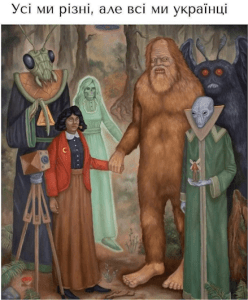
We are all different but we are all Ukrainian -meme
Are there any albums or tracks by Ukrainian artists that have managed to capture current events in a meaningful way?
I guess it’s (still and for long ahead) the time of rediscovering the classics of ours, so I really appreciate when musicians do it both beautifully and meaningfully.
Absolutely beautiful performances of DakhTrio who work with texts of Ukrainian poets.
3.81, the label (and educational project really) that works with tape recordings of instrumental folk music never published before, they also have a YouTube series where researchers talk about the manner of play presented on newly published albums.
Open Opera and Bozhychi have a series of concerts where they combine in space Ukrainian baroque chants with traditional ones from the same time period.
Ukraine is a big country with many regional differences including the folk tradition of native minorities like the Crimean Tatars and the North Azovian Greeks. Is Ukraine doing enough to preserve all different strands of folk music?
Ukraine doesn’t do enough even to preserve ethnically Ukrainian folk, but it’s never enough I think. I’m glad that there are initiatives and researchers who work with non-Ukrainian folk music of Ukraine, here are some of them: Urban Space Radio, Oleksandr Rybalko, Budzhak Heritage, Shum Rave.

A banner saying “We’ll change or die”
What does it mean for you to be Ukrainian?
A very complex question. To make this state possible through all, probably.
Which book / film / album / song / traditional dish / podcast / blog / artwork / building / meme best captures Ukraine for you?
A poster on demonstration against liquidation of autonomy of NABU and SAP in Mariinsky park in Kyiv, July 2025.
OCTOBER 15, 2025 – ON THE FRONTLINE

photo by @maxverstak
My name is Valerii, though in the music community I’m known as Raavel.
I’ve been making music for over ten years, but half of that time was spent searching for my own sound.
I founded two techno labels, but due to the shift in musical tastes and the commercialization of the techno scene, both are currently on pause.
Has the full-scale invasion changed the way you think about music and sound in general and how did it impact your motivation to make music?
The full-scale invasion has completely changed the way I perceive music — that’s a fact.
Right now, I’m going through a period of constant self-doubt — in my actions and in my tracks. It feels a bit like imposter syndrome. Sometimes I feel like I don’t know anything at all.
Since the beginning of the war, I’ve created more than a hundred demos that could’ve been developed into something interesting, but after some time I listen to them again — not as the author, but as a listener — and think: “What a piece of crap.”
Then I either delete the project or move on to the next one. Sometimes I try to return to old projects and finish them, but it’s a vicious cycle: I write a track → I like it → I listen again → I hate it → I get mad and delete it → I cool off → I start another one. And so it goes on.
 How has your setup changed since joining the military and are you able to produce new material on your time off? Also, was Insect Replicant already completed before the full-scale invasion?
During the full-scale war, my setup has gone through several phases. At the very beginning, when we were defending the Kyiv region, I didn’t even think about music. Later, in 2022, we were deployed to the Kharkiv region and stayed there for quite a while. That’s when I brought a minimal setup — a laptop, an audio interface, and a MIDI keyboard — just enough to sketch ideas.
A year later, once I had adapted to the rhythm of military life, I brought more gear: studio monitors, a mixer, and a few synths. In theory, it was a great idea, but in practice constant relocations made it exhausting — always packing and unpacking.
By 2024, I decided to focus more on combat work, as I became a UAV crew commander, which means much more responsibility. So, I sold most of my equipment, keeping only the essentials: a laptop, MIDI keyboard, and audio interface.
The Insect Replicant release was written shortly before the full-scale invasion began.

photo by @maxverstak
How would you describe the musical preferences of service members? Considering this is a very diverse group of people, have you noticed any dominant genres—say, metal or hip-hop—and do people exchange playlists?
Good question.
Unfortunately, for most soldiers, music isn’t a priority. In my surroundings, people usually listen to military-phonk, Ukrainian pop, and similar stuff.
But when we’re driving to a mission or training ground, I’m usually the one in charge of the playlist — and it all depends on the mood. If we’re going on a combat task, it can range from AC/DC to heavy drum’n’bass.
And sometimes I like to introduce my comrades to something new — for example, one of my guys came to see me perform at Brukht, and after that I started overhearing him listening to electro and techno more often 🙂
When I spoke with Timur (John Object), he told me that most soldiers use TikTok rather than listening to music. Has the constant stream of quick dopamine-releasing content replaced music as a source of instant gratification and comfort?
No one in my unit uses TikTok anymore. First, we have an internal rule not to use it. Second, Instagram has more than enough short videos anyway. We share them just to laugh and switch off from what’s happening around us. But we don’t really exchange music — only with fellow musicians who also serve.
Are there any specific tracks that have become widespread among soldiers, or used in memes—and if so, what made them popular?
Hard to say. There are some absurd songs we sometimes joke about, but that’s about it.
Are there particular songs or genres used to honour fallen comrades, and does music help in the process of healing?
Yes, there are a few tracks that we associate with fallen comrades. But that’s something very personal, and I’d rather keep it within the unit.
 Is the club scene doing enough to take into account the experiences of veterans in terms of audio-visual triggers and guest-lists?
Yes, most clubs are very considerate. I really like K41’s approach — in their artist briefing, they include a line that says: “Please avoid tracks with sirens, as they may trigger negative emotions among visitors.” That deserves real respect.
Many clubs have also introduced free entry for veterans, which is a nice gesture. Though honestly, many conscious soldiers don’t use that privilege — they prefer to support the scene by paying for entry like everyone else. Of course, sometimes it’s tough financially — when your last money goes to fixing a combat vehicle, but you still want a night out.
 How does it feel to play live, and have you felt a different kind of energy on the dancefloor?
The feeling of playing live is incredible.
I love the whole process — that moment when I can express what’s happening inside me through sound.
And after a good gig, there’s this unique sense of satisfaction.
It’s somewhat similar to a successful combat mission — everyone made it back alive, the job’s done, and you can finally exhale.
Are there any releases by Ukrainian artists from the past three and half years that have managed to capture current events in a meaningful way?
Right now, the tracks that best reflect the current reality for me are:
Zlypni – “Sontsekrov” and Гоня (Gonya) & Jointjay — “Як?”
What does it mean to be Ukrainian for you?
Being Ukrainian means having a certain stubbornness inside you — something that never lets you give up. It’s the ability to love life even when it’s tinted by war. And it’s the belief that music can also be a weapon — just of a different kind.
OCTOBER 16, 2025 – KYIV

Hello. My name is Mykyta. I work under my real name (Mykyta Herasymov) and pseudonyms MP3GOD, DJ Nekit, and anonymously on interesting projects that I choose not to name to avoid leaving a digital footprint.
I am originally from Kramatorsk, an industrial city in the Donetsk region, known for its engineers and machine builders. Not only that, but I consciously started engaging with music — at least what we call music — from a very early age. I would walk the streets during my preschool years and hum various melodies to myself that would get stuck in my head. I would tap out rhythms with sticks in the yard, fool around, and I truly enjoyed it. It’s sad, but since childhood, I wanted to engage in academic music, take guitar or piano lessons, but my parents were against it. Because we’ve been poor, we never had money, even for basic needs. Later, as a teenager, I attempted to attend music school on my own, but I was refused, supposedly because I was too old. Probably, I was dealing with a picky person who administered that institution.
When I was 16, my parents gave me a ukulele (I had been begging for a guitar for a long time). I didn’t play it for long. At the same time, I got a pirated copy of FL Studio, and I remembered how my older brother, when I was little, made music there, and I started experimenting, mastering digital tools for creating music and sound. Some simple hip-hop, ambient, and house. I listened to music, was inspired, and imitated. Years went by, and I still listen to music, get inspired, and imitate. I generate, imitate, generate, imitate, reflect.
Currently, I’m using various tools that I find interesting to work with: Ableton, SuperCollider, VCV Rack. I really want to master Max DSP combined with TouchDesigner, but unfortunately, I can’t find the time due to my main job and graduate studies. But I get so inspired by immersive and interactive sound works, where a camera or any other instrument captures your movement, shape, colors, volume — anything — and influences what you hear, how you hear it, and what you see. Someday, I promise, I will master this. Someday.

Prepares for a performance at noizeschoseredy with sportcar
Has the full-scale invasion changed the way you think about music and sound in general and did it change your playlist in any way?
My playlist became much more primitive and sad. I started listening to more experimental electronic music, which was brutally dark and melancholic. Have a Nice Life, Boards of Canada, and William Basinski returned to my playlist during my depressive episodes.
I am young, so I learned a lot about music as a cultural phenomenon, its development, and more during this time. I picked up some snobbish knowledge. Additionally, I became interested in glitch and explored this genre myself, especially focusing on everything with “mille plateaux” in its name that appeals to discreteness (I see this as discreteness, a certain atomization of personal perception of reality).
In fact, sound has become a fixer of reality for me. Air raid sirens have been going off for four years now, each time reminding me of 2014, when there was fighting in the Kramatorsk area, and I was a child. Now, this sound has a much more fatal connotation, although many people, myself included, have gotten used to it. It’s the new normal. Since the start of the full-scale invasion, I’m paying more attention to the sound than ever. I regularly notice that. Reflecting on sound, I felt a shift in my perception of the concept of music, moving from the more canonical and conventional to the generalized, abstract, intimate, and personal.
For me, music is a human choice: the sound you process and treat with your brain and perception, which is what we call music. In other words, music is how you perceive sound. It is a category of perception and conscious interpretation of sound waves. For example, the cannonade of explosions is music to me, as sad as it may sound. The sound of intense keyboard clicking is music to me. My heartbeat is music. The hum of the refrigerator, combined with the rhythmic ticking of the clock, is music. It is everywhere; it surrounds my reality, whatever that reality may be. And my choice to call that music, to perceive that as music. Something like that.

Enjoying music in my room during depressive episode
You are originally from Kramatorsk. How would you describe the electronic and experimental scene there, and would you say there is a supportive network of producers, artists, and venues in Kramatorsk?
When I lived in Kramatorsk, I was essentially isolated from the community of creative young people. Unfortunately, I didn’t get to be part of that scene. However, there was a volunteer cultural and educational hub called “Vilna Khata” (Free House), where many interesting young people began their path. My mate, Marko Medvediev (Parking Spot), is into electronic music and is doing really great. I’m really into his music and art, and I’m happy for him that he’s taking his life in such a direction. I’m truly happy for him; respect! I suggest giving him a look.
As a contributor to Neformat you recently wrote about glitch highlighting the most significant album by Ukrainian artists. How would you say the more experimental side of the electronic music scene has developed since Euromaidan and what do you consider the most interesting developments?
Honestly, this question can only be answered with a PhD dissertation. I haven’t researched it.
You have also written about Parking Spot charting his development up to his latest album. Marko seems to be one of a number of artists that have matured very quickly and explored different directions over the course of a short period of time. Would you say the war has made producers more focused?
Everyone is different, really. Some focus their attention on creating music, some have stopped or slowed down. It’s important to remember that artists join the military. So, I don’t see any clear pattern here; I wouldn’t say that the war has made artists more focused, but I wouldn’t dismiss that hypothesis either. Again, it’s a great topic for academic research.
 Are there any tracks of albums from Ukrainian artists that you feel have captured current events in a meaningful way?
Okay, anyone who does something, in one way or another, records and documents reality as it is through their activities. In my view, it is impossible to separate the context we are in from our activities, whatever they may be. These things are completely interconnected, although the degree to which context influences depends on the individual. In pop, niche, experimental, canonical, and other types of creativity in Ukraine today, the present moment is being recorded. The impact of war is felt in art that tries to be as detached from events as possible, aiming to hide this reality and indulge in escapism. Some people create sharply politicized conceptual works. Every individual is different, I might say.
Has the loss of nightlife due to curfew hours influenced the way you experience music?
I am 23 years old. Full-scale war started in 2022, when I was 19 or 20. Before that, there was COVID, and I was around 17 or 18. Before that, I lived in a small town where such events, if they happened at all, were rare and occurred in a community I didn’t belong to. My experience of nightlife includes walks with friends, parties in apartments until morning, and similar activities. I’ve been to night raves a few times, and they were incredible. I miss that feeling, but I’m not complaining. A curfew is necessary for our safety.
Which book / film / album / song / traditional dish / podcast / blog / artwork / building / meme best captures Ukraine for you?
All right, I’ll compile a collection of works of art in various media associated with modern Ukraine, where we live.
- Music: Adaa Zagorodnya – Pustit’ Mene
- William Basinski – The Disintegration Loops
- Film: ‘I Am Twenty’ directed by Marlen Khutsiev
- Book: Franz Kafka – The Trial (not sure about my choice)
- Artwork: Photo projects by Alexandr Chekmenev
- Meme: Pes Patron.
OCTOBER 18, 2025 – KYIV

photo by Yuliia Kostyrenko
My name is Ksena. I was born in Kerch, Crimea, and moved to Kharkiv when I was sixteen. Since the beginning of the full-scale invasion, I’ve been based in Kyiv, and it’s here that I finally started DJing, something I had been dreaming about and putting off for many years.
Music has always been with me, it just changes its forms. I studied vocals and dance from the age of five, and I still sing today. As a teenager, I spent hours listening to albums and discovering new sounds. Later, I began creating playlists and sharing them online, and eventually started curating playlists for venues. Now I express my creativity through DJ mixes and sets.
Has the full-scale invasion changed the way you think about music and sound and has it changed your playlist?
I wouldn’t say the war has changed the way I perceive music, it’s more that my playlist has become darker. There’s more intensity now, more bass and drive. Sometimes emotions like anger or disappointment come to the surface, and they inevitably find their reflection in what I listen to.
I’m glad that I now have DJing as a tool to express those emotions, I can come to the studio and just play whatever I feel in the moment. A solo set for myself feels almost like a form of therapy.
As for calm, relaxing music, it has always been with me and still helps me find balance whenever I need it.
How would you describe the Ukrainian electronic music scene and how do you see it developing in times of war since many have left and many more are serving in the military?
There are many new names and formations of artists emerging, and new festivals are being born too. Festivals like Brudny Pes and Splav appeared after the beginning of the full-scale invasion, and you can really feel the concentration of energy in them. It’s an energy that has been building up for a long time and is now bursting out through music.

photo by Yuri Gryaznov
How would you say the loss of nightlife due to curfew hours has affected the clubbing scene in Ukraine and has it affected the way you prepare a deejay set in any way?
I guess my experience is a bit different because I wasn’t really part of the nightlife scene before 2023, when I started living in Kyiv. My musical identity was shaped more by the releases and albums I’ve listened to throughout my life rather than by clubs or parties, so it’s hard for me to make direct comparisons.
Honestly, I enjoy daytime parties. If some of them lasted for a week, I’m sure there would still be people who wouldn’t want to leave. But the way it is now, being home by midnight also feels right to me. I value my sleep routine, and I’m comfortable with it.
Who would you select for an ideal B2B set?
I’ve already had a few perfect matches in B2B sets, and some of them I’d love to repeat, like the one with Taqaddam. I’d also be really interested in playing with Bellis because I love the electro and breakbeat side of her selection. I have dark vibe tracks in my collection, but I’m not sure I’m ready to play a full solo set in that mood yet. B2B sets are always a space for experimentation and fresh sounds, and that’s what attracts me the most.
What percentage of Ukrainian tracks do you normally include in a set?
I follow many Ukrainian artists, and almost every published mix of mine includes one or two tracks by Ukrainian producers. When it comes to DJ sets, it’s not something I plan, it really depends on the mood. But I always have tracks by our artists on my USB, just in case. I also have vinyl records by Ukrainian producers that don’t quite fit the selection I usually play, but I still enjoy supporting their work. And who knows, maybe one day those tracks will find their place in my sets.
There were 15 international artists in the latest line up of Brave! Factory Fest. Do you think international names are ready to play festival in Ukraine again?
Kyiv clubs regularly invite international artists. Many artists have come to Ukraine more than once since the beginning of the full-scale invasion.
Traveling to Ukraine is not easy right now, the journey is long and can be quite stressful, and not everyone is ready for that. So the fact that artists still choose to come really deserves respect. When it comes to festivals, it can be even more complicated because sometimes you don’t know until the very last moment whether the artist will actually make it. And of course, anything can happen, one major explosion in the city could easily scare someone off, which is completely understandable.
I’ve read several posts from international artists describing the unique energy of Kyiv’s dance floors. I think it’s a very emotional experience for them to come and play here at a time like this, and all we can do is thank them for it.

Kerch, Crimea
You are from Crimea, so the war started for you back in 2014. What would you say are the most common misconceptions that still circulate about Crimea?
When I think about Crimea, the first thing that comes to mind is how powerful propaganda can be. We don’t really understand what it is until we see its effects. I would call it a disease, or even an epidemic. It spreads through people’s minds, and it’s constructed so cleverly that they start believing those thoughts are their own. It’s heartbreaking to watch how the mindset of your relatives or old friends changes, as if they become different people. And in that moment, they don’t realize that this way of thinking has been implanted.
It was very hard for me to come to terms with all of this, but I don’t really have a choice. You never fully grasp what propaganda is until someone close to you falls under its influence. Its power is enormous.
What does being Ukrainian mean for you?
First of all, it means being free and strong. But in the fourth year of the war, I wish people saw us not only as an unbreakable nation but also understood, even just a little, how much pain and stress we live with every single day.

community cafe
Which book song best captures Ukraine for you?
The first thing that came to my mind was Jamala’s song “Шлях додому” (“The Way Home”). Jamala often explores the painful theme of the deportation of Crimean Tatars in her music. I’m not Crimean Tatar myself, but the lyrics of this song resonate with me deeply because they’re about searching for the way home. I listened to it when I was abroad, after leaving Kharkiv with just a backpack and my dog, on an evacuation train into the unknown. I’ve read the YouTube comments where people write about their hope to return to their hometowns, many of which are now under occupation. It’s heartbreaking and very moving. It’s surprising because I usually listen to completely different music, but this song has stayed with me. It perfectly captures my own feelings about everything that’s happening.
Another track that reflects my emotions is “Rykh” by Si Process. The fast tempo and tense drumming are exactly what I mentioned earlier, the kind of dynamic, emotional sound that has appeared in my playlist lately. When I listen to it, I feel a surge of energy, it’s a very special emotion.
NEW RELEASES
Lostlogic ~ Archaic
Different subgenres of electronics are combined again: breakbeat with trance, house with bass music; beats per minute range from the usual 136-145 to 100 beats per minute, which causes dissonance. The only thing that is constant in Lostlojic’s work is the romantic mood of “dancing through tears”, mysticism and hope. In the track with the participation of Vinnytsia resident Saturated Color, the problematic of one’s origin is explored and danced out – where are we from and where are we going, what is homeland in the 21st century. The composition Alternativ absorbed nostalgia for old computer strategies and the feeling of the presence of an extraterrestrial being within oneself. Downpour Baroque is dancing during a downpour, lightning breaks out in the middle of the dance floor amidst the bass. At the end, we are waiting for relaxation under the super-slow Archaїc, which seems to have been recorded using ancient methods of a destroyed previous civilization. After the previous album Anomaly, which was dedicated to futuristic downshifting and activity in the Chornobyl zone, a tangible continuation of the theme of studying the trauma of humanity in 1986 – on the cover of Archaїc there is a three-dimensional interpretation of the memorial complex “Monument to the Victims of the Chornobyl Tragedy”, which, like an anomaly, spins in the Kyiv sky. Serious electronics carved in stone!
Rescale Musicbox ~ Podil Underground Noises
Viktor Pushkar – composition, beats programming (Nord Modular G2), synths: DSI Prophet P12, Cherry Audio Voltage Modular + Roli Seaboard
Stanislav Bobrytsky – bass synth (Yamaha TX81Z), recording, mixing
Dmytro Arzumanov – guitar (1-2)
tofudj ~ care
Dedicated to all the friends who remain close and those who are no longer with us.
58918012 ~ Consonance
Hey, friends! I hope you are all doing well! As you can see and hear, this is my new album “Consonance”. During the time I worked on it, I had a problem with my left kidney, and it was pretty painful and stressful for me. Anyway, my main idea was to create something as light as possible. I mean, to create music that can play on repeat for hours and hours again, and not get boring.
I just wanted not to overload the music with timbres and melodies, but keep it listener-friendly and let it tell the story, with a minimum of sentences. Without expositions, midpoints, and climaxes…just by feelings and consonances.
Of course, it’s my subjective point of view. But I think this album sounds incredibly warm, soft, airy, and pleasant for the brain. This stuff will definitely teleport you into another dimension if you let it do so. Thanks for your time and support! Stand with Ukraine! Peace ❤
Demian Feriy ~ Utopicalypse
This album was created by me between 2021 and 2025, exploring ambient, minimalism, neo-classic, and liminal space music.
The album encapsulates a state of calm, hidden attention and alienation. It conveys the feeling of a “Utopycalipse” — the moment of an approaching end of the world that never arrives, unfolding on a warm and sunny day. This combination creates a pleasantly eerie atmosphere.
The compositions were created spontaneously. None of them were planned in advance. Their emergence was situational: for Instagram Reels, as a phone recording, for a collaboration at an art residency, or for a radio performance. Some tracks are the result of the first experiments with a MIDI guitar in 2021. Despite this chaotic nature, all the compositions are united by a common sensory and psychological identity.
For me, the sound of the album is associated with the empty streets of Borshchahivka on warm August and September days. Therefore, it was important to release it during this specific time of year.
Юрій Йосифович ~ Мої думи аж до тебе братньою сльозою
This is my fourth album, featuring songs written between 2022 and 2025. These difficult three years shifted me from authentic music toward writing my own songs. In particular, they gave rise to some of my favorite work – Caucasus, Prayer of War Nights, and Veronica. Of course, it would be better if there had been no reason for them.
Ship Her Son ~ Саундтрек до порядку денного
The second album from Ship Her Son maps the quiet panic of an ordinary day. Each track marks a moment in the life of a man under constant strain: waking after too little sleep with a head full of dark thoughts; trying to stay ironic and keep the routine alive; practicing calm, then losing it to intrusive visions of eternity; sitting through medical checkups, wondering what’s real; ending the night drained, chores un-done, insomnia still waiting.
The cover captures this blurred reality — a lone figure in headphones watching a fire burn in an empty field, never revealing whether it’s a dream or the world itself coming apart.
Musically, Soundtrack to the Daily Agenda pushes Ship Her Son into a heavier, more physical realm. Post-industrial foundations collide with noise-rock abrasion, ambient textures, industrial-rock drive, and flashes of techno, punk, and post-punk. It’s the project’s first release sung entirely in Ukrainian, and the first to feature live guest vocals instead of sampled fragments.
Recorded instrumentally over nearly three years in Lviv, the album gathers voices from across Ukraine: longtime collaborator Stepan Burban (Palindrom); Anton Slepakov, a legend of the Ukrainian scene (ВГНВЖ, warнякання); Eugene Tymchyk of Septa, The Nietzsche, and АНТАЙТЛД; Oleksandr Kuts of Vøvk; and Divuar of Zwyntar and Old Cat’s Drama. Their performances — raw, intimate, and unmistakably alive — turn personal anxiety into a collective, cathartic howl.
The result is a soundtrack for anyone who knows the weight of another relentless day and the restless night that follows.
Native Outsider ~ Episodes
Episodes is an image of the fragility of movement and change, where the slightest breath can transform an echo into a new form. The music lives in the spaces between dreams and awakening, between noise and silence. Native Outsider treats sound as matter: stretching time, turning noise into meditation, and transforming space into a place of encounter with one’s inner images.
This work exists on the boundary between ambient and sound poetry, where each layer reveals hidden states: from the delicate calm of spring dreams to ghostly afterglows forever etched by experience. There is no intrusive melody or excessive form here — only the pure movement of waves and the fragility of a moment that can be lived, but never held.
VA ~ VACUUM
Second VA on DISK_D and a fourth release DSKD004 is to be out on October 24-th. This time we have more participants, more sound-pressure, more aggression and more tracks with vocals. It also contains hypnotic techno, electro tracks, percussive music, old-school techno and sound collages like Nartsysy by Givem3kiss. Our releases for bandcamp are dj-friendly in format 44100 16 as to be read by most of dj-players.
Low Communication ~ Others
Low Communication is the project of Bohdan Linchevskyi from Ukraine. While he hasn’t been releasing music for a very long time, he has been active for quite some time, originally leaning toward an ambient style. In fact, in 2024 he released several works in quick succession on labels such as Byrd Out, Neotantra, and EQ, which were ambient, experimental, and soundscape-oriented projects.
However, under the name Low Communication, he does not confine himself to ambient, but continues to change and evolve within the broad field of electronic music.
The album released this time on FORM@ RECORDS is characterized throughout by strong beats and basslines. While rooted in a minimal sound, the tracks also feature dynamic shifts and clear melodies, reminiscent of late-90s Detroit minimal techno.
It seems certain that Bohdan will continue to accelerate his activities while transforming his style in the future.
v4w.enko ~ Sequenced Segments
Rhythmic and poly-rhythmic structures in one grid of sequences recorded in various time segments.
Each segment of the recording forwards to meditation on constant sequence of sound form which is differentiating on each new step.
4 tracks release.
All tracks recorded in max/msp 4.5.7
PURE TOOL ~ VA MULTITOOL VOL 2
The continuation of the “Multitool” series is a selection of diverse techno tools united by a single purpose: to generate pure dancefloor energy, where groove, textured layers, and deep basslines keep the body moving.
We’ve brought together artists from Ukraine, Argentina, Switzerland, and Germany to create music that ignites wherever the floor is burning.
Melancholic tones intertwine with raw textures and heavy low-end, while tribal rhythms and a distinct Detroit vibe break through at just the right moments.
lebben ~ цигарки vol. 2
цигарки [cigarettes] vol.2 is a continuation of the creative searches of lebben, a multi-instrumentalist from Bila Tserkva, who boldly combines recitative, hip-hop and lo-fi. The release includes 11 tracks, most of which are stories with broken rhythms, an improvisational atmosphere and a personal imprint of emotions. This is music about memories, dreams and short moments between inspiration and burnout from existence, the culmination of which is reflected in this release
SI Process ~ Боривітер
It seems to me that only Ukrainians will understand this name phonetically and meaningfully, because the combination of these words is absolutely unique. I first heard it at Alla Gorska’s exhibition and it especially hit home in my soul. I was incredibly impressed by the works and strength of spirit of this woman. A dedication to every Boryvitr among us, to everyone who steadfastly holds the wind of time on their shoulders. To every future and eternal.
Iklañ / eleOnora ~ Pastyr
“Tell me, shepherd, will teach how to die?”
VIEWING ROOM
(Gianmarco Del Re)
 a closer listen
Pingback: ACL 2025 ~ Top Ten Experimental | a closer listen
Pingback: ACL 2025 ~ Top Ten Rock, Post-Rock, Folk & Jazz | a closer listen