
Blue Bull by Mariia Prymachenko
Whenever I start a new episode of Ukrainian Field Notes, I have no idea where it will take me. This month I ended with 21 interviews (15 male and 9 female – some of the interviews are with bands). Among these, there are 4 active servicemen and 1 veteran. It all makes for 35,000+ words. It might sound trite, but I am always grateful to those who share their stories.
In Kyiv we talk Barbie with Chloё Landau; in Cherkasy we ponder about failed experiments with Zaviruga; Helena Atkin and Daria Titova discuss storytelling between London and Estonia; in Bila Tserkva, lebben tries not to write about war; on the frontline, adm:t appreciates every second of creativity while Remez reassures us that no one has cancelled AC/DC or Johnny Cash.
Further afield, in Finland, Yevgen Chebotarenko picks a sexy cover for his album; in Poland, Volodymyr Ponikarovsky trusts actions only; Renata Kazhan goes for a minimal setupin Helsinki; Sharko mourns his cat in Czechia; in Kyiv Embrion Bormana is not ready to return to studio work, whereas cybermykola, a Pavlohrad native, admits to not having seen himself as artist to begin with.
Moving across the ocean, Ro Rouseeau reminisces on post-Euromaidan Kyiv; back in Cherkasy, Tryastya goes full on rave; in Rzhyshchiv, Høstvind expresses his dislike for streaming services; in Berlin NASTYA NVRSLP literally never sleeps; in Lviv, екскременти picks up the harmonica; in Kyiv, mariia&magdalyna ask what the fuck is wrong with this world? In Kyiv, Ksenia Yanus and Vadym Oliinykov from noizshchoseredy explain why Wednesdays have gone silent; and finally, Ambiotik invites us for a session of music therapy in Kalush.
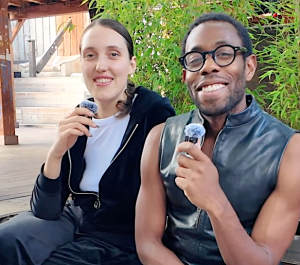
Olha and JP from Drift Kyiv
In this month’s UFN podcast for Resonance FM we discuss after hours parties and the Ukrainian diaspora with Olha Korovina and JP Doho from Drift Kyiv.
Tracklist:
- Kichi Kazuko – “Battlefield”
- Hasvat Informant – “Touch Brass”
- Vera Logdanidi – “Keep Pushing On”
- TYGAPAW – “Black Trans Masculine Experience” feat. Kings-Lee Rose
- Aniway – “Dead Mouse”
Also, plenty of new releases, including 58918012, Haido, Orfin, Tongi Joi, Paloven, Morphey, екскременти, Ship Her Son, Low Communication, We’ve Already Talked About Th*t, PROLETARSKYI, Koloah, некрохолод, Hidden Element, Weaverbird, Stalkvoid, Pororoka, Delayed Minds, Dirtbag Loris, Dubplanet X, Polje, Monotronique, ummsbiaus, 1914, Bad New from Cosmos, Rebel, Andrey Sirotkin, and Shadow Unit.
In the viewing room, we check out the latest from Latexfauna, Andrii Barmali, DakhaBrakha, Hidden Element, Oi Fusk, Blooms Corda, Ingret, Palindrom, Monokate and хейтспіч.
OCTOBER 19, 2025 – KYIV
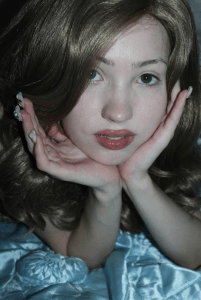
photo @hristinazhopa2
I’m a musician based in Kyiv. I love performing in front of an audience—dancing with them and flirting with them. I write songs about what I’m going through or what I’ve been through before. In many of my lyrics, I imagine that I’m already dead. I adore quiet nights, when you can sleep as long as you want. I love wigs and constantly dressing up, I paint my nails with glitter nail polish, I love drawing swans and roses, and I deeply enjoy the feeling of how much agonizing chaos surrounds me.
I started making music about three years ago. I wrote lyrics and tried to sing them or find ways to put them on music. I didn’t know how to use Ableton back then, so I used simple programs I found online and recorded everything on my phone when no one was home.
It wasn’t about an audience—I just wanted to express something, to get it out. Around that time, I also started filming music videos with my ex-girlfriend. They were amateur, but they meant a lot to me emotionally.
Now I’m still doing more or less the same thing, but with better tools. I have a professional microphone at home (it’s pink), and I understand the technical side better. I’ve also started focusing more on live shows. I prepare for each one carefully and try to make it feel like stepping into another world. I don’t want to look polished or perfect on stage—I want to look intense, maybe even a little grotesque. I want to feel like a character from a gruesome fairytale.
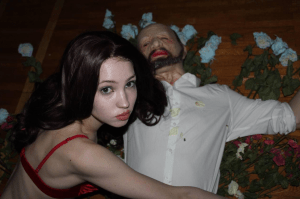
photo by @hristinazhopa2
Has the full-scale invasion changed the way you think about music and sound?
It’s difficult for me to answer this question. Since the beginning of the full-scale war, I’ve become more sensitive to loud sounds and more afraid of them. My body reacts instantly to alarming noises like sirens or anything that resembles explosions. This kind of response I notice among the majority of my friends.
Before everything that happened, I used to find those sounds almost poetic — they didn’t cause such strong physical reactions. Because of this shift, I try to be more careful when working with sound, in order not to unintentionally harm others who might have similar sensitivities.
That said, I don’t think my general approach to making music has changed much. The lyrics may have become more complex and less naive, but that’s also a result of growing up. I was 19 when the full-scale war began, and now I feel like my personality has simply become more formed and layered with time.
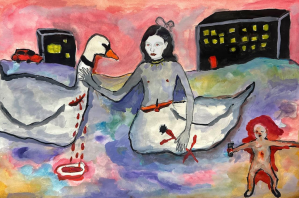
artwork by Chloё Landau
Has your playlist changed in any significant way after the full-scale invasion?
To be honest, since the war began, it has become strangely difficult for me to listen to and process new music. For many months, I found myself looping the same ten tracks over and over — I simply didn’t have the energy to seek out anything new.
I love noise and experimental music, and I’m now surrounded by an incredible number of insanely talented musicians whose live performances I truly enjoy. It feels like I’m slowly starting to “come back to life” and hear again, after several years of silence.
In my teenage years, I used to actively dig for music, often spending half the day searching for something unfamiliar and interesting. I was very into bands like Nurse With Wound, Throbbing Gristle, and Current 93. These days, I enjoy listening to James Ferraro and Pharmakon.
I’ve also become much more selective about what I listen to. It’s extremely important to me that an artist has a clear political stance. I no longer engage with anyone who claims to be “apolitical” or chooses inaction — to me, that reflects weakness and indifference.
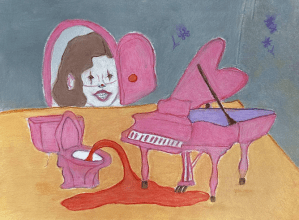
artwork by Chloё Landau
You took part in the Construction festival in Dnipro. What can you tell us about that experience and how would you say Construction compares to similar festivals in Ukraine?
I really enjoyed performing at the Konstruktsiya (Construction) festival — the audience was absolutely incredible, and I genuinely had a great time. It was very easy to connect with everyone, and I loved the sense that each person in the crowd felt free to express themselves in their own way.
The festival program was impressively rich and diverse, and it’s especially remarkable that the festival has been held annually since 2014. I’ve grown very fond of Dnipro, and I’m looking forward to the next time I can return there.
I believe that festivals like Konstruktsiya are extremely important for the development of Ukrainian culture. Right now, we have hundreds of incredibly talented musicians who have something meaningful to say. In my opinion, our scene is highly progressive — perhaps even surpassing what we often see abroad.
It seems to me that the war has triggered a powerful shift in our musical landscape and profoundly changed our collective consciousness. Konstruktsiya is without a doubt one of the most unique and compelling phenomena in our current musical world.
Another festival I love and would mention in the same spirit is Fantazery, which also holds a special place in my heart.
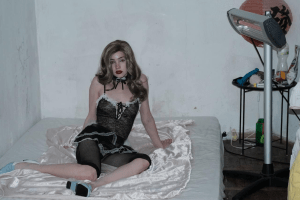
photo @supernovwva
You started making music after the full-scale invasion and have released a number of tracks since 2024. How have you managed to be so productive?
In general, my first attempts at making music were back in 2020–2021, but sometime after 2022 I was able to better shape my artistic style and understand more clearly what ideas I want to convey to the crowd. It’s very important for me not to stop and to constantly continue doing my work — it helps me feel like myself.
I remember how during the first 6 months of the war I lived with my friend’s family in a small village in western Germany. There was only a cemetery, an endless forest, and an inactive children’s camp with small wooden playhouses (they were the size of miniature copies of real houses and were painted in all the colors of the rainbow) — I liked to climb in there and record songs on a voice recorder — because for hundreds of meters around there were almost no people and I could finally be alone.
I always try to find an opportunity in my free time to come up with something and record it. Now I still try to constantly do something, although it can be difficult because of full-time work and constant night shelling. This summer, a missile fragment shattered several windows in my apartment while I was at home, and it’s still unsettling to remember that night. But such events only remind me that life is short, and I just try to do more and more.
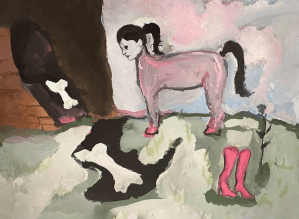
artwork by Chloё Landau
How is your visual art output connected to your music?
Visuals are a really important part of my art. I love adding photos to go with my music, and I really enjoy coming up with different looks for performances. Also I often draw — my drawings are kind of a visual representation of what’s happening in my songs.
A couple of years ago, I also created designs using 3D dolls, and my friend and I made clothes with those images on them.
With my looks, I want to express fragility and innocence — but with something stirring and a bit unsettling hidden underneath. I like wearing exaggerated doll-like dresses, or costumes from sex shops (like a nurse outfit or a Playboy bunny suit, for example). I love the contrast that creates when combined with my lyrics and music.
I’m drawn to things that are grotesque and theatrical — like I’m Alice in Wonderland, but everything around is destroyed and radioactive, and somehow everyone’s still having fun.
You took part in the Home VA compilation for Klikerklub. Your track was composed in Lviv. How would you define the concept of home and has it changed for you since the full-scale invasion?
The concept of home feels quite blurry for me right now. For the past few years, I’ve been moving around a lot, and most of the time I didn’t feel safe or grounded.
At this point, I have a few places that feel like home in different ways — Chernihiv, where I was born and lived until I was 17; Kyiv, where I’ve been spending most of my time lately; and Lviv, where I stayed for a while at the beginning of the war.
I don’t think home is one specific location — it’s more about having a sense of stability and balance.
I know that for the next few years I want to stay in Ukraine and be part of what’s going on here. The first months of the war were brutal — my family was scattered, and there were days when I honestly didn’t know if they were alive. Now that we’re back together, at least partly, it feels like home is wherever they are.
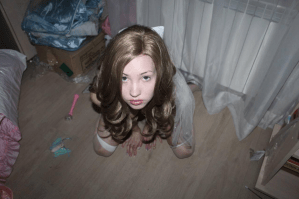
photo @hristinazhopa2
Have you seen the film Barbie and if so what did you think of it?
I watched Barbie and, honestly, thought it was solid. I’ve had a soft spot for Barbie since I was a kid, and I still enjoy the old animated films and games.
I ended up using samples from the film in a track called Sport Car — it reflects on a destructive period in my life and the feeling of being completely powerless within it.
I wouldn’t call it a masterpiece or something that shifted my perspective. But I do think it’s relevant. Feminism remains a poorly understood topic in our society — people either don’t see the point of it, or assume its goals were achieved decades ago.
In that sense, the film serves a purpose.
I also find myself drawn to exploiting the Barbie image in my own work — partly because it strikes me as a painful, hyper-exaggerated version of the “ideal woman” constructed by the patriarchy. There’s something deeply artificial about it, and I like pushing that absurdity even further.
The image of the blonde with a permanent, soulless smile becomes almost grotesque when taken to its extreme — and that’s exactly what makes it interesting. It’s not just aesthetic; it’s a way to expose how empty and performative that ideal really is.
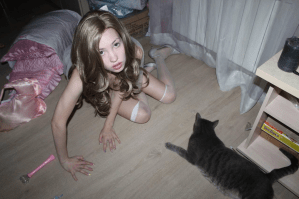
photo @hristinazhopa2
Are there any works by Ukrainian artists that you feel have captured and conveyed the full-scale invasion and the war experience in a meaningful way for you?
A lot of my friends are artists whose work also deals with the war, and their perspectives mean a lot to me. One of the first names that comes to mind is Illia Todurkin — his work is raw, painful, and incredibly powerful. It really struck me when we met at the beginning of the war.
I’m also deeply moved by Dana Kavelina’s animation. I remember watching one of her films at the Konstruktsiya festival, right before going on stage — and I almost cried. It was that beautiful and that heavy.
Another artist I really value is Kateryna Lysovenko. I love how the bodies in her paintings bleed in this strangely beautiful, almost sacred way — they feel soft and clean, but also disturbing. She captures something very real about motherhood, especially what it means to be a mother during war.
I also think of Tamara Turliun and Krystyna Melnyk – their work has a quiet intensity that sticks with you long after you’ve seen it.
What does being Ukrainian mean for you?
To me, being Ukrainian means being blessed by angels.
Which book / film / album / song / traditional dish / podcast / blog / artwork / building / meme best captures Ukraine for you?
If I had to choose one song that best captures Ukraine, I would pick “Пішла Киця ” by Katya Chilly. As far as I know, it’s a reinterpretation of a traditional Ukrainian lullaby. For some reason, this song always moves me in a way I can’t quite explain — it feels like the most beautiful and mystical thing I’ve heard in months.
I really like this version because it has so much silence, space, and sorrow in it — but also gentleness, protection, and hope. I love that the story is told from a child’s perspective, through something as simple as a tale about a kitten that fell into a well.
I often listen to this track while walking down the street with my headphones on.
OCTOBER 22, 2025 – CHERKASY
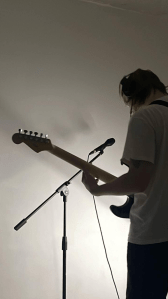 завірюга (Zaviruga)
My name’s Danylo (Daniel). For almost three years, I’ve been running this small but stubborn project called завірюга (zaviruga – blizzard). It all started with a bunch of failed music experiments — different genres, styles, sounds — everything seemed “fine,” but deep down I knew it wasn’t mine. One day, out of pure frustration, I decided to make something that wouldn’t fit any mold — not trendy, not “expected.” That’s how I stumbled into egg-punk. I instantly loved how weird and unapologetic it was.
I’ve been into punk for years, but this time something clicked. In five days, I wrote three tracks for the first single, drew the cover, and even made a video. It felt insane in the best way — like I was laughing at my own chaos. For the first time, it was pure fun.
The war changed everything. It stripped life down to black and white — no grey zones, no pretending. Either you’re honest or you’re not. That’s probably why завірюга sounds the way it does — it’s just me without filters.
 You started releasing in 2023 and have been quite prolific. At the same time your longest track is probably 2 minutes 1 second long. What is your production process and what motivates you?
To be honest, I was hoping no one would ask me about my “creative process,” because it makes me sound lazy as hell. But okay — I work in bursts. I can go months, even a year, doing absolutely nothing. Then suddenly — three songs in three days. I’d love to make more, but if it doesn’t have that same spark, that same honesty as the first one, I’d rather stay quiet.
How would you describe the punk scene in Ukraine and in particular the egg punk scene?
There are some solid punk bands in Ukraine — I listen to a few. Since the full-scale invasion, even more have popped up, which is great. But honestly, most still sound too similar. It’s only a matter of time before some new blood kicks the doors in. As for egg-punk — I haven’t seen anyone else doing it here. Either I’m alone in this corner, or the others are just ghosts on another frequency.
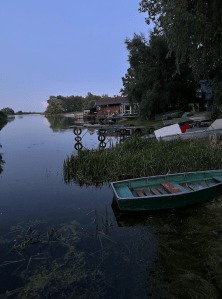 The track “18000” is about Cherkasy. Could you tell us about your relationship to your hometown?
Cherkasy for me is a quiet refuge — a place to walk by the Dnipro, breathe, and reset. I’ve lived in big cities — Kyiv, Kharkiv — loved both, but only here I can actually chill.
How would you describe the music scene in Cherkasy and do you feel part of its community?
The music scene here is small — mostly techno raves now.
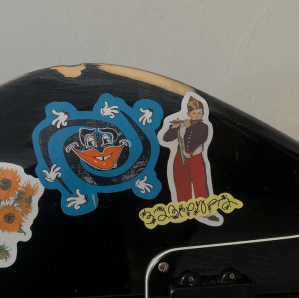 What does it mean to you to be Ukrainian?
Being Ukrainian is both a curse and a gift. It’s heavy, but real. You see things that break you, and things that make you proud beyond words. I wouldn’t trade it for anything.
Which book / film / album / song / traditional dish / podcast / blog / artwork / building / meme best captures Ukraine for you?
Before the invasion, Ukraine was like the Shire — calm, green, full of small joys. Now it’s Minas Tirith [the capital of Gondor in The Lord of the Rings] — battered but standing tall.
And Rohan — yeah, we’re still waiting for your ride.
OCTOBER 22, 2025 – UK and ESTONIA
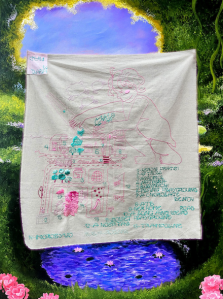
Daria: I have a background in Graphic Design and illustration. I’m a passionate embroiderer exploring themes of memory and storytelling. I like to keep a sense of childlike wonder in my work — my pieces often feel like small games or fragments of fairytale worlds. The main character in these worlds is usually a short-haired girl, or sometimes many of them. My connection to music is through Helena; I’m deeply inspired by the way she weaves storytelling into notation — something that feels like a secret language to me, yet an essential tool for her.
Helena: I started as a classical pianist and composer, before being introduced to the contemporary music/arts world during my master’s. I was always super fascinated by scores and the score-writing process, but only started to think about notation as an artistic end in and of itself after being exposed to this more experimental context. Since then, I’ve been interested in the not necessarily musical residue and resonance of the notated score; the way notation ‘unsounds’. My connection to the visual arts (especially embroidery) has, likewise, been hugely inspired by Daria and the beautiful tactility with which she quite literally weaves her stories into existence!
How did a British Estonian composer and a Ukrainian artist come to collaborate, and how do you combine two very different artistic practices?
Helena: We met earlier this year while working on a project run by Narva Art Residency and The British Council in Estonia.
Daria: During the Narva Art Residency, we were asked to lead workshops for children in local Russian-speaking schools, all in Estonian. I think I was selected because I had managed to learn Estonian quite quickly — within a year — and perhaps the organizers thought that might inspire the kids to learn it too.
Helena: We were housed in the same accommodation and so had a real insight into one another’s process and experience of the whole thing – we were simultaneously getting to know each other as artists and as friends, and so the combining of our practices from there on was pretty intuitive.
Daria: I remember seeing Helena “in action” — her gentle and thoughtful way of engaging with the children, guiding them through the workshops, and reflecting on the process afterward. After that residency, I developed a strong interest in co-creation: in giving something creatively, embracing the flow, and letting go of the idea of “this is mine, I am the author.”
Helena: When Daria first reached out with the idea for this project, it felt like a natural continuation of everything that had brought us together in Narva, a majority Russian-speaking city on the Estonia-Russia border that’s been significantly affected by recent reforms to make Estonian-language education compulsory for all. While I’m not Ukrainian, I think our meeting in this context really brought forward the connection felt between Estonia and Ukraine. Our freedoms have been marred by the same occupiers and our histories erased and rewritten with the same lies. We have shared a trauma that is barely acknowledged, let alone understood, in the West (something I felt keenly going through the British education system), and we have shared the joy of reaching an independence we should never have lost in the first place. To now see this independence attacked as brutally as it has been in Ukraine is devastating. It’s for Estonians to care about as much as any Ukrainian, and it’s for the world to care about as much as any Estonian. While I have occasionally questioned my place in this project, I think my lack of immediate connection to Ukraine, combined with Daria’s very close connection, can perhaps help reframe the way we think about care and what is ‘for us’ to care and not care about.
If I understand correctly, your project is about weaving a tapestry of aural testimonies from Ukraine. What kind of stories were you looking for and what were the demographics you were concentrating on?
Daria: We’re not looking for stories — rather, we want to create a safe space where people can bring and share their own. We welcome participants of all ages and backgrounds. Their stories may differ, but this is exactly what’s needed.
The idea is to record / create modern Ukrainian folklore, the body of expressive culture. Being Ukrainian is something that many people experience not only within Ukraine, but across the world. You might live abroad, or have a Ukrainian great-grandmother, and feel a wish to reconnect with your heritage. Modern Ukrainian folklore is being written by Ukrainians everywhere, and their perspectives should be collected.
Why a tapestry? For us it is a mystical, fairytale-like form — one that fits naturally with the process of remembering and storytelling. Threads are stronger, when they’re woven together. Embroidering, it’s like telling your story piece by piece, word after word, stitch after stitch. It’s a tactile form of narration — intimate, yet communal. People can feel included while also having their own space for their story, creating a work made by many.
It’s a textile conversation in Ukrainian.
Helena: With consent, we will also record these stories as audio. This parallel tapestry of sound is, in part, our response to the plundering of Ukrainian art by Russian forces. One of the central aims of this whole project was to create something that cannot be destroyed or taken; something rooted in, and generative of, knowledge, memory, and connection. We hope this will be achieved on an experiential level via the workshops and physical creation of the tapestry, but we also wanted to explore this idea artistically, digitalising our tapestry onto a website to which Ukrainians from around the world can contribute beyond the project’s completion. The creation of an ‘aural tapestry’ is intended to further safeguard the permanence of our work, translating the stories and testimonies people have shared into the security of another medium, which, in this case, is further shielded by its immateriality. We hope to present this part of the tapestry in full towards the end of our project and will also incorporate it onto the website.
You used the world “folklore.” Are you inspired by Ukraine’s folk song tradition in any way?
We’ve been using the word ‘folklore’ as a way to bring together and find sense in the diverse stories we hope to collect, rather than in an attempt to draw on any particular style or practice. Similarly, the aural elements of this project could, in many ways, be seen as a sort of Ukrainian folk music, literally composed by and from the ‘folk’ of Ukraine, without necessarily referring back to any particular tradition or sound.
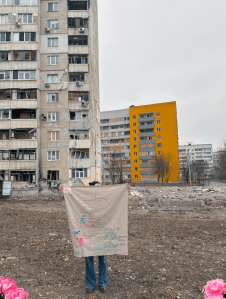 As a composer, how do you approach spoken words based works?
Helena: As I kind of mentioned, a lot of my work is rooted in the idea of there being an ‘unsound’; that any given articulation is already loaded with a sort of ‘unarticulation’ that exists both within and beyond the one we’re immediately presented with. From this perspective, I’m interested to see how ‘untold-ness’ manifests in and around the stories we collect and ultimately create from/with – what compositional possibilities are housed in the negative space of narrative?
How would you say the role of the artist changes in times of war?
Daria: Nowadays, the word artist has become a broad term, which is good. We have the freedom — and the responsibility — to engage more deeply, to help more. Artists today must share, stay grounded, and use their knowledge and empathy to support others.
In times of war, the artist becomes a mirror of society and its transformations, a shadow of society. The artist has a voice to tell stories, to tell the truth. In such moments, being socially responsible and deeply honest is not just a choice; it’s essential.
OCTOBER 22, 2025 – Bila Tserkva / in the army
Hi, I’m lebben, the founder of the lebben project and in the past the drum and bass project Ochitsuki. I’m a drummer and I just really love music, I collect vinyl, manga and everything I like. I’ve been making music since 2015, when I first discovered FL Studio and drums.
Has the full-scale invasion changed the way you think about music and sound in general and has your setup changed as a result?
The war changed my whole lifestyle, which was reflected in my work, and from the moment I joined the army – everything changed, because war became a more personal and less stereotypical concept for me. I try not to write about war in my tracks, because I don’t really like it because it’s everywhere, so I try to express my emotions with the help of images so as not to overexert the listener and myself. At least that’s how I like to write, because it most authentically conveys my vision of music in the context of Ukraine.
What can you tell us about the production process for цигарки vol. 2?
The production of this album took quite a long time, because after the previous split with Чортополох (Цигарки), I planned to immediately make a new release. The album was recorded half at OBLAZ Records, and half at home. I recorded it on cassette, and then digitized it, which is why the sound that I dreamed of before appeared, but could not reproduce due to the specifics of the sound of analog music media. Before I record a music release, some kind of reversible event always happens in life that changes my mental state, which is reflected in the music. And this release is no exception. Several tracks were taken and re-arranged from old releases from 2020, which, in my opinion, were perfect for this release. Plus, comparing to past releases, it seems to me that this release is a bit more than my usual EP, which I’m happy about
 The album цигарки vol. 2 starts in an almost ambient mode, and the music for “два по ціні одного” is almost similarly ambient. And yet elsewhere the album flirts with jazz and even noise at times. How do you go about constructing the instrumental parts into a cohesive whole while mixing them with hip hop lyrics?
It comes more from my musical preferences and mood. I just make some instrumental, and then I write lyrics for it because it seems to me that the synergy with the beat is much better this way. It’s no longer about music, but about what mental state I have at the time of writing the track. For example, the track “костянтинівка” was written based on the period of my military service in this place and is more associated with a touch of sadness and a feeling of complete hopelessness.
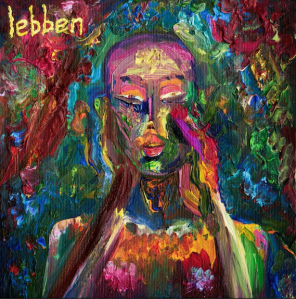
I had the idea to create a musical score around the artwork. I had an album called найкращі друзі, and this artwork was created by a friend, inspired by my music. Music is very variable and in my opinion does not need specific genre frameworks except for formally defining the foundation of the song so that listeners can at least associate the music with something.
Is there a music community in Bila Tserkva that you feel part of?
I spent some time studying the music scene of Bila Tserkva, but, to be honest, I could not find people who would share my vision of music. The most interesting thing is that the city produces really talented musicians such as session drummer Mykhailo Galinin – but really interesting bands can be counted on the fingers of one hand. There used to be a pretty active underground rap scene here, but now it has mostly disappeared due to the full-scale invasion and lack of promise of the rap that was made in Bila Tserkva from 2015-2018. Nevertheless, I think there is a lot of potential here. Maybe I just haven’t been that deeply interested in the artists from my city. Considering that famous Ukrainian artists rarely come to Bila Tserkva, the local scene actually has a real chance to develop.
How would you describe the experimental and lo-fi hip hop scene in Ukraine and what would you say are its most interesting developments?
In my opinion, the lo-fi hip-hop scene in Ukraine is difficult to characterize due to the not so rich number of these artists. Plus, quite a few people mean by the word lo-fi any stream with lo-fi beats, which was previously popular, which is why the meaning of the definition of this genre is lost. Lo-fi is more likely not about the quality of the recording, but about emotions.
Are there any Ukrainian albums from the past four years that have captured current events in a meaningful way for you?
I like the mood of the Lasta release – Sunflower, which reflects the stream of consciousness and in general my mental state and the feeling of being in society. Of the latest releases that I listened to, I would note ЧОРТОПОЛОХ – глум, Увага – Сум’яття, івл івл – я непотрібен мені, almost any Zipcult album.
 Do you ever suffer from burnout and how do you deal with it?
Burnout as such occurs for me after the album is released, so I usually take a break to not listen to any music, meditate to the sounds of nature in a local park. Despite the fact that music for me is more of a hobby and a way to sublimate emotions – in some places it is the same job, though without a salary and sometimes when thinking about a track – with brainstorming. With my approach “music according to mood” the option of rest and distancing is ideal.
What does it mean for you to be Ukrainian?
For me being Ukrainian means having a deep understanding of the historical, cultural context. it is about appreciating the community and the ability to unite even in difficult times. at least this is what reminds me of who we are.
Which book / film / album / song / traditional dish / podcast / blog / artwork / building / meme best captures Ukraine for you?
In my opinion, the best film that reflects Ukraine is Parajanov’s film Тіні забутих предків. It is difficult to single out something from music, because in my opinion all underground artists who write music in Ukrainian or in general on the territory of Ukraine are great guys.
OCTOBER 23, 2025 – In the army
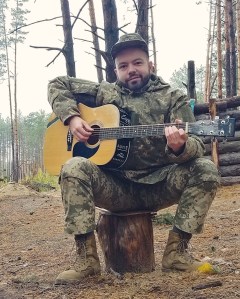
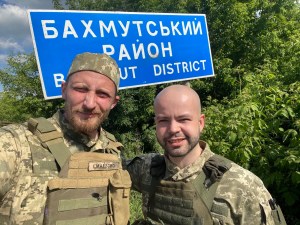
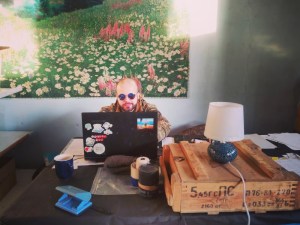
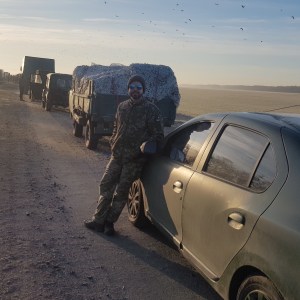
Hi! My name is Andrii Dmytrenko – a frontman of indie band called adm:t. Before the full-scale invasion we played on the biggest music festivals in Ukraine: Zaxidfest, Respublica Fest, Koktebel Jazz Fest and dreamed about performance at Atlas Weekend. The irony is that we still haven’t done a single full-fledged solo performance yet. So I’ll keep these objectives after being demobilised someday.
Has the full-scale invasion changed the way you think about music and sound in general and has your setup and lyrics changed as a result?
To be honest, the war changed everything. If you`ll compare my old and new songs, the lyrics have become less carefree, almost every song now features war, and the music has become heavier and more rhythmic.
First of all, I have much less time for music now, and sometimes there is none at all. This, in turn, changed my approach for writing and releasing my songs. I no longer write them just in the “Demo” folder on my PC and try to finish every idea. I appreciate every second I have for creativity and every opportunity to work a little in the studio. Every time I’m in the studio, I can simultaneously record guitar and vocal parts for three or even more upcoming songs. Then all the recording I send to my teammate Taras Pidkuimukha – who makes brilliant mixing and sound for all my songs since 2019. Such online format made me more productive musician (in terms of the number of releases) during my military service than before. From other hand, as a band – we hadn’t have any rehearsals as well as live performance with Dmytryk, Kostyk and Sashko since November 2021.
 How would you describe the indie folk scene in Ukraine and the music community in Kyiv?
I guess I’m not part of the music community. Especially now. And in general, I’ve rethought my sound and style, because I don’t use ethnic instruments classically in my songs, but rather ask Dmytryk to play parts on woodwinds that are more typical for guitar.
To my knowledge, the last couple of track you released are collaborations with Lisnyi, На Її Основі and Tember Blanche. How important are collaborations to you and how do these come about?
I planned my next EP as an album of collaborations with those artists who are close to me in spirit and whom I like to listen. Some of the songs have already been released: “Ах, життя моє дороге” with James Hot, “Метаморфосінь” with Tember Blanche (lyrics by Maksym “Dali” Kryvtsov), “Течія” with Terry Phao. I also hope to release the song “Швидкоплин” with musician and brother-in-arm Remez by the end of the year.
Collaboration with Lisnyi on the project “На її основі” is, if I may say so, a release that was not planned in advance. I am very proud of participating in this project and perhaps, after all, it will be able to include the song “Лід у воді” to my upcoming EP.
Ukrainian music seems to be thriving in spite of the war, but how do you see the scene evolving with many artists having now relocated and many being mobilised?
I think that those artists who are currently serving in the Ukrainian defense forces have something to tell – that’s why it’s important if each of them would find an opportunity to write and release new songs.
And I personally don’t accept and don’t follow those artists who left Ukraine after the full-scale invasion.
I understand you are currently serving. How would you describe the musical preferences of servicemen? Considering this is a very diverse group of people, have you noticed any dominant genres—say, metal or hip-hop—and do people exchange playlists?
It’s very difficult to generalize the preferences of all military personnel, but if I had to choose one genre, I would say it’s post-punk.
 Has the constant stream of quick dopamine-releasing content from TikTok or Instagram replaced music as a source of instant gratification and comfort within the military?
I still don’t use Tik-Tok. It’s a bit wild, I guess, isn’t it?
Are there particular songs or genres used to honour fallen comrades, and does music help in the process of healing?
Two of my songs are based on lyrics by Maksym “Dali” Kryvtsov: “Завтра?” and “Метаморфосінь“. We agreed on their publication while he was alive, but he was killed during combat actions in Kharkiv region last year.
My songs “Флешбеки“, “Течія” and the upcoming song “Швидкоплин” are dedicated to killed and missing brother-in-arms from the 207th separate battalion of the territorial defense forces. It is important to remember everyone as well as to build up a culture of memory.
 What does it mean to be Ukrainian for you?
To be territorially in Ukraine. To be active and conscious. To be a part of Ukrainian defence forces or to help them.
Can you think about the future and, if so, what does it hold for you?
Victory of Ukraine. It is different for everyone. But it is equally desirable for everyone. It won’t be tomorrow.
Which book / film / album / song / traditional dish / podcast / blog / artwork / building / meme best captures Ukraine for you?
My choice would be the next:
- Book: Artem Chekh – Гра в перевдягання (Dress Up Game)
- Film: Lesya Bakalets – Вода буде завтра (Water Will Be Tomorrow)
- Album: Remez – Кілометри (kilometry)
- Song: Renie Cares – “Дамоклів меч” (Damokliv mech – Sword of Damocles)
- Traditional dish: Деруни (Deruny)
- Best memes: Mysha v blindazh
OCTOBER 24, 2025 – In the army
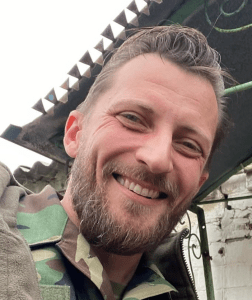
I’m Remez, my name is Oleksandr.
Since I was 15, I played in rockabilly bands, also played and wrote songs in American roots way (old jazz, blues, yearly soul). My band RvB was active both in Ukraine and abroad. With the beginning of the full-scale Russian invasion of Ukraine, over time I began to release songs solo, as Remez.
What can you tell us about the Ukrainian Cultural Forces and the way they operate?
This is an organization that covers many different cultural needs at the same time. Both in the army and outside it. These include cultural events for the military, near the contact line, and social projects aimed at drawing attention to military needs, as well as cultural and diplomatic delegations around the world.
Does the role of the artist change in wartime and what role can music play in the war effort?
Of course it is changing! First of all, we have a very unusual situation, Ukraine has been under the influence of Russian propaganda for over 200 years and during this time, about 100 times the excesses of the ban on the Ukrainian language and culture were recorded. This also included shootings, torture and torture of artists and cultural figures of the country.
Because of this, now the job of any artist is to return us all to our culture, and this is a task with an asterisk! We also all know how art heals the soul, tunes it in, so we put a lot of effort into this direction.
Granted that people in the military come from very different backgrounds, how would you describe the musical preferences of servicemen and women? Have you noticed any dominant genres—say, metal or hip-hop—and do people exchange playlists?
In fact, there are as many genres as there are people. But since fighters often post on the Internet, it’s rap and post-punk, but no one has canceled AC/DC and Johnny Cash.
Has the constant stream of quick dopamine-releasing content from TikTok or Instagram replaced music as a source of instant gratification and comfort within the military?
This effect is certainly present! But when people do something like drive a car or cook food or chop wood, they listen to music.
When I interviewed Sasha Boole in Lviv back in May, he told me that one of the things he learned while serving is to write more direct, stripped down songs without worrying too much about production values, or making tracks too “ornate.” Is this something you agree with and how have you managed to keep your creativity going?
Sasha Boole is a great artist! I understand him well! Personally, I don’t have a specific approach to creating songs, sometimes direct language is the best solution, and sometimes I want to create an atmosphere with words and leave variability, as well as develop my poetics and storytelling.
But as for the recordings, I want to convey the emotion as purely as possible and I believe that lo-fi will be the most honest here, especially since the conditions in which I record and mix them cannot be made any better, and there is no time or money for that.
What makes me continue to create? For me, this is life, I can’t keep it to myself, and no matter how hard it is to realize it, without it there is no meaning to existence for me.
What can you tell us about the production process for your album Kilometres and what kind of feedback did you get from people in your unit?
I hope it’s too early to talk about feedback, because at the time of our interview, only a day had passed. But some people wrote to me that this is very sincere music and thanked me. Unfortunately, some music communities are ignoring the appearance of this album, which is a shame.
There are 2 different things here, it’s writing songs and recording them. The songs were written from 2024 to 25. I recorded it all in 2025, all by myself (except for the drums and piano in the flood song, which Lucas Byrd played) and the last song, where my wife sings. I recorded it in the car, then in the barn early in the morning before leaving for work, and something at home on vacation.
On a general note, are there any particular tracks that have become widespread among soldiers, or used in memes—and if so, what made them popular?
I think more about authenticity and less about popularity or memes. So I don’t know what to say.
 Does music in the army reinforce stereotypes of masculinity, or amplify ideas of nationalism and identity as some claim?
Everything you say is true! But it also promotes reflection and encourages acceptance of reality and paints a different angle of perception.
Are there particular songs or genres used to honour fallen comrades, and does music help in the healing process?
Yes! In certain units there are certain traditions with burial. There is music for recovery, but I don’t work in those genres. I’m more of a storyteller and story collector.
What does it mean to you to be Ukrainian?
Haha! I don’t know how not to be Ukrainian. Despite the fact that I read books and watched films about life in other countries. But a lot of things come to us from birth, subconsciously. I must admit that since 2022 I have been discovering the country, people and culture in a completely new way, it is a very strange and pleasant feeling.
OCTOBER 25, 2025 – HELSINKI
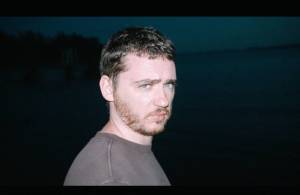
photo by Renata Kazhan
Hi, and thank you for having me — it’s a pleasure to be featured in A Closer Listen.
My name is Yevgen Chebotarenko. I am a musician and audio technology specialist. In my teens, I started playing my dad’s guitar and messing around with different audio software, mostly writing down ideas and playing with sounds on my computer. Later, in 2007, I started a band in Odesa called My Personal Murderer. Back then, the band was quite a typical mockery of the Western rock music canon, which was often the case for Ukrainian bands of that time, though its genre changed quite drastically later on and the music became more abstract, so to speak.
My interest in audio technology evolved into a full-time profession, which deepened my knowledge of and appreciation for sound. These days, along with working for a company called Neural DSP, I am mostly focusing on electroacoustic music composition, which I studied a bit while in Finland.
I don’t know when you moved to Helsinki, but has the full-scale invasion changed the way you think about music and sound in general?
I moved to Helsinki in 2019. I don’t think I know the answer to your question yet. When the Russians invaded Ukraine in 2022, music was the last thing I wanted to think about. Only after some time did I start returning to it, slowly.
What is your production process and your home studio setup?
My process is relatively standard — I usually work in three stages: recording, mixing, and assembling the final piece.
For recording, I improvise and record the instruments I have, ask friends to play, or walk around with a field recorder capturing sounds I find interesting. After collecting sounds, I mix them by manipulating their pitch, spatial characteristics, applying filters, and so on, thus producing various so-called textures. I never know what I want to get in the end, and that’s the most exciting part of music-making for me.
To simplify the mixing process, I use computer software — mostly Ableton Live and the JUCE framework for the C++ programming language, which gives me the freedom to tweak things to my liking in the smallest detail — as well as the Elektron Octatrack hardware sampler, my all-time favorite piece of musical gear.
Once the “textures” are ready, I start improvising with them again, adding special effects and more traditional instruments or voice until I get a piece of music that feels right.
My home studio consists of a 14-channel mixing desk, a couple of microphones, a guitar, an analog synthesizer, a hardware sampler, and a bunch of guitar processors and special-effects units.
How did your collaboration with Samuel Van Dijk on Ear to Ear come about and what can you tell us about the way you prepare for a live performance?
We met at work. He shared his music, and I really liked it, so at some point I invited him over to listen and play some music together. The improvisation session we had went pretty well, so we decided to make it a tradition. Each time, Samuel brought some new and interesting piece of gear to play with, and we improvised for three to four hours, recording everything. There must be tens of hours of Ear to Ear recordings on his PC. Every such improvisation felt like a conversation — it was always exciting to hear what kind of sound would come next.
In the liner notes to Birth of a Song, you state that the album started as random moments of sound. How important is improvisation for you and how did the vocals come into play? Also, the sound of the album feels organic, did you use any processed field recordings?
Improvisation is fundamental. The only thing I usually plan before the recording process is which configuration of instruments and musical gear I’m going to use.
As for the vocals — it just felt right at the moment.
Regarding the organic sound, on Birth of a Song I used only two field recordings I am aware of: one of a bike parking lot next to the power plant not far from my place here in Helsinki, and another from a walk in the snowy forest. I also really love swamps — they sound amazing and mysterious — so I have a couple of pedals that helped me create that “swampy” feel: Moog’s MF-104M delay and MF Chorus.
I am intrigued by the cover artwork. What can you tell us about it?
I wanted something sexy, so I asked my girlfriend to take a photo of my legs.
Are there any albums from Ukrainian artists that have managed to capture current events for you in a meaningful way?
I enjoyed listening to the Shadow Play album by the Ukrainian black metal band Drudkh, released a couple of months ago. I think it fits the times pretty well.
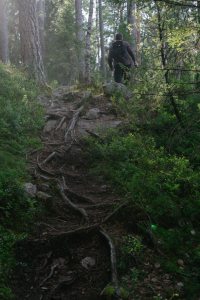
photo by Renata Kazhan
How would you describe the electronic and experimental scene in Ukraine and what would you say are its most interesting developments?
I’m lucky to have talented friends, so I don’t have to look far to find good electronic music.
Trinidad Shevron makes haunting and visceral techno — I really enjoy the combination of heavy machinery and wailing soundscapes in his music; Promised Consort is my go-to track from him.
super inter creates very intimate and detailed music that can also be quite emotional — really well-balanced stuff. I especially enjoy her From the East release.
Renata Kazhan combines drone and pop music, and it works really, really well — very dreamy, and she’s also a great singer. I steal some ideas from her from time to time. Check out her song “Swift Sword.”
Just imagine how many more talented people from Ukraine are out there. It seems to me that, despite the existential threat that Russia brings to the people of Ukraine, the music scene is thriving.
Which book / film / album / song / traditional dish / podcast / blog / artwork / building / meme best captures Ukraine for you?
- The song would be “Любов” (Love) by Воплі Відоплясова (Vopli Vidopliasova).
- The book — Вірші з Бійниці (Poems from the Loophole), frontline poetry by the late Ukrainian soldier Maksym Kryvtsov.
- As for the blog, I really enjoy watching the Хащі (@hush.chi) channel on YouTube — a couple of guys wandering around Ukraine in search of abandoned places and good stories.
- I spent my best years in Kyiv living next to St. Nicholas Cathedral — the one damaged some time ago by the Russians — that would be the building.
- And finally, the dish: definitely varenyky with salty cottage cheese, egg yolk, and smetana. Celestial food.
OCTOBER 27, 2025 – Wrocław, POLAND
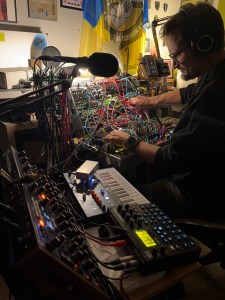
I’m a self taught music artist and sound designer from Kharkiv, UA. I’ve started making music at school as many teenagers do playing in bands on drums and/or keys/synths+live FX and learning to produce in my free time. Then served in 2014-2015 in Donbass when the war had just started. After demobilization, I rethought my life and started making music full time, working as a full time video game composer and sound designer. Also started to occasionally compose for theatre. Been doing it since.
Has the full-scale invasion changed the way you think about music and sound in general and how did it impact your motivation to make music?
The way I think of it (and not just music and sound, but life in general) has changed a lot earlier, in 2014.
The full scale invasion in 2022 made me stop doing any music at all, as I’ve started my volunteering activities to help the army and civilians from the first days of the invasion. I had neither the time nor any will to make music. To make music, I need time, distance and ability to reflect, and back then it was (and often still is) the wrong time.
Eventually, I started to compose for theatre and experiment with my own projects (just switch attention to something different). Volunteering remains my main priority, while music remains a friend, a helping hand, a safe harbour to stay for some time.
Could you describe your production process when it comes to creating soundtracks for the theatre, and at what point do you become part of the creative process?
Theatre gives lots of creative freedom for sonic experiments, and as a composer you also need to provide much space and time for the actors to improvise to. The same scene rarely lasts the exact same time twice, so you need to compose accordingly.
I love using my modular synthesizer and other hardware when it comes to theatre. Modular synth gives this focus, freedom, space, sometimes real weirdness needed, and I figured out that theatre+modular is a perfect match for me.
I also like to use field recordings, often processed via modular, especially granular processors. This provides unique sound textures and organic feeling. Processed field recordings are also a great tool to set up the tone and provoke associations you need for a scene.
Of course you also need software to record, process, mix and master it all.
You wrote about the emotional toll of working on She the War, a post documental play following the real life stories of 30 Ukrainian women of different age, character and experience caught by the horror of war. Was the choice of working mostly with analog gear a way of feeling closer to the characters?
Not quite. In fact, several themes improvised on a modular synthesizer were recorded long before the play came to life. These recordings just found their place in the play.
I had a hard time making music since my demobilization in 2015, but I realised that every single draft I recorded since 2015 was in fact my own processing of the war experience.
The play director and I were surprised to find how appropriate these aged pieces happened to be for the play’s context, and we used them almost unedited.
How did the production process change or evolve in the case of The Sea Will Remain?
Tech-wise, it was a development for me, because for the first time I was able to combine all tools I had at my disposal and make them work together. Modular synth, acoustic and electric instruments, vocals, field recordings, software – all worked in conjunction.
Emotionally, this was a hard experience. Since 2022, I’ve been trying not to dive into reflection and overthinking, because I need to stay functional and focused for my volunteering work. But this project had me take off my emotional “armour”, and it was like messing with the open wound.
On my next theatrical project, I’d like to perform live with a modular and some strange sound sources, which should be interesting.
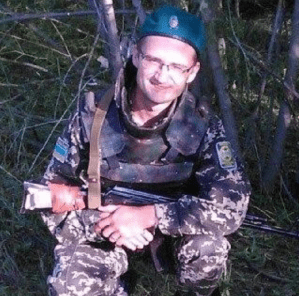 How would you describe the music scene in Kharkiv and how would you say the artistic community in general has been holding up since the full-scale invasion and are formations like Some People keeping the cultural momentum alive?
I’m not in Kharkiv anymore. I moved to Wrocław even before the full scale invasion started to try and live somewhere else. Some can say I was lucky, others can blame me for not returning, but I keep a very close perspective.
Although it’s mostly my fellow military whom I help and talk to, not artists.
Anyway, cultural life in Kharkiv thrives, thanks to Some People, DK Art Area, Nafta theatre and more. New talents emerge, and they indeed have what to say with their art, unlike a lot of “art” nowadays which feels empty “art for the sake of art”.
Art in Kharkiv, Dnipro and other cities close to the front is different. It may not be so sophisticated, but it’s real, it’s sincere, and it has a lot to say.
Unfortunately, theatre workers are in trouble, there’s no state financing. So it’s always a personal initiative and personal funds to keep unorthodox culture running in the city. As it’s always been. Lots of respect for these people and their work.
How would you say your acoustic environment has changed since the full-scale invasion aside from the ubiquitous presence of air-raid sirens?
Again, for me it changed more in 2014. As of now, I’d rather let others who remain in Kharkiv speak about this experience.
My friend, a renowned film and game composer, records all shaheeds, rockets, bombs and AA guns and shares these recordings with me (and uses them in his work!). That’s his way to cope.
I have recordings of Grad missiles, rifles and mortars from my time at war, but also recordings of night forests, fields, night birds. There are very weird sounding birds in Luhansk region, I have never heard them anywhere else. They sound like some UFOs in dolby atmos, they’re circling around you and make these strange noises. So yeah, lots of interesting sound sources (dark humor).
But everyone agrees on this: there’s nothing more horrifying than an aircraft jet engine above you. It’s a combination of this evolutional thing of expecting danger from above, and also pure force of sound (sonic booms), infrasound affecting your subconscious, and conscious understanding what it may cause and how random its outcome can be. Fortunately, there are no russian aircraft above our cities anymore. But on frontlines – yes.
Does the role of an artist change in times of war?
I think yes and no. At the beginning, many artists felt obliged to express the horrors of war, to shout out loud to the whole world. Cultural diplomacy they call it. You feel you just must do something.
But not everyone actually can. Some artists are able to quickly process things and are able to quickly deliver their experience in a selected art form. Their art is like a live feed from the place. I respect this ability very much.
But I’m not that kind of artist, I process things very slowly. That’s why for me feeling that I MUST do it became a blocker. Only when I freed myself from this feeling of obligation, I became able to make music again. Music must help you and be your partner to live through events, I think.
And when you’re actually at war as a soldier – it’s quite hard to make music or to even think about it.
I tried, but the only thing I could do was just play with some software you have on your mobile device. Priorities become very different.
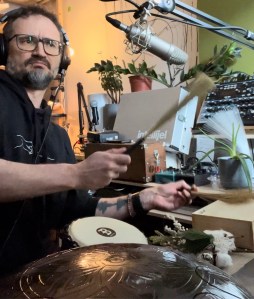 Are there any specific works by Ukrainian artists that have captured current events in a meaningful way for you?
Yes, definitely. I’m sure there are a lot more than I’ve heard of. Also, wartime is a time to rediscover old artists in completely new ways. One example is an album by a songwriter, musician, actor, volunteer and warrior from Kharkiv Oleg Kadanov, a well known local artist and a deep personality. In 2022, he somehow managed to release an album Чи то так, чи то ні (something like “Is that so or is that not”) between his rides to frontlines to help military and civilians. These peaceful, minimalistic, very quiet songs made such a powerful counterpoint with horrors happening everywhere and all the madness of the world. This music just hugged you and told you “There’s still good. There’s love. There’s quiet. Easy. Just live”. And I understood this was exactly what I needed at that moment, just like a lot of Ukrainians everywhere in the world. This counterpoint was so timely and so powerful. I just embraced the feeling and surrendered to it for a moment.
Another example is my friend from Kharkiv, and artist and volunteer Katya Kharchenko, who has been drawing stylized flowers each day since the invasion started. One flower per day. She uses them to mark each day passed, sending them to her beloved at the frontlines. Her flowers evolved, and this consistency and evolution have become an important symbol of life and resistance for me personally. It’s not a very public art, but it’s a real art with the real story behind it, and this is what really counts, imo. Check it out on her Instagram. In fact, there is so much love expressed in Ukrainian art nowadays, it’s like everyone is trying to confess to a beloved one till they still have time.
Anton Slepakov and Andrii Sokolov from Dnipro with their project warнякання. This felt just like broadcasting all our collective 2022 experience via a series of beats, texts and visuals. Very powerful. Both of them have joined the military since.
A poet killed in action, Maksym Kryvtsov. He wrote a book of instant poetry Poems from a loophole while on the frontline.
A children’s writer Volodymyr Vakulenko, who was tortured and killed in Izyum. He wrote diaries of occupation and hid them in his parents’ yard before he was taken.
There are so many, and there are so many we’ve lost. But each single little story of help, support, kindness seems a true art in itself for me. Art of love, art of life that prevails. You just need to capture and remember it.
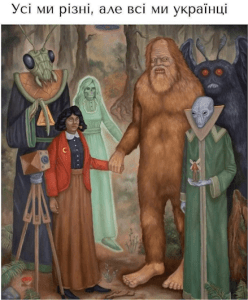
We are all different but we are all Ukrainian -meme
What does it mean for you to be Ukrainian?
To resist
To support
To give
To lose close ones
To want to live and love
To trust actions only
Which book / film / album / song / traditional dish / podcast / blog / artwork / building / meme best captures Ukraine for you?
- Book: Hnat Khotkevych – Musical Instruments of the Ukrainian People
- Film: Oleg Sentsov – Real (2024)
- Artwork: Maria Prymachenko – A Menace of War
- Building: A bombed residential building in North Saltivka, Kharkiv
- Meme: всі ми різні, але всі ми українці (we’re all different but we’re all Ukrainians)
OCTOBER 29, 2025 – HELSINKI
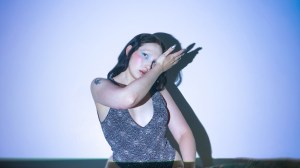
I’m a musician and artist from Odesa. My musical journey began in 2015 with a band I formed with friends called Zukkor Zzov, where I was the singer and songwriter. It was a multi-genre project that started off rough, rockish, even punkish, and gradually evolved into ethereal, dark cabaret. The sound kept changing as I changed the lineup several times. Just when I was close to achieving the sound I was searching for, the band fell apart. That was in 2020. After that, I slowly began my solo project, which I’m still developing today.
Has the full-scale invasion changed the way you think about music and sound in general, and has it changed your playlist?
Radically. Now I can clearly see the connection between music and politics. The global position of an artist has become crucial to me. Suppression often speaks louder than manifestation.
I no longer believe it’s possible to separate art from the person who creates it. The “death of the author” doesn’t apply anymore. Before, I wasn’t particularly interested in who musicians were as individuals; that’s changed completely. The same goes for sound itself — it feels more radical, more intense. My playlist has changed accordingly: some artists have disappeared from it, but many new ones have come: Zelienople, Jan Jelinek, Tim Hecker, Scott Walker, OHYUNG, among others.
You work at the intersection of pop, ambient, drone, and electronic music. What is your setup, and how would you describe your sound?
My setup is minimal: a laptop, a soundcard, headphones, and a microphone. I work entirely in Ableton Live, using a mix of plugins, synths, and samples. I like the freedom of keeping everything inside the laptop. It’s a full studio and a space for exploration.
The process is about letting go of sound and then rediscovering it, collecting fragments, rearranging them, decoding the sense behind them.
My boyfriend once described my genre as “slow burn pop,” which I think fits quite well. My sound is intimate, atmospheric, and deeply textural. It values tone and transformation over structure or convention.
What can you tell us about the experimental music scene in Odesa and its evolution?
Unfortunately, there isn’t much to say about Odesa’s experimental scene at the moment. There are only a few spaces left for artists of this kind, and most musicians from Odesa have relocated to Kyiv or abroad. I would love to see it thrive again, but I have to admit that I witnessed its decline even before the full-scale war began.
How important is the visual element in your practice?
It’s important, though in a different way than before. It used to be central, I used to build everything around a visual image. My background in photography naturally influenced my musical approach.
But as I dove deeper into sound — learning, constructing, and actively listening — my relationship with visuality changed. It’s still significant, because when I compose, I perceive sound visually as well. But now the balance has shifted; the focus is more on sound itself.
Last April you released Hymera, a track composed entirely from samples and field recordings provided by friends, including essentialmiks, who is also from Odesa (now based in Germany). Considering you’re currently in Helsinki, is sonic connectivity important to you?
Of course. That was one of the main reasons I created this project. I wanted to explore active listening and see how many of those listeners already existed within my social circle. But the essential goal was to connect different people within a single piece of music — from the battlefield to safe places like Germany and Poland. I wanted to bring together sounds and worlds that would never meet otherwise.
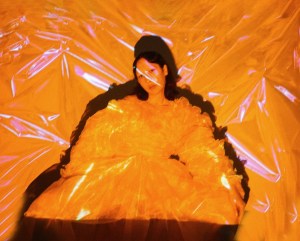 What does it mean to be Ukrainian for you?
Identity, to me, is something evolving. It’s not fixed or inherited; it shifts and must be built consciously.
Despite my background — the unrooted feeling, the “cosmopolitan” environment I grew up in, parents somewhat lost in that same atmosphere — I made my personal choice. It became clearer after 2014, and in 2022 it grew sharper and more defined. It’s probably the least I can do.
So I would say I’m growing my own identity. For me, it’s not about blood or history but about awareness and personal decisions.
Are there any Ukrainian releases from the past four years that have captured the war experience in a meaningful way for you?
СТАСІК — “Герої вмирають” (STASIK — “Heroes Die”). For me, it’s one of the strongest examples, painful and beautiful at the same time.
Yevgen Chebotarenko — Birth of a Song. It comes from a completely different universe than the first piece, but I think it captures this feeling of longing, sadness, and that anxious state you eventually learn to live with.
Which book / film / album / song / traditional dish / meme best captures Ukraine for you?
- Film: Babylon XX — Ukrainian poetic cinema.
- Album: Recordings 1987–1991, Vol. 1 by Valentina Goncharova.
- Song: “Велика ріка Хєнь-Юань” (The Great Hen-Yuan River) by Цукор Біла Смерть (Sugar White Death).
- Traditional dish: Borscht — 100 percent!!!
- Meme:
Захеканий мудило (лежачі долі). Там масла дохуя! [Panting jerk (lying on the ground). There’s a shitload of butter!]
Всі мудила. Де? [Other jerks. Where?]
Захеканий мудило. Там! (Помирає). [Panting jerk. There! (Dies.)]
OCTOBER 29, 2025 – CZECHIA
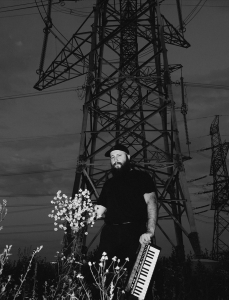
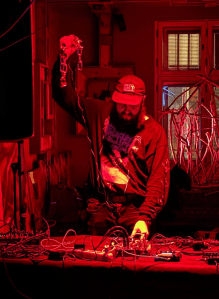
I’m Artem Sharko, and this is my solo noise project, named after my last name. I occasionally participate in various genre projects with my friends. I don’t really have a musical background. I’ve been playing instruments my whole life, starting in childhood.
Has the full-scale invasion changed the way you think about music and sound in general and has it changed your playlist?
Yes, absolutely. I began to take a deeper interest in noise and sound texture, it served as a meditation and distraction. This is where my first works and recordings came from. Overall, I’d say I was stuck for a long time, not really listening to anything, and then I rediscovered music. This project is a form of self-reflection, and noise is good at that.
What is your setup and your favourite piece of gear and what would you say is the defining trait of your sound?
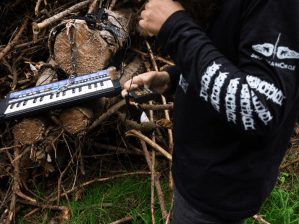
Literally Ukrainian Field Notes. All the equipment is small devices and battery-powered synthesizers that fit in a bag for playing outdoors. The project has been going on for many years. I can go on a bike ride with friends or hike in the mountains and quietly jam away for the birds. My main and favorite instrument here is the Microgranny Monolith granular sampler from the Czech company Bastl Instruments. I started in Kherson when I was making tape loops and only had a Monotron Delay and Pocket Operator 32. They’re still used on my recordings. I also have a small Dude mixer, also from the Czechs, which I use in No-Input mode. Sometimes I use a re-flashed Zoom G1 Four bass multi-effector.
That’s where my portable basic setup ends. For recordings and performances, I also use an analog Behringer mixer and a distortion pedal with a piezo mic connected to the chain. And sometimes my Yamaha synthesizer also runs on batteries. But it’s almost never on the recordings.
 Your first release is titled Rybníček – Stop of René Matoušek and other Liberec signatories of Charter 77 a real bus stop in the city of Liberec where you reside. It is inspired by Charter 77, the human rights manifesto and civic initiative in Czechoslovakia that began in January 1977. It was a document criticising the government for failing to uphold the human and civil rights it had previously agreed to in international pacts like the Helsinki Final Act and was motivated in part by the arrest of members of the rock band The Plastic People of the Universe. What can you tell us about the production process and the use of field recordings?
Well, at first, before the full-scale invasion, I just wanted to create a harsh noise project for fun. And I liked the fact that the stop name was so long. When they announce the stop, you can hear the announcer getting tired and trying to drag it out in one breath 🙂 And the Blackmetal logo, which is on the cover. Essentially, the question says everything about the charter. Of course, I immediately became interested in what kind of charter it was, and it reminded me of the story of Vasil Stus and the parallels with the Ukrainian Helsinki Group.
The idea was to mix samples as if I were streaming my thoughts from my head. They have nothing to do with Stus or the first president of the Czech Republic; they’re just samples I found somewhere, perhaps related to the context of that time. Indiscriminately, Czech and Ukrainian fragments, and not only from films, cartoons, and TV shows in short, it’s all about emotions. That’s what noise is. I’d like to especially highlight the fourth track, recorded on a voice recorder in the forest on the equinox, where you can even hear the birds singing. This is essentially my first full recording, so it’s so important to me.
Exactly one year from now, I’ll be performing for the second time at axis fest, where I’ll be performing with Czech underground giants Markoman Electronics. Incidentally, they’ve greatly influenced my sound. Special shoutout to Marek from Bahratal, v0nt, and zimoles. Thank you so much for the invitation to Gregory and congratulations on the release of Hothouse.
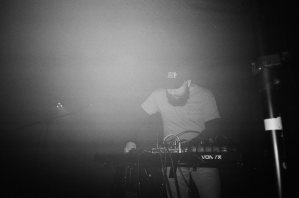 Your second release Koty (to the cat) is dedicated to the animals affected by war. It reflects your personal experience of losing a friend and your feelings for animals as victims of war. The album could be defined as folk noise, what can you tell us about the use of folk instruments and the looped snippets of singing and speech embedded within the overall noise texture and how do they relate to memory, in the sense of both collective and personal memory?
Yes. Releasing a track is an experience both personal and collective. I first tried recording on two tracks. On one, I played a full live performance, playing around with the main motifs, and on the second, I played some loopy sketches that had been sitting in my head for quite a while, using very short sections, and also tried polyrhythms. Returning to instruments, I unleashed the potential of the granular sampler, using the additional capabilities of the MIDI output. It’s hard to say where and how I get samples. It’s always different, and it’s what resonates with me. For example, I watch a film and I really like that sound. I’m a fan of the Dovzhenko Film Studio, as well as the Barandov Film Studio. This is where the interweaving of samples comes in. I like juggling them. I graduated from music school and was around string players for a long time. It’s an echo of my childhood. I like the sounds of radio and instrument tests. I really, really like the chaotic nature of philharmonic settings. By looping, I can control this chaos. Calling it folk noise is quite difficult, and I really hope it’s just that. Three collaborations and recordings with live instruments are planned for the future.
The first and last tracks, designated by capital letters, refer to my cat. It so happened that the viscous, bloody hand of war touched my heart in the form of my cat’s death.
Through looping samples throughout the record, I depicted a moment in life, the coming of war from without through the sound of drums and brass, a moment of forced migration, unfamiliar sounds (Czech hum, attention, test), peace, and, again, the echo of war, because being in the Czech Republic, you’re still not safe. I’m a migrant researcher who lived in the Czech Republic for many years, even before the full-scale war began. My parents couldn’t leave for a long time; they were occupied for a year, and then, with great difficulty, they moved to me in the Czech Republic, and a month later, Kherson was heroically liberated.
My cat was a stray ginger and often had territorial fights. He’d wander outside all day and come home in the evening to eat and sleep. He would often come home bruised, but was always happy to see me. After moving to the Czech Republic, he developed heart problems.
He died before my eyes. If not for the war, he would still be alive. I grieved this loss for a long time. I’m quite sensitive, and this loss was comparable to the explosion of the Kakhovka Reservoir dam. There were so many casualties back then. I remember conversations with people in Kherson before the water had risen, but everyone understood it would be very difficult. (I also wanted to convey this in this release.) In Kherson, there was an outbreak of diseases associated with toxic substances found in the water. All the music in this release is about the time of the flooding of southern Ukraine and the sacrifice of animals that still exist today.
The impact on Askania-Nova, a biosphere reserve in the Kherson region, is especially worth noting. The scorched Serebryansky Forest (a needle of which found its way into my monotron and is still there). The devastation of the Dzharylhach national nature park, and so on.
Everyone will hear something unique in this release. There’s a reflection on the flood, and a memory that rushes past like a ringing sound, never fading. With each beat, the sound grows louder and louder. The noise is memory, it’s pain, and the ringing in the ears is all “Memory” (the last track). Every soul is not forgotten, and everything will remain as heaviness in my chest.
The cat was my friend and even a “work colleague”; I wrote my dissertation with him when I was in Kherson during COVID. He helped me experience a ton of emotions in my life. When I picked him up as a kitten, he had a great sense of rhythm, which is why he was named after the jazz drummer Buddy Richie. A little ginger piece of happiness in my heart, which is now forever gone.
Like the first release, this one was again created with a touch of humour. The funny cat and the name of the cat are a nod to Kharkiv punks and their songs about a cat, about a father, and about themselves. Despite the pain, you should always treat everything with warmth and joy. I only remember the good.
 You are originally from Kherson, what can you tell us about the music scene in your hometown prior to the full-scale invasion?
The Kherson scene is very interesting, spanning a variety of styles. Many have migrated to other cities. I’d like to highlight Andrey separately. An old childhood friend of mine whom I’ve known my whole life. My godfather in music, who led me by the hand into an entire era. He was already on Ukrainian Field Notes when he presented his project Merti Dereva. He is a master of the Ukrainian heavy scene. I like all of his projects without exception.
Check out Signals Feed the Void specifically. The guys from South Death Circle and the Kherson breakcore scene are also good. Suck Puck Records is worth mentioning. Although it’s closer to Odessa, there are a lot of Kherson artists on their compilations. There are actually a lot of musicians, and the punk scene is also good.
 Are there any Ukrainian releases from the past four years that have captured the war experience in a meaningful way for you?
Yes, there are many significant ones, unfortunately, related to the loss of project participants who gave their lives in the war. I haven’t seen anyone who actually shared their military experience. It seems like lately I’ve only heard about war crimes or reflections on the war. Again, I’m reminded of the work of my friends Gvalt. Also, the projects of Andrey Waidelotte.
It’s worth mentioning my brother in music Alexey, he runs the cassette label Sklep na Strasnice. Listen loudly and insistently to everything released on this label. Everything is great there. And there will be much more. His noise project, ZOB, features the horrors of war and the sound of ceilings collapsing. We have planned a joint release and are working on several projects together. Alexey also inspired me to create releases with Sasha from dissipativ, who later invited me to perform for the first time with Coachella (solidaritycollectives, Riot Over River).
Which book / film / album / song / traditional dish / podcast / blog / artwork / building / meme best captures Ukraine for you?
The media landscape is so vibrant right now that it’s hard to answer this question definitively.
I really appreciate young people returning to old films. Watching The Lost Letter (1972) with friends would probably be a good idea. It’s a form of fond nostalgia for Ukraine.
OCTOBER 30, 2025 – KYIV
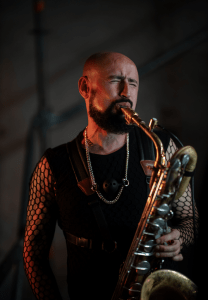
My name is Andrey Sidorkin. I came to music from text-centered and conceptual practices. I’m not even sure I can say I came into music, because I don’t really consider what I do to be music. I don’t solve any specifically musical problems — I work, rather, with cultural ones: with the expectations surrounding what music is supposed to be. I’m interested in drifting among styles and the signs that make them recognizable and reproducible — drifting without staying anywhere for too long. I usually describe it this way: I’m an artist critically reproducing the position of a musician, performing an intervention into the territory of music. I don’t play music — I play with music: I produce quasi-musical continuities that correspond to established stylistic codes, and then I overturn them — by introducing an alien element or collapsing the structure in some other way.
Has the full-scale invasion changed the way you think about music and sound in general, and has it altered your setup?
I can’t say that external circumstances have significantly affected my creative routine. I remember the first days of the invasion, when the air defense system barely worked and anything that flew could hit — sirens wailing, explosions thundering — and I was playing scales to a metronome. There was, of course, a certain sense of absurdity. I couldn’t help but recall the scene in Kusturica’s Underground — you know, the one where the character masturbates during the bombing. Now, as before, I’m primarily focused on live performances. My setup consists of a pedalboard that modifies the saxophone sound, and an Elektron Octatrack, which I use simultaneously as a groovebox, mixer, and effects processor. Most of the challenges I face are not musical but rather engineering and sound-design ones — for example, how to properly amplify the saxophone on stage, which becomes quite a nontrivial task under loud club conditions.
As far as I know, Scattered is your only solo release since February 24, 2022. Many have told me that in the immediate aftermath of the invasion they were unable not just to produce new material but even to listen to music. Has this been your experience as well, and, if so, what brought you back to music?
That release was, to some extent, accidental. It’s a compilation of heterogeneous recordings that came out only because the label Signora Ward Records reached out to me, and I didn’t have any new tracks. So I gathered what was left unreleased. I’m not yet ready to return to studio work — it’s a completely different process, a different pattern of compositional thinking compared to preparing live sets. I just don’t feel ready. I already have one album that I now completely dislike, and I want the next one to be, at the very least, great. “God saw everything that He had made, and behold, it was very good.” For now, I’m working on a new live set.
How would you describe your sound, and do you feel more at home with dark jazz or doom glitch?
The product of my work could be described as N + saxophone, where the variable N is whatever I’m currently interested in. Right now it’s aggressive dance music — rhythmic noise, hard techno. Earlier, my live sets contained elements of ambient, illbient, doom dub, dark jazz, post-rock, musique concrète, and so on (though the material developed back then hasn’t disappeared). I can easily drop a jazz standard like Ellington’s “Sophisticated Lady” into the set in some IDM wrapper — to make the listener think, “Wait, what the hell was that?”
I use the saxophone (baritone, and soon possibly soprano as well) for solos, for sound effects, and as a basic oscillator for looping multilayered textures, pads, and so on. Bringing the jazz saxophone sound into an unconventional environment produces a deconstructive effect in itself — the style seems to turn itself inside out, showing its guts. I’m fully aware that to achieve my conceptual goals, I first have to relax and seduce the listener, following Horace’s famous maxim – before evoking a flicker of meanings, before drawing them into a Fort/Da game. To take something away, first you must give.
Last May I saw you perform at Laboratorium together with Sasha Dolgiy and solo at Noise Every Wednesday. How do you prepare for a live and how much room for improv do you leave?
I pre-write grooves with a high degree of probability and options for live intervention during the performance. On stage, I loop textures and pads and improvise saxophone solos. A performance is always an improvisation — but within predefined boundaries. When I rehearse at home, I record everything and listen back to note what works and discard what doesn’t.
Noise Every Wednesday has now closed after 100 glorious weeks. How do you explain its success and what does its loss mean to you?
It’s a colossal loss — for everyone, and for me personally. For me it was a genuine creative laboratory, a place where I could bring new ideas and test them on an audience. Now that it’s gone, the pace of producing new material may slow down considerably, because it’s not clear where to play it. There weren’t many venues to begin with, and now there are almost none left. Still, if there ends up being nowhere to play at all — perhaps that’s a sign it’s time to start recording an album. Sometimes I feel like I’m the only person in Kyiv playing music (well, “music”) that truly deserves to be called experimental. In the original sense, an experiment is when you do something to see what happens — and I genuinely don’t know what will happen. Noise is already a format. And I exist outside of all formats. Noise or pop — to me they’re both just cultural material to be processed. That’s why I’m equally unlikely to be invited to harsh noise events, ambient concerts, or rave parties.
Are there any Ukrainian releases from the past three and a half years that have managed to convey life during the full-scale invasion in a meaningful way for you?
I’ve hardly listened to any new releases. I’ve been listening mostly to jazz — mainly music without words, without clear messages. I’ve been transcribing solos by my favorite players — Ronnie Cuber, Joe Temperley, Zoot Sims. I haven’t listened to music for relaxation for a long time; I listen to get inspired, to steal a clever trick, or to quote something.
Kyiv is bracing herself for another winter of blackouts. How are you preparing yourself for the months ahead?
Fortunately, the saxophone doesn’t consume electricity, so I’ll keep practicing — though less efficiently. Well then, I guess I’ll have to buy a mechanical metronome.
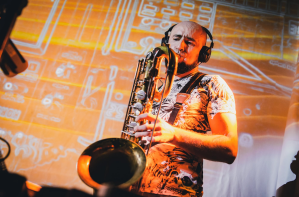 What does it mean to you to be Ukrainian?
I’m not Ukrainian, so I can’t really answer that question. I’m a Jew (which is my identity) from Russia (which is NOT my identity), living in Kyiv for the past twenty years — and I’m not sure it’s the final stop. Still, it so happens that musicians need a kind of “home port” — a label of where you’re from, whose team you play for. For a long time, that label is UA.
Do you suffer from burnout and what do you do to relax?
I suffer from not being as creatively efficient as I’d like to be — because of laziness and distractions. Every day I dedicate about three hours to music: writing grooves, practicing instruments. Some might say that’s a lot, but to me it’s not enough. So burnout is still a long way off. At the same time, since I remain a dilettante — in the good sense, meaning I don’t do music professionally — I have little chance of getting tired of it anytime soon.
OCTOBER 30, 2025 – ON THE FRONT
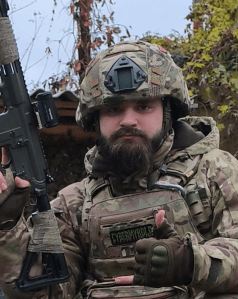
My name is Oleh, I am a serviceman, and I write music under the pseudonym cybermykola. I started writing music back in school, just for fun. As a child, I took violin lessons and graduated from music school in that field, but I never truly loved the violin. I always preferred electronic music, and playing the classical works of great composers was very uninteresting to me. I started writing and experimenting more in university. I have always done music as a hobby. Since childhood, this activity was, firstly, simply “fun” for me, and secondly, it served as additional art therapy. Overall, I’ve been writing music for many years, but I never did it very actively because I worked as a marketer. I had a normal job, normal problems, a normal life, and I didn’t see myself as an artist of any kind.
Has the full-scale invasion changed the way you think about music and sound in general and has it altered your setup?
Of course, the war changed everything. Since the beginning of the war, under the influence of stress, I completely stopped listening to any music at all. I simply couldn’t listen to anything. I tried to write, but nothing came out. Everything seemed meaningless against the backdrop of the war. Any topics for songs didn’t seem relevant or interesting in the face of the deaths of thousands of Ukrainians. The war probably helped me to set priorities more clearly and distinguish the important from the unimportant. I started writing about terrible things that many people were simply trying to avoid. I began trying to articulate difficult subjects through creativity, using humour. Also, after the start of the full-scale war, I posted my tracks online for the first time, as I had never seen the need before. I wasn’t interested in an artistic career. At one point, I realized that I couldn’t predict how long I had left to live, and for the first time, I wanted to upload what I had created online so that it wouldn’t just vanish from my computer without a trace.
You were born in Pavlohrad, a city in Ukraine known for mining. Your grandfather worked in the mines for 30 years. After high school, you studied Political Science and Sociology in Zaporizhzhia but dropped out to start his own marketing agency. How would you say your background influenced your approach to music?
I finished school in Pavlohrad, a completely russified city in eastern Ukraine, which is currently an important logistics hub and a frontline city where you can meet soldiers resting after battles on the contact line. It’s a mining city dominated by the atmosphere of a post-Soviet community of labourers doing heavy physical work. Alcoholism is very common among miners as a form of therapy after extremely hard, risky physical labour. This was also present in my family. I grew up in such a city. These people were the first I saw from childhood. I had a good childhood, but life in Pavlohrad is probably the hardest I’ve encountered anywhere so far. This applies to most of its residents. Life there is truly difficult. It has always been difficult, but during the full-scale war, it has become significantly harder and more dangerous. The shelling of Pavlohrad is currently a daily occurrence.
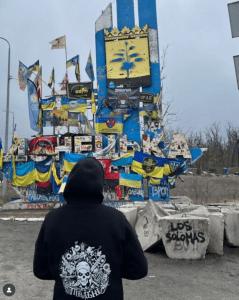 A lo-fi hip hop musician currently serving mentioned your name as one of the hip hop artists they listen to in his unit together with Nord Division. Your approach is very different, but would you say hip hop has replaced metal in popularity within the military and do you ever exchange playlists?
The advantage of hip-hop over metal or other more instrumental genres is that it is a simple genre with the lowest barrier to entry. This music is easy to understand, easy to reflect upon, and if it truly conveys some meaning, it is easiest to deliver that meaning in this format compared to all other genres. At least, that’s what I think.
Has the constant stream of quick dopamine-releasing content from TikTok or Instagram replaced music as a source of instant gratification and comfort within the military?
Serving in the military, daily stress, and the inability to be in a comfort zone create a strong need for dopamine. Therefore, anything that can quickly improve the mood works. The most popular thing in the military is smoking cigarettes. Up to 90% of servicemen have a nicotine addiction. Because the army includes people of various ages, not everyone actively uses social media, so TikTok and Instagram Reels are not suitable for everyone. However, it is truly ironic that some stupid memes on TikTok are used by soldiers who see death every day to lift their spirits. The content creators are unlikely to realise under what conditions and by whom their content is being viewed right now.
Your own music seems to be influenced by Insta reels, they are short, catchy, and humorous. How would you say social media has affected the way you approach music?
Ahaha, that’s almost an offensive question. No, I don’t think that’s the case. When I started writing music, this content craze didn’t exist yet. Reels, TikToks didn’t exist. AI didn’t exist (for some reason, many people think my tracks were created by AI). I just lived my ordinary life and never had much time to create big, perfect tracks. Because I had little time for creativity during the day, I adapted to writing music quickly, within a few hours, and never dwelling on a track for too long. That’s why many of my tracks might sound quite raw, imperfect. That suits me. I think it’s possible to do even worse, even more imperfect sound processing so that people understand that a human created this, not a robot.
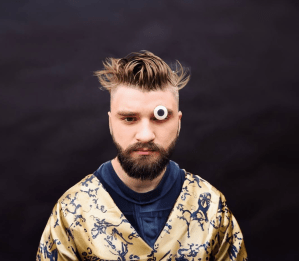 What is your production process and how quickly are you able to produce new tracks?
I make myself a cup of tea, sit down at my computer, open FL Studio, and start writing some music, without any plan or goal, just playing around with some sounds and trying to build a beat out of it. If I like the beat, I might immediately try to rap something over it, just some random lyrics from my head. When it sounds cool, then I start developing the idea, writing out the verses, recording them, playing with effects, and it’s done. My most popular track, їду я двухсотитись (I’m going to be a 200/KIA), from the album кривавий гопачок (Bloody Hopak), I wrote in 4 hours. Within those 4 hours, I created the beat, wrote the lyrics, recorded, and finalized the track. So, quite fast. But it also depends on the mood. Sometimes I simply don’t have the motivation to do anything, and then nothing happens in 4, 12, or even 24 hours. In such cases, I simply take a break to rest.
Mама-канібал (Cannibal Mother) is one of your most talked about tracks and it reminded me of the documentary Intercepted where they used conversations between Russian soldiers and their families (often their mothers). How aware would you say people in the “west” are of the extent of support there is in Russia for the war?
russian society is deeply degraded by centuries of repression, genocides, and selective selection. The modern russian doesn’t even realize what is happening now, why the war is happening, or if it is a war at all. I believe that even the least interested people in the “West” still have access to more information and are capable of at least some basic analysis, regardless of their social status or level of education. In russia, any manifestation of will in society that does not align with the will of the Tsar has been repressed for centuries. People there do not know how to think for themselves and have no personal position because forming one’s own position requires courage and will.
Are there any particular tracks that have become widespread among soldiers, or used in memes—and if so, what made them popular?
My album кривавий гопачок (Bloody Hopak), which is lo-fi Memphis rap with elements of Ukrainian folk instruments and military themes, is very popular among soldiers. The track прильот (Arrival/Shelling) is also quite popular. It is a satirical work about a person who sees explosions every day, is not afraid of them, and even tries to see something beautiful in how their own body is scattered by the blast wave.
Does music in the army reinforce stereotypes of masculinity, or amplify ideas of nationalism and identity?
I won’t say that all stereotypes and problems have already been overcome in the Ukrainian military. We still have issues with the perception of women in the military. My music is definitely not misogynistic; I love women and even sing that women are better than men. But objectively, the modern image of a serviceman is the image of a warrior. This is a masculine image, and this image is not toxic, but inspiring. I think this is a wonderful example of a positive masculine image of a man. A man-defender, a man-warrior. This image should not offend women. Especially since our women also serve in the military and inspire with their strength and bravery.
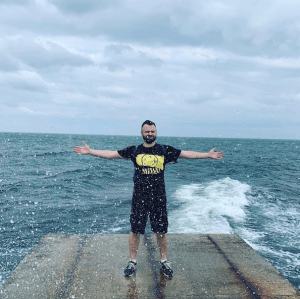 Are there particular songs or genres used to honour fallen comrades, and does music help in the process of healing?
I haven’t written songs specifically dedicated to fallen soldiers. One reason is that I view my creative work more as fun and mischief. I don’t feel I have the right to sing about fallen warriors; their contribution has a higher value than a silly track by cybermykola. My job is to maintain good morale for servicemen and civilians. I articulate problems they might be ashamed to talk about in real life and help them through that. I don’t aim for anything more.
What does it mean to be Ukrainian for you?
To be a warrior. To defend what is yours. To love what is yours.
Which book / film / album / song / traditional dish / podcast / blog / artwork / building / meme best captures Ukraine for you?
The beautiful film Atlantis by Valentyn Vasyanovych.
OCTOBER 31, 2025 – NEW YORK
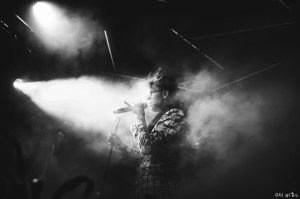 Ro Rousseau / Curva Peligrosa [UA]
I’m a musician and co-founder of several venues in Kyiv — UBK Beach, ANGAR (Malaya Opera) — plus my favorite baby, Hedonism Festival.
Since 2021 living in the U.S. and under stage names Ro Rousseau and Curva Peligrosa, I organize events mostly in Miami and NYC. Performing at places like Do Not Sit on the Furniture, Mad Radio, MODE Miami, House of Yes, Chetana, Apollo Studios etc.
I’m also a co-founder and event planner of Kurenivka Camp and Blue Bull art car at Burning Man, curating most of our lineups on the Playa and related events.
 Has the full-scale invasion changed the way you think about music and sound — and has it changed your playlist?
Since I started playing in live bands and later DJing, my music selection has always evolved, reflecting the world and society around me. When the full-scale invasion of russia began, I was already in the U.S. — so we started organizing fundraising events and promoting Ukrainian culture in every possible way, both traditional and modern.
Burning Man became the main platform and cultural front line for these ideas, where our diverse community has been bringing meaningful art installations and unique music that showcase the best sides of our rich heritage and contemporary vision.
 How would you describe the electronic music scene in Ukraine during the Euromaidan years, and were there any Ukrainian artists with international careers?
Music in Ukraine after the Revolution of Dignity (2013–2014) changed dramatically. Cutting ties with the russian market and its “stars” gave space for a truly remarkable local scene to grow.
From projects like DakhaBrakha, Jamala, Cepasa, Jerry Heil, and Onuka, through more mainstream electronic acts like ARTBAT, Miss Monique, Korolova, 8Kays, and The Organism, to the underground scene represented by Koloah, Hidden Element, Nastia, Daria Kolosova, Volodymyr Gnatenko, iO, Borys, Shakolin, SE62, Tolkachev, and hundreds of others — Ukraine blossomed musically. Most of the artists touring around Europe and U.S. expanding their recognition and often having bigger international followings then Ukrainian one
 What can you tell us about Malaya Opera and Angar during their years of activity?
Our project ANGAR at Malaya Opera was founded in late 2012 and was very active until May 2014, when the conflict in the East entered its hot phase.
It was hard and in the same time such a romantic flow of wild creativity — a musical oasis without limits or censorship. With a closure of some big major venues for almost a year we stayed one of the few active concert halls in town. Telepopmusik, DakhaBrakha, TRUST, XXYYXX, Slow Magic, Kasper Bjørke, UNKLE, Cape Cod, Sophie Villy, Jay-Jay Johanson, Pianoboy, LTJ Bukem, Emika and countless of local underground musicians performed there in less than two years.
That energy evolved into our summer project Angar Beach on Trukhaniv Island in 2014, and then into UBK Beach the following year. The symbolic bridge between these projects was Darkside (Nicolas Jaar & Dave Harrington), who performed in September 2014 when most international artists had to cancel their tours due to the war escalation. That show was a huge support and blessing for our future projects.
 Do you agree with those who say Ukrainians once had an inferiority complex — staying for international acts but leaving when a local DJ took the stage?
I’d say that since 2014 we’ve successfully moved past that phase. The Ukrainian scene now has its own strong, independent identity that captures local audiences’ attention more than ever.
Did the Revolution of Dignity bring noticeable changes within the music community in Ukraine?
As mentioned above, it was a dramatic turning point in every sense. 2014 became a point of no return — and since 2022, the boom in Ukrainian culture has become even more independent and limitless, especially as bringing international artists to Ukraine has turned into a heroic task.
Cultural refugees are also gaining more recognition on the world stage, which works in both directions.
Was “Kyiv as the new Berlin” an annoying cliché, or did it help put Ukraine on the electronic music map?
I used to live in Berlin and have visited it often since 2006 — and yes, there are many similarities, though we’ve always preserved our authenticity, roots, and social context.
During the pandemic, while clubs in Europe and the U.S. were closed, flights to Ukraine were full of ravers. That didn’t make Kyiv “the new Berlin,” but it definitely helped put our beloved capital and the country in general on the world music map.
After russia’s 2022 invasion and the cultural migration that followed, we got a new cliché — that Berlin is the new Kyiv. Luckily or not.
 What can you tell us about UBK Beach, and how would you place its sound within Kyiv’s music scene? What were its peculiarities and strengths?
UBK Beach was founded in 2015 as the successor to Angar Beach (which I ran with part of my Angar / Malaya Opera crew in 2014).
With my new partners — who I still miss very much — we built a new structure on the island with a perfect beach overlooking Kyiv’s legendary hills and the iconic pedestrian bridge. We wanted to preserve that “friends and family” spirit while adding comfort and turning it into a diverse, multi-genre melting pot at the forefront of the city’s vibrant scene.
Two stages (a 3,000-person live stage and a 1,000-person disco shed), four bars, a food court, an open-air cinema, and a sports zone.
In 2016, I came up with the idea for a festival called Hedonism. The same beautiful riverside, but three times larger than the club. Three days, four stages, 60 Ukrainian and international artists. It ran in various forms at the same beach until 2021, celebrating cutting-edge music that attracted talents and audiences from around the world.
Each season from May to September we hosted over 100 gigs, parties, workshops, talks, and cinema shows.
Among our performers were Hot Chip, Is Tropical, Lake People, Kiasmos, Jay-Jay Johanson, Sevdaliza, Westbam, Acid Pauli, AFFKT, David August, Lapalux, Nathan Fake, Alex Metric, Oceanvs Orientalis, Blockhead, KMLN, Boddika, Catz ’N Dogz, Black Lips, Acid Arab, Guano Apes, Jonathan Bree, The Organism, Kikagaku Moyo, DakhaBrakha, WhoMadeWho, Connan Mockasin, Fango, Dakh Daughters, Louisahhh, Balthazar, Morcheeba, Coss, Iorie, Xinobi, Just Emma, O/Y, Com Truise, Magician on Duty, 8Kays, Frédéric Beigbeder, Mira, and hundreds of Ukrainian talents.
One month before the war, the main part of the venue was burned down — we still don’t know the real cause or who was behind it.
After the war, it will definitely rise from the ashes — like the rest of the country.
 What were the logistics of running a music venue in Ukraine, and how did the pandemic compare to the full-scale invasion?
When the full-scale invasion began, I was already living in the U.S., and we decided to suspend the UBK Beach project for three main reasons: safety, ethics, and unprofitability.
So I can’t judge fairly, but surprisingly, the two pandemic summers were our best seasons out of eight years. Being an open-air venue with plenty of space and usage of typical precautions made us probably the safest public place in town.
Now we’re sending intentions to organize the Festival of Victory at that same venue as soon as possible — with or without me.
How do you see the Ukrainian music scene developing in times of war?
It’s becoming more unique, united, independent, educational, sensitive, and socially oriented. Music is a hope, abstraction, and the main source of inspiration. It literally saves lives and helping our country to realize our identity more and more clearly.
What does being Ukrainian mean to you?
To represent and support your country in the best possible way — no matter where you are.
Which book / film / album / song / traditional dish / podcast / blog / artwork / building / meme best captures Ukraine for you?
- Movies: My Thoughts Are Silent (2019), Pamfir (2022), Luxembourg, Luxembourg (2022), Cyborgs: Heroes Never Die (2017), 20 Days in Mariupol (2023), Shadows of Forgotten Ancestors (1965), Man with a Movie Camera (1929), The Long Farewell (1971).
- Music: DakhaBrakha, Volodymyr Gnatenko, Jamala, Alina Pash, Si Process, Tonka, Ragapop, Anton Slepakov.
- Art: I’m Fine & the Blue Bull art car.
- Architecture: Kyiv UFO Building (Institute of Information), House with Chimaeras, Poltava Local Lore Museum, Chernivtsi National University.
OCTOBER 31, 2025 – CHERKASY
photo by Anton Razin
Natalie – Tryastya
My name is Natalie, I am 39 years old, I have a family, a dog and a cat. In addition to organizing parties, I work as a psychologist in body psychotherapy. I have been organizing the Tryastya project in Cherkasy for two years, so this happened during a full-scale invasion. I call it a project because I position it as a cultural electronic music event, not just as a party. I really put a lot of meaning into it.
I don’t have a very big background in music. Rather, it is about the layering of different experiences, which at first glance are not connected. A little studying at a music school, DJ courses. The important thing is that the period of my youth coincided with the development of club life in the city. I remember many different clubs in the city that we visited with our friends on the weekends and the high-quality, modern music there. I love art, my native culture, history, and I dream that one day we will stop imitating others and form our own vision. This full-scale invasion gave me the impetus to do something in this area.
Has the full-scale invasion changed the way you think about music and sound in general?
Oh yes! as I said before, I rethought a lot during the full-scale invasion. I had never lived abroad for a long time, since my husband is German, we moved to Germany for a year and a half. This time was full of pain, rethinking and realizing my own value, as well as how much I love my country and culture. I realized that in cultural aspects, in particular in music, we were oriented towards someone else. And we did not notice our own value and did not attach due importance to it. This is understandable, because since childhood, television, books, everything around us told us that everything is better abroad, everything is better in russia. So, after the full-scale invasion, I looked at Ukrainian music from a different angle, especially the electronic scene. And I was pleasantly surprised at how many talented producers, musicians we have. Another thing that changed was that I started listening to more experimental music and live performers.
photo by Anton Razin
What can you tell us about Tryastya, how is it run and what are its strengths and weaknesses?
Tryastsya (Трясця) is a project, a series of events dedicated to uniting Ukrainian artists and fans of the electronic scene in Cherkasy. An important component is the values of this project, which include supporting DJs and electronic musicians, especially those who create music themselves, exchanging cultural experiences of DJs from different cities and local ones from Cherkasy, uniting conscious people who support Ukrainian culture and the army, conveying the value of electronic music even in difficult times.
The word “Tryascia” itself is an old Ukrainian name for a fever and is also sometimes used as a swear word, but it is more something between a joke and anger. This is what many Ukrainians are feeling right now. I really like the fact that it is local and cannot be translated into another language. It is about music that can be felt and is difficult to explain or describe in words. The idea to create a party came to me back in Germany, but I realized it here after returning. The strength of Tryastsya is its openness to different musical experiences, strategic vision for the development of the local electronic scene, faith in our audience and its ability to develop good taste. And not giving up even if failures occur. The weakness is the lack of a permanent team, Tryastsya is looking for its identity and its place. I also don’t know how to find sponsors or grants, so the entire organization is at my own expense.
How would you describe the electronic music scene in Cherkasy in terms of bars, clubs, producers and deejays and how wide would you say is the music community?
I often compare the current scene with the distant past, about 20 years ago. Back then, there were a lot of clubs, electronic music parties in our place, large-scale, underground. Then the club life of the city became very commercial, and this destroyed the cultural part. Most of the talented DJs left for big cities or abroad, because they had work there. And out of 6 clubs, 2 remained, and it became not about electronic music, but about anything. Sometimes someone held non-commercial events, but it wasn’t on a permanent basis. The lack of an electronic scene in the city was the impetus for the creation of Tryastsya. At the beginning, I managed to unite many active people around me and broadcast the idea that creating your own event is easy. That’s why now at least 4 more events have appeared in the city, somehow connected with Tryastsya. The difficult thing is that people have become unaccustomed to electronic music and such parties during the coronavirus and the full-scale invasion, and they need to be re-instilled, explained, and introduced to the culture of attending events.
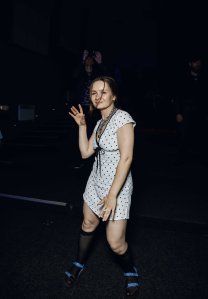
photo by Anton Razin
Since the full-scale invasion I have interviewed a variety of musicians from Cherkasy, raging from Latexfauna to Low Communication and from User Kyx to Deadhead encompassing anything from to ambient to dream pop. Is there enough of a music community?
Not all of the above-mentioned musicians live in Cherkasy and perform here. We often invite User Kyx to play at our events, I consider him a talented producer and musician, Vlad Rzpsst, noise artist Budu Dumaty, Tender Heart… There are other artists who also release their music, but the more well-known and public part is rock bands and performers. But the electronic music scene has become significantly impoverished with the lack of venues for permanent performances.
In general, we have small communities of electronic music, techno, house, noise, rock in our city. But they are now more on the verge of survival.
Is the Ukrainian media doing enough to promote and support the electronic music scene especially of smaller cities?
I’ve thought about this a lot, because media support is really lacking and it’s really needed. Maybe I should take the initiative myself and suggest that they write about us 🙂 I also have an idea to do a historical study on the culture of electronic music in the city, to ask those DJs and organizers who are still here. I would like to publish it somewhere. Thank you for your informational support of Ukrainian culture, it’s very important.
I know it’s been almost four years now and you probably got used to it, but how do you feel martial law has affected the clubbing scene in Ukraine?
During the 4 years of the big war in Ukraine, the idea of club culture has changed. It has ceased to be just about entertainment, many people have united around electronic music to also help the military, raise money through parties. Of course, fewer foreign artists perform, and those who still support Ukrainians and come to us — we really appreciate it. There are also fewer visitors and the younger generation is not familiar with electronic music and rave culture. There are a lot of different events taking place in Kyiv, there are even in Kharkiv, 30 km from the front line, Lviv, Dnipro, Odesa. In smaller cities, the difference in the level of cultural development and variety of events is felt. And parties have become much healthier, because we start at 6 pm and finish by 11 pm. In terms of the variety of genres, classical techno is slowly being replaced by experimental music, people are becoming interested in something more complex and sophisticated.
Are there any albums or tracks by Ukrainian artists that have managed to capture current events in a meaningful way?
For me, it’s the Parking Spot album Moai! It’s a bit nostalgic, very beautiful, gentle, with a powerful instrumental and vocal part. It’s about nostalgia for home and the loss of a sense of home, which is close to me personally and to many Ukrainians. I can also mention Komponente and Kurilo Voyager.
photo by Anton Razin
What are your “guilty pleasures” in terms of music, what three artists or tracks that we might be surprised to fin on your playlist?
My tastes are very diverse, so I don’t know what in my playlist will surprise people more — extravagant tracks or classics. If I had to choose three artists or compositions, they would be: Sister Vika “Bulolochka z makom”, Kalwi and Remi “Explosion”, Weather Girls “Raining Man.”
Can you think about the future and if so, what does it hold for you?
In the future, I would like to have my own space for holding my own events, as well as for fine art exhibitions and performances. I would like to collaborate with other cities and organizers. But the most important thing in the near future is to find or create my own team.
Which book / film / album / song / traditional dish / podcast / blog / artwork / building / meme best captures Ukraine for you?
For me, my country is very multifaceted, and it is really a difficult task to choose one thing. But if you go by feelings, then it is probably lullabies. They best help to feel the soul, the core of Ukraine. It is about childhood, love, care, sometimes humor, setting for the future. I remember the lullabies “Sonko Drimko”, “«Oy khodytʹ son kolo vikon», «Kotyku siresenʹkyy»
NOVEMBER 2, 2025 – RZHYSHCHIV
 Høstvind
Hi! First of all, thank you for giving me the chance to introduce myself — this is actually my first interview 🙂
My name is Dmytro. In everyday life, I’m a graphic designer and a drawing instructor. In another life, I’m known as Gromak, the author of the musical project Høstvind. At first, it was meant to be an anonymous project, but the anonymity didn’t last long — it was accidentally broken after I rather clumsily uploaded the self-titled debut album to streaming platforms (I hate streaming services) through a distributor (I hate distros even more) that my label at the time, Erythroleukoplakia, was using. I joined the label by pure coincidence – I met M. (Emotional Anhedonia) in a dormitory sometime around 2020–2021, I can’t recall exactly. Our conversation started because I “named three songs” by a band whose merch I was wearing :D. It didn’t take long for us to find common ground – he’s a true music geek. Honestly, I probably wouldn’t have released my music publicly if it weren’t for the label’s support and opportunities. And I definitely wouldn’t have dared to print cassettes – that was M.’s idea, and I got really into it later on. I consider that one of the most important encounters in my life. M. – is an interesting person who genuinely loves music (and even anti-music too), and besides that, he’s a good friend. Now he’s defending our country in the ranks of the Armed Forces of Ukraine – so I’d like to take this chance to say hi to him. I think he’ll be reading this. 😉
I’m not a very social person IRL, to put it mildly. Before meeting M. and the label, I mostly kept to myself and wrote music “for the drawer.” My fascination with music started in childhood – but as a listener first. My older brother got me into metal when I was very young, and I’ve been listening to it consciously since the age of five. I grew up in a small town where no one really listened to heavy music. It was already something if someone from a neighbouring class had at least heard of Skillet or Nirvana – but Dream Theater or Nevermore? Forget it. Haha, I still remember showing a classmate “In the Presence of Enemies” by DT during a break at school – he never got to hear when the song actually “started,” because the break ended before James LaBrie even sang the first verse. (Maybe that somehow influenced my own music later on ;D)
From early on, I had to make peace with the fact that music, for me, would always be something deeply intimate and personal – and almost always about solitude. I felt that even more when I went a bit further than my brother did – into extreme metal. My parents weren’t exactly thrilled about songs that sound like “someone’s being murdered” or “a dog is barking.” And as for my devout mother – to this day she still doesn’t know the real context behind that Norwegian black metal I used to listen to. I never told her; I wanted to spare her mental peace :D. As always, I listened to that music only in headphones – out of respect for both my own and other people’s boundaries.
My artistic perception of metal began to form when I discovered atmospheric black metal. Before that, I had a rather primitive – I’d even say “technical” – view of metal as genre. Then came Burzum, Drudkh, Katatonia… and I discovered a new dimension of music – the textural one. Drudkh and Burzum shattered my belief that good sound, dense production, down-tuned guitars, and complex riffs are necessary for success. They showed me what *atmosphere* truly is – and how an album can completely draw you into itself through sound alone.
In primary school, we had a music class, and for a while those lessons were an inseparable part of our daily school life. Most of the folk songs and melodies I remember come from that time. Back then, though, I wasn’t really interested in theory – so later I had to learn everything on my own, from scratch.
All the projects I made before Høstvind could basically be considered study works. My earliest recordings were made even before I got an electric guitar as a gift in high school. I’d program dungeon synth and ambient tracks in the piano roll on a keyboard (mörk skog, silence of the nights, Vatt’ghern), and sometimes wandered into DSBM territory (Øbscurantist, Холодрыга), playing on my brother’s old acoustic guitar – which I still use to this day. The project Uaral was inspiration for me back then. I learned to play guitar by covering it and medieval Dissection / Lord Belial interludes… Even after getting the electric guitar, I kept recording on my phone’s voice recorder (ступор project). Some of those early demo projects can still be found on Bandcamp – though, honestly, I wouldn’t recommend listening to them.
Bands like Katatonia and Forgotten Woods later opened up for me a completely different understanding of melody and musical harmony – intricate, ornamental, and at the same time profoundly depressive and melancholic. No matter what inspires me or what I decide to compose next (and sometimes I want to do everything at once), in terms of composition I still primarily orient myself by their example whenever I write music. The shift toward folk music happened gradually. In general, it’s connected to the fact that atmospheric black metal, aside from its tolerance for unconventional sound, is very open to the use of different instruments in arrangements – and that gives an even wider space for diverse sonic expression. The main thing is that it must sound “atmospheric”. A key discovery for me in this context was the sopilka (Ukrainian wooden flute). Kroda’s Funeral of the Sun and Zgard’s Through the Forest were the first compositions that actually made me cry – simply because of how unbearably beautiful they were.
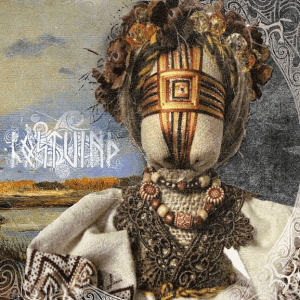 Has the full-scale invasion changed the way you think about music and sound in general and has it changed your playlist and your setup?
I don’t think the full-scale invasion as an event has directly changed my music or the way I perceive it. Perhaps that’s because I had already been living with a certain tension connected to the earlier ATO period. Back then, I was able to channel that feeling through my project Криґа. The “Крижані стіни” album (“Icy Walls”) was about the soldiers there – among them was my great-uncle. Honestly, I never expected that album to turn out “prophetic,” at least not in such a short span of time. In the first months of the invasion, I returned to that project as a form of therapy – to improvise a few more tracks. “Закрите Небо” (“Closed Sky”) was one of the first recorded in the basement of my own house. As it turned out later, it was probably one of the very first metal mini-albums to reflect on the full-scale invasion.
But the war – as a constant, heavy pressure of its reality and the daily accumulation of consequences -o fcourse leaves a mark on creativity. It feels stronger each time. I think that’s noticeable in Høstvind. And work on Høstvind began during the war, in the summer. At first, I planned the project simply as an homage to the sound of bands I love – mostly from the American Cascadian scene like Gallowbraid or Agalloch – and as an ode to my favourite season, Autumn. Later, during production, other references appeared – like Ulver. The funny part is that Ulver influenced Agalloch, Agalloch inspired Gallowbraid, and here I was – inspired by Gallowbraid – realizing that something felt off. Maybe it wasn’t worth making yet another copy; maybe it was time to bring something of my own – to show not just a translated version of those “Cascades,” but to hint at the place where the music was recorded, to add an element of identity. That desire only grew stronger after the full-scale invasion began. Since then, I’ve almost completely erased russian music from my life – even the bands from my childhood that once influenced me – and instead, I’ve immersed myself deeper into the Ukrainian scene. My main reference point became Drudkh – a completely natural and traditional choice, since it connects both to the heritage of Ukrainian atmospheric black metal and to that same sense of nostalgia and love for Autumn. As I told another Dmytro – “Doomdoze” (Dim Dymythch) – who agreed to handle the mastering (and recorded the bass + drum correction): “We need the kind of guitar sound that feels like diving into rough autumn leaves – not dry, but fresh and cool, like on ‘Forgotten Legends.’ Make this lead guitar sounds like in Fall Of The Leave’s song ‘Into the Autumnsphere’” M. introduced me to Doomdoze and he was also the one who suggested doing the mastering, since my mixing skills are still quite poor. When the material was almost ready, Høstvind still had no lyrics or even a name. In our local scene, we tend to pick interesting project titles, and this one I actually borrowed from my colleagues Mørkt Tre – it’s Norwegian. Høstvind means “Autumn Wind.” I liked how it sounds – short, yet warm and fresh at the same time, just like the kind of autumn I feel starting already in late August, when the evenings turn cool. That’s when I catch the first breeze of nostalgia that’s hard to express in words – so I try to do it through sound.
While writing the lyrics, I caught myself thinking that maybe, in such difficult times, it’s not the best idea to write something too depressive or melancholic. The first victories on the front inspired something more uplifting, even heroic. The old folk song “Вийшли в поле косарі” (“Reapers out into the fields”), which I remember from school, suddenly took on a new military meaning. The album Legenda also carries that kind of spirit – a certain stoic restraint – even in the tracks where I explore new sounds or philosophical themes, like “Galgeskog”.
Later, when I started working on Nebokraj, where I consciously wanted to avoid the topic of war, I realised how deeply it had already seeped into my creative process. All the imagery that comes up easily fits into that context. I even talked about it with ChatGPT – I’ve been using it a lot lately to analyse my own lyrics and see what’s hiding in my subconscious. Eventually, I decided not to resist and just let things flow naturally. That’s how the track “Сльози Сонця і зорей плач” (Tears of the Sun and Starcry) was born – probably the most melancholic piece of Høstvind. Symbolically, its main cosmіс synth melody came from an old recording from 2018, when i was another, more depressive person, it is happened to blend perfectly with the new guitar harmony.
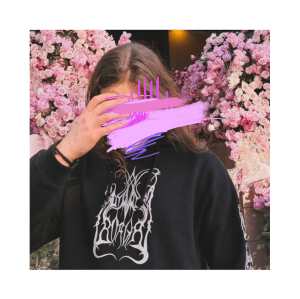 What can you tell us about the production process for Nebokraj and how did you go about putting together such a different cast including DEDDOOM, Некрохолод and Vlad Yakolev?
I usually keep a Guitar Pro project full of tabs – sort of like a musical notebook where I jot down anything interesting that comes to mind. Over time, it becomes this archive of fragments, and when inspiration strikes, I open it again and start experimenting with riffs, combining or reworking them. It’s especially helpful when you hit a wall and don’t know how to continue a track. Sometimes a whole composition just flows out from a single riff, purely on instinct. That’s what happened with «Syni hory kryhoju okuti» – all I had was the opening melody from those tabs, and the rest just wrote itself. Structurally, it really feels like a continuous stream, a kind of flow.
I like to “wander” through my compositions – to hint back at earlier motifs, bring refrains in unexpected places, sometimes even reverse sections, and eventually close the piece where it began. It’s a way of playing with the listener’s sense of direction. I picked up that approach from Opeth. I haven’t even looked up the lyrics to “Forest of October”, but I imagine it’s about that same kind of wandering – moving through a forest that feels familiar until you realize you’ve just been walking in circles.
My conscience doesn’t really let me repeat myself too much or go down the standard paths – and I think that’s what brought me and Deddom together in the first place. Andrii is a prog lover, and I basically grew up on that kind of music. It all started when he ordered a Legenda cassette from me. He really liked the track “Amber Tears” – the longest one on the album, almost fifteen minutes. Quite an ironic compliment coming from someone who once recorded a 30-minute grindcore track! ;D So yeah, our shared love for long formats turned out to be another thing we had in common. That’s how I invited him into what I’m not afraid to call my Erythroleukoplakia family – by that time I’d already met almost all of the label’s residents and even levelled up my social skills a bit.
That’s also where I met некрохолод (Necro-cold? trve kvlt!) and Vlad Yakovlev – though in that case, I was the one ordering cassettes this time. I really liked their music and wanted to support them. Vlad is an incredibly interesting person; his project Неймовіра touched me deeply.
Since I recorded and mixed Legenda entirely by myself, this time I wanted Nebokraj to feel less solitary for me. So I turned again to Dima “Doomdoze” of Delayed Minds for mixing – he also recorded a jaw harp part for me – and invited Vlad to add his melodic or solo touches in the Neimovira spirit to a few sections of “Syni hory…”. Vlad was extremely generous and ended up filling all of them, double-tracking everything. That gave the parts a fascinating spatial effect, and to me, his use of tsymbaly and kobza within an atmospheric black metal arrangement feels absolutely unique. I invited некрохолод [Nekrokholod] to record a solo part for “Tears of the Sun…”. He has an incredible sense of mood and texture – maybe even a kind of synesthesia – and he completely captured the same vision I had in my head. His part sets the entire tone for that fragment; it reminds me of another nocturne with similar night landscapes – “Mistrust” by Die Verbannten Kinder Evas. Bit by bit, the overall picture became clearer.
For me, as someone with an art background, the process of making music isn’t so different from painting. At some point, you just start following your aesthetic intuition, and layers of meaning emerge on their own – almost subconsciously – through the right choice of imagery.
One of the concepts I embedded into Nebokraj was inspired by the legend of Lake Synevyr – the interplay between the feminine and the masculine. Two tracks reflect these moods differently: one is depressive, where the image of the mountains symbolizes the weight of grief and obstacles; the other has a more defiant tone, as if ready to move those mountains. According to the legend, Syn’ cried an entire lake of tears for her slain beloved, Vyr – and “Tears of the Sun…” carries that feminine sorrow.
That’s what gave me the idea to include a female vocal part. I reached out to the band Альфатер (small world – I actually knew some of them back from my dorm days), and they responded warmly. Guma from Alphater has this wonderful, piercing voice that stays with you – and, most importantly for what I envisioned, it’s deeply feminine and melancholic.
Some parts of the lyrics – as well as the sound itself – were wrapped in a kind of misty mystery, so I decided to add an element of narration. I invited the professional voice actress Veltty to record a few lines. That’s when I realized: you can never have too many invited friends on a project like this. It was all starting to take on the shape of a true collaboration, so I thought “if you’re going to add honey, do it by the spoonful” 🙂
I invited even more musicians right from my university circle. A promising guitarist, Metover, who had already made his mark in the local thrash-metal band Horilka, recorded a beautiful heavy metal / neoclassical solo. Viktoria Brei, a professional bandura player from the «Чураї» ensemble, added a refreshing melodic dynamic to one of the acoustic passages. And then came the saxophone – not exactly the most expected instrument in a folk metal release. From one angle, it was experimental; but both I and Deddom have always been open to experiments. I was encouraged by Ukrainian bands that had already used saxophone before – in my case, the avant-garde Святогор and their album Doctor Veritas were a big reference. Andrii’s task was to capture the same nocturnal atmosphere that некрохолод had created with his keys, while distancing himself from the “urban” associations of the saxophone as much as possible. People said the result turned out misty and nocturnal, somewhat like White Ward – which to me only means the experiment worked, as long as they don’t call it “Lovecraftian noir,” I think we’re did it :).
Another guest I must mention joined the album in a rather mystical way – Nina Matviienko. The vocal line in the middle of “Syni Hory…” is built manually, note by note, from samples of her a cappella recordings. When I first started assembling that “sampler” of her voice for an Eldamar covers, she was still alive…
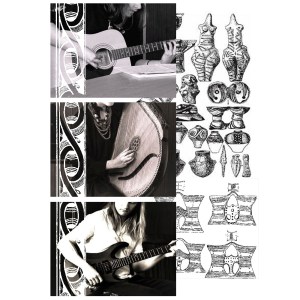 How important was it for you to include traditional instruments like the bandura in Nebrokaj and how important is your Ukrainian folk heritage to you?
It’s a rather ironic fact – you can actually record folk music without using a single traditional instrument. In fact, you can make folk music without anything “folk” at all. We live in a world of simulacra, and much of what’s called folk metal today often has little to do with the real folk traditions of a specific region.
Moreover, you can take certain cultural elements and create an entirely imagined form of folk music for an imagined people the way Summoning did for Tolkien’s world, or how Jeremy Soule composed the Morrowind soundtrack: something that feels alien, otherworldly, yet still faintly familiar and earthly. For my earlier project Høstvind, the focus was on the eastern “steppe” Ukrainian folklore. Legenda drew inspiration from the “mountain” traditions of the Carpathians and the “forest” motifs of Volyn. But with Nebokraj, I stopped setting those boundaries for myself. I gave imagination more space, trying to build a sound that would fit not just a generalized idea of Ukrainian music – blending eastern and western colours – but also a kind of “fantasy world” with its own distinct spirit. Something like an elves of Eldamar vs Mordor orcs scenario 🙂 but reimagined through a Ukrainian lens. The painting Teberdin lake by the Ukrainian artist Yaroshenko evokes the same feeling when you look at it. His legacy was later appropriated by russia, though he himself once served in the imperial army… much like Shevchenko, who was also inspired by those same mountains.
I see Nebokraj as a space almost prehistoric – filled only with natural landscapes, untouched by clear geography or human borders. That vision was deeply influenced by the ancient history of my region. In my hometown there’s a museum dedicated mostly to the Trypillian culture. Very little is known about those people, and we can only imagine what their music might have sounded like. I’ve always felt a strong, almost blood-bound connection to this land. All of my known ancestors on my mother’s side lived here for generations. My father’s line, however, was more nomadic, moving across Ukraine and even into the russified territories of the Kursk region – which is probably where my *-ov* surname ending comes from.
Family history matters to me because I can see its reflection in myself and my passions. My great-grandfather was an unknown painter – some of his works are still preserved as family relics. I also paint and draw, design covers for fellow artists, and teach drawing classes – that’s how I make a living. So naturally, I design all of my own artwork. You can usually find my paintings inside the cassette booklets.
For Nebokraj, the artwork features a pastel landscape of the Kaer Morhen watchtower from The Witcher 3 – a nod both to Slavic fantasy and to my own roots. My grandfather played the bayan – I still have his instrument. His story was, in a way, similar to mine: he discovered music late in life and never had the chance to realize himself as a musician, though he loved it so much he even invented his own notation system. Later, I found out that music ran deeper in the family – we even discovered an old photograph of my great-great-grandmother in a local folk orchestra. (I can show you that photo she’s the woman in the centre-left.)
What’s fascinating is that I learned all this after enrolling at the art department and recording my first album Høstvind. It made me realize that my life path isn’t about choosing between music and visual art – it’s about merging them. To me, folk instruments are like colors on a painter’s palette. The timbral beauty of Ukrainian instruments is both incredible and mysterious. I believe that each instrument’s nature – its construction, its material – reflects the environment it was born in, carrying those landscapes within its sound. For example, the acoustic guitar made of wood sounds like the scent of an autumn forest – cedar cones, dying oaks. Perhaps that’s why so many acoustic folk projects gravitate toward autumn melancholy.
Most Ukrainian folk instruments, on the other hand, sound bright and sparkling, like the murmuring of streams – tsymbaly, bandura… The landscapes of our land are vivid, even the Ukrainian night is luminous in its own way. So yes I don’t just compose my music, I *paint* it. I see specific images in my mind and then try to find harmonies that match them – and only then do I add the textures. To me, texture matters even more than mood.
 Are the sounds of warfare at the end of “Sľozy Sonća i zorej plač” found sounds? Also, on a general note, when would you say is it appropriate to include the sounds of explosions in a musical composition?
That’s a real recording – one of the biggest drone attacks on Kyiv, in the night of July 4th this year. Some of my fellow musicians condemned this decision, saying that this is enough in life. My neighbour recorded it. I’m not even sure why, but at the time he used to do that often and send the recordings to his friends. He sent this one to me, saying, “Listen how f*ckin’ hard it’s hitting.”
It made me think. In a way, I did the same thing – I took that sound and shared it with the world. But I think I understand why: I wanted someone out there, somewhere far from this reality, to hear and imagine it. That’s how almost every night sounds here now. Once it was a magical, bright night – like in the old song “Ніч яка місячна” (What a Moonlit Night). Now the brightness comes not from the moon, but from the fires and the humming of Iranian drones. Sľozy Sonća i zorej plač is about such a night – dark, seemingly endless. You just want to be heard. To feel that someone understands, that you’re not alone. I think in an artistic form, it makes sense to reveal such things – because I’d never wish for anyone to hear/feel them in real life. And if, Gods forbid, someone ever finds themselves in that situation, please – don’t stand by the window to make a recording. Go to the f*cking shelter!
Lately, I’ve started noticing air raid sirens in music just recently I was listening to Katatonia’s “Shifts” and heard something that sounded very similar to ours as sample. Once I even accidentally recreated the alarm notification sound on my synth (just two notes!). Sounds aren’t guilty of what they come to mean for us. Listening to music is a controlled experience – it doesn’t catch you off guard like it does when you’re in a bus on your way to work. Though maybe someone is discovering new music exactly on their way to the factory. To avoid those sounds would be to avoid even mentioning the reality around us – to avoid discomfort, to live in a bubble. But everything around us now is the music of war. It reminds me of Luigi Russolo’s The Art of Noises – the first manifesto of industrial music, where such sounds are often used. So maybe you could think of it as the music of the sun sinking and crackling like firewood in a bonfire.
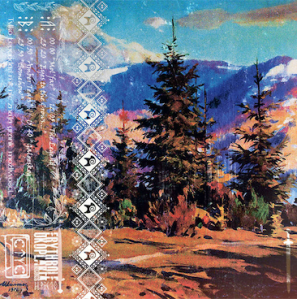 Since the full-scale invasion several artists have been rediscovering Ukrainian folk across the musical spectrum. Is this always welcome or do you have some reservations about the way traditional instruments and songs are sometimes used like at Eurovision, for instance?
Before the full-scale invasion, there was a term in Ukraine – sharovarshchyna (шароварщина) – used for folk performers with an unserious approach, if not for all of them. After the invasion, another term emerged – bayraktarshchyna (байрактарщина) – for particularly topical radio hits. Both have negativ connotations. I’m not sure how this translates to Europe, but here, I think society is somewhat saturated with folk archaicism and has grown tired of consuming this kind of content, even when they feel obliged to. Some do it to fill gaps in their cultural “gestalt,” others because Ukraine is in the global spotlight and they see a chance to make money. This is also true, by the way, for Eurovision.
I believe that, first and foremost, these things should be done out of love – only love can truly give birth to something meaningful. The last time Eurovision featured anything similar, I can’t even recall it – though, before I was born, duos like Secret Garden managed to win with it. None of my friends or colleagues follow Eurovision seriously; most even consider it “cringe.” From Ukraine, the one I remember is Kalush – more for the imagery than music, although their song “Stefania” is actually not bad at all. For some reason, an ad for “Carpathian yogurt” just popped into my head. this is terrible rapping over a folk beat. Anyone from the younger generation would call it «cringe», not «chinazes». Overly obvious, flashy folk elements mixed with modern music often give the younger audience the feeling that it’s forced, fake, and out of touch – like being told, “Listen to your grandma and grandfather, behave properly,” to which a teen might think: “No, Mom, I’m a damn teenager, a rebel!”.
It’s the 21st century, yet in the world, our identity is often perceived as if it were already archaic, something that belongs to the distant past. The problem, of course, is that our region – Eastern Europe – has always been culturally absorbed by the vast russian sphere, both internally for us and externally for the rest of the world. Perhaps that’s why folk elements seem new and exotic to outsiders only now, when Ukraine is finally being noticed as separate from russia – even though geographically we are not exactly small. But our listeners, it seems, are simply looking for something new, something that represents a more contemporary Ukrainian identity.
What personally concerns me is that modern Ukrainian pop music in these explorations often becomes indistinguishable from Turkish pop. Traditional Ukrainian folk music does contain some traces of orientalism and similar modes, scales, but never to that extreme. Maybe Jamala is to blame for this, and it’s about the influence of Eurovision again, despite the fact that the share of Tatars from the population of Ukraine is extremely small. There’s a subtlety, a regional authenticity, that gets lost when it’s over-simplified or commercialised.
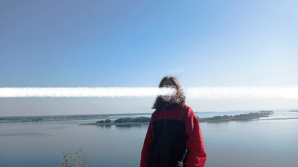 How would you describe the folk metal scene in Ukraine and how influential would you say bands like Drudkh and Nokturnal Mortum are for the younger generation?
Unlike the pop scene and the trendy techno-folk experiments, which have started to lean more toward Eastern, Turkish motifs, Ukrainian folk metal seems to go to the opposite extreme – towards a kind of Nordic aesthetic. And often, unfortunately, it gets lost there.
Drudkh and Nokturnal Mortum have been icons for as long as I can remember, and not without reason. They’ve always had authentic influences and a true understanding of the process of writing Ukrainian music. Drudkh often repeats canonical chord progressions and the movement of folk dumy genre. Nokturnal Mortum’s songwriting, if translated into classical arrangements, would sound like Volodymyr Ivasyuk’s songs. There are very few bands like this. Personally, the projects that impressed me the most in terms of faithfully conveying Ukrainian musical identity in a metal context are Чур (Chur) and Чорторий (Chortoryi).
Chortoryi, in particular, revealed the bandura in metal for me and inspired the idea to use it in my own music – though sadly, the author, Ievhen Olefirenko, died in combat, and I won’t have the chance to share this with him. I do, however, keep in touch with Mørkt Tre. To me, we share a similar vision of the genre. I discovered them through the album Земля забута богом і людьми, which feels like a dark soundtrack to the film Shadows of Forgotten Ancestors and is one of the most powerful Ukrainian black metal records from true Hutsuls. Their most influential work, which I would highly recommend, carries the mystical and dark title Некрофолк (Neсrofolk). it’s substantially different from anything else on the Ukrainian scene, especially compared to bands that merely copy Western templates. Ironically, of course, I also work with these templates myself – which makes it much easier for me to draw parallels today with foreign bands like Häive, Saor, or even Alda in terms of sound and approach to the genre.
Also, if you’re into more psychedelic, unconventional, and authentic stuff, I need to mention my colleagues from the label – Чортополох band (Chortopolokh). Their latest release breathes with the energy of “blackened punk”, ancient Hutsul modes and chants, and the kind of mystical esotericism reminiscent of Death in June. I designed their new logo as well. They’re one of the few bands truly faithful to tradition, following in the footsteps of the legendary Kosiv-based band Гуцули (Hutsuly), whose remastered release “Чи пам’ятаєте ви нас” I also worked on – cover artwork and logo. Sadly, the situation with the audience is such that, despite the careful restoration and design of one of, if not the first, Ukrainian psychedelic rock / heavy metal bands, people simply passed it by. I will not comment on the audience…
I think Drudkh and Nokturnal Mortum definitely still influence the younger generation of the genre – if not through their sound, then through their approach to presentation and aesthetics, for example. I mean, I once saw that Drudkh was even listed alongside Windir and Burzum as an influence for Saor! In his interview with Heavy Blog Is Heavy (here’s the link: https://www.heavyblogisheavy.com/2017/06/07/the-anatomy-of-saor/). That was quite interesting to notice. Once upon a time, the Scottish poet Robert Burns inspired our Shevchenko – and now Shevchenko, through Drudkh, inspired the Scotsman behind Saor to quote Burns. The world seems so unusual and complex when you start tracing who inspired whom. Everything is interconnected! Like in a Celtic knot. But who can help you see these connections – and first of all, your own – better than your compatriots, speaking to you in a familiar, intuitive language of sound?
Drudkh and Nokturnal Mortum are names too monumental not to inspire someone in Ukraine even now. The problem, perhaps, is that they are often the *only* ones people draw inspiration from. These projects are no longer “fathers” but rather “grandfathers” for the “children” of today’s scene. And in my opinion, this creates a kind of “father figure” complex in many young projects – they’re trying to fill in the gaps left by certain stages of metal’s evolution that we somehow skipped, while at the same time catching up with the global trend of reinterpreting old school metal. It’s hard to speak of any shared vision for the genre’s future or any real intergenerational dialogue, yet that’s exactly what’s necessary to form a school/scene like the world-renowned Kharkiv Black Metal Scene. There are cases where you can quite logically predict the appearance of projects like They Came From Visions, RUÏN, or Omhosten on the Ukrainian scene – but you would never expect something like Këkht Arräkh, Selvnatt, or Nightspell.
It’s even hard to guess these are Ukrainian releases, as if they appeared out of nowhere, outside any context (but, they pretty cool). Those guys were clearly not inspired by their older peers like Severoth, Stryvigor, or Colotyphus, who, in turn, probably didn’t take much from their own predecessors either. Tradition on our metal scene is a rather ephemeral thing.
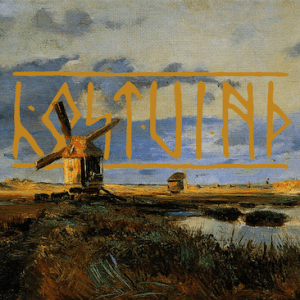 Are there any tracks or albums by Ukrainian artists that have conveyed the war experience in a meaningful way for you?
Maybe it’s a popular answer, but the first thing that instantly came to mind is “Обійми” by Океан Ельзи. The line “the day will come, the war will end” once felt like a beautiful abstract symbol of longing – not a hope-filled dream of a day we now actually wish to see in reality.
The song “Квітка-Душа” by Nina Matviienko isn’t just a lovely piece of ethno-new age about hospitality and peacefulness of our peoples for me anymore – it’s a prayer for self-soothing. “Метве Дерево і Вітер” by Обійми Дощу became something I like to reflect to during blackouts, in the dark, when everything feels still. meanings changed for me.
As for albums, the stance of the band Kroda, which had inspired me for quite some time, disappointed me after reading the members’ statements. But I still listen to those albums recorded in collaboration with Yulian Mytsyk (Viterzgir). After Mytsyk left, Kroda gradually lost its Ukrainian sound and leaned entirely into a kind of Germanic Nordism – which, fittingly, is where they’ve ended up physically as well. In Germany.
Against that background, the “Dzherelo” (EP) album by Mytsyk’s side-project Viter revealed itself to me in a completely new light – another example of metal with a genuinely folk approach. Have you ever heard four sopilkas playing in harmony? 😀 By the way, the motanka doll idea I used for the artwork and re-release of my first album was conceptually borrowed from his Springtime album.
Are you able to think of the future?
Hard to answer. Probably not.
What does it mean for you to be Ukrainian?
To be myself. And not to be afraid of being myself. Not to be afraid to speak your mind – to say what you believe needs to be said. Not to be afraid to do what you feel must be done – and to do it quietly, on your own, because no one else will do it for you. To have dignity. To rely on your own hands.
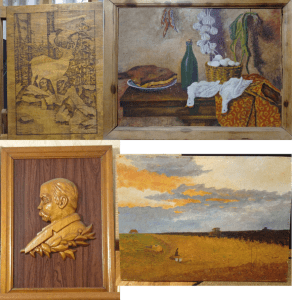 Which book / film / album / song / traditional dish / podcast / blog / artwork / building / meme best captures Ukraine for you?
My Thoughts Are Silent. Film. That was probably the first modern Ukrainian film that made me almost jump up in my seat and yell, “Damn, this is real Ukrainian cinema!”. As a Ukrainian, I absolutely love how the film uses “living language” – the kind of speech you actually believe in, because it surrounds you in everyday life, full of surzhyk and dialects, not that clean literary Ukrainian that sounds more like official bureaucratic style. And besides, the film is exactly about what we were talking about earlier – the dialogue between generations. The director really nailed the Ukrainian mentality and a very real generational issue that’s not only relevant to Ukraine. The main character can’t explain to his mother what he actually does for a living – his job is something new, unusual, and to her it just looks like a childish hobby that could never pay the bills. That’s literally me when I upload my music on Bandcamp and wait for enough sales to at least cover the utilities… And the actress who plays the mother behaves exactly like my own. 😀 Anyway, I won’t spoil the film for you.
Your question just reminded me I haven’t had holubtsi in a while. Ukrainian cuisine is rich, generous, and tastes just as good as it looks – maybe even better. I think that says a lot about our values: being sincere and true to ourselves, open and honest – perhaps so much so that to Western Europeans it can sometimes come across as bluntness or lack of tact. But that’s just because we don’t hide anything – not from the world, and not from ourselves.
NOVEMBER 6, 2025 – BERLIN
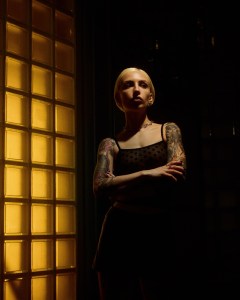
photo by @weigandt_off
My name is Nastya. I’m from Nova Kakhovka, and that’s where music first got into my life. When I was 14, I suddenly decided I wanted to play guitar. My dad, who’s a big new wave fan, was super excited. The next day he brought me a guitar and signed me up for lessons. My teacher then told me about a local girl rock band looking for a guitarist, and I ended up joining them as a guitarist and back vocal singer . We played a bunch of shows around the Kherson region and even released an album in Ukrainian.
After the band broke up, I still couldn’t see my life without music. I joined another band for a bit and also started DJing. I organized my own little events, played private parties, and just had fun experimenting. Later I moved to Kyiv and completely fell in love with nightclub culture there. It changed my taste and how I see music overall. I took a small break from DJing because of lack of time and confidence, but I always missed it.
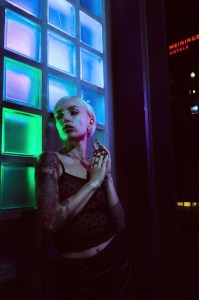
photo by @weigandt_off
When the war started, I moved to Canada. Losing everything familiar made me realize I should follow what truly makes me happy. So I went back to music. And this is where I am now, still doing what I love.
Has the full-scale invasion changed the way you think about music and sound in general and has it changed your playlist?
Definitely. The war pushed me to reconnect more deeply with my roots. I think many of us became more united and more aware of our identity. I started feeling a stronger connection to the music I grew up with in Ukraine and to the cultural influences that shaped me. It made my playlists more personal, more emotional, and closer to where I come from.
What would you say is the defining trait of your sound aside for the endless energy?
I would say it is very dynamic and emotional.
You started off playing guitar and singing backing vocals in a band as a teenager before moving to deejaying. What attracted the most about being behind the decks?
I’ve always liked having a bit of independence. In a band you have to wait for everyone to be on the same page. When I DJ, it’s just me, my music and the crowd. I get to make all the decisions and create the vibe on my own. I really enjoy that freedom.
You recently moved to Berlin from Montreal. Do you feel part of the Ukrainian community there and how welcoming / tough is Berlin for a newcomer?
I actually felt really welcomed here. The Veselka crew booked me for an event right after I arrived, which was such a big support, especially for a newcomer DJ in Berlin. The competition here is huge, so getting those first gigs means a lot. I’ve also reconnected with friends from Kyiv who live here now, and it’s been really nice to feel that kind of support. Berlin can definitely be tough, but the Ukrainian community makes it feel more like home.
How did you prepare for your Veselka set in Kyiv and how would you describe the Ukrainian queer community and how do you see it developing?
Honestly, I didn’t prepare at all, because the day before I went to K41 and spent the whole night there. It was a full improvisation and that’s exactly what I love!
Since I started going to parties in 2017, there was always a strong queer community around. One of the first queer collectives for me was Veselka, and that’s one of the reasons why I have so much respect and inspiration from them.
Our queer community is very open, bright – just like Veselka, and brave 🙂
If I am not mistaken, you also performed at Trace in Lviv? How was that experience and would you say Lviv has a distinctive electronic vibe?
I actually performed at 7Fridays, and it was my first ever gig in Ukraine. Huge respect to the organizers, because the hospitality was on the highest level. The venue was an abandoned factory, the crowd was amazing, and the vibe really touched me.
For a smaller city compared to Kyiv, Lviv definitely has a solid electronic scene and a very dedicated audience. I can totally see a lot of potential there.
How does performing in Ukraine compare to Montreal or Berlin and how much of a difference would you say curfew hours have made to the clubbing scene?
Compared to Montreal, I’d say the Ukrainian crowd is definitely more wild and open. Our scene has been around longer, while Montreal is still kind of in the early stages of building its own culture. With Berlin, it feels more similar in energy, but Ukrainian crowds are more welcoming and warm. I think it’s just part of who we are as a nation.
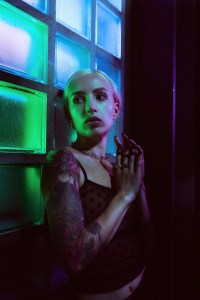
photo by @weigandt_off
Also, after all the curfews, I got used to day parties. It’s funny, because I barely remember what nightlife felt like before. Back then we were definitely more carefree and happy. Parties during the day and at night give totally different vibes. At night you can’t see much in the darkness, and maybe that mystery is exactly what we love.
Who are the most interesting Ukrainian producers for you and do you include Ukrainian tracks in your sets?
Somehow only Yan Cook comes to my mind 🙂
Has the international clubbing scene become more aware of the Ukrainian electronic artists since February 24, 2022?
I don’t think so , I think the Ukrainian electronic scene was always known and respected worldwide even before the war started.
Are there any Ukrainian releases from the past four years that have captured the war experience in a meaningful way for you?
One of the most meaningful projects for me was the charity compilation TOGETHER FOR UKRAINE released jointly by Standard Deviation and Mystictrax on March 4th, 2022.
This release is especially meaningful to me because it showed how deeply the global music community cares. In one of the darkest moments for Ukraine, artists from all over the world including some of the biggest names in the industry came together to support us. It wasn’t just about music; it was about solidarity, empathy and the feeling that we were not alone.
Which book / film / album / song / traditional dish / podcast / blog / artwork / building / meme best captures Ukraine for you?
So many of them hard to pick one , so I’ll write my top!
- Book – Taras Shevchenko – Kobzar
- Song – “Chervona Ruta”
- Album – Okean Elzy – Model
- Dish – golubcy
- Building – museum Pirogova
- Artwork – Taras Shevchenko – “Kateryna”
NOVEMBER 8, 2025 – LVIV
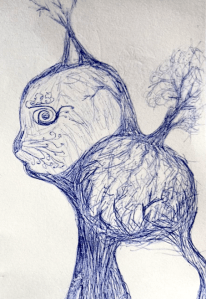
I come from the province of Dnipro oblast, Nikopol city. Now it is bombed everyday therefore I’m not there. Currently living in Lviv.
My interest in music was always with me but not so obvious before I discovered that I can actually play an instrument. My grandfather liked to hum some freestyled goofy melodies while he cooked a meal. My brother started playing guitar in his youth but it was just a hobby. Although I haven’t noticed nor found any musical talent (in terms of talent I mean desire that couldn’t be satiated—something you just live with and can’t get rid of ) that I could inherit from my ancestors. I still can’t believe that I’m the only one like this in my whole family.
I remember when my brother gave me he’s mp3 player. There were SOAD, Linkin park and Король и шут (i haven’t listened to them because i didn’t like to understand lyrics). Also in school while being on lesson i liked to make up some rhythm on the desk using something that was under hand. Nothing unusual. My childhood was as plain as it could be.
Things started to be interesting when I was 15. Before that I was that biased kid who played pc games and was afraid to look beyond that. So the story goes like this: I used to go to my brother’s house. He was 26 at that time with wife and newborn child. I usually came to them and played board games or just spended time with my brother’s family. And at one of those moments while playing chess with my brother I looked at the wall of his room and noticed an acoustic guitar. I mean of course I have looked at it before but now I have really noticed it. And from years on I understood one thing: when something truthful approaches you, you need to step to it using your own will. So I asked my brother to borrow his guitar. That’s how I started playing. My icons of that time were: Cobain, Hendrix and Frusciante and they encouraged me to play a lot.
After 6 months of playing on my birthday, my brother gifted to me his electric guitar with an amp (it was a YAMAHA starter kit) and I have it to this day because it is still usable and guitars are very expensive.
When the full-scale invasion started I was 16 and for the past two years lived in Irpin because my brother’s wife from there and my parents divorced so me and mom moved there. After 24th of February we`ve been there for a week or so. And when the decision to evacuate was made my brother didn’t allow me to bring guitar with us. I was very upset. We moved to my grandmother’s place in the west part of the country. And for a few days I was dead silent. Then my family decided to buy me a new guitar. It was some classical guitar which I still use.
Approximately at that period I have discovered Koka Records label: Цукор біла смерть, Оселедець, Коллежский Асессор, Вежа Хмар etc. Also I joined a community around this bands. It was a telegram chat called “В кроні прозорих хмар” (which is the lyric from Svitlana Nianio song).
From then on I graduated from school and moved to Lviv, met in person guys that I got to know from the community and few of them my soulmates to this day. Also I started to be more of a keen listener and reader. Bands, composers and performers like: This Heat, Lounge Lizards (John Lurie), Albert Ayler, Pharoah Sanders, Marc Ribot, Olivier Messiaen, Sonny Sharrock, Bohren & der Club of gore, Death in June, Claude Debussy, Gunnar De Frumerie, James Cotton, Big Walter Horton, Paul Butterfield etc; and writers and poets: Erich Maria Remarque, Jack Kerouac, Knut Hamsun, Herman Hesse, Andre Gide, Yukio Mishima, Arthur Rimbaud, Rafał Wojaczek, Михайло Коцюбинський etc. all of them and many more have impact of what I have did or still do.
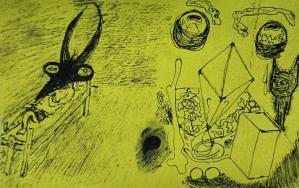 What is your setup and what can you tell us about instrumentation on your albums?
I have an amp, guitar, harmonicas (started to play them recently), some cheap microphone, chorus pedal, distortion pedal and looper. With looper I create layers and with other things I make something that fills the layers 😉
First three albums I did with my friend. His name is Vlad Yakovlev. He is a geek in ukrainian underground music, founder of tapes shop bloomed in september tapes, also of the band Неймовіра and just a cool guy who featured in many other ukrainian music projects. I gave him my recordings and he did some magic: sampled them, added effects and interesting features, even mixed them with each other (this approach has something in common with Burroughs “cut-up” technique ).
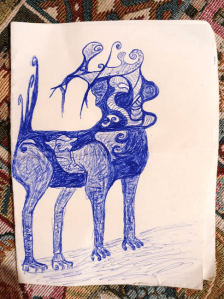 Before I listened to your music, from your moniker I expected some death metal or grind core. Instead I found complex music mixing a variety of different influences. How would you describe your sound and why did you choose your moniker?
The name of “excrements” came to me by simply sounding alike with the word “experiments”. When I was a bit younger I used to say the phrase “for the experiment’s sake” before doing some stupid stuff like getting high or drunk. my friends laughed at me and actually i never really think of it like a serious statement. I was young and wanted to make mistakes so… I did. I am still young though… and my attitude towards music derived from that. I’m having fun with instruments and usually I just play something spontaneously and then make something I could record on a phone speaker. All of those melodies that come out from my hands are just gifts from above that i really appreciate because they are feeding me and i can share it with others.
What can you tell us about the production process for your latest album Cлоник стоїть на своєму?
Heh, it’s just some things I’ve recorded in the period from spring to autumn (my favourite seasons). If you know Ukrainian you can see that names of the tracks create a poem and I hope music describes the feel of each lyric.
NOVEMBER 10, 2025 – KYIV
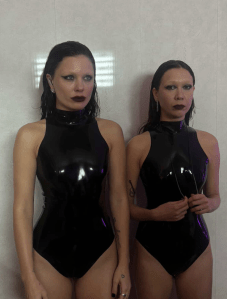
Hi! This is mariia&magdalyna — an independent music and theatre project based in kyiv since the covid times. in our work we always combine theatre and music, because first of all both Nadiia and I (Marusia) are actresses, and we have been involved in theatre for many years.
Our path has always combined music and theatre. even back in university, as acting students, we loved playing musical instruments. Nadiia played the double bass, and i played the cello. when covid happened, apart from theatre and music — which we’ve always loved — we also became very drawn to literature. that’s how the idea of creating literary masses appeared. we started studying biblical texts, and that became our first musical set.
After the bible texts, we went deeper into Ukrainian literature. one of the authors most important to us is Taras Prokhasko, and we created another set based on his book neprOsti (The UnSimple). Step by step, year after year, we came to writing and using our own texts — monologues, dialogues — while still combining them with literature and poetry.
You have been working with some of the most interesting experimental producers, from Khrystyna Kirik to Parking Spot and Bunht. at what stage of the creative process do you get them involved and could you describe your working method?
Marusia: I think we’ve been really lucky to meet incredible, talented Ukrainian artists — people like Khrystyna Kirik, Yaroslav Tatarchenko, and Marko Medvediev. There was always some kind of match happening between us. at different periods of our lives, we were asking ourselves similar questions, and somehow, we met these people who were asking the same ones — young artists living and continuing to create in Ukraine. So, these were, for me, important and quite magical encounters.
Our working method is always rooted in a question. we often start from a question — and from that question comes the search for a text, or the writing of new texts. then, together, when we discuss the music, we speak about the state, the mood, and the direction we all want to move in.
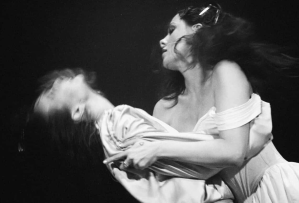
photo by Yuri Gryaznov
As far as i understand, you are still based in Kyiv and you have recently performed at Black! Factory. while so many artists have left, and with many being mobilised, how can one ensure its culture remains vibrant?
Marusia: Yes, we continue to live in Kyiv. recently we performed at black factory — it was an incredible experience. unfortunately, many Ukrainian artists have indeed been mobilized. so as long as we have the possibility to create, we feel it’s our shared responsibility to keep working — to keep speaking about Ukraine, to speak loudly, to keep asking questions.
For us, it’s very important now to continue making art in Ukraine — because this is our form of resistance.
How would you compare your experience with performing at home and abroad under present circumstances and are you expected to act as cultural ambassadors?
Marusia: It’s really a completely different experience. most of the time when we perform in Ukraine, our shows reflect the reality we live in — the questions that exist here and now in our society. Our performances become a space for reflection, for people to see each other, and maybe to find some answers — or even more questions.
When we perform abroad, of course, since 2014 we have, in a way, been acting as cultural ambassadors. we are not people from television, not the news — we are real people living through this reality. it’s important for us to share our experience, to make others feel what is happening in Ukraine. we focus on humanity — on helping, on standing together against evil. you don’t have to go through the same experience to understand it; you can empathize and act together.
What can you tell us about successful success, is it about ai and did you use ai to construct its narrative?
Marusia: Successful success became a completely unexpected discovery for us this year — a collaboration with Yaroslav Tatarchenko.
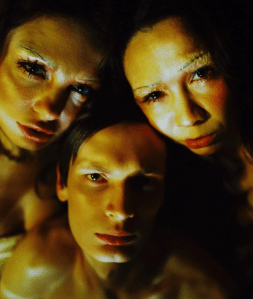
with Parking Spot
In Dance on the Edge of the World you ask the question, “Will there be a place of freedom in this world?” What is freedom for you and how was your show received in Germany?
Nadiia: We are all separate worlds depending on our experiences living in a shared world.
And for me, freedom is the opportunity to build your own world, to manifest for the common world, and here it is very important to manifest your world freely, as you feel you have the opportunity to manifest this world with love for the common world and respect.
And of course, absolute Freedom is impossible because we have a lot of limitations, prejudices, social restrictions, age restrictions, but it is precisely the choice of these restrictions that is freedom, the choice of which channel, which is a restriction, the river of my inner manifestation will flow.
And of course, it’s about the freedom to be the creator of your own and shared future, not to be the executor of someone else’s will, that is, not to be a slave.
The German audience perceived us very sensitively. They were very open and interested in what was happening on stage. Afterwards, they asked us many questions about our lives and how they could help us and how we should all be in this situation. It was a very valuable dialogue with the audience.
What the fuck is going on in this world?
Nadiia: This is my favourite question. Thank you for it. I think the world is developing. In fact, we are becoming more complicated. Technology is becoming more complicated. Opportunities for expression and self-discovery. But with that comes more diversity and less opportunity for equality and dialogue.
I believe that through large-scale disasters and wars we are moving towards building a new law, new laws and a new system of human interaction.
In human?… you tackle the war with daily diaries and texts from the Bible. The music incorporates sounds of warfare and air raid sirens. Was this show devised with an international audience in mind and what are the ethics of including triggering sounds?
Nadiia: To be honest, we started creating the play Human on the 30th day of the full-scale invasion and then we didn’t think about what its fate would be. We had a lot of unlived pain, a lot of unspoken, and it spilled over into this play. And of course, as translators, we created from what was around us, what was in space, that’s why so many trigger sounds are used there.
First of all, it is an honest attempt to reflect on a difficult and scary experience that we have not had before.
How did you get to form Marii&Magdalyna, what is the involvement of Vlad Troitskyi in your most recent projects and what is your position within the Dakh family, so to speak?
Nadiia: We were actresses at the Dakh Theater for 4 years and we can say that we were students of Vlad Troitsky because we received a lot of unique theatrical experience from him and with him.
But the project Mariia&Magdalyna is our independent work – it is a collaboration of two artists Nadiia and Maria and everything that happens between us.
We are in a creative relationship with the Dakh family, we often see each other at European locations, sometimes we have joint projects.
Before we speak to about Mariia&Magdalyna what can you tell us about your experience with Dakh Daughters and the social rave band TseSho? I am especially interested in hearing about the post-Euromaidan context and has the Revolution of Dignity influenced the direction you were taking at the time?
Nadiia: It is important to say that creativity in the Dakh – it has always been about the question of what hurts me, we even had such a song.
“I feel the pain because nobody felt the pain”
What is the main question, what worries you in the world right now as an artist, what do you want to talk about? Well, in Ukraine it is always about the people, about community, about freedom.
During the Revolution of Dignity, we were not yet actresses in the theater, but it really shaped us as individuals. We were there together with Marusya and saw the price of Freedom.
We were young, we were 20 or 21 years old, and even then it was clear that Freedom does not happen by itself, like democracy, like other values, they must be protected, they are not static.
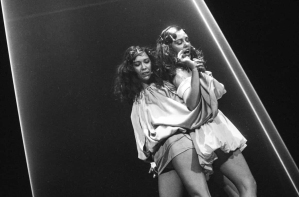
photo by Yuri Gryaznov
People of the Sun is based on poetry from Mykola Vinhranovskiy. Since the full-scale invasion, many musicians have been rediscovering their cultural heritage. How important would you say it is to reconnect to the past in order to construct a meaningful future?
Nadiia: In my opinion, we are beings who continue in time, we build our future based on the experience of the past and do something for it here and now.
And of course, in order to understand how to build the future and what kind of future to build, this is a very complex issue, we need to look into the experience of the past, it is very important for Ukrainians.
russia is constantly trying to make us forget our past. They are doing everything to make it dangerous to remember. They can kill you for this memory. The russian government constantly tried to destroy my people, so memory is very important for Ukrainians to build their national borders.
And in particular, if we talk about poetry, our predecessors left us many valuable, deep poetic images that we can rely on, that can give strength and hope, that can warm us when it’s cold, that fill us and inspire us.
NOVEMBER 11, 2025 – KYIV
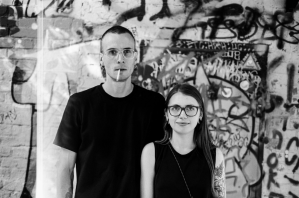
Kseniia Yanus and Vadym Oliinykov
Ksenia Yanus and Vadym Oliinykov – noizshchoseredy
A lot of preparation went in before you launched your series noizshchoseredy (Noise Every Wednesday). Can you tell us what were the key points you felt you needed to get right from the start and how you laid the groundwork?
Vadym Oliinykov: What we really had in the beginning was a kind of preparation in terms of developing our listening sensitivity and intuition. On the technical side, the club owners were always very supportive and helped us set things up. At the first events, it was just us and our closest friends performing. Ksenia was drawing the posters, I was writing the Instagram texts — and later our friend Ira Sokur took over the poster design. From there, everything began to evolve quite naturally.
Ksenia Yanus: There were actually two starting points for Noise Every Wednesday. The first was at Wild Stone, where there was almost no technical preparation, no Instagram, no complex planning — we chose a weekday, invited friends to play, and let the concept form organically through practice. The second start at Otel’ was much more deliberate. We outlined what kind of project we wanted to build, which artists we wanted to support, and how we saw its development. We launched Instagram, initially working with a close friend on visuals and communication, and later, through Projector Institute, a student developed the full visual identity that accompanied the project throughout its run. Preparing a presentation and press materials for the Cultural Monday grant competition helped us crystallise the idea and create documentation we then reused for further grants and collaborations. So instead of complex technical setup, the key groundwork was thoughtful work on the concept, identity, and communication.
From the start one of the aims of noizshchoseredy was to create a community. Ksenia, you in a recent panel discussion at the Construction festival in Dnipro titled “Sound as a Common Space: How Electronic Music Unites Postmodern Communities,” you asked “Why do you think electronic music is relevant in Ukraine right now and unites people?” What is your personal answer?
K: For me, its relevance starts with accessibility: today you can make electronic music with just a laptop, pocket synths or second-hand gear, without academic training — you need curiosity and listening, not permission. For listeners, it’s a huge spectrum of sounds, from harsh to meditative, dancefloor to experimental, so very different people can find something that speaks to them. And in Ukraine now, live electronic performances create shared, horizontal spaces of trust and presence, which is why this music really brings people together.
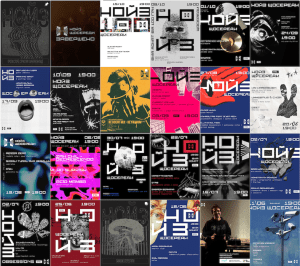 Another question you asked is, “What are some examples of social actions or political changes created thanks to electronic communities?” We have seen initiatives like Repair Together with volunteers rebuilding damaged houses in frontline regions to the sound of electronic music and electronic music hubs like Some People in Kharkiv keeping the cultural life alive. One of the key issues is sustainability.
While it was operating, Gasoline Radio brought together different creative forces and created synergies. Sadly, that experience also came to an end for a number of reasons, chief among them the lack of funds. How can one maintain momentum in wartime with so many unknowns coming into play and ensure at the same time that the legacy of these experiences doesn’t go lost?
K: In Ukraine now there’s an almost informal expectation that cultural events include some form of solidarity or fundraising. For Noise Every Wednesday we built a simple model: donations at the door covered our basic operational costs and fees, and part of what we raised we regularly directed to vegan military rations. It was a way to support those serving and, at the same time, draw attention to the lack of plant-based options in the army.
In terms of sustainability, many important initiatives rely on grants, which makes them vulnerable: once a grant ends, it’s hard to keep going, and you’re always working within someone else’s framework. We tried to do the opposite. Our core activity at Otel’ was based on a stable, mutually beneficial collaboration with Pavlo and on audience support, while any grant money we received was used only for additional formats or equipment. That independence, together with consistent documentation of what we do, is what helps projects like ours maintain momentum in wartime and leaves a trace that doesn’t vanish with a single funding source.
V: I don’t think there can be a single universal strategy when it comes to sustainability.
As for us, we were simply persistent and stubborn enough to keep doing weekly events no matter what. We continued working through power cuts and all kinds of other disruptions caused by the war.
When it comes to the question of legacy, it’s unfortunately a painful one for Ukrainian culture as a whole — because for various reasons, our literary, musical, and architectural heritage often gets lost or fails to form continuous movements or schools.
One of the strategies you put in place was to document all your events, so that the archive of noizshchoseredy sets exists online. Did you already have a sense of the cultural importance of what you were doing?
K: We didn’t start filming with a grand idea of “building a monument” — it was simply important for us that these live sets didn’t disappear after one night. Over time, we began to see how this archive actually worked. Some major Ukrainian festivals discovered artists through our YouTube videos and invited them to play. Musicians used recordings from Noise Every Wednesday in their applications for events, and it helped them get booked. We also heard from people who couldn’t attend in person that the channel was their way to stay connected to what was happening.
For many artists in the series, these videos are still their only documented live sets, as some don’t release music in a conventional way at all. So the archive became not about the numbers under each video, but about preserving a scene that is usually very fragile and making those performances accessible beyond the walls of the club.
What would you say are the things you got right and those you got wrong?
V: We didn’t get anything wrong.
K: Agree 🙂
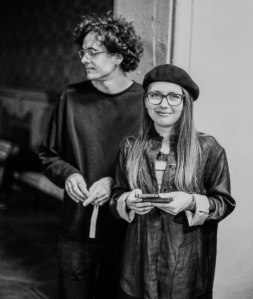
photo by @grotesquefilm
In Jacques Attali’s, Noise: The Political Economy of Music, Attali wrote that “The world is not for the beholding. It is for the hearing. It is not legible, but audible.” He also added that “Nothing essential happens in the absence of noise.” Would you agree with that, and now that noizshchoseredy is no more will nothing essential be happening in the Ukrainian adventurous music scene?
V: One of the simple yet central ideas that Noise Every Wednesday tried to convey was that the human being — the subject — has no access to the ontological.
The text, that is, the symbolic order, always has a boundary beyond which begins the unwanted Real — that which cannot be fully integrated into language.
Noise, in the Lacanian sense, can be seen as a manifestation of this Real — an object whose encounter may be traumatic and whose symbolization can never be complete.
This perspective, in my view, restores a sense of limit and invites a certain humility — both intellectual and existential — which the contemporary era so evidently lacks.
When I interviewed Alexey Shmurack in December 2024 and asked him about the popularity of noise, he explained it as follows, “It seems to me that the saturated sound helps to physiologically distract from the unpleasant news, from a feeling of powerlessness, from the impossibility for many men to travel abroad. This saturated sound helps to feel unity and intense pleasure.” Would you agree that this is the secret of your success?
V: I can agree in terms of the physiological aspect of our sound. It truly was — as it should be for music played in one of Kyiv’s key dance clubs — very physical. For us, it was indeed a way to cope with stress and to measure time. It helped us, and I believe many others as well, to maintain mental health and to feel a certain stability during a very anxious period.
At the same time, the notion of unity — and especially that of “intense pleasure” — personally raises a fair amount of suspicion for me.
There are some I spoke to that were confused by the “Noise” tag you adopted for your event, saying that this tag wasn’t always applicable to the music that was being played. Indeed, you interpreted the notion of noise to include a large spectrum of sounds. For many it was a chance to experiment and try out a new formula in a safe environment. How would you explain the reason why your event ended up attracting so much interest from a variety of different players?
V: Many people still like to talk about noise in the same way they talk about subgenres of hardcore. I see that approach as narrow and, in a sense, repressive.
Purism was never our thing. We never excluded artists based on aesthetic or ideological criteria.
When we were putting together the lineups, the only thing that mattered to us was how interesting the material was — and how strangely or strikingly different musical genres could sound together within the same evening.
K: We were interested in artists who were curious enough to step outside their usual comfort zone — including those who normally don’t play noise at all — and we often encouraged them to add something harsher, more chaotic, more textural to their live sets. Over time we watched very clear transformations: someone’s first performance could be only slightly “noisy”, and their next ones would already be much denser, more radical, shaped by this context of freedom. I think this openness — not asking people to fit into a template, but giving them a safe space to test new ideas — is exactly what attracted such a wide range of artists and communities to Noise Every Wednesday.
I know it is not polite to pick favourites, so I will ask you instead to pick five of the most memorable sets that for technical, or personal reasons struck a chord with you and the audience.
K: It’s hard for me to name a strict top five, partly because my experience was specific: I worked at the door every week, heard most sets in fragments, and later rediscovered many of them through our own recordings. That double perspective shaped how I remember the series.
Some moments still stand out: the Radical Sound showcase and Prince Buba’s set, a few artists we kept inviting back because their performances always felt right for the context, the night with almost 300 people and a lineup of 100000, Maksym Toshcho, Cedrik Fermont, ummsbiaus & Difference Machine. And the noise operetta by Clemens Poole and collaborators. And then there were many evenings where we put seemingly incompatible acts together — cinematic drone next to blackened doom — and it worked so well that the whole night stayed with you much longer than just one set.
V: I’m very glad that Noise Every Wednesday became a space where artists boldly and effectively deconstructed club dance music. It’s worth mentioning Kim Kardashien and Illia Oholtsov here.
At the same time, I’ve always been more interested in the organic development of performers.
For example, when Vlad Suppish started playing at Noise Every Wednesday, I felt that he should be filling entire venues with his very distinctive kind of dance music — not really dance-floor music; it holds you still, almost transfixed. So I was genuinely happy to see a full dance floor of mesmerized people during Vlad’s set.
Also Noise Every Wednesday often reused decorations or light installations left from previous events, which sometimes created surprisingly effective combinations with the performer’s music.
For instance, during the first — and unfortunately the only — set by Plandonapearl, a large laser cross happened to stand behind her and coincidentally aligned with her sound. That set made a very strong impression on me.
And now for the one-million-dollar question, many were left bereft when you announced the closure of noizshchoseredy, could you reveal what prompted such a move and was noizshchoseredy a victim of its own success?
V: The military and political situation in the country.
K: There wasn’t one dramatic reason — it was a mix of factors. We didn’t want to wait until the series became a burden for us or for the space. Stopping on the 100th event felt like the right decision: a clear, beautiful point to close this chapter while it was still alive, honest and meaningful, rather than slowly stretching it out. I wouldn’t call it a victim of its own success — it was a conscious choice to end on our own terms.
Finally, I am the proud owner of a noizshchoseredy t-shirt. How much could I get for it on eBay?
K: I hope it never gets to the point where only collectors can afford it. For us it’s important that anyone who wants a small piece of this history can still get it, so we continue to print the t-shirts on demand. They’re around 30 USD plus shipping — and, honestly, we’d much rather see them being worn at gigs than sold on eBay.
NOVEMBER 12, 2025 – DNIPRO
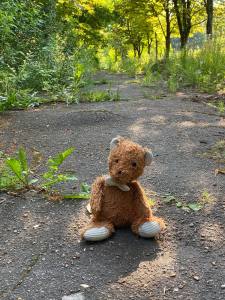
I was born in Dnipro, but I spent most of my life in a small town nearby. My name is Daniil, but I go by the pseudonym iceleep. I studied at a music school for about seven years, with piano as my main instrument.
I had good results and a natural sense of rhythm and pitch. After some time, I grew tired of academic music and took a short break. A few years later, I developed a deep interest in learning how to create electronic music.
Has the full-scale invasion influenced the way you think about sound and music and the way you approach your work and has it changed your setup?
The war didn’t change my attitude toward sound or music itself. On the contrary, music became an anchor for me — a source of calm and nostalgia. I love music of all kinds, emotionally and stylistically. In fact, the beginning of the war pushed me to start creating again.
I have many goals in life, and one of them is to make music — to become an artist who creates quality sound and evokes emotions in others, the same way I once felt from other musicians’ works. The war made me realize that I couldn’t keep waiting — I had to start now, because tomorrow might never come.
I should mention that I’m not a professional musician in terms of mixing or mastering. I’m a beginner just starting my journey in the musical world. I’m aware of my mistakes and constantly try to improve. Every release I make is imperfect, but I see that as part of my growth. Some tracks I might not even want to release, but I think it’s important to show everything — so that listeners can witness my progress.
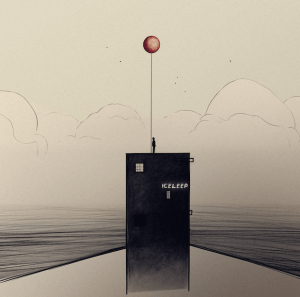 What can you tell us about the production process for your album Metamorphosis?
Metamorphosis became an idea that carried a lot of meaning for me. It took about a year to create the album. I wanted to pour all my emotions into it — everything I had lived through at that time. For me, the witch house and electronic genres hold a much wider emotional range compared to ambient. I wanted to challenge myself and see how far I could go in this direction, because before this album, I had mostly been releasing ambient works.
My very first track ever was electronic, but at that time I decided to focus on ambient. While working on Metamorphosis, starting from the first track, I began to feel inspiration — a kind of drive that’s hard to explain. I spent dozens of hours on each track. It made me genuinely happy to feel so deeply connected to the process.
While chaos unfolded outside my window, working on this project gave me peace and a sense of stillness. The album is emotional and expressive — yet the heavy bass and the “vacuum” sound still carry the imprint of wartime feelings: the muted rumble reminiscent of explosions or drones, the fear, the anxiety for family and the future. All of this lived inside Metamorphosis.
Is there a particular reason why you seem to favour one word titles?
My reason is simple — I want to express emotions through sound and let the listener experience the full emotional picture of each composition. Metamorphosis itself is about the transformation of one emotion into another — a passage from one state to the next. I want the listener to truly feel that.
How would you define your sound, is it closer to ambient or to witch house?
I can’t really define my music by a single genre. I want to create whatever I feel like making. If one day I produce a lo-fi track, that doesn’t mean I’ll become a lo-fi artist. My recent releases showed me more from the side of witch house and electronic, but that’s not all I am. My project is about seeing how diverse I can be — not limiting myself to one direction. Who knows what will come next.
How would you describe the electronic music scene in Dnipro and how do you see it developing after so many are serving in the military or have left?
I don’t closely follow the Ukrainian music scene, especially in Dnipro, but I can say that the war has changed a lot — both for the worse and for the better, as strange as it sounds. The war sparked a strong sense of unity and the desire to create national music. There are now many more Ukrainian artists who are proud to sing and write in Ukrainian.
This movement helped our country focus more on developing its internal creative scene — music, film, and more. It’s still small, but it’s a start. I’ve listened to electronic artists from Ukraine and even from Dnipro, and I’m happy to see so many new names appear. It’s inspiring to see people finding creativity even in such times. I hope this growth continues.
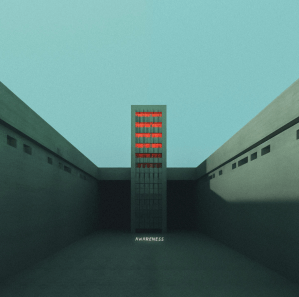 How would you say your acoustic landscape has changed and what would you say are now the most triggering sounds for you?
I haven’t noticed drastic changes in myself, but I can say that I’ve learned to value the sounds of nature more — the atmosphere of natural landscapes and their harmony. At the same time, the horrifying scenes of ruined cities, the sirens, and the panic — those sounds will stay with me forever. They are impossible to forget.
What does it mean for you to be Ukrainian?
For me, it means being a person with my own culture, nature, and people. I’m Ukrainian, and Ukraine is my home. I’ve traveled across Europe, including Switzerland — one of the most beautiful and comfortable countries to live in — yet I still choose to stay here, in Ukraine, with my loved ones.
I’m grateful to be able to associate myself with a country that could have been destroyed by war — but survived.
NOVEMBER 12, 2025 – KALUSH
photo by Olga Kubyk
My name is Alexander Sky (Aleksandr Skydan). I am a musician and composer from Ukraine. My journey in music, which began in the early 2000s, has now grown into a professional career in the music industry. I started my musical career as a bass guitarist, playing in a punk rock band in my hometown of Odesa.
After moving to the capital (Kyiv) and honing my skills in funk and fusion, in 2009-10 I decided to dive deeper into the process of creating music and producing as a music producer and composer, studying DAWs such as Ableton, Reaper, and Reason.
My first electronic live project was called SkyTrix and was something like DnB punk, filling the drum and bass sound with dirty guitar riffs and effects. In 2012, the project was shut down and I started working on a multi-genre project called Light Dreams, which has been around since 2013 and continues to this day. Now it’s a Liquid DnB / Chillout duo with my wife Olga Kubyk. We play our sets using live instruments (guitar, violin, vargan), as well as synthesizers and samples.
Light Dreams successfully performed at major festivals such as Koktebel Jazz Festival, Leopolis Jazz Festival, Atlas Weekend, Gogol Fest, and Vibronica Music Festival. Light Dreams’ music is used as soundtracks for advertising and in the fashion industry. Since its inception, Light Dreams has released five EPs (Faces of Nature, Time for Spring, Moonlight, The Trip, and X-mas Eve), three singles, and two albums, one of which (Escape from Nebula) was a collaboration with musicians from Latvia and Spain.
In 2022, when russian troops invaded Ukraine and the war began, I couldn’t accept the situation and spent several weeks in a state of prostration, not knowing what to do, unable to see the future or understand what was happening. But, thank God, I pulled myself together and realized what I could do and how I could help people and my country in this situation.
I realised that the only things I am good at are music and my knowledge of psychology and psychotherapy. With a background in psychology and therapy (I am a psychologist by training and practiced as a therapist in the mid-2000s) and my long-standing desire to write music that heals, I decided to create the Ambiotik music and wellness project.
Combining my knowledge of the influence of music on the mind with psychosomatics and relaxation sessions, I created a program that helps people quickly relieve stress and tension, as well as improve their mental health. Over more than 3.5 years of existence of the Ambiotik project, I have conducted more than 100 offline and 50 online music therapy sessions, in which more than 1,500 people have participated. The method itself has shown 100% positive results and has helped session participants improve their mental health and learn to reduce stress and tension on their own.
During the project’s existence, I have worked extensively with wounded soldiers and military personnel undergoing rehabilitation. My method has helped many of them improve their well-being, restore healthy sleep (without the use of medication), and even get rid of phantom pains, which cannot be achieved with any painkillers.
In addition to my main music projects, Light Dreams and Ambiotik, I write music for commercials, videos, audiobooks, and poetry, and I am also working on a large music app project (scheduled for release in 2026), where all the music for meditation, relaxation, and other genres is written by me.
Plus, I teach online music creation, mixing, and mastering, and I also give lectures and master classes on music production.
photo by Maxim Gaidouchenko
Has the full-scale invasion influenced the way you think about sound and music and the way you approach your work and has it changed your setup?
Yes, definitely. As I said, there was a period when I couldn’t think about music or creativity. In general, the future became uncertain and unclear, as did my future life.
But, on the other hand, the full-scale russian invasion forced me to realize a long-held dream of creating therapeutic, calming music. While studying at university in the mid-2000s, I became deeply involved in hemi-sync technology, binaural rhythms, and the effect of frequencies on consciousness.
But my knowledge and skills in music were weak (I did not graduate from a music school and acquired all my musical knowledge on my own). Now, the desire to help my fellow countrymen has prompted me to create the Ambiotik project. I already had ideas for the project, so I was able to prepare it fairly quickly, create the music and the program itself.
In the spring of 2022, refugees from the east (Kharkiv, Mariupol, Berdiansk, Kherson, etc.) who needed help and psychological support arrived daily in Kalush (a city in western Ukraine), where I live.
Together with the local youth organization Вільні калуські люди (Free Kaluga people) we began to hold musical and wellness events for IDPs. The first sessions showed positive results and helped many people improve their emotional state and reduce stress levels. In the first few months, we constantly held such musical therapy sessions for adults and children.
Together with the Kalush Regional Hospital and the NGO Ветерани захисту батьківщини (Veterans of Homeland Defense), I began conducting therapeutic music sessions for soldiers who were undergoing rehabilitation at the hospital after being wounded.
For me, this was my first experience working with wounded soldiers who were in the hospital after suffering severe injuries, concussions, and PTSD. I had to change the program and the music, as not all sounds were suitable for working with the wounded. During my first six months at the hospital, I refined the music therapy program and was able to help many Ukrainian soldiers improve their emotional and mental state, restore their health, and teach them how to use this method independently.
Now I continue to develop my project and hold charity events for everyone. The project itself is charitable and is entirely funded by me. Of course, sometimes I get help from public organizations, acquaintances, and people who simply donate money.
I have already held charity events in Lviv, Kalush, Ivano-Frankivsk, Odessa, Kyiv, Dnipropetrovsk, and Vinnytsia. But there are many other cities that I want to visit with my Ambiotik project. That is why I am currently seeking funding for the project, so that I can introduce it to residents of other cities and help them improve their mental health and learn to cope with stress.
I have also released an audio program that anyone can use. It is effective and can be used for independent study.
Also, together with my friend Shantiago, we have created a musical healing album that combines sound healing and ambient music, using healing frequencies and binaural beats. The release of this album is scheduled for 2026.
In addition, I continue to perform live shows with my projects Ambiotik and Light Dreams.
Have you been displaced by war at any point?
My hometown is Odesa. In 2006, I left there and moved to Kyiv, the capital of Ukraine. I lived there until 2014. Fate brought me to the small town of Kalush, located in western Ukraine, not far from the Carpathian Mountains.
When the war began in 2022, I stayed here. I had no intention of fleeing, as my parents and relatives remained here in Ukraine, and I couldn’t abandon them. Looking back now, I wouldn’t change my decision. I am glad that I stayed here and can help my fellow citizens in this difficult time.
Many say that after the full-scale invasion, ambient and noise became the two most popular genres.
To be honest, I haven’t thought about it. Maybe. I’ve always been interested in ambient music, so my attitude towards it hasn’t changed.
I think people need something calming, something quiet and non-aggressive. That’s why ambient music is perfect for switching to a state of monotony and tranquillity.
As for noise music, I don’t know much about this genre and am not very familiar with its representatives.
photo by Olga Kubyk
How did you get involved with Victory Beats and what can you tell us about the healing powers of music?
We met Vova online in the winter of 2024, when Victory Beats was a project that published mixes by various artists on its website and social media. I shared my idea about music therapy with him, and after a while he said that he had a rehabilitation centre in mind near his home where we could try to organize a music and wellness session.
It was May 18, 2024, when I arrived to see him and we held our first music session at the Superhumans rehabilitation centre. At that time, we had only one participant, a little boy who had lost his leg while escaping shelling with his parents. I showed Vova the methodology and how a music therapy session should be conducted. From that moment on, thanks to Victory Beat, a music therapy centre was established at Superhumans, where military personnel can undergo rehabilitation through music and even change their destiny by playing musical instruments or becoming DJs.
Music has always been and will always be medicine. If we want to feel happy, we listen to cheerful music. If we want to feel sad, we listen to sad music. If we want to vent our anger or protest, we listen to aggressive and hard music. And if we want to relax, we listen to calm music.
My method is based on a combination of special relaxing music (to which I add certain frequencies and binaural rhythms), which catalyses quickly immersing oneself in the process and remaining in it; a psychosomatic concept (our psyche cannot exist without the body and the other way around, so by affecting the body and relaxing it, we affect our psyche, relieving tension and stress, and vice versa); and my voice as a tool for quickly immersing oneself in the process and returning from it.
If you practice a music and wellness program regularly, your emotional state improves, stress and tension in the body decrease, and sleep improves.
Plus, even just listening to relaxing music, mantras, or nature sounds can unconsciously calm and relax a person, making their breathing calm and steady. If they listen to this kind of music for a long time, they may simply fall asleep, completely relaxed. That’s why I recommend listening to this kind of music. You can find it online and on streaming services. I also invite everyone to visit my YouTube channel @ambiotikhealingmusic, where you will find lots of similar music and audio programs for improving mental health and relaxation.
What would you say you have learned from veterans?
First and foremost, I am grateful to each and every soldier I have worked with. Each of them has given me the opportunity to write these lines, to do my job and create, to open my eyes in the morning and feel alive.
I am grateful and happy that I can help them cope with stress and PTSD. To teach them how to cope with stress and tension.
When I started working with them in 2023, it was a little difficult:
– relaxing the bodies of people who had lost limbs, some of them multiple
– noise in the head after concussion
– triggers for different music and noises
Now, after several years of working with military personnel, I have learned how to work with them easily and have managed to develop a musical healing program specifically for them (which I plan to release in January 2026).
Military personnel are quite closed off, especially to this type of therapy, as they do not consider themselves to be “crazy” and find it difficult to engage with others, including in music sessions. However, I have managed to find a way to approach them.
I have heard many times how sceptical they were before my sessions and how grateful they were afterwards.
Have you been surprised by what some people consider triggering sounds?
No. I was ready for it. I think we all have our triggers, both positive and negative. Think, for example, of a song that makes you happy and brings back memories of pleasant moments from the past. Or, conversely, a song that makes you sad. Music is a powerful thing, so triggers in it are completely natural.
I had one case when I was working in a hospital with a wounded soldier. The music I played for him during the session caused him unpleasant feelings. I had to select music for him individually, and as it turned out, Mendelssohn’s classical music suited him best.
What surprising tracks or artists we might find on your playlist?
When it comes to the playlists you can find on Spotify or YouTube for my project Ambiotik, it’s pretty straightforward. Each track is selected to calm and relax you.
As for my personal playlists, you can find anything you want there, of course. From classical works by Beethoven to The Prodigy, Amon Tobin, Richard Cheese, Nina Simone, The Smashing Pumpkins, 2Unlimited, and Roxette. I love different kinds of music, and each one “triggers” me in its own way ))), in a good meaning of the word 🙂
photo by Maxim Gaidouchenko
What does it mean for you to be Ukrainian?
For me, being Ukrainian means being strong and brave. I can’t say how other Ukrainians feel.
How many times have I been under rocket and drone fire. I’ve seen warehouses explode and heard drones fall behind my house. I’ve seen how air defence works. I’m not even talking about videos of fighting and deaths. I don’t think I’ve ever felt so keenly the fragility of life and the desire to live every moment, every minute to the fullest.
Are there any Ukrainian releases from the past four years that have captured the war experience in a meaningful way for you?
Unfortunately, I haven’t come across any Ukrainian releases that reflect what is happening in Ukraine during the war. To be honest, I’m not sure, but maybe I’ve missed something. Because all the patriotic and military songs that are played on the radio are more about pop culture and the hype that the music industry wants to create, against the backdrop of the war. I don’t accept that.
Which book / film / album / song / traditional dish / podcast / blog / artwork / building / meme best captures Ukraine for you?
A good and, at the same time, difficult question. So, in order:
- Book – Evenings on a Farm Near Dikanka by N. Gogol
- Film – Once Upon a Time in Ukraine
- Album – Янанебібув by Okean Elzy
- Song – Були на селі by Воплі Відоплясова
- Dish – Borscht
- Painting – Any painting by Petro Bujak
- Building – Motherland
NEW RELEASES
Orfin ~ Toi
Danya Tkachenko (Orfin) returns with Toi — a luminous journey through organic ambient soundscapes that shimmer with warmth and quiet wonder. Joined by Mariia Koliadina (Mechika) on violin, voice, divya, and accordion, the album drifts between sunlight and shadow, where gentle melodies chase flickers of light and softly ignite the lanterns within.
Paloven ~ Avalon
Bathed in a vintage synthpop glow, Avalon turns inner turmoil into shimmering resilience. Beneath its pulsing beats and nostalgic textures lies a dark yet uplifting journey — a sonic refuge for the pain that trembles just beneath the surface.
Morphey ~ Teratophilia
With Teratophilia (the sexual attraction to monsters), Morphey unveils his alter ego, Lilith — a vessel born from shadow and self-confrontation. Swinging from dark pop to drift phonk, the Kharkiv-based artist dives deep into themes of identity, fear, and transformation. It’s a haunting exploration of desire and acceptance, where beauty and monstrosity intertwine in the depths of the unknown. Teratophilia plays like a televised exorcism against the bite of a spider with an electric heart.
екскременти ~ Cлоник стоїть на своєму
What to make of an album titled The elephant stands its ground by an artist named excrement? It would be fair to expect some gore metal, but instead of brutality we get an entrancing blend of lo-fi post-rock and ambient experimentation, laced with soft noise and poetic melancholy. The title tracks unfold like verses — “While darkness is sloshing around / The demon still hasn’t gotten off his tail / But there will come a clear time.” Sorrowful guitar lines emerge through the crackle of digital textures, creating harmony where discord lies.
До дитинства ще належить дорости by екскременти
A blues infused reflection on childhood, languid in tone and melancholic in outlook that ends on a sombre note “there will be peace, but not now”.
Haido ~ Tales Beyond
From “My Generator”—about love as the very force that sustains it and connects it to the world—to “Cryo Porcupine”, a tale of unexpected friendship and hidden beauty within seemingly dangerous forms, underscored by crystalline synths and deep bass. “Blue Star” with its rhythmic, grainy textures intertwined with melodic synths, explores empathy and connection with delicate nature. Tracks like “Nebulance” transport the listener across stars and cosmic nebulae, unfolding bright textures and warm analog synths, while “Fragile 92” reflects transformation: its main synth line splits into molecules and weaves them back into intricate patterns, carried by a glitch-driven beat verging on drum’n’bass. In its most introspective moments, “Embers” immerses us in the silence of a dying fire under the rain. Finally, “Distant Warmth” closes the journey with a steady rhythm that offers hope and solace amidst expansive, sometimes somber soundscapes.
Low Communication ~ 12 AM Not For Sleeping
Low Communication is the musical project of Bohdan Linchevskyi from Ukraine. Originally an ambient endeavor, it has evolved into a more elusive and genre-fluid expression. His work has been released by respected labels such as Byrd Out, Neotantra, and last year under our sublabel, EQ.
In this album, “12 AM Not For Sleeping,” the artist presents some of his most percussively intense work to date. Expect intricate drum breaks, spoken word fragments, raw textures, aggressive melodies, and, as always, a subtle ambient thread running beneath the surface. This release features a collection of six remixers from our roster: J-LOWER, Evry, Eden Grey, DJ Track, Aderacid, and LAMEBOT.
58918012 ~ Memories Into Dust
A gentle, introspective journey through the fragile landscapes of memory, this album captures moments as they fade and return like dust in sunlight. Warm, melodic, and quietly nostalgic, it reflects on time, loss, and appreciation — where even the darker tones only deepen the light. Memories Into Dust features subtle piano touches despite the artist’s known aversion to the instrument, — in April 2023, 58918012 released the album titled Hating Piano. This new work reveals emotion with honesty and grace — a soft meditation on remembering, letting go, and finding peace. The Autum sunset delivers compressed thoughts where the geometry of light points to one more day.
We’ve Already Talked About Th*t ~ точка тиску
Pressure Point is the debut album of the band WHATAT, which calls for the eradication of the oligarchy, resistance to fascism, imperialism and repressive institutions. Each and every one of us must be aware of our own resistance, defend our own principles and values, which is what the band calls for in their songs.
PROLETARSKYI ~ hidden back.
“I like these branches, like roots, / I see the names of black metal bands in them, / I hear the whisper of the night, like trembling, / The trees sway, not touching the words.”
In the opening track “Incurable,” there are references to anhedonia (the inability to feel pleasure) and melophobia (the fear or pain caused by sound/music). These are clinical and symbolic signs of deep depression or PTSD-like detachment. From there on, it’s a catalogue of psychological decay, emotional alienation, the failure of language and meaning, and the collapse of communication in both personal and social relationships. And yet, this new EP from Proletarskyi is far from despressive, lifted by the music of 58918012 in his more industrial-techno incarnation.
Koloah ~ Orbital Pacific
System Error welcomes Koloah with the Orbital Pacific EP – a fierce, unflinchingly direct statement in electro form.
Sounds forged between the industrial shadows of his Ukrainian hometown and Berlin’s underground. From the brooding drive of the A2 to the epic peak-time weapon ‘Origin,’ just the right mix of feeling and force. Pow.
Ship Her Son ~ Саундтрек до порядку денного (Instrumentals)
The stripped-down edition of Ship Her Son’s Soundtrack to the Daily Agenda delivers the project in its rawest form. With Eugene Tymchyk, Антон Слєпаков, паліндром, Олександр Куц, and Divuar now gone, what remains is the relentless thrum of everyday grit. The post-punk spirit that once animated the project has evaporated, clearing the way for a resolute industrial workout. The once-surreal vistas of collapse have flattened into a bleak, desolate plain—harsh, minimal, and unwavering.
Hidden Element ~ Live at Brave!Factory 2025
Hidden Element Live Show is a dialogue between the past and the present. A tribute to memory, freedom, youth, and the inner strength of a generation that is shaping a new Ukraine. Performed live at Brave!Factory Festival 24.08.2025 at Dovzhenko Film Studio.
Weavebird ~ Yarn Fault
With characteristically cryptic titles like “Mulching Quills” and “Periwinklehead Pastel,” Weavebird pushes deeper into his disorienting passage from black ambient into dungeon synth on his latest release. The second track, “1581,” might nod to the publication year of the Ostroh Bible—the first complete Church Slavonic translation—but any clues dissolve quickly as the listener is pulled into an echoing, reverb-drenched void.
некрохолод ~ Khladna reka
Who am I?
A truly difficult question — one that remains unanswered even after decades of exploring information and creating various forms of art that emerge from within me into the world.
I began creating at the intersection of emptiness and curiosity — a desire to understand why what I feel can exist at all in this reality. What universal laws could have shaped my ability to feel the cold and to contemplate the boundless ice of the sky above the steppe?
Out of that cold and the absence of a sense of reality, the art project “Khladna reka” was born. Its purpose was to document the atmospheres that brought me into a state of belonging to something higher and voidlike. It became my first true step toward creating something meaningful — the foundation of my perception not only of art, but of closeness itself.
There is nothing that could describe my fundamentally emotional perception of this world better than this album. It is a sonic visualization of my documentary and autobiographical project “Khladna reka.”
And you know, sometimes I feel that no matter where I go or how I change, I will always remain there — within those native, cold atmospheres.
It is worth noting that there is no sorrow or darkness here, as one might think from the album’s somber tones. It is merely a method of expression, one of the ways to immerse oneself in what shaped me. In a sense, this is simply the sonic embodiment of my writings about self-awareness.
Yet, while exploring such deep layers of another’s reality, each of us may find a chance to reconsider our own — and of course, never forget the old and faithful resonance.
Please, as you listen to this album, remain as open and sincere as possible in your feelings, emotions, and sensations. Just let the sound flow through you.
Thank you.
Stalkvoid ~ Dead Air
𝐼𝑛 “𝐷𝑒𝑎𝑑 𝑎𝑖𝑟”, 𝑡ℎ𝑒 𝑎𝑢𝑡ℎ𝑜𝑟 𝑐𝑜𝑛𝑣𝑒𝑦𝑠 𝑡ℎ𝑒 𝑎𝑡𝑚𝑜𝑠𝑝ℎ𝑒𝑟𝑒 𝑜𝑓 𝑡ℎ𝑒 𝑆𝑡𝑎𝑙𝑘𝑒𝑟 𝑍𝑜𝑛𝑒 — 𝑎 𝑝𝑙𝑎𝑐𝑒 𝑤ℎ𝑒𝑟𝑒 𝑠𝑜𝑢𝑛𝑑 𝑜𝑢𝑡𝑙𝑖𝑣𝑒𝑠 𝑚𝑎𝑛. 𝑇ℎ𝑖𝑠 𝑎𝑙𝑏𝑢𝑚 𝑏𝑒𝑐𝑜𝑚𝑒𝑠 𝑎 𝑔𝑢𝑖𝑑𝑒 𝑡ℎ𝑟𝑜𝑢𝑔ℎ 𝑟𝑎𝑖𝑛, 𝑓𝑜𝑔, 𝑐𝑜𝑛𝑐𝑟𝑒𝑡𝑒, 𝑎𝑛𝑑 𝑚𝑒𝑚𝑜𝑟𝑖𝑒𝑠 𝑑𝑖𝑠𝑠𝑜𝑙𝑣𝑒𝑑 𝑖𝑛 𝑡ℎ𝑒 𝑠𝑡𝑎𝑡𝑖𝑐 𝑜𝑓 𝑟𝑎𝑑𝑖𝑜 𝑠𝑖𝑙𝑒𝑛𝑐𝑒.
Delayed Minds ~ luminescent void: BLUE HEAVEN
luminescent void: BLUE HEAVEN is a continuation of the story of the previous album. It is a sound diary that tells all the interesting moments of life, all the experiences that have happened over the last few years of life. Genre-wise, it is shoegaze, with elements of post-rock, screamo, emo, sometimes ambient and lo-fi. It’s all wrapped up in one canvas, and it sounds like one long song. Many interesting people who were also part of that time took part in the album. The title of the album is an attempt to convey the feeling when you plunge into emptiness and don’t know what awaits you next, every day
Dirtbag Loris ~ Spring Ends Mid-Sentence
Recorded at home with using a laptop microphone, acoustic and electric guitars, a chord organ, kalimba, piano, synths and much more, Spring Ends Mid-Sentence unfolds as a sprawling magnum opus—an intimate triptych of “Calls,” “Walls,” and “Rooms,” spanning 41 tracks. Few albums capture adolescent love with such fragile luminosity: heartache, longing, and the quiet glow of feelings too big for their moment. Fragments of poetry drift through the lo-fi haze—“Let your bed grow flowers / And you become covered in moss.” Wrapped in a warm patina of introspection, this is a world of tender cracks and softly blooming emotional ruin.
Tongi Joi ~ Радіо Сонцехід
A breezy escape to Petrovych’s faraway house, surrounded by pines and the weirdness of the world, sets the scene for radiant summer jams. This uplifting album blends dub-tinged warmth with bossa-nova mellow tones, weaving hints of folk and neo-psychedelia into a gently intoxicating, sunlit haze.
Dubplanet X ~ Data Flow
Dubplanet X presents a 4-track journey through deep dub, dark electronics, and hypnotic rhythm science — an exploration of sound designed to move both body and mind.
Something raw, trippy, and full of subtle energy.
Solid Pan opens the release with a trippy psy-electro pulse — deep vocal waves and dub-infused basslines pulling you inward.
Verba drifts into hazy, hypnotic territories filled with pulsing synths and shadowy melodies.
Data Flow dives even deeper — minimal, spacious, and dark, where every detail breathes.
Elusive brings the warmth back — colorful synth patterns, fluid basslines, and that late-night introspective glow.
A sonic trip from the outer edges to the inner space — crafted, mixed, and imagined by Dubplanet X on OBRIY.
DieAufgabe x noise (ob)sessions ~ DETACHMENT & ALIENATION: DieAufgabe x noise (ob)sessions / VA Noise Compilation
Detachment&Alienation: noise compilation
All funds from sales will go to support the Ukrainian Army.
This compilation, created together with the alumni of noise (ob)sessions, is dedicated to the theme of detachment — in all its shades: misunderstanding, emotional isolation, retreat into the inner world, feelings of shame or guilt, negative self-identification, anger, indifference, inner paralysis, anxiety, loneliness.
Detachment is a state of distance and disconnection from oneself, from others, or from reality. It can also be a passage — from inner chaos to outward indifference. Through the diversity of noise music, we seek to capture and convey the many stages and nuances of this condition.
Die Aufgabe is a series of sessions where musicians and visual artists explore emotions through sound and visual practices. Each session sets a theme — a “task” — and the goal is not perfection but an honest engagement with states that are often ignored or stigmatized.
The task for the artists is to create a collective work that helps them recognize, experience, and express these emotions. Improvisation is at the core of our practice: what matters is not polished form, but genuine experience, made tangible through the media and tools available — both visual and sonic.
Polje ~ Incomplete
The title “Incomplete” reflects fragmentation, imperfection, and layering. This album could have been much longer (by the way, it includes bonus tracks when purchased on Bandcamp), but I decided to include only the tracks I never feel like skipping when I listen to them. Some of them are being published for the first time; others could already be heard in my mixes and on charity compilations. I chose to release the album on my own label, Liky Pid Nohamy, because it perfectly fits the label’s concept — embracing the aesthetics of the incidental and the unfinished, as well as the healbient sound that has naturally taken shape there.
Monotronique ~ Mr Procrastinator
“I delayed this album for months. Then suddenly I had one week left and no excuses. Every day I’d open the laptop, do nothing for hours, feel guilty, scroll, start again. These tracks came straight out of that mix — stress, small breakthroughs, and a weird honesty you only get when you’re out of time,” says Monotronique.
One of the interludes includes a real recording of phone doomscrolling — kept raw, without editing. The album doesn’t try to hide the messy parts of the process. It turns them into sound.
Pororoka ~ Samhain
Nordic inspired vibes from Ukrainian project Pororoka(Kyiv). The work on this EP began in 2021, then the full scale war became a real challenge. Anyway it is finished and available online.
21 minutes, 6 tracks devoted to the symbolism of the Runes:
1)Laguz – unpredictable vibe, Water
2)Berkana – feeling of the new start, Birth
3)Raido – expectations and plans, Road
4)Ehwaz – what hope is, a Friend, Help
5)Algiz – vital needs, Protection
6)Sowilo – capacity to move on, Energy
1914 ~ Welcome to the trench club EP – Viribus Unitis Bonus LP
Includes remixes by Ship Her Son and Kadaitcha + the Recitation of the Oath of the Sich Riflemen by Oleksandr Homenyuk a military doctor serving in Avdiivka.
ummsbiaus ~ Poklyk Mavok / Clarion of Nymphs
Poklyk Mavok / Clarion of Nymphs is the second single from the upcoming album FLORA, a metaphorical herbarium of emotions.
Poklyk Mavok / Clarion of Nymphs is not a lullaby – it is a cry to rise. Not from sleep, but from forgetting. She had nearly returned to the water – to hibernate, to sink beneath the lilies, to silence the ache and drift into deep, unending stillness. But the nymphs called Her back. Not with gentleness – but with fire in their breath. They summoned her to walk forward with wildflowers growing in their hair, to meet Her memories like ghosts in the daylight, to carry the weight of what once was – and not let it drown Her again. Their voices are like wind and pollen, root and flame. They surround her. Guide her. Wake her. And She moves forward without turning back.
Bad News from Cosmos ~ queen’s routine
The wind – you see? – is roaming wild
The flowers growing in plain sight
The colors never fade in here
And there’s no hunger and no fear.
In spring or summer in moonlight
The flowers whisper “Earth is kind”.
Yes, Earth is kind and Sun is bright.
The flowers growing in plain sight.
Rebel ~ Denis
A journey into a schizophrenic mind with lo-fi impro intensity and a prog heart. A therapy session that ends with the start realisation that the pills don’t work.
Shadow Unit ~ New Day
Shadow Unit drops New Day EP on 2064 Recordings — an EP influenced by the UK garage/2-step wave of 2010–2014. Expect four deep, versatile tracks built to shine on the dance floor and in your headphones.
Andrey Sirotkin ~ Zeropolis
For his debut on Regulardisco, Andrey prepared a collection of tracks that equally shows his recognizable emotional sound while also bringing it closer to the label’s sound. It’s a deep adventure across complex emotions about human nature orchestrated with screaming acid basslines and crying synthesizers, with a bright hopeful feeling hidden in each track.
VIEWING ROOM
(Gianmarco Del Re)
 a closer listen
Pingback: ACL 2025 ~ Top Ten Experimental | a closer listen
Pingback: ACL 2025 ~ The Top 20 Albums of the Year | a closer listen
Pingback: New book explores how war reshaped Ukrainian electronic music – Elektrosbeatz
Pingback: EDM Is Life | EDM News, Features, New Releases, Djs, Festivals