
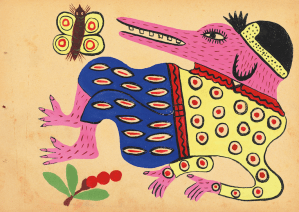
artwork by Mariia Prymachenko
The last UFN episode of 2025 is also our 50th. Under different circumstances, this would be a moment for celebration, but in truth we would rather there were no need to keep reporting from Ukraine beyond the simple fact that the music is good. As Lawrence Freedman argues, a strong narrative has taken hold in “Western” discourse portraying Russia’s victory in Ukraine as inevitable because of its numerical advantages and willingness to absorb heavy losses, fostering fatalism and pressure on Ukraine to concede territory. That is Why Kupyanks Matters. And that is why we continue exploring the music scene in Ukraine.
First we hear from Mykhailo Opekan who feels a stronger pull toward more aggressive vocals and heavier guitars, then we move on to Ilya Kovalenko from rap.ua who hails the mass transition of hip hop artists to Ukrainian while Praktyka Records decray the lack of a permanent community in Uzhhorod and Mykhailo from Emotional Anhedonia and ELP talks about Ukrainians overcoming their inferiority complex. We end somewhere in the Pacific Ocean in the company of worse who reflects on how war doesn’t only destroy cities and infrastructure, but it also corrodes social bonds, distorts values, and leaves long-lasting damage to the way a society functions.
Also, don’t let the end of year lists distract you from this month’s new releases with essential contributions from Gasoline Radio, Difference Machine, Ian Spektor, Edward Sol, Dirtbag Loris, Monoconda, Waveskania, Hidden Element, Vvanya Samokrutkin, Iriy Records, Oleg Makovskiy, Пиріг і батіг, Dubplanet X, DBR (DEADBEZREVO), 58918012 and DakhaBrakha.
For those who enjoy the heavier side of the end of the year lists, here’s the one from Neformat which includes many familiar names like Death Pill, Ship Her Son, Andrii Kunin, cybermykola, Høstvind, Morwan, Break the Habit, Frontcore, Farba Kingdom, Bayun the Cat, and Heinali & Andriana-Yaroslava Saienko together with new discoveries such as Sumno Soloveiko and Smalldick Samurai.
To round things off, in the Viewing Room, we find DakhaBrakha, Пиріг і батіг, Hidden Element, Mertvi Dereva, Yurii Pikush, the Black! Factory film and She, the fourth installment from the Varta project.
Enjoy the musical ride and see you in 2026.
NOVEMBER 24, 2025 – UKRAINE
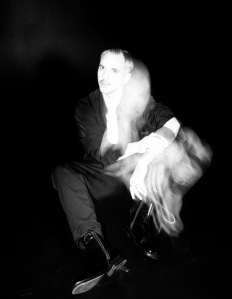
photo by @margott_ttt
I’m the frontman and founder of the band Lady Aphina. I’ve been writing songs since my student years, but it wasn’t until 2021 that I finally arrived at creating a band that truly fulfils my inner need to make music.
Since the band was formed shortly before russia’s full-scale invasion of Ukraine and the main members are currently serving in Ukraine’s Defence Forces, our musical experience so far consists entirely of releasing music and recording live sessions.
Has the full-scale invasion influenced the way you think about sound and music and the way you approach your work and has it changed your setup?
Of course. Lady Aphina is a band born out of the war. All of our music is a reflection of some of the darkest days in our history. It is also a way of documenting the events, emotions, and states we have been living through. Lady Aphina is music about searching for, and trying to grasp onto humanity, calm, and love in the midst of overwhelming darkness.
You recently released Привіт я вдома (Hello, I am home) in collaboration with Sviatoslav Vakarchuk from Ocean Elzy and Гурт Дно. The song is dedicated to all those in captivity who will return home. How did this come about and are you able to tell us what systems are in place to reintegrate veterans with civilian society?
I wrote this song back in 2012, when I was a student and was missing my home. But in today’s reality it carries completely different senses, because Hello, I am home are the words every Ukrainian prisoner of war dreams of saying, every child abducted and taken to russia, and every Ukrainian living under temporary occupation.
The demo of the song was stored at the studio of my friend, a sound producer Sasha at Badminton Records, where Sviatoslav Vakarchuk records some of his new songs. When Sasha played the demo for Sviatoslav, he really liked it and suggested we make it together. That’s how we met and recorded the song, along with many other wonderful musicians.
As for reintegration, Ukraine currently has state programs as well as public organisations funded through international grant programs and partnerships. These organisations provide free psychological support, help veterans reintegrate into civilian life, and, if needed, help them in finding suitable jobs.
What can you tell us about your involvement with Musicians Defend Ukraine and how would you say its aims and objectives have changed over time?
Alongside my military service, I also work on procurement and logistics for the Musicians Defend Ukraine foundation. At the beginning of the full-scale invasion we provided military musicians with everything they needed, from clothing and medical kits to vehicles and spare parts to them. But as the war evolved and became more technologically advanced, our priorities changed. Today the foundation’s main focus is purchasing drones and modern equipment that allows our defenders to observe the enemy more effectively and at longer distances, as well as to neutralise enemy personnel and machinery.
You have been serving for a number of years now, what role would you say music has within the army?
As of today, I’ve been serving in the army for exactly one year. Music plays a huge role within the army. Soldiers train, clean their weapons with music on, and play it loud in their cars when they’re heading to or coming back from a mission.
Musicians also come to the front line to play concerts for the soldiers, which lifts their morale and fighting spirit. And in the cities behind the front line, concerts help raise donations that cover essential needs for the army, because the frontline is so vast that the state simply cannot supply everything fast enough.
Granted that people serving come from very different backgrounds, are there any common elements about listening habits within the military? Do you share playlists? Are there favoured genres? Any tracks or songs that have become memes? And do most listen to Nord Division and Ukrainian hip hop?
The army is a huge cross-section of society, with people who have very different views and very different life and intellectual backgrounds. Many soldiers are not passionate music listeners and listen to what the streaming algorithms suggest to them. If we talk about common listening habits, I will probably say – heavy rock. This music, much like military work, has lots of energy and adrenaline.
In my brigade, I haven’t met people who listen to Nord Division, but I know and have heard that many guys listen to them. Sharing playlists usually happens when two music enthusiasts meet.
There is a lot of new and interesting Ukrainian music today, so soldiers often prefer to listen to Ukrainian artists. The new wave of Ukrainian post-punk is very popular in the military, as well as American rock and roll from the 70s.
Has the constant stream of quick dopamine-releasing content from TikTok or Instagram replaced music as a source of instant gratification and comfort within the military?
I think so. I personally don’t have TikTok and have never used it, but most soldiers really do spend a lot of time on these social media platforms. They scroll the news, follow what is happening in civilian life, or simply try to distract themselves from the horrific reality of the war.
There are a number of musicians in the military who have been releasing new material since enlisting. How easy / difficult have you found it to work on your own music?
It’s difficult. The army during the full-scale invasion is constant working with almost no days off. I usually record music when I’m on leave, or simply when I happen to get a free day or a free evening. At this point, I’m writing more songs in my notebook than I’m able to record in the studio.
How would you say your acoustic landscape has changed and what would you say are now the most triggering sounds for you?
There isn’t a specific change, because as I’ve already mentioned, all of our music has been created during the war. The only thing I can point out is that these days I feel a stronger pull towards more aggressive vocals and heavier guitars. In general, there’s a feeling and a need for every new song to sound heavier than the previous one, although of course it always depends on the song itself.
What does it mean for you to be Ukrainian?
For me, being Ukrainian today is a choice. A choice to fight for Ukraine and to love it no matter the circumstances. It means living by dignity and freedom and doing everything within my power to defend these values.
Are there any Ukrainian releases from the past four years that have captured the war experience in a meaningful way for you?
Yes, for myself, the artists I would highlight the most are Palindrom, Prozak, Sasha Chemerov with the Dymna Sumish album, the Dakh Daughters with their album Pandora’s Box, and Lady Aphina with the single Demons.
Which book / film / album / song / traditional dish / podcast / blog / artwork / building / meme best captures Ukraine for you?
There are many symbols and works of art that can describe Ukraine, but I would like to focus on what has been created during Russia’s full-scale invasion of Ukraine, because this is the largest existential war in Europe in the 21st century, and it has produced an enormous amount of art that documents the war.
- Films: 20 Days in Mariupol, 2000 Meters to Andriivka
- Book: Maksym Kryvtsov, Вірші з бійниці (Poems from a Firing Position)
- Song: Zwyntar – Золото і блакить (Gold and Blue)
- Album: Dakh Daughters – Pandora’s Box
- Blog: Serhii Sternenko
- Dish: Varenyky with potato
- Building: Mariupol Drama Theatre, Polina Rayko House Museum
DECEMBER 1, 2025 – KHARKIV

I am from Pavlohrad, a small town in the Dnipropetrovsk region. I started my journey when I moved to Kharkiv to study and began writing for various blogs about clothes and style. Later, I joined rap.ua and started working in the editorial office in 2021. In 2024, I became the editor-in-chief of the media, where we write about the Ukrainian hip-hop scene and the foreign industry.
How would you describe the Ukrainian rap and hip hop scene and how would you say it developed since the full-scale invasion?
In 2022, Ukrainian hip hop finally achieved what it had been striving for for decades: a mass transition of artists to Ukrainian and the emergence of the names that had shaped our original sound for years. This has been a huge contribution to the development of culture. But when it comes to current challenges, the small economic scale of the scene and the lack of a full-fledged, stable hip hop industry remain key issues.
Hip hop is a very masculine world with few female performers breaking through, chief among them alyona alyona. Does this mean that Ukrainian rap is also victim to sexist and misogynist attitudes, as maybe exemplified by the case of Skofka and Kalush Orchestra?
I don’t think so, this problem is not relevant to the Ukrainian hip-hop scene because there are simply not many female rappers.
In a 2023 article for Louder than War, you wrote that people have grown tired of patriotic and war-themed tracks. What would you say are the most interesting examples of artists addressing the war without resorting to bayraktar-core and nationalist clichés and concentrating instead on the everyday life of the civilian population?
I would highlight the electronic project TYSK and the military serviceman Тур [Tur], as well as the interesting project with military irony and Memphis sound cybermykola — these are good examples of working with the context of wartime.
Following from the previous questions, in the early stages of the full-scale invasion, the work of people like Jockii Druce went viral. Three years later, those songs remain as important cultural testimonies of those times but they seem to have reached the end of their shelf life, so to speak. What would you say can ensure the longevity of hip hop tracks that deal directly with the war?
We have plenty of tracks with good lyrics, but often the sound is outdated and uninteresting. Experimenting with production and meaning in the lyrics could give the audience something they’ve never heard before. But we have enough tracks about the war that will be remembered forever.
Speaking to musicians serving in the military, hip hop is one of the most popular genres with Nord Division being often quoted in the listening habits of the most servicemen and women. Has their collaboration with artists like Tina Karol ensured their popularity with the general audience or would you say they remain niche?
I think this band is mainly listened to by the military, this collaboration hasn’t changed anything.
Rap is probably the only genre where the Russian language is still accepted, especially if it comes from musicians currently serving. How would you say the language issue was debated within the scene?
I can say that more and more rappers who used to rap in Russian are switching to Ukrainian, which is a natural process.
How would you describe the music scene in Kharkiv and what can you tell us about the way Some People is reviving culture in the city?
Before the war, Kharkiv was the center of underground culture, especially hip-hop. With the start of the war, many people left the city, but most importantly, the city was left with almost no young people. Cultural life came to a halt, and Some People’s mission is to give young people space for cultural life and parties even in the darkest times, when the city needs it most.
Are there any albums that have successfully conveyed daily life during wartime in Ukraine in a meaningful way for you?
Misha Pravilnyi’s Unfunny geography is a very successful project in terms of criticizing the situation inside Ukraine. This is a very relevant topic for our society and a canonical topic for rap storytelling.
What does it mean for you to be Ukrainian?
I think Ukrainians are the nation that values life the most in the world, because they understand better than anyone that, unfortunately, it can be cut short at any moment. Being Ukrainian means valuing your own life and the lives of your fellow citizens.
Which book / film / album / song / traditional dish / podcast / blog / artwork / building / meme best captures Ukraine for you?
It’s my alma mater, Karazin University in Kharkiv, a large main building with huge columns, a place where the most prominent figures of Ukrainian culture, science, and politics have studied for over 200 years.
DECEMBER 14, 2025 – UZHHOROD

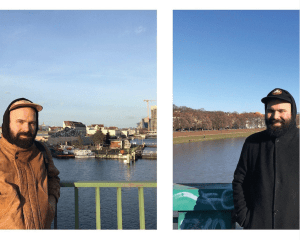
Praktyka Records is a community of three artists with different backgrounds. The three of us are co-founders of the label.
Anton is a sound engineer and musician, handling mastering and the technical side. Tomash is a musician, visual artist, and filmmaker. Viktoriia is an artist, curator, and producer who oversees the visual and conceptual aspects.
The label was created in summer 2023. Our initiative emerged organically from our music practice and the realization of how important it is to preserve sonic traces of what’s happening around us.
A: I’ve been doing music and sound recording in general. Mostly I’d record stuff and post it on Soundcloud. Now with the label, we’re trying to build a more organized approach to releasing music and reaching a wider audience.
T: I’ve been making music for as long as I can remember. The label became a natural extension of my music practice and the desire to somehow systematize releases, as well as help other musicians publish their work.
V: I’m an artist and co-curator of Mizhkimnatnyi Prostir (an artist-run space) with an interest in writing and making music. In 2022, I started trying to write something, play synthesizer, learn Ableton.
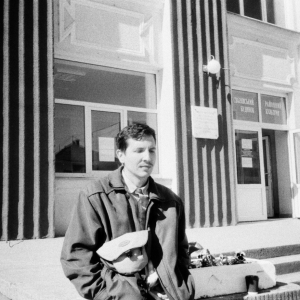
Anton Humenyuk
Has the full-scale invasion influenced the way you think about sound and music and the way you approach your work and has it changed your setup?
T: I think it affected everyone, one way or another. For one thing, not everyone has the opportunity to continue their music or art practice. In my case, it’s probably the approach and the way I create music that changed.
A: The full-scale invasion had a major impact on my lifestyle and rhythm in general, which naturally reflects in the music. Personally, I started recording less of my own music due to lack of time. However, working on the label gives me a chance to at least partially realize creative ideas through other people’s projects. This confirms the idea of the label as a community that we had in mind when we created it.
V: The spectrum of sounds associated with danger has expanded. Overall, sensitivity to sound has changed. I think that for most people with lived experience of war, the “sound–image–reaction” system has been upended, and this will stay with us for a long time.
Could you describe the electronic and experimental music scene in Uzhhorod?
A: Uzhhorod is a city where there’ve always been certain avant-garde art movements. There’s this creative freedom in the air, which combined with being somewhat removed from central Ukraine and close to the mountains gives ground for interesting ideas and visions. This applies to movements related to experimental and electronic music too. However, the lack of sufficient infrastructure (clubs, concert venues) and a significant number of interested people doesn’t allow these movements to develop into something stable that you could call a “scene.” DJ sets, jam sessions, and improvised concerts happen here from time to time. Right now you can single out a few initiatives connected with Photinus, Nemozhlyvo Povtoryty, moreforest.
T: Yeah, I agree with Anton that there’s no stability, because people leave the city at some point. I remember back in the 2000s and around 2007, it seemed like every other person in the city was playing in some band, and these were actually really strong and cool groups, like “The End” or “Tango Tempo” – it was a very vibrant scene and there were concerts every week, but then everything started to quiet down and only lone rangers remained.
A: Uzhhorod has also always had a developed punk and metal scene. If we’re talking about today, we’re probably not really in touch with potential young bands or musicians anymore. Also, part of our collective isn’t based in Uzhhorod. At the moment, we’re not organizing concerts yet – we’re more focused on archiving and releasing music and working with new label artists.
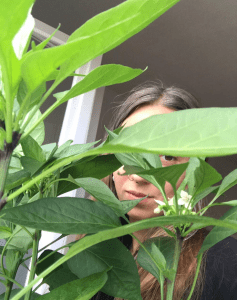
@viktoriia.dorr
Uzhhorod is one of the “safest” cities in the country as it is so close to the border with Slovakia. Have you seen an influx of people and has this helped develop its music community?
A: Yes, a lot of people have moved to Uzhhorod. Mostly families from eastern regions, people who managed to relocate their businesses, or people who lost everything and started life anew in Uzhhorod. But for musicians, having a community, venues, rehearsal spaces is important. The biggest cities have the most of these opportunities, so even despite the shelling, they usually stay where these opportunities exist. It’s precisely because there’s no permanent community in Uzhhorod that we created our label – to document our activity.
V: I don’t live in Uzhhorod right now but I visit often and observe changes in the landscape, architecture. And of course, the war in the country and the relocation of a large number of people affects all of this. What Anton pointed out about community and venues is a valid observation. If that’s not there, it’s hard to stay in such a city for long. Either you have a very strong and irresistible desire to build this world around you, or you’re a very self-sufficient person who can work alone, or you stop doing it altogether.
Since I’m more from the art scene, I can mention the Korydor gallery and the “Sorry no rooms available” artist residency where the city’s art crowd hangs out, and musicians working at the intersection with visual art have also worked there. For a long time it was basically the only place like that for people doing various artistic practices, but after 2022 the Nemozhlyvo Povtoryty collective that we already mentioned appeared. As far as I know, it emerged after Max Robotov from Photinus studio moved to Uzhhorod and taught an experimental course at the Transcarpathian Academy Of Arts. Now they have a really cool place/studio where they meet as a collective, hold exhibitions and concerts, play pretty experimental music. This is probably a bright example of how new faces in the city can change, complement, and develop the city’s cultural landscape.
I believe there is no curfew in Uzhhorod. Does this mean that parties and concerts can take place at night and does it mean it is easier to get artists to play?
Geography-wise, Uzhhorod is a quite small (smallest regional center), densely built city. There’s a nice downtown area with a few venues where music events happen, but because everything is so “close together,” people often complain about noise and police quickly respond to parties that run past 11 PM. So the absence of a curfew doesn’t really affect the number or duration of parties. There are other reasons why fewer artists come here and large-scale raves don’t happen. But these are organic things that don’t necessarily need to be changed.
@tomi.hazslinszky
What has the response been to your open call?
T: Actually, to our surprise, a lot of artists responded to the open call, and we had a long selection process. During this we realized we wanted to communicate and work on releases with two, maximum three performers. So we offered to work with two applicants, and one’s release will be available on Praktyka soon. It turned out to be more complex than we thought, but it’s interesting collaborative work where both the new performers gain experience and we as a label do too. In spring we’re planning to hold a new call, but we’ll share the details later.
So far you have released three different artists, Anton Humenyuk, Tomi Hazhlinsky and Attila Hazhlinsky (are Attila and Tomi related?). Their releases all seem to be covering experimental pop.
T: I don’t think we focus on a specific genre, it’s just that all the music we’ve released so far happens to sound like that. I guess we have more of an intuitive sense of what the sound could be. That’s how we shape the releases.
V: We’ve actually released four releases on the label so far. The ones you mentioned above plus another Tomash release. Answering your question about the connection between Tomash and Attila – yes, they’re brothers. I’d describe Attila as an artist, but with an interest in making music. His Praktyka release also has a music video created by artists Tetiana Pavliuk and Masha Leonenko.
How would you describe the lo-fi, dream pop and experimental pop scene in Ukraine?
T: The pop scene is very developed but I think most of it is concentrated in Kyiv. In Lviv, where I lived and played music for a long time now exists what I think is a cool doom, kraut rock and drone scene. There’s this venue Soma where interesting events happen, the space has a rehearsal base and concert venue. Also probably worth highlighting Planet Bit, an interesting project from Lviv and Mauser, a hardcore band – already classics.
Dim Zvuku (House of Sound) – an independent space in Lviv dedicated to experimental sound, sound art and contemporary electronic music, does a lot of cool things. I’ve been living in Berlin for three years now so because of that it’s hard to follow the scene in Ukraine as closely.
A: Since I’m not in Kyiv and don’t attend concerts, it’s hard for me to comment on the scene, but if you draw conclusions from the amount of this kind of music being released on streaming platforms, this scene is very active and diverse. I’d say that lo-fi and experimental sound in pop music are quite organic for Ukraine since life in general in Ukraine is a bit “lo-fi” and there’s no long-standing tradition of recording in studios. So the choice of lo-fi sound can be both conscious and provoked by lack of resources at the same time.
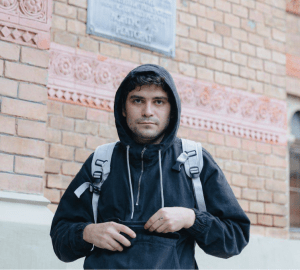
@attilahazhlinsky
What surprising tracks or artists we might find on your playlist?
T: I listen to medieval choral works and Indian ragas. From Ukrainian artists – Аппекс and the composer Shalyhin.
V: I don’t think the music I’m listening to now is surprising. I can mention an artist I randomly heard in a bookstore and now love listening to – J. Carter – Vessels. Another performer I find interesting is Astrid Sonne, probably the album Outside of Your Lifetime.
What does it mean for you to be Ukrainian?
A: It’s hard to answer this question – we’re in the process of forming and exploring our own identity. That’s exactly why we do creative work and try to express our vision of ourselves and the world, which is hard to articulate with words. Another thing is that we’re essentially the generation that was born at the same time Ukraine gained independence, meaning we’re the first such generation of Ukrainians, so it’s hard for us to identify with anything. We’re experiencing this formation in real-time and there’s no time to analyze it.
Are there any Ukrainian releases from the past four years that have captured the war experience in a meaningful way for you?
T. This is an interesting question. Lately I’ve been thinking a lot about how during the war, especially the full-scale period, a lot of interesting/important literature, documentary cinema, contemporary art projects have emerged that reflect on or highlight the events of the war – asking questions, creating discourse around it. But music, it doesn’t really get there. Music works in a different dimension, in the dimension of emotions, affects, personal experiences of this reality maybe, fantasies. And it can be pain and joy, but here you don’t necessarily have to talk about war. I don’t know how to talk about war at all… This is a complex, multifaceted question that’s hard to give a comprehensive answer to, but it would be interesting to talk more about it.
A: In my opinion, the “war experience” is very individual and at the same time global in a certain sense. It’s always “fragments of experience” and each musician fragmentarily recreates some broader story. Because of this individuality and synchronicity of experiences, someone else’s experience will only be someone else’s experience. It seems to me that the meaning in music created during the war will be best understood by the next generations of Ukrainians who never had the experience of living during war, or people from other countries.
V: I don’t think I can say/single out anyone who somehow conveyed the war experience for me. But there are several compositions that have something in them that can later evoke certain narratives in you. KYUB – Innovative Sonic Culture organized a music residency in 2022-23, Tomash’s track that was created during it had sounds of things that surround us and that evoke a specific image and have a history (sounds of flags fluttering, sounds of generators). All together it’s perceived as an imprint and atmosphere of this time.
Anton’s track “Neveseli Dni” which will be released on Praktyka, possibly this year.
I can highlight an interesting observation for myself that I thought about for a long time – it’s about Ukrainian rap, “military” rap. In general, I don’t like listening to rap, one of the reasons is often the sexist component of the lyrics (not in all performers, of course), which is supposedly justified by the long tradition of this genre. So, this “military” rap is very descriptive, has a lot of aggression, provocativeness. It works through images of violence and anger, often raising topics that are uncomfortable for society, but because of the “narrowness” of perspective it limits the capacity for dialogue. Despite all these aspects, I think it’s an important cultural symptom, phenomenon.
Which book / film / album / song / traditional dish / podcast / blog / artwork / building / meme best captures Ukraine for you?
T: I think you can actually talk about certain periods, because right now it’s a historically very dense time. Right now I’m reading Oleh Lysheha from Ukrainian literature.
V: I probably won’t name a book or a meme right now, but a word that can describe Ukraine for me and myself in it is road/journey. I leave Ukraine, come back, and so in circles, friends travel from east to west, then go back east again.
DECEMBER 14, 2025 – UKRAINE
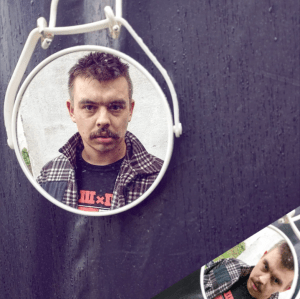 Emotional Anhedonia – Erythroleukoplakia Records
Hello! My name is Mykhailo, I was born in Kamianets-Podilskyi at the very beginning of 21th century. All my conscious life I’ve adored music, constantly searching for new genres and unique sound approaches, also I was running a small zine on Telegram for almost 4 years, where I wrote articles about albums I enjoyed. At the age of 18, I realized it was time for me to transform from a listener into someone who actually creates sound that can reach the souls and ears of the world.
The starting point and the main stimulus to begin creating “here and now” for me was the album “Frozen Niagara Falls” by Prurient, as well as videos from his various live performances. I didn’t know music theory, notes, guitar chords, how to write good lyrics, or how to work in music software either. But I still had a sense and a vision of the composition, emotion, and sound design I wanted to achieve in the end. And that’s how my first project, Emotional Anhedonia, was born in 2019 — as a solo dorm-room noise project “made on the knee.
It was an attempt to join the mysterious world of music without any experience, theoretical knowledge, and any genre boundaries. I guess, I’ve tried to express and capture certain emotions that were important at that certain moment in my life. Around the same time my friends and I came up with the idea to create a Bandcamp label where we would release our experimental, noisy, and rather niche work just for fun, to have one place where our sound experiments would be stored. What it eventually turned into — you can see for yourself. 😅
 Has the full-scale invasion influenced the way you think about sound and music and the way you approach your work?
I have always tried to follow the principles of freedom and solidarity, and I’ve always valued individuals who strive to give the world something authentic, new, and original. So I can sincerely say that with the beginning of the full-scale invasion, my life views (to my own surprise) have only grown stronger. Of course, war affected me and Ukrainian scene in general a lot, no argue. If we talk about inner feelings and what I’ve personally felt – it was an insane surge of people’s interest in domestic art, as well as a powerful sense of solidarity within the scene and beyond it.
A huge number of people discovered Ukrainian music from a new angle, many Ukrainians overcame their inferiority complex and realized that they had failed to notice the treasure that had been right under their noses for all their lives. As a result, musicians started feeling support and interest in their work began actively generating thousands of hours of music, and our label was no exception.
I dream of seeing Ukrainian music powerful and properly appreciated — both new projects and those that existed even before independence. The world has finally noticed Ukraine, albeit through the terrible context of war, and I foresee a rapid rise of our culture. I just hope there will be less kitsch on stage and fewer shamelessly bad copies of foreign music.
For me personally, the best answer to this question is hidden in the lyrics of the song
“Ничего не изменилось” by Demontag:
Nothing has changed for me, I didn’t understand a damn thing!
I still choose a «good» side!
The same qualities, The same principles, The same moral foundations.
 How did Erythroleukoplakia Records start and what was the ideology behind it?
The label was founded by Artur Mazurets, Vladyslav Onyshchenko (R.I.P.), and me in the end of 2019. We had no plan for the label’s future development, no business strategy, and no ambitions. To put it bluntly, ERYTHROLEUKOPLAKIA is a prank that got out of control. 😁
The priority genres at the beginning were noise, power electronics, ambient, and grindcore. Later on, the genre limitations disappeared in favor of promoting and producing all kinds of authentic, experimental, cross-genre music by Ukrainian and international artists. I was strongly motivated by the belief that the world of music is turbulent and colorful, and I’m convinced that everyone is capable of touching this mysterious space of sounds and noise, creating their own piece of something unique and unrepeatable. Perhaps then the world will become a little better, and psychiatrists will have less work to do.
In April 2021, we decided we were ready to start organizing events, and that’s when the booking agency of the same name was founded. At the first event we organized — “ELP Home Rule Gig” (Cherkasy: June 2021) — we decided to take a risk and put together a two-day festival with 16 bands. Making such massive event as a debut showcase was very risky, we didn’t knew would there be enough people to make it financially possible, if bands would enjoy organization or not and many other work-related issues that seriously worried us. But in conclusion, all efforts were worth it, and everything that happened those 2 days was legendary, trust me!
As of December 2025, our team has released more than 500 records and organized over 40 events in 6 Ukrainian cities, experimenting with event formats and combining different genres — from stand-up and jazz to grind and noise — in order to create a unique experience and a new approach to how various cultural phenomena can coexist on one stage.
The label has indeed released a staggering number of singles, EPs and albums, how many demos do you get a week and how do you manage to keep on top of all the work that comes with it?
I can’t even give you an approximate number, because I’ve spent the past year serving in the Armed Forces, and my involvement in selecting artists has been rather indirect.
But purely by mathematical calculation, it turns out we release about eight records per month. 🙈
Until I mobilized in the summer of 2024, I handled about 90% of the Bandcamp page management, distribution, social media, as well as organizing and designing concerts myself — driven by the belief that “if you want something done well, do it yourself.”
But I always had friends who helped when I physically couldn’t cope with everything — studying for my bachelor’s/master’s degree, participating in several music projects, and handling communication, organizational work with such a large number of people: from artists to sound engineers, venue owners, and designers.
As a convinced anarchist, I approached label work with horizontal decision-making in mind. Everyone who was genuinely interested in the joint effort and its development was heard and involved. It was precisely this trust and sincere love for art that saved the label from shutting down when, due to circumstances, I could no longer devote time to working with artists, posters, social media, and other aspects of our activity.
Thanks to amazing people like Bohdan (delayed minds), Yura (Xerxerash), Volodymyr (Музична Шкатулка), Dmytro (doomdoze), Nikita Riabushev, Ivan (Gender Studies), Denys (smoke screen set), Oleksandr СТУС, and other friends, the label did not stop working. On the contrary — thanks to our collective effort, a well-structured division of responsibilities, and the experience gained over the years, ELP has become much better, more organized, and more professional, in my opinion. And I hope that we will keep improving and discovering new horizons despite everything.
I know it is not fair to ask which your favourite releases from ELP are, instead I am going to ask you which are the ones that stuck in your mind either because they were so unexpected, or because they document a scene that lo longer exist, or for any other particular reasons?
It’s genuinely very difficult to answer such questions without deceiving anyone — first and foremost myself. After all, every release I’ve put out was meaningful and unquestionably worthy of attention at its particular moment in time. It would be strange to publish music in our roster that we don’t like, really.
Still, I don’t want to avoid this question, and I’d like to share the releases that have stayed in my heart forever. While putting this list together, I skimmed through all the releases we’ve ever put out and, to be honest, immediately felt a strong wave of nostalgia. I had to shorten the initial list three times so that this question block wouldn’t take up two full pages of text, but I simply don’t have the moral right to talk about only 2–3 releases out of the half-thousand works that have accompanied me over the past six years.
For convenience, I will divide them into three groups: Albums; Live Performances; Splits/Singles/EPs.
I could talk for weeks about the released albums that I truly love. Among this year’s recent releases, the albums 27 by ВИР! and ГЛУМ by the band ЧОРТОПОЛОХ are undoubtedly worth attention. It is very strong work within their genres and will surely not leave fans of quality punk and its derivatives indifferent. I’m also happy to have such cult albums in the ELP roster as Страшний Суд і Мягка Піся by the legendary Хамерман Знищує Віруси, and of course veterans of Ukrainian folk-rock from Ivano-Frankivsk – Перкалаба, with the album Навіки.
Albums that have become undeniable mascots of our label include the hit compilation Бест Оф Зе Бест from Ukraine’s main blues-punk band Два Два Дев’ять, the relentless and ultra-fast powerviolence act Private Pyle with their album Ketamphetodrone, the most heartfelt & serious war-themed album Околовойны by the label’s chief gangster Мс Мягкий Металл, and the dense Мощний Реп from the godlike freestyler Ніжна Оксана.
It would also be a crime not to draw listeners’ attention to the enchanting Далекий Лиман by our prog-sound advocates Gender Studies, highly soft and magical Музика Сутінок from the project Неймовіра, the extremely stylish remaster of our main metal album from Høstvind, and of course the unique noise-shoegaze never knows best by doomdoze.
For those, who are ready to fully dive into the ELP lore, we strongly recommend to check love- and warmth-filled УВАГА with the album ЧОТИРИ, Israeli screamo from our friends sonya with their heartbreaking album kingdom, and of course our dear friends — the band плерома with their magnum opus Вихід. And be sure you don’t pass by probably the most interesting mix of alternative, trip-hop, and noise rock — Shadazz with their self-titled album.
Throughout the war, concert activity did not stop at all — we put in every effort to raise funds to support the army by doing what we do best: making music. Very important to me in this context are the recordings Accidentia by the Ukrainian Improvisers Orchestra, LIGHTS ON! split featuring івл-івл / Увага / BURI / -YCH / Emotional Anhedonia, as well as our funny improvisation in Lviv, Безкоштовний Джаз, performed by Серб і Молодь. I also can’t help but mention the release of the vintage album Гуцули в Коломиї ’89 by Гуцули — Ukraine’s first ever hard rock band — and the final recorded live performance by my close friends !alarm, Live in Kyiv 11.07.21, in memory of Владислав Онищенко, who died at the age of 21 defending the country from the occupiers.
Besides albums and concerts, I absolutely must mention the releases that have touched me for life and simply have to be included in this list:
- Meryvo – Somniloquy
- kerath – I
- ЧОРТОПОЛОХ \ Emotional Anhedonia – СПЛІТ
- п о з а п а в у к а – Поза Павука
- Boys Do Cry – Some things that matter
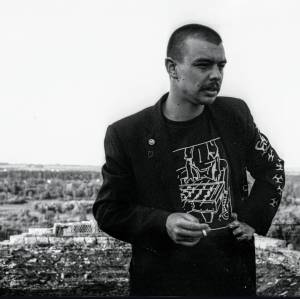 You are also part of the “post-everything” band Emotional Anhedonia. How would you trace the evolution of the band, how many different iterations did it have? Also, now that you are serving in the army, are new recordings on hold for the foreseeable future?
As I mentioned above, the project appeared in 2019 as a solo dorm-room noise project “on the knee.” It was an attempt to enter the musical world without experience, theoretical knowledge, or any genre boundaries.
With only Audacity and pure curiosity at hand, I started sampling the clinking of coins on a table, voices, street recordings, the hum of household appliances, and other strange sounds, playing keyboards by ear, and recording people singing in underground passages as well as rehearsals of grind bands I knew, trying to convey certain emotions that were important at that moment in my life.
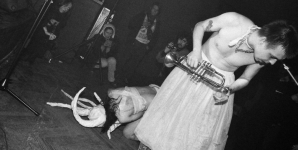
When Anhedonia was just me, all recordings were home-made, I performed them live from my laptop a few times, and honestly, it was rather funny and awkward. But with the addition of new members, everything changed. Since the lineup constantly changes, and mostly includes people from different corners of Ukraine, we haven’t yet had the opportunity to rehearse certain material and record it in a studio. As a result, we create Anhedonia live on stage each time — it’s both rehearsal and new material at the same time. I’d like to believe that with each performance, we hear and feel each other better.
I act as a kind of conductor, percussionist, and noise maker. We have cards with primitive symbols and markings that help me show the musicians the dynamics, mood, and rhythm of what we will play in the next few minutes. It’s like a game, similar to John Zorn’s Cobra, where musicians compete and have fun while playing.
Honestly, even though I set the dynamics of the performance, it’s hard to say that I am the leader of the sound we create, because I adjust the card cues not least for the audience and the musicians on stage, trying to capture the overall vibe. Every participant’s contribution is invaluable, and often I show the cards almost by instinct, guided by, for example, the drums, vocals, or keyboards. Sometimes, hearing a guitar, I sense which emotion we should move to next, or I adjust to the lyrics someone is singing. All of this is an integral part of the performance, and ignoring any member of the band would result in total chaos, with no compositional cohesion or synergy.
The concept of the project has changed over time, acquiring new meanings and themes, but the main idea has remained almost the same — freedom in creativity is essential, and if you want to make music, do it the way you can, even if it turns into complete anti-music. Because at every period of life there are many unique emotions & reflections, and if you don’t capture them in the moment, it’s unlikely you’ll be able to relive and comprehend them in future. I never thought the project would gain such momentum, that more than forty different musicians would take part in it, or that it would ever go beyond my room. But it was precisely the idea of complete freedom in music that made this possible. There were people who wanted to express their emotions in music here and now, unafraid of criticism, judgment from music critics, or phrases like “this is total unlistenable crap, who even needs it?”
At the moment, I have several recordings that might appear online over time, but I’m still not sure if they should be shared with listeners. During my service, I came to believe that the project has fulfilled its mission, and further performances could turn into forced repetition, which directly contradicts the main concept. I’m waiting for the right moment and a break to perform Anhedonia one last time. And considering that this performance is planned as a farewell, we simply have to come up with something that no listener or musician will ever forget. This requires time, funds, and many concepts, from which we will choose the best. Perhaps this isn’t the end yet, but there is an inner feeling that this stage of creativity should be concluded properly, without producing second-rate content. As we can see through years, band that has been playing emo for more than five years isn’t real emo band, they are just posers. 😂
I have been told that post-punk is probably one of the most listened to genres in the military. Is that something you can confirm and how would you describe the listening habits of military personnel in general?
It’s important to understand that the army is a huge cross-section of society, with people of different ages, views, and tastes. And when it comes to musical preferences, it’s no exception. Most likely, the people who told you this serve in units with predominantly young personnel who, to be honest, were never really interested in domestic music. When they talk about “post-punk,” they probably mean a third-rate knockoff of russian new wave like ДК Енергетик, Smurno, Sadsvit, and other boring parodies of Цой — but definitely not something like Joy Division, Beastmilk, PiL, or the domestic Ivanov Down, Мортидо, Кадриль, and other great representatives of the genre.
I want to stay honest, so based on my personal army experience, I can say that soldiers — especially those from older generations — mostly listen to 90s hits, awfully bad pop, russian “blatnyak,” and kitschy patriotic music that just makes you sick at this point. Tastes differ, of course, but the vast majority of music I’ve heard from the people I serve with is simply a nightmare.
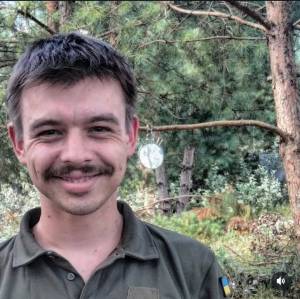 On a general note, what kind of role would you say music has in the military and has the constant stream of quick dopamine-releasing content from TikTok or Instagram replaced music as a source of instant gratification and comfort within the military?
Sometimes service conditions are so mentally and physically exhausting that people simply don’t have the energy to listen to anything — let alone to be selective, looking for something interesting or original. Indeed, most leisure time is spent doomscrolling, sleeping, and talking with family and friends. I’m not sure this quick dopamine hit is beneficial, but I’m not in a position to judge soldiers when it comes to how they choose to spend their free time.
How would you say your acoustic landscape has changed and what would you say are now the most triggering sounds for you?
As a noise musician, the sounds of war have simply become good samples for future musical experiments. Sometimes I notice myself having a nervous reaction to sounds that resemble a drone, but overall my perception of sound hasn’t changed much, considering my love for tons of distortion and noise. The most triggering sounds for me were — and still are — the blatantly poorly made pop songs on the radio, the ones that appeal to banal meanings and values.
What does it mean for you to be Ukrainian?
A constant struggle for your values and priorities against external enemies and internal ignoramuses. As an anarchist, I don’t like to appeal to concepts such as nation, ethnic group, mentality, or other generalizations. My answer rather describes what it means for me to be myself in the context of what surrounds me.
Are there any Ukrainian releases from the past four years that have captured the war experience in a meaningful way for you?
Undoubtedly, for me the number one release in this regard is the album МС Мягкий Металл – Околовойны. The only thing that can compete with it is the next MMM album — Укроборонпром. Also quite fitting, in the context of our lives over the past four years, are Горизонт подій які не згадати by Derwisz, Велике й мале by Doctor Bugg, asmr for ptsd by dalek, and 1.8.32 by zipcult. Each of these releases resonated deeply with my emotional state and captured the experiences and thoughts I went through during the full-scale invasion.
Which book / film / album / song / traditional dish / podcast / blog / artwork / building / meme best captures Ukraine for you?
I’ll try to answer without being too ironic, I swear.
- Book — Anarchy in the UKR by Serhiy Zhadan
- Film — Ivan and the Mare (1992) by Volodymyr Fesenko
- Album — КУЙ! (2010) by Хамерман Знищує Віруси
- Song — “Трійця” from album how to stop worrying and love the war (2017) by oh, deer!
- Traditional dish — benderyky
- Podcast — don’t have time for them, really
- Blog — don’t have time for them either. I’ll better recommend to check bubblegum zine & сродність ліри і тону telegram channels, there’s some really good music journalism there
- Artwork – all works by Alexander Kostetsky in the style of magic realism, fantastic art
- Building — Church of Our Lady of Candlemas and the Dominican Monastery (Starokostiantyniv, 1580)
- Meme — Poroshenko with a Crocs shoe on his head.
DECEMBER 21, 2025 – THE PACIFIC OCEAN

My name is Maksym. I’m originally from Kherson, and I now move between Warsaw, Portugal, and time spent at sea. Music has been part of my life since my early teens. After watching the anime K-On! around the age of 13 or 14, I became obsessed with the idea of playing drums. My parents couldn’t afford a kit, so I picked up a guitar instead and enrolled in a local music school.
At 16, I started my first band, Story of a Stranger, playing emo and screamo. Like many teenage projects, we were searching for ourselves, and over time we shifted toward more contemporary metalcore and deathcore sounds with a djent-y sound. Alongside this, I ran a small DIY label with online friends, managing a few bands and organizing tours across Ukraine. In 2014, I put together my first concerts simply because no one else was doing it, while also playing in two bands at the same time.
Those years were formative: playing shows in different cities, studying in college, and being completely immersed in music. Around then, I also went to my first rave, where I encountered breakcore and electronic music, which opened an entirely new world for me.
As my bandmates and I finished our studies and entered working life, the bands gradually fell apart. For several years, music took a back seat. In 2019, I returned to organizing small club events and began performing hybrid DJ/live sets using Ableton and MIDI controllers. What started as a basement show for around 40 people grew into events with over 300 visitors in abandoned industrial spaces — experimental live music in a provincial city with no real scene beyond what we built ourselves.
Then came the full-scale invasion, relocation to another country, and the loss of my community. After a long period of stagnation and depression, in 2024, I was inspired by the resurgence of experimental music in Ukraine. That momentum pushed me to fully commit to production, learning Ableton, mixing, and sound design — which is when work on my current album began.
You were abroad at the time of the full-scale invasion. Did that experience influence the way you think about sound and music and the way you approach your work?
Absolutely. After relocating to Warsaw, I was exposed to a wide range of festivals and performances centered on experimental music and multimedia art. Seeing these live acts reshaped how I think about sound, space, and performance, and expanded my understanding of what a live set can communicate beyond music alone.
At the same time, being abroad during the invasion deeply affected my relationship with making art. In the current state of the world, I feel that artistic work carries a responsibility — not necessarily to offer answers, but to engage with social, cultural, or political reality in a meaningful way. For me, this made it impossible to approach music as something purely decorative or self-promotional. My work became less about entertainment and more about reflecting the tension, instability, and contradictions of the moment we are living through. For this reason i even started to make hiphop this year in order to voice my own thoughts on different matters.
How would you describe the production process for your album smelting and how did your collaboration with Maryana Klochko come about?
I would describe the production process as a second job, or a gym. It was physically and emotionally demanding work, done in small, consistent pieces. With this album, I was trying to release a heavy accumulation of emotions — the kind that emerge when your home is destroyed and friends are killed. So the process wasn’t an impulsive burst of ideas, but rather a disciplined routine: working every day from morning until evening for several months.
After that intense period, I took a break — traveling, sailing, and stepping away from the material. Returning with new experiences and distance allowed me to finish the album with a clearer perspective and reassess what I had already done.
The collaboration with Maryana Klochko came about in a very natural and almost accidental way. I wrote the demo for the track over a few days at home during a cold, boring Polish autumn. Even early on, it felt incomplete without vocals. One cloudy evening, while out walking, a random stream played her track “Babusia,” and it immediately felt like the missing element.
Although we didn’t know each other personally at the time, we had many mutual friends from my years living in Kyiv. I asked a friend for her contact, wrote to her with the idea, and she agreed almost immediately. Maryana brought a strong personal vision to the piece, and after only a few minor adjustments, the track was finished. It came together very quickly and smoothly — in fact, it was one of the first tracks completed for the album.
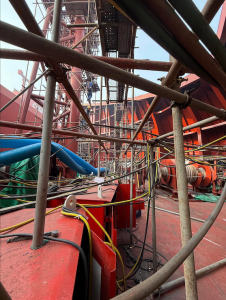 Since the full-scale invasion, a number of electronic artists have started using samples from folk songs in their work, which is what you have also been doing in “Grief_Dance”, the closing track of smelting. How important would you say it is for you to reconnect to your cultural heritage?
Elements of traditional music appear elsewhere on the album as well — for example, the fifth track, “Black Sea — Dark Waters,” features a folk bandura. In that case, the intention wasn’t nostalgia, but a recontextualization: placing traditional instrumentation inside a contemporary sonic environment to see how it functions and transforms.
With “Grief_Dance,” the approach was different. The idea was to deconstruct a well-known, almost playful pop song and examine it from another angle — stripping it of its original context and exposing a more unsettling emotional layer beneath it.
More broadly, reconnecting with cultural heritage feels less like a conscious aesthetic choice and more like a protective mechanism. History shows that when a nation goes through extreme hardship, its culture often intensifies, mutates, and finds new forms of expression. I see this process happening now, and I wish more Ukrainian — and international — artists would engage with it. Hearing folk motifs reinterpreted through contemporary forms can be incredibly powerful, as demonstrated by projects like Raja Kirik or some of the artists connected to Nyege Nyege scene. That dialogue between past and present feels especially urgent right now.
How did you get to release your album on Xternal Domain?
I first met Slikback briefly at an airport before a show in Berlin, where we exchanged contact details. Later, we crossed paths again while playing on the same stage at Avant Art Wrocław. Backstage, he mentioned that he had missed my set and asked me to send him some of my music. I did, and he connected with it immediately.
After months of sending demos to labels without receiving any responses, I reached out to him again — not looking for a release, but asking if he knew a platform that might be a good fit for the album. I explained how difficult it had been to find a home for a project and that i had spent half a year for just mailing.
Not long after, he called me with the idea of starting a new platform focused on emerging artists — one built around direct engagement rather than algorithm-driven promotion. The concept resonated strongly with me: no forced social media routines, no constant content churn, just music finding its audience in a more intentional way.
Within a month, everything came together, and smelting found its home on Xternal Domain. Freddy is someone who acts decisively and follows through on ideas, and I have a lot of respect for that. I’m very grateful to be part of this project.
You are originally from Kherson. How would you describe the music scene there before the full-scale invasion? Also, as far as I am aware, most of the musicians have now relocated and there is not much of its original scene left. Are you in touch with anyone from back then?
Kherson is a relatively small city — around 280,000 people before the war — and its music scene was always intimate. Events were rare, which gave them a particular intensity. Artists and audiences brought an energy that I haven’t experienced anywhere else — not in Kyiv, not in Warsaw, not elsewhere. People knew that the next event might happen in three months, six months, or might not happen at all, so when it did, everyone gave everything they had — on stage and on the dance floor.
When I first encountered the experimental side of the scene, it felt vibrant in terms of ideas and people, even though the city offered very limited infrastructure or long-term opportunities. Many artists eventually left in search of places where they could grow. There were other parties happening in Kherson, but they were mostly focused on genres that didn’t resonate with me personally, which pushed me toward creating something of my own.
In 2019, together with friends, we began organizing our own series of events. By 2020–2021, something important started to happen: younger people began showing up, new faces appeared, and other projects started emerging alongside ours. It felt as if the city was slowly beginning to bloom — a fragile but genuine cultural ecosystem taking shape. Our final events before the invasion brought strong lineups, solid sound, and audiences traveling from other cities and even from abroad.
The full-scale invasion abruptly ended all of that. The scene, the spaces, and the sense of continuity were taken away. I don’t know any artists who are still based in Kherson today. Most people have relocated, and what remains are distant connections, shaped by displacement and the feeling that something living was suddenly removed.
 What does it mean for you to be Ukrainian?
It’s a difficult question. Because of my work, I’ve traveled a lot and seen many parts of the world, and through that distance I realized how fortunate I was to grow up in a free country, surrounded by creative, resilient, and deeply talented people. That understanding came especially clearly once I left.
At the same time, it’s impossible not to feel the weight of what has been lost. War doesn’t only destroy cities and infrastructure — it corrodes social bonds, distorts values, and leaves long-lasting damage to the way a society functions. Living with that contradiction is challenging: loving a place while witnessing its ongoing trauma.
Still, being Ukrainian for me means holding onto that love without idealizing it, and carrying responsibility rather than certainty. It’s not something simple or comfortable, but it is something I remain proud of.
Are there any Ukrainian releases from the past four years that have captured the war experience in a meaningful way for you?
Clonnex – “ТЦК”
Demian Feriy – Utopicalypse
and my new hiphop track coming out on 26th
Which book / film / album / song / traditional dish / podcast / blog / artwork / building / meme best captures Ukraine for you?
Does a reel counts as a meme?
NEW RELEASES
 VA ~ Звукові Ландшафти
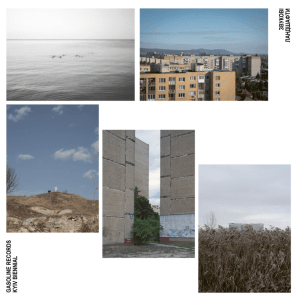
Звукові Ландшафти stands as a poignant continuation of Gasoline Radio’s mission, even after the station’s closure in August 2023 due to financial constraints. Released as a set of five vinyl postcards, the compilation captures a cross-section of Ukrainian urban soundscapes without resorting to straightforward field recordings. Instead, it invites interpretation and transformation: Hanna Svirska’s Kyiv emerges as an ethereal, almost weightless presence, while DJ Sacred refracts Kharkiv through the dark, claustrophobic textures of his Dungeon Rap. Each contribution feels deeply personal, less like documentation and more like memory filtered through individual artistic language.
That sense of subjectivity is what gives the release its emotional weight. Maks Yos reshapes Ivano-Frankivsk into a sleek electronic environment, Mires submerges Uzhhorod in woozy, underwater dub (courtesy of the Uzh river), and Sasha Tsapenko’s piece evolves from tribal rhythms into fractured experimentation. Together, these tracks embody Gasoline Radio’s ethos of amplifying diverse communities and encouraging experimentation across scenes. Knowing that some of these artists no longer live in the cities they depict, or only ever visited them, adds an unspoken layer of both nostalgia and discovery, turning the compilation into a quiet tribute to places and sounds in flux—reshaped by displacement, memory, and a country undergoing rapid, irreversible change.
Each postcard is illustrated by a different Ukrainian photographer making the physical release a very special collector’s item.
Difference Machine ~ Shape Memory
After a run of albums investigating the psychological fallout of warfare—from macro systems to intimate human effects—Difference Machine turns inward, focusing on four everyday materials found in the home. Here, domestic matter becomes a fragile membrane: meant to shield its inhabitants from external violence, yet inevitably marked by trauma. Working in the shadows of musique concrète, the record moves from the heavy drone of “Shape-Memory” to the strident wail of “O Fount of Mercy,” from the convulsive tensions of “Abiogenesis” to the fractured, percussive surfaces of “Fracture Point / Ostrakon.” It is a bleak but lucid work, in which sound bears witness to damage, endurance, and the uneasy illusion of safety.
Edward Sol ~ Hot Air Rises
Hot Air Rises Cold Air Falls is an observation of natural processes, a sacred harmony within chaos, and music that is felt physically. In this album, Edward Sol combines organic textures, cyclicality, and a meditative form, opening a path to self-discovery.
The fabric of the music comes alive not from a single sound, but from the interaction of several. Through their combination, a “third dimension” emerges – a depth greater than the simple sum of its elements. This is the cumulative effect of collage music and sound art, where form arises not from control but from precise collisions.
The album evokes the experience of flipping through an old notebook or a basic physics textbook: fragments of sentences, simple formulations, pieces of fundamental principles of nature. Nothing overly complex – just the essence of the most important processes and phenomena expressed in the simplest terms.
Edward Sol is a Ukrainian composer, sound designer, and musician from Nova Kakhovka, working in experimental, noise and industrial music. He often uses vintage analog equipment to create unique soundscapes and also runs the labels Quasi Pop Records, Sentimental Productions, and Village Tapes.
Ian Spektor ~ Cherven
Cherven is an audio documentary composed of 53 overlapping recordings made across Kyiv, Chernihiv, and Volodarka during 2022–23. The work is dedicated to four of Ian’s friends — Hena Kolesnyk, Kostya Kuzin, Bohdan Mazurenko, and Anton Petrochko — who were killed in the summer of 2023 while fighting near Bakhmut, Orikhiv, and Kupyansk. A personal diary of loss, it listens to a city away from the frontline but never beyond the war’s reach.
Commissioned by Ukho Music, the piece draws on material from Spektor’s long-running archive of on-site recordings. It avoids stylizing reality or arranging it into contrasts. Children’s voices appear as they do in Ian’s daily life; the music of mourning processions enters as it does in Kyiv’s everyday soundscape. Almost all the voices in Cherven — apart from those of priests, commanders, and hospital patients — belong to friends or neighbours. The story centres on four heroes who, with one exception, are never heard directly.
Though there is much “ambience” in the work, it is not an ambient release. No musical elements were added; about half of the material consists of fragments of conversation, overheard and later remembered — sometimes clear, often submerged in the noise of other memories. The tracklist, which briefly describes each recorded situation, marks only the first occurrence of every track and is integral to the work.
Monoconda ~ Overwhelming Growth
Berlin-based Ukrainian artist Monoconda unveils Overwhelming Growth, an expansive and visceral exploration of uncontrollable expansion — technological, biological, and emotional.
Rooted in experimental electronics, broken beat and bass, the album captures a sense of constant transformation: rhythm and texture collide, fracture, and regenerate into unpredictable forms. Nearly half of the record was composed without a grid, with electronic structures assembled entirely by hand, free from tempo or quantization. This approach lends the music a rare organic pulse — a feeling of life growing in directions it chooses for itself.
Waveskania ~ Stillpoint
Stillpoint is an inner point of silence, found where the outer world becomes too loud.
The core material for the album was created in a small home studio on the edge of a German town, overlooking a woodland and the Weiße Elster river valley, where quiet became part of the sound just as naturally as the synthesizers themselves. In that space — between the wind outside the window and the soft flicker of hardware — a world slowly took shape, a world one can enter not to escape reality, but to return to oneself.
The music of Stillpoint was born in migration, during a period of enforced stillness both inside and out. This album is my small attempt to offer listeners (and myself) a space where one can breathe: a place where rhythm becomes an anchor and a blurred melody becomes a light.
The sonic fabric of the album absorbs gentle glitch structures, drifting atmospheric pads, and almost cathedral-like melodies — like a journey through numerous unrecognized halls of the subconscious.
A period of isolation caused by a foot injury completed the formation of the concept — when a step forward is impossible, only one direction remains: inward.
Stillpoint is the vibration of a small inner world that lives within everyone trying to stay afloat in an era when so much is collapsing.
VA ~ Intryha, vol.1 by INTRYHA / ІНТРИГА
This various-artists release from INTRYHA / ІНТРИГА, a new darkwave and industrial label spotlighting emerging talent, plunges into the darker fringes of contemporary noisepop. Opening with iwouldcutmyhands’ ritualistic “Magick Mystick Cabaret Musick,” the compilation moves from the erotic hallucinations of вібруй!звивайся to the post-mortem sonics of label co-founder pagibel. localhvost delivers compact tributes to the Ukrainian modernist artist Sonia Delaunay, while pants descends into nightmarish dark-ambient synth pop with “spider of your face.” The kamènskykh noise brigade proves that “revolution is very simple,” snarling with raw urgency, while 888888888888888 fractures the mix with abrasive deconstruction, and Kondratie drives it home with beat-heavy industrial force. A fierce, coherent statement, this release stakes INTRYHA’s claim in the lo-fi, neo-noisy post-punk underground.
DakhaBrakha ~ Ptakh
Released on 25 December, Ptakh marks DakhaBrakha’s first album since Russia’s full-scale invasion and stands as a distilled statement of the group’s ethos. Drawing together Kozak sonorities, folk polyphony, blues and their trademark “ethno-caos,” the record fuses tradition and experimentation with renewed urgency. Mixed and mastered by Lesik Omodada (Musicians Defend Ukraine – Пиріг і Батіг, Shpytal Records) and featuring artwork by Marko Halanevych, Ptakh is both intimate and expansive. The centrepiece, “Kozak,” serves as a poetic invocation of inherited memory, resistance and identity, while “Dytyatochko,” a war-born lullaby, alludes to the illegal deportation of Ukrainian children. Elsewhere, moments of levity—such as the playful “Oh lá lá”—puncture the gravity without undermining it. Across the album, DakhaBrakha evoke erased histories and walked-over lands, framing endurance as a generational obligation: to carry inner fire forward, to reject imposed masks, and to uphold defiance not as rebellion, but as a way of being.
Dirtbag Loris ~ Wind Sways Roses in My Hands
Wind Sways Roses in My Hands functions as a coda to Dirtbag Loris’ Spring Ends Mid-Sentence, distilling its themes into four intimate sketches of longing and vulnerability. Moving from quiet yearning and the desire to be seen to moments of comfort and familiarity, the songs favour small, tender gestures over grand declarations. Nightfall, fatigue and physical closeness recur throughout, shaping a relationship defined by gentleness and refuge. The closing moments linger in suspended time—shared breath, fading surroundings—where intimacy feels both fragile and all-consuming, offering brief escape from the outside world.
VA ~ Низовина by Iriy Records
On December 26, Kyiv-based label Iriy Records releases Lowlands — a compilation that captures two years of the label’s work through experimental Ukrainian bass music. It works as both a snapshot of the scene and a link between Iriy’s earlier releases and what comes next.
The compilation brings together artists closely connected to Iriy’s journey, including Geyera, whose album Wolfram was released on the label in 2024. Rather than a showcase of isolated tracks, Lowlands feels like a shared space — different approaches to bass music tied together by a common sense of tension, texture, and low-end focus.
Lowlands moves through four bass-driven directions that shape the label’s sound:
Industrial bass – “Unrun Citizen” by pants, “Вчергове Паплюжать” by Demian Feriy, “Headshot” by worse.
Post-club – “Short” by Geyera, “Всі Новини Хуйові” by Bakunn, “No Connection (Iriy Mix)” by drvwncvnt, “Sprayed’em” by evil iseeshine, “Putaria” by Panghoud.
Ethereal and ambient bass – “Inspiration” by nizhna, “Dungeon” and “Atoms” by kvitka, “Iron Orb” by kate lizzerd, “Afterimage” by Khrystyna Kirik.
Glitch bass – “cultcode” by Cymbal, “LLM” by uniq_id, “Magnesium Beat” by Native Outsider, “Everything Dissolves” by NFNR.
The title Lowlands works on several levels. Geographically, it describes areas surrounded by higher ground — like Podil in Kyiv, where key spaces for Ukrainian bass culture and Iriy’s own history are based (Otel, 20ft Radio). Sonically, it points directly to low frequencies and bass pressure. In Ukrainian culture, “низові ініціативи” refers to grassroots, fringe artistic movements that exist outside mainstream promotion — low as in underground.
The name also connects to the myth of Iriy itself. While Iriy is often linked to birds, these creatures feed on what lives below the surface. Iriy becomes a place for both what flies above and what stays hidden beneath — predators and worms, sky and soil. Lowlands sits exactly in that space.
Lowlands is a document of the Ukrainian bass underground as it exists now — rooted in place, shaped by collaboration, and focused on what grows below the surface.
Oleg Makovskiy ~ Two Half
This music is not for the dance floors.
First and foremost, it is about emotions, sensations, and the transformation of one music and one set of sounds into another.
Enjoy your trip.
Vvanya Samokrutkin ~ Svydshe Za Vse Ponad Use
Vvanya Samokrutkin’s album, Svydshe Za Vse Ponad Use, comprises eight tracks. This release captures a state of continuous internal overload through electronic elements, emphasizing a non-melodic narrative that intentionally avoids club-oriented tendencies. The music is approached as a process, where structure, dynamics, amplitude, and spectral relationships define its evolution.
Characterized by monotonous patterns, low-frequency pressure, and micro-textural changes, the compositions utilize sound design to document the system’s state. They do not aim for emotional resolution; instead, tension accumulates gradually through spectral interactions and noise elements.
As a documentary work within contemporary electronics, this album captures the dynamics and physical properties of sound, serving as a tool for observation and analysis rather than entertainment. Repetition serves as a foundational element, enabling variations to emerge. Internal pressure operates as a structural component in conjunction with sound. Overall, the album conveys a distinct form of tension that unfolds within its framework.
Hidden Element ~ Varta OST
These tacks was composed for Varta Project documentary series about the Ukrainian military, created by the authorial team of filmmakers called NEUTRINO. Since the full-scale invasion of russia into Ukraine began, the team has been documenting the military events and telling the stories of Ukrainian soldiers.
Kapela Zbyten ~ Labka
Labka is the debut album by kapela Zbyten, featuring nine forgotten traditional Ukrainian dances performed by a traditional folk ensemble: two fiddles, bass viola, cimbalom, and frame drum. These melodies were originally documented 150 years ago from blind kobzars, and the kapela now brings them back into contemporary daily culture.
Vakula ~ Buchla Concept
Buchla Concept is a release dedicated to the Buchla synthesizer and its philosophy.
Not as an instrument of control, but as a system of exploration.
The tracks are built around analog processes, unstable voltages, evolving structures, and non-linear thinking.
Sound is allowed to move freely, without being forced into rigid forms.
This release is not about genres or functionality.
It is about listening, space, and the relationship between human intention and autonomous electronic behavior.
All compositions were created using analog synthesis, with a focus on texture, depth, and dynamic movement.
No presets, no shortcuts — only interaction.
Buchla Concept is an observation of sound in motion.
A study of electricity as music.
Peshka ~ Ruined Archives EP
This album gathers tracks recorded between 2016 and 2018, at home in Mariupol — a city that no longer exists as it once did. For a long time, I hesitated to release them, holding onto these sounds in fear and uncertainty, but life moves so quickly that I’m afraid I might not get another chance — so let them live, at least, within the memory of the world’s vast network. These pieces were thought lost when the house and computer that held them were destroyed in the war. Restored from a damaged hard drive, they return now as fragile echoes of a life before the silence: memories of a place erased, moments preserved in sound, and the quiet ache of everything that can’t be rebuilt.
Pushkar – Ohrimchuck – Neaga ~ 3.1416 of a Gentleman
Electroacoustic microtonal compositions for 3.1416 of the Gentleman Musicians. Recorded live in Kyiv during two short sessions. However, some longer preparations done in advance. In particular, custom 24 tone tuning and corresponding patches…
NIZHNA ~ Eye Under
Nizhna is a Kyiv-based DJ and producer exploring experimental, dance-driven, and hypnotic electronic music. She has performed on diverse underground stages in Ukraine and abroad, shaping immersive journeys for the dance floor. Eye Under is the culmination of a year of activity.
Hockins ~ Blackout City
Hello everyone!
Check out my new release #uagarage about the capital city plunged into darkness.
But don’t forget – light always wins!
Prysich ~ Look Through Yourself (EP)
Prysich (fka Saturated Color), as a very sensitive person, caught the tendency towards straight beats and trance motifs, while performing in his native bar 0432 in Vinnytsia. At the same time, the vicissitudes of life, drug abuse and a stay in a psychiatric hospital influenced the artist’s perception of life and music, which added tactility and a hallucinogenic effect to his compositions.
“Emotional Swing’ is about personal mood changes, ‘Transition To Reality’ – about transformation of the perception of reality, I began to perceive life more easily and became more decisive, like this track. ‘Balanced Segment’ is about the day, when I finally felt my balance in the wheel of life. ‘Look Through Yourself’ – as a symbol of returning the focus to your life, not from a position of selfishness, but from a position of inspiration to create it.
No matter what happens in life, there should always be time for self-reflection, a little self-reflection, rethinking some things, and for some fiery dancing!
58918012 ~ Warped Space
Hello. This album seems like it came from nowhere. It was born out of my tries to “meditate” by writing music. I mean, I am always entering into some kind of trance while writing…but this release is special from this perspective because I just created a folder and wrote one track in a day during the week and saved them there. I didn’t think about the mood of tracks, their length, conception, color, or anything else. I just wrote them without any backthought and immediately tried to forget what I just wrote. I repeated this process day by day.
When the week ended, I left that folder alone for some time (probably for a few more weeks). And when I finally opened it and re-listened to everything together, I figured out that they sound incredibly tight together. They really fit each other like they were written like this on purpose. Yes, they are different…but sounds great together. I didn’t even touch anything. The most interesting thing about it is that I had no clue what I would hear when I opened those projects one by one, because I totally forgot what I did.
The album is very soft, calm, deep, and introspective. It was a very interesting experience for me. I hope your experience in listening will also be pleasant. Traditionally, thanks a lot for being with me on this long musical journey! Enjoy the music and stand with Ukraine! Peace ❤
58918012 ~ Unbelievable Trip
Hello, my friends 🙂 As you probably know, sometimes I release albums with beats. It’s something like a tradition for me. And this album is one of those “beat albums”.
The album is named “Unbelievable Trip”. It’s not a coincidence. I have lived in this apartment for over eight years now, but in he middle of summer I was notified that this place will be sold in a few weeks. So, I had no choice but to leave my home and move to another place. Even though that place is also close to my heart, and now I live with my sweetheart…I will be missing my lonely room, those walls, that dirty window, and the atmosphere that room has. By the way, the whole story of 58918012 began in that room. All albums/releases (until this one) were written there. Time goes fast…
Anyway, this album reflects my different feelings about this major change in my life. The mood of the music on this release is somewhere on the edge between sadness, anticipation, elevation, uncertainty, nostalgia, and happiness. A lot of genres are mixed in this stuff, from new age to lofi hip-hop and techno. I can’t even say for sure, what it is. Yep, sounds pretty weird, but you will hear what I mean when you check this album out for sure 🙂
As usual, I am incredibly thankful to each of you, my friends! Thank you for your support and attention. You made such an amazing musical journey come true. Thank you from the bottom of my heart! Enjoy the music and stand with Ukraine! Peace ❤
DBR (DEADBEZREVO) ~ ША-БА-DA
“SHA-BA-DA!” is a musical crazy attraction, where pop-rock, punk, hip-hop and ragga-jungle mix into one big explosion of sound, satire and emotions. This is an album about life without filters – honest, trashy, sometimes painful, sometimes snarling, but always real. The title is a sound recording I invented “shabada”: a symbol of the incomprehensible crap that is also found in our lives every day. The word “shabada” itself is an abstract thing I invented, a state, a vibration, an emotion that is difficult to explain, but easy to feel. It is about the chaos that rules the world, and about how we survive in it, snarl, love, fight, get high and break down. The album mixes satire, drama, dark humor, and very human themes: from bias and sleaze to missing persons, from holy fathers to dirty desires, from beer on the way home to toxic love and selfishness. “SHA-BA-DA!” is not a collection of songs. It is a state. It is a chronicle of the chaos we call life.
Dubplanet X ~ Illum
This release was created between 2023 and 2025 in Chernihiv, Ukraine.
At its core lies an exploration of dark sonic matter and an observation of how such sound environments affect the listener’s emotional state in real time.
The tracks are built from emotionally weighted textures that expand both inner and outer perceptual spaces. A continuous sense of instability and unsafety runs throughout the release — not presented directly, but emerging through density, frequency pressure, and deep reverberation.
Traditional dub delays are used in recontextualized and contemporary forms, functioning not as rhythmic embellishments but as tools for dissolving structural boundaries. At times, overdriven chords appear, submerged in heavy reverberation, creating a sensation of form erosion and spatial blur.
The entire release is wrapped in minimal atmospheric structures, where sound operates as an environment rather than an object. This is not a collection of tracks, but a space for immersion and real-time emotional observation.
Пиріг і батіг ~ Замордовані. Подзвін другий
Ukrainian poets, mostly from the Executed Renaissance, set to music by Пиріг і батіг and featuring Dakh Daughters on one of the tracks.
Monotonne ~ Days Move Slow
Days Move Slow is the new release by Monotonne (Yuriy Bulichev). The album captures a sense of space that shifts, folds in on itself, and loops day after day. Through cinematic soundscapes, it reveals themes of isolation, distorted reality, and the emotional imprints shaping our fractured present. Created over a period of a year and a half, the record blends shades of 60s soul and jazz with the melancholic sensitivity of 90s electronics.The album’s conceptual narrative was shaped together with collaborators Paporot (Leleka i Paporot), Kebu, nusia, Grisly Faye, Tik Tu, Виставка Дисторшн, Lola Cola, and Ana Pasko.
VIEWING ROOM
(Gianmarco Del Re)
 a closer listen