
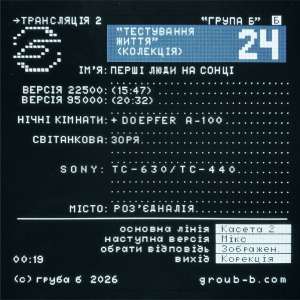
 When Timur Dzhafarov retired his John Object alias, he didn’t so much pivot as detonate. Under the Група Б (Group B) moniker, he has spent the past couple of years dragging his sound deeper into abrasion, deconstruction, and circuitry, releasing tracks that offer new material as fundraisers for his military unit. Тестування життя (Testuvannya zhyttya) — released on February 24 to mark the fourth anniversary of Russia’s full-scale invasion — was never intended as an album. The title translates as “Life Testing,” and that’s literal: these are live setup stress tests, bedroom rehearsals recorded through blackouts, pressed into service after an FPV drone strike hit the SUV he had fundraised for. Repairs: €3000. Everyone alive. Music as patch cable and tourniquet.
The record is bookended by two longform versions of “Перші люди на сонці (First People on the Sun)” — (Версія 22500) and (Версія 95000) — twin pillars that stretch between the 15- and 20-minute mark, the former previously released as a “single” in 2025. Between them lies a terrain of glitches, short circuits, and stubborn beats persisting inside collapsing soundscapes. Dzhafarov’s gear list reads like a quartermaster’s inventory — Moog Matriarch, Roland JX-3P, Korg MS-20, Fender Stratocaster, a small army of Boss and Electro-Harmonix pedals, cassette and MP3 players, “more DIY crap.” There’s a bitter irony here: enlistment made it financially possible for Dzhafarov to acquire more gear.
But this isn’t a hardware flex. It’s an album about impact — sonic and otherwise. “Нічні кімнати” (Night Rooms) begins in a liturgical hush. The Doepfer A-100 hums like a chapel generator, while disembodied speech — possibly culled from the NASA control room — drifts in. It feels archival, procedural, controlled. Then the floor drops. The modular system spasms into a full-spectrum assault, less countdown than catastrophic launch. It’s a motif that recurs: systems that fail and systems that keep pulsing anyway.
On “я не маю жодної думки в голові” (I Don’t Have a Single Thought in My Head), crackle and detritus give way to a Stratocaster line that feels almost naked. Field recordings and found sounds scud across the mix like distant artillery. The piece is brief — 2:37 — but it captures a particular psychic vacuum: overload tipping into blankness.
Elsewhere, the record reveals a capacity for startling tenderness. “Коли тобі не боляче (за уч. Андрія Косача)” (When You Don’t Hurt, featuring Andriy Kosach) feels unabashedly romantic, its melody blooming through distortion like a 1950s sci-fi soundtrack left too close to the reactor core. The oscillators sigh; the delays shimmer; for a moment, the noise recedes. The effect is not escapism but contrast — beauty made sharper by the knowledge of what surrounds it.
There’s a question I’ve asked repeatedly in my Ukrainian Field Notes series: which albums since February 24, 2022, have helped Ukrainian musicians make sense of current events? Over the first couple of years, many pointed to warнякання by Anton Slepakov and Andriy Sokolov, whose civilian chronicles of the invasion have since given way to direct military testimony in the ongoing warнякання Part Two – Call Sign Publicist. Many albums and works by Difference Machine, Ujif_notfound, NFNR, ummsbiaus, Oleksii Podat, Kataryna Gryvul, Parking Spot, and Mystictrax, alongside the Standard Deviation compilations and Kyivpastrans’ Drone for Drones series, have articulated different aspects of the full-scale invasion.
For me, though, Тестування життя comes closest to registering the totality: the loss, the absence, the incompletion; the repetition, rotation, inversion. It captures the sensation of world indifference — or ineptitude — pressing down, while something inside keeps oscillating. The album switches without warning from deconstructed brutality to ambient drift — the final track, “коли ти” (When Are You), is a lullaby for astronauts lost in space — and from punishing distortion to dreamy drone. It is expansive without being indulgent, chaotic without losing intent.
The liner notes are blunt: this is “a ‘best of’ of my practice sessions before I play with this setup for people,” recorded live in a bedroom during blackouts, on the fourth anniversary of the invasion. That context is not garnish; it is voltage. The beats that persist in these tracks feel like proof-of-life signals. The glitches and broken systems aren’t aesthetic choices so much as documentary residue.
Група Б remains unpredictable. Previous offerings have alternated between straightforward noise and cover versions of The Cure’s “The Forest” to more rounded — even when deconstructed work — but here the surprise is how fully realised these “tests” sound. What wasn’t meant to be an album becomes one of the most complete statements to emerge from Ukraine’s electronic and experimental scene in the past four years. It is brutal and abrasive, yes — an extreme aural depiction of a country fighting — but it is also tender, melodic, even cosmic, like solar storms and flares captured as overlapping soundwaves.
John Object is dead. In the wreckage and the feedback, Група Б is very much alive. (Gianmarco Del Re)
 a closer listen
Pingback: A Closer Listen Reviews – Avant Music News