
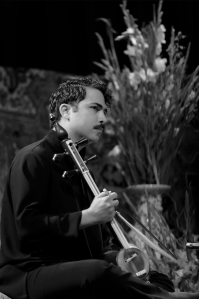
 Born in Tehran in 1983 as son of the world renowned tar and setar virtuoso Hossein Alizadeh, Saba Alizadeh established himself not only as a true master on the Iranian spike fiddle kamancheh but one of the groundbreaking voices in contemporary Iranian music.
After the critically acclaimed releases Scattered Memories (his international debut, released on Karlrecords in 2019), I May Never See You Again (2021) and last year’s Temple of Hope, his new album Rituals of the Last Dawn unfolds as a deeply meditative dialogue between tradition, experimentation, and the present moment. The Iranian composer and kamancheh virtuoso—widely recognised for bridging classical Persian heritage with avant-garde sound—crafts two expansive pieces that evolve slowly, like sonic ceremonies shaped through attentive listening and response.
Joined by Pietro Caramelli (guitar and electronics) and Liew Niyomkarn (lap steel and electronics), Alizadeh builds immersive landscapes where each instrument carries equal weight. Guitar, lap steel, electronics, and kamancheh move not as accompaniment but as voices in conversation, allowing the music to unfold organically in real time.
The result is a meeting point between centuries-old sonic traditions and contemporary experimental practice: spacious, reflective compositions that blur the lines between ambient, drone, and Persian classical sensibilities. Rituals of the Last Dawn feels both intimate and expansive—music that invites stillness, reflection, and a deeper form of listening in unsettled times.
To find out more, we discussed the production process of the album directly with Saba Alizadeh via email. This interview was initiated before the latest developments.
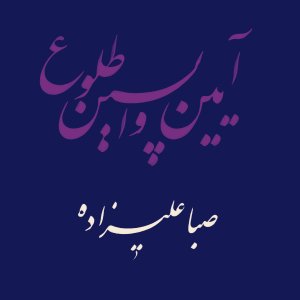 Hi Saba, thank you for taking the time. Rituals of the Last Dawn feels both resigned and quietly empowering. What does the idea of the “last dawn” represent to you personally and politically?
Rituals of the last Dawn is my offering to the LIGHT:
to every sunrise that calls us to rise,
to every sunset that wraps us
in the sky’s quiet glory,
to the fragile brilliance of each passing glow
we are still blessed to behold.
And it is for the countless souls
whose mornings and evenings
were torn from them
by ruthless wars,
by defiant uprisings,
by the burning hand of tyranny.
Whether performing at festivals like Reeperbahn or in concert halls such as the Berliner Philharmonie, your live performances are often described as singular and deeply narrative. How do you translate the intimacy and vulnerability of your studio recordings into a live context?
That’s more on the technical side and doesn’t usually get mentioned, but in that process, I try to stay as true as possible to the original studio composition. Still, things sometimes take on a life of their own, since I tend to improvise, both on the Kamancheh and in the signal processing, letting the sound evolve in the moment.
The album consists of two epic, immersive pieces created spontaneously with Pietro Caramelli and Liew Niyomkarn. How did working “on the spot” shape the emotional intensity and structure of these rituals and how will you be translating the album into a live setting for your forthcoming tour?
Each of these tracks have their own interesting story. So I moved to Netherlands two and half a year ago, which I also produced and released (by 30M) my 3rd album Temple of Hope.
For the release show of this album, I was invited to play at Reset Brussels organized by “Music on a whim”. That night I shared the bill with the amazing Welsh experimental musician Rhodri Davies and Liew Niyomkarn.
Me and Liew go way back, from the times I was studying at Calarts (California) 2010. The day after the performance (April 2nd, 2025), we got together at her studio in Brussels. Liew is amazing and has been experimenting with different tuning systems on the lap-steel guitar apart from being a supercollider wizard. After being friends for so long (since 2010) and just enjoying each other’s company and our individual sound worlds we thought we should try something together, her on Lap-steel guitar and minimal electronics, me on the Kamancheh with minimal effects. We set up for 30 minutes and recorded an improvised set for about 21minutes, and later it became the “Second Ritual” on the album which is a bit shorter than the original recording.
For the second recording, which later became “First Ritual,” the story is a little different / special to me. It happened on the graduation night of my wife, Azin, who had just completed her MFA at KABK in The Hague. We went out to a bar to celebrate. Shortly after we sat down, a quiet, friendly guy with natural red hair and a warm smile took the seat next to me. I later learned he is Italian. I said a few words in Italian that I knew, and that small gesture opened the door to a longer conversation. I found out he’s a sound artist, performer, and composer. What immediately drew me to him was his conceptual approach to sound, which felt very close to my own way of thinking and composing.
After my session with Liew, I felt inspired and thought it would be beautiful to invite him for an improvised recording as well. The following week, we met at my studio, Noiseworks, here in Leiden. We spent about 20 minutes setting up, then played continuously for 36 minutes. Later, we had to shorten the piece for the vinyl format.
After being a musician for almost 30 years and collaborating with so many beautiful souls, these sessions are very special to me because everything unfolded so naturally. There was no planning, no discussion about structure, just listening and responding in the moment. Pure improvisation. When it flows like that and gets captured properly, it becomes something truly precious.
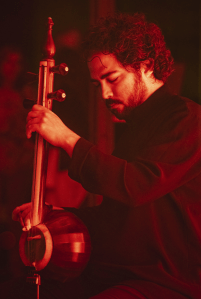 Your music has been described as “a bridge between the ancient and the contemporary.” How do you consciously balance centuries-old Persian sonic heritage with avant-garde experimentation without one overpowering the other?
With today’s studio technology available to almost every musician, I don’t really see a strong border between genres or musical traditions anymore. In a modern composition context, everything can exist side by side. I think of each instrument I use as a different color or layer in the overall sound.
Of course, the Kamancheh carries centuries of history in its sound. But I often shape and process it in a way that makes the source almost unrecognizable. Other times, I leave it completely pure, it always depends on the piece.
In my electro-acoustic, concept-based compositions, I try not to rely on the traditional phrasing or surface aesthetics of the Kamancheh. Instead, I aim to abstract those elements while keeping the deeper principles of Iranian traditional music alive in the work, things like temporal structures, the use of silence, and tonality.
If I simplify it, you could say there is a visible bridge between Iranian musical heritage and electronic or electro-acoustic music in what I do.
Having relocated to the Netherlands, how has distance from Tehran influenced your sense of memory, resistance, and identity in your recent work?
As an Iranian – someone from Southwest Asia – it often feels like we may never experience a truly normal and peaceful flow of life in our countries. So many old male totalitarians are still shaping our reality.
Of course, I would love to focus on themes that any musician anywhere in the world might explore. But the truth is, my memories and my way of thinking are deeply affected by what happens in my country and to my people.
These experiences naturally find their way into my work. For example, in Temple of Hope, the album before Rituals of the Last Dawn, those emotions were already very present.
I’ve now been based in the Netherlands for almost three years, and I still wake up every morning and check the news from Iran. Being outside the country creates a different kind of experience. When you’re no longer inside the daily reality, the news can feel even more intense, more saturated.
When I was living there during the Woman, Life, Freedom movement, I witnessed dark and painful events, but life continued. I had to make breakfast, visit family, go to work, everything happening in the same physical space as the unrest. Life and crisis were intertwined.
Now, being outside Iran, I experience it differently. It’s more distant, yet sometimes more overwhelming. It can be nerve-racking.
Thankfully, music and the studio have become my shelter. That’s where I can process these emotions and transform them into sound.
As for Rituals of the Last Dawn, as the title suggests, the album is about celebrating every moment we are still given. Many lives have been cut short because of social and political events, because of wars and this continues to happen.
In that sense, this album is a celebration of life itself, and of the simple, powerful fact of being alive.
On Temple of Hope, you transformed the events of the Woman Life Freedom movement into electro-acoustic compositions. What responsibilities do you feel as an artist when engaging so directly with political and social trauma?
I wouldn’t call it a responsibility. It’s more a lived experience that naturally finds its way into my compositions.
I believe any sound can be political, because every sound carries a background geographical, historical, or cultural. In that sense, the materials I work with are already loaded with meaning. Even when I don’t state something directly, the context is there.
I also use a lot of historical recordings—sounds from demonstrations, speeches by dictators. To me, these are part of the background music of our lives. Some people hear it clearly; others choose to close their ears, thinking they live in a different place and are protected by peace. But often that peace exists at the cost of someone else’s unrest, somewhere else in the world.
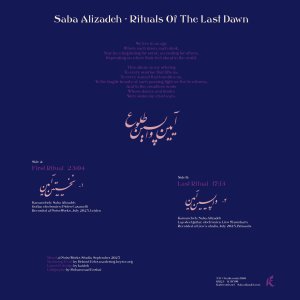 Temple Of Hope incorporates modular synthesizers, no-input mixer, historical radio sequences, and powerful guest vocals. In contrast, Rituals of the Last Dawn feels more stripped and meditative. Was this shift intentional—a response to the intensity of the previous record?
It could be, maybe an unconscious decision or just two lucky encounters with two beautiful souls, Liew and Pietro.
Growing up as the son of the renowned tar and setar virtuoso Hossein Alizadeh, how did you find your own artistic voice while carrying such a profound musical legacy?
Hossein Alizadeh, my father, is a performer composer that is considered one of the most important Iranian artists of the century as a forward thinking and border bending musician who has strong roots in the tradition but the vision of an Avan garde. Throughout his extensive discography you can notice the vast palette of ideas and sounds he has been building up for more than 60 years.
Growing up in his film score environment and often playing for the scores as a Kamancheh player, I witnessed his process of creation, aesthetics and I guess some of that experience stayed with me and my composition process. Maybe in this sense you could say that I am inspired by him.
Your debut Scattered Memories merged field recordings from Tehran with electronics and kamancheh. Looking back, how do you see that album in relation to your newer works—has your relationship with memory changed?
No, it stays the same and has actually become more layered as I think of memory as a temporal structure nowadays. Also looking back to Scattered Memories – my debut – feels like a manifest of what my intentions or concepts regarding composition will be, which until now stays the same but more layered and nuanced I would say.
You founded Noise Works as a platform for experimental music and knowledge exchange in Iran. How important is community-building to your practice, especially in a scene that often works under restrictions?
Back in Iran, especially during the years Noiseworks worked as an educational and performance based platform made an impact on the emergence of experimental/electronic music alongside other groups and platforms which they were not that many back then.
So, I am happy that with the limited resources that I had then I made events that could also open a broader discussion about music and music making. And since we did not operate under any approval by the government – since crowds under 100 did not need a permission back then – the only restrictions were resources. (Gianmarco Del Re)
Rituals of the Last Dawn 2026 tour dates Saba Alizadh + Pietro Caramelli:
Mar 21 – Utrecht, Culture Shock
Mar 22 – Groningen, Mooi Mislzig
Mar 23 – Den haag, Culture Unlimited Festival
Mar 27 – Den Haag, 3345 Record Store
Mar 28 – Rotterdam, Batavierhuis
Mar 29 – Amsterdam, Mezrab
April 16 – Berlin, Galiläa Kirche
May 06 – Paris
May 30 – Osnabrück, Morgenland Festival
 a closer listen
Pingback: A Closer Listen Reviews – Avant Music News