
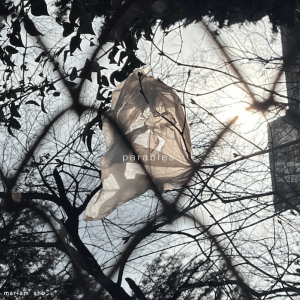
 The cover artwork for Parables — a plastic bag snagged in the branches of a tree, seen through the ruptured mesh of a fence — offers a succinct emblem for mariam shu’s album: something synthetic caught in the organic, suspended between drift and arrest, glimpsed through a screen. It’s an image of mild estrangement, of the everyday rendered faintly unreal. Across these ten pieces, Shu cultivates precisely that dislocation — not through fracture, but through soft misalignment.
Melodies are sketched rather than declared. Tracks feel momentarily self-contained before slipping into false endings, phrases resuming only to be abandoned, as if the music has second thoughts. Reverb and echo are less effects than conditions of being: everything seems to occur at a slight remove. Loops circle like intrusive thoughts. The album murmurs. Machines and natural ambiences generate a low-level chatter that never quite resolves into statement. The opener, “a wash in the current,” establishes the album’s grammar of understatement, its field recordings slowly receding from view.
If Parables is structured as a sequence of “sonic stations,” they are not narrative episodes but images that refuse to stabilise. “lost and found future service” imagines a bureau where visitors inquire whether their futures have been recovered — an absurd administrative dream rendered in subdued tones. “Long Lift Ride” turns the elevator into a temporal pocket where clock-time loosens its grip.
The spoken texts on “ravine” and “pewter swollen sky” emerged during the compositional process and carry a faintly surreal hue. They are not vehicles for clarity. The voice acts as witness rather than narrator — present, observing, yet unwilling to synthesise the scene. Words hover within the mix like condensation, never fully settling.
On “elision garden,” mariam shu mimics the experience of standing in a courtyard while muffled liturgical music and voices drift from inside a church — the sacred glimpsed obliquely, always partially occluded. True to its title, the piece avoids resolution, withholding meaning and gesturing toward what remains off-screen. In these withheld cadences and abandoned motifs lies the album’s particular charge. mariam shu composes not toward arrival but toward dispersal, allowing each parable to dissolve back into the margins from which it emerged.
In the closing “of close trajectories,” tentative piano lines are interrupted by the barking of a dog, yielding to a wash of synths. It is a characteristic gesture: the intimate unsettled by the incidental, the acoustic displaced by the electronic. mariam shu composes estrangement as texture. Like the plastic bag in the tree, these pieces tremble in suspension — caught between environments, between memory and immediacy — never entirely at rest, never fully reclaimed. (Gianmarco Del Re)
 a closer listen
Pingback: A Closer Listen Reviews – Avant Music News