
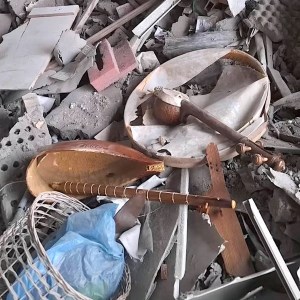
 Iranian Voices aims to offer a snapshot of the Iranian electronic and experimental music scene, examining current events through the lens of Iranian musicians, with the hope that this will be the first installment.
Over the years, I have conducted a number of interviews with Iranian artists, including Sote, 9T Antiope, and Pouya Esahei for Fluid Radio. Following the latest crackdown on protests by the Iranian regime, I reached out to a number of musicians, many of them based in the diaspora. The war and the subsequent internet blackout made communication more difficult and, at times, more guarded. These interviews bring together some of the voices I was able to gather.
I began with introductory and personalised questions about each artist’s work, before moving to shared questions about the scene and responses to recent events. The interviews with Mona Matbou Riahi and Pouya Pour-Amin were conducted prior to the war, while Arash Ghasemi’s responses were received afterwards.
Mona Matbou Riahi
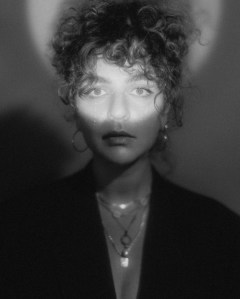
photo by Victoria Nazarova
I am a clarinetist, improviser, and composer. My journey began in Iran at the age of eight when I started playing the recorder. Immediately, music felt like something that gave me joy; it felt so easy and natural. Later, I attended the Tehran Music Conservatory, where I began my formal training in classical clarinet.
Everything I experienced shaped me. Iran remains a massive part of me; it is ‘under my body,’ always so close. Music connects me to all the feelings that I learned to suppress in order to survive. I feel it is a valve to liberation.
How has your journey from the TehranConservatory of Music to the University of Music and Performing Arts Vienna shaped your approach to improvisation and electronic experimentation—and in what ways does your work with ECM Records reflect your idea of music as a “wild natural playground” where freedom and discovery are central?
Moving from the Tehran Conservatory of Music to the University of Music and Performing Arts Vienna (MDW) allowed me to discover my love for experimental music and free improvisation. My interest in electronic music came later, sparked by my connection to club culture. I see the dancefloor as a form of resistance, and that energy is what drew me toward the electronic scene.
I believe all of these elements are deeply connected; I don’t think in terms of ‘genres’ that doesn’t make sense to me. My vision is about being fluid with all of those experiences and maintaining imagination. It is a continuous process of learning, playing, searching, making mistakes, observing, and staying in motion.
You use your training as a foundation, but you must be willing to let go of it to truly ‘play.’ It’s about being present, trusting your own voice, and letting the music lead toward that moment of authentic, free discovery.
Working with ECM Records and Manfred Eicher has shaped my perspective; his unique way of listening, authenticity, and knowledge create that ‘natural playground’ where you can actually exist within a recording.
Pouya Pour-Amin
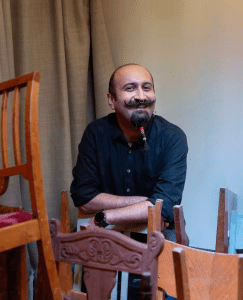 I’m a composer and also work in theatre and performance art. I was born and raised in Iran. My musical background is in Western classical music, and I began composing by writing for string orchestra and ensembles.
One of the main reasons I moved toward electronic music was simply the lack of possibility and budget to work with an orchestra. Electronic music became both a practical solution and a creative expansion for me.
As for my musical voice, I believe it has been shaped — and is still being shaped — by many different influences: from medieval European composers to contemporary American maestros, from Iranian traditional and folk music to black metal, from literature to the society I grew up in. The experience of despotism and Islamic dictatorship, and now immigration, have also deeply influenced my artistic language. And that process is still ongoing.
Back in 2019 you released the album Prison Episodes on Flaming Pines. You are about to revisit this album for a dance and visual technology performance. What is your approach going to be and what has changed for you in the intervening years?
Simply put, nothing has changed. Imprisonment because of your beliefs is a historical and global crisis. Out of 195 countries, in more than 140 you can find people in prison simply because of their beliefs or non-violent activism.
I still believe that the very concept of a political prisoner should not exist at all.
What has changed for me is the urgency and clarity with which I want to address it. This time, through the performance, I will speak more directly. To achieve that clarity, I will expand the work beyond music and use theatre, dance, and visual technology as integral elements of the piece.
Arash Ghasemi
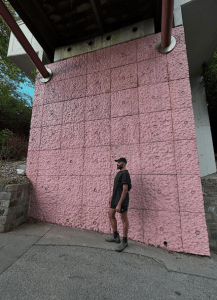 Arash Ghasemi is an Iranian musician, composer, and vocalist. Together with Simo Hakalisto he released the albums I and II under the moniker Gnäw. In 2026 he released 11 as KAILAS a Prague-based trio formed with Eva Porating and Daria Samo.
Your solo album Ahvaz (2025) feels deeply rooted in memory and place, evoking landscapes, voices, and fragments of Iranian cultural history. How did working alone on this record differ from the open-ended musical dialogue you share with Simo Hakalisto in Gnäw? Did the process change how you approached the guitar and the narrative quality of the music?
These tracks are my sonar notes—signals perceived from near and far, shaped into conscious form in the past few years. Gnäw resides more closer to the subconscious.
Improvisation seems central to your work, particularly in Gnäw where you’ve described the music as “photographs” of moments of energy and mind-travel. When creating Ahvaz, did you approach composition in a similar spirit of spontaneous discovery, or was the album shaped more deliberately around specific memories, images, and emotional states?
Spontaneity and playfulness live here too—wandering and more focused around the less familiar corners of my comfort instrument, the electric guitar. Both technique and sound palette experiment.
In Gnäw, Iranian instruments and musical sensibilities meet Finnish experimental traditions and modular synthesis, creating what you’ve described as a kind of “borderless drone chessboard.” Do you see your solo work as continuing that cross-cultural dialogue in a different way, perhaps between the past and present, or between traditional sounds and more psychedelic or blues-inflected guitar language?
Many cross-cultural echoes appear here, yet unlike Gnäw the tracks keep more visible edges—more contained, more conservative in structure and harmony. I hear traces of the past years throughout, their elements cast into these pieces. Side A drifts toward the abstract; Side B settles more firmly into a grid.
Across both Ahvaz and the Gnäw albums I and II there’s a strong sense of landscape—deserts, distant horizons, or abstract sonic terrains. How much do physical environments and lived geographies—from Tehran to Prague, or even Finland through your collaboration with Simo—shape the way you imagine and build your music?
My mood restlessly, shaped and impacted by the surroundings, habitats, people, the lived experiences, and any felt element—at times overwhelming, at times tender. Perhaps the quiet price of feeling the far ends of the spectrum.
On current events
How would you describe the current landscape of electronic and experimental music in Iran, and in what ways has it evolved or shifted in the past few years—especially in response to social and political pressures?
Mona Matbou Riahi: I am not the right person to answer this question fully, as I have lived abroad for almost 18 years. Even though I travel there every year, those visits are too short to truly capture the complexity of the current landscape. However, what I do know is that there are so many artists and brave souls working and making art under incredibly hard conditions and facing serious consequences. I am in awe of them. They are so progressive in their way of being; you can see it through their art in any form.
Pouya Pour-Amin: From my point of view, many experimental music artists from Iran are now scattered around the world. Those who still live in the country often collaborate with international labels outside Iran or present their work in underground events.
I should say that I can’t speak on behalf of my colleagues, and I don’t have complete information about artists across the entire country — not even in my own city, Tehran. So what I’m sharing here is only based on my limited perspective.
In the past few years, the collapse of the economy and the increasing repression have affected everything. Independent art and music are among the most vulnerable professions in such conditions. When survival becomes the main concern, experimental and non-commercial art suffers the most.
Iranian society is experiencing one of the deepest periods of disappointment and desperation in recent history. You can imagine that artists respond to this in very different ways. Some move toward darker and more introspective sounds, others become more aggressive, more confrontational.
Music, in this context, becomes a form of reaction — sometimes resistance, sometimes mourning, sometimes pure survival.
Arash Ghasemi: Sadly, the course of my life has kept me distant from the scene in Iran. In the past twenty years I have returned home only three times, and each visit too brief to truly explore the experimental landscape. It’s a quiet regret—I’m certain beautiful things are happening there, and I hope one day to discover them.
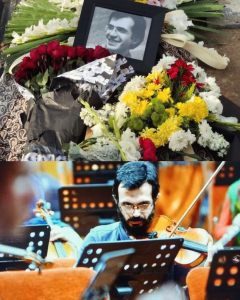
Pouya Faragardi was a musician and artist who lived in Tehran. According to local reports and social media posts, he was killed by repressive forces during recent unrest in the city.
For Iranian artists working in the diaspora, how has distance from Iran shaped your response to the recent events? Do you feel a different kind of responsibility, freedom, or pressure when addressing what is happening back home through your music?
Mona Matbou Riahi: Being part of the diaspora, you often feel as though your body is here, but your heart and soul are in Iran; it is a life of parallel realities. During recent events, it has felt like walking through a nightmare, you are here, yet you are there. You feel lost and numb, trying to live a ‘normal’ life while knowing that it is impossible; you are moving through a constant state of uncertainty.
I feel a deep responsibility in every step and breath I take, and at the same time, I feel so helpless. We must reflect the times, but I don’t see this as a ‘theme’ to simply make music out of; it is something much deeper that affects everything I do. All of the images and videos accompany me through my days and nights. These people were not just numbers; they were someone’s daughter or son, a mother or father, a brother or sister, a lover, a friend. Each one was a human being with a soul. I feel this loss so deeply. To me, they are not strangers; they are my family.
Pouya Pour-Amin: In general, I feel that being outside Iran allows me to speak more directly and freely, without the constant fear of detention. That is a very new experience for me — and honestly, a very pleasant one.
You can hear this more clearly in my recent release, Tabula Lacrimarum, created in collaboration with Barbad Golshiri. The work directly confronts certain traditions within Islam and challenges the theocratic concept of Allah. It’s something I simply could not have done so openly before.
But regarding the recent massacres in Iran, I haven’t even had a minute to think about an artistic reaction. My main concern right now is the people who are detained. The number of arrests is unbelievable, and every day the regime arrests more. Their conditions are awful, and their lives are in serious danger.
These days, I’m working with a collective of artists and activists to identify detainees from the art community, publish their names, and, in whatever way we can, try to be their voice. We are also documenting those from the art community who were killed brutally during the protests.
Sadly, one of them was my old colleague and friend, Pouya Faragardi, a violin player.
Arash Ghasemi: I try to speak about Iran with care. Living in a safer, more privileged part of the world, it feels unfair to be very opinionated about those who live under far greater pressures. I do my best not to fall into geopolitical narratives; what often goes missing there are the people themselves. I simply hope that the brave people of Iran can experience happiness and feel life as fully as possible.
From your perspective and to the best of your knowledge, how have the protests, violence, and repression affected communities of artists, venues, and underground networks in Iran? Are there new forms of collaboration, resistance, or expression emerging despite the dangers or is this happening only within the diaspora?
Pouya Pour-Amin: Usually, during periods of uprising, we see a noticeable increase in artistic activity, especially in music and visual arts. Many works are created and shared during protests. Even after repression by the regime, underground events often continue to grow, and art becomes a space for resistance.
But this time feels different. The scale of the violence and the massacre — with tens of thousands killed — has changed the atmosphere entirely. The repression has been more severe, and so the reaction has also been different.
Right now, for many people, the priority is the removal of this Islamic fascist regime. In that context, I haven’t seen the same level of artistic activity as in previous uprisings. Survival and political change feel more urgent than cultural production at the moment.
Arash Ghasemi: Sadly, this is nothing new. For nearly (at least) half a century, the people of Iran have endured some of the harshest chapters of modern history. Yet their creativity has never been silenced. Again and again, through music, cinema, poetry, and visual art, Iranian artists—especially those working inside Iran—have revealed some of the most genuine and resilient expressions of the human spirit.
What kind of international solidarity or support do you think would be most meaningful for Iranian artists and cultural communities at this moment—whether artistic platforms, exhibitions, residencies, or political advocacy?
Mona Matbou Riahi: It is not only about artists; the Iranian people as a whole need to be heard. My message to the international community is: do not stop talking about Iran. Inform yourselves deeply, and do not rely solely on mainstream media for your understanding.
At the same time, providing platforms for Iranian artists right now is extremely important, but not as a way of consuming their bodies, their trauma, or their country’s suffering. Artistic platforms, exhibitions, residencies, and institutions should create space for Iranian voices with care, respect, and long-term commitment.
What we need most is genuine solidarity grounded in empathy and action. We need the world to recognize our humanity, not just our headlines. Silence allows violence to continue. This is about justice, freedom, and human dignity. It goes beyond borders.
Pouya Pour-Amin: Honestly, it’s difficult to answer this question. The situation in Iran is horrible, as it is in many other parts of the world. We are living in a chaotic and deeply unstable era. In that context, any kind of genuine support is meaningful and essential.
From my own experience, I was very fortunate to receive a residency in Norway through Safemuse. They have supported me in every possible way since I arrived. Without their help, I wouldn’t have been able to accomplish what I have in my first year here.
I performed at several festivals, recorded a new album, created a musical storytelling performance and presented it multiple times. Now we are working on a large-scale production of Prison Episodes, which will premiere in October 2026 at CODA – Oslo International Dance Festival. None of this would have been possible without their support.
So naturally, I wish the same kind of sustained, practical, and long-term support for any artist who finds themselves in the situation I was once in.
Arash Ghasemi: We need to listen more to those who live under oppression, rather than defaulting to performative activism. Artistic platforms can become powerful spaces to resist propaganda—especially in times that demand deeper listening, critical thought, and a move beyond black-and-white thinking.
(Gianmarco Del Re)
 a closer listen