
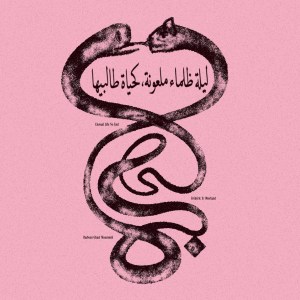
Artwork by Farah Fayyad
Some albums foreground process, as if the journey were more important than the destination. Eternal Life No End unfolds as something closer to a ritual—an extended act of listening that feels less composed than summoned. Built from modular synthesis, buzuk, rababa, drum machines, and voice, the record operates in a liminal space between invocation and erosion, where sound becomes both carrier and residue.
From the outset, “Squeal of Swine” establishes the album’s grammar: drumming coupled with a low, circling drone with Radwan Ghazi Moumneh’s digitally processed voice emerging not as narration but as incantation. “I hear the squeals of swine… without morals, with righteousness,” he intones, the words hovering somewhere between prophecy and lament. The track doesn’t develop so much as accumulate—density gathering in layers, like a storm that never quite breaks. It is less about progression than pressure.
“Dagger Eyes” shifts the palette toward a more defined rhythmic undercurrent, Frédéric D. Oberland’s modular system laying down a subtly insistent grid beneath the surface. The voice fractures into image and abstraction—“all people are eyes / and all eyes are people”—as if perception itself had turned hostile. The modular textures here feel embedded rather than imposed, a kind of living circuitry through which the voice must pass, refracted and reassembled.
Across the album, absence becomes a structural principle. Titles such as “A Silence With No Ceiling”, “A Shadow With No Silhouette”, and “A Dream That Never Arrived” articulate a negative space that the music continuously circles but never resolves. These are not voids in the conventional sense; they are charged absences, carrying the weight of interrupted trajectories and deferred meanings. Even at its most intense, the record resists catharsis.
Notably, the album was completed before the current escalation of war in the region. This temporal distance may account for its restraint: there is no overwhelming sonic onslaught, no collapse into chaos. Instead, everything remains tightly controlled, measured, and deliberate. The tension is internalised rather than explosive. This is not resignation, but containment—a refusal to let the music mirror destruction in a literal way, opting instead for a sustained, focused intensity.
“The Serpent” extends this logic into motion without destination: “He walks and walks… to a dream that never arrives.” The repetition becomes hypnotic, almost liturgical, yet drained of transcendence. Desire persists, but its object has dissolved. What remains is movement for its own sake—a looping, self-consuming path.
Religious and mythological imagery appears throughout, but always destabilised. In “A Shadow With No Silhouette”, the Buraq—traditionally a vehicle of ascension—becomes part of an inverted cosmology: “to a heaven that is a hell.” These inversions do not merely critique; they dislocate. Moral frameworks collapse into one another, leaving behind a landscape where categories no longer hold.
Silence, or rather the suggestion of it, plays an equally important role. The music frequently recedes into suspended states where texture thins and time stretches, as if the listener were left alone with the afterimage of sound. These moments are not pauses but thresholds—spaces in which meaning hovers, unresolved.
The closing “Walked and Walked” offers something like a release, though not a resolution. An ambient swell opens outward, less an ending than a continuation into another register. If earlier tracks feel enclosed—trapped within their own gravitational pull—this final gesture suggests a different orientation: not escape, but a quiet persistence.
Throughout, the voice remains central. Moumneh’s delivery is neither purely musical nor purely textual; it operates as a conduit, carrying political outrage, spiritual ambiguity, and poetic fragmentation simultaneously. The lyrics do not explain the music—they haunt it.
In this sense, Eternal Life No End resists categorisation as either document or abstraction. It is both, and neither. A record shaped by the present, yet unwilling to stabilise it into a single narrative. A ritual without resolution. A space where mourning and resistance become indistinguishable.
What lingers is not a message, but a condition: an awareness of something unfolding, endlessly, without closure.
To find out more about the production process of the album I spoke directly to Radwan Ghazi Moumneh and Frédéric D. Oberland via email.
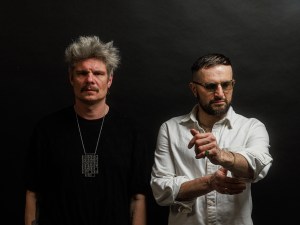
Photo by Robin P. Gould
Q: You are both no strangers to collaborations and have worked together in the past, but this is the first time you’ve made a full album together. What drew you to this duo format, and how did the dynamic between the two of you reshape your usual way of working?
RGM: This idea had been brewing for a while. We had chatted casually about a light attempt at a composition residency, and a few years back. We are such close friends and spend a considerable amount of time a year together being and reflecting, so it seemed like a natural step.
It most definitely was a very new way of working for me, which was quite a relief, as I normally am all alone in my creation and have no one challenging or pushing me on my ideas. It made me really have a lot of fun giving someone else the steering wheel in terms of direction when I felt at a loss. This has by far been the most “pleasure” I’ve ever had making a record.
FDO: The simple desire to combine our deep friendship with a shared musical project was an underlying dream that slowly took shape. The ease with which we carried out our previous collaborations—whether with Oiseaux-Tempête, where Radwan was a recurring guest and sometimes one of the producers, or when he invited Oiseaux-Tempête to participate in one of the tracks on Jerusalem In My Heart’s latest album—opened up a new realm of possibilities.
We share the same values with Radwan, the same curiosity, and common visions; with the deliberate hiatus of our respective collective projects, the idea of forming a duo together and taking our time with it became an obvious and inspirational choice. Working with Radwan is like cooking a brand-new dish with multiple hands and minds operating in tandem, and a lot of heart. Our duo is an open framework where many ideas can come together.
Q: Radwan, I had the pleasure of meeting you back in 2016 in London at Cafe OTO when you performed as Jerusalem In My Heart with Charles-André Coderre. When we spoke, you described your process as often beginning with voice and political sentiment before the music takes shape. Has that approach evolved over time, and how did it integrate with Oberland’s more modular and textural framework?
RGM: It actually didn’t at all. All but one track from our original session was kept, and we had started it as very much an instrumental “jam”. Once we decided that we needed to focus our work a little more, thematic ideas, as per usual started piling up in my head and I followed a “typical” writing process where ideas precede anything. Not that the lyrics were set in stone but the ideas definitely were. Frédéric is always able to jump on my wavelength with so much ease, and he was proposing many ideas that supported what was being put on the table.
Q: Eternal Life No End has a strong incantatory, almost ritualistic quality—particularly on tracks like “Squeal of Swine”. Was this sense of invocation or “shamanic” intent something you consciously pursued, or did it emerge naturally through the collaboration?
RGM: Shamanic aesthetics aren’t ones that I am drawn to, but evoking imagery that represents the sentiments I am carrying (and have been since 2023) was very much part of the concept of the record. There is so much anger inside of me at this very moment and this was such an important moment to let it come out.
FDO: Whether consciously or not, I think the incantatory quality of our music still comes through in many of our tracks, whether in our respective past projects or in this first collaborative work. There’s definitely something here that envelops us and transcends us, something that radiates or shines through beyond ourselves. To a certain extent, I almost felt that our recording sessions created a kind of hypnosis that allowed us to bring out buried truths. I also see in it the need, on our own small scale in the midst of this dystopian and utterly chaotic world, to build a shelter, and to offer it.
Q: Could you talk us through the instrumentation on the album? How did you arrive at certain key choices—like introducing the Buchla at the start of “Dagger Eyes” or closing “Walked and Walked” with the clarineau—and how did you approach blending these elements with the buzuk and rababa? You both also use drum machines throughout—how did you think about rhythm and its role within the overall structure?
FDO: Since both Radwan and I are multi-instrumentalists—or at the very least, have dabbled in a wide range of instruments—there were plenty of ingredients on the table and plenty of possibilities to start with. Our first session was an opportunity to figure out how to blend our very distinct sensibilities, to determine how to build a shared, open and solid architecture that would allow either of us to take the lead, play a solo, or ride the wave with emotion. The idea was certainly to experiment, but absolutely not to create an experimental album; rather, to craft hybrid pieces that would highlight rhythms and melodies, and could almost function as songs, whether instrumental or sung. The merge of analog electronics, percussion played by synthesizers, and acoustic instruments (strings, perc and wind instruments) often recorded live in one or two takes at most, was the key to crafting this record.
Sometimes we could even write certain tracks or arrangements together, without ego, listening to the recorded material and what was happening in the studio, in a very intuitive way. There is a deep trust between us in what the other hears, perceives, and feels. In that sense, we guided one another. It was a pleasure to encourage Radwan to fully embrace his voice on many tracks, just as he inspired me to play certain saxophone and clarineau parts with more delicacy.
Q: The record moves between very dense, almost oppressive textures and moments of stillness or suspension. How important is silence—or the suggestion of it—as a compositional element for you both?
FDO: That’s right. Silence is both a bond / a binder between us, like a sauce, and a hidden member of our duo. Listening to each other, but also the note, the beat that isn’t necessarily played but suggested in its absence, is just as important as what’s currently audible. It’s something that guided not only our composition and recording process, but also, it seems to me, Radwan’s mixing, or Jesse Osborne-Lanthier’s mastering.
Q: There’s a recurring sense of absence and negation in titles like “A Silence With No Ceiling”, “A Shadow With No Silhouette”, and “A Dream That Never Arrived”. What kind of emotional or political space were you trying to articulate through these ideas?
RGM: Absence and negation is very well put. It’s so exactly that. These are sentiments that are ever present in my life, and I feel they very much are also in the very fucked up world we are in today.
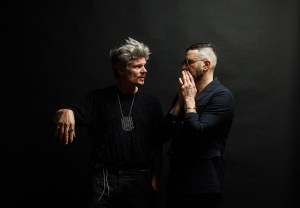
Photo by Robin P. Gould
Q: The lyrics are full of inversion—morality without morals, heaven as hell, shadows without form. Are you trying to describe a world that has lost its internal logic, or are these contradictions meant to open up a different kind of spiritual or poetic truth?
RGM: This very much ties into the previous question. We are in a world today where we have accepted and embraced the idea that we can be “okay” with a whole population being starved, humiliated and decimated, reduced to a dehumanized “animal”, all in the name of some abstract absurd and inverted “morality”.
We also simultaneously have accepted that the grey decrepit men in suits who run this world are pedophiles, and are open and proud of it, and groom children and sacrifice these kids’ childhood. We have accepted that there is a nation state that we all have, whether we want to or not, accepted as a “superior” people and thus allowed them to create a political and financial system that holds said suits hostage to their disgusting greed. There is no logic to this world. We live in a very fucked place.
Q: The reference to the Buraq introduces a very specific spiritual image, but it’s placed in a context where transcendence seems inverted or corrupted. How do you think about the role of religious or mythological imagery in this album?
RGM: I use this imagery only to connect certain themes I’m singing about. Honestly, a lot of this imagery is more of an aesthetic than a deeper meaning. I consider myself simultaneously very spiritual and a complete atheist.
Q: There’s a strong sense of endless movement without arrival, especially in The Serpent. Is this a reflection of political paralysis, or something more existential—about desire, belief, and disillusionment?
FDO: In this text, Radwan speaks of a dream: a figure who walks endlessly, traversing the world and encountering snakes of different colors that smile at him and open various doors to his unconscious, and to our current lives. Each time, the dream suddenly resumes; the wind carries him elsewhere, and the aimless and psychedelic walk begins anew.
The words, like music in its spiraling motion, which might never end, like a hurricane that would endlessly swallow us up and spit us out, function here as a metaphor. Seeing it as a disillusionment is one side of the coin or the glass; seeing it also as perhaps not a dream at all—that it is up to each of us who has the chance to try to break free from what binds us into another, to testify, to live, to struggle, to help.
Q: The press materials describe the album as being shaped by outrage and lamentation in response to the current political moment in the SWANA region. How did you navigate translating something so overwhelming into sound without it becoming abstract or distanced? And given how events have since escalated, does the album now feel complete to you, or does it point toward further work?
RGM: I’m not sure that “complete” is ever something I experience, be it an artistic state or artistic work. Everything is always in flux and ever evolving for myself. All my work, literally 100% of it, always has been shaped by the “outrage and lamentation” to what is going on at home. I am of course sensitive to the fact that it’s only been 3 years that a lot more people are starting to understand what the SWANA region has endured at the hands of the occupying entities of israel and the united states for approx. 80 years, but this has been in my life, all my life, of course.
Q: Can you talk a bit about the lyrics more broadly—what they are addressing, and how they function within the music?
RGM: The lyrics are written very much in the same manner that I always have written lyrics when working on music. It comes from a deep and personal place, that is a reflection of what is happening around us, and how I am filtering it all. I love reading or hearing lyrics and being simply pointed down a path, one that I need to forge myself to arrive at an understanding. The album title, the song titles and the lyrics are a very ‘prickly’ criticism of the utter shit we have endured over the last little while.
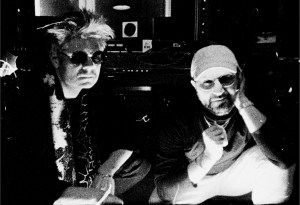
Photo by Charles-André Coderre
Q: Radwan, you have often spoken about the relationship between tradition and transformation in your work—taking elements of Arabic musical heritage and “messing with them,” as you described to me back in 2016. How did that idea evolve in this collaboration?
RGM: The natural evolution of the process here is one of time. I have always had such a deep connection to the idea of “ruining” things or cannibalizing them and denaturing them. It’s a process that really appeals to me. So for me, where Frédéric and I took this record was a place of trying to marry his aesthetics with mine, and finding a bastardized middle ground that appeals to us both.
FDO: It doesn’t seem to me that finding this common path together was all that difficult. It is empirical, and lies far beyond, or, more simply, outside, rigid frameworks or traditions. Our backgrounds are different, but we exist within the same reality. We exchange ideas, we listen, we resist as we can. I believe in our shared need to create new territories of imagination and to infuse them with desire and meaning. It is much more than an impulse to escape; it is about being able to find solace in them.
Q: Finally, the album seems to exist between states—ritual and document, mourning and resistance, presence and erasure. Do you see it as a form of testimony, a kind of exorcism, or something else entirely?
RGM: I have to say that from my perspective it is a document, resistance and presence. No part of me will ever allow erasure. Cultural imperialism is a very true and real weapon, and I use the word “weapon” to its fullest meaning. This to me is a document, one of millions that are birthed every second of our lives. Our resistance isn’t one of brute force nor capitalist machine war. Our resistance is simply existence. We exist therefore we resist. Imperialism defines victory as the power to erase a people and rewrite the story of their existence. That is actively what Israel, the USA and Europe are trying to do in Palestine, Lebanon and Syria. This humble work here is but a stark reminder of all these notions, and their inevitable and assured failure. It’s all spelled out in the arabic title of the album.
ليلة ظلماء ملعونة، كحياة طالبيها
A dark cursed night, just like the lives of those who ask for this night.
(Gianmarco Del Re)
 a closer listen