
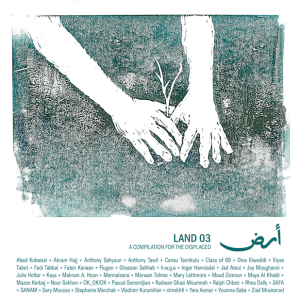
Artwork by Carla Aouad. Design by Josette ‘Zooz’ Khalil.
Curated by Tunefork Studios and Beirut Synth Center, the third volume in the Land series raises funds for those displaced by Israeli attacks on Lebanon in March 2026, with proceeds directed to Beit Aam and other grassroots initiatives. If Land 2 leaned toward songcraft and voice, Land 3 returns to something more unstable, more diffuse: a terrain of textures, fragments, and unresolved gestures. But like its predecessors, it functions as more than a compilation—it is a sonic cross-section of a scene responding in real time to crisis.
Organised alphabetically, Land 3 embraces a sequencing logic that produces friction rather than flow. Tracks range from Rhea Dally’s fleeting “baygon be bygone” (2:15) to Class of 69’s sprawling “Three tampuras” (19:28), and while this uneven distribution can feel disorienting, it also generates unexpected juxtapositions. What the album lacks in conventional balance, it gains in volatility.
It opens with one of its strongest statements: Abed Kobeissy and Sary Moussa’s “a simple song about weather and murder”, featuring Hala Omran and Ali Hout. Built around a reworking of the muwashah “hal ‘alā al-astār” (هل على الأستار), the piece reframes the lovers’ defiance as something both intimate and catastrophic, its electroacoustic palette oscillating between restraint and rupture. It sets the tone for a compilation where violence is rarely explicit in sound, but constantly present in implication.
From there, the album moves through a wide, often dissonant field. Akram Hajj’s “Day 2” and Anthony Tawil’s “Centipede” introduce a nervous, textural unease, while Class of 69 stretch time into a meditative drone that feels less like stasis than suspension. Fadi Tabbal and Inger Hannisdal’s “I wish we had more time” provides one of the compilation’s few moments of harmonic clarity, Hannisdal’s plaintive violin tracing lines of regret over Tabbal’s ambient field.
Throughout, the interplay between electronic processing and acoustic tradition becomes one of the compilation’s defining threads. Faten Kanaan’s “إكليل (ikleel)” folds minimalism into early music structures, while Flugen’s “Ikleel al-Jabal” layers field recordings and electronic textures into something distinctly Mediterranean in tone. Ghassan Sahhab’s qanun-led “Waiting (انتظار)” sits alongside the modular explorations of Marmalsana and Cansu Tanrikulu’s “Ekbruligita”, expanding the compilation’s sonic vocabulary across traditions without forcing synthesis.
Elsewhere, the compilation oscillates between abstraction and direct address. Mazen Kerbaj’s “I Hope Netanyahu Will Be Dead When You’ll Listen to this Piece” stands out as one of the most overtly confrontational moments—abrasive, angry, and deliberately unprocessed in its intent. In contrast, Julia Holter’s “XXXVI” (featuring Dicky Bahto on oud) and Mary Lattimore’s collaboration with Pascal Semerdjian and Fadi Tabbal on “Nada (ندى)” introduce a quieter, more reflective register, where melody emerges through restraint rather than declaration.
Several contributions engage explicitly with themes of displacement and memory. Nour Sokhon’s “Big dreams, a phone call too far” continues her exploration of migration and fractured communication, while OK?OK!OK.’s “When The Moon Falls (عندما يسقط القمر)” channels the lingering aftershocks of the 2020 Beirut explosion into a fragile, suspended soundscape. Yara Asmar’s “the heart beats one, two, then not”, incorporating a poem by Dr. Michael Dennison, captures a similar sense of interruption—life reduced to its most basic rhythms, then abruptly halted.
The presence of diaspora artists—Kerbaj now based in Berlin, alongside international contributors such as Holter—adds another layer to the compilation’s geography. Land 3 is not simply rooted in Beirut but extends outward, mapping a network of artists connected by shared histories, collaborations, and ongoing displacement.
The closing track, “Sahira” by Youmna Saba, Dina Elwedidi, and Maya Al Khaldi, brings the compilation to a quiet point of convergence. Originally composed for Lara Tabet’s film Enter Corridors, it unfolds as an open-ended invocation where voice, melody, and spatial depth are held in delicate balance. The piece draws on the film’s exploration of interconnected ecologies—linking human and non-human life, natural and constructed environments—without becoming illustrative. Instead, its submerged textures and breath-like rhythms evoke a sense of continuity and suspension, as if sound itself were moving through water or memory. After the fragmentation and volatility of what precedes it, “Sahira” does not resolve the compilation so much as absorb it, leaving the listener in a state of quiet, unsettled reflection.
As with many large-scale VA compilations, Land 3 resists easy cohesion. Its strength lies precisely in that refusal. It documents a scene not as a unified aesthetic movement, but as a constellation of responses—some direct, some oblique, all shaped by the same underlying conditions.
What emerges is not a singular narrative, but a field of listening in which tradition, experimentation, and urgency coexist. In that sense, Land 3 is less an album than a snapshot of a moment: fractured, uneven, and deeply alive.
To discuss the production process for the Land series I have reached out to Julia Sabra and Fadi Tabbal from Tunefork Studios.
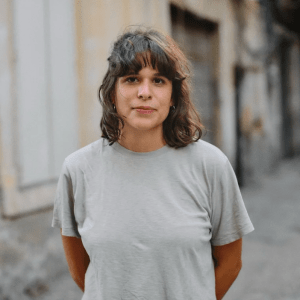
Julia Sabra
To begin, could you introduce Tunefork Studios—its origins, your collective structure, and the role it has played in shaping Lebanon’s experimental and alternative music scenes since 2006?
Tunefork Studios is a specialized sound and music workspace that has contributed to shaping the Lebanese art scene since 2006. Founded by Fadi Tabbal, the studio has gradually grown to also include a small team of sound professionals and enthusiasts: Joy Moughanni, Julia Sabra, Anthony Sahyoun and Marwan Tohme. Tunefork Studios provides a range of services such as studio and on-site recording, music production, mixing, live sound and technical direction, sound design, composition and consultancies.
The team’s goal is to push sound and music boundaries in all art forms and to help the art and sound community grow. Over the years, it has grown into a pillar of the artistic community and become an incubator for creative thinking and artistic expression. Tunefork has also led several initiatives to help those in need during the country’s worst times; from setting up the Beirut Musicians Fund in August 2020 to help musicians/engineers recover their destroyed gear after the deadly port blast, to the initiative with the Beirut Synth Center in September 2024 to help provide basic needs to the displaced, to curating two compilations of unreleased tracks in March 2026 to raise funds for those displaced by Israeli attacks on Lebanon.
Tunefork has helped shape a community of musicians and artists committed to support the Lebanese art scene across its multiple sectors. The collective established itself as a launching pad and a home for some of today’s most prominent musicians such as Mashrou’ Leila, Scrambled Eggs, Mayssa Jallad, Postcards, Ghassan Sahhab, Sanam, Kinematik, Youmna Saba and Sharif Sehnaoui…
We have worked on local and regional films with Cyril Aris, Mohammad Abdouni, Raed and Rania Rafei, Maher Abi Samra, George Barbari, Mai Masri, and Chadi Aoun. We have collaborated with artists such as Tania el Khouri, Petra Serhal, Rawane Nassif, Rima Najdi, Mounira el Kadiri, Lamia Joreige, and Ali Chahrour on sound installations, theater and dance performances. We have also worked with cultural centers and museums such as the Sursock Museum, Beit Beirut, Beirut Art Center, Ashkal Alwan and Metropolis.
Our goal is to push sound and music boundaries in all art forms and to help the art and sound community grow, while teaching new generations about sound art and music.
You’re speaking to us at a time of renewed war and displacement in Lebanon. How would you describe the situation on the ground right now, both personally and as a collective working within the cultural sphere?
Julia: It’s been barely 2 years since the last war in 2024. And even during the “ceasefire”, Israel was still bombarding the South and occupying border villages, and people were still displaced. We haven’t had time to rest or rebuild. The initiatives working on the ground also tell us there’s less mobilization of volunteers and less donations being made this time around, despite the fact that displacement is way higher – over 1.5 million people displaced (and these are just the officially “registered” ones), with Israel ordering the displacement of people from the entire South of the country, and the entire southern suburbs of Beirut.
In moments like this, what role can music and sound play? Do you see it primarily as documentation, solidarity, a form of resistance—or something else entirely?
Fadi: I don’t know if there’s really a role for music to play. The first focus is survival. The solidarity of the musicians here is more an all hand on deck but not through music. The sonic documentation I think comes as an aftermath of the situation.
The Land series has quickly become a powerful fundraising initiative. Could you tell us how the project first came together with Volume 1 back in December 2024, and what your expectations were at that stage?
Julia: Our team, along with the guys from Beirut Synth Center, were looking for ways to gather more funds for the displaced in the last war, and thought about reaching out to our community of artists to give us tracks for a compilation. LAND 01 was born – and it was limited to electronic/ambient/experimental tracks, I think we were just trying to set rules internally so that we could limit ourselves and get it done quickly. We were very touched by the generous response from the international community music, and the compilation alone raised around $4,000. This is what encouraged us to do it again, aiming to double this amount and widen the scope of artists and genres.
Volumes 2 and 3 were assembled through an open call with a very short turnaround—just about a week for submissions. What was that process like in practice, and how did artists respond to such urgency?
Fadi: Local musicians are prolific and very dedicated. Some people recorded tracks especially for this, within one week, while others used songs that they never released. As for the subject, we are always in a state of war, sometimes more extreme than others. So the music is within the same broad theme.
Listening across Land 2 and Land 3, there’s a remarkable diversity of approaches—from intimate recordings to highly experimental pieces. How did you curate the compilations while maintaining coherence?
Fadi: We did not really curate, as we wanted to get it out as soon as possible to be able to distribute the funds to those who need them. So we asked friends, frequent collaborators, musicians who played at Beirut Synth Center or recorded at Tunefork – anyone from the community we could think of, both established and up-and-coming artists – and we got a huge amount of contributors. It’s wonderful to see all of the musicians come together so fast. We received so many tracks that we decided to divide them into two compilations, broadly as song- based tracks (Land 02) vs more abstract musical pieces (Land 03).
There’s also a strong mix of local and international contributors, including figures like Julia Holter and Mazen Kerbaj. How important was it for you to position the project both locally and globally?
Julia: I think it was more about seeing who would be up for this within our network. Having international names, from the diaspora and beyond, definitely helps since we are trying to get funds that don’t exist locally. Julia Holter also happens to be a quarter Lebanese 🙂 and we’ve been in contact since the last war, she was part of the Land 01 compilation.
You chose to direct funds to Beit Aam and other grassroots initiatives. Could you tell us more about your relationship with Beit Aam and why supporting local, community-based structures felt essential?
Fadi: Unlike many western countries, Lebanon does not have many governmental institutions that can help in these situations, for a lot of reasons like the recurrent wars and aggression or the internal corruption. We have to rely on ourselves and the community. Beit Aam is one of the many initiatives run by people we know and trust working day and night to provide needs for the displaced. They also have a wide network of volunteers across all of Lebanon, not just in Beirut. They seemed like the obvious choice.
Tunefork has long been a key node in Beirut’s experimental and electronic music ecosystem. How would you describe the current state of that scene under present conditions?
Fadi: The goal is to focus on the immediate priorities, which is to try to help the displaced as much as possible while trying to keep the morale up. So pushing the musicians to keep composing and performing is part of that.
Lebanon has a strong musical diaspora, with artists like Mazen Kerbaj now based in cities like Berlin. How do you see the relationship between those working abroad and those still on the ground?
Julia: The connection is always there – we’re always helping each other. Lebanon is a small country with few resources except for the dedication of its people. We rely on our friends to help with our fundraising and to spread the awarness of the danger we are going through while we work on the ground.
Do projects like Land help bridge that gap—creating a shared space between local and diasporic artists?
Fadi: I don’t think there is a gap to be bridged. Lebanese musicians in Lebanon and abroad are always connected one way or the other. We are all constantly trying to help each other. We are linked by our generational trauma and the love we have for each other and our home.
Several tracks on Land 3—like Abed Kobeissy & Sary Moussa’s a simple song about weather and murder or Mazen Kerbaj’s sharply titled piece—carry a direct or symbolic engagement with violence and political reality. How do you think artists are processing the current moment sonically?
Fadi: Every artist deals with the situation differently. Some focus on love, others on escape and some on anger like the ones you named.
Given the speed and urgency of these compilations, how did the production side work—especially mastering, coordination, and assembling such a large body of material in a short time?
Julia: Over the years through Tunefork and other collectives, we have built a very tight community of musicians and artists. The coordination and assembling was done internally by Tunefork’s team. The artwork was done within a week by our artist friend Carla Aouad, and the design by our friend and frequent collaborator Josette Khalil. Mastering was also done by a close collaborator in Germany, Stefan Echeir (Lopazz – mixmastering.de). And like everyone they responded quickly, and did everything pro bono, which we are so grateful for.
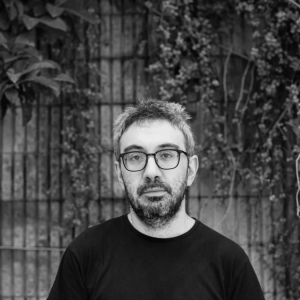
Fadi Tabbal
Looking ahead, do you see the Land series as something that will continue evolving, or was it conceived as a response to a specific moment?
Fadi: Land was conceived in 2024, the last time Lebanon was attacked by Israel. Like these two volumes, it was done very quickly as a response to an immediate crisis. We are hoping that we would not have to have future volumes… Of course sharing music from the region will always be part of our goal, but hopefully not only during wars.
Finally, what would you want listeners outside Lebanon to understand—both about the situation on the ground and about the music coming out of it?
Fadi: More than 1.5 million people have been displaced because of the Israeli aggression on Lebanon. Around 1500 people have been killed and more than 4000 are injured. Israel threatened to occupy the south of Lebanon indefinitely (it amounts to around approximately 20% of the whole country). Infrastructure is constantly being destroyed. And I don’t think there is a way to explain the psychological toll this is doing to the whole country.
The music will always be there, as artists need to create to process what is happening or escape it. Through all the hardships the Lebanese have faced in the last few years, there has been no shortage of releases and musical projects.
(Gianmarco Del Re)
 a closer listen