
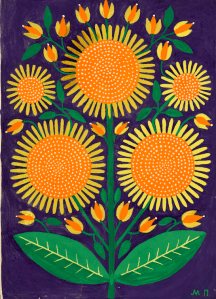
Artwork by Mariia Prymachenko
This month we speak to alanmortus in Kyiv about how the war changes the perspective on what is important. Horizon Resonances tells us about how the city of Odesa has shaped him, Pororoka talks about her life being split in two and Plaaaato laments having to leave Zaporizhzhia.
Meanwhile, Letovchenko reminisces about growing up in the Luhansk region, Коца address the topic of religion, and Yurii Pikush discusses classical music.
Finally, we hear from NIZHNA about making club music with field recordings and Dmytro Kurovskyi takes us through 35 years of Foa Hoka, one of the most innovative and exuberant bands in Ukraine.
Also, there is a flurry of new releases from 58918012, Dada vs Evil, ken=en, lebben, low communication, Tsatiory, Symonenko, ummsbiaus, Lvcerate, нікіта дорошенко, støïbrok, Rescale Musicbox, NOISOID, Andy Nechaevsky and DEDDOM & НОЙЗ ГАЛИЧИНА.
In our Viewing Room, we have new videos from DEDDOOM & НОЙЗ ГАЛИЧИНА, Apashe & Alina Pash, and Tysk.
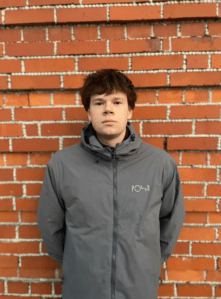 For our monthly podcast instead, we discuss rap music with Ilya Kovalenko, editor in chief of Rap.UA who also talks about Kharkhiv and the cultural hub Some People.
Tracklist:
- Monomonster – Killa
- Alex Pervukhin – صَبْرٌ
- DJ Sacred (ft. Re: Drum) – The Gun
- FORCEGNG, 4ERDAK – COBRA
- Покам, Ласта, KLIM – МАЄМ
- Lostlojic, Cybermykola – Шаблячуєрізанину (Lostlojic Remix)
MARCH 24, 2026 – KYIV
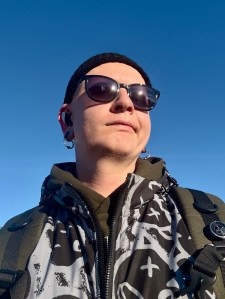
photo by alanmortus
My name is Andrii, I’m almost 39 years old, and I’m from Kremenchuk, a city in central Ukraine. Music has fascinated me since childhood because my father loves all kinds of music, and it really shaped our lives – vinyl records all over the house, colourful lamps on the wardrobe, record players, and cassettes on the shelves… By the time I was 11, I had developed a desire to play the guitar. When I was a teenager, I was introduced to a local band, and I started attending their rehearsals, which eventually led to a lasting friendship. A couple of years later, I began organising concerts in my city, inviting bands from all over Ukraine to perform. My friends and I also toured many cities across Ukraine with that band. That’s how it all started.
Has the full-scale invasion changed the way you think about music and sound in general? Has your setup or way of working shifted as a result?
Let’s put it this way: before the war, I rarely made music just for myself or for others to listen to, so the first album was recorded pretty quickly and haphazardly. I had an electric guitar, an iRig adapter for my phone, and an iPhone 5, so you can imagine how amateurish it was. The war changed everything, especially my perspective on what’s important and what isn’t. So now I’m doing things more or less the traditional way: I bought a sound card, I have two guitars and a ukulele, a microphone, headphones, and I plan to buy a bass guitar.
How did alanmortus first take shape as a solo project?
Oh, there’s really nothing special about it. Sixteen years ago, I moved to Kyiv, and my friend and I tried making music together (he was already a musician at the time). Those attempts made me realise that I was capable of something. Time passed, my friend moved to another city, and I was left on my own, so I just played guitar at home, trying to figure out what exactly I was doing. Then I came up with a nickname, which for a long time was simply my
online handle.
Your music sits somewhere between post-rock, post-punk, and something more personal and guitar-driven. Do you think of alanmortus as belonging to a scene, or as something deliberately outside of one?
To be honest, no, I don’t consider myself part of any specific scene, but I’m not deliberately distancing myself from anything either. I think it’s up to the listeners to decide whether I belong to a particular scene, if they really want to. It’s not that important to me.
You record everything yourself, often in single takes with minimal processing. What draws you to this stripped-back approach, and what does it allow you to preserve?
For me, this is the most honest way to make music, because that way it stays exactly as I imagined it, just as it sounds in my head. The more I edit the music, the more time I spend working on it, the less it resembles what it’s supposed to be.
Your tracks tend to be short but very focused. How do you know when a piece is finished, especially when working so intuitively?
Even as a child, I realised that many songs contain a lot of parts that aren’t interesting to listen to, but there’s always a certain highlight, a passage that’s worth paying attention to, and I can listen to just that part. Intuitively, I always know: “That’s it, I should stop now—this is exactly what I need.”
There’s a strong sense of melancholy in both Mute Summer Song and One Hundred Year Autumn. Is that emotional tone something you consciously shape, or does it emerge naturally from playing?
I guess I hadn’t thought about that:) I just don’t know how to make music with a different mood. Mute Summer Song was written years before it was released.
Did your relationship to that material change over time, especially once it entered a different context — including its use in S.T.A.L.K.E.R. 2: Heart of Chornobyl?
The songs from that album are products of their time, so now I see them as memories of a past life that can never be recaptured. So I guess I view this album differently, more emotionally. As for the songs from this album being featured in S.T.A.L.K.E.R. 2: Heart of Chornobyl, that actually gave me the push I needed to create the second album 🙂
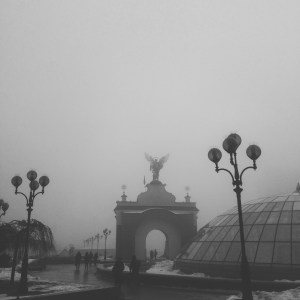
photo by alanmortus
Your new album One Hundred Year Autumn is tied to a very specific feeling — your dislike of autumn and cold. What does that season represent for you emotionally, and how did it shape the sound of the record?
Oh, I hate the cold season; I always have. For me, it’s the time when everything dies, and the world turns grey and dreary. Every year, I eagerly await spring, when everything that has died begins to come back to life—there’s nothing better than that. So creating music out of my dislike for autumn and the cold was probably inevitable.
Are there any albums from the past four years that have helped you process what’s been happening — either musically or emotionally?
Probably the last The Cure album I’ve been waiting for for 16 years:)
What does it mean for you to be Ukrainian right now, and how — if at all — does that identity enter your music?
To be honest, I’ve never really thought about it that way. But my life experiences as a Ukrainian – both before the war and now – influence my work in one way or another. The war and COVID have affected everything.
Which book / film / album / song / traditional dish / podcast / blog / artwork / building / meme best captures Ukraine for you?
Probably the album Мандрівник by Pins. For me, it’s the best Ukrainian music album ever.
MARCH 29, 2026 – ODESA
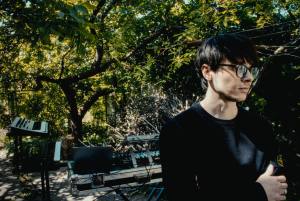
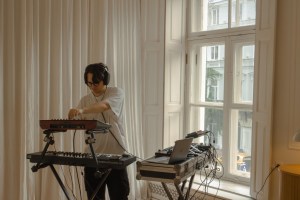
My name is Boris. I live and work in Odesa. I fell in love with music extremely early — so early that I don’t even remember it myself. My parents still tell stories about how I built my own makeshift instruments and “performed” all kinds of music on them. Later I studied at a music school. For many years after that I was searching for my artistic voice: I loved too many different genres and couldn’t choose just one. Eventually I realised that the most honest and liberating path for me was to work completely alone, as a one-man project.
A real turning point came on April 20, 2025, when I independently released my mini-album In the Rain. From that moment I began consciously moving toward electronic music, but always keeping acoustic instruments, organic textures and live sounds at the core.
You came to electronic music relatively recently, if I’m not mistaken, and you describe yourself as an indie electronic artist. How did that transition happen?
Yes, it happened quite recently. In a few weeks it will be exactly two years since I released my first single “Distant Shores”.
I call myself an indie electronic artist because I control every aspect — from the initial idea to the final sound — strictly according to my own vision. Over time my sound has evolved naturally, absorbing new elements and techniques, but there was never one dramatic “switch”.
What can you tell us about the production process behind Shadow of Wings? How did you approach blending different genres—from ambient to more experimental sonorities—with the track “Nocturnal Glide” functioning as the emotional core of the album and bringing together your interest in combining organic and digital sounds?
I worked on this album for a very long time. I constantly revisited and rethought earlier material, experimented with harmonies and sonic layers, and slowly learned what truly served each musical idea.
In the end the record became a very honest reflection of who I was during that period — both musically and emotionally. I’ve always been drawn to an experimental approach: combining simple, memorable melodies with improvisation and unexpected textures. You can hear it clearly in “Days”, where jazzy bass lines float through ambient clouds and electronic pulses. The title track “Shadow of Wings” works with the same principle, but with completely different energy and dynamics.
“Nocturnal Glide” is perhaps the most minimalist piece on the album. I focused on a steady, almost hypnotic rhythm and a heavy, oppressive atmosphere. For me, ambient music sometimes needs exactly that kind of tension and strictness.
At the same time, I don’t see any single track as the “emotional core”. Every composition on the album carries my main obsession — the organic-digital dialogue. This blend is not just a technique for me; it’s the very palette I work with. The result is a set of different pieces, each with its own character. I realise this fusion may not always be obvious to the listener — it lives mostly in my own head. But when someone hears it and finds it meaningful, that’s the best reward.
You seem to be a “one-man band”, handling recording, mixing, and mastering yourself. Which part of the process is most important to you, and which do you feel most comfortable with?
Yes, I do everything myself, and I’m fully aware how risky that can be — it’s very easy to lose perspective when you’re wearing all the hats at once. That said, I’ve been mixing and mastering for my own projects with real pleasure for about five or six years now, and it has become an organic part of my creative process. There is creativity in every single stage — from the first note to the final mastering.
Of course I can imagine delegating mixing and mastering in the future, but for Shadow of Wings it would have been almost impossible. The sound of the album is very delicate; any other approach to processing could easily destroy the atmosphere I was chasing. The parts I feel most confident and free in are writing instrumental parts and sound design.
You wrote lyrics for your track “Micto” (Misto – “the city”), closing with the line: “The city hums in wires like a distant organ.” How influential is Odesa in your work?
Yes, in “Micto” I wanted to capture the sacredness of the modern city. Its constant hum feels eternal and immense — something much larger than any single person. You become like a small parishioner standing inside a vast temple where the city itself is the organ playing.
I spend almost all my time here and rarely escape to open spaces without streets and routes. I constantly hear the life of the city around me, yet I rarely participate in it. The hum of the wires feels like a quiet reminder that somewhere far away real life is boiling, while here I only catch its distant echo.
I was born in Odesa and have never left it for any long stretch. The city has shaped me — its mild climate, the many places where you can simply spend time pleasantly. At the same time, there are moments when everything turns gray, damp and cold. Suddenly the city feels mechanical, filled with an ocean of cars and electric light.
How would you describe the experimental music scene in Odesa, and do you feel part of its musical community?
I’d really like to get to know the experimental scene in Odesa better — right now I feel I don’t know it nearly as well as I should. I follow and really like work of a few artists, such as pitch_trees and lu_joyce, but that’s still not enough to give a full picture.
Has the full-scale invasion changed the way you think about music—both in terms of what it can express and how it is made? Has it affected your setup or access to tools in any way?
Yes, the full-scale invasion has deeply changed me as a musician. It pushed me to trust my own emotions and inner state much more than anything else. Since the war began, my feelings have been in constant tension. I often dream about the war — situations that never actually happened, but which my mind keeps replaying under the permanent sense of threat. In such conditions you start relying on your own sensations far more than on anything coming from outside. I became much more attentive to my emotions and started expressing them with greater freedom and honesty.
As for equipment, I didn’t face any serious problems. Almost all my music is created with virtual instruments inside the DAW, and any hardware I’ve bought in recent years was delivered without issues by Ukrainian music stores.
Have there been any Ukrainian releases in recent years that have helped you process or understand the present moment?
Yes, the album that has stayed with me the most is Kyiv Eternal by Heinali. It came out exactly one year after the full-scale invasion began and became for me a very powerful way to process everything that was happening. Heinali took field recordings of Kyiv from before the war — some of them more than ten years old — and wove them together with his signature ambient electronics and modular synths. The result feels like a living, breathing portrait of the city I know and love: streets, voices, traffic, rain, everyday life that we suddenly feared losing forever.
What makes the album especially meaningful to me is that it’s not a dramatic “war album” with tragic tones. Instead, it’s a tender, almost protective love letter to Kyiv — a way of saying “this is what we had, this is who we are, and that spirit is still here.” It helped me hold on to a sense of continuity and quiet resilience when everything around felt uncertain. Listening to it feels like walking through the city again in my memory, while fully understanding how much has changed. It gave me comfort and strength without any big statements — just pure atmosphere and honesty.
 How do you personally think about your identity as a Ukrainian artist today? Is it something that informs your work directly, or more indirectly?
Being a Ukrainian musician and living in Ukraine right now is quite difficult. Creativity is always shaped by the world around us, and today our country is going through an incredibly hard time, resisting both external and internal destructive forces. Of course this affects the culture in Odesa and across Ukraine as a whole.
At the same time, it’s very hard to fully grasp the depth of the trauma that the musical community — and society in general — has experienced while you’re still living inside it. I don’t yet feel that I truly understand how deeply this has changed me personally. Perhaps only after we have lived through this entire path will we be able to comprehend it more clearly and meaningfully.
Nevertheless, I believe that in the end this experience will lead to a profound re-evaluation of values and priorities — both for our society and for the country.
APRIL 2, 2026 – KYIV
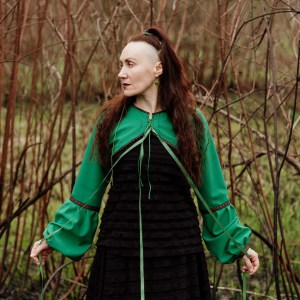
My name is Svitlanka. I was born and grew up in the east of Ukraine. My hometown, where I got my first musical experience, has been occupied by russians since 2014. When I was a child, I was interested in playing different instruments: piano, guitar, and accordion, and took part in ensemble and choir. Nothing extraordinary, I was just curious, excited, and loved to listen to the music and sing a lot by mood. When I moved to Kyiv, I forgot about playing music for almost ten years.
Dancing became my new passion. Anyway, since then I started to appreciate the rhythm. I opened a small dancehall studio inspired by Jamaican culture, formed a dance crew, organized workshops, and traveled to festivals in different cities. It was a great time.
But at some point, I started to feel that something was missed – as if there was something bigger inside me. Maybe it was the influence of the strong dancehall vibe, I don’t know. But I decided to start again from scratch with playing and vocal.
In 2014, when the hybrid russian war against Ukraine began, I joined the project “Я Тебе Не Знаю” (literally “I Don’t Know You”) and wrote many songs about injustice, loss, pain, and heroism.
My life was split in two. Many people in Ukraine quickly forgot about the war and acted as if it didn’t exist, but I lost my home, my roots, and the chance to visit both my living and deceased relatives. In 2017, my music partner — the composer and author of the Я Тебе Не Знаю project, Eugen Kolyada, decided to freeze the project. I persuaded him to try something new, and that is how Pororoka was born.
Currently, I have formed the third concept of the project. Due to the full-scale war, the lineup changed – several bandmates joined the Army.
Samhain is built around runes and cycles of movement, protection, and renewal, yet its production process started before the full-scale invasion. How did living through this period change the way you understood symbols like Laguz (uncertainty) or Algiz (protection)?
Honestly, regarding Laguz, I feel an emphasis on another side of its meaning — the immense power of energetic flow, full of inner and outer sensations. You are completely out of control, driven only by pure reactions that reveal your true nature. This feeling is stable and unchanged, because I sensed it much earlier.
As for Algiz, while working on the track, I discovered its meaning from a different perspective. At the beginning, I perceived it as external forces, but by the end, it felt like a union of inner resources and deep concentration. I reworked this track several times trying to get the clearest version.
Your music often connects very personal memories (“Aidar,” childhood, home) with much larger historical or cosmic imagery (the Sun in “Origins,” ancestral symbols). How do you balance the intimate and the mythic in your creative process?
No balance. It is as it is. I see myself as a part of something… bigger.
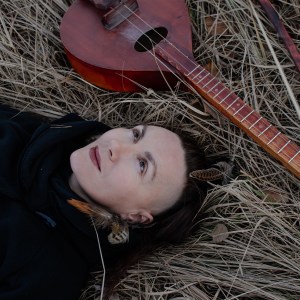 In “Заквітчали,” you reinterpret a riflemen’s song written over a century ago. What does working with such historically charged material mean to you today, especially when the themes of sacrifice and resistance are no longer distant history?
This song is one of several Ukrainian riflemen’s songs, which we perform live. It is too close to me. When I only started to work with that material, I was struggling to focus on music cause the lyrics were painful. It seemed like we were on the same stage energetically, doing the same mistakes, but not as huge as in the last century. Hope we as a nation have a chance to close these fate questions.
Several tracks — “Hey, Look Around,” “Origins” — seem to focus less on fear and more on attention, connection, and inner strength during moments of danger. Do you see your music as a form of grounding or orientation in chaotic times?
The gods bless those who have found their inner strength, who have managed to calm themselves and focus. And I believe this is on the people’s side. If they see it, I am happy. If they don’t, that is also fine. Everything has its timing.
Across your releases, movement appears again and again — roads, rivers, paths, counter-offensives, cycles of the sun. Do you think of Pororoka as a project about survival, transformation, or something else entirely?
Maybe this is because of my feelings – what is life itself. To Move. And I return again and again to the symbolism of movement.
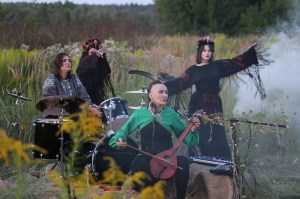 Are there any Ukrainian albums or tracks released since 2022 that have captured the war experience in a meaningful way for you?
I love this song so much – Шибеник – “Shibenyk” . To give you a bit of context, Hartsyzy refers to an old, not widely used word meaning robber or burglar while Shibenyk indicates a person who was put to death by hanging on the gallows, or by any structure used as a gallows. These are some of the lyrics:
“The gallows was swinging merrily on the pine tree… and it was spring… birds flew from the nest… only the hartsyz was unlucky on that day…
He got up in the morning, fed the horse, loaded the pistol… little did he know that on that day his hartsyz soul would go to hell…”
This song is rather popular among a certain group of Ukrainian soldiers who have dedicated their lives to the fight. They remain in the army for a long time and have very little connection to peaceful life, which feels distant from the frontline. It speaks to a full acceptance of fate, even as the rest of the world continues as if nothing is happening. It is such a vivid image of how the strongest of us feel – absolute acceptance of your way despite anything.
What does it mean for you to be Ukrainian?
It is like a Pororoka wave. We are standing on the edge of a confrontation between two opposing forces, with all its consequences.
Which book / film / album / song / traditional dish / podcast / blog / artwork / building / meme best captures Ukraine for you?
Maybe what I’m saying sounds very simple, but for me our national emblem captures the essence of Ukraine best. If you visit St. Sophia of Kyiv Cathedral, look at its walls and then at the emblem — you’ll understand it.
APRIL 5, 2026 – WARSAW
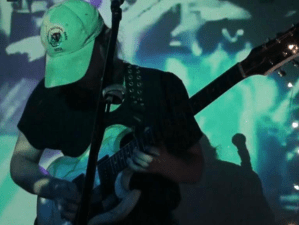 Plaaaato
Hi, my name is Kostiantyn Sakhin, and my project Plaaaato has existed for 6 years. During this time, I have released 5 albums. In my hometown, Zaporizhzhia, I started making music and searching for opportunities to develop. From the very beginning, it was a personal project — I sang about my feelings, searched for new sonic and lyrical solutions, participated in different projects, and had a few friends who played concerts with me.
Has the full-scale invasion reshaped the way you think about music—both in terms of what it can express and the conditions under which it is created?
It changed everything a lot. I changed the language and the direction of my movement. My music probably became more melancholic. Since that moment, my life has been quite chaotic. Now I am in emigration, and it is hard for me to feel okay. My music carries these emotional changes together with me.
You collaborate with Tymur Pylypets on bass and share vocals and lyrics with Sofiia Anna Hrushko. How does this dynamic shape your creative process—does it feel more like a central vision with contributions orbiting around it, or a more collective, evolving dialogue between you?
This is my personal project, where sometimes I involve other musicians. Across all albums, different people contributed to recording certain instruments, but ideologically and musically, it is my work and my decisions.
What can you share about the process behind your new album brightdeathstarr? In the liner notes, you describe it as “not a story about escape, nor about defeat,” but rather an attempt to find grounding at a moment when meaning dissolves and the future remains uncertain. Did working on the album feel cathartic, or was it something more unresolved?
This album was written during the period when I became a refugee. I lost my home and could not emotionally stay in Ukraine, but here I faced a different kind of misunderstanding. I feel like I don’t have a home and cannot yet imagine if I will find one. In this state, the album was born. I was deeply focused on mixing sounds and exploring identity, while strongly feeling that these difficulties were destroying it inside me. Unfortunately, this album led me to the decision that it will be the last for Plaaaato. I am tired and lost, and I want to find something new. This project has lasted a long time, and when I compare it to the first albums made before the full-scale invasion, I am now a completely different person. Everything in my life has changed, and sometimes this project limits me because of its past.
In “uyavy sobi,” the lyrics evoke a split sense of self—“two souls,” emotional emptiness, and a recurring return to pain. There’s a striking tension between intimacy and detachment. How do you translate such internal, almost existential states into sound, and what role does repetition—both lyrical and musical—play in conveying that emotional cycle?
“Uyavy sobi” is a song about the creative cycle — the circulation of feelings. When we give a colorful creative burst to the universe, we are fully inside something beautiful. I visualize it as multicolored particles in the air that move with us until the moment when we become grey and empty. The creator enters a crisis and searches for a new impulse to create again. This process is cyclical and constantly repeats. I inspire someone when they need it, and something inspires me when I need it. Musically, this can be heard as a transition from clean guitars into heavy, roaring textures — the moment when something inside starts pressing, and darkness takes over. Then electronic textures grow, guitars rise, vocal samples appear, and delays fill the space — this is how I show saturation, color, and inspiration. The final part is that same explosion where something new and beautiful is created.
In an interview with Neformat, you described Vse Zminylos as a reflection of the early days of the war—constant movement, separation from loved ones, and loss. You also mentioned using distortion, modulation, and lo-fi textures to express that instability. What is it about lo-fi sound that allows it to carry or communicate those kinds of lived experiences?
For me, lo-fi is a musical decision to make the sound naively simple in order to transmit personality and closeness to the artist. At the same time, it originally happened accidentally due to the lack of proper recording conditions. Now I use less lo-fi — I found new ways to express my feelings musically without relying on typical lo-fi elements.
How would you describe the music scene in Zaporizhzhia, and to what extent did you feel part of a local community there?
Before the full-scale invasion, from 2020 to 2022, I felt a strong connection to the local scene. Together with the band povod, we were almost the only ones making indie and alternative concerts in the city. We personally knew most of our listeners, and it felt very intimate. After 2023, I no longer live there because I lost my home, so now I don’t know what to feel about that place. My emotions are confused. In the first year of the war, right in front of my eyes, that city felt destroyed, and I experienced too much negativity.
Have there been any Ukrainian releases in recent years that have helped you process or better understand the present moment?
This is a difficult question. I don’t know. Probably not. I listened to a lot of music, but for some reason, nothing really resonates with me now. I don’t know why. But I can name some bands I like musically: last past., pencil legs, rippedd, eustoma.
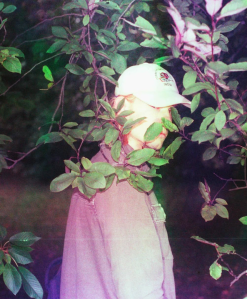 How do you think about your identity as Ukrainian artists today? Is it something that directly shapes your work, or does it operate more subtly?
I feel this very strongly. When I moved abroad, I realized how much I can tell the world and how much I have experienced. I never limit myself creatively and prefer working alone. I also have a side project with 3 albums already, and I am making two films about my life — about losing identity and trying to hold onto it. But it makes me sad that I cannot go back to Ukraine and present something there. I also have some organizational problems here, but I hope this will change, and I will be able to share my ideas with people more easily.
Finally, if you were to point someone toward a few cultural references—whether music, film, food, places, or even a meme—that capture something essential about Ukraine right now, what would you choose?
I would show the indie community of 2020–2022 — it was something special. Especially events like electricity — very intimate and meaningful for those who experienced them. I would also show the nature of Zaporizhzhia — endless fields and a very calm atmosphere. I would talk about how poets described these lands and about hundreds of years of struggle for independence and culture.
APRIL 5, 2026 – KYIV
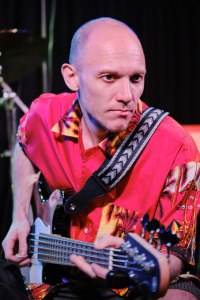
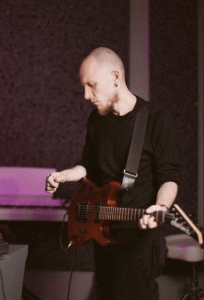
My name is Ihor. I am from the Luhansk region, which is located in the eastern part of Ukraine. Now it is occupied territory by russia. I listened to and enjoyed music from early childhood. It was soviet and russian rock and pop music that was in my father’s collection of vinyls and audio tapes, but when I celebrated my 10th birthday, my parents gifted me an audio tape player, and I started to create my personal collection and listen to music everywhere.
When I was 12, I went to the music school and for 2 years learned the guitar, but after that, my parents bought me a computer, and I stopped learning guitar. While the guitar was collecting dust, I was learning how to use a PC and collecting music in digital format. A year later, I opened the world of sound recording and music creation with a PC, cleared the dust from my guitar, and started to make the first recordings with my friends.
Looking back at your earlier work, how has your artistic approach evolved over time, and what initially drew you toward more experimental or noise-based forms?
Actually, it was a really long trip to the noise-based because I tried to work in different genres. At the beginning, I preferred different rock and metal genres and played in a punk band. Later, I discovered some electronic music for myself. Also, there were some periods when I listened to hip-hop. And maybe in 2015 or 2016, I visited my first rave party and started to discover the world of dance music. My favorite genres were witch-house and techno, and I even produced 2 albums in these genres. And it wasn’t canonical techno and witch-house, I tried to make them a bit experimental. Actually, I tried to add some experimentation to the music that I made before, but it was not so cool and was not released.
With the discovery of dance music, I was accumulating money and bought my first groove box and drum machine. I’ve started playing live improvisations, and they were related to the dance music, but sometimes they became more experimental and not so danceable. And in one day, I’ve totally tired of the dance music and started to play more slow music with less beats. In general, my music is continuously changing depending on my setup, the music that I listen to, the events that happen in my life, and now I am here)
Has the full-scale invasion changed the way you think about music, sound, or even listening itself? Has it also affected your setup, tools, or the way you produce music on a practical level?
As I said before, my relationship with music is changing continuously, but only one thing: clearing the playlist from most of the russian artists and more discovering of the Ukrainian scene. If we talk about setup, yes, it affected. Big synthesizers are not so convenient for relocations, and now I definitely know that my main setup has to fit in my backpack. Talking about other aspects of the setup, tools, and the way of production, full-scale invasion has no influence.
Your latest release LB-RN-TH feels very deliberate in its structure and texture—can you walk us through the production process? How did the material come together?
It was the 2 weeks of vacation at the beginning of December. Finally, I had enough free time for a precise production process, and I decided to visit the studio every day and work on the album. Previously, I was just thinking about the concept, setup, and approach. In the studio, I was playing and recording, trying to find interesting sounds and trying to make a sound and a mood that I imagined for each track. I recorded all tracks during these 2 weeks, but after that, I returned to work, and the time for the album has shortened dramatically, and the process of finalization took more than 2 months.
Some tracks reference Ensemble 24’s Songs of Coal and Steel, which focuses on the industrial heritage of eastern Ukraine. What drew you to that project, and how important was it for you to engage with those specific regions and histories in your own work?
Regarding the Ensemble 24, I had 2 cases of interaction with this project, if it is the correct word for their collective of academic musicians. First is our collaboration, when we (ADSR community) play with them at some event. For me, it was a great experience, and I met a professional musician who makes music that I like, and I plays in my own way with my instruments, but they make their music with classical instruments like violin, cello, and different wind instruments.
Regarding the Songs of Coal and Steel, it was the concert that happened during the period of the recording of the album. This sound is close to me, this topic is close to me because my childhood was spent in a small town where there was a big steel factory and a coal mine. I would say it’s the town of the miner and metallurgist. I could not skip this concert, and I was so inspired by this event that I decided to dedicate a couple of tracks to Ensemble24’s Songs of Coal and Steel. All this experience was important for me, and I wanted to reflect it in my tracks. One thing that I want to add, maybe it is also related to the previous question, is that during the concert, I recorded a couple of samples and used them for the “Steel song” and “Coal song” tracks in combination with my synthesizers.
There’s a strong sense of narrative or coded meaning in tracks like Davno Xlam. What can you tell us about the lyrics and the ideas behind them?
This track is also a reference. It is related to the song of the Luhansk band with the name “Хламіда”. Songs of this band have russian lyrics, and I listened to one of them many times. It has a lot of senses. I thought about translating the whole text of this song into the Ukrainian language, but I thought in this case it would be a cover version, and I felt that it would be enough for this song. It is difficult to describe the meaning because it is about feelings.
In the liner notes, you mention communities like noise (ob)sessions, ADSR, and RVSTG. How important is this sense of community to your practice? And more broadly, how have you seen the experimental music community respond to the full-scale invasion?
It is hard for me to say something about the reaction of the experimental music community to a full-scale invasion. Understandably, no one in this community likes it, but when a full-scale invasion started, I lived in Kharkiv, and I was a part of the community that related to dance music. For me, this moment was something of an entrance to the experimental and noise community. Talking about communities in general, it was important to have people with the same interests, goals, and views.
The noise (ob)sessions is community that is totally oriented toward noise and experimental sound, created as a result of a course about noise music and an introduction to the module synthesis. ADSR is a jam community where live musicians can exchange their knowledge and experience between each other and just play music together, and we try to gather everyone in our studio every 2 weeks. As RVSTG we tried to develop rave culture in Kharkiv and show our view of the rave. Now part of this community in Kyiv and part in Kharkiv, but now it is something like a “post-rave party”. Those are small events for our friends where we mix dance, jazz, and experimental music.
Ukraine has a particularly active scene for noise and experimental music. Why do you think these more challenging or abstract forms resonate so strongly right now?
As for me, the answer is pretty easy: challenging times make challenging forms resonate.
Have there been any Ukrainian releases over the past four years that have helped you process or make sense of the current situation?
I think it is not possible. The current situation makes no sense, and there are a lot of senses at the same time. And there are no releases that can help here.
 How do you personally define or understand your identity as a Ukrainian artist today?
I live in Ukraine and share my impression of living here through the music or other art forms. Art is a reflection of our being and our context. You can be from another country and use another language, but make your art through the Ukrainian context, and you will be a Ukrainian artist, in my opinion.
If you had to point someone toward a few cultural references—whether a book, film, album, song, dish, artwork, or even a meme—that capture something essential about Ukraine, what would you choose and why?
The last question is the most difficult. I think the Ukrainian culture is so multifaceted, and it is hard to choose a few artworks or even memes. Easy to choose a dish… It is a borsch, but it is not the only one Ukrainian traditional dish that can show how different and interesting Ukraine can be.
APRIL 5, 2026 – POLTAVA
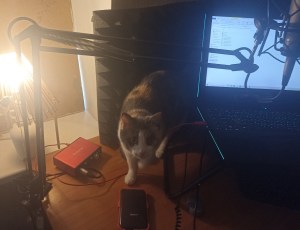
My name is Illia. One of my earliest encounters with music was through songs at religious gatherings, where everyone would sing and I would join in. I also had a very musical brother, who became my first guitar teacher during my teenage years. At that time, drawing was my main form of self-expression, and it eventually became the foundation of my profession. Over time, however, music became a more intuitive and accessible way for me to express myself. The first real impulse to write something complete and personal came in my early twenties.
Has the full-scale invasion changed the way you think about music—both in terms of what it can express and how it is created?
Speaking from my own experience, the war was something completely unexpected. It brought with it a range of new emotions and reflections, which naturally became a strong foundation for creativity. At the same time, creating music has become more difficult. There are many more factors now that drain your internal resources—especially when there weren’t many to begin with. Creativity can be both a form of release and a kind of work that requires time and energy.
There is also a constant sense of uncertainty about what will happen tomorrow. It makes you want either to leave something behind or at least feel that your ideas won’t disappear with you—that they’ll find a way to exist beyond you.
More broadly, it’s been interesting to observe how music manifests during wartime. We’ve grown up with war songs—whether from World War II, older Cossack traditions, or later reinterpretations. These were often instrumental or carried a certain solemn beauty. Today, however, there is a wide range of genres. Hearing contemporary rap about war, or even a pop song playing in a supermarket—with a steady beat but lyrics not about love or parties, but about Ukraine defeating its enemies—feels striking. It’s eclectic, almost surreal.
What can you tell us about the process behind your album Дорога належної форми [Doroga nalezhnoi formy (The Path of Proper Form)]?
The release came together over years of slow work, with long pauses in between. There’s actually a lot more material, but these five tracks were the ones that could be unified by a shared theme and language, forming a concise release.
Your lyrics often explore questions of identity and perspective—lines like “Am I the victim or the one who tortures?” suggest a kind of internal uncertainty. How do you approach writing about these shifting roles?
The initial idea for the song came from the notion of faint-heartedness. It’s often translated as cowardice, but it can also mean indecision—the inability to choose a side, or the attempt to remain in between. That was only a starting point. The theme of opposing forces, both external and internal, is much broader. I intentionally avoided making the meaning too explicit, because that would turn the song into a kind of sermon. I’d rather it function as a spoken reflection. To me, that feels more honest and appropriate. I also don’t want to limit how listeners might interpret it.
You mentioned that religion has been part of your life since childhood, yet you’ve also reflected on its paradoxes. How has this experience shaped your music and the themes you return to?
This theme directly influenced the release. When something is rooted in faith, it opens up a vast space for contradictions, interpretations, and paradoxes. People often speak about “truth” as something absolute, yet it’s impossible to prove it definitively to someone else. I’m also fascinated by the human ability to justify or explain almost anything when needed. For me, this becomes fertile ground for reflection and creativity. When there are no clear answers, you begin to find beauty in the questions themselves—in the contradictions and paradoxes. In many ways, the release emerged from that space.
Of course, religion is not the only thing I think about, but it felt impossible not to respond to it at all. So I created a small project where these themes could exist naturally, in a genre that feels close to me.
In the track “Rizdvo” (Christmas), you use religious imagery in a very intense and symbolic way. What inspired you to explore these rituals and collective experiences?
I was inspired by the history of Christmas, which today blends Christian and pagan traditions. Even Christian rituals often feel very close in atmosphere and structure to pagan ones. I was also drawn to the power of the crowd—the way an idea can spread like a virus and lead to something resembling collective hysteria.
In tracks like “Son” (Dream) and “Myla,” there’s a strong atmosphere where intimacy and unease seem to coexist. How do you approach creating that kind of emotional balance?
I’m glad you noticed that balance. I didn’t use any deliberate techniques to achieve it, but I think it comes through in the lyrics and the timbre. There’s a kind of “dark presence” that speaks, but not in a purely threatening way—it almost expresses care or tenderness. It feels bound by certain rules that force it to act, yet at the same time it derives some kind of pleasure from it.
If darkness stays with you long enough, you get used to it. It stops feeling frightening and becomes part of your life—something familiar, even comforting. And perhaps if it were only frightening, it wouldn’t be as effective.
In “Spokusa” (Temptation), there’s a sense of an internal dialogue—almost like a conversation with yourself. Is writing music a way for you to process personal questions or inner dilemmas?
As I mentioned earlier, I want the songs to feel like spoken reflections. Often, the first step toward answering a question is simply to articulate it. Thoughts are chaotic, and putting them into words helps to organize them and eventually reach some kind of understanding. A song might begin with a single sentence, but expanding it can reveal new layers and nuances.
You’ve described the present moment as uncertain and fragile. In this context, what role does music play for you now—personally or creatively?
I might repeat myself here, but I don’t see music as a way to change the world. I just try to do what I enjoy while I still can. And if it resonates with someone, that’s enough. It’s comforting to feel that there are people out there who share something with you, especially in times like these.
 Have there been any Ukrainian releases in recent years that have helped you process or better understand the present moment?
I can’t think of a specific song that fundamentally changed how I think. War, unfortunately, is not new to humanity, and many powerful songs about it were written long before I was born—not only Ukrainian ones. When it comes to contemporary releases, they often reinforce a sense that we are still caught in cycles, far from resolving our problems. Of course, that’s just my impression.
Society feels very polarized right now, but in art there is still a kind of censorship—partly official, partly informal. I think that after the war, art may become more honest, bold, and direct—perhaps closer to society itself.
It’s also interesting that artists today seem to have distinct pre-war, wartime, and hopefully post-war periods. I imagine this will be something worth studying in the future.
How do you think about your identity as a Ukrainian artist today? Is it something that directly shapes your work, or does it operate more indirectly?
Being born in Ukraine has had a profound influence on both my personality and my work. For this release, Ukrainian folk music was one of the key references. So yes, the influence of my environment is very direct.
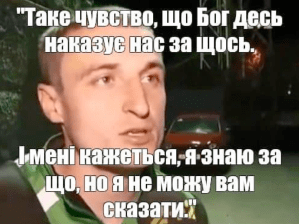
It feels like God is punishing us for something somewhere.
And I think I know what it is, but I can’t tell you.
Finally, if you were to recommend a few cultural references—music, films, food, places, or even a meme—that capture something essential about Ukraine today, what would you choose?
In terms of films, I’d mention road movies that capture everyday Ukrainian life and culture, such as My Thoughts Are Silent, Easy – Un viaggio facile facile, and Everything Is Illuminated. There are also films that provide historical context—about the Holodomor, like Mr. Jones or Holod 33, or about the dissident movement, like Forbidden (about Vasyl Stus), as well as films about the Cossacks.
This is all part of our past, but it’s also something we learn in school and hear about from our families. Some of these events are recent enough that people can still tell their stories firsthand. This forms the context in which our consciousness develops—and it’s something that still carries pain. Unfortunately, that context has continued into the present. There are already films about current events, though I haven’t seen any yet.
As for food: borshch—best tried in different places, since every version is different—then varenyky (preferably steamed), halushky, and okroshka.
As for memes, I would choose this [see image].
APRIL 6, 2026 – LVIV
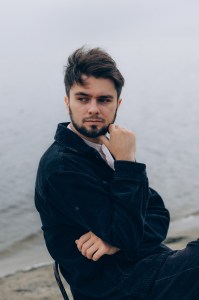
Photo by Maria Hladka
My musical path began in Dnipro, where I studied mandolin. Playing the instrument also introduced me to a tactile understanding of music. The instrument’s articulation is similar to violin so I studied a lot of virtuosic repertoire. But gradually, composition became a way to expand this curiosity.
Writing music allowed me to explore sonic phenomena beyond the limitations of a single instrument and to investigate how different timbres interact and transform each other.
Conservatoire education shaped these but the interaction with the performers gave a real understanding of how the orchestra and chamber music works.
Your work is often described as a search for new forms and techniques. How would you describe your compositional language today, and what kinds of questions tend to guide your writing?
I think of my compositional language less as a fixed style, as I’m still quite young (28 y.o.). I am particularly interested in situations where musical material appears unstable or transitional. Rather than presenting clearly defined gestures, I often work with complicated dramaturgy strategies, also prefer gradual transformations, fragile textures, and subtle shifts in density. Experimentation, for me, is not an end in itself but a method of discovering relationships between elements that might otherwise remain hidden. I often explore extended techniques or unconventional instrumental combinations because they open access to sonic territories that might be interesting to the listener.
Solum emerged from a collaboration with Hlib Sasko and Maksym Shadko. How did this dialogue with specific performers shape the piece, both conceptually and sonically?
The collaboration with Hlib Sasko and Maksym Shadko was fundamental to the development of Solum. From the early stages, the piece was conceived not as an abstract instrumentation but as a dialogue with particular musicians, their artistic sensibilities. Also, the composition became possible due to the grant of Jam Factory Art Center and help of the partner institutions that made the performances possible in Lviv (Contrasts International Contemporary Music Festival), Kyiv Music Fest and Vere Music Hub (Kyiv).
The piece seems to unfold across distinct yet fluid stages, moving between fragility and more rhythmically charged passages. How conscious are you of form as a narrative or dramaturgical arc when writing?
When composing a piece, I proceed from my personal sense of form and try to write in a way that responds to an inner necessity. It is what it is, and the only thing I can do is to yield to it, while at the same time trying to discover something new for myself.
Before beginning a new work, I do not choose from among known dramaturgical models or conceive of form as a predetermined arc. Rather, I follow the path that, at a given moment, creates in me the feeling that this is how it should be. Only retrospectively can it appear as a certain dramaturgy or narrative, but in the process it is not a matter of rational construction.
You often work closely with performers, especially when using extended techniques. What does that collaborative process give you that you might not find working purely on the page?
In my case, it is still a fixed authorial process. It is simply normal to consult with performers.
They were the initiators of the piece, and this interaction emerged naturally. It provides a more precise understanding of what actually works, how it sounds, and how it feels for the performer. It helps to avoid decisions that may appear convincing on paper but do not function in reality.
There’s a strong sense of trust in the way Solum was developed—with performers contributing to technical adjustments. Do you see composition as a shared process rather than a fixed authorial act?
There are compositional techniques that partially transfer responsibility to the performer, but I did not use them here. The decisions remained mine, even if they emerged through dialogue.
Since 2022, many artists have spoken about a shift in urgency or responsibility. Has the full-scale invasion affected how you think about writing music, or what music can do?
In 2022 I was still a student, completing my master’s degree. Now, of course, I am responsible not only for myself. But when writing music, this does not affect me. The process itself remains the same.
You’ve received both Ukrainian and international commissions in recent years. How would you describe the current ecosystem for composers in Ukraine—what works, and what still feels fragile or missing?
Internally, the system is weak. Some segments function to some extent, but overall it is not systemic. There is a lack of stable infrastructure, regular commissions, and institutional support. Much depends on individual initiatives, and therefore the situation appears fragile.
There’s a sense in your comments that support for Ukrainian artists surged and is now receding. How has that shift affected your outlook as a composer working internationally?
It is a natural process: the shock of the war, empathy, noble intentions — but they gradually fade.
Still, it was positive: many received a significant career boost, new contacts, and development opportunities. The first projects were connected to the fact that I am from Ukraine, rather than simply that I am myself.
Now it is important that more Ukrainian state and private partnership initiatives are becoming involved, and this network — which was previously inaccessible — is expanding.
Your music has been performed at major festivals across Europe and beyond. How do you perceive the position of Ukrainian contemporary music within the broader international scene today?
Unfortunately, it remains on the periphery. When Ukrainian music is performed, it is primarily classical repertoire. And even within the classical sphere, it is often presented alongside Russian music. In other cases, it is placed in a kind of reservation.
Of course, it is heard more often now, but this is not connected to a natural artistic process — rather, it is a consequence of the war. At the same time, this creates an opportunity for artists.

photo by Maria Hladka
Some performers mention that younger musicians in Ukraine are still relatively disconnected from contemporary repertoire. Do you see this changing, and what might help bridge that gap?
Overall, this is indeed true, although I studied in Kyiv, and this gap in general knowledge did not feel so pronounced there.
The problem is that the educational system does not encourage young performers to engage with contemporary music. And once they graduate, the economic situation itself often does not allow for it, as concert institutions still tend to see contemporary music as peripheral to their repertoire and as a significant risk.
There is Volodymyr Runchak’s ensemble based at the Kyiv Conservatory, Ensemble 24, Petrichor Ensemble, Margines Ensemble, as well as the duo of saxophonist Roman Fotuyma and pianist Daria Shutko, who both perform and commission new works.
There is no magic spell to overcome this situation. Many factors are involved.
Looking ahead, what kinds of projects or ideas are you most interested in exploring next—whether in terms of sound, form, or collaboration?
I just want composition to stay as my profession.
APRIL 7, 2026 – BARCELONA
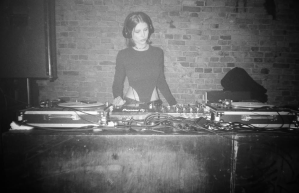
My name is Oleksandra Kalyuzhna, performing as NIZHNA. I’m originally from Nizhyn, a small city in the Chernihiv region of Ukraine, and I spent many years in Kyiv. Currently, I’m based in Barcelona.
I’ve been fully involved in music for around three years. I started with DJ education in Kyiv with DJ JANE, and later continued shaping my artistic direction through Module Exchange, which I completed in 2024.
Since then, I’ve been developing both as a DJ and producer, working closely with sound producer Bohdan Zaiets. I’ve performed across Kyiv venues such as K41, ABO, Opik, Brukxt, Community Café, Otel, Keller and others, as well as on 20ft Radio (Kyiv) and Radio Béguin (France).
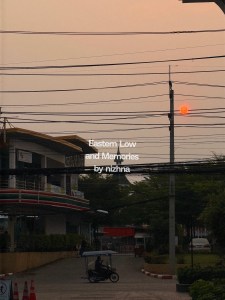
I’m currently part of Iriy Records, where I released my debut album Eastern Low End Memories.
Has the full-scale invasion changed the way you think about music—both in terms of what it can express and how it’s made?
Yes. After the full-scale invasion, music shifted for me from aesthetics to presence. It became a way to hold and process unstable or conflicting states. Less control, more honesty.
Your debut album on Iriy Records Eastern Low End Memories is built around field recordings from your travels across Southeast Asia. What drew you to documenting sound in this way, and at what point did you realize these recordings could form the backbone of a full-length record?
I recorded sound as a form of memory. Not with the intention of making an album, but as a way of holding onto moments — environments, voices, fragments of situations. Over time, these recordings began to relate to each other. At that point, it no longer felt like an archive, but a structure.
In the liner notes, you mention that “each track contains symbolic samples…closely tied to the place.” How do you decide when a field recording becomes “symbolic” rather than just atmospheric?
A recording becomes symbolic when it stops functioning as background and begins to influence the composition — its direction, tension, or rhythm.
At that point, it is no longer about a place, but about a state — something that can be transmitted through sound as a trace of a moment.
“Cash Machine” evokes a very specific, almost mundane environment—a small shop—through sound. What interests you about translating such everyday spaces into immersive club-oriented tracks?
I’m interested in how ordinary spaces shift through listening. Small, everyday environments — a shop, a machine, a voice — when isolated, begin to feel unfamiliar, almost unreal. For me, the club is not separate from reality, but a displaced version of it.
“Wind Ritual” blends the Chao Phraya river ambience with processed chants and new age elements. How do you approach balancing spiritual or meditative source material with heavier, contemporary bass structures?
I don’t separate these layers — they coexist. Ambient elements create a sense of space, while bass adds physical presence and depth. In this combination, the track becomes more like a narrative. It creates a state that is neither fully internal nor fully external.
On “Temple Ceremony”, you describe a “gonzo-like form” reflecting internal turbulence. Could you talk more about that emotional state and how it shaped the composition?
“Temple Ceremony” emerged from a sense of internal instability. There was noise, fragmentation, and a lack of clarity. The composition doesn’t try to resolve it — it stays within it. The structure shifts, feels unstable, partially uncontrolled.
“Close Your Eyes” revolves around a mantra and incantatory repetition. What role does voice—or the suggestion of voice—play in your work, especially in creating hypnotic dancefloor moments?
Voice plays a central role for me. It connects to a memory — hearing Thai language translated into English somewhere in Southeast Asia, mixed with the sound of water and insects. That moment felt meditative. Through repetition, voice shifts from language into rhythm. This is how I merge meditative and electronic elements into something slightly dissonant, but immersive.
“Neon Pagoda” stands out as a projected, imagined space rather than a documented one. Why was it important to include a track based on memory or fantasy rather than direct experience?
Memory is not less real than physical experience — sometimes even more intense.
“Neon Pagoda” is about a place that doesn’t exist, but feels familiar.
It was important to include it because the album is not only about geography, but about perception.
Prior to Eastern Low End Memories, your album Eye Under explored Arabic sonic textures on tracks like “Technomantra.” What draws you toward engaging with musical languages from different cultural contexts, and how do you translate those influences into something that still functions within the physical, kinetic space of the dancefloor?
Different cultural sound languages carry different emotional codes. I don’t try to replicate them — I translate them into my own system. The dancefloor remains a physical space, so even abstract elements need to work through the body.
Is life a circus and are we all clowns?
Sometimes. But not necessarily in a negative way. There is a certain honesty in how people perform.
 Have there been any Ukrainian releases in recent years that helped you process or understand the present moment?
Yes. Many Ukrainian artists are working with direct, raw forms of expression — through noise, field recordings, and voice. Artists like e03 and Pep Gaffe, as well as Borys Stepanenko’s track “Askaniia,” resonate with me. It’s less about genre, more about necessity.
How do you personally think about your identity as a Ukrainian artist today? Is it something that informs your work directly, or more indirectly?
My identity is not fixed — it shifts with what inspires me.
I’ve never felt that creativity should follow rules. For me, it’s a space of freedom — a way to express thoughts and sensitivities without adapting them to expectations.
I’m influenced by my environment, by information, by details — small things that can be noticed, combined, and transformed into sound.
Finally, if you had to point someone toward a few cultural references—music, film, food, places, or even a meme—that capture something essential about Ukraine right now, what would you choose?
- Music — the current Ukrainian experimental and electronic scene, especially artists working with texture, noise, and emotional rawness.
- Film — slow, heavy, observational cinema. Something that doesn’t explain, but allows you to stay inside a feeling.
- Places — Kyiv, particularly its underground spaces. There is a specific tension there right now — a mix of fragility and strength that you can physically feel.
- Food — something simple and homemade. Not performative, just real.
- And maybe a meme that feels slightly absurd but also too accurate — that balance between irony and reality says a lot about how people cope.
APRIL 8, 2026 – CHERNIHIV
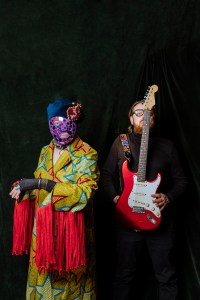
photo by Polina Polikarpova
My name is Dmytro Kurovskiy and I’m from the northern Ukrainian city of Chernihiv. I am a musician, artist, and the leader of the project Foa Hoka, and I also play the flute in the academic theater orchestra.
My interest in music began when I was a child. My mom is a teacher of folklore and music literature; she played the piano and took me to concerts at the philharmonic. But in reality, I was drawn to rock and pop music. So I’d listen to banned Western radio stations in the kitchen, enjoy the rhythms (through the static of the jammers), and draw imaginary rock idols with markers. The atmosphere in Chernihiv in the early ’80s was stiflingly Soviet, and cheap criminal trash reigned supreme. So I was lucky to go study at a specialized music school in the large industrial city of Kharkiv, where life was bustling and there were plenty of concerts and artistic events. And most importantly, I met interesting people, musicians, and teachers in Kharkiv.
There was more information and conversation—about music, movies, literature, and the visual arts. I returned to Chernihiv for the holidays feeling happy. In early 1991, together with guitarist Vladyslav Dikhtiarenko, in my mother’s one-room apartment, we recorded 10 compositions on a Soviet reel-to-reel tape recorder, created on a homemade drum kit. I sang and played these “drums,” while Vladyslav Dikhtiarenko accompanied me on a Musima de Luxe electric guitar (made in the GDR) and a crazy set of Soviet sound effects. That’s how, in 1991, the first album, “Chihuahua,” was created, featuring a rather harsh industrial sound and Ukrainian-language lyrics. We named the new band after a plant discovered in the Polynesian jungle by the explorer Thor Heyerdahl. Foa Hoka was meant to signify the exoticism of the newly formed band in its sound and stylistic explorations.
Foa Hoka emerged from the “Novaya Scena” context and early post-industrial/neo-folk experimentation. Looking back, how would you describe your sound in those formative years, and what were you trying to express?
In the late 1980s and early 1990s, I studied at the Kharkiv Institute of Arts and was also a member of the punk bands Gnyda, Chichka-Drichka and Amoebas. Basically, all musicians in this bands were my classmates. We were very young and curious. We were having fun listening everything from Stravinsky to Cannibal Corps and Dead Kennedys. Someday in 1989 via Evgen Hodosh (in those times he was member of the band Tovarishch) we met Sergiy from Nova Scena, something clicked and all our gang joined this art initiative. It can be said that the band Foa Hoka emerged from fertile ground, consisting of numerous artistic events and intellectual discoveries.
In 1991 Soviet Union finally fell apart and with that came colossal economic crisis and very hard times for everybody in Kharkiv city, which was affected by this downfall within a year in a truly apocalyptic manner. No money, no food, no heating in winter and a lot of violence on the streets. That’s when album “Music without a Master” was born. Those days Sergiy Myasoedov (of Nova Scena) bombarded us with music of Swans, Einsturzende Neubauten and Birthday Party from one side. From the other side out of nowhere appeared very strange boy from USA under the name Matthew (he decided that Kharkiv is a perfect place in 1992 to spend college holidays – very unusual decision for any human being in those times!) with his perfect collection of PTV, Throbbing Gristle and Coil albums in CD-format. All this combined just blew our mind and for sure influenced “Music without a Master”. So, if you are asking what we were trying to express by this music – the answer is – denial, anger and hope. We were learning to be soulmates the hard way.
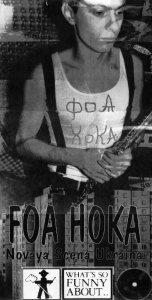
Foa Hoka poster from 1996 by Mathias Go-Go Gordon
In 1994 you released Live in Berlin. Would you say it captures your live energy at the time? And how was your music, and Ukrainian music in general, received in Berlin and other European scenes in the 90s?
Yes, there is a recording of Foa Hoka live at Die Zone club in Berlin. This performance radiates the energy of joyful moments and raw instincts in times of global changes. It felt as though we were heading toward an unknown destiny. In 1994 and 1996, Foa Hoka toured Poland and Germany, and tours were organized by Nova Scena and Polish Koka Records (with the help of Alfred Hilsberg’s WSFA records and Potsdam art centre Fabrik e.v.). The impressions of that era and atmosphere remained and influenced our entire lives. After all, we managed to see a completely different lifestyle, get acquainted with the subculture of those times, and meet uninhibited people and artists. It was like waking up from a deep slumber. And I fell in love with techno!
Berlin remains my favorite city to this day. It’s nice that Foa Hoka has performed in Berlin on multiple occasions throughout our history. Overall, our mid-90s concerts were received quite warmly and enthusiastically in Europe. But in Poland we encountered hostile stares, clashes and aggressive individuals. Once, on stage at a club in Lublin, I brought a baseball bat just in case… We were lucky; the skinheads didn’t show up at the concert that evening.
Around releases like Acid Rock (1995), your sound shifted toward something more electronic and groove-based. Did that feel like a natural evolution, or a conscious break from earlier experimentation?
This year marks the 30th anniversary of my homemade Midi Free studio. It’s a fantastic feeling when an audio-visual experiment (spanning half a lifetime) becomes an expedition into the world of electronic disco. In the early ’90s, a Kamosonic F3A children’s synthesizer appeared in Foa Hoka’s arsenal; my old friend Illya Buchelnikov had bought it while serving in the Soviet Army in Berlin.
There were very few electronic instruments back then, and the Kamosonic was somewhat programmable. So this instrument was pivotal to Foa Hoka’s sound for about 10 years. The jagged beat of this children’s synthesizer was processed through Soviet effects units and painted amazing textures… with a toxic dance spark. The point was to awaken desire. Right now, this Process at Midi Free Studio has picked up crazy momentum, and that’s wonderful.
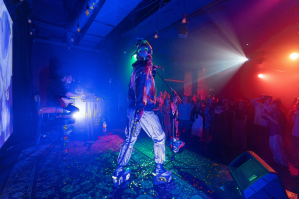
live at Nyzhniy Zal, Lviv 2023 – photo by Petro Chekal
Foa Hoka has always been a performative project—masks, projections, multimedia collaborations. What does the live context allow you to do that the studio doesn’t, and vice versa?
I’ve been collaborating with Kyiv-based fashion designer Natalka Yakovenko for nearly 10 years now. We’ve finally managed to bring some extraordinary ideas to life for Foa Hoka’s concert shows lately. A cosmic opera – Vivid images, characters, and figures: the God of War, the Termite Man, Mickey Mouse the Camel, the Still Life Man, the Illusion Seller, the One-Eyed Pirate, the Cosmic Pimp, the Squid Man… Of course, all of this is a reaction to the manifestations of the new world of anti-humanism. And here is the answer. The main meaning and motif of the Foa Hoka stage production is the hope for the “possibility of happiness.”
You’ve worked closely with video artists like Sampled Pictures for many years. How important is the visual dimension to your music—do you think of Foa Hoka as a multimedia project from the outset?
In 2004, Foa Hoka participated in the Serious Pop Summit in Vienna. In addition to two concerts, an impromptu exhibition by artist Dmytro Kurovskiy took place at the Academy of Fine Arts. These were precisely those first gems of eclecticism—small sheets featuring rock idols drawn with markers, as well as a series of comics and collages. And this was one of my very first exhibitions, of which there would be more to come. The works were created at Midi Free studio: graphics, mixed media, painting, audiovisual installations, digital art, collage… I even came up with (jokingly) a name for my style: Trash & Soul. Of course, all the visual pieces and videos are deeply connected to music. Interestingly, right now, in April 2026, two of my exhibitions are taking place simultaneously in Chernihiv.
So the visual dimension is important for Foa Hoka’s music. In the late ’90s, I met Kyiv-based directors and music video makers Oleg Chorny and Gennadiy Khmaruk (Sampled Pictures). In my view, they are unrivaled masters and gods of freedom (in the creative process). I learned a lot from Oleg and Gena, and Sampled Pictures’ music videos and the experimental music film FON remain relevant to this day and are still screened at festivals and exhibitions.
Foa Hoka wasn’t a multimedia project from the very beginning. In fact, it wasn’t until the late ’90s that Ukrainian society became more open, and as technology advanced, more information became available about the state of global culture and art. The emergence of pirated VHS tapes played a significant role for Ukrainian society. Their influence on tastes and aesthetic views was palpable (I’m thinking of Zbigniew Rybczynski, Peter Greenaway, Norman McLaren, Shuji Terayama, Toshio Matsumoto…)
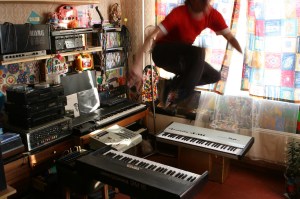
Midi Free studio 2007 photo by Illya Buchelnikov
Since 2002, Foa Hoka has functioned as an open project, with different collaborators joining over time. How do you maintain a sense of continuity or identity while still allowing the project to evolve?
It has been an indescribable joy for me to share the stage and create music with Evgen Hodosh from Kharkiv for many years. He is a true multi-instrumentalist: guitar, bass guitar, keyboards, and vocals. Lately, the transformative project Foa Hoka has been performing as a duo: Dmytro Kurovskiy and Evgen Hodosh. The professional arrangements are undoubtedly successful, as is Evgen’s instrumental style overall. He’s a true hitmaker!
For several years now, there has been a collaboration with wonderful musicians from Chernihiv—pianist Oleh Bohush, saxophonist Yuriy Tarasov, and trumpeter Oleksandr Movchan. The guys are soloists with a well-known military orchestra and last year participated in a major concert at London’s Royal Albert Hall.
To be honest, my life is a continuous creative process in which it’s important to maintain an energetic core, a sense of style, and a sense of humor. I spend a lot of time at Midi Free studio, jamming. This naturally involves systematic, painstaking work on mixes, lyrics, and sketches for Foa Hoka’s album covers. The help of my friends and collaborators is also important: American designer Terri Kenyon, director Victor Onyshchenko, sound engineer Andriy Moiseenko, member of the Chernihiv duo Flying Super Pension—Dima Silich, journalist Serhiy Myasoedov… Foa Hoka 35! And this experience is truly a unique treasure.
Your recent collaboration with Fedir Tkachov on More Light! brings together quite different sensibilities—his ambient approach and your more rhythmic, eclectic palette. How did that dialogue shape the album?
During our many sessions at Midi Free studio with Fedir Tkachov, it became clear that he is, without a doubt, a versatile and multifaceted musician who has a great feel for dance music, a unique approach to electronic instruments, a good ear, and a special sense of humor. Fedir is also a great sound engineer and always has a few improvisation ideas up his sleeve for the synthesizers. He also creates amazing grooves. Thanks to Fedir, almost everything has changed at Midi Free studio. From the implementation of MIDI (Musical Instrument Digital Interface) to the studio setup. Fedir helped me fulfill my long-held dream of becoming a mixmaster. As a technical expert, he continues to help solve complex issues with music equipment. Fedir Tkachov is a great teacher.
More Light! feels both energetic and reflective, with titles like “Objects of Critical Infrastructure” or “Impossible Happens Every Day” clearly tied to the present moment. How directly do you see the album as responding to recent events in Ukraine?
The collaboration between Chernihiv-based electronic musicians Dmytro Kurovskiy and Fedir Tkachov began in 2021 and culminated in the 2024 album More Light! by Foa Hoka & Fedir Tkachov. It is a rather eclectic and industrial work. A peculiar, distorted blend of electronic pop, dub, dirty disco, kosmische, and surreal easy listening (which isn’t actually easy).
Boundless sorrow laughs. Sins flow like blood. For over 10 years, Ukraine has been at war with the russian aggressor. Undoubtedly, the album’s atmosphere carries a sense of impending catastrophe and chaos. But overall, the release is filled with vibrant energy, groove, warm harmonies, and fresh sounds. For me, it’s an enchanting epic and a journey of psychological discovery. More Light!
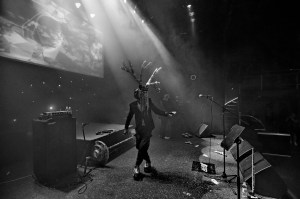
Foa Hoka live at Monteray Club, Kyiv, 2019 – photo by Oleksiy Zaika
How has the full-scale invasion changed your relationship with music? Has it altered how you listen, compose, or think about sound altogether?
Millions of Ukrainians face death every day. Constant air raid alerts, shelling, fear, confusion, stress, and an uncertain future… Prolonged blackouts, misinformation, and conflicting news feeds intensify the sense of chaos and take a toll on people’s health. The war has reached the level of a metaphysical clash where compromise is impossible, as it is a “war of annihilation” between opposing worldviews. In such an atmosphere, delicate matters—such as harmony, joy, a positive soundscape, favorite activities, and preferences—become like the light of a very distant star. This feeling warms the soul and becomes priceless. For me personally, music has taken on even greater meaning; it has become a part of my very being.
Foa Hoka has been active for over three decades. Looking back, what have been some of the key turning points—both creatively and personally?
It just so happened that at certain stages of life, I met interesting and talented individuals—musicians, artists. And usually, a new chapter in the history of Foa Hoka would begin. For example, after a twenty-year collaboration with directors Oleg Chorny and Gennadiy Khmaruk (Sampled Pictures), a long-term partnership began with Chernihiv-based artist and music video director Victor Onyshchenko, who continues to actively support Foa Hoka and always amazes with his boundless imagination and use of color. In the last four years alone, Victor has created about ten videoclips featuring Foa Hoka’s music. I am glad that among my fellow countrymen there are true artist friends who are open to contemporary artistic trends. This gives me hope that ancient Chernihiv will remain among Ukraine’s cultural cities.
Despite all the changes—technological, political, personal—the project remains active and evolving. What continues to drive you to create under the name Foa Hoka today?
I love this world for its surprises (every day), just like in the novels of Mario Vargas Llosa. I also love discovering new musicians, interesting artists, and filmmakers… every day! I follow the global music scene. As a professional musician, I have no hang-ups and am open to criticism from fellow virtuosos. I also continue to learn many skills and techniques related to modern technologies. Of course, I’m interested in Ukrainian poetry and literature (as well as world literature). Practicing at Midi Free Studio is very important to me and is, in general, a special mystery and miracle. So all that free, positive energy transforms into the cosmic sound system Foa Hoka. For me all this is unique radio show (inner radio). And then, a glimpse into eternity.
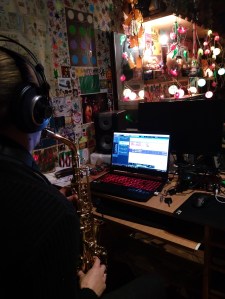
Photo by Yuriy Tarasov
Finally, what are you currently exploring—either musically or conceptually—and where do you see Foa Hoka heading next?
For me the Foa Hoka are consummate chameleons and argonauts of the cozmic seas of the 20th and 21st centuries.
Rhythms and grooves!—I love and explore this theme. I’ve spent half my life building a collection of 8-bit samples—on a trashed Ensoniq Mirage. I no longer have a collection of old Soviet synthesizers. Instead, I play enchanting synthesizers from various eras and brands.
I’m inspired by and appreciate: Andy Weatherall, Jimi Tenor, DAF, The Fall, King Tubby, Psychic TV, Suicide, Bruce Haack, Lee Perry, Air, Roe Deers, Gaslamp Killer, Coil…
My interest in music, world culture, and cutting-edge technologies has only grown over the years. A gift for originality and a producer’s instinct never let me down. The main thing is to stay sharp and bring my ideas to life. In the future, I envision Foa Hoka’s music as a powerful synthesis of modernity, beauty, and the grotesque. That is true emotion and a source of joy.
There is war and crisis in Ukraine, so promoting Foa Hoka’s musical ideas in the future will not be easy. And yet, we hope to continue introducing the global audience to new creative projects. We are always open to collaboration with interested producers.
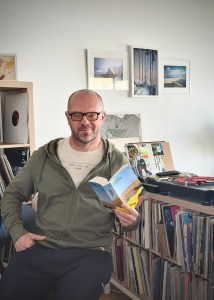
Vlad Fisun
To complete our feature on Foa Hoka, we also have an exclusive set prepared for us by Vlad Fisun.
These tracks by Foa Hoka are 2025 unreleased works produced by Dmytro Kurovskiy. The collection was recorded, mixed, and mastered at Midi Free Studio and HiGain Records in Chernihiv, Ukraine. Contributing Musicians: Oleh Bohush, Fedir Tkachov, Dima Silich, Yuriy Tarasov, Oleksandr Movchan, and Andriy Moiseenko.
TRACKLIST
History Grows Richer
White Geese, Black Goats
Ruins of Ancient Cities
Pythagorean Jokes
Happy to Be in Your Pride
Stars of the New World
Utopian Fairytale
Chimera
Ridiculously Charming
An Important Clue
Psychological Conclusions
Zeal
Dedication
Mixed by Vlad Fisun
Mastered by MacWise
NEW RELEASES
Low Communication ~ The End Of Music Industry
the true nature of the music industry.
a massive money-guzzling machine.
while others are left penniless.
Dada vs Evil ~ a little tea for two nightgowns
Messy, shmessy, noisy. Noise rock or whatewer – call it as you like. I’ve been working on this album a little too much, but I’d do it again. And again. Untill… You know… I know you know. You are smart. Thanks to everyone who supported, believed or disbelived. My job is not done yet.
DEDDOM & НОЙЗ ГАЛИЧИНА ~ Гуцульський мольфар витрачає свою першу пенсію на саксофон і дрон FPV
DEDDOM and NOYZ HALYCHYNA have teamed up for the second time to surprise you with a continuation of the legendary track about a Hutsul molfar who goes to receive his first pension.
This time, he got it.
And you know what?
He’s going to the store to buy himself a saxophone and an FPV drone!
Because this is Ukraine!
Because he’s a molfar!
støïbrok ~ Humanity
Humanity, the tenth release from Ukrainian project støïbrok since February 2026, expands her already distinctive sonic language into something more reflective and quietly monumental. Steeped in reverb and anchored by a persistent, almost ritualistic percussive pulse, the album drifts between guitar-led crescendos and sparse piano passages, tracing a fragile line between post-rock, dark ambient, and blackgaze. Tracks like “A Friend of Solar” introduce a rare vocal presence, adding an intimate, human counterpoint to the otherwise expansive textures, while “The Pinnacle of Evolution” rises into something choral, almost liturgical. Conceived as a meditation on human evolution and self-perception, Humanity unfolds like an attempt to situate the individual within a vast, echoing continuum. As ever, støïbrok continues to surprise and enchant, refining a sound that remains both immersive and quietly disquieting.
58918012 ~ Awakening
Hello. I think you all know that feeling, when you’re at the bottom in the moment, but your brain’s movement vector is to the light at the end of the tunnel. This release was created specifically from those feelings. It’s like a process of step-by-step awakening from a deep nightmare. These 7 tracks/phases will guide you through the dimension of darkness to the light of the morning of a new day.
During these uncertain, dark, and scary times, I’ve tried to find the ray of light and hope, if not outside, then at least inside of me. And I found it! This album is evidence. Probably, this is the lightest, softest, and most positive ambient release I’ve made lately. A lot of piano and wide / major harmonies were used here. I hope you will catch my point in this musical note of time. Thanks for your support! Stand with Ukraine! Peace ❤
lebben ~ блок цигарок
Block of cigarettes is a compilation of a few years: decline, a little LSD, and the silence that came later. The tracks are collected without much logic, but with the feeling that each of them was covering something. Some sound older than they seem, and some sound more painful, but all of it together sounds like a single canvas.
Symonenko ~ Turbo-robot
Turbo Robot finds Ukrainian producer Symonenko channeling the raw energy of his live sets into a tightly edited, high-impact studio release, built primarily from performances on Digitakt and modular gear. The album pulses with hard techno intensity, but constantly mutates—threading hypnotic rhythms with ethno motifs, bass-heavy pressure, and flashes of global influence shaped by his work with Cmyk and past explorations of Arabic sonorities.
kyïvite ~ broadcast 20/03/26
Format: radio broadcast.
Samples: archival recordings from Filaret Kolessa’s folk expedition.
Recorded by: Filaret Kolessa, Lesya Ukraïnka, Klyment Kvitka.
Performers: Lesya Ukraïnka, Hnat Honcharenko, Melania Dankovska.
On air: radio “Kyïanochka”
ken=en ~ сире, невидане, занедбане
Ken=en’s new EP is a fractured, late-night transmission from Kyiv, weaving together broken beats, distortion, and cross-genre experimentation into something both disorienting and quietly melodic. Blurring lines between alternative electronic, experimental dubstep, and indie sensibilities, the release feels like a restless exploration of tension, disappearance, and inner noise—unsettling yet deeply immersive.
Tsatiory ~ Syzygy
Syzygy is a 50-minute sonic canvas exploring the concept of vertical ascent and the quest for ontological balance. Conceived as a continuous collage, the project allows fragmented sound structures to gradually align into a single line, tracing a path from chaotic noise to absolute silence. In an unstable external world, the mix format becomes the only successful strategy for capturing reality, transforming scattered sonic impulses into a directed flow of consciousness.
нікіта дорошенко ~ азбест
The album is a collection of a certain, very small part of the music created in the period 2023-2026. The multi-genre nature of the album allows you to convey all the emotions that were felt during its recording, but still not all the works were included in it. Sometimes the tracks contain either melodies that go in a non-standard mode (a la Pythagorean), or have a time signature of the type 5/2, which creates interesting rhythms as a single canvas.
ummsbiaus ~ Flora
FLORA is a sonic herbarium – a collection of flowers, memories and transformations unfolding through a cycle of day and night.
In FLORA, the day-night cycle begins with a dedication to the water lily, the symbol of auroral rebirth and the shining sunrise engraved in sound. A creature who spent her whole life in water steps onto land, feeling desperately lonely and alien. She calls upon the world of herbs and flowers around Her, asking the Nymphs to guide Her through earthly things, to help Her find her lost soul, scattered like pollen across petals and leaves.
Each composition in the album corresponds to a flower within an imaginary herbarium. Together they form a living garden of symbols, where every bloom marks a step in Her journey.
Lvcerate ~ Anatomiia Rozriziv
Anatomiia Rozriziv is a track inspired by darkwave sounds, featuring the artist’s own lyrics and vocals. The work deliberately departs from conventional structure, creating a cold atmosphere of inner monologue that balances between despair and the search for light. The lyrics outline the boundary between pain and good, apathy and courage, raising the central question: is goodness possible beyond pain? This release is an attempt to expose the artist’s most vulnerable intonations and step beyond his usual sound.
Noisoid ~ Pulse Under the Shell
He pressed the shell to his ear, expecting to hear the echo of the sea, but the sea was silent. Instead of the sound of waves, a cold electromagnetic hum pierced the vast void.
Rescale Musicbox ~ Countess Kapnist and the Young Pioneers
This album tells the surreal, darkly folkloric life story of Maria Kapnist, tracing her journey from a privileged aristocratic childhood in Crimea through the upheaval of war, revolution, and Soviet repression. After her father is executed during the Red Terror, Maria and her family flee, only for her to later be imprisoned in a brutal concentration camp, where trauma awakens strange, possibly supernatural abilities inspired by her grandmother’s tales of a Celtic witch. Transformed physically and spiritually, she emerges as a mysterious figure in Kyiv, navigating life on the margins while retaining a moral core. Her unusual presence eventually leads her to a career in cinema, where she becomes known for playing witches and aristocrats, blurring the line between her lived experience and her on-screen roles. The album closes with a lingering, almost mythic suggestion that her spirit endures, merging history, folklore, and memory into a haunting reflection on survival, identity, and transformation in the face of violence and upheaval.
Andy Nechaevsky ~ Secret Life of Button Boxes: Red Box
This album is about my first home, the way I remember it – the place where I learned to say my first clever things, walk without falling, and swallow grated carrots if I had to.
The house had something poignantly Southern about it, but then again, it was also very Northern, a bit Eastern, and in the evening, even Western. It was all scuffed and well-worn, stuffed tight with little apartments full of old, scuffed people. From the window, they looked no bigger than a pinky finger, but unlike a finger, they kept walking, kept not falling, kept saying clever things.
Their doors were decorated with long lists of names and doorbell buttons – you can’t have a door without a button. But I couldn’t read the names yet, and I couldn’t reach them either – they were just there.
It was a time of old things and long days, when you poured colored water into the TV screen to see better, and draped a perfumed handkerchief over the radio’s warm tubes so the music would smell nice. I’m not making this up. Nobody would believe me if I were.
My greatest joy – a treasure chest I was only allowed to open every once in a while – was a big box of buttons. It had countless sliding drawers where, besides buttons and thread, you’d find unsorted beads, old keys, incomprehensible metal junk, and even a silent vacuum tube from my Granny’s old radio. An entire infinite universe, which I was actively exploring at the time.
Our house was inside that box, too. All day long it rang with telephones, thumped with doors, and played fragrant radio music on crackly radios. It spun old records and tortured pianos. And in the evening, when they rocked me to sleep, somebody behind the wall would inevitably flush a toilet and shyly sing in a silly, sheepish voice, as if to say: good night, sweet dreams, you strange child.
That’s just how it was.
This album is about the moon and the stars, the birds outside the window, the window itself, and the rumbling cars at night. It’s about every pebble on the street, the whole street, the mysterious houses beyond the garden, and the rest of the things from my Granny’s button box. Sorted roughly by purpose. By color. Or by key.
VIEWING ROOM
(Gianmarco Del Re)
 a closer listen