
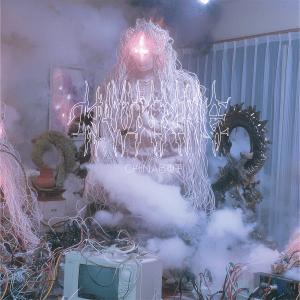
 What is K-Core? In the hands of DJ HWXXNG (Jaeho Hwang), K-Core deconstructs traditional Korean music and refits it for the modern era. The visual element is important as well, a way to demonstrate that the past has a way of haunting the present, while the present continues to reevaluate the past.
Consider for example the bonkers teaser videos for Shift Key and “2045 Apocalypse.” “Shift Key” is an anime nightmare of malevolent demons who look to have descended from dragons. The music creeps at first, seeping into the frame, in the full track adding cautious percussion and vocal snippets, wild drums twisting and turning in ceremonial fashion before exploding in a ritual dance. “2045 Apocalypse” turns everything up by multiple notches; there is in fact an apocalypse, during which a seemingly invincible modern goddess is alternately jumping, dancing, pouting, glaring, floating, soaring, smiling and posing, in one frame losing half a leg (1:29, oh, A.I.!), while a bunny-like figure remains on the ground, unperturbed. The full track makes great use of massive drums, stuttered “ah”s and synthetic whooshes, like aircraft carriers.
So this is K-Core, as opposed to K-Pop. The opening “manifesto,” “Neo K-Core,” “samples Samdo Nongak Garak, janggu drum patterns and ceremonial chanting, chops them into micro-fragments, pitch-shifts and reassembles them.” The listener has the feel of something ancient and something new, wrapped up in a four-and-a-half-minute piece, like fragments of sound in rice paper. One is unsure what the ancestors would make of this, or if one’s living elders would call it heresy, but the intention is to honor and update traditions rather than to mangle them.
“Neo Ritual” and “Cyber Shamanism” underline the tension between grounded spirituality and ungrounded technology, the stable pace of the old world and the disjointed pace of the modern world, and the agrarian and the technological. How is one to honor tradition: by observing it on occasion, or by integrating it into a supercharged life, like “800-year-old ceremonial fragments” dropped into a cauldron of techno beats?
The closing piece – as well as the videos – thrust the question even further, as A.I. further muddies the waters. Might A.I. be able to regenerate ancient compositions, or compose its own in similar style? If so, would this be seen as authentic or inauthentic? Will A.I. eventually become a sonic Ship of Theseus? Is there spirituality in the machine? (Richard Allen)


Pingback: A Closer Listen Reviews – Avant Music News