
 Here’s something that has to be seen to be believed; fortunately, we have the video evidence. Those who are in Munich this Wednesday will also have the rare opportunity to experience Sharper Than a Needle in person at the album release event.
The instruments used by ensemble Dressed in Sound include spindles and spools, zippers and needles, knitting and sewing machines, a spinning wheel, even credit cards and magnetic strips. This textile orchestra may at times seem familiar, while sounding like nothing else on earth. Together, the machines and homemade instruments create a glorious, rhythmic cacophony. From the very first moments, water splashes, synthesizers beep and the ages-old sounds of creation are amplified. Some may be reminded of parents mending clothes, factory workers in a mechanical trance, or thanks to the spinning wheel, the tale of Princess Aurora. The ensemble seeks not only to address such ancient associations, but to rewrite the narrative of textile production, gracing it with dignity and power.
In the sixth minute of Side A, a motor sputters to life; in the tenth, a stubborn screech. These machines often need coaxing. Between these sounds, a lovely, repeated breath, a reminder of the workers behind the wheels; and then scissors, reminiscent of the Fates. No law requires this to be “women’s work” – in fact, men appear in the ensemble – but the traditional image is one of female dedication. The ensemble highlights the truth of female strength: incredible endurance, stubborn perseverance, astonishing creativity. The mystery of this music, joined by voice in the fifteenth minute, is that it imitates the weaving of the world, the original creation.
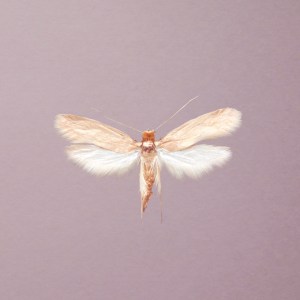
At first, the presence of the clothing moth appears threatening, but the ensemble has a large collective heart, and sees not an enemy, but a companion. If the cloth can make peace with the moth, there is hope for everybody. The more abstract second side introduces a dressmaker’s dummy “converted into a noise cello” and the sewing machine choir, a symbol of unity. If the opening side emphasizes the individual voice, the second emphasizes the collective voice.
Side B grows intimate in the eighth minute, then expands: one voice becomes two, then many. Societal parallels are easy to glean; only the source is surprising. Who are we without woven cloth? What price is paid by the marginalized so that those in industrialized society may afford these garments? Is there blood on our hands? Sharper Than a Needle asks, are not those who create greater than those who wear? Abstraction gives way to rhythm, the rhythm imitating a pulse, the pulse of workers in tandem, spinning the world; and a voice, no longer alone.
The introduction of drums at 15:44 is a true surprise as only three minutes remain. Synths and motors join the dance, which imitates a well-oiled machine. Gone are the sputters and half-starts; now the voice is distorted, and the machines have the final word. To Dressed in Sound, each voice is important: the moth, the machine, even the needle itself, which never asked to be the conveyer of a curse; on Sharper Than a Needle, it gets to be part of the band. (Richard Allen)


Pingback: A Closer Listen Reviews – Avant Music News