
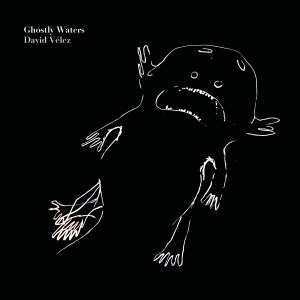
 After seeing the illustration of a cute but anguished monster, one wants to know more. Lina Velandia‘s line drawings grace the release by David Vélez, an original way to draw us into the story of the River Calder. Two months of recordings have produced three international installations to date, and now these sounds appear on a physical release.
The story begins 310 million years ago during the Carboniferous period, as the River Calder was formed. Home to “amphibians such as Microsauria, Eryops, Diplocaulus, Labyrinthodontia, and Nectridea,” the basin was a hotbed of biodiversity until a “rainforest collapse” marked by a six-degree temperature drop wiped out most of its thriving population.
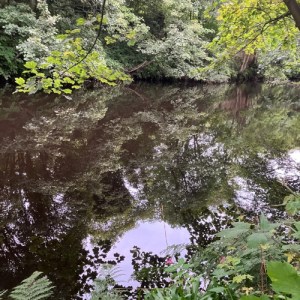
Enter now the “ghostly elements” of the river, as captured by Vélez, and the “giant amphibian ghosts” drawn by Velandia. These creatures communicate now through the Ghostly Water. The backdrop is black, a reflection of the environment: “black water, black soil, black boulders,” the product of carbon, coal and iron. Less than a minute in, and already some strange creature is grinding, either a living creature or a fossilized remnant begging to be heard. The white noise behind the drip and flow is similar to that heard in hauntology. But why would the ghosts of the past seek to communicate with us today? Is it simply because their lives were cut short by the rainforest collapse? No, because the area eventually recovered, becoming the main source of water for a series of surrounding farms, only to be devastated once more by a series of sewage leaks. In a short period of time, millennia of progress were dissolved.
 Look again at the creature on the cover. That is the face of one powerless to protect its own environment, its loved ones, its life. The creature may have been frozen in mid-grimace, its soul locked into the coal. Vélez’s murk and hiss are intentional representations of pollution and decay. The irony is that life continues to proliferate, even in these circumstances. One can hear the residents crunching, mating, conversing, and making a hydrophonic racket, amplified with studio treatments. But the more Vélez records, the more he hears ghosts: ghosts of warning, ghosts of dismay, ghosts who have been through this before and never thought they would go through this again. They call to us from the past, these “giant amphibian ghosts,” perhaps threatening to rise again, to enact revenge on behalf of their besieged descendants.
At times during the 70-minute recording the sounds of these creatures fall quiet, perhaps the result of a poisoned feeding, or in a more innocuous fashion, a nap. And all the time, the river continues to flow, just as time continues to flow, carrying all in its wake. Compared to the species who live in the river, humans have been around only a very short time. In one form or another, the river may outlast us. But we can still – and have – done irreparable damage in our short span. At one point, the biophony was said to be akin to that of the Amazon rainforest; now it is thin and divided. The listener is able to hear every individual creature: roach, chub, cricket, fish. The biophony is active, always in flux, switching characters every few minutes; but it is not as lush as it was before. One would not want to dip even a toe in this sewage-addled water, yet somehow there is life.
After a series of tiptoe sounds, an audible shift occurs in the 41st minute. Suddenly the sonic field increases in density; deeper, hollowed-out, like manhole covers dragged across asphalt. Are these the sounds of recovery or demise? In this segment, the boulders, the sediment, the rocks begin to speak, bringing to mind the prophecy, “the stones will cry out.” All of nature seems to be in total agreement – sadly, all except us. (Richard Allen)


Pingback: A Closer Listen Reviews – Avant Music News