
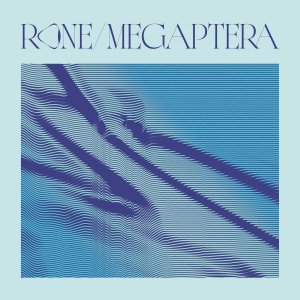
 A worthy successor to David Rothenberg’s fine 2008 book Whale Music: Thousand Mile Songs in a Sea of Sound, Rone‘s Megaptera is the original score to the French film The Musician and the Whale, in which the artist discovers that his music attracts whales and sets out to begin a musical conversation. The story alone is one of wonder, and the music follows suit.
Megaptera was “developed in dialogue with scientists, environmentalists, sailors, and bioacousticians,” and “largely composed at sea” as a series of transmissions that grew into a dialogue. In one of the trailer’s most striking scenes (seen below), Rone himself enters the ocean. The watery score holds many tiny intimacies, enhanced by field recordings and graced with joy.
First there is the sense of a journey, the crew starting off on its quest, Rone’s synth lines as clean as the horizon. “Premier Contact” offers an exultant “ohhhh!” as the nearby whale breaches, sending up a spume of water. Then the first human notes that sound like whale notes, a preliminary stab at communication. (The dance beats, however, are another thing.). The music percolates like sunlight on waves, and one wonders, albeit momentarily – do whales dance?
“Breach” contains a massive, cinematic surge; it’s easy to imagine a similarly triumphant scene in the film. In the (somewhat) title track, “La Baleine et le Musicien,” the dialogue begins to develop. Will the Megaptera respond? The answer of course is yes; without this, there would be no movie. The lingering question is whether the response is keyed into Rone’s music, or if this is but wishful thinking; pareidolia is difficult to dismiss. But something is happening on the whale’s part, some curiosity or even fascination that keeps it near the boat, exhibiting neither distress nor warning. Whalesong sounds otherworldly to the human ear; what might whales make of subtle EDM?
Midway through the album, wordless human song comes into play, a communication more of tone than of word. The sheet of song in “Insomnia” is particularly striking, like a school of fish swerving just below the surface, a single voice rising above the rest. “Zodiac” exudes a feeling of adventure, expanding from ambience into electronic beats, pausing mid-journey before plunging in again. In “Megaptera Novaeangliae,” full communication seems to have been established above and below the surface. The data will still need to be analyzed, but for now, isn’t it wonderful to imagine that music may have been the key all along? (Richard Allen)


Pingback: A Closer Listen Reviews – Avant Music News