
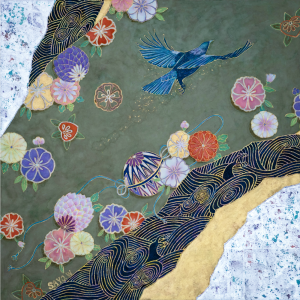
 Earthworks is a travel set: a memoir of places visited, impressions gleaned and experiences translated into sound. Garling Wu and Jessie Leov composed the album remotely, folding in impressions of London, Japan, New Zealand and more. In the same way, the perfume that one may order along with the download is infused with orange blossom, ambergris, geranium and cypress. New Zealand’s Sandra McEvoy created the scent, Japanese artist Sayo Watano the cover and zine: a true international collaboration.
Despite its many influences, the music is as unified as the cover collage. “Saline” begins with old-fashioned strings fed through new-fangled processing, receding to a series of synthetic dots. The music sparkles like sunlight on streams. A stuttering weather report offers glimpses of the day to come. The artists’ voices wander speaker-to-speaker over the sounds of water as the weather report grows clearer. A can is opened, producing an effervescent fizz.
The music softens at the midway point. Solo piano opens a door to the second half, where flowing water meets encroaching wind. “Retreat” launches with that same piano; as Martin Roberts’ cello enters the frame, the timbre tilts from experimental to modern composition. The combination of this title and “All That Remains” hint at the album’s sub-theme of climate change. While the music celebrates the collected beauty of travel, it also suggests that the world’s wonders are as fragile as decaying piano notes. The opening chords of “All That Remains” ebb and flow as traffic speeds by, temporarily obscuring the now-improvised keys. Notes spin like tops, then fall over. The music bears a sense of encroachment; everything seems ready to collapse. Then Leov begins to sing of spirits, and the focus shifts from fracture to harmony: a gorgeous reclamation.
“Sounding Bell” begins with solo, wordless voice, enhanced by intakes of breath. Placid crickets sing in the distance. The organic and electronic instruments both re-enter, working together in a spirit of cooperation. This time, in an act of generosity, even the passing car is given its own sonic space, while the train is well-integrated. “Sounding Bell” offers room to all, ringing said bell as an invitation, as holy ritual, as temple meditation. The album ends with a sense that disparate pieces have become one and a delicate balance has been restored. (Richard Allen)


Pingback: A Closer Listen Reviews – Avant Music News