
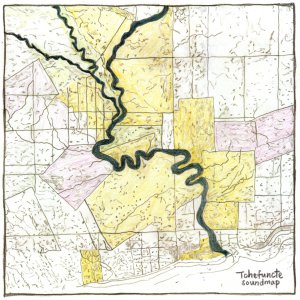
 In 1989, Annea Lockwood released A Sound Map of the Hudson River, followed by A Sound Map of the Danube in 2008 and A Sound Map of the Housatonic River in 2013. Inspired by Lockwood, Brad Seippel (known here as thruoutin) traveled to Louisiana to record Tchefuncte Soundmap, tracing the course of the 70-mile river whose name honors a culture over two millennia old.
Ironically, the generous (1 hour 44 minute) album begins not with the sound of obvious water, but with birdsong and distant traffic. The river is audible, but drowned out; later it will grow less shy. Seippel writes that he was first frustrated by the “imperfections” of human intrusion, but later came to regard them as honest reflections of the current biophony. Gators are present at the first location, though only their splashes are heard; the thought of gators cancels fantasies of drifting lazily down the river in an inner tube.
By “Little Tchfuncte 2,” the human noise has grown ever more apparent. Few untouched places remain. Seippel wonders whether the beavers, egrets and other local residents have acclimated to the sounds of humanity, the listener wonders whether we have done so as well. Those who come to hear the river are likely enchanted by the natural sounds, such as the canopy of crickets in the next piece, while also being distracted by the unnatural sounds as they learn that “getting away from it all” seems no longer possible. There are exceptions: the joy of hearing children at play in “Bogue Falaya Park 1” and the soft, comforting clacks of “I-12 Bridge.”
In “Bogue Falaya Park 2,” we finally hear the river – the main attraction! – flowing at full power. Much of the album become a pilgrimage, like a hidden image puzzle, as one yearns to hear such power again. One yearns to know how far from the river the recordist is traveling, or if the river is reduced to a trickle at various junctures. This also brings up the question, “What do we expect from nature?” Do we expect it to nourish us, or understand that we also need to nourish it in return? The rush to visit “unspoiled places,” thereby spoiling them, underlines the point.
“Guste Island” is one of the shortest and most powerful pieces, as it highlights the wind, water and wildlife, all in concise fashion. “Barge 1” and “Barge 2” offer a quiet tribute to the intersection of humanity and nature; a local real estate company writes, “this premier community offers a serene retreat surrounded by nature while remaining just minutes from top-rated schools.” One can see the attraction, but also the problem. Finally Seippel arrives at the Tchefuncte River Lighthouse, a historic landmark built in 1837 that guards the shores of Lake Pontchartrain from a tiny peninsula. The river normally flows to the lake, save for times of intense flooding, when the flow is reversed.
The album is bisected by an interview with Park Ranger Steve Poss, and ends with an interview with lifelong resident Dennis Bloom. If this were a double CD, one would expect that these would close each disc. Poss waxes rhapsodically about the limpkins and apple snails, who lay “bubble gum” eggs. He makes friends with rabbits and “communes” with an alligator. Bloom reminisces about boating trips on Lake Pontchartrain and camping by the river. The water laps beside his words, like a caring companion. “It’s just beautiful,” he says, “until the hurricane comes.” It’s a foreboding note to end on, making the listener question, “could we be the thousand-year storm?” For now, ol’ man river jes’ keeps rollin’ along. (Richard Allen)


Pingback: A Closer Listen Reviews – Avant Music News