
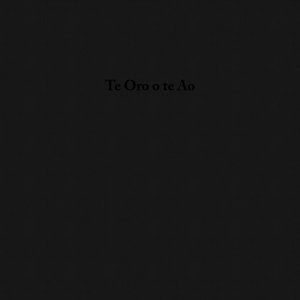
 Black album covers are fairly rare; Prince’s The Black Album comes to mind, along with Thembi Soddell’s black-on-black Love Songs, which includes a book of black print on black pages. Rachel Shearer is the latest addition to this small group, as Te Oro a te Ao (the resounding of the world) presents black type on a black background. The hue honors Hinenuitepō, the goddess of night and death, and issues a warning on climate change.
Shearer reflects her Aotearoan (New Zealand) roots by translating the Māori concept of whakapapa into aural form. The belief that all of nature, including time, is connected forms the basis of this work. The opening “Waha” (featuring Cathy Livermore) means both gate and voice, and serves as an entry point not only to the album, but to the spiritual world. It arrives as an invocation or incantation, at first a cappella, then layered, then sanded with dirt, dust and rock. Over time it becomes a choir, its sedimentary layers accumulating until they solidify into a drone. Is this the earth speaking, or our ancestors, or the buzz of time? The collective sound overtakes the individual without sublimating her power.
The heart of the album is the two-part “Pounamu Becoming Crystal.” The first part reflects the “movement and strength of water,” which begins as a mist yet transforms into a torrent. While experiencing such dynamic contrast, one may think of everything from the act of creation to the destruction of the planet. The piece incorporates “subterranean volcanic activity, tectonic plate movements and land slippages,” and acts as a parable of disruption. Yet by the end, the timbres soften, offering a modicum of hope; perhaps time’s arrow is instead a cycle. The second segment, subtitled “Wiriwiri” (to tremble), honors the dance of Tānerore: the visible shimmer of hot air as it rises from the ground. At first, the piece continues the rumbling timbres of its predecessor, but these give way to white noise: the processed sound of cicadas, whose volume increases with the temperature. As Earth warms, the cries of the cicadas grow ever more insistent.
“Ao” is a flexible word that can mean “sunrise,” “clouds” or even “world.” This gentle guitar coda suggests a manner of living on the planet, honoring sound with sound, presence with presence, gift with gift. While this is the Māori way, it is not often replicated, especially in Western societies. The arc of the album – invitation, experience, farewell – suggests a mode of interaction that posits all creation, animate and inanimate, as partners, the breath of heat mingling with the breath of life, the audible with the inaudible, the present with the absent and the yet-to-come. (Richard Allen)

