
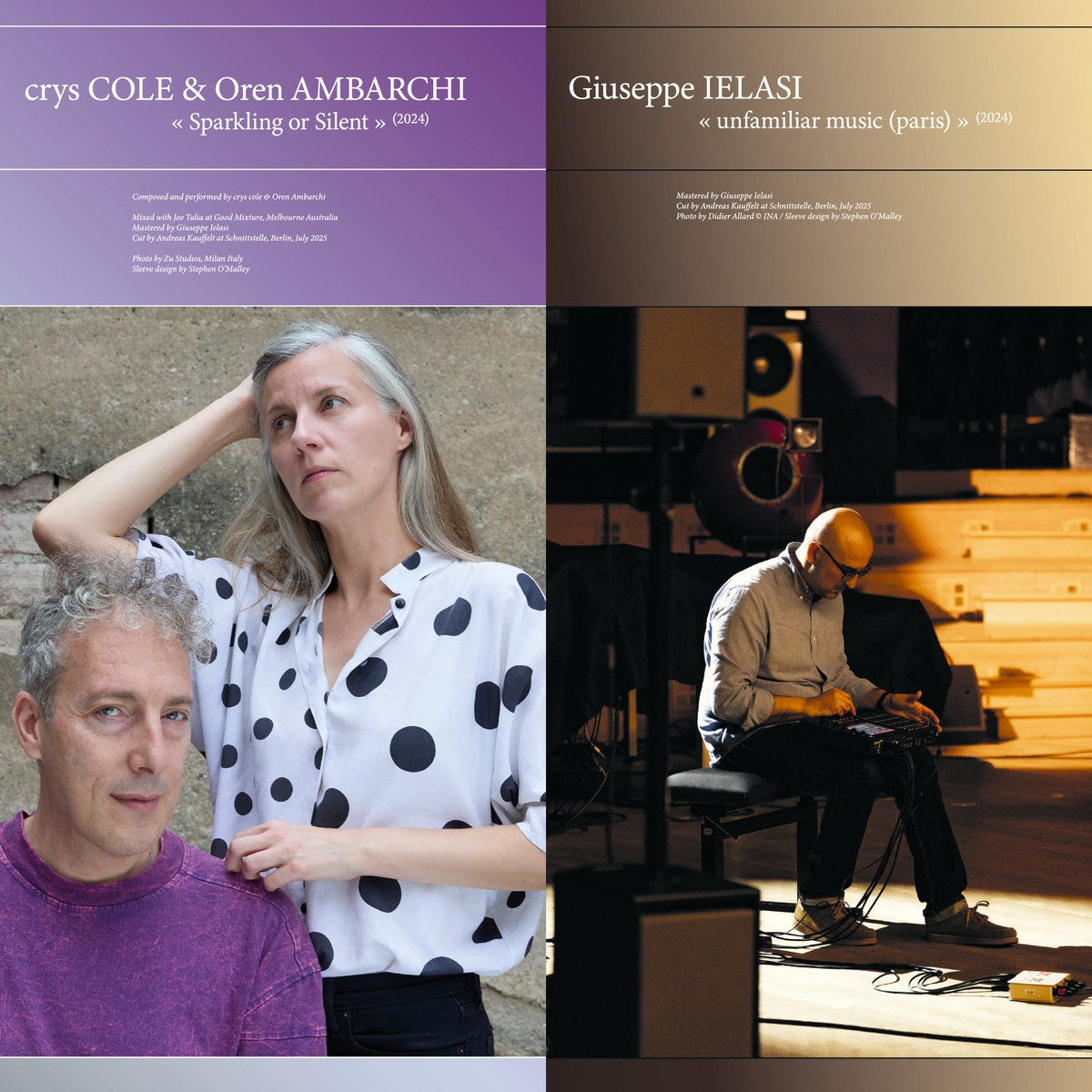
 The latest installment in the Portraits GRM series pairs the duo of crys cole & Oren Ambarchi with Italian maestro Giuseppe Ielasi. Each occupying a full side of vinyl, the result is a document of where contemporary sound practice finds itself in 2026 while paying homage to the institutional framework that made such work possible. This is not musique concrète in the traditional sense, but it is undeniably born from the same spirit of inquiry that drove Pierre Schaeffer to upend our relationship with sound nearly eighty years ago.
Pierre Schaeffer (1910-1995) is remembered not necessarily for his music, or even his philosophical contributions to the study of sound (which were significant), but for his institution building. After pioneering musique concrète while working in French radio in the late 1940s and early 1950s, Schaeffer began almost instantly institutionalizing his legacy, what became the Groupe de Recherches Musicales (GRM) in 1958 (known as Ina-GRM since 1975). The tension between preserving a tradition and remaining open to the new has defined the institution ever since. My 2019 interview with François J. Bonnet—composer, philosopher, and current director of Ina-GRM—explored precisely this question: how does an institution honor its past while making space for the unfamiliar?
An answer arrived in 2020 with the launch of Portraits GRM, a series of commissioned releases designed to bring contemporary voices into the GRM’s hallowed studios. The first release was Jim O’Rourke’s Shutting Down Here, fittingly so, as his sessions there spanned 30 years and thus that work’s completion constituted the closing of a significant loop. The re-issuing of classic and adjacent GRM titles began under the direction of Editions Mego, but after the death of Peter Rehberg (Pita) in 2021, the series transitioned to the stewardship of Shelter Press.
Since then, Portraits GRM has featured Lucy Railton, Okkyung Lee, Kali Malone, Lasse Marhaug, Laurel Halo, Beatrice Dillon, and many others—artists who share little aesthetically but are united by a willingness to push against the boundaries of what sound can do. As with most installments in the series, the latest release offers two compelling sidelong works from heavyweights of the experimental underground. On one side, crys cole and Oren Ambarchi continue their collaborative exploration of texture and density; on the other, Giuseppe Ielasi presents something distinctly his own.
crys cole & Oren Ambarchi ~ Sparkling or Silent
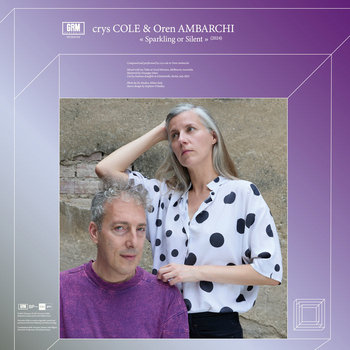 The title suggests something binary—a flickering between presence and absence, articulation and withholding—but the piece itself operates in the spaces between. Sparkling or Silent opens with what might best be described as ASMR-concrète: close-mic’d rustling, breath, the micro-articulations of objects manipulated in near-silence. It is intimate yet abstract, as though the listener has stumbled upon a private ritual. Over its 19’43’’ duration, the work unfolds in several distinct movements, each building upon the last until the accumulated density becomes something else entirely.
Oren Ambarchi needs little introduction. The Australian guitarist has built a formidable reputation as a solo artist and one of the most prolific collaborators in experimental music, with a discography that touches on everything from the glacial drone of his solo work to the rhythmic propulsion of his trio with Johan Berthling and Andreas Werliin—whose Ghosted series has only grown more assured with each installment. Records including Grapes from the estate (2004), Hubris (2016), and Simian Angel (2019) are personal favorites, not to mention his ongoing dialogues with figures like Keiji Haino and Jim O’Rourke. But alongside this celebrated career, there exists another body of work, equally significant if less discussed: his partnership with crys cole.
Likely the less familiar name to many listeners, cole’s work is no less deserving of attention. I have been a fan of this Canadian sound artist’s practice for years, both in her solo work and her collaborations. Her third album for Black Truffle, Making Conversation collects three recent commissioned pieces and demonstrates a trajectory that has moved steadily toward greater formal control without sacrificing the tactile, almost sculptural quality of her sound. She had been involved with Winnipeg’s send + receive festival for over a decade, contributed photographs and projections to classic Canadian experimental records, and continues to be an active performer and sound artist. Her work with Ora Clementi—the duo with James Rushford—offers a dense thicket of sonic material that feels both organic and constructed. Sylva Sylvarum, in particular, stands as a high-water mark in her collaborative output.
On Ambarchi’s Audience of One (2012), she’s credited as contributing contact microphones and brushes to the track “Passage.” They’ve since produced several records as a duo: Sonja Henies Vei 31 (2014), a hazy collage of intimate gesture and field recordings from a Norwegian sojourn; Hotel Record (2017), its title a dryly witty reference to its origins in hotel room sessions, a study in digital textures; and Gallivant (2021), documenting a live concert from the previous year. The pair have often played with others, including Keith Rowe and Leif Elggren.
The collaborative dynamic is worth dwelling on, if only because there is something peculiar and generative about a musical duo that is also a romantic couple. One thinks of the historical precedents: Sonny and Linda Sharrock, whose volatile partnership produced some of the most ferocious free jazz of the late 1960s and early 1970s; Max Roach and Abby Lincoln, whose work together addressed civil rights with a moral urgency that still resonates, again overshadowed by a documented history of abuse. More recently, and hopefully less problematically, I think of Christina Vantzou and John Also Bennett, Matmos (MC Schmidt and Drew Daniel), and Two-Way Street—Ashlee Booth on cello and Adam Lion on percussion, for whom Sarah Hennies wrote a piece exploring precicely the dynamic between a romantic and musical partnership. Giuseppe Ielasi and Jennifer Veillerobe have even released a few short pieces as Eselsohr. There is something about the intimacy of shared life that translates into the shared space of improvisation and composition, a trust that allows for risk without the safety net of distance.
A residency abroad, a portrait of two artists developing a shared vocabulary in confined spaces, the energy of a live recording. Sparkling or Silent represents something different—a consciously composed concert work. As the Portraits GRM materials describe it, the piece is “a moment apart in their respective artistic approaches” where an electroacoustic method that has always been latent in both of their practices “here asserts itself as a central compositional modality.” This shift from documentation to composition makes Sparkling or Silent feel more expansive and considered, even if it doesn’t necessarily represent a linear “evolution” so much as a deliberate side-step into a different mode of working.
From its intimate opening, Sparkling or Silent gradually accumulates tonal densisty before dissolving again. About halfway through, after cohering into a sustained drone cloud, the texture thins; ghostly melodies and gentle rustlings emerge from the haze, while field recordings slowly ground us in an unexpected place. The real surprise arrives in the final four minutes: a sudden chorus of truck (?) horn harmonies. The effect recalls Alvin Curran’s Maritime Rites, transposed from water to asphalt; the collective ritual of Curran’s foghorns replaced by the found sounds of the highway.
Within a minute, these sounds accumulate into a dense, surprisingly consonant cluster, overlapping blares forming a sustained fog of noise that continues until, finally, the sparkle turns to silence. It is a closing gesture that reframes everything that came before, revealing the delicate rustlings of the opening as part of a larger soundscape that extends far beyond the studio walls. The piece does not so much end as disperse, its constituent parts returning to the world from which they were borrowed.
Giuseppe Ielasi ~ unfamiliar music (paris)
In Milano in 2017, I met Giuseppe Ielasi and Jennifer Veillerobe for dinner accompanied by Oren and crys, who were part-time residents of the city then—their European headquarters, before relocating to Berlin, was this underrated Italian metropolis, a base between their Australian and Canadian homelands. So in my mind, the connection between the artists featured on this record is obvious, forged not only through shared aesthetics but through shared meals, shared cities, shared lives.
But Ielasi’s relationship to this series extends far beyond personal connections. He has mastered every Portraits GRM record except the first, and his own Senufo label released early records by Kassel Jaeger, which was in fact my introduction to François J. Bonnet many years ago. This record, then, feels like a culmination; the current director of Ina-GRM, the mastering engineer, the series, and the artists all intertwined in a web of mutual influence and respect that spans decades.
Ielasi’s catalog is deep and varied, marked by a restless curiosity that refuses to settle into comfortable routines. He has his interests and proclivities—a fascination with small sounds, repetition, motors, unusual rhythmic grooves, in other words “an insistence on material”—but he rarely deploys the same technical setup or approach twice, constantly searching for new means of expression. This commitment to renewal is evident throughout his discography, from his early work on the 12k label to his more recent return to explorations of guitar and electronics.
unfamiliar music (paris) arrives with some precedent. Ielasi has performed at the GRM before; I have a recording from 20 January 2014 at GRM Paris that captures his take on acousmatic diffusion. The title itself is shared with unfamiliar music vol.1 (guitar duets), a 2024 digital record that expanded a renewed focus on guitar as a sound source that began with releases in 2020. But what connection does this new piece have to that earlier work? The title seems to refer less to a specific genre or instrumentation and more to a mode of production, an approach to working with sound that prioritizes the strange, the dislocated, the not-quite-familiar.
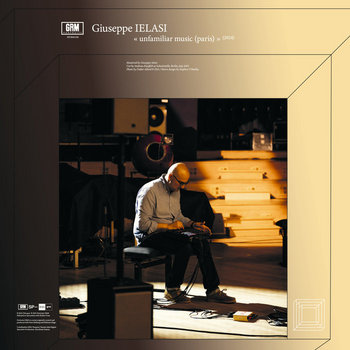
The cover of this release depicts Ielasi performing in Paris with a sampler, suggesting a process rooted in improvisation and constraint. And indeed, some of the samples in the piece do seem to be shared with previously released works, here recontextualized and repurposed. This is not a work of pure creation ex nihilo but of rearrangement, of finding new relationships between existing materials, a practice that echoes both the concrète tradition as well as Ielasi’s own history of pushing it into new territory. The GRM’s acousmatic tradition is evident in the microphone technique and in the spatial treatment of sounds, but there is also a digital air to the proceedings that feels distinctly contemporary, a reminder that the techniques Schaeffer pioneered have been absorbed, transformed, and rendered nearly invisible in the work of subsequent generations.
Where cole and Ambarchi’s contribution moves from intimacy to surreal mundanity, Ielasi’s work operates in a different register entirely. The piece itself unfolds as a study in gentle contrast and rhythmic accumulation. The rhythmic elements that have long characterized his work are present but transformed—pulses that never quite lock into a predictable groove, small sounds that build into larger textures, a sense of propulsion that constantly threatens to derail itself. Static gives way to layers of competing rhythm gives way to a mobile lullaby. unfamiliar music (paris) passes through a range of sonic territories without any clear delineations between movements. Ielasi opts instead for a gradual process of substitution.
What emerges is a piece that feels both of its moment and somehow outside of it. The “unfamiliar” of the title is not a description of the sounds themselves but of the relationships between them, the way they refuse to settle into expected patterns or resolve into comfortable listening. Ielasi makes music that demands attention without demanding understanding, that rewards close listening without promising easy rewards.
Taken together with the cole and Ambarchi piece, this release offers a portrait of the series at its best: two works that share little in common but are united by a willingness to push against the boundaries of what sound can do, and a commitment to the kind of exploration that Schaeffer himself would have recognized. The Portraits GRM series continues to honor its institutional legacy not through preservation but through renewal, not by looking backward but by making space for the unfamiliar. (Joseph Sannicandro)


