
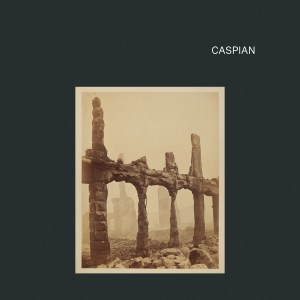
 Can Caspian really be 21 years old? You Are the Conductor was released in 2005, instantly launching the Beverly, MA post-rock band into the upper ranks. These past two decades have been kind to the quintet, although six years have passed since the release of On Circles, whose title ironically fits this release; the band has gone back to its roots. The cover art, depicting the Great Boston Fire of 1872, is a depiction of “the way something recognizable could be transformed without losing its underlying identity;” the same principle can be applied to Caspian.
We’re especially enamored with the increased use of strings, hearkening all the way back to the early days of GY!BE. When the full ensemble plays, the quintet becomes a dectet. This is immediately apparent on the opening “Hiraeth,” the only track short enough to be a radio single. Rising from a soft, guitar-grounded beginning, the piece is as reflective as its title, which refers to the longing for a place and time that may never have existed. Now that the band members have reached middle age, there’s honest room for such introspection. Chris Baum’s string arrangements weave a wistful aura. The band has always a gift for gentle introductions (“Quovis,” “Wildblood”), but this time extends the tone through the entire track. To hear the first crash of guitars and drums, one must wait for the opening minute of the melodic “Far Country,” whose later minutes are graced with glockenspiel.
But let’s get to the meat and potatoes. The 9:15 “Remain” was the first track to be released to the public: a comeback single of sorts. This is classic post-rock at its finest, so much so that fans will recognize the way we write about it: crescendos and interludes, loud-quiet-loud. The track also demonstrates the patience and maturity of the band, no longer in a rush to impress, resting on a fine career and enjoying the fruits of their labor. The first transcendent moment arrives not in a blast of sound, but in the moment when the acoustic guitar joins the electric: a subtle, harmonic peak. The track grows in increments rather than in leaps and bounds, ascending the mountain steadily and faithfully. The eighth minute looks back with a sense of accomplishment.
“A Great Fire” develops an instant contrast between fuzzy bass and sharp Sherpa bells. One can sense the smoke and soot, the early alarms leading to panic and devastation. Combined with “No One Left to Tell” and “Waltz to the End,” “A Great Fire” becomes the first piece of an apocalyptic triptych, a conceptual Side B, all the more powerful due to the restraint that has preceded it. The brief drum passage toward the end is particularly powerful; after this, a trembling cloud appears, leading directly into the middle movement. Midwestern in timbre, “No One Left to Tell” gallops across the prairie on the hooves of well-fed horses. At first, one may think there is no one left to tell the story to; eventually one realizes that it may mean there are no original witnesses alive.
If “Hiraeth” represents a manner of looking back, “A Waltz to the End” represents the opposite. Again the title lends itself to multiple meanings: in literal fashion, it may refer to the Great Fire, while in metaphorical fashion it may refer to the end of all things. The most likely explanation is that in middle age, people look both backward and forward, taking inventory of how far they’ve come while steeling their resolve for the road ahead. As the strings return, so does the sense of a grander scheme, one whose outlines are now visible to the band, whose self-titled album is also their most confident release to date. (Richard Allen)

